
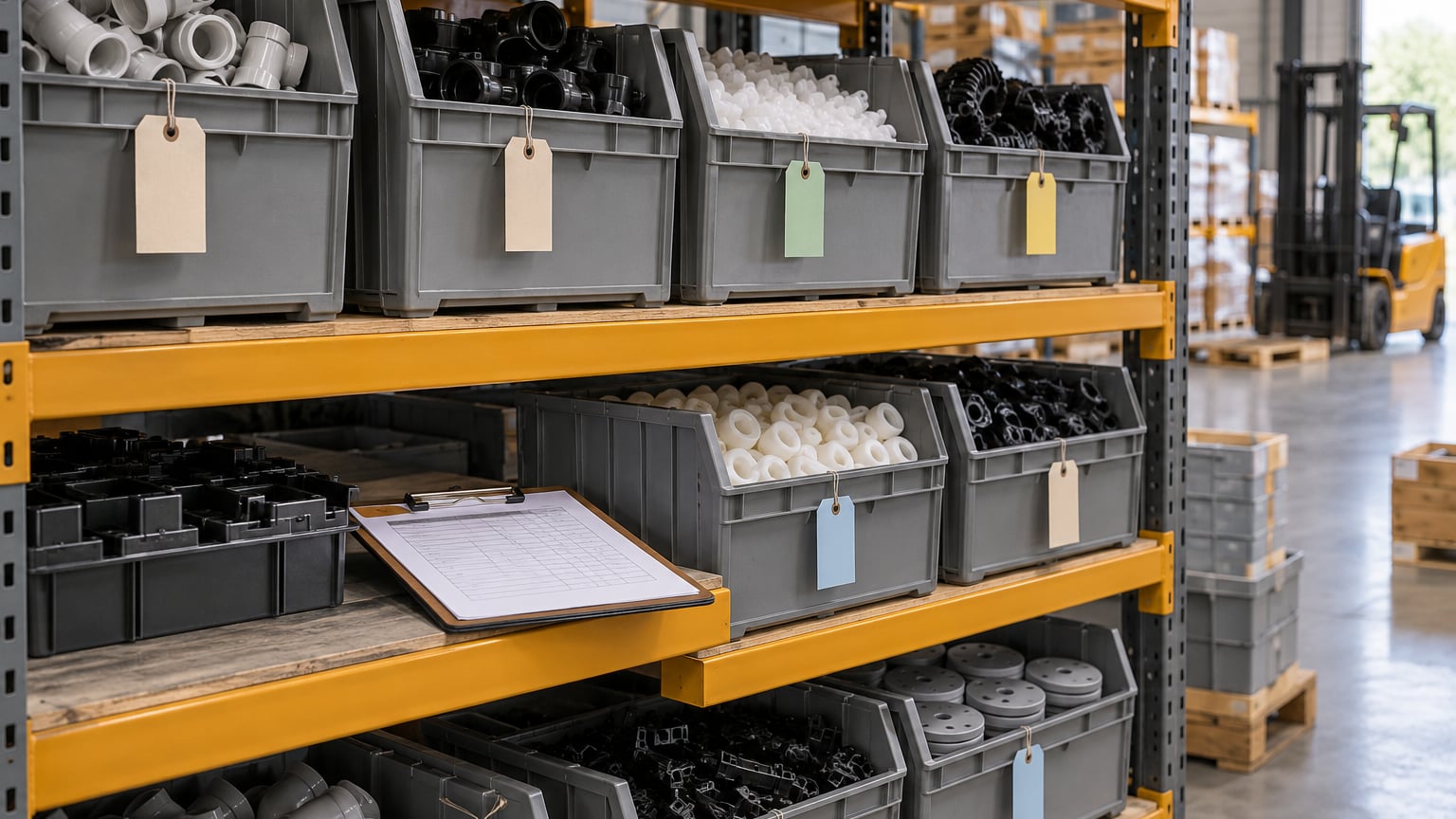
Consignment inventory explained in one line: a supplier, called the consignor, places goods with a seller or plant, called the consignee, and keeps legal ownership until a defined trigger, usually sale or use, at which point the consignee pays. Until then the goods sit on the consignee’s floor and come off the consignee’s balance sheet. If you have ever been asked to stock someone else’s parts and not pay for them up front, this is the arrangement you just agreed to.
I have watched this model get set up in injection molding shops and medical supply operations, and the ones that work share a single trait: nobody is vague about who owns what. Everything else, the fees, the reports, the monthly call, is downstream of that one fact.
Below is how the arrangement actually runs, who carries which risk, how the money and the paperwork move, and the specific terms to nail down before you accept a pallet of stock that isn’t yours.
Table of Contents
- What Is Consignment Inventory?
- How Consignment Inventory Works
- Who Owns Consignment Inventory, and Who Controls It?
- How Are Consignment Sales and Payments Recorded?
- How Does Consignment Inventory Affect Manufacturing and Supply Chain Decisions?
- How to Manage Consignment Inventory in Practice
- What Consignment Fees and Costs Should Buyers Expect?
- What Risks Do Buyers and Suppliers Face?
- Which Terms Should a Consignment Agreement Include?
- Frequently Asked Questions
- Does the consignee have to pay for consignment inventory before it is sold?
- Who legally owns unsold inventory stored at a customer’s warehouse?
- How should damaged or missing consignment inventory be reported?
- How often should the consignee send a consignment inventory report?
- What happens to consignment inventory when the contract ends?
- Can consignment inventory be moved to a third-party warehouse?
- What to Do First with Consignment Inventory
What Is Consignment Inventory?
Consignment inventory is stock a supplier delivers to a customer site but continues to own. The consignee stores it, displays it, and may sell it, but it is not the consignee’s asset and does not appear as inventory on the consignee’s financial statements. Legal title passes to the consignee only when the contract’s trigger event happens, normally the sale, consumption, or a defined number of days on the shelf.
The distinction that causes all the confusion is custody versus title. The consignee has physical custody and operational control. The consignor has title, the accounting obligation, and usually the obligation to replace anything that vanishes without a sale.
How it works, in three lines:
- The consignor ships stock to the consignee at no cost to the consignee.
- The consignee sells or uses the goods, keeps a set margin, and pays the consignor only on what left the shelf.
- Anything unsold at the end of the agreed period is returned to the consignor or credited back.
Two related arrangements get mixed up with this constantly. A sale or return lets a wholesaler buy stock outright and send back what does not move. Vendor-managed inventory still involves ownership changing when the goods are delivered. Consignment is the one where ownership stays put until the goods move.
If you want the ownership question settled before anything else, read ABC inventory analysis explained, which covers how buyers classify stock once it is on their floor.
How Consignment Inventory Works
The full cycle runs from a signed agreement to a returned pallet, and it has seven stages. Each stage produces a record that the next stage depends on.
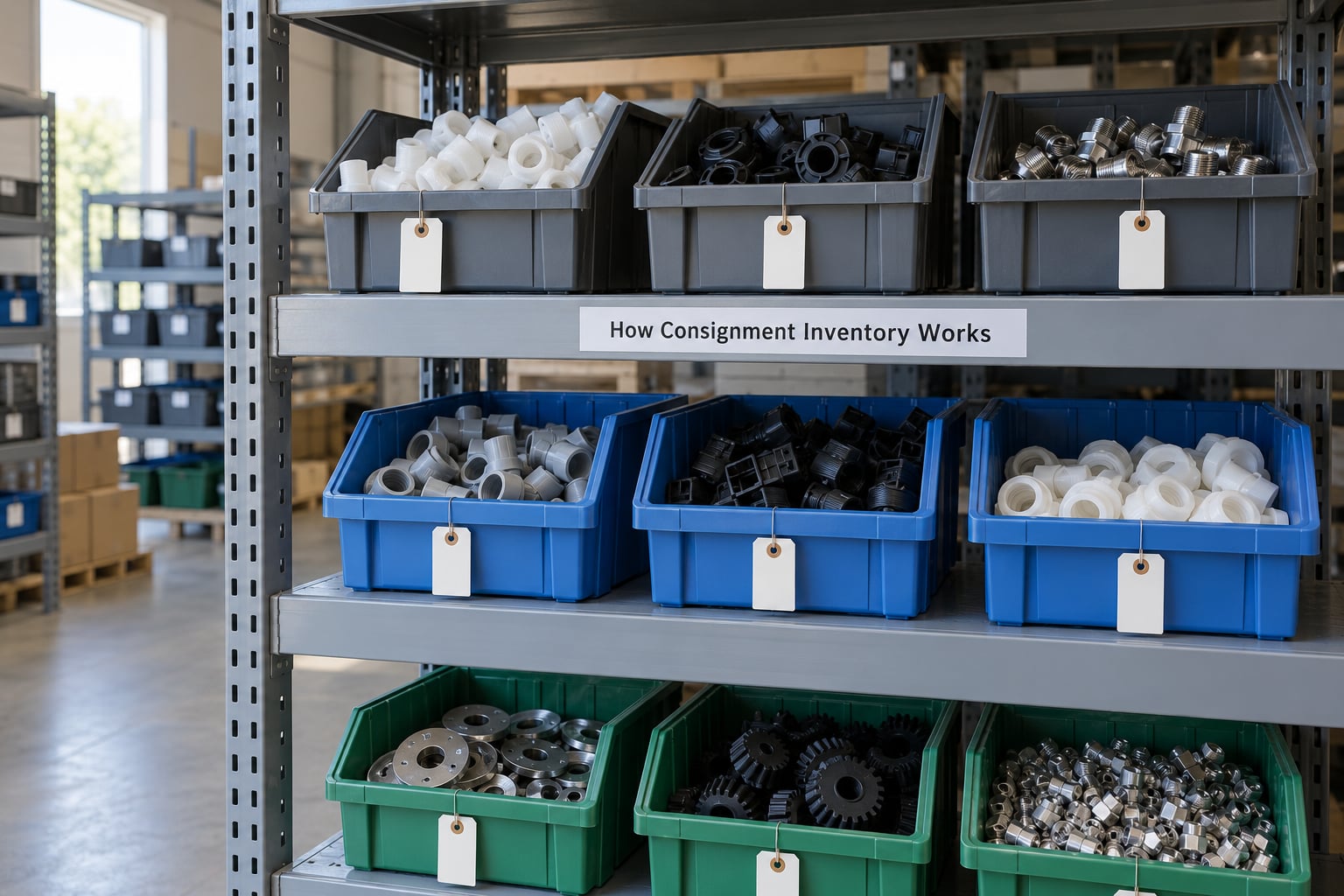
- The agreement is signed. It names the SKUs, the trigger event, the price, the margin split, the reporting cadence, and who pays freight.
- Stock is delivered and received. The consignee counts it in, records quantities against the agreement, and puts the supplier’s name or reference on the storage location so nobody reorders it by mistake.
- Ownership is flagged. Consigned units sit in a separate stock type, storage bin, or system status so they never mix with owned inventory in a cycle count or a reorder calculation.
- The goods are sold or used. Each unit leaves the consigned pool and moves into sold or consumed stock. That movement is the event that starts the money clock.
- Records are reconciled. Opening balance plus receipts minus sales minus returns should equal the physical count. Any difference gets investigated before settlement, not after.
- The supplier is paid. On a fixed schedule, usually monthly, based on a settlement report showing units sold, the agreed price, and any commission or service charge.
- Unsold stock is resolved. At the end of the consignment period it is returned, extended by agreement, or purchased by the consignee at a stated price.
Step three is where most programs quietly break. Once consigned and owned units share a shelf and a SKU number, nobody can tell them apart at count time, and the supplier ends up billing for goods the consignee actually paid for.
Who Owns Consignment Inventory, and Who Controls It?
Ownership under consignment is split across five parties, and each one has a different set of rights. Understanding the table below settles most disputes before they start.
| Party | Holds title | Operational control | Receives sale proceeds | Reporting duty | Bears loss or damage |
|---|---|---|---|---|---|
| Consignor (supplier) | Yes, until the trigger event | Sets prices, ranges and quantity limits | Yes, net of commission | Sends settlement and stock statements | Usually yes, until sale or transfer |
| Consignee (buyer or host site) | No | Stores, counts, sells, allocates | Keeps the agreed margin | Reports sales, losses and counts | Only where the agreement shifts it, e.g. negligent handling |
| End customer | Only on the sale | None | Pays the sale price | None | Owns what they bought |
| Third-party warehouse | No | Stores and picks on instruction | None | Confirms receipts and picks | Per its own contract with the consignor or consignee |
| Lender or factor | Only if it takes a security interest | None | None | May require periodic stock statements | Depends on the financing terms |
The row buyers argue about most is the second one. Custody does not automatically equal liability, which is why the standard of care matters so much. A well written agreement says the consignee takes responsibility for loss caused by negligence or by failing to follow agreed storage rules, and leaves ordinary shrinkage or supplier defect with the consignor.
How Are Consignment Sales and Payments Recorded?
Consignment goods are not the consignee’s inventory. They are not counted as an asset, they are not on the consignee’s books, and they do not inflate the consignee’s inventory turns. When a unit sells, it stops being the consignor’s asset and becomes the consignor’s receivable or revenue. The consignee recognises only its own margin on the transaction.
Bookkeepers who run these programs usually describe the recurring entries as three: one for the consigned stock received, one for the payable to the consignor, and one for the sales reconciliation at settlement. That simplicity is the reason consignment is popular with smaller operations that do not want a full vendor-managed system.
What happens at each transaction point:
| Event | What moves | Accounting effect |
|---|---|---|
| Goods delivered to site | Consigned stock, received but unsold | No inventory recorded by the consignee; quantity logged as a memo balance |
| Unit sold or consumed | Consigned stock out, receivable created | Consignee records its margin; consignor records a sale or usage event |
| Settlement report issued | Accrued balances to a payable | Consignee books the payable to the consignor, net of commission |
| Payment made | Payable cleared | Cash leaves, payable goes to zero |
| Goods returned unsold | Consigned stock back to the consignor | Both sides remove the units from their open quantity records |
Are consignment payments due upfront?
No. The entire point is that the consignee does not pay for stock before it sells. Payment is due after the sale, on the schedule the agreement sets, usually monthly and often on a fixed day so the supplier can forecast cash. Some agreements add a deposit or a fee for holding the stock, and some let the supplier invoice per shipment with credit extended instead, which is a different arrangement wearing a similar name.
How Does Consignment Inventory Affect Manufacturing and Supply Chain Decisions?
Consignment changes planning in five places. Demand visibility improves because the supplier can see consumption at your site rather than infer it from order history. Production planning shifts, because the supplier carries the buffer stock and replenishes it as it moves, so your safety stock calculation looks different. Working capital moves off your balance sheet, which usually matters more to a plant than the margin does. Storage capacity stays yours, since the goods still occupy floor space and rack positions. And material availability becomes conditional, because the unit exists only while the supplier keeps sending it.
That last point is the hidden cost. A supplier that misses a replenishment cycle can stop your line, and since you do not own the material you may have less leverage than you think. Nearshoring vs offshoring tradeoffs explained covers that supplier-reliability angle in more depth.
Who should use consignment inventory?
Match the arrangement to the situation rather than to the sales pitch. Some combinations work well, some create more problems than they solve.
| Situation | Good fit or poor fit | Why |
|---|---|---|
| New product launch at a retail partner | Good fit | Low cash commitment for the retailer, high shelf presence for you |
| Slow-moving spare parts for a single customer | Good fit | Avoids the customer stocking parts that may never be needed |
| Fast-moving production materials you consume daily | Poor fit | Consumption is hard to measure precisely and disputes are expensive |
| Highly regulated material with expiry dating | Poor fit | Expiry write-offs and traceability rules complicate settlement |
| A reseller who consistently reorders your owned stock | Poor fit | There is no demand problem for consignment to solve |
| Hospital or clinical supply used in procedures | Good fit | Stock stays current and the site carries no inventory cost |
For fast-moving lines, a review of RFID vs barcode for inventory tracking is worth doing before you add hundreds of consigned SKUs to a manual count cycle.
How to Manage Consignment Inventory in Practice
The controls that matter are boring and repeatable. Receivers check quantities against the packing list and the agreement and flag differences the same day. Stock is identified in the system and physically, with a label, a bin, or a stock status that says not ours. Storage follows supplier requirements for temperature, humidity, and stacking. Allocation is recorded at the moment a unit is picked or installed, not at month end when someone reconstructs it. Cycle counting covers consigned bins on a fixed rhythm rather than waiting for the annual count. Reconciliation compares opening quantity plus receipts minus sales minus returns against the physical count, and any variance is explained in writing. Replenishment happens against agreed minimum and maximum levels. Returns follow one documented path, with a pickup record and a signed receipt, so nobody can say the goods never arrived.
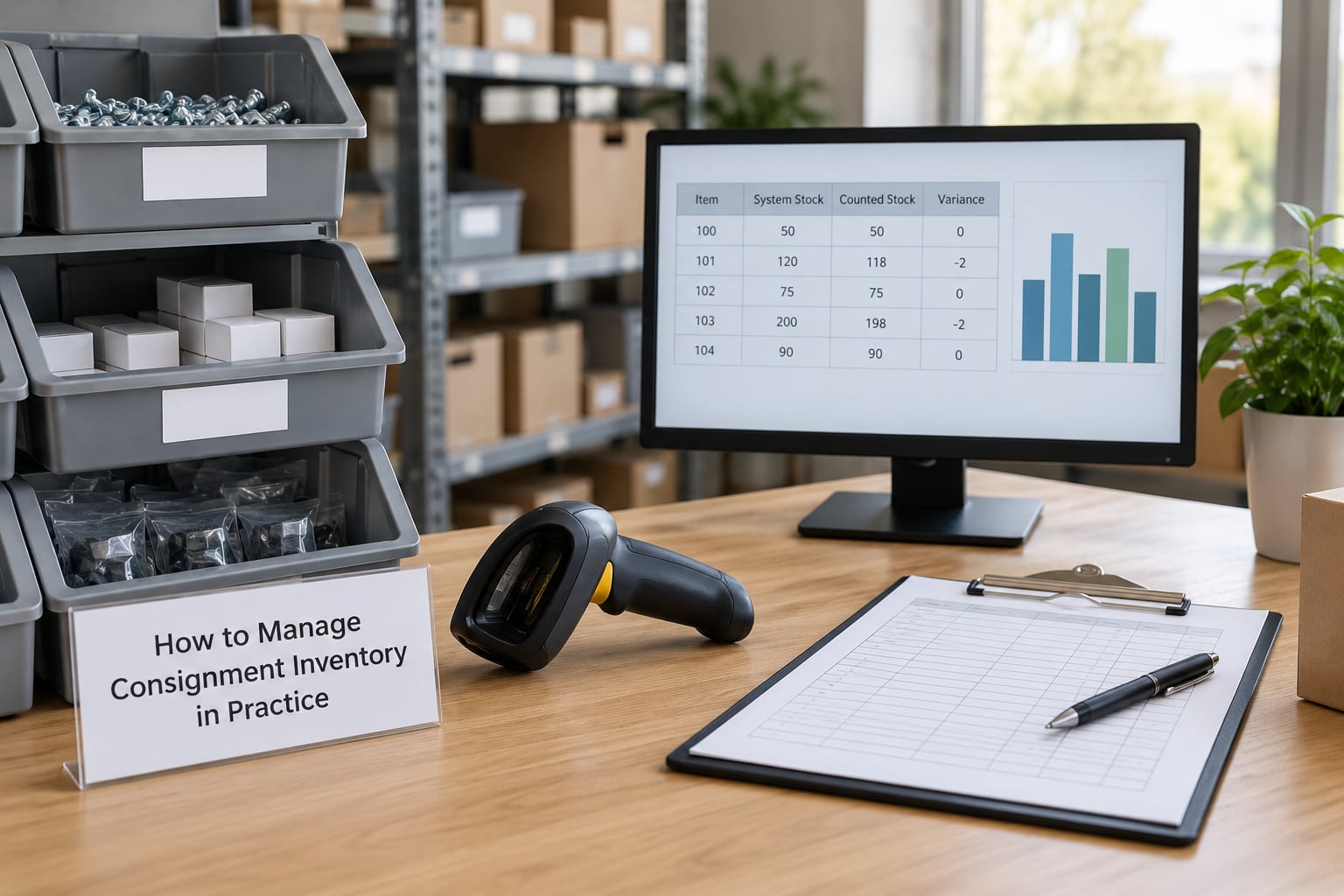
Consignment inventory explained as a weekly control loop
If you only run one habit, run the count against the supplier’s statement once a week and settle the difference in writing. The routine small operators tend to land on is simple: return what is left, and expect to be debited for anything missing at the next count. Teams that wait a month discover the variance has no clean explanation, and that is when the relationship gets tense.
Three record sets have to agree with each other. If they do not, one of them is wrong, and the supplier’s invoice is the one that gets challenged:
| Record | Owned by | What it proves |
|---|---|---|
| Purchase or consignment order | Supplier | What was authorised, at what price, on what terms |
| Inventory system movement records | Buyer | What was received, sold, consumed, and returned |
| Monthly statement or settlement report | Supplier | What the supplier believes was sold and what it is billing for |
| Cycle count sheets | Buyer | What was physically on the shelf at a known date |
What Consignment Fees and Costs Should Buyers Expect?
The price you pay for goods that sell is one thing. The cost of holding someone else’s goods is a separate line, and the two should never be blended when you compare offers.
Common charges include a handling or service fee per unit per month, storage fees if the stock occupies dedicated space, inbound and outbound transportation, inspection or testing costs, financing costs if the supplier charges for extended terms, and loss recovery where the consignee is made to pay for shrinkage. Some suppliers absorb all of it as a cost of winning the account, which is normal for higher volume programs.
Model the cost per unit at two horizons: one for the expected consignment period, and one for a worst case where nothing sells and the goods come back. A fee that looks minor per unit turns expensive when it sits on slow-moving stock for six months.
What Risks Do Buyers and Suppliers Face?
Every risk here has an owner, and the whole job is deciding who before the first pallet arrives. Here is the register I would build with a new partner.
| Risk | Who usually carries it | Mitigation |
|---|---|---|
| Shrinkage or theft in storage | Consignor unless negligence is proven | Segregated storage, restricted access, agreed cycle count cadence |
| Damage from poor handling | Consignee | Written storage standards, packaging specification, photo evidence on receipt |
| Supplied goods failing at the customer site | Consignor | Lot and serial tracking, defect replacement clause |
| Obsolete or expired stock | Consignor | Short consignment periods, expiry tracking, return-before-expiry rules |
| Slow sell-through | Consignor | Agreed minimums, target sell-through rates, periodic markdown rules |
| Settlement disputes over quantities | Shared | Fixed report format, a dispute window, and a named contact on each side |
| Unapproved price or markdown changes | Consignor loses margin | Written pricing authority, mandatory approval for discounts below a floor |
| Consigned stock growing without limits | Consignee loses space | Capped quantities, expiry of unreplenished lines, monthly stock review |
The markdown row comes from a consistent complaint among consignors in retail: stores discount slow lines without asking, and the supplier eats it. If that matters to you, write it into the agreement with a floor price and an approval requirement.
Which Terms Should a Consignment Agreement Include?
Before accepting any consigned stock, have these provisions written down. If a clause is missing, assume the other side decides that question later.
- Title and trigger. The exact event that transfers ownership, such as sale, consumption, or pickup, and confirmation that title stays with the consignor until then.
- SKUs, quantities, and ranges. What is being supplied, the minimum and maximum on hand, and how additional units are authorised.
- Pricing and commission. The price per unit, the consignee’s margin, any fee for holding or handling, and a floor price below which discounts need approval.
- Reporting. What the consignee reports, in what format, by what day, and how long records must be kept.
- Payment terms. The settlement schedule, the due date, the dispute window, and what happens during a dispute.
- Standards of care and insurance. Required storage conditions, who carries insurance, and proof of coverage.
- Authorized locations. Whether stock may leave the primary site, and what happens if it moves to a third-party warehouse.
- Loss and damage. Who pays for shrinkage, breakage, theft, and defects, and what evidence each side needs to claim.
- Consignment period and returns. The length of each term, the return process, who pays freight, and the deadline for returning unsold stock.
- Termination. Notice periods, what happens to stock on hand, and how quickly the final settlement is paid.
Requirements and enforcement vary by jurisdiction and by contract type, so have your own counsel review the final document rather than copying a template.
Frequently Asked Questions
Does the consignee have to pay for consignment inventory before it is sold?
No. The consignee holds and sells the goods without paying for them first, which is the defining feature of consignment. Payment falls due after the sale or consumption, on the schedule the agreement sets, usually monthly on a fixed date. Some agreements add a deposit or a holding fee, and some use invoicing with credit terms instead, which is a different arrangement with a similar name. Confirm in writing which one you have.
Who legally owns unsold inventory stored at a customer’s warehouse?
The consignor does, until the contract’s trigger event occurs. The consignee has physical custody and operational control, but not ownership, so the goods stay off the consignee’s balance sheet and out of its inventory counts for valuation purposes. Custody and liability are separate questions, so the agreement should state the standard of care and whether negligent handling shifts the loss to the consignee.
How should damaged or missing consignment inventory be reported?
Report it in writing within the window the agreement defines, with photographs, the count sheet, and the location where the discrepancy was found. Do not wait for the monthly settlement, because missing units get billed by default and disputed later. Keep a running variance log so the pattern is visible, since repeated losses at one location usually point to a storage or access problem rather than random shrinkage.
How often should the consignee send a consignment inventory report?
Monthly is the common minimum for settlement, paired with a weekly or biweekly quantity report so problems surface early. Settlement reports should show opening balance, receipts, sales, returns, and closing balance, and should tie to the movement records in the inventory system. If the reports only arrive at month end, variances are discovered too late to fix, and the supplier is invoicing for stock nobody can locate.
What happens to consignment inventory when the contract ends?
The agreement should set out a return window, who arranges and pays for freight, and whether the consignee may buy remaining units at a stated price instead of returning them. A final statement is issued for everything sold during the term, and unsold units leave the open quantity records on both sides. Do not return stock before the final settlement is agreed, as the paperwork gets tangled quickly.
Can consignment inventory be moved to a third-party warehouse?
It can, but only if the agreement permits it. Authorized locations are usually listed explicitly, and moving stock elsewhere without approval creates disputes over who bore the loss in transit and who holds the reporting duty. If you plan to use a third-party warehouse, name it in the agreement, confirm that it counts and reports on your behalf, and check whether it will release stock data to the supplier.
What to Do First with Consignment Inventory
Start by writing down who owns each unit and how you will report it, before a single pallet arrives. Then walk the current process end to end, from receiving dock to settlement invoice, and find the place where consigned and owned stock could get confused.
Name one person on each side as the control owner for counts and disputes. Reconcile physical balances against the system and the supplier’s statement, and clear the differences before you expand the program. Everything after that is detail.