
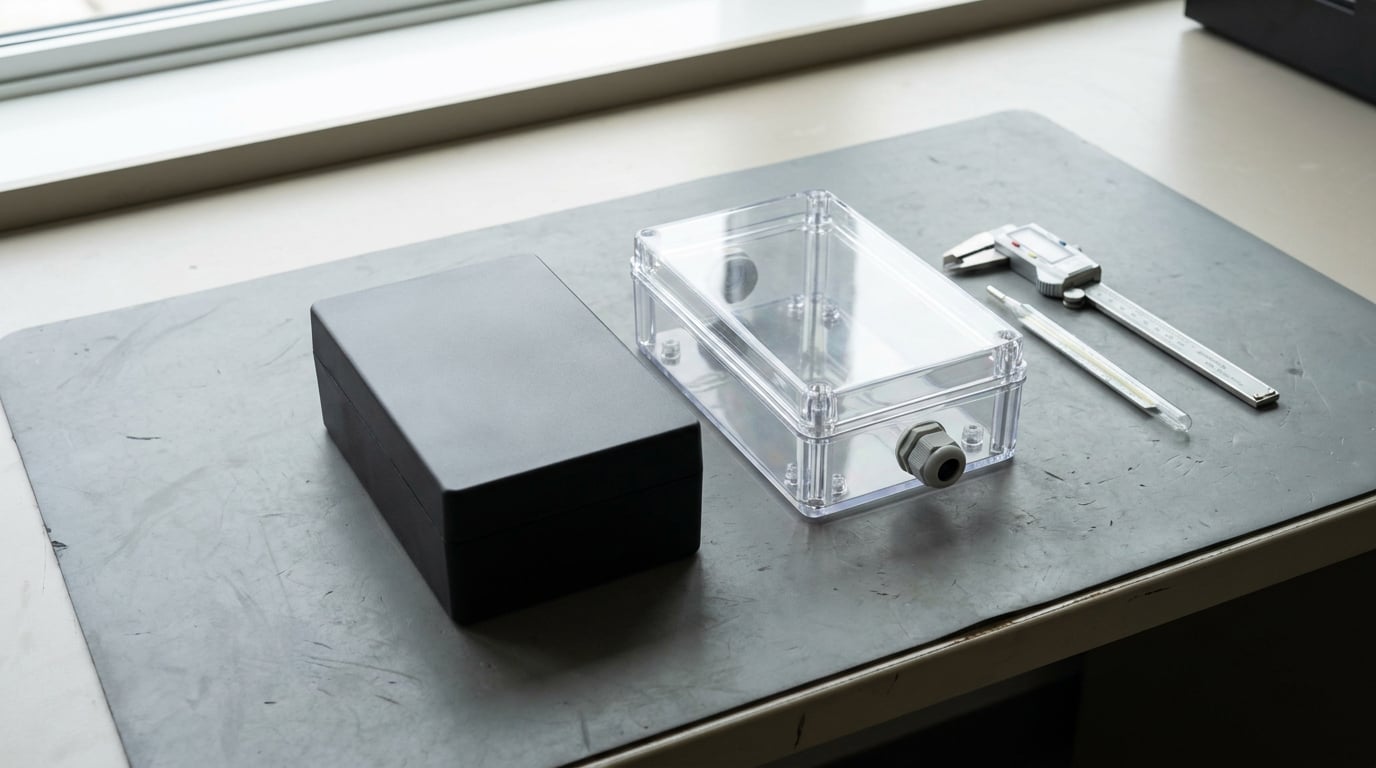
Updated for 2026. This guide is written for engineers, product designers and purchasing teams who need a defensible enclosure material decision, not a parts catalog.
The short version: choose ABS for indoor, cost-sensitive housings that need to be drilled, tapped, painted and held in tight dimensions. Choose polycarbonate when the enclosure takes drops, sits in sun and weather, runs hot, needs to be transparent, or has to be molded with thin walls. When the answer sits in the middle, a PC/ABS blend is usually the more sensible next step.
That is the rule most people arrive at, and it is broadly right. The trouble is the details behind it. A datasheet tells you numbers, not consequences, and the consequences are where field failures come from: an ABS box that crazes after one summer, a polycarbonate lens that hazes from handling, a screw boss that creeps loose under a constant clamp. This guide walks through how to choose between ABS and polycarbonate for enclosures property by property, then gives you a selection process you can run in an afternoon.
Table of Contents
- How to Choose Between ABS and Polycarbonate for Enclosures at a Glance
- Impact Resistance and Drop Performance
- Heat Resistance and Thermal Stability
- Flame, Electrical, and Regulatory Considerations
- Chemical, UV, and Environmental Resistance
- Stiffness, Machinability, and Design Flexibility
- Molding, Forming, and Assembly
- Cost, Weight, and Supply Considerations
- Which Should You Choose?
- Frequently Asked Questions
- Is ABS or polycarbonate better for outdoor electronics enclosures?
- Which material is better for a battery-powered device enclosure?
- Can ABS and polycarbonate be used for UL-rated products?
- Does polycarbonate always cost more than ABS?
- Which material is easier to mold into thin walls?
- What information should I send to an enclosure manufacturer for a material recommendation?
- Conclusion
How to Choose Between ABS and Polycarbonate for Enclosures at a Glance
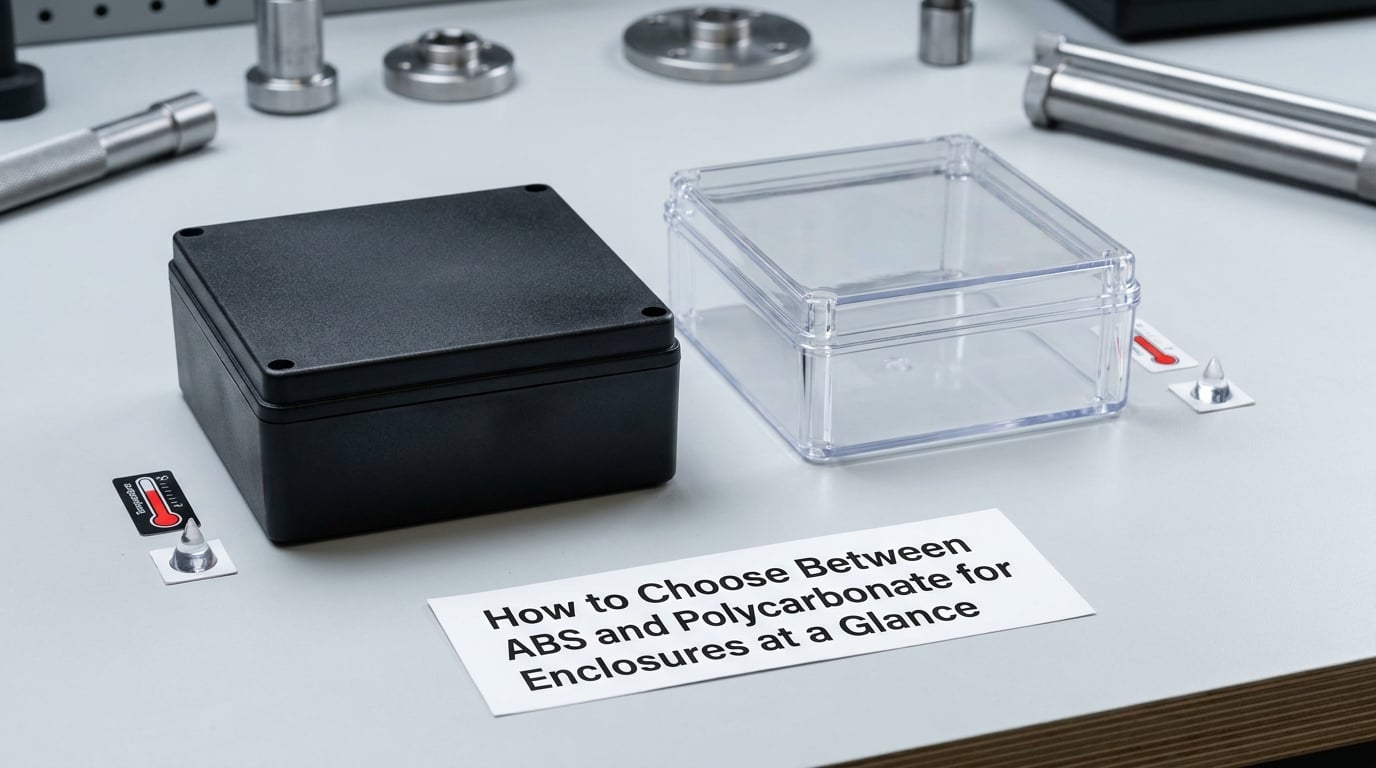
Both materials are injection-mouldable thermoplastics, and both are sold by the same enclosure distributors in the same footprints, often with the same part number in two materials. That makes the decision harder than it should be, because nothing about the listing tells you which one your application actually needs.
| Property | ABS | Polycarbonate |
|---|---|---|
| Notched Izod impact strength (typical) | 200 to 260 J/m | 600 to 900 J/m |
| Unnotched impact behaviour | Good, tough rubber phase absorbs energy | Very good; ductile, bends before breaking |
| Flexural modulus | 2.0 to 2.6 GPa | 2.3 to 2.4 GPa |
| Heat deflection temperature at 1.82 MPa | 85 to 100 °C | 120 to 135 °C |
| Glass transition temperature | Approx. 105 °C | Approx. 145 to 150 °C |
| Base resin flame rating | Often HB; FR grades available | Often HB; FR grades available |
| Electrical insulation | Excellent, high dielectric strength | Excellent, high dielectric strength |
| Chemical resistance | Good with oils and cleaners; poor with solvents | Good with oils and weak acids; poor with strong solvents |
| UV and weathering | Poor unstabilized; needs UV-stabilized grade or coating | Good base UV resistance; hardcoat extends life further |
| Transparency | Opaque; light tints only | Water clear, tinted and opaque grades available |
| Machining, drilling, tapping | Easy; accepts threads and paint well | Workable; must avoid stress-raising notches |
| Wall thickness achievable | Typically 1.5 to 2.0 mm general purpose | Down to about 1.0 mm in moulded ribs and walls |
| Injection moulding | Easy flow, low stress, wide colour range | Higher melt temperature, moisture sensitive, needs high tool temps |
| Relative resin cost | Lower, the budget option | Higher, commonly 30 to 50 percent more per unit |
| Specific gravity | About 1.04 | About 1.20 |
| Typical enclosure applications | Indoor control boxes, sensor housings, consumer devices, prototypes | Outdoor junction boxes, solar and LED housings, rugged equipment, clear lids |
Two numbers in that table do most of the decision work. The heat deflection temperature gap is roughly 35 degrees, and the notched impact gap is roughly threefold. Everything else, UV stability, transparency, cost and machinability, follows from those two plus the price of the resin.
Read the table as a starting position, not a specification. Every cell varies by grade, and the same supplier will offer a standard ABS, a UV-stabilized ABS, a flame-retardant ABS and a high-gloss cosmetic ABS. Always specify a grade, not a resin family.
The other thing the table cannot tell you is whether the enclosure is rated for where it will be installed. IP65, IP66 and IP67 describe an assembled housing, not a resin. IP65 is dust protected with protection against water jets, IP66 adds powerful water jets from multiple directions, and IP67 adds temporary immersion. All three depend on wall thickness, gasket compression, the seal around cable entries and the fasteners, so the material you choose affects the rating without ever being sufficient on its own. A polycarbonate box that is watertight in the catalogue can leak in service if the gland plate is not torqued or the gasket has taken a compression set. Ask for the rating of the exact part number, then design to keep it.
Impact Resistance and Drop Performance
Polycarbonate wins the impact comparison, and the margin is large enough that it is rarely a close call. Typical notched Izod values run from 200 to 260 J/m for general purpose ABS against 600 to 900 J/m for polycarbonate. Notched testing deliberately cuts a notch into the specimen, which is the fair comparison for a moulded part with ribs, corners and stress concentrations. Unnotched test bars flatter ABS, which is why marketing language about toughness and bulletproof performance is not much use to a designer.
The practical difference shows up in three places. First, thin walls: polycarbonate holds its impact performance in walls that ABS would need to be twice as thick to survive. Second, notches and sharp corners: a polycarbonate part that gets dinged tends to flex and survive, while an ABS part can snap at the stress riser. Third, assembly and service mishaps, where a tool slips or a housing is dropped during installation. In equipment that gets carried, shipped and installed by different people, that third case is more common than most spec sheets assume.
Cold weather complicates the picture. Polycarbonate’s toughness falls as temperature drops, and very thin sections can become brittle below about minus 20 degrees Celsius, while the butadiene rubber phase in ABS gives it a low-temperature shock resistance that polycarbonate does not match. For a freezer-adjacent enclosure, a refrigerated vehicle, or a field device that must survive a Canadian winter, the temperature at the notch matters more than the room-temperature number. Ask for impact data at your minimum service temperature rather than accepting a 23 degrees figure.
Assembly stress is where both materials fail in the field. Screw bosses that carry a constant clamp load, hinge pins, and latch fingers all concentrate stress. A crack in a polycarbonate hinge usually propagates from a sharp internal corner near the pin hole, while an ABS failure more often starts as a whitening stress line at a boss root that becomes a through-crack after a season of thermal cycling.
Where ABS is entirely sufficient: indoor devices on a desk or wall, enclosures with no drop exposure, low-cost consumer products, and prototypes where the enclosure will be replaced if it cracks. Where you should not compromise on polycarbonate: handheld and field equipment, enclosures shipped in cases, anything mounted where a service technician will drop a wrench on it, and any housing with thin walls and external mounting tabs.
Heat Resistance and Thermal Stability
Heat decides material more often than impact does. Heat deflection temperature is the number most datasheets lead with, and for standard grades it runs about 85 to 100 degrees Celsius for ABS against 120 to 135 degrees Celsius for polycarbonate, both measured at 1.82 MPa stress. HDT is not a melting point. It is the temperature at which a loaded sample deflects a set amount, which is exactly the situation a screw-bossed enclosure wall or a clamped lid is in.
The number that matters more in practice is continuous use temperature, and that is lower than HDT for both materials. A housing around a mains power supply, an LED driver, or a lithium battery pack can run well above ambient inside a sealed box with no airflow. Sunlight adds a second load on outdoor units: a dark enclosure in full sun can reach 60 to 70 degrees Celsius surface temperature with no internal heat at all. Add the internal dissipation and you can exceed the point where an ABS wall starts to sag around a boss, distort a gasket channel, or lose clamp force on a sealing screw.
Dimensional stability follows from the same physics. ABS creeps more under sustained load than polycarbonate, which matters for compression-set on gaskets and for any fastener that stays tight at one torque for years. If your design holds continuous clamping pressure, write creep into the specification and ask for a comparison at your actual load and duration. Most datasheets do not list creep at all, which is a common complaint from engineers working on long-duration field equipment.
Neither polymer is right for every temperature. Polycarbonate softens near 150 degrees and is not a choice for anything near a heat source such as an exhaust duct, a kiln interface or an engine bay. If your enclosure sees sustained temperatures above roughly 100 degrees Celsius, step outside both materials and look at glass-filled nylon, PEEK, or a metal enclosure with a polymer cover.
Flame, Electrical, and Regulatory Considerations
Both polymers are good electrical insulators, with high dielectric strength and volume resistivity, so ordinary electronics housings rarely fail on electrical insulation. The material decision is driven by fire performance, not by conductivity, and that is where the base resin name tells you almost nothing.
A standard ABS or polycarbonate grade is usually rated UL94 HB, which is a slow-burning classification. If your product needs V-2, V-1 or V-0, you need a flame-retardant grade of the resin, and the rating is only valid at a specified minimum wall thickness. A thin 1.0 mm wall in a V-0 rated polycarbonate is not the same certification as a 2.5 mm wall in that grade, which is why a datasheet note about a certified thickness belongs in your purchase order. Flame-retardant grades also come with a colour palette that is narrower and a surface finish that is duller, and they usually cost more per part.
For anything mains-connected or energy-storage related, check whether the certification you need is the polymer’s, the part’s, or the assembly’s. UL recognition on a resin grade is not the same as a listed or recognized enclosure, and a field evaluation may be required for the finished product. Ask the enclosure supplier for the certification file for the exact part number and material combination rather than for the resin.
Creepage and clearance come from geometry and material family, and both ABS and polycarbonate sit in the same broad group for most low-voltage work. At higher voltage or higher pollution degree, the certification database treats them differently, so check the group designation in the material’s file instead of assuming equivalence.
Chemical, UV, and Environmental Resistance
Neither material handles solvents well, and this is where enclosures fail in ways that look like a material defect but are really a compatibility miss. Both ABS and polycarbonate are attacked by aromatic and chlorinated solvents, ketones, esters and strong acids. ABS is generally the more forgiving of the two with oils, mild alkalis and household cleaners, and it is the easier material to bond with epoxy, cyanoacrylate and solvent-based adhesives. Polycarbonate has excellent resistance to water, weak acids and salt solutions, which is why it is the default for marine and coastal equipment.
Check compatibility against the exact chemical, at the concentration you actually use, at your maximum temperature, for the longest exposure. A material chart that says resistant to a family of chemicals is a starting point, not a decision. A parts washer that sprays a solvent at a gasket every shift is a different problem from a maintenance technician wiping the housing once a year.
UV is the one area where the two materials separate cleanly, and it is worth understanding why. ABS gets its toughness from a polybutadiene rubber phase dispersed in a rigid styrene-acrylonitrile matrix. That rubber phase is exactly what ultraviolet light attacks. Chain scission breaks the polymer chains, the surface loses its glossy skin and turns chalky, yellowing moves through the part, and the material embrittles. Engineers on r/AskEngineers describe it plainly: ABS needs to be modified for UV service, and polycarbonate will not go brittle the same way. Long-running discussion on Physics Forums reaches the same conclusion, recommending the polycarbonate version of a housing for outdoor installations.
There is a middle path. UV-stabilized ABS grades exist, and they buy you a few seasons rather than a decade. For equipment with a short life, a shaded mount, or a mild climate, that is a defensible trade. Look for a stated grade designation and an exposure reference such as ASTM D4329 xenon-arc testing, because a seller listing a box as UV resistant without a test reference is telling you nothing.
Polycarbonate weathers well in the resin, but it scratches and hazes. Handling, grit and repeated wiping put micro-scratches on the surface, and after a season outdoors that reads as a fogged window and an operator complaint. A hardcoat or an anti-scratch grade extends the useful life considerably. If the enclosure is watertight, material choice alone does not give you an IP rating: IP65, IP66 and IP67 come from the housing design, the gasket, the gland entries and the wall thickness, and the certification belongs to the assembled part, not to the resin. Ask for the rating of the specific part number.
How do you tell whether a listed UV-resistant ABS grade is genuinely stabilized? Ignore the adjective on the product page and look for three things: a named grade with a supplier code, a stated exposure method such as ASTM G154 fluorescent UV or ASTM D4329 xenon arc with an hour count, and a retention figure for impact strength or colour delta after exposure. A supplier who can give you the hour count and the retention percentage is selling you a tested material. A supplier who cannot is selling you a pigment.
Stiffness, Machinability, and Design Flexibility
ABS and polycarbonate have surprisingly similar flexural moduli, both in the 2 to 2.5 GPa range, so stiffness is rarely the deciding factor. What changes the design is how each material behaves once you start adding features: snap fits, hinges, bosses, lenses and threaded inserts.
ABS machines well. It drills, taps, reams and paints cleanly, holds a threaded feature, and accepts paint and adhesive bonding with little prep. For a housing that will be drilled in the field or finished with a sprayed or pad-printed cosmetic layer, ABS is the easier material. The main care point is that drilling and tapping generate stress risers, and a hole drilled close to a corner or a wall transition is the classic place an ABS enclosure eventually cracks.
Polycarbonate is stable and dimensionally accurate, which is why it is used for instrument housings and clear windows, but it is less forgiving of sharp notches and it does not hold a coarse thread as well as ABS. Design around this with generous radii at internal corners and by keeping fastener holes out of high-stress zones. Metal threaded inserts are common in polycarbonate housings precisely because the polymer itself is a mediocre thread-forming material.
Snap fits and living hinges are worth a separate note. A living hinge in ABS will cycle many times at moderate loads but will fatigue faster at elevated temperature because the rubber phase softens. A polycarbonate living hinge tolerates a wider load range and is the usual choice for a lid that opens often. Gasket compression is the third place where the material shows: a softer or more creep-prone polymer lets an elastomer seal lose preload over time, and that shows up as a slow water ingress complaint rather than a clean failure.
Molded-in features change the calculus. If you need an integral lens, a transparent window over a display, or a light pipe, polycarbonate is the only realistic choice of the two. If you need colour, texture and gloss, ABS has a wider and more cosmetic palette.
Molding, Forming, and Assembly
Injection moulding is the dominant process for both, and ABS is the easier of the two to run. It flows well at moderate melt temperatures, carries pigment and texture well, and holds tight dimensions with relatively low residual stress. The typical general purpose wall is 1.5 to 2.0 mm, and that is what most stock tooling is designed around.
Polycarbonate needs a hotter melt, a hotter tool, and careful drying. It is hygroscopic, and moisture in the melt causes splay marks, reduced molecular weight and a loss of impact strength, so drying and sealed material handling are part of the process rather than optional extras. That dryness requirement is one of the practical reasons small-volume PC parts cost more than the resin comparison suggests. In return you can mould thinner walls, around 1.0 mm in supported sections, which cuts material use and cycle time, and you get a clear part in the same shot if the geometry allows it.
Shrinkage runs around 0.5 to 0.7 percent for ABS and 0.5 to 0.6 percent for polycarbonate, close enough that tools are often interchangeable, but the differences that matter are cosmetic. Polycarbonate shows weld lines and flow lines more visibly in a clear part, and any transparent housing needs polish or a good texture to hide them. Sink marks over thick bosses are common in both, and a uniform wall is the better defence than a heavier section.
Extrusion is worth mentioning for the transparent sheet and profile market. Extruded polycarbonate sheet forms clear visors, guards and machine covers, and it behaves differently from injection moulded PC because the orientation leaves residual stress that causes crazing later. If you machine an extruded part, anneal it first.
For low volume, 3D printing is a common prototyping route. ABS prints well on a closed machine and is the affordable workhorse for fit checks. Polycarbonate filament needs a high-temperature chamber, tends to warp, and demands an enclosure around the printer, which is why the 3D printing community reserves it for genuinely high-strength, high-heat parts.
Cost, Weight, and Supply Considerations
Polycarbonate resin costs more than ABS, and the gap is commonly quoted in the range of 30 to 50 percent. Treat that as an order of magnitude rather than a quotation, because pricing moves with supplier, region, grade and order volume. The bigger point is that the material price is often the smallest part of what you pay per part.
Four items drive the real number. Wall thickness matters most: at the same outer dimensions, a polycarbonate design that can drop from 2.0 mm to 1.2 mm recovers a meaningful share of the material premium. Cycle time and scrap come next, and moisture-related rejects are a real cost in PC moulding. Colour and finish follow, since transparent and heavily pigmented grades carry different loadings and cosmetic grades cost more than standard. Tooling is the last, and it is the same one-off either way, which is why a small production run makes the material premium look far worse than it does at volume.
One cost trap worth naming: a flame-retardant grade can cost more than the base resin difference between the two materials, so switching material to chase a UL94 rating can be a false economy. Specify the flame rating first, then compare the two families within it.
Weight rarely decides the choice. Polycarbonate’s specific gravity of about 1.20 against 1.04 for ABS means a polycarbonate part is roughly 15 percent heavier for the same volume, and thin walls erase much of that difference. Supply is straightforward for both, and both are commodity materials with broad distributor coverage, so lead time usually follows part complexity and finish rather than resin choice.
Which Should You Choose?
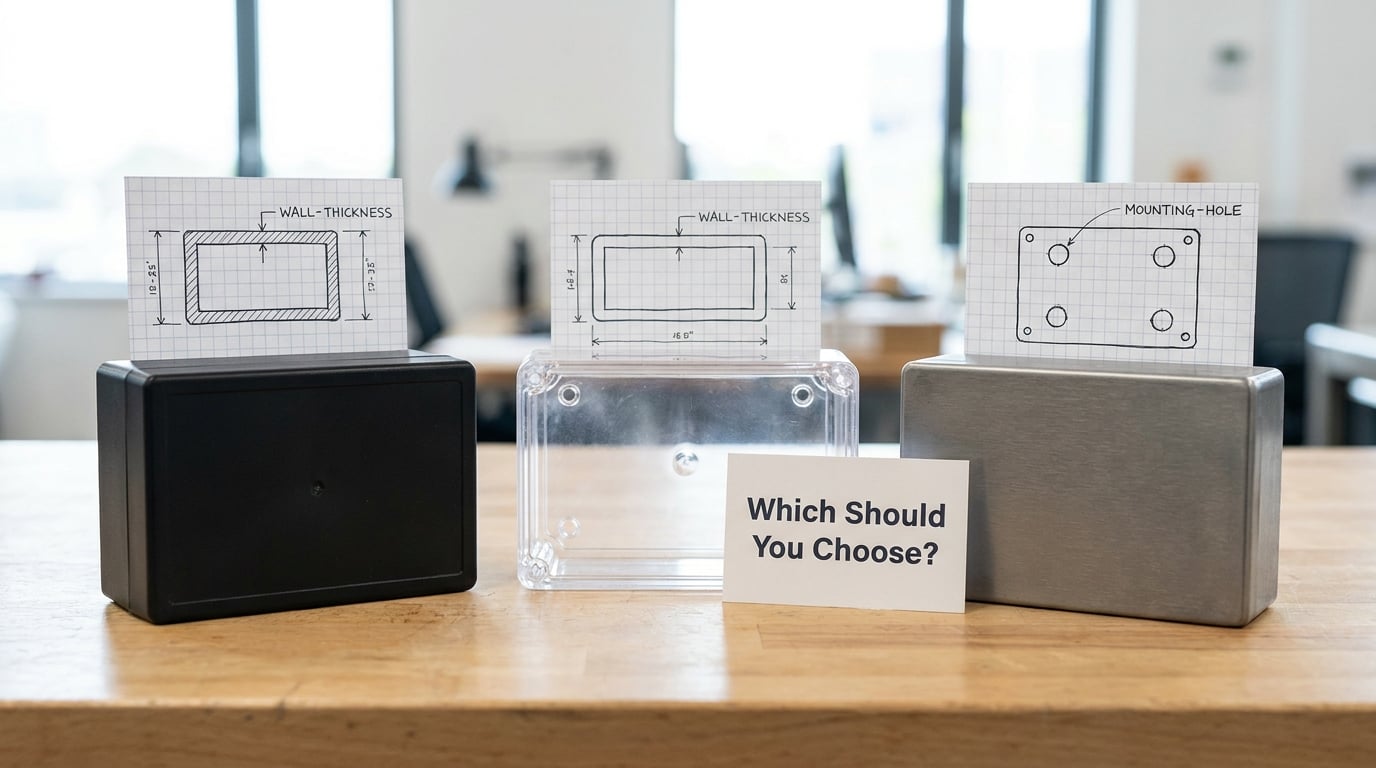
Choose ABS when the enclosure lives indoors, the environment is benign, dimensional stability and finish matter more than impact, and the unit will be assembled by a person rather than dropped by one. Indoor control boxes, sensor housings, consumer devices and prototype builds all sit here. Choose polycarbonate when the enclosure is installed outdoors, takes handling, sees higher internal temperatures, needs to be transparent, or must be moulded with thin walls. Outdoor junction boxes, solar and LED housings, marine equipment, battery packs and rugged handheld devices all sit here.
A five-step process will get you there faster than a property chart.
Step 1: Define the environment. Write down every chemical, every temperature extreme, whether the unit sees sun, salt, dust or cleaning cycles, and the IP rating you actually need. If the answer includes direct sunlight without a specified UV-stabilized grade, you have already narrowed the field considerably.
Step 2: Assess impact and load. Estimate drop height, vibration exposure and whether the housing carries sustained clamping force. Treat screw bosses, hinges and latches as impact locations. Heavy drop exposure or a permanent clamp under load points to polycarbonate or a PC/ABS blend.
Step 3: Set the thermal ceiling. Calculate the internal temperature from the heat source plus absorbed solar load, then add a margin. Compare that number to the continuous use temperature of the grade, not to the marketing figure on the box.
Step 4: Fix the cost frame. Establish an acceptable cost per part, then ask what tooling is needed and whether thinner walls in polycarbonate bring the total back inside the frame. This is where PC/ABS often wins on total cost rather than resin price.
Step 5: Decide the finish and the paperwork. Transparent, tinted or opaque; painted, textured or natural; and whether you need a flame rating, an outdoor rating and a certification file for the exact part number. If the answer to the finish question is a clear window, step 5 ends the debate in favour of polycarbonate.
If steps 1 to 5 leave you genuinely torn, that is the signal to evaluate a PC/ABS blend. PC/ABS combines polycarbonate’s impact and heat resistance with ABS-like processing and cost, and it is the right answer when ABS is too weak and pure polycarbonate is over-specified. Flame-retardant, UV-stabilized and high-gloss cosmetic versions are all standard. Beyond that, glass-filled nylon for stiffness and temperature, aluminium for grounding and heat sinking, and glass-fibre reinforced polyester for chemical resistance are all legitimate next conversations.
Before you send a quote request, put these on the page: resin family and grade, required flame rating and minimum wall thickness, required IP rating, maximum internal and ambient temperature, chemical exposure list with concentration and duration, transparency requirement, expected annual volume, and the finish. Suppliers quote faster and more accurately when all nine are on one page.
Frequently Asked Questions
Is ABS or polycarbonate better for outdoor electronics enclosures?
Polycarbonate is the better default for outdoor electronics. Its UV resistance is inherent in the resin rather than dependent on an additive, and its heat deflection temperature is roughly 35 degrees higher, which matters on a sunlit surface. ABS works outdoors only as a UV-stabilized grade, and even then a limited life. Note that material choice alone does not give you an IP rating, which comes from the enclosure design and the specific part number.
Which material is better for a battery-powered device enclosure?
Polycarbonate is the stronger choice for most battery-powered devices. Li-ion cells expand slightly during charge and can vent in a fault, so a housing that resists impact and stays dimensionally stable at elevated temperature is worth the extra cost. Polycarbonate also holds a better grip on mounting hardware over time, since its creep resistance is higher than ABS. Choose ABS only if the device is indoor, low-volume and cost-dominated.
Can ABS and polycarbonate be used for UL-rated products?
Both can, but only with the right grade and wall thickness. Standard ABS and PC are usually UL94 HB, and a V-0 or V-1 rating requires a flame-retardant grade of the resin. That rating is certified to a minimum wall thickness, so a thin moulded wall does not inherit the rating of a thick test specimen. Request the certification file for the exact part number and material combination, not the resin datasheet.
Does polycarbonate always cost more than ABS?
Polycarbonate resin costs more per unit, commonly in the 30 to 50 percent range, but the finished part premium is often smaller. Polycarbonate can be moulded with thinner walls than ABS, which reduces material use and cycle time and can recover much of the difference. Compare total cost per part at your actual volume, including tooling amortisation, rather than comparing resin prices on a per-kilogram basis.
Which material is easier to mold into thin walls?
Polycarbonate. It holds impact strength and dimensional accuracy in walls around 1.0 mm, where general purpose ABS typically needs 1.5 to 2.0 mm to perform acceptably. The trade is process difficulty: polycarbonate requires a hotter melt, a hot tool and rigorous drying because moisture degrades its impact strength. ABS is the easier material to run and is still the right answer for any design that can live at a standard wall thickness.
What information should I send to an enclosure manufacturer for a material recommendation?
Send nine things: resin family or your constraints, required flame rating with minimum wall thickness, required IP rating, maximum internal and ambient temperature, a chemical exposure list with concentration and duration, transparency requirement, expected annual volume, and the surface finish. Add the enclosure dimensions and mounting style. A supplier can recommend a grade in minutes with that page, and quote the wrong thing without it.
Conclusion
Start by defining the enclosure’s numbers, not its material. Write down the maximum internal and ambient temperature, the impact and drop exposure, the chemicals it will meet, the fire rating, the geometry and wall thickness you need, and your annual volume. Once those six are fixed, choosing between ABS and polycarbonate takes a few minutes, because only two properties carry most of the weight: heat deflection temperature and impact strength. Fill in the numbers before you request samples or compare supplier quotations.