
Short version: PET is the default sheet for clear, rigid, dimensionally stable trays, blisters, and retail displays, and PETG is the better pick when the part is a deep draw, gets dropped, flexed, or handled hard. Both are polyester thermoplastics and both form on ordinary vacuum or pressure equipment, so the decision comes down to crystallinity, forming temperature, and what happens to the part after it leaves the mold.
That is the whole argument for PET vs PETG for thermoforming, and this guide walks through the properties behind it: forming windows, drawdown, shrinkage, clarity, impact, chemical resistance, and cost per finished part rather than cost per pound.
A note before we start. Almost every search result for this question is about 3D printing filament. Extruder nozzle temperatures of 230 to 250 degrees have nothing to do with forming a sheet. A fabricator running a 0.020 inch PETG sheet in a twin-sheet vacuum machine is working in a completely different thermal regime, and the recycled numbers floating around online will scorch the material.
Table of Contents
- PET vs PETG for Thermoforming at a Glance
- What Is the Difference Between PET and PETG?
- How Do PET and PETG Behave During Thermoforming?
- Which Material Produces Better Clarity and Appearance?
- Which Is Stronger and More Durable?
- How Do Chemical and Heat Resistance Compare?
- Which Is Easier to Print, Cut, and Assemble?
- How Do Cost and Recyclability Compare?
- Which Should You Choose?
- Frequently Asked Questions
- Conclusion
PET vs PETG for Thermoforming at a Glance
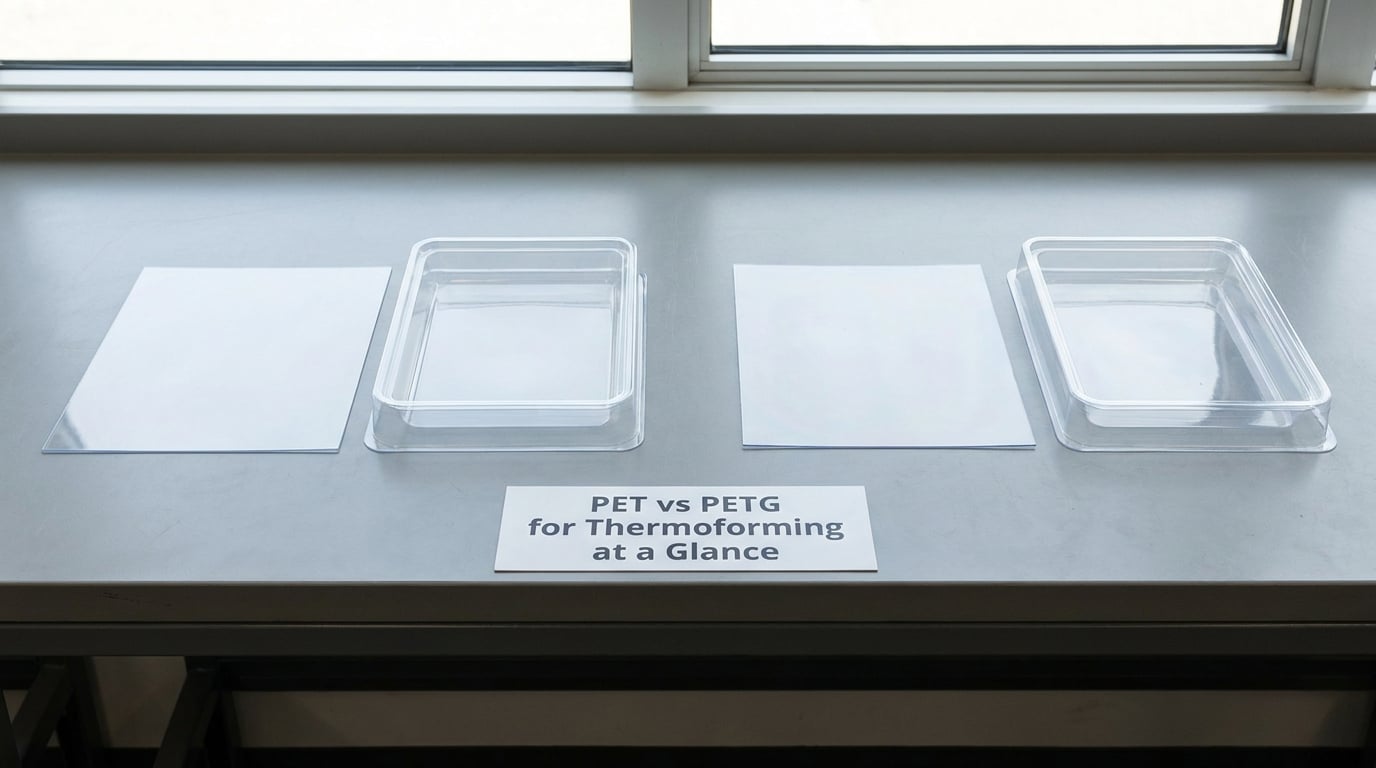
One root cause sits under almost every difference in this table: PET is a semi-crystalline polyester, and PETG is an amorphous glycol-modified copolyester. Crystallization is what gives PET its stiffness, its shrinkage, and its tendency to pop back into shape after forming. Suppressing it is what makes PETG tougher and easier to control.
| Property | PET | PETG |
|---|---|---|
| Polymer family | Polyethylene terephthalate, semi-crystalline | Glycol-modified copolyester, mostly amorphous |
| Glass transition temperature | About 73 to 78 C | About 78 to 85 C |
| Indicative sheet forming range | Roughly 120 to 160 C at the sheet | Roughly 110 to 150 C at the sheet |
| Forming window | Narrower, more sensitive to temperature swings | Wider and more forgiving |
| Typical draw ratio | Around 1:1 to 1.3:1 in simple vacuum forming | Around 1:1 to 1.5:1, more with pressure forming |
| Shrinkage after forming | Low but variable, and it continues as crystallization completes | Low and more predictable, with less post-form movement |
| Stiffness | Higher flexural modulus, holds shape on a shelf | Lower modulus, more flex in the part |
| Impact resistance | Brittle at thin gauge, can crack or split on flexing | Tough, tolerant of drop, flex, and shock |
| Optical clarity | Very high light transmission and gloss, low haze when well made | High clarity, slightly softer, easier to tint |
| Chemical resistance | Good against oils, cleaners, and many solvents | Good on the same front, but grade dependent and not solvent-proof |
| Food contact | Well established, widely specified, hot-fill grades exist | Available in compliant grades, verify per supplier documentation |
| Moisture pickup | Low, but hydrolysis degrades it over time | Higher, drying before forming is standard practice |
| Recyclability | Widely accepted in curbside streams, strong rPET supply | Often needs specialist recycling, less curbside access |
| Best fit | Clear displays, blister packs, shallow trays, lids, covers | Deep draws, complex geometry, reusable parts, protective covers |
Read that as a tendency, not a rule. A grade with a higher intrinsic viscosity, a different glycol level, or added modifiers will move several of these numbers, which is why supplier data for the exact sheet you intend to buy should control the final decision.
What Is the Difference Between PET and PETG?
PET, short for polyethylene terephthalate, is a semi-crystalline thermoplastic polyester. It is the same material family as the bottle in your hand, refined for sheet and tray work at a different molecular weight. Crystallization is what gives it its glass-like clarity, high modulus, and low creep under a static load.
PETG is the same base polyester with a glycol comonomer substituted into the chain. That small change does three things: it suppresses crystallization, it broadens the softening window, and it raises elongation at break. Suppressed crystallization is the reason a PETG tray bends and survives a drop where a PET tray of the same gauge would crack at the corner.
Both are thermoplastics, not thermosets. You heat them, form them, and cool them back into a solid, with no irreversible crosslinking. The same sheet can theoretically be reformed, though in practice you usually scrap it.
One practical naming trap: PETG is almost always used in conversation to mean 3D printer filament, and suppliers sometimes write PETg with a lowercase g. Sheet grades are a different product with different data sheets. Ask for the sheet-specific processing range rather than trusting a number you found on a spool listing.
Neither polymer family name decides the outcome by itself. What decides it is the required part performance: how deep the draw is, how hard the part gets handled, how hot it has to survive, and what happens to it at end of life. That framing is what the rest of this guide uses.
How Do PET and PETG Behave During Thermoforming?
Thermoforming heats a sheet until it is soft enough to drape, pulls it against a mold with vacuum, pressure, or a matched die, then cools it below its glass transition temperature to lock the shape. Everything that separates the two materials happens inside that sequence.
PET at forming temperature is stiffer and has more melt strength, so it holds detail and resists blowing back. That is genuinely useful for shallow, well-defined parts. The cost is a narrower window: run the sheet too cold and it stress-whitens or cracks in the corners, and run it hot and you accelerate degradation, shift the intrinsic viscosity, and invite crystallization problems.
PETG drapes sooner, spreads more evenly, and forms across a broader temperature band. On a deep draw or a part with tight radii, that is the difference between one clean shot and a bin of rejected shells. Most fabricators who switch from PET to PETG report that the first article stops cracking and that cycle times get more repeatable.
The PET-specific failure to plan around is blow-back. When semi-crystalline PET crystallizes unevenly during or after forming, the part whitens, warps, or reverts toward its original shape. It is most common in thick sections that hold heat, in parts pulled out of a cold mold, and in parts with high local stress. PETG largely avoids this because it barely crystallizes at all.
Crystallization is the material reorganizing from a disordered melt into an ordered solid structure. It releases heat, it shrinks, and it changes the optical properties. Once you understand that PET crystallizes and PETG does not, most of the other differences fall out of it.
PET vs PETG for Thermoforming: Temperature and Drawdown
As a starting point for sheet work, fabricators typically heat PET sheet in the region of 120 to 160 C and PETG sheet in the region of 110 to 150 C, measured at the sheet rather than at the oven setpoint. Those are orientation figures, not recipes. Grade, sheet thickness, heating method, equipment, mold temperature, and stretch ratio all move the useful window, and your supplier processing guide or a production trial should set the final values.
Draw ratio is the depth of the part divided by the smaller footprint of the sheet that forms it. A tray one inch deep formed from a four inch square has a draw ratio of about 1.25:1. Above roughly 1.3:1 on simple vacuum equipment, wall thinning and webbing between features start to show; deeper parts usually need pressure forming, plug assists, or a pre-forming step. PETG tolerates the deeper end of that range more gracefully because it stretches rather than cracks.
Moisture is the third variable, and it bites both polymers. Both are hygroscopic, meaning they draw water from the air. PETG is the worse offender because of the glycol addition, and wet material is the classic cause of popping, splaying, and a poor surface finish. Drying before forming is routine for PETG and advisable for PET. A moisture problem also quietly costs you intrinsic viscosity, which is a chain-length measure, and degraded resin forms worse.
Thickness changes everything downstream. Thicker sheet holds heat longer, so it keeps drawing after the mold has closed, which increases both thinning and post-form shrinkage. If you move from 0.020 inch to 0.040 inch material on the same tool, re-run the settings rather than assuming the old numbers still hold.
A few symptoms are worth recognizing on sight. Webbing, the thin membrane that stretches between two features instead of filling the corner between them, is almost always a temperature or pressure problem rather than a material problem; the sheet was too cool, or the vacuum could not reach that corner before the sheet lost its heat. Chatter, or a rippled wall, points to a mold that is too hot or too cold for the sheet, or to a vacuum leak. Corner cracking on a tight radius is a material and temperature signal, and that is where switching from PET to PETG usually pays for itself.
Sticking to the mold usually means the surface is too cool or too glossy for the contact area. A mold release treatment or a small adjustment in mold temperature usually solves it. A part that whitens only after it has been out of the machine for an hour is crystallizing late, which is a PET problem and generally a sign that something in the cycle needs to come down, not up.
Which Material Produces Better Clarity and Appearance?
PET wins the optical comparison. It combines very high light transmission with a hard gloss, and it can be processed to a low haze level, which is why it remains the default for blister packs, cosmetic packaging, and display covers where the part is a window.
PETG is also genuinely clear, but the surface character is a little softer and the haze figure is typically a little higher. Where PET looks like glass, PETG looks like good clear plastic. Most buyers are perfectly happy with that trade for a tougher part.
Color is a differentiator in the other direction. PETG takes tinted and colored sheet easily and holds color well because it does not crystallize. For colored, frosted, or opaque parts, PETG is often the easier material to match between production runs.
Appearance consistency is worth calling out. Because PET’s appearance is tied to how much crystallization occurred, a PET part can go cloudy in a thick corner or after a slow cooling phase. PETG’s appearance is far less sensitive to how the part happened to cool, so batch-to-batch consistency is easier to hold, especially on parts of varying wall thickness.
Rule of thumb: choose PET when the part is meant to look like glass and stay dimensionally rigid, and choose PETG when depth, impact, or consistency matters more than the last increment of optical polish.
Which Is Stronger and More Durable?
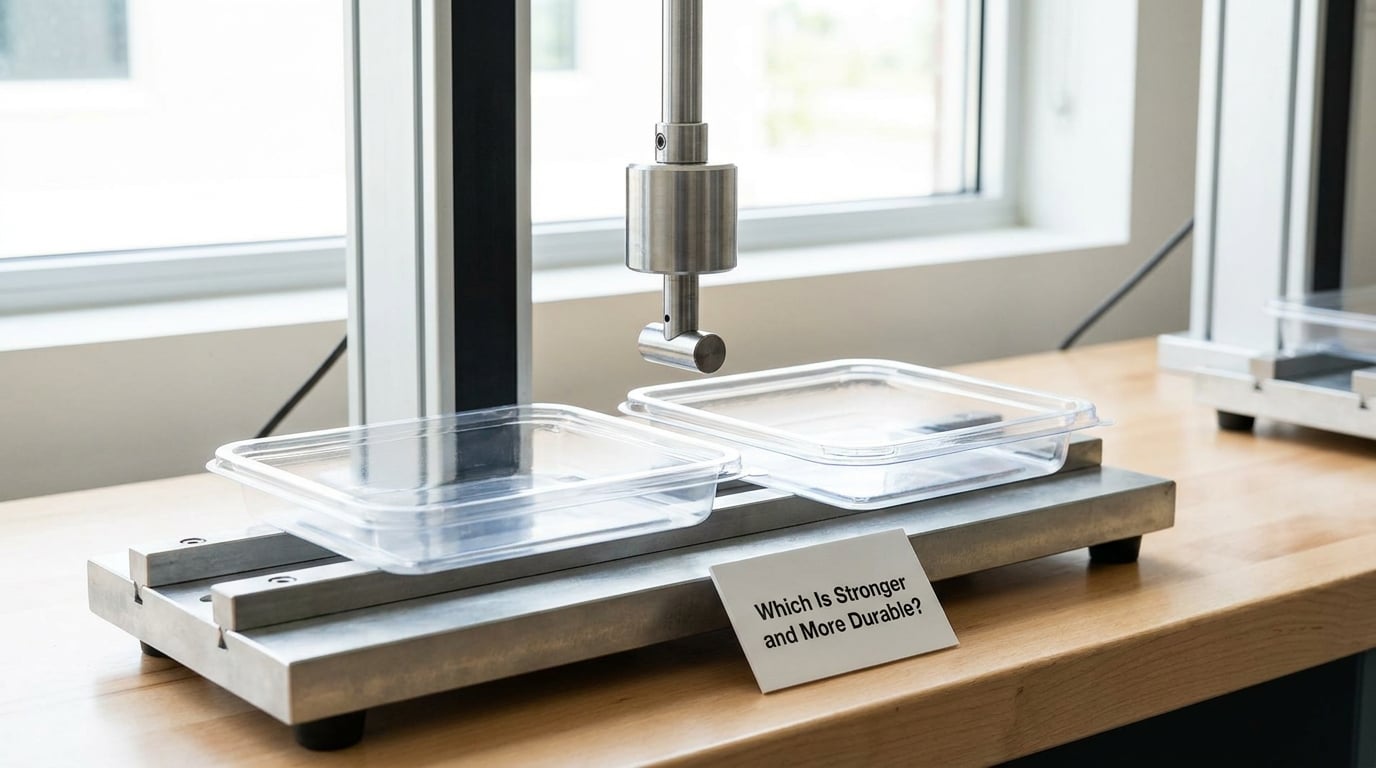
Neither material is stronger across the board, because they fail differently. PET has the higher modulus and the better flexural stiffness, so a PET part resists sagging and holds a crisp edge. It is also more brittle, and a thin PET wall under repeated flexing will eventually stress-crack, often starting at a corner radius or a hole.
PETG has a lower modulus and a much higher elongation at break. It deforms before it breaks and absorbs energy while doing so. In drop testing, packing, and reusable applications, that is the property that decides the outcome, and it is why a PETG tray survives handling that would split a PET tray.
Creep is where PET has the real advantage. Under a constant load, especially warm and humid, PET holds its shape far better. A display stand, a shelf divider, or a snap-fit lid that carries a steady load will stay put in PET and can slowly deform in PETG.
Match the material to the failure mode you are actually worried about. Electronics trays, appliance panels, and rigid display inserts favor PET. Protective covers, reusable containers, totes, deep-drawn shells, and anything that gets dropped or flexed in service favor PETG. Members of a 3D printing forum describe the trade-off in plain terms: PET is very rigid but almost brittle under flexing forces, while PETG allows more deformation and simply does not crack. That observation comes from the filament world, but the mechanics carry straight over to sheet.
How Do Chemical and Heat Resistance Compare?
Both polyesters handle oils, greases, detergents, and most routine cleaning chemistries without drama. Neither is a solvent-proof plastic, and both can be attacked by strong aromatics, ketones, and chlorinated solvents. Glycol-modified grades vary more than PET here, so do not carry a chemical compatibility chart from one supplier’s data sheet over to another supplier’s sheet.
For food contact, PET has the longer and broader regulatory history, with specific listings that packaging engineers already specify. PETG sheets are available in food-contact compliant grades as well, but the documentation and the limits travel with the grade, not with the letters PETG on a label. Get the supplier’s declaration in writing before you approve a food-contact part.
Service temperature is close but not identical. Continuous-use temperature sits below the glass transition temperature, roughly 70 C for PET and in the 80 to 100 C region for many PETG grades, and the hot-fill case deserves its own check. Hot-fill applications run hotter and longer than ordinary warm-fill, and PETG is not a drop-in substitute for a hot-fill rated PET grade. That is one of the few places where choosing the tougher material quietly costs you compliance headroom.
UV and weathering are similar: neither material is a long-term outdoor performer without a coating or an added stabilizer. Elevated temperature plus humidity is the combination that hurts PET most, because moisture accelerates hydrolysis, the slow breakdown of the polymer chain.
Check both the resin supplier and the applicable regulatory requirement before production approval. Chemical compatibility is grade- and formulation-dependent in both families, and a general statement in a blog post will not satisfy anyone signing off on a part.
Which Is Easier to Print, Cut, and Assemble?
PET machines well. Its stiffness means it holds a cut line, trims square, and routers predictably, which matters when you are cutting nests of trays rather than one part at a time. Drilling, tapping, and fitting inserts all feel normal on rigid PET.
PETG is more forgiving on fit-up. A slightly undersized hole can often be worked, a trimmed edge can flex into a snap rather than shattering, and a prototype part that does not quite meet print tolerances can usually be adjusted instead of scrapped. That flexibility is a real productivity gain when a job is in development and dimensions are still moving.
Welding and assembly need a different answer for each. PET bonds well with solvent-based adhesives and welds cleanly, and its rigidity holds a welded joint under load. PETG also bonds, but its lower modulus means a joint can flex before it fails, which is sometimes desirable and sometimes a creep risk in a permanent assembly.
Heat bending favors PETG, since it can be bent around a radius without cracking at thin gauge. The same operation on thin PET tends to split along the bend line unless the material is annealed first.
For decoration, both print and accept coatings, but ink adhesion and surface energy differ by grade and by surface treatment. Confirm adhesion on a production-representative sample rather than on a clean lab coupon.
How Do Cost and Recyclability Compare?
Sheet price depends on resin grade, gauge, color, finish, width, supplier, order volume, and how much recycled content is in it. PET sheet is generally the more widely available and the more competitively priced option, partly because the supply chain behind it, including recycled PET, is older and larger.
Cost per pound is the number most quoted and the least useful. The number that matters is cost per accepted part, which includes scrap rate, cycle time, oven energy, and labor. A cheaper sheet that cracks corners and gets rejected on a deep draw is more expensive than a slightly pricier sheet that forms right the first time, and this is where PETG quietly wins on parts that are hard to form.
On recycling, PET is the better-placed material. It is one of the most widely accepted plastics in curbside programs, and the recycled PET supply chain is mature, so rPET content is straightforward to specify. Formed PET parts generally re-enter the bottle and fiber stream.
PETG is less commonly accepted curbside and more often routed to specialist recycling, so the end-of-life path is less certain and can cost more. Recycled PETG exists but is thinner as a market, and quality is more variable.
Neither material is automatically the greener choice. A durable PETG part that stays in service for years can beat a thin PET part that gets discarded, and a mono-material PET design is often easier to recycle than a multi-layer or multi-resin assembly. Make the end-of-life call early, because it constrains material choice more than most people expect.
Which Should You Choose?
| Use case | Pick | Why |
|---|---|---|
| Blister packs, cosmetic and retail display packaging | PET | Maximum clarity, gloss, and dimensional stability |
| Shallow trays and inserts with tight tolerances | PET | Stiffness holds the shape and the print register |
| Deep-drawn shells and clamshells | PETG | Wider forming window, less corner cracking on deep draws |
| Reusable totes and containers that get dropped | PETG | Impact and flex tolerance over a long service life |
| Protective covers and enclosures exposed to handling | PETG | Toughness where a crack would mean a return |
| Prototypes and low-volume development | PETG | Forgiving forming, easier rework, less scrap on fit-up |
| Food contact, standard warm-fill | Either | Both have compliant grades, confirm documentation per grade |
| Hot-fill applications | PET | Rated grades and a longer established compliance record |
| Displays that carry a steady load in warm conditions | PET | Better creep resistance at elevated temperature |
| Programs targeting curbside recyclability targets | PET | Far more widely accepted at end of life |
Run this checklist before you commit to a sheet. How deep is the draw, and what draw ratio does that imply? Does the part need glass-like clarity or just clarity? What happens if it is dropped from a counter height, and how many times? What is the peak temperature in service, and is it a fill temperature or a storage temperature? What is the annual volume, and does that move you into a different price tier? What has to happen to the part at end of life, and who owns that decision?
If any of those answers is uncomfortable, the honest move is a trial, not a guess. Run representative sheet of the actual grade and gauge you intend to buy, form the real part, and let the finished part sit for a week before you judge it.
Frequently Asked Questions
Can you thermoform PETG?
Yes. PETG thermoforms on standard vacuum forming and pressure forming equipment, and it is often easier to form than PET because the glycol-modified structure softens predictably over a wider temperature band. Typical sheet work happens well below the temperatures quoted for 3D printing filament of the same name. Dry the sheet before forming and expect less blow-back than a semi-crystalline PET part of the same geometry.
Is PET plastic better than PETG plastic?
Neither is better in general. PET gives you higher stiffness, better creep resistance, sharper optical clarity, and wider recycling acceptance, which is why it is the default for clear display and blister packaging. PETG gives you better impact and flex tolerance, a wider forming window, and fewer failures on deep or complex draws. The part you are making decides which set of properties matters.
Is PET thermoforming or thermosetting?
PET is a thermoplastic, not a thermoset. It softens when heated, can be formed, and hardens again as it cools, so it can in principle be reformed. The same applies to PETG. In practice, formed parts are rarely reformed because the sheet has already drawn and thinned, so scrap is cheaper than a second cycle.
At what temperature will PETG start to deform?
PETG has a glass transition temperature of roughly 78 to 85 C, depending on grade. That is the point where the sheet goes from rigid to soft on a continuous ramp, so service temperatures should stay below it with margin. Many PETG grades are specified for continuous use up to around 100 C. A hot parked car can exceed that, so a formed part left in the sun can sag or distort.
Is 240 too hot for PETG sheet?
For sheet forming, yes, far too hot. Numbers in the 230 to 250 C range belong to 3D printing filament and would scorch a thermoforming sheet long before it formed properly. Sheet work typically happens around 110 to 150 C at the sheet. Always confirm the processing range on the data sheet for the specific sheet grade rather than relying on a number from a filament listing.
Does PET or PETG shrink more when formed?
PET typically shows more total shrinkage because crystallizing material packs more densely, and some of that shrinkage continues after the part leaves the mold, which is why PET can whiten or warp later. PETG crystallizes very little, so its shrinkage is lower and more predictable. Either way, design in a mold allowance and measure a real part rather than trusting a generic percentage.
Conclusion
PET is the right default for PET vs PETG for thermoforming whenever the part needs to look like glass, hold a tight dimension, resist creep, and reach a recycling stream that actually exists. PETG is the right choice when the draw is deep, the geometry is complicated, the part gets handled, flexed, or dropped, or when you are in development and scrap is the main cost.
The first action to take is not a material decision. Write down the part geometry, the performance you need, the peak temperature in service, the annual volume, and the end-of-life requirement, then request current processing data from a sheet supplier and run a representative trial with the real grade and gauge.
If that trial shows clean parts in PET, ship in PET. If the corners keep cracking or the parts keep whiting up after forming, that is your cue to move to PETG rather than to keep tuning the oven. Updated for 2026, and the numbers here are starting points, not a substitute for the data sheet of the sheet you actually buy.