
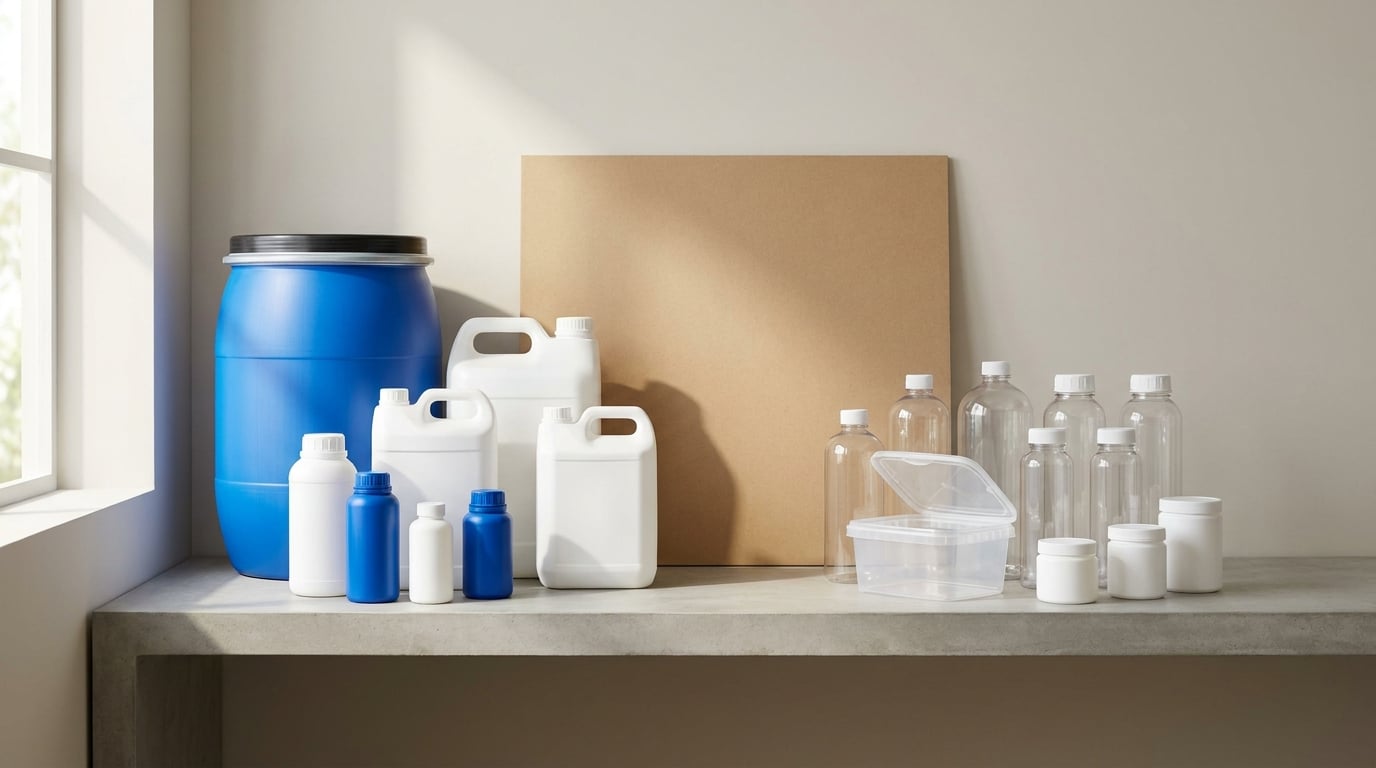
Short answer: use HDPE for containers that hold cold or room-temperature product, take a beating, and must resist chemicals; use PP when the container sees heat, repeated flexing, or needs to look clear on a shelf. That is really the hdpe vs pp which plastic to use for containers decision for most designs.
Both are polyolefins, both carry food-contact approvals, and both recycle. The differences are in melting point, stiffness, impact behavior, and how each one fails under stress. Get that right and the choice takes about ten minutes. Get it wrong and you are fielding warped caps, cracked drum walls, or a warped tub after a hot fill.
This guide is written for people who specify containers for a reason: packaging engineers, buyers, product designers, and lab managers. Numbers come from published material data sheets rather than marketing copy, and where a claim depends on grade or wall thickness, I say so.
Table of Contents
- HDPE vs PP Which Plastic to Use for Containers at a Glance
- What Is HDPE and How Does It Work in Containers?
- What Is PP and How Does It Work in Containers?
- HDPE vs PP: Differences in Strength, Chemical Resistance, and Heat
- HDPE vs PP: Clarity, Flexibility, Barrier Properties, and Processing
- HDPE vs PP: Cost, Recycling, and End-of-Life Considerations
- Which Plastic Is Better for Common Container Types?
- Detergent, bleach, and household chemical bottles
- Milk, water, and juice jugs
- Bulk chemical drums, IBC totes, and agricultural jerrycans
- Food tubs, takeout containers, and hinged lids
- Hot-fill bottles and microwave containers
- Medical and laboratory containers
- Outdoor, agricultural, and marine containers
- Why one package often uses both
- Food contact, BPA, and microplastics
- Which Should You Choose?
- Frequently Asked Questions
- Conclusion
HDPE vs PP Which Plastic to Use for Containers at a Glance
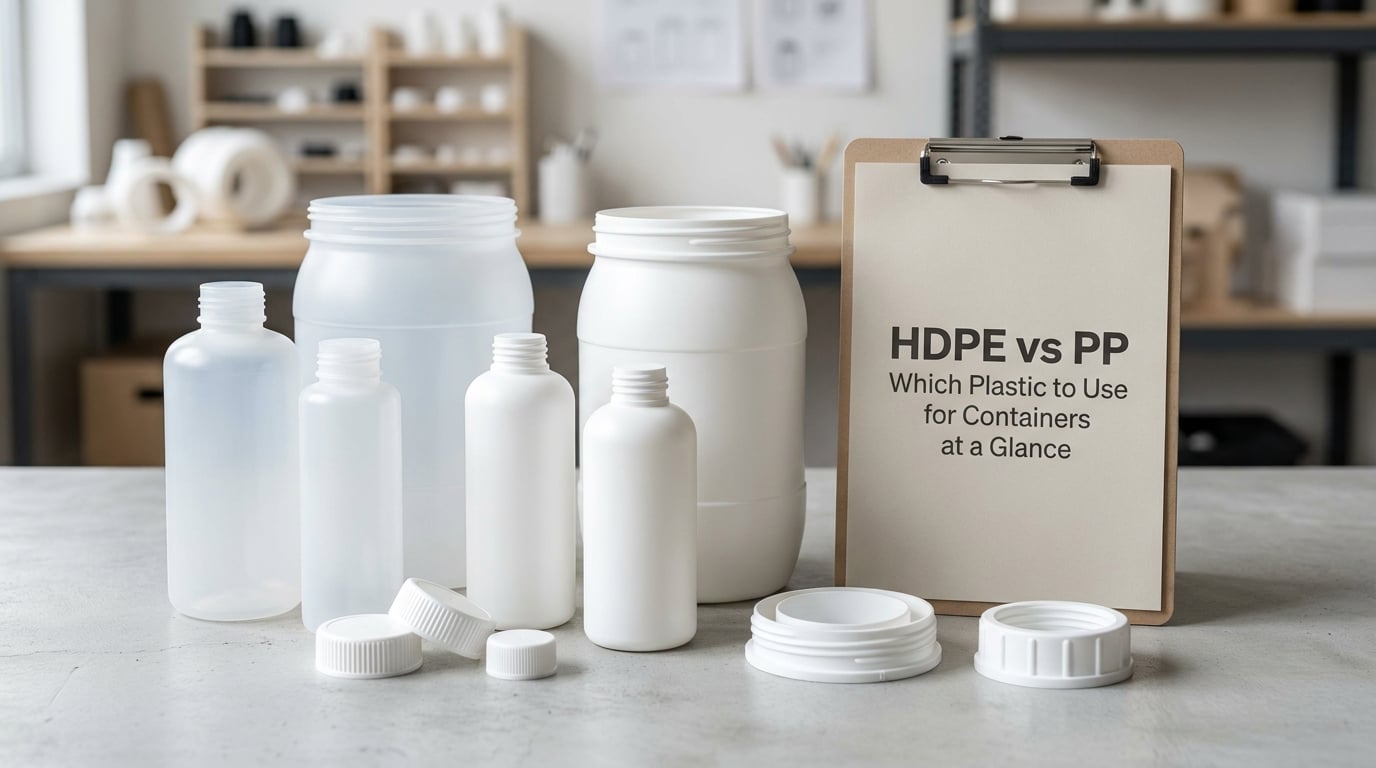
The table below is the short version. The winner column tells you which material usually wins that row for a typical molded or blow-molded container, not for every grade in existence.
| Property | HDPE (resin code #2) | PP (resin code #5) | Usual winner |
|---|---|---|---|
| Density | 0.941 to 0.965 g/cm3 | About 0.90 to 0.91 g/cm3 | PP (lighter per part) |
| Tensile strength | 26 to 38 MPa | About 20 to 35 MPa | HDPE |
| Impact and drop behavior | Excellent, especially when cold | Good; stiff and can shatter-feeling when cold | HDPE |
| Stiffness and rigidity | Rigid | Stiffer on paper, more flexible in thin sections | HDPE for thick parts, PP for thin |
| Fatigue and flex life | Moderate; hinges crack under repeated flexing | Very high; supports living hinges | PP |
| Chemical resistance | Very good with acids, bases, salts, alcohol | Good; less tolerant of some strong oxidizers and aromatic solvents | HDPE |
| Melting point | Roughly 120 to 137 C | Roughly 160 to 171 C | PP |
| Continuous service temperature | About -50 C to 80 C | About -20 C to 100 C | PP for heat, HDPE for cold |
| Hot fill and boiling water | Not suitable for boiling or steam service | Suitable for hot fill and steam sterilization | PP |
| Clarity | Translucent to opaque; no true clear grade | Clear to translucent, easy to tint | PP |
| Puncture and cut resistance | High; wall tears stay localized | Lower; sharp shards possible on impact | HDPE |
| Moisture barrier | Very good, low water absorption | Very good, low water absorption | Close |
| Oxygen and aroma barrier | Moderate; long storage can lose freshness | Moderate to good, better than PE in many films | PP |
| Environmental stress cracking | Susceptible under sustained tensile stress with surfactants | Also susceptible, grade dependent | Depends on grade |
| Surface energy and labeling | Very low; ink and adhesive need treatment or primer | Low; also needs corona, flame or plasma treatment | Close |
| Main processing routes | Blow molding, injection molding, rotationally molded | Injection molding, hot-fill blow molding, compression molding | HDPE for hollow parts, PP for thin wall and hot fill |
| Curbside recyclability | Widely accepted under #2 | Widely accepted under #5, more variable locally | HDPE |
| Typical container uses | Detergent and bleach bottles, milk jugs, water, chemical drums, agricultural jerrycans, IBC totes | Caps and closures, hot-fill bottles, food tubs with living hinges, medical and lab containers, cutlery | Different jobs entirely |
Read the last row again if you only remember one thing. These are not competing versions of the same bottle. They end up in different rooms of the factory.
What Is HDPE and How Does It Work in Containers?
HDPE is high density polyethylene: a polyolefin whose chains are mostly straight, with very few side branches. Straight chains pack tightly, which raises the density above 0.94 g/cm3 and pushes the material toward a semi-crystalline structure. That crystalline fraction is the reason HDPE feels rigid and holds its shape without much wall thickness.
Chemically, the backbone is a long chain of carbon atoms with a hydrogen on each. There is no ester group, no chlorine, and no aromatic ring, which is exactly why water, salt, mild acid, mild base, and alcohol barely bother it. Nearly every chemistry lab that has ever needed a wash bottle started here.
Turn that structure into a container and you get predictable behavior:
- Impact tolerance. HDPE takes drops and side loads without shattering, which is why the classic milk jug and the 55-gallon drum are HDPE. Industrial users handling bulk liquid report that a dropped jug bounces and dents rather than breaks.
- Moisture resistance. Water absorption is negligible, so HDPE holds aqueous products without softening or gaining weight.
- Puncture resistance. In thin blow-molded walls, a puncture tends to tear in place and stay contained, a favorable failure mode for shipping liquids.
- Low melt processing temperature. Blow molding runs comfortably, and thin walls form easily in extrusion blow molding.
- Weak points to watch. HDPE creeps under sustained load, stiffens and becomes brittle in cold weather unless impact-modified, and is vulnerable to environmental stress cracking.
Environmental stress cracking deserves its own paragraph because it causes more field failures than anything else. If a HDPE container is held under continuous tensile stress, in contact with a mild surfactant such as a detergent concentrate or a stress-cracking agent, cracks can nucleate and grow at a rate you would not predict from tensile data alone. Detergent bottles sit in this exact corner of the material map, which is why grade selection, not resin choice, is what keeps them from splitting.
UV exposure is the other trap. Unstabilized HDPE left outdoors chains scission, the molecular weight drops, and the surface goes chalky and brittle. Marine-grade and UV-stabilized grades exist for this reason, and they are not interchangeable with general-purpose grades.
One more practical wrinkle: HDPE has among the lowest surface energies of any common packaging polymer. Labels will slide right off, and most inks and adhesives refuse to wet the surface without corona treatment, flame treatment, or a tie-layer primer. Suppliers report this constantly when a new labeling line is qualified.
What Is PP and How Does It Work in Containers?
Polypropylene is also a polyolefin, but every other carbon carries a small methyl side group. Those methyl groups stop the chains from packing as tightly, which lowers density, lowers crystallinity, and pushes the melting point up to roughly 160 to 171 C. That single structural change explains most of what polypropylene is good at in a container.
The practical consequences for containers:
- Heat tolerance. PP is routinely used for hot-fill applications and steam sterilization, with continuous service temperatures commonly quoted around 100 C. Hot-fill bottles and retort-adjacent packaging are polypropylene territory.
- Living hinge. PP tolerates thousands of flex cycles without cracking, so a thin molded lid can fold back on itself and stay folded. HDPE in the same geometry would crack.
- Clarity and tint. PP can be molded nearly clear or in clean translucent colors, which HDPE cannot do without a different material entirely.
- Stiff thin walls. Injection-molded PP gives a rigid wall far thinner than HDPE would need for the same stiffness, which is why yogurt pots, deli containers, and cutlery are polypropylene.
- Fatigue resistance. The same flexibility that gives the living hinge also lets a PP cap survive thousands of open-and-close cycles.
Polypropylene is also the standard for closures. Because it is chemically inert enough for food contact, sterilizable, and tougher in a thin section than the alternatives, a water or detergent cap is almost always resin code #5. Many caps are a hybrid: a PP cap on an HDPE bottle.
The flip side is that PP is stiffer and more brittle when cold, and it is less forgiving of certain aggressive chemicals than HDPE. Concentrated oxidizing acids, some aromatic and chlorinated solvents, and certain fuel and oil blends attack polypropylene faster than they attack polyethylene. For a shipping drum that might see an unexpected cargo, that difference matters.
HDPE vs PP: Differences in Strength, Chemical Resistance, and Heat
The strength question is not really which material is stronger. It is which behavior you need at the moment of failure.
Is PP stronger than HDPE?
HDPE generally has the higher tensile strength, with published values in the 26 to 38 MPa range, while typical PP grades sit lower. Modulus tells a similar story: HDPE is the more rigid material in thick sections, and PP carries stiffness in thin molded walls. But tensile numbers predict pulling, not dropping, and dropping is what kills containers.
Under impact, HDPE wins for cold and abuse conditions because it deforms and absorbs energy. PP is the better performer for repeated low-amplitude flexing, which is why a PP lid survives a year of daily opening while a same-geometry HDPE lid would show a hinge crack in weeks. Choose on the loading mode, not on the label.
Which is more chemically resistant, HDPE or PP?
HDPE, for most practical container service. Both resist water, dilute acids, dilute bases, alcohol, and salt solution well, but polyethylene is more tolerant of the aggressive chemistries that quietly destroy polypropylene.
| Chemical class | HDPE | PP |
|---|---|---|
| Water, salt solution, dilute base | Excellent | Excellent |
| Weak acids (citric, acetic, fatty acids at room temperature) | Excellent | Good to excellent |
| Strong mineral acids, oxidizing acids | Good to excellent, grade dependent | Attacked by strong oxidizers; check the data sheet |
| Alcohols, glycols | Excellent | Good to excellent |
| Ketones, esters, vegetable and mineral oils | Good; slight swelling at high temperature | Good; more swelling and softer at heat |
| Aromatic, chlorinated, and petroleum solvents | Limited, check grade | Poor to limited, check grade |
| Surfactants and stress-cracking agents | Susceptible to environmental stress cracking under load | Also susceptible, grade dependent |
Never rely on a general statement like “HDPE is chemical proof.” Compatibility depends on concentration, temperature, contact time, and applied stress. Pull the data sheet for the specific grade and raise the question with your converter if the container will be under load while full, which is the combination that triggers stress cracking.
What temperature can each material withstand?
Distinguish two numbers that get constantly confused. The first is the processing temperature, the melt temperature in the extruder or the mold, which is high enough to flow the resin and get ruined by a small deviation. The second is the service temperature, the range the finished container actually survives in the field.
- HDPE. Melts around 120 to 137 C. Continuous service commonly specified from about -50 C up to about 80 C. It is a cold-chain material, and it tolerates freezer temperatures that would embrittle PP.
- PP. Melts around 160 to 171 C. Continuous service commonly specified up to about 100 C, with steam sterilization well established. Hot fills at 80 to 95 C are routine in PP blow molding.
So no, HDPE is not the right material for a container that will hold boiling water or see a steam cycle. And PP, while the heat winner, becomes noticeably stiffer and more brittle below freezing, which is why outdoor and frozen-goods applications often come back to HDPE or to an impact-modified PP copolymer rather than a general-purpose homopolymer.
UV stability deserves the same honesty. Neither resin survives indefinite outdoor exposure unstabilized. HDPE fails by chain scission and goes chalky and brittle; PP fails by photo-oxidation and cracks around stressed areas. Both need a UV-stabilized or carbon-black masterbatch, and both need to be tested as a system with the actual wall thickness and color you plan to sell.
HDPE vs PP: Clarity, Flexibility, Barrier Properties, and Processing
Clarity and color
Clarity is the fastest visual differentiator. HDPE is inherently translucent to opaque; even a thin, well-processed HDPE bottle has a soft, hazy look, and true clarity simply does not happen in extrusion blow molding. PP can run nearly water-clear in injection molding and semi-clear in stretch and blow molding, and it takes tint concentrate cleanly.
That is why water bottles are HDPE and yogurt cups are PP. If the product has to look like liquid in liquid, PP or a clear copolyester is the only option.
Flexibility, puncture and hinging
HDPE is flexible in bulk and tough, but it does not survive repeated flexing of a thin feature. Any design that folds, snaps, or hinges should be polypropylene. The living hinge, that thin flexible web left in the mold so a lid can fold back 180 degrees and stay there through thousands of cycles, is a polypropylene trick that does not work in HDPE.
For puncture and cut resistance in thin walls, HDPE behaves better. A dropped, punctured HDPE jug tends to tear locally; the same event in a PP tub can produce a long split or a sharp fragment. In a hazmat or a consumer package, that difference in failure mode sometimes matters more than the tensile numbers.
Barrier behavior
Both materials absorb almost no water, so for aqueous products the moisture barrier is a tie. Where they separate is gases and aroma. Polypropylene generally performs better as an oxygen and aroma barrier than HDPE at equal wall thickness, which is why oxygen-sensitive contents such as oils, some flavors, and vitamin-fortified products lean PP or a multi-layer structure. Long-term storage of a perishable in either resin is still a shelf-life question best settled by testing, not by resin code.
Processing and design
HDPE is the workhorse of extrusion and injection blow molding: thick-walled drums, jerrycans, and large totes form easily and cycle fast. PP dominates injection molding of thin-wall parts, and hot-fill blow molding, where the parison must survive a fill near its softening point.
Weldability favors PP. The cap and the body of a PP container can be heat-sealed together on the molding machine, producing a tamper-evident bond that is genuinely hard to defeat. Polyethylene welds poorly by comparison, which is why closures are often mechanically threaded or snapped on rather than sealed.
Surface treatment for labels and ink sits in the same box for both. Low surface energy means a corona treater, flame treatment, or a primer is required in almost every case, so if your project has a labeling line, treat that as a shared engineering task rather than a tiebreaker between the two resins.
HDPE vs PP: Cost, Recycling, and End-of-Life Considerations
Resin price moves daily, so any number I give you would be wrong within a month, and package-level cost depends on too many variables to quote honestly. What I can give you is the list of what actually drives the cost of a finished container, and it is not the same list most people assume.
- Wall thickness and cycle time. The biggest lever. A thin-wall PP tub and a thick-wall HDPE jug use very different amounts of resin per unit and very different amounts of machine time.
- Part geometry. Deep draw, tight corners, and heavy ribbing raise both scrap rate and cycle time. A geometry that is easy in blow molding can be expensive in injection molding, and the reverse is also true.
- Tooling amortization. A high-volume run spreads steel cost across millions of parts; a short run does not, which can flip which material is cheaper on a per-part basis.
- Color and finish. Custom tinting, UV stabilization masterbatch, and anti-static or antimicrobial additives all add cost, and PP is generally easier to color cleanly.
- Freight and secondary packaging. Lightweight PP parts reduce shipping weight, which matters more than resin cost at high volume.
- Local market conditions. Recycled content availability, energy prices, and converter capacity all move the number, sometimes by more than the gap between the two resins.
On end of life, both are thermoplastic, both are labeled under the resin identification system, and both are accepted by curbside programs across most of the US. HDPE (#2) has the smoother path. It is the single most common plastic in household recycling, and the bottle and jug stream is so well established that recyclers reliably get clean feedstock from it. PP (#5) is accepted in a growing number of programs but is more hit and miss region to region.
Recycled content behaves differently in the two. Post-consumer rHDPE is plentiful and the mechanical properties degrade gracefully, which is why recycled HDPE shows up in jugs, pipes, and yard waste carts with little fuss. rPP exists in volume but tends to be more application-specific, and a recycled grade needs matching on melt flow so the process window stays wide. In both cases, ask for the recycled fraction by weight and a melt flow index range rather than a vague “contains recycled material.”
One design decision has an outsized effect on recyclability: avoid mixing polymers inside a single item where a recycling stream will not separate them. A multi-material bottle with a barrier layer can still be a well-designed package, but it is more expensive to reprocess and sometimes not accepted at all.
Which Plastic Is Better for Common Container Types?
Detergent, bleach, and household chemical bottles
HDPE, almost without exception. These products are aqueous, mildly alkaline or mildly oxidizing, and they get squeezed, dropped in a truck bed, and stored in a hot garage. HDPE wins on chemical tolerance and on surviving a cold delivery truck. The one historical failure mode to manage is environmental stress cracking under a hoop stress, which is why detergent concentrates get stress-crack-resistant grades rather than a general-purpose bottle resin.
Milk, water, and juice jugs
HDPE for the body, PP for the cap and the handle. The body wants low cost per liter, toughness, and a good barrier for water, and blow molding HDPE hits all three. The closure and any integral handle want flex fatigue resistance, which is polypropylene.
Bulk chemical drums, IBC totes, and agricultural jerrycans
HDPE for the container, with a PP cap and sometimes a PP or HDPE frame. This is where the difference in chemical tolerance becomes a safety decision. A drum destined for a solvent, a fuel, or an aggressive cleaner needs a compatibility check, because PP will not tolerate some of those cargoes.
Food tubs, takeout containers, and hinged lids
PP, for the living hinge and the thin rigid wall. A snap-fit lid that a customer opens ten times a day will fatigue in HDPE. For containers that must see a hot fill or a steam cycle, PP is the only realistic option.
Hot-fill bottles and microwave containers
PP. It is the standard for hot-fill packaging and for containers sold for microwave use, and the resin code #5 on the base is the quick confirmation a shopper looks for. HDPE does not belong in either application.
Medical and laboratory containers
PP dominates single-use medical items, specimen tubes, and lab ware because it is sterilizable, chemically inert, and autoclavable. HDPE is common for larger volumes, for opaque storage, and for containers that value impact tolerance over transparency. In a clinical setting, users consistently ask for food-grade or medical-grade certification and the resin code, not the trade name.
Outdoor, agricultural, and marine containers
HDPE in UV-stabilized or marine-grade formulations, because it holds toughness at low temperatures and tolerates the knocks that come with a worksite. Both resins need UV stabilization outdoors. Carbon black is the most effective and it changes the color, so a natural-colored outdoor part will need a stabilizer package and a real weathering test.
Why one package often uses both
It is normal, and it is usually the right answer. A detergent bottle is an HDPE body with a PP cap and a PP handle. A motor oil jug is an HDPE shell with a PP base and closure. The body does the chemistry and the abuse, and the closure and hinge parts do the flexing.
Food contact, BPA, and microplastics
Both HDPE and PP are approved for food contact in the US and are BPA-free, since neither contains bisphenol A. What matters for food contact is not just the resin but the grade and the certification: virgin food-grade resin, compliance with the relevant FDA food contact regulation, and for some applications an NSF listing. Industrial and post-consumer recycled grades should not be assumed food safe just because the resin code matches.
On leaching and microplastics, the honest summary is that both polymers shed particles through abrasion, repeated washing, UV exposure, and mechanical damage, and neither is zero-shed. Studies on recycled versus virgin material find that wear state and thermal history matter at least as much as the polymer identity. The practical guidance is straightforward: buy virgin food-grade where the contents are consumed, replace scratched containers, hand wash rather than scrub, and do not reheat a container that has been through a hot fill and a dishwasher many times. Nobody should be storing food in a container that is visibly abraded, whichever resin it is.
Which Should You Choose?
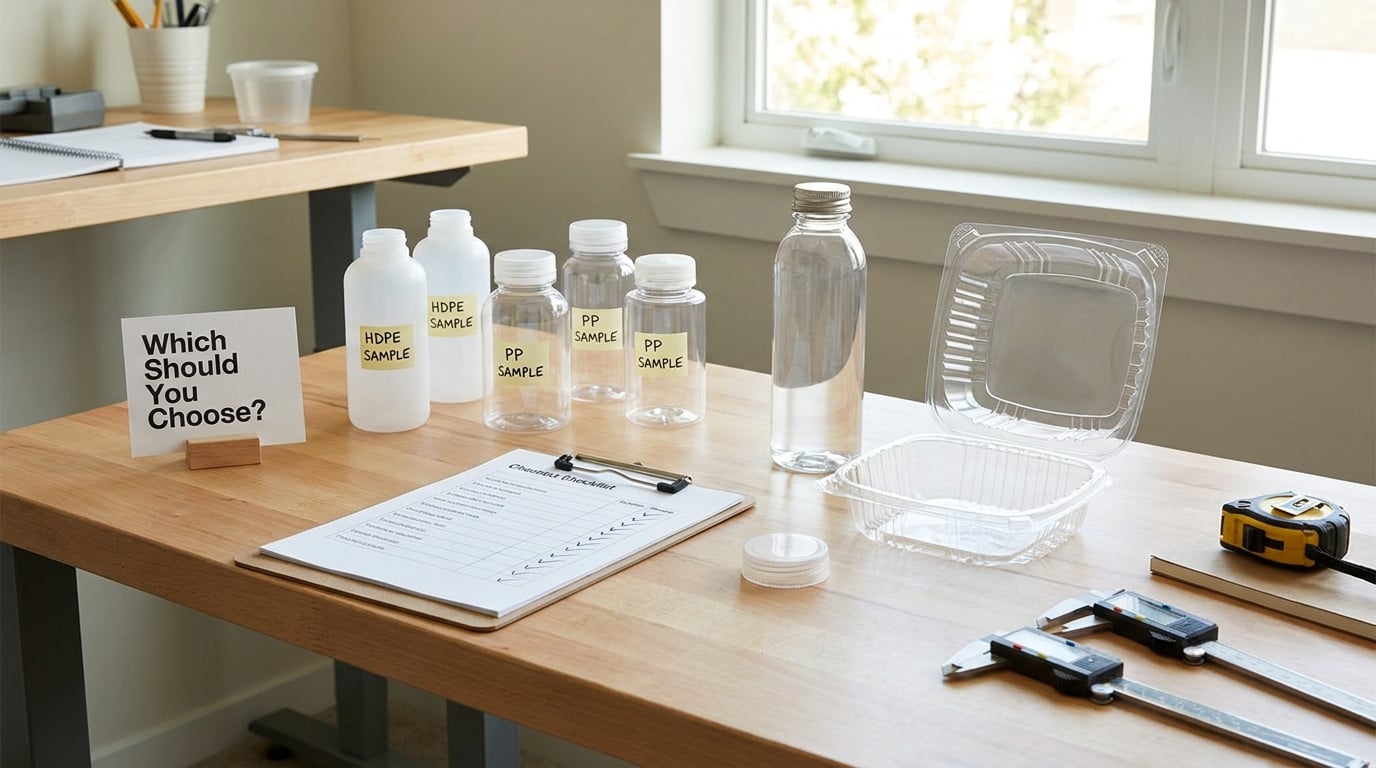
If you remember nothing else, remember this: HDPE is the tough, cold-tolerant, chemically broad container resin, and PP is the heat-tolerant, clear, flex-fatigue-tolerant resin. Walk the checklist below and you will land on one of them.
- Will it hold anything hot? Boiling water, hot fill at 80 C or above, steam, or a dishwasher cycle. If yes, choose PP. If no, continue.
- Will it sit in a freezer or a cold truck? If yes, choose HDPE, or an impact-modified PP copolymer if heat is also a factor.
- What is inside? Water, detergent, dilute chemicals, grains, produce, and general household products suit HDPE. Oily, aromatic, or oxidizing cargoes need a compatibility check, and the answer usually favors HDPE.
- Does the part flex, hinge, or open repeatedly? If yes, choose PP. A cap, a snap lid, a handle, or a living hinge belongs in polypropylene.
- Must the consumer see through it? If yes, choose PP. HDPE will always look hazy.
- Is it dropped, stacked, or shipped? If yes, choose HDPE for the body, and add wall thickness where impact concentrates.
- Will it see sunlight? Either resin, but only in a UV-stabilized or carbon-black grade, and only after a weathering test on the real part.
- Is it food contact? Either resin, but only in a certified virgin food grade with the resin code and the supplier’s compliance statement in hand. Do not assume an industrial or recycled grade is food safe.
Two more rules I would not break. First, decide body and closure separately; the right answer is very often both materials. Second, validate the actual part rather than the resin datasheet. Fill it, freeze it, drop it, flex the hinge ten thousand times, and put the worst-case chemical in it, because a container is a geometry and a grade, not a polymer name.
Frequently Asked Questions
Is HDPE or PP better for food containers?
Neither is safer than the other for food. Both are approved for food contact in the US, both are BPA-free, and both carry resin codes (#2 and #5) that identify them. Pick HDPE for cold storage and impact-prone packaging, and PP for hot food, hinged lids, and anything needing clarity. The grade matters more than the resin, so confirm virgin food-grade certification rather than relying on the code alone.
Which is more chemically resistant, HDPE or PP?
HDPE is generally the more chemically resistant of the two, particularly against strong acids, oxidizers, and some solvents that will attack polypropylene. Both handle water, dilute bases, weak acids, alcohol, and salt solutions well. Always check the specific grade data sheet, because concentration, temperature, contact time, and sustained load all change the outcome, and stressed HDPE can still stress crack.
Can HDPE or PP containers hold hot liquids?
PP can. Polypropylene is used for hot fills, boiling-water service, steam sterilization, and microwave containers, with continuous service temperatures often quoted around 100 C. HDPE generally tops out near 80 C for continuous use and will soften or distort with boiling liquids, so it should not be specified for hot fill. For frozen contents the answer reverses, and HDPE holds its toughness better in the cold.
Is PP or HDPE better for bottle caps and closures?
PP. It survives thousands of open-and-close cycles without cracking, which is what a cap has to do, and its high melting point lets the closure be heat-sealed to the body for a tamper-evident bond. HDPE threads and snaps fine but tends to fatigue at the flex points. That is why most detergent, water, and juice packages pair an HDPE body with a polypropylene cap.
Which material is more recyclable or accepted in recycling programs?
HDPE has the easier path. Resin code #2 is the most widely accepted plastic in curbside programs across the US, and the bottle and jug stream gives recyclers a clean, abundant feedstock. Polypropylene, #5, is accepted by a growing number of programs but availability varies by region. Both are thermoplastics and both are genuinely recycled, so the deciding factor is usually local program coverage rather than the material itself.
Can a container be made from both HDPE and PP?
Yes, and it is extremely common. A detergent bottle is typically an HDPE body with a polypropylene cap and handle, because the body handles chemicals and abuse while the closure handles repeated flexing. Multi-material packaging complicates recycling slightly, since the streams have to be separated, but it is often the only way to get both performance properties in one package.
Conclusion
Start with temperature and contents. Hot or steam service means PP, cold or frozen means HDPE, and anything in between usually works in either. Then pick the failure mode you can live with: HDPE dents and tears, PP cracks. Specify a certified grade for the duty, run a compatibility check on the actual contents, and test a real part before you commit the line to it.