
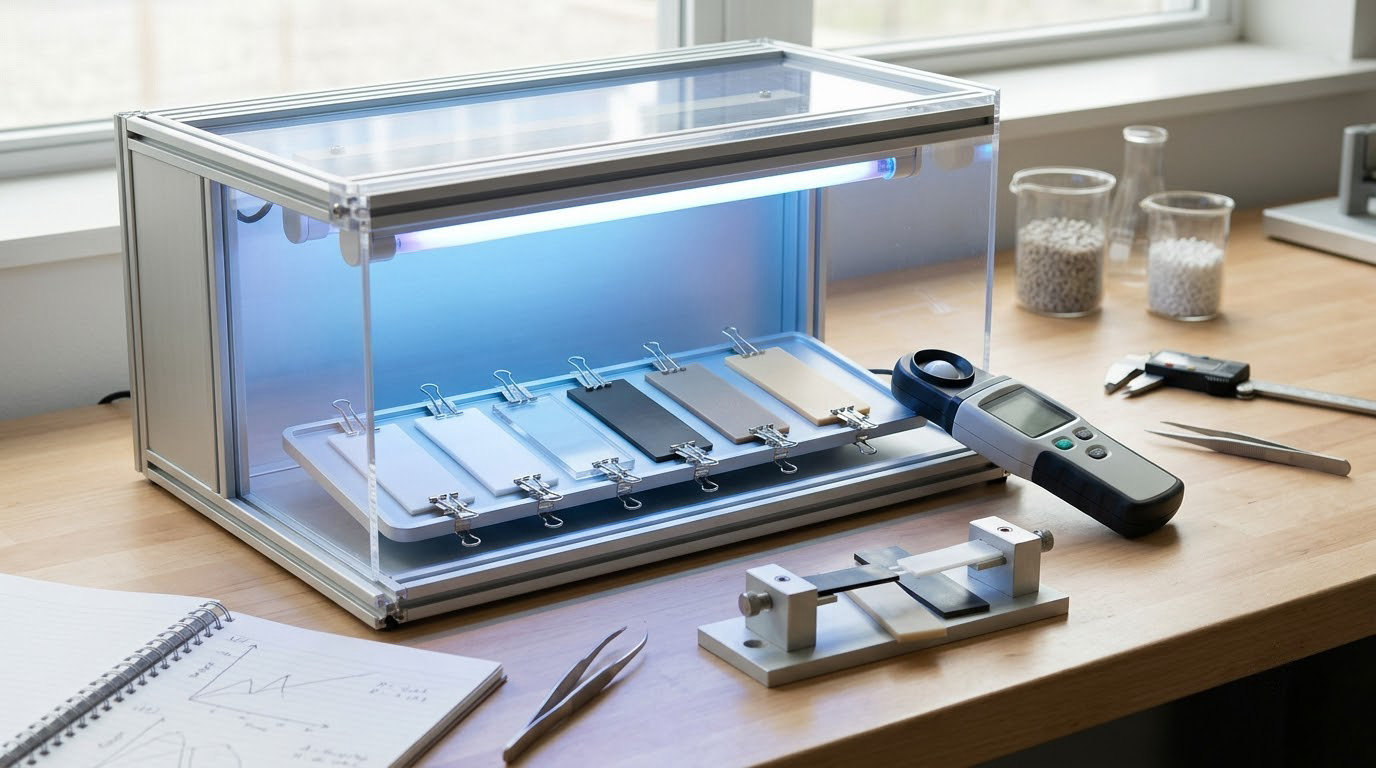
Choosing a plastic for UV exposure comes down to four questions: how much ultraviolet energy the part actually sees, how long it has to survive it, what the part has to do mechanically, and what colour it has to be. Get those four answered and the resin choice narrows quickly.
Which plastic is best for UV exposure? For clear parts, UV-stabilized PMMA (acrylic). For opaque parts needing toughness and colour retention, UV-stabilized ASA or a UV-stabilized polycarbonate. For chemical-tolerant mouldings and pipe, stabilized polypropylene or HDPE in a dark colour. The base resin matters more than the marketing label on the datasheet.
This guide walks through a repeatable selection method rather than a list of “UV-resistant” plastics. You will define the exposure, shortlist candidate resins, check how the part is actually stabilized, match mechanical needs, validate with representative testing, then lock the grade down on the purchase order. It takes an afternoon for a simple moulding and a couple of weeks if you want real weathering data.
One thing to say up front: every plastic degrades outdoors. The question is never whether it will fail, only when, and whether the failure is cosmetic or structural. Yellowing and gloss loss show up first. Embrittlement and stress cracking show up later, and that is the one that cracks enclosures and breaks latches.
Table of Contents
- What You Need
- Step-by-Step
- 1. Define the UV exposure and service environment
- 2. Shortlist plastics with suitable UV behavior
- 3. Check stabilization, additives, and material limitations
- 4. Match the resin to mechanical and thermal requirements
- 5. Validate the choice with representative testing
- 6. Confirm the grade and production process with suppliers
- Common Mistakes
- Frequently Asked Questions
- Conclusion
What You Need
Before you compare any resins, gather four things. Without them, every comparison is guesswork dressed up as engineering.
An exposure definition. Write down where the part lives and what the sky does to it. Direct sun for six hours a day in Arizona is a different problem from a north-facing wall in Manchester, and both are different from a part behind a window. Include temperature swings, moisture, and any chemicals the part touches.
A service life target. Not “it should last”. A number: two seasons, five years, ten years. Without a target you cannot tell whether a resin is adequate, because every resin on the shelf lasts longer than you think in a laboratory and shorter than you hope in the field.
Resin data that goes past the headline. A datasheet that only says “UV stabilized” tells you nothing. You want the base polymer, the stabilizer package and loading, the colour formulation, and the pigment type. You also want mechanical data at the temperature the part actually runs at, not just room temperature tensile numbers.
A place to test. At minimum an outdoor exposure rack of your own. Better, an accelerated weathering chamber and a colourimeter. Many labs and universities will run coupons for a few hundred dollars if you ask properly, and a rack on a south-facing roof costs nothing but time.
Keep a short decision record as you go: exposure, candidate resins, why each was accepted or rejected, test results, and the final grade designation. When someone asks in two years why the part is polycarbonate, you will have an answer that is not “that is what the moulder used”.
Step-by-Step
1. Define the UV exposure and service environment
UV is roughly 4.6 percent of the solar spectrum and carries most of the energy that damages polymers. Wavelengths from about 290 to 400 nanometres do the damage, and the dose your part receives is what matters, not the fact that it is “outdoors”.
Express that dose as irradiation per year, usually in kilocalories per square centimetre or in Langleys. Values run from roughly 70 kcal/cm² per year in northern Scandinavia to about 220 kcal/cm² per year in the Sudan. A part in Phoenix sees far more than a part in Cleveland, and a vertical surface sees less than a horizontal one because the sun swings across it.
Multiply the annual dose by your service life and you have a total dose figure you can hand to a supplier or a test lab. Practitioners regularly ask us for this number at quotation stage, and the honest answer is usually more useful than a resin name. Writing it into the custom plastic part RFQ saves a round of emails later.
Then write down the rest of the environment in the same document:
- Temperature range, including the peak surface temperature of a dark part in summer sun, which can run 20 to 30 degrees above ambient.
- Moisture and condensation cycling, especially if the part is mounted where water sits in crevices.
- Chemical exposure. Detergents, fuels, oils, salt spray and cleaning agents all compound UV damage rather than sitting separately beside it.
- Machined or molded-in stress. Sharp corners and thick-to-thin transitions raise local stress and start cracks earlier.
- Service life target, stated in years or seasons.
2. Shortlist plastics with suitable UV behavior
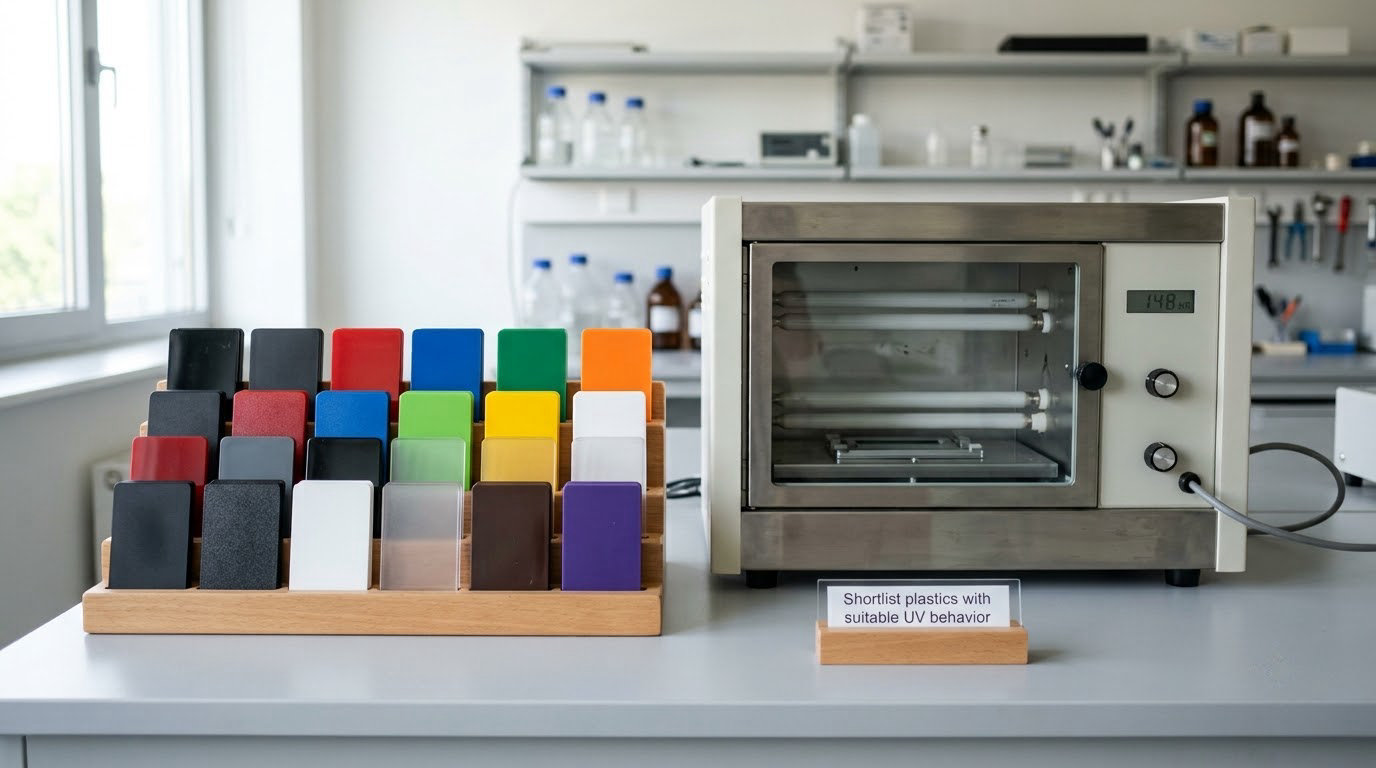
Now compare candidates against the exposure you just defined, not against a generic “UV rating”. The table below is the working comparison I use. Ratings assume a properly stabilized grade and a reasonable wall thickness.
| Resin | UV behaviour as supplied | Yellowing | Impact retention | Typical strengths | Best fit |
|---|---|---|---|---|---|
| PMMA (acrylic) | Excellent, no stabilizer needed | Very low | Good but brittle at sharp notches | Optical clarity, hardness, gloss | Glazing, signage, lenses, skylights |
| Polycarbonate | Needs a UV-stabilized grade; standard grades are poor outdoors | Low in clear stabilized grades | Excellent retention when stabilized | Impact strength, heat, flame performance | Sun-exposed enclosures, lighting covers, machine guards |
| ASA | Excellent; inherently weatherable | Very low | Very good | Gloss retention, rigidity, weatherability | Automotive and appliance parts held in full sun |
| Polypropylene (stabilized) | Moderate to good with HALS and a dark pigment | Not applicable when pigmented | Fair; embrittles over time | Chemical resistance, low cost, low density | Pipe, irrigation fittings, outdoor containers |
| HDPE (stabilized) | Moderate to good with carbon black | Not applicable when pigmented | Fair; suffers UV plus detergent stress cracking | Toughness, chemical resistance, weldability | Tanks, planters, playground parts |
| PET and PETG | Fair; stabilizers needed for long outdoor life | Moderate, can amber | Moderate | Clarity, chemical resistance, low cost | Short-life parts, 3D printed outdoor components |
| Ultraviolet-stabilized PVC | Good in outdoor pipe and profile grades | Low | Fair | Rigidity, low cost, self-extinguishing | Fencing, conduit, window profiles, roofing |
| ABS | Poor without stabilization; fades and embrittles | High and permanent | Poor outdoors | Cheap, easy to mould, good surface | Indoor housings only, unless coated |
| Polystyrene and GPPS | Poor; rapid yellowing and chalking | Severe | Poor | Clarity, rigidity, low cost | Not recommended outdoors |
| UHMW-PE | Excellent, naturally resistant | None | Excellent | Wear resistance, low friction | Wear strips, guides, outdoor rollers |
| PTFE | Effectively immune to UV | None | Excellent | Chemical and temperature resistance | Seals, bushings, coated fabric |
Two patterns in that table are worth pausing on. Transparent resins and opaque resins fail differently, so you cannot rank them on a single scale. And the polyolefins, which people often treat as equivalent, separate cleanly once chemicals are involved: polypropylene resists oils and acids better, HDPE is tougher and welds better. If chemicals dominate the exposure, work through how to select a plastic for chemical resistance before you finalize the UV shortlist, because the two screens overlap more than people expect.
Polycarbonate is the case that catches people most often. The base polymer yellows noticeably under UV unless it carries a stabilizer, and general-purpose grades are not outdoor grades. Practitioners on machining and engineering forums consistently rank UV-stabilized polycarbonate among the few thermoplastics that hold up in sun-exposed service, with real-world expectations in the region of five to seven years before impact strength drops to a point that matters.
Acrylic sits at the other end. It needs no stabilizer to hold colour and, in the clear grades, is the reference standard for outdoor glazing and signage. Its weakness is that it discolours under high-intensity UV below about 265 nanometres, which is why instrument housings and some lamp applications do better behind a filtered or stabilized grade.
3. Check stabilization, additives, and material limitations
“UV stabilized”, “UV resistant” and “UV inhibited” all appear on datasheets and none is a standard term. No supplier organisation defines them. Ask what is actually in the compound, and if the answer is a grade name rather than a chemistry, treat the claim as unproven.
There are three families of stabilizer and they work at different stages of the degradation mechanism.
UV absorbers are organic compounds, typically benzotriazoles, hydroxyphenyltriazines, benzophenones or oxanilides, that absorb the damaging wavelengths before the polymer does and convert that energy to heat. They are the strongest single mechanism for protecting colour and transparency, and benzotriazoles and benzophenones are the two classes you will meet most often.
Quenchers, historically nickel complexes, intercept excited chromophores and hand the energy back harmlessly. Effective, and increasingly displaced by other classes for regulatory reasons.
HALS, hindered amine light stabilisers, do something different again: they trap the free radicals that photo-oxidation generates, interrupting the cycle rather than blocking the light. HALS work extremely well in polyolefins and are the reason a black pipe or a stabilized tote can sit outdoors for years. Because they act on radicals, their protection grows with light dose rather than wearing out at a fixed exposure.
Now the pigment, which is the point most people get wrong. Pigment is not a stabilizer, but it changes the outcome completely. Carbon black at an adequate loading absorbs broadly across the UV and visible spectrum and is the most effective single colorant for outdoor life, which is why black pipe and black automotive trim outlast the same part in white. Rutile titanium dioxide is next. White and natural grades give up far sooner because they reflect instead of absorbing.
That creates a real commercial conflict. The colour your customer wants is often the colour that ages worst, and changing it after tooling is expensive. Resolve it early, or plan a coating.
Coatings and laminates are a legitimate alternative route rather than a compromise. An acrylic or fluoropolymer laminate over an ABS part gives you the surface colour and gloss you need while the substrate stays protected. Powder coat over moulded parts works the same way. Both add a process step and both fail at edges and through-holes, so treat them as a designed system with the joint geometry specified, not as a shortcut.
One more limitation to know about: recycled content. Regrind carries a mix of stabilizer packages and unknown pigment histories, so outdoor properties vary lot to lot. For sun-exposed parts, specify virgin material or a tightly controlled regrind percentage and put it in writing.
4. Match the resin to mechanical and thermal requirements
A resin that survives the sun and still fails in service has not solved the problem. UV resistance is one column of a wider requirements sheet, and it is often the column the buyer forgets to balance against the rest.
Check impact strength retention, not just initial impact strength. Notched Izod is a useful screening number, but what matters is what remains after a season of exposure, and only a test on aged coupons tells you that. Check stiffness and creep too: outdoor parts carry loads for years, often at temperatures far above the datasheet test point, and a semi-crystalline polyolefin that passes at 23 degrees can be a different part at 70.
Heat deflection temperature sets the ceiling on a sun-exposed dark surface, which can run well above ambient. Check dimensional stability across your temperature range, because a part that grows or warps loses seal compression and fastener preload. Then check the two areas UV work often exposes. If the part is assembled with adhesives, solvents or ultrasonic welding, some polymers need surface treatment or a corona pass to bond at all, and that treatment ages too.
The practical rule: pick the resin family for UV first, then confirm the mechanical requirements can be met inside that family. If they cannot, you need a different family or a reinforced grade, not a thicker stabilizer loading. Where the part is a housing, the UV question and the impact question are usually decided together, which is the case covered in choosing between ABS and polycarbonate for enclosures.
5. Validate the choice with representative testing
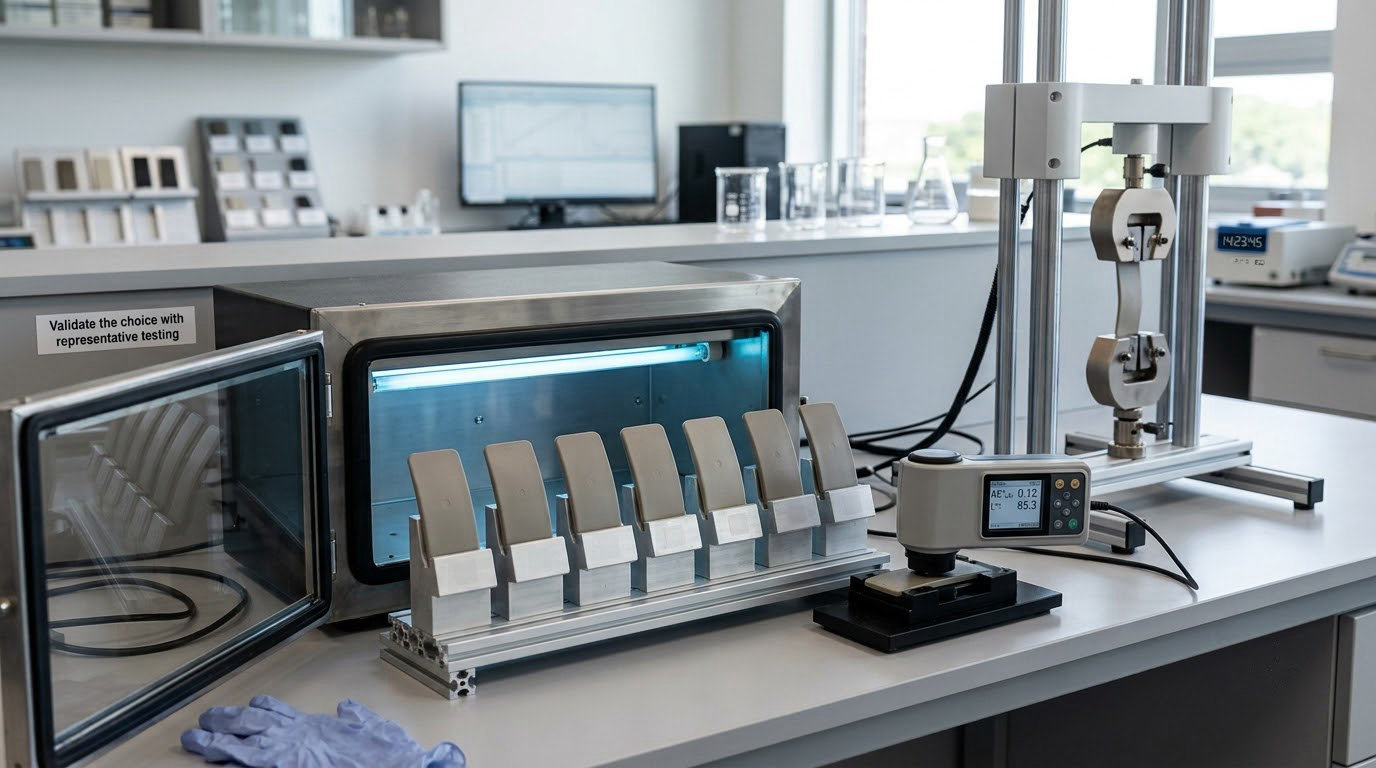
Nobody specifies a resin on a datasheet claim alone, not if the part is safety-relevant or expensive to replace. Validation has two halves: proving the material degrades slowly, and proving the specific part does not fail.
For the material, accelerated weathering is the standard route. ASTM G155 uses a xenon arc lamp with controlled irradiance, humidity and temperature cycles, and it is the closest simulation of sunlight. ASTM G154 uses fluorescent UVA-340 or UVB-313 lamps with condensation cycles; UVA-340 is the better match for outdoor service, while UVB-313 is deliberately harsh and accelerates everything equally, which makes it useful for ranking materials rather than predicting years. Q-Lab and Atlas instruments are the common commercial platforms running these methods.
Measure the properties you actually care about, at intervals rather than only at the end. Delta E colour shift, gloss retention at 60 degrees, yellowness index for clear parts, tensile retention, and notched impact on aged coupons. Gloss and impact usually move first; colour often lags, which means a part can look acceptable while already being mechanically compromised.
Be honest about the limits. Accelerated tests rank materials well and predict poorly in absolute years, because no chamber reproduces the full combination of dose, temperature, moisture, pollution and orientation a part sees outdoors. Use them to narrow the field and to compare your candidates, then confirm with real exposure. A rack of coupons on your own roof, exposed at the same orientation as the real part, costs almost nothing and occasionally settles an argument faster than any lab report.
For parts already in service, the same method works as a diagnostic. A burn test, a density measurement, a solvent swipe and an FTIR scan will usually identify the resin, and knowing what it is tells you whether the failure was a bad material choice or a missing stabilizer. That distinction saves a lot of wasted upgrades.
6. Confirm the grade and production process with suppliers
Once testing has narrowed you to one or two candidates, close the loop with the supplier in writing before the first production order. Ask for the exact resin grade designation, not a family name, plus the stabilizer chemistry and loading, the colour and pigment type, the processing method, any recycled content limits, applicable certification, and evidence of lot-to-lot consistency. Ask whether they will report stabilizer content on the certificate of analysis. Most will not, and that answer alone tells you a great deal about the compound.
Then repeat the grade number on the purchase order and on the tooling documentation. This is the step that stops a substituted non-stabilized grade from arriving on a sunny Tuesday six months later. Every person who has watched an ABS enclosure yellow and go brittle in the field has the same lesson: the material decision belongs in the specification, not in a verbal conversation with the moulder.
Common Mistakes
Ranking resins by a generic UV rating. A “UV resistant” label carries no test method, no dose and no service life. Compare candidates on dose-anchored data instead, or on your own coupons.
Assuming pigment is stabilization. Black is genuinely better outdoors, but the pigment is doing the absorbing, not a stabilizer package. A black grade with no HALS still embrittles, just later and after you stop caring about the colour.
Deciding on colour after tooling. Light and white colours fade first and are the usual reason a part is rejected at final inspection. Choose the colour in the same meeting as the resin.
Ignoring wall thickness and residual stress. Thin sections with sharp corners and heavy machining stress crack earlier than the material’s UV data suggests. Increase radii, keep walls uniform, and anneal where the grade allows it.
Treating transparent and opaque resins as one ranking. Acrylic’s clarity is the reason it lasts; a transparent grade without stabilizers does not behave like a pigmented one. Judge each on its own failure mode.
Trusting test conditions you did not choose. A lamp that cycles humidity when your part lives in a dry shed, or a chamber run with no condensation when your part sweats every night, tells you little about your part. Match the cycle and the orientation to the service environment.
Leaving the grade off the purchase order. This is the cheapest mistake to fix and the most common one to make. A grade designation that never appears in writing is not a specification.
Frequently Asked Questions
Which plastic is best for UV exposure?
It depends on whether the part must be clear. For transparent applications, UV-stabilized PMMA (acrylic) holds colour and gloss without additives. For opaque parts needing toughness, UV-stabilized ASA or a UV-stabilized polycarbonate perform better. For chemical-tolerant mouldings, stabilized polypropylene or carbon-black HDPE are the usual answers. Always specify a stabilized grade rather than a general-purpose one.
Is polypropylene plastic UV resistant?
Not as supplied. Unstabilized polypropylene photo-oxidizes fairly quickly and embrittles, which is why it performs poorly in thin, unpigmented outdoor parts. With a HALS package and a dark pigment it becomes a genuinely durable outdoor material, which is exactly why black pipe and irrigation fittings last. The downside is that once PP embrittles it cracks rather than stretches, so wall thickness and notch radius matter.
Which is more UV resistant, acrylic or polycarbonate?
Acrylic is more UV stable as a base material and needs no stabilizer for outdoor colour retention. Polycarbonate has better impact strength and heat resistance but yellows under UV unless you buy a stabilized grade, typically a UV long-life grade. For glazing and signage, acrylic. For impact-critical parts such as machine guards and enclosures, stabilized polycarbonate.
What is the difference between UV resistant and UV stabilized?
Neither term has a standard definition, and suppliers use them interchangeably. UV stabilized usually refers to a compound containing UV absorbers, quenchers or HALS that chemically slow photo-degradation. UV resistant may mean that, or it may mean only that the part is pigmented in a colour that absorbs light. Ask for the stabilizer chemistry and loading, and for certificate of analysis data, before treating either phrase as a specification.
How do I test a plastic for UV resistance?
Run accelerated weathering per ASTM G155 (xenon arc) for sunlight-like conditions, or ASTM G154 with UVA-340 lamps for a faster, cheaper screen. Measure colour shift, gloss retention, yellowness index and mechanical properties at intervals rather than only at the end. Always pair it with real outdoor exposure on your own site, because accelerated tests rank materials far better than they predict service life in years.
What is the best material for blocking UV rays?
If you mean blocking radiation rather than surviving it, the answer is a film, laminate or coating rather than a bulk resin. A fluoropolymer or acrylic laminate over a moulded part, a UV-blocking film, or a powder coat will block the UV while the substrate handles the mechanics. Bulk resins such as PMMA, UV-stabilized polycarbonate and PTFE are inherently opaque to the damaging wavelengths, so a solid part in those materials needs nothing extra.
Conclusion
Start with the number, not the resin name. Document the annual UV dose in kcal/cm², the temperature and moisture conditions, the chemicals involved and the service life you need, then work backwards to a specific stabilized grade of a resin that meets your mechanical requirements.
How to choose a plastic for UV exposure reduces to three decisions: pick a base resin that is naturally weatherable where you can, add a proper stabilizer package where you cannot, and specify the colour and wall thickness that go with it. Then confirm the choice with coupons, put the grade number on the purchase order, and check the parts after a season in the sun rather than trusting a datasheet phrase.