
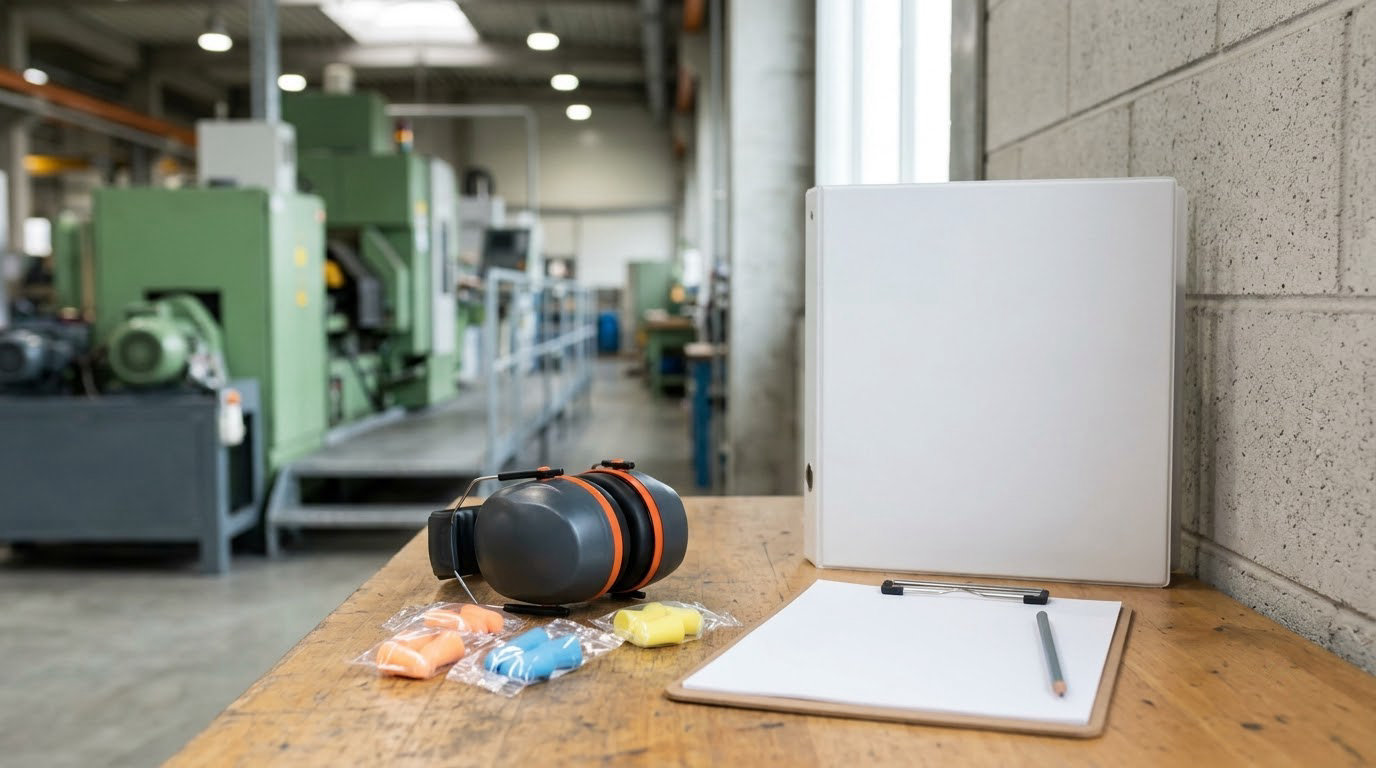
OSHA requires a hearing conservation program at any factory where workers are exposed to noise at or above 85 decibels averaged over an 8-hour time-weighted average, measured on the A-weighted scale (85 dBA TWA). The rule lives in 29 CFR 1910.95, and it is not satisfied by handing out ear plugs. Hearing conservation program basics for factories come down to six written components: monitoring, audiometric testing, audiogram evaluation, hearing protectors, training and recordkeeping.
That last point is where most plants get it wrong. A box of foam plugs in the supply room is personal protective equipment. A program is a documented system that measures exposure, tests hearing, fits protection, retrains annually and records the results. This guide walks through what each piece looks like on a real shop floor, from the press room to the packaging line.
Last reviewed October 2026. Requirements below describe the federal standard. State-plan states and some local rules add their own requirements, so check with your state plan or an industrial hygienist before treating this as the final word.
Table of Contents
- What Is a Factory Hearing Conservation Program?
- Which OSHA Noise Standards Apply to Factories?
- How to Build a Hearing Conservation Program Step by Step
- How to Identify and Measure Hazardous Noise at Work
- How to Reduce Noise at the Source
- How to Use Hearing Protection and Employee Training
- How to Run Audiometry, Records and Program Reviews
- Frequently Asked Questions
- Does OSHA require a hearing conservation program?
- At what noise level is a hearing conservation program required?
- What are the five required elements of a hearing conservation program?
- What are the OSHA audiogram requirements for employees exposed to noise?
- What is the acceptable noise level in a factory?
- What is the rule of five for hearing protection?
- Conclusion
What Is a Factory Hearing Conservation Program?
A hearing conservation program is an employer’s written, site-specific set of procedures that protects employees exposed to workplace noise. It identifies who is exposed, measures how much, provides protection at no cost to the worker, tracks hearing health over time and keeps records long enough to prove what you did.
The exposure is common in manufacturing. NIOSH estimates roughly 32 million US workers are exposed to hazardous noise in the workplace, about 16 million of them in manufacturing. Industry sources put the manufacturing share even higher, with close to half of plant workers exposed and about one in five reporting some degree of hearing loss.
Hearing conservation program basics for factories in one sentence
Measure the noise, test the ears, protect the ears, train the crew, record everything, and put the plan in writing so an inspector or an audiologist can follow it.
Common factory noise sources
Noise rarely comes from one machine. In a typical plant it stacks: stamping presses and power presses running on a shared line, injection molding machines with their hydraulics and hoppers, saws and grinders, blast cleaning, air compressors and blowers, conveyors, and punch presses cycling all shift. Ancillary equipment is the one that gets missed, because nobody thinks of the roof air handler as a noise source until a worker stands under a return vent for a full shift. GD and T Basics for Plastic Parts covers the molding side of a plant, which is where the noise usually starts.
Why hearing protection alone is not a program
Plug distribution satisfies one line of 1910.95 and nothing else. The standard is built on the idea that you measure first, control the source where you reasonably can, and use protection for the residue. A plant that buys protectors for everyone without measuring does not know whether the chosen protection matches the exposure, and it has no record to show what anyone was exposed to.
Health effects beyond hearing loss
Noise-induced hearing loss is permanent. It is also the most visible symptom of a longer list that includes tinnitus, elevated blood pressure, fatigue that ends up in recordables and accidents caused by missed verbal cues around equipment. Hearing loss itself shows up as an invisible disability: no pain, no blood, no obvious event. Workers notice ringing after a shift, or they start asking for repeats on the phone, and by then the damage has been building for years.
Which OSHA Noise Standards Apply to Factories?
The trigger level for a hearing conservation program is an 8-hour TWA of 85 dBA. Above that exposure, measured at the employee’s ear position in their actual work area, the program obligations kick in.
The numbers that matter
| Term | Value | What it means for a factory |
|---|---|---|
| Action level | 85 dBA as an 8-hour TWA | The threshold at which a hearing conservation program is required |
| Permissible exposure limit | 90 dBA as an 8-hour TWA | The upper limit for permitted exposure without mandatory controls |
| Noise dose | Percent of the daily exposure limit | A dosimeter readout, not a spot reading, is the better measure for a full shift |
| Measurement range | 80 to 130 dB | Instrument range used when surveying a plant |
Decibels are logarithmic, so a 3 dB rise doubles the exposure energy. That is why the gap between 85 and 90 looks small on paper and is not small in practice: at 90 dBA the permitted time drops from 8 hours to 4. The exchange rate matters too, and hearing conservation programs generally follow the conservative 3 dB exchange rather than the more generous 5 dB figure.
When to re-survey
Repeat your noise survey whenever equipment changes, a new process or material arrives, a machine moves, ventilation changes, or the plant expands. OSHA also expects re-survey after employee complaints about noise levels. Treat the survey as living documentation rather than a binder you filled once and never opened again.
This section describes how the federal standard generally works. It is not legal advice, and state-plan states may run stricter limits.
How to Build a Hearing Conservation Program Step by Step
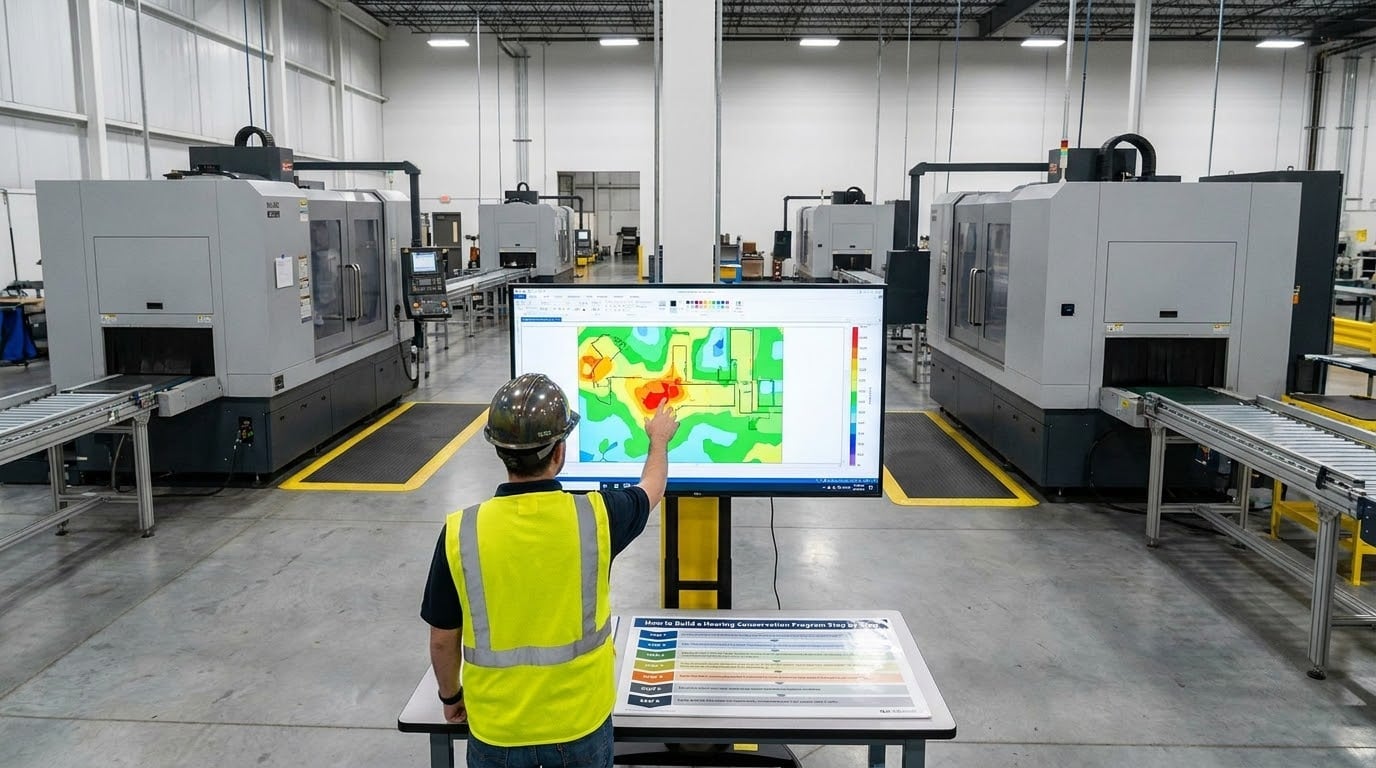
Programs fail when they start as a document nobody owns. Start with a person. Most plants appoint a hearing conservation administrator, often an EHS lead, safety manager or occupational health nurse, and back that person with a written program the plant owns.
Step 1: Assign an owner and write the program
Name the administrator, define their authority, and put the written program in place. The written plan should map to the sections of 1910.95: monitoring, observation, audiometric testing program, audiogram evaluation, hearing protectors, training, recordkeeping and program evaluation. Keeping the outline parallel to the regulation makes audits fast.
Step 2: Involve the people doing the work
Bring supervisors and line operators into the survey. They know which press is loudest at the tie bar and which grinder is fine until the guard comes off. Employee participation is part of the standard, and it makes the controls easier to live with.
Step 3: Survey the noise
Map every area where exposure is plausible, measure across representative shifts, and identify each employee whose exposure is at or above the action level. Do not skip temps and contractors; their host employer owes them the same protection.
Step 4: Control the source, then protect the worker
Apply feasible engineering and administrative controls first, then supply hearing protectors for whatever exposure remains. Do not skip straight to plugs.
Step 5: Set up audiometry, training and records
Contract with a mobile audiometry provider or a clinic, schedule baseline tests, build the annual training cycle, and pick a record system that keeps exposure surveys and audiograms for their required retention periods.
A 90-day rollout
Days 1 to 30: appoint the administrator, draft the written program, and pull equipment lists and previous surveys. Days 31 to 60: run the noise survey and pick engineering controls for the worst areas. Days 61 to 90: issue protectors, book baseline audiograms, deliver training, and start the records system. A schedule like this works because the survey drives everything after it instead of running in parallel.
How to Identify and Measure Hazardous Noise at Work
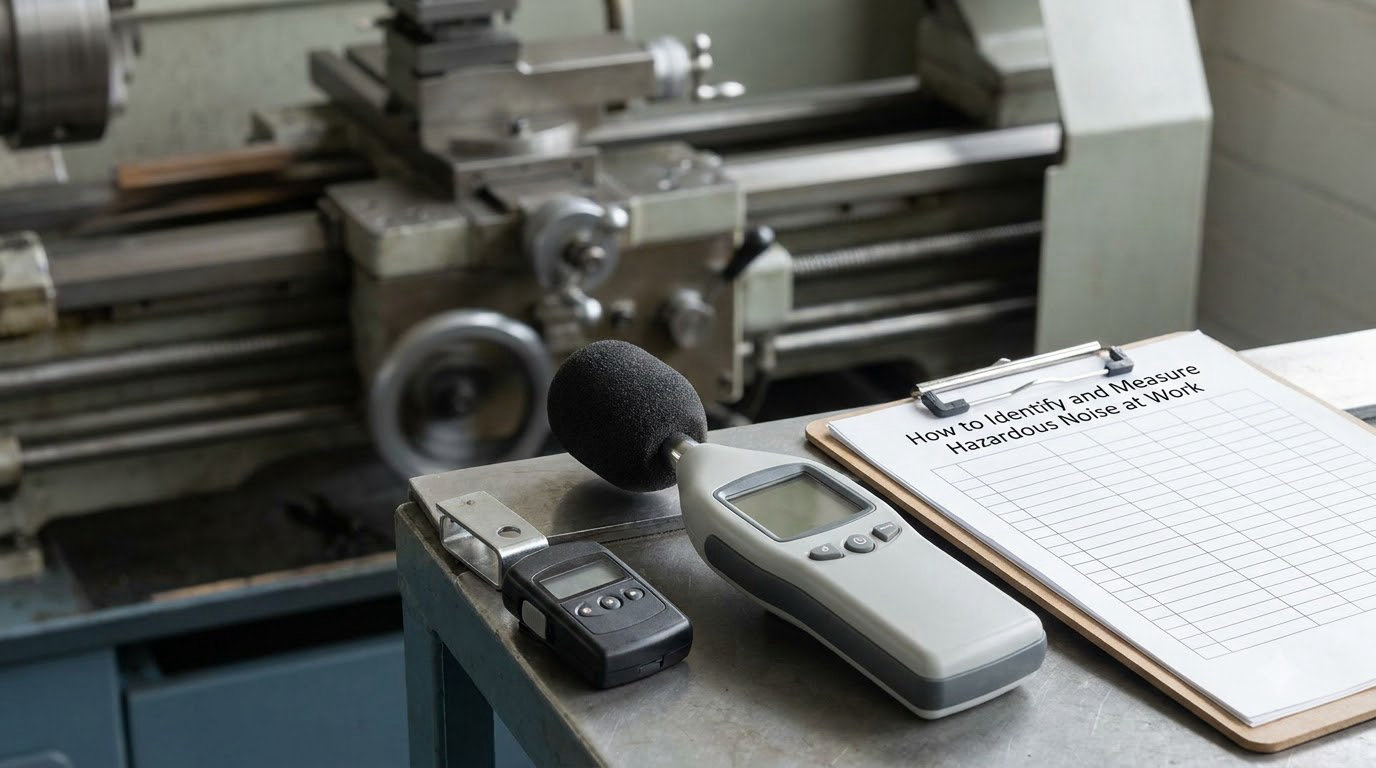
Survey by task, not by room. A press room measured once in an empty state tells you very little, because the exposure belongs to the operator standing at the tie bar during the cycle.
Choosing the right instrument
| Instrument | What it gives you | Best use |
|---|---|---|
| Sound level meter | Spot level at a moment in time | Quick screening, checking whether a fixed noise source moved |
| Noise dosimeter | Time-weighted average and dose over a full shift | Confirming whether a worker crosses the 85 dBA action level |
Use a dosimeter for anyone whose exposure you are deciding. Place the microphone at the employee’s ear position during a typical work situation, and run the full shift on at least one worker per job classification in each area.
Sampling across shifts and job variations
Measure first, second and third shift. Day-shift readings do not describe a night crew that works a different product, and a plant that runs one product on days and another on nights has two exposure profiles, not one.
Calibrate before and after each survey day and record the results. The meter is the only instrument that supports the numbers in your file, and an uncalibrated instrument is an easy finding during an inspection.
What to document
For each measurement record the date and time, the equipment or process, the location, the job classification, the instrument and its calibration, the TWA and dose, and the person who took the reading. Keep that record for two years.
How to Reduce Noise at the Source
Noise control follows a hierarchy, and ear plugs sit at the bottom because they depend on a person doing something every second of every shift. Work down the list.
Engineering controls
- Enclosures. Put guards and acoustic blankets around presses, grinders and punch presses. A press running with its guards open is both a noise problem and a safety one.
- Isolation. Use vibration isolators and flexible connectors so the machine is not bolted rigidly into the slab and the duct work.
- Louder things get quieter. Replace an aging compressor, a screaming conveyor drive or worn bearings before spending on protection.
- Ventilation. Route exhaust away from a worker standing zone instead of blowing conditioned air across the line.
- Layout. Separate noisy cells from inspection and assembly stations so a person on a quieter job is not standing in a neighboring zone’s dose.
Administrative and work-practice controls
- Job rotation. Spread exposure between two or three people rather than one operator taking the whole shift.
- Maintenance. Loose guards, dry bearings and unbalanced cutting tools all add noise. Put them on the PM schedule.
- Scheduling. Run the loudest presses during the shift when the fewest people are near them.
- Signage and restricted zones. Mark the 85 dBA and above areas so nobody wanders in to help without protection.
Control at the source is not always fully possible. A stamping press room on a two-shift schedule is not going to get quiet overnight, which is exactly why the standard also requires hearing protectors for the exposure that remains.
How to Use Hearing Protection and Employee Training
Employers must provide at least two varieties of hearing protection, one plug and one earmuff, so employees can pick what actually works in their job. Protectors are provided at no cost to the employee and replaced when they wear out.
Why the highest NRR is the wrong pick
The noise reduction rating is a laboratory number for a perfect seal on a large head. Real-world performance is lower, so protectors are commonly derated by half when estimating protection. Pick the protector that brings the exposure under the limit without cutting off so much sound that the worker takes it out.
That failure mode is common. Overprotect a press operator and they cannot hear a forklift, a radio call or a change in machine pitch, so the muff comes off within an hour. Protection that gets removed in an hour protects nobody.
What training has to cover
Training is annual, and it should explain what noise does to the ear, why the plant has a program, what each measurement means, how to insert plugs and check a seal, which protectors suit which task, and how to report a machine that starts running louder. Hands-on practice beats a slide deck every time.
Reinforce it on the floor. New hires need it before they run a press, and a short refresher when a machine changes or an area gets re-surveyed costs little.
How to Run Audiometry, Records and Program Reviews
Audiometry is how you find out whether the controls and the protection are working. It measures hearing; it does not prevent anything.
The testing schedule
| Test | When | Notes |
|---|---|---|
| Baseline audiogram | Within 6 months of first exposure at or above the action level | Within 1 year if a mobile van is on a schedule |
| Annual audiogram | Once a year after the baseline | Compared against the baseline, not the previous year |
| Standard threshold shift | Evaluated on every annual comparison | Average change of 10 dB or more at 2000, 3000 and 4000 Hz in either ear |
| Record retention | Audiograms for the duration of employment | Noise exposure survey records for 2 years |
What happens after a standard threshold shift
When an annual audiogram shows a standard threshold shift, you have a defined workflow and a clock on it.
- Tell the employee in writing within 21 days of the determination.
- Retest the employee’s hearing within 30 days, without wearing hearing protectors for the test.
- Refer to a licensed audiologist or physician when the retest is still abnormal or the employee needs a fitness-for-duty answer.
- Refit hearing protection and adjust controls in the area where that employee works.
These conversations are uncomfortable. A worker who has lost hearing over 20 years often says they only need to hear enough to do their job, and no audiogram is going to feel urgent to them. The written notification is not optional and it is not a disciplinary step, so keep it factual and pair it with the refit.
Records and annual review
Each record should carry the employee name, job classification, test date, results, and the name of the technician or examiner. Store audiograms where they cannot be casually shared with supervisors, since medical results carry privacy expectations that production data does not.
Once a year, walk the program with the administrator: are the surveys current, did every shift get covered, has every new hire had a baseline, are protectors still available and stocked, and did every threshold shift close out inside 21 days. Program evaluation is itself a required element, and doing it on a calendar beats doing it after an inspection.
Frequently Asked Questions
Does OSHA require a hearing conservation program?
Yes, when employees are exposed at or above 85 dBA as an 8-hour time-weighted average. That triggers a written hearing conservation program with monitoring, audiometric testing, audiogram evaluation, hearing protectors, training and recordkeeping. Even below the action level, you still have to provide protection and warn employees about exposure, so the program trigger is not the only rule that applies.
At what noise level is a hearing conservation program required?
At 85 dBA averaged over an 8-hour time-weighted average, measured on the A-weighted scale at the employee listening position in their real work area. A spot reading above 85 is not enough to decide the question, because the trigger is the shift average. The 90 dBA permissible exposure limit is the ceiling for permitted exposure, not the point where protection starts.
What are the five required elements of a hearing conservation program?
OSHA names these in 29 CFR 1910.95: monitoring of employee noise exposure, an audiometric testing program, evaluation of each audiogram, provision of hearing protectors, employee training and recordkeeping. Most plants also document program evaluation, since that is required too. Handing out ear plugs covers exactly one of these elements.
What are the OSHA audiogram requirements for employees exposed to noise?
An employee needs a baseline audiogram within six months of first exposure at or above the action level, or within one year when a mobile van runs on a schedule. After that, an annual audiogram. Each result is compared with the baseline, and a standard threshold shift means an average change of 10 dB or more at 2000, 3000 and 4000 Hz in either ear, which triggers written notice within 21 days.
What is the acceptable noise level in a factory?
Federal rules permit exposure up to 90 dBA as an 8-hour time-weighted average, with a hearing conservation program required from 85 dBA TWA. That is the ceiling, not a comfortable working target, and many plants run a lower internal action level because NIOSH recommendations are more protective than the enforceable standard. Several reading pages still rank on figures from the 1990s, so verify current text before designing a program.
What is the rule of five for hearing protection?
The five dB exchange rate is not a hearing protection rule, and it is not the number this guide uses. OSHA permits a more generous 5 dB exchange, but hearing conservation programs generally apply the conservative 3 dB exchange because exposure energy doubles with each 3 dB increase. Use 3 dB when setting internal action levels and when judging whether a control brought the exposure under the limit.
Conclusion
Start where the noise is. Walk the floor with an industrial hygienist or your own calibrated equipment, measure by task and by shift, and write down which employees cross 85 dBA on an 8-hour TWA.
Then work the list in order: control what you can at the source, supply two varieties of hearing protection at no cost, book baseline audiograms inside six months, train everyone annually, and close out every standard threshold shift in writing within 21 days. Ninety days of focused work gets most plants a documented program they can actually defend.