

To source recycled resin for production, start with the material your plant already generates, then qualify reprocessors by polymer stream, chain-of-custody documentation, and multi-lot sample testing before you sign anything. A full qualification cycle usually takes six to twelve weeks from first contact to an approved pilot order, and most of that time goes into testing rather than paperwork.
The reason this matters is supply arithmetic. Plastics Europe figures reported by TOMRA put global plastic production at 390.7 million tonnes, of which 352.3 million tonnes was virgin material and only 32.5 million tonnes came from post-consumer recycling. That is roughly 8.3% of the total, and it has not moved much as demand for recycled content has grown. Buyers who treat recycled resin as a simple commodity swap get caught by a market that behaves nothing like the virgin one.
An engineer on r/AskEngineers asked for exactly the kind of guidance that is hard to find: how recycled plastics behave in product development compared with brand-name virgin resins. Procurement answers the contract questions, but the molding behavior, the property drift, and the contamination limits are what decide whether a program succeeds. This guide walks the whole path, from defining the grade to signing off the first production order.
Table of Contents
- What You Need to Source Recycled Resin
- Step-by-Step
- 1. Define the application and required resin grade
- 2. Set recycled-content and traceability requirements
- 3. Identify suitable post-consumer and post-industrial streams
- 4. Screen and verify potential suppliers
- 5. Request and evaluate representative resin samples
- 6. Run application-specific processing trials
- 7. Audit the supplier and verify the recycled material stream
- 8. Negotiate a pilot order and supply agreement
- 9. Validate the first production order
- Common Mistakes
- Frequently Asked Questions
- What is the easiest way to source recycled resin for production?
- Can recycled resin perform the same way as virgin plastic?
- How do I verify a supplier’s recycled-content claim?
- What is the difference between post-consumer and post-industrial recycled resin?
- How much recycled resin should I request for sample testing?
- Should recycled resin be approved on the same quality specification as virgin resin?
- Conclusion: Start With a Qualified Sample
What You Need to Source Recycled Resin
Before you contact a single reprocessor, get five things in place. The work is not glamorous, but skipping any one of them is how buyers end up approving a material that cannot hold up on a real line.
Production requirements
You need the part or process in front of you, not a vague brief. Write down the polymer family, the current virgin grade, the application, the end-use market, and the annual consumption in tonnes. Also note how the part is produced, whether injection molding, extrusion, blow molding, or fiber spinning, because that determines which quality parameters actually matter.
Then define tolerances. Recycled material behaves differently from virgin, so your existing specification is a starting point rather than an answer. Decide in advance which properties are negotiable and which are not. Odor and color are frequently negotiable; a minimum tensile strength on a structural part usually is not.
Technical documents
Collect the data sheet of the virgin grade you use today, your part drawings with material callouts, and any internal processing windows for drying, barrel temperature, and cycle time. If you plan to make a public recycled-content claim, gather the marketing and legal requirements too, because those drive the certification demands in step two.
Supplier information
Build a supplier longlist from reprocessors who actually run the line for your polymer. You want the company that produces the pellets, not the broker reselling them. Ask early for plant location, processing technology, annual capacity, and which certification scopes they hold.
Quality control resources
Know what testing you can do in-house versus what needs a third-party laboratory. Most plants can run melt flow index and density. Intrinsic viscosity on PET, ash content, gel counts, and color measurement usually need external support, and color measurement ideally needs a spectrophotometer. Budget for that cost before you start.
Commercial terms
Decide who pays for freight, who owns the material in transit, and what happens to a lot that fails incoming inspection. Recycled material is more variable than virgin, so rejection rights have to be written down before the first dispute, not after.
Step-by-Step
Here is the sourcing workflow in the order that works. Each step has a clear output you can point at, so you always know whether it is finished.
1. Define the application and required resin grade
Translate the molded part into a resin specification you can put in front of a supplier. The output is a one-page grade sheet naming the polymer, the recycled-content level, the color and odor limits, the viscosity target, the mechanical requirements, the allowable variation on each, and any regulatory constraint.
Be specific about viscosity. Melt flow index, or MFI, is the parameter that will tell you most about how the material will process, and recycled grades rarely match virgin MFI exactly. State your tolerance as a range and state where in the range you want to sit. An MFI spread of two points may be fine for a thick non-critical part and fatal in a thin-walled container.
For PET, intrinsic viscosity, or IV, is the equivalent control point. Extrusion and bottle-grade applications live and die by IV because it governs melt strength and the ability to draw a preform. Most other polymers are judged on MFI plus density and ash.
2. Set recycled-content and traceability requirements
Decide what claim you actually need, because post-consumer recycled content and post-industrial recycled content are not interchangeable in a specification. Post-consumer, or PCR, comes from used packaging and products that reached the consumer. Post-industrial, or PIR, comes from factory scrap, offcuts, and rejected parts generated during manufacturing.
PIR is usually cleaner and more consistent because it has a known origin and a controlled mix. PCR has the marketing value and the wider variety of contamination. If your program needs a content claim for reporting, you need post-consumer material in the bill of materials, and you need the supplier to prove it with a chain-of-custody record.
Ask about mass balance explicitly. Under mass-balance accounting, recycled material can be accounted for across a wider production run rather than physically traced to your pellets. It is legitimate and widely used, but it is not the same as a physically traced stream, and your claim should reflect the difference. Global Recycled Standard, the Recycled Claim Standard, and ISCC PLUS are the certification frameworks buyers encounter most often.
3. Identify suitable post-consumer and post-industrial streams
Match the feedstream to the application rather than the reverse. Each polymer has a different contamination profile and a different tolerance for it, and the stream you choose determines how much quality control you will need downstream.
Polyethylene and polypropylene streams are usually the easiest to work with because the sorters separate them well and the material is chemically robust. PET flakes from bottle streams are widely available and well characterized. Polystyrene and ABS are more difficult, because the sorting relies on density and infrared detection and the polymers are more sensitive to mixed contamination.
Color segregation is the quiet variable. A natural or clear stream demands far more sorting effort than a mixed-color one, and mixed-color material lands in a different price and application tier. Odor is the other one. PET and polyolefin regrind can carry a residual smell from the waste stream, and if the part is consumer-facing then that odor is a defect, not a preference.
Engineering plastics deserve a separate note. Recycled nylon, polycarbonate, and ABS blends exist but supply is thin and consistency is poor, so most buyers use a limited percentage in a blend with virgin rather than a drop-in replacement.
4. Screen and verify potential suppliers
Check supplier identity and capability before you request material. Confirm the legal entity, the plant address, and whether the company you are talking to is the manufacturer or an intermediary. Ask which sorting and pelletizing lines the plant runs, what the annual capacity is, and how many polymer families they process, because a plant that runs five unrelated polymers on shared equipment will have cross-contamination you inherit.
Look for a real quality system. ISO 9001 is the baseline, but the more useful question is what the plant measures on every lot and whether it will share that data. Ask about their incoming controls, their nonconforming material handling, and whether they hold customer-specific specifications for anyone else.
Check business stability next. Recycled material suppliers are often smaller and younger than virgin resin producers, and some are traders. Ask for references from customers running comparable volumes, and ask how the business survived the demand swings of the last few years. Capacity claims matter, but continuity of supply matters more.
5. Request and evaluate representative resin samples
Ask for samples from at least three separate production lots, produced across a realistic time span. A single sample tells you about one shift, and the whole reason you are testing is to learn how much the material moves. Suppliers will offer their best run if you let them, so specify that lots must come from consecutive normal production rather than a selected batch.
Document the labelling and packaging as you receive them. Note the lot number, date, packaging type, and any storage instructions. A supplier who sends unlabeled bags in a reused sack has already told you something about their lot control.
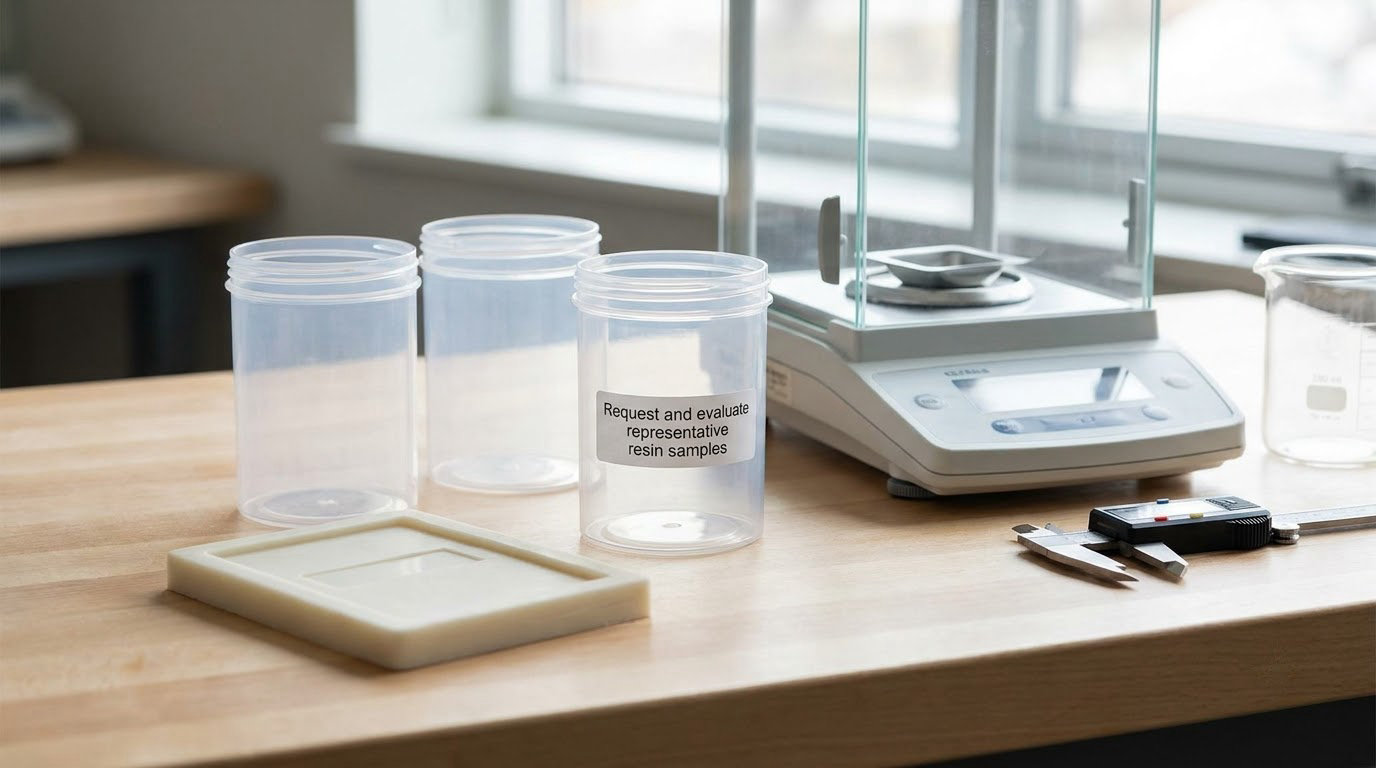
Do a visual check before any instrument. Compare color across lots under consistent lighting, and smell each one. Then measure the properties that predict processing behavior: melt flow index for polyolefins, intrinsic viscosity for PET, density, moisture content, ash and contamination levels, tensile and impact strength, and color measurement if appearance matters.
Keep the retained sample from every lot. When a problem appears on the line in six months, that retained bag is the only evidence that distinguishes a resin change from a machine change.
6. Run application-specific processing trials
Test the material on your equipment, not on a datasheet. Start by confirming drying behavior, since recycled material often carries more moisture and the drying window can be tighter than the virgin equivalent. Then walk the processing window deliberately, changing one parameter at a time.
Record cycle time consistency, not just the average. Recycled material often runs with a wider process window, which shows up as more variation between shots rather than a slower cycle. Watch surface appearance, weld line strength, flow marks, sink marks, and dimensional stability against your tolerances.
For extrusion, look at output rate stability, melt temperature drift, and die pressure. For injection molding, look at fill consistency, part weight variation, and short-shot behavior. If the application includes hot-fill, dishwashing, or UV exposure, those need their own trial because odor, hydrolysis, and color shift show up under stress rather than at the press.
The output of this step is a signed trial report with the settings you ran and the results you measured. It is also the document that lets you set a realistic incoming specification.
7. Audit the supplier and verify the recycled material stream
Verify the physical stream, not just the paperwork. An audit can be remote to start, but a site visit is the only way to see how segregation actually works on the floor. Look at receiving controls, sorting steps, washing and decontamination, regrind management, batch record keeping, laboratory testing, storage, and the handling of nonconforming material.
On the floor, check that different polymers and colors are physically separated and labeled, and that regrind from one grade never gets reintroduced into another. Ask what happens to material that fails a test, and look for the record of a recent example.
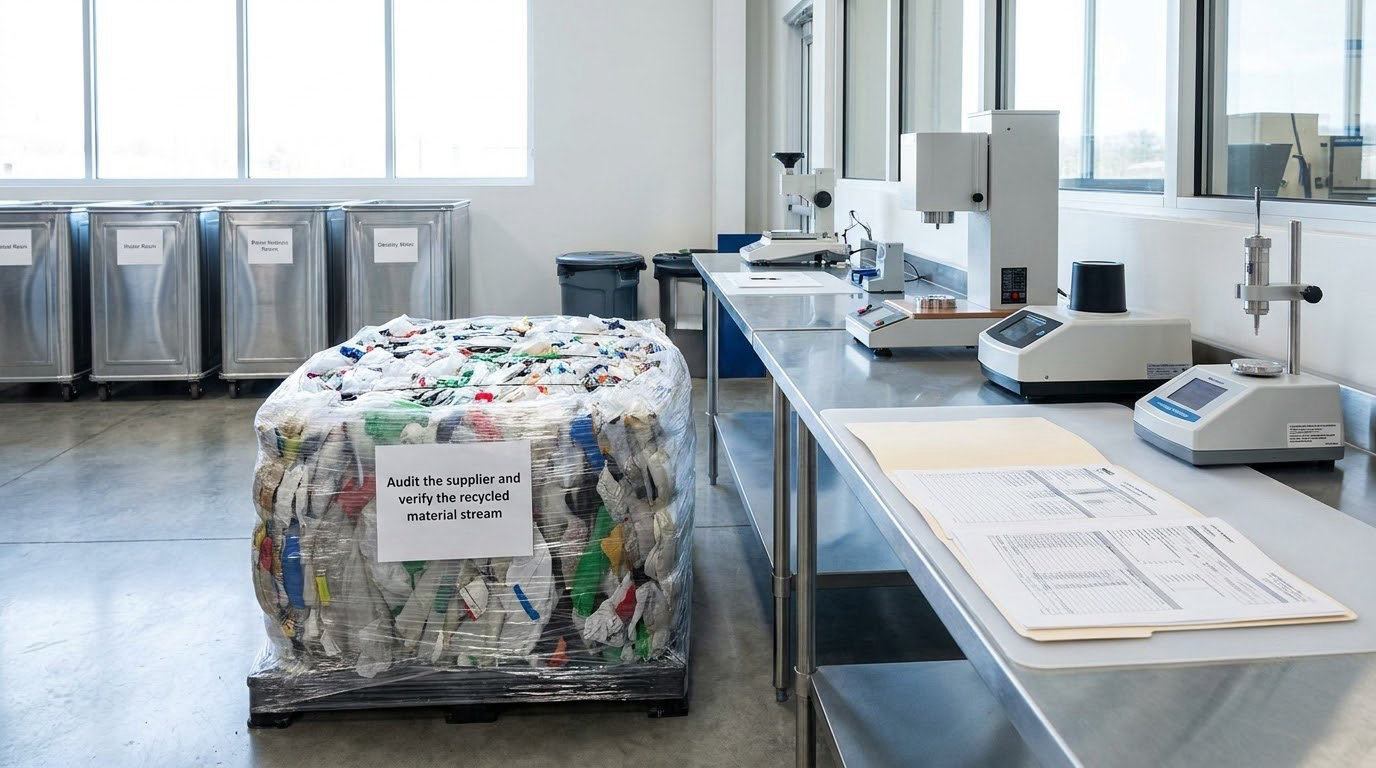
Trace one lot end to end. Pick a lot number and follow it back through batch records to incoming feedstock and forward to the packed bags. If the supplier is working under mass balance rather than physical traceability, that walk becomes a documentation review, and you should weight your evaluation accordingly.
Use the audit to settle the variability question. Ask the plant to pull recent production records and show you the actual spread in MFI, IV, and color across the last several lots. A plant that shares real numbers with a wide spread is more trustworthy than one that quotes a single perfect average.
8. Negotiate a pilot order and supply agreement
The pilot order should be small enough to be a real trial and large enough that the supplier runs it on normal equipment. Cover the following terms in writing, because recycled material makes each one matter.
Set the minimum order quantity and volume bands, and price by band with indexation to a published feedstock benchmark, since recycled resin moves with virgin pricing and with collection volumes. Agree delivery packaging so the material arrives in a form your receiving system can handle without re-bagging, which is where contamination enters.
Write in the change-notification obligation. The supplier must tell you in advance about a change of feedstock source, sorting line, or pelletizing line, because any of those can shift properties without changing the grade name. Add inspection rights, a quality agreement covering rejection and return, a warranty on the recycled-content claim, and a clear process for recall.
Also decide what force majeure means in a market that is structurally short. A clause written when supply is tight will not be the same clause that works in two years.
9. Validate the first production order
Treat the first production order as the last step of qualification, not the start. Run the full incoming inspection protocol on it, and keep a retained sample from every lot you run. Set a trial limit, for example a set number of lots or a set number of weeks, during which you test properties you could not measure during the pilot.
Monitor performance in the field, not only on the line. Cycle times, scrap rates, and customer complaints over the first quarter tell you more than a single trial molding. Then promote the material from approved pilot status to routine purchasing only when the data supports it.
After that, keep the loop closed. Re-audit on a schedule, keep sampling across lots, and revisit the specification when the supplier’s feedstock mix changes. Recycled resin is not a static material, and neither is a qualified source of it.
Common Mistakes
Most recycled resin programs fail on the same handful of mistakes. Each one has a straightforward fix.
Treating all recycled resin as interchangeable. A non-food industrial regrind, food-grade PCR PET, and a mixed post-consumer stream are different materials with different prices. The fix is to write the grade and the intended application into the purchase specification and refuse material that does not match it.
Accepting a recycled-content claim without a record. A percentage printed on a datasheet is not evidence. The fix is to require a transaction certificate, the chain-of-custody records behind it, and the certification scope that covers your material. If a supplier cannot produce those, the claim is marketing.
Sampling only one lot. One sample tells you the supplier had a good day. The fix is three or more lots from normal production, tested the same way, with the spread recorded rather than the average.
Ignoring the processing differences. Recycled material usually has a wider process window and higher moisture, so virgin settings often need adjusting. The fix is to run a deliberate trial and record the settings rather than assuming the old recipe transfers.
Failing to control storage contamination. Pellets that sit open near a dusty dock pick up foreign material, and cross-contamination between lots is easy. The fix is dedicated sealed storage, first-in first-out rotation, and never returning opened material to a closed bag.
Treating a first sample as production approval. A sample approves nothing on its own. The fix is to require multi-lot data, a processing trial, a documented audit, and a controlled pilot before the material enters your bill of materials.
One more worth naming, because it is so common. Buyers ask for the highest recycled content they can get rather than the highest content their process can hold. Higher content usually means wider property variation. The realistic content target is the one your part survives.
Frequently Asked Questions
What is the easiest way to source recycled resin for production?
Start with the material your own plant already generates, then qualify reprocessors by polymer stream. Define the grade first, shortlist suppliers that run the line for your polymer, request chain-of-custody documents, test samples from three separate lots, and close with a controlled pilot order. In-house scrap is the fastest and cheapest source and needs no qualification beyond an internal specification.
Can recycled resin perform the same way as virgin plastic?
For non-critical parts, close to it. Recycled grades usually sit within a few percent of virgin on tensile and impact strength, but viscosity, color, and contamination tolerance are usually wider. The practical question is whether your part tolerates that spread. A non-visible industrial bracket rarely does, and a thick wall in a consumer product almost always does.
How do I verify a supplier’s recycled-content claim?
Ask for the transaction certificate behind the claim, the chain-of-custody records that support it, and the certification scope covering your specific material, such as Global Recycled Standard, Recycled Claim Standard, or ISCC PLUS. Confirm whether the claim is physically traced or mass balance, because mass balance does not put recycled material in your pellets. Then tie the certificate number to a lot number on every delivery.
What is the difference between post-consumer and post-industrial recycled resin?
Post-consumer material comes from used packaging and products that reached the consumer. Post-industrial material comes from factory scrap, offcuts, and rejected parts. Post-industrial is usually cleaner and more consistent because the source is known and controlled, while post-consumer carries the marketing value for content claims but more variation in contamination, color, and odor. Many programs blend both.
How much recycled resin should I request for sample testing?
Ask for at least three lots of one to five kilograms each, drawn from consecutive normal production rather than a selected batch. That is enough for melt flow index, density, moisture, ash, mechanical testing, and several trial moldings, and small enough that most suppliers will send it without hesitation. If appearance is critical, ask for enough extra material to mold full test plaques from each lot separately.
Should recycled resin be approved on the same quality specification as virgin resin?
No. Write a separate specification for the recycled grade, because tolerances that make sense for virgin often cannot be met consistently by a recycled stream. Base it on the same property list, but widen the ranges on viscosity, color, and ash, and state contamination limits explicitly. Approving recycled material against a virgin specification usually ends in endless rejected lots and a supplier relationship you cannot sustain.
Conclusion: Start With a Qualified Sample
Define the grade, shortlist reprocessors by polymer stream, request the documents and three lots of samples, and qualify the material through testing, an audit, and a controlled pilot before committing to volume. Recycled resin is a short, structurally tight market, and the buyers who succeed are the ones who qualify a source instead of buying a claim. The immediate next action is a one-page grade sheet in your own process terms, because everything after it depends on it.
Published and reviewed for 2026.