
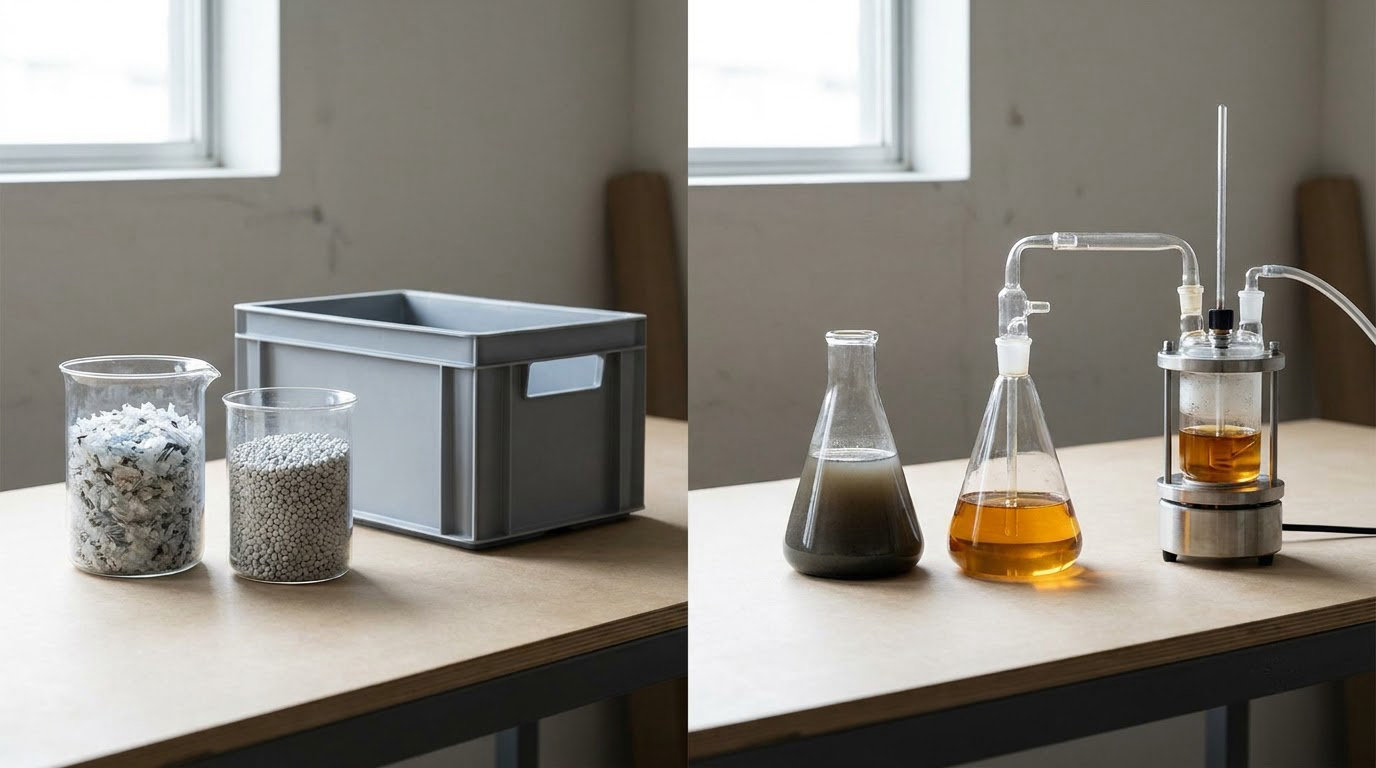
Mechanical vs chemical recycling explained in one line: mechanical recycling physically re-melts sorted plastic without changing its chemistry, while chemical recycling breaks the polymer chain back down into monomers or intermediate feedstocks so new plastic can be built from scratch. One reshapes what you already have. The other unbuilds it first.
That distinction decides almost everything downstream — which streams you can process, what quality the resin comes out at, how many times a material can go around the loop, and what a plant costs to build. If you specify packaging, buy recycled resin, or run a manufacturing line, getting this wrong shows up in your bill of materials rather than in a textbook.
This guide walks through both processes step by step, compares them across feedstock, output quality, energy and cost, and ends with a decision framework you can apply to a specific material. It is written from the process side rather than from any one camp’s marketing, because the honest answer is that neither pathway wins everywhere.
Table of Contents
- Mechanical vs Chemical Recycling Explained at a Glance
- What Is Mechanical Recycling?
- What Is Chemical Recycling?
- How Do Mechanical and Chemical Recycling Processes Differ?
- Which Plastics Can Each Recycling Method Handle?
- Mechanical vs Chemical Recycling: Output Quality and Performance
- Cost, Scale, and Environmental Impact Compared
- Which Should You Choose?
- Frequently Asked Questions
- What is the difference between mechanical and chemical recycling?
- What are the three main types of recycling?
- Is chemical recycling just burning plastic with extra steps?
- Which plastics are best suited to chemical recycling?
- How many times can plastic be mechanically recycled?
- Can chemical recycling replace mechanical recycling?
Mechanical vs Chemical Recycling Explained at a Glance
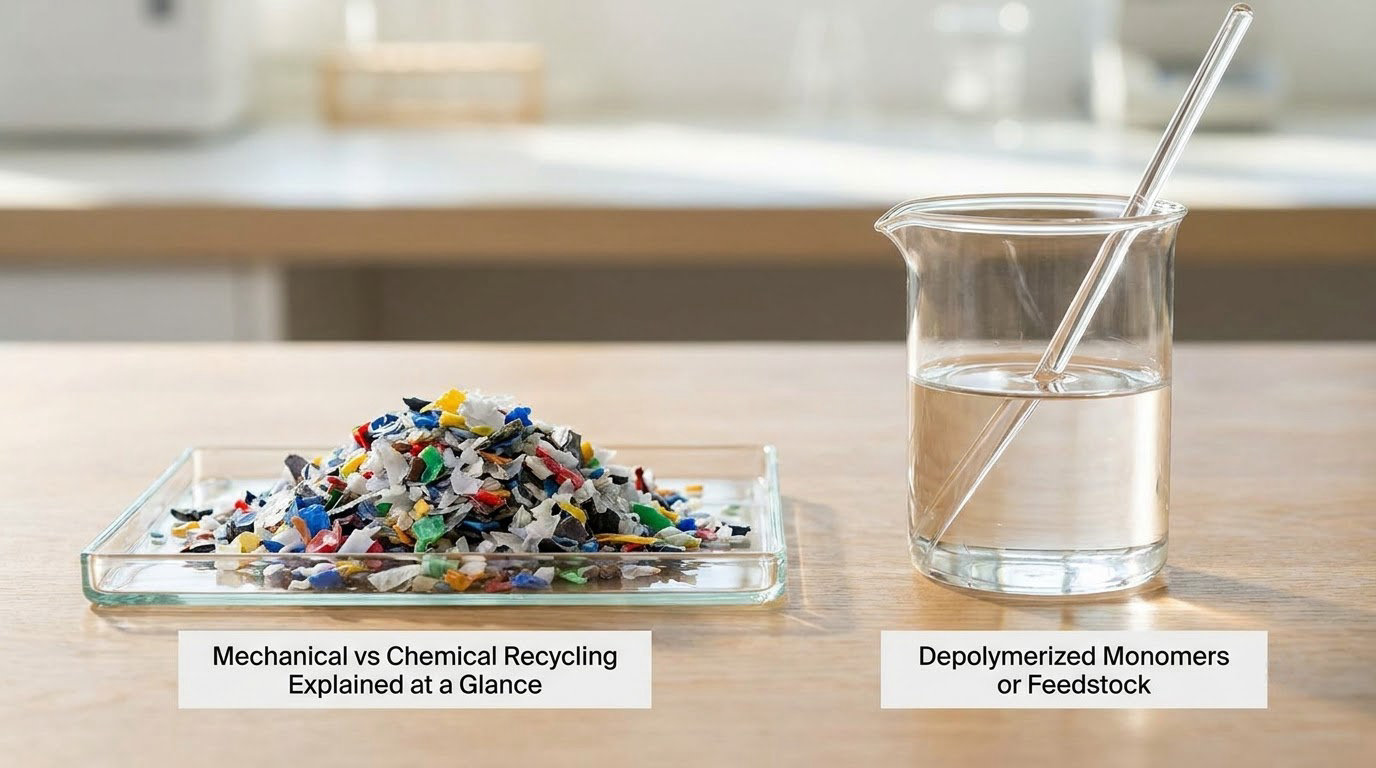
Here is the short version. Mechanical recycling keeps the polymer chain intact and pays for cleanliness with sorting and washing. Chemical recycling destroys the chain deliberately and pays for complexity with capital, heat and chemistry. Every row in the table below is a consequence of that one decision.
| Criterion | Mechanical recycling | Chemical recycling |
|---|---|---|
| Feedstock | Clean, sorted, single-polymer streams such as PET bottles, HDPE jugs and PP | Mixed, multilayer, contaminated or already-cycled plastics |
| Core process | Sort, wash, shred, melt, extrude and pelletise | Break polymers into monomers, oil or gas using heat, solvents or catalysts |
| Output form | Recycled pellets such as rPET, rHDPE and rPP | Monomers or purified feedstock, sometimes pyrolysis oil and gas |
| Output quality | Good on the first cycle, degrading with each pass | Virgin-equivalent resin after re-polymerisation |
| Additives | Carried through the cycle and accumulate | Largely stripped out before new polymer is built |
| Energy use | Lower; melting is a physical phase change | Higher; cracking needs sustained heat and often an oxygen-free atmosphere |
| Cost profile | Lower per tonne, relies on cheap clean feedstock | High capital cost per plant, sensitive to oil and chemical prices |
| Infrastructure | Mature and widespread | Younger, concentrated in a small number of large plants |
| Colour | Tends toward lighter, less consistent shades each cycle | Made fresh to specification, colour added downstream |
| Best-fit applications | Bottle-to-bottle food contact, milk jugs, pipe, decking, fibre | Flexible films, multilayer pouches, automotive and chemical-grade applications |
| Key limitation | Needs sorting; multilayers and mixed streams fall out of the line | Cost, energy and limited proof of scale on a per-plant basis |
What Is Mechanical Recycling?
Mechanical recycling reclaims plastic by changing its shape, not its chemistry. The polymer molecules you put into the line come out the other end as the same molecules, just shorter and carrying a few more impurities than they started with.
The process runs in a fixed order. Material arrives from collection, usually mixed, and goes through the following steps:
1. Collection and baling. Bottles, jugs and containers are gathered and compressed. This is where much of the economics of mechanical recycling are decided, because bulk clean material is far cheaper to process than a heap of mixed items.
2. Sorting. Optical sorters and human sort lines separate polymers by type. Getting PET apart from PVC, or a polyethylene film from a food-soiled tray, is the single most important step for the quality of everything downstream.
3. Washing and cleaning. Labels, adhesives, dirt and residual food are washed off. Bottle-to-bottle grades need this to be thorough, since the output goes back into food contact.
4. Shredding. The cleaned items are cut into flakes. Drying matters here too, because moisture in the melt creates defects downstream.
5. Melting and extrusion. Flakes are heated until molten, filtered and pushed through a die into pellets. This is where the accumulated additives of previous lives carry straight through into the new resin.
6. Pelletising and compounding. Pellets are blended to specification and shipped to converters, who turn them into new products.
What emerges as rPET, rHDPE or rPP is genuinely useful material. In a Great Lakes region pilot referenced by the American Chemistry Council, 42% of residual recovered material was mechanical-market material, against 38% films and mixed plastics, with roughly 80% of the residual waste stream recovered overall. That pilot also showed how easily 2D flexible packaging falls through the gap: chip bags and pouches get misrouted to residual because they slip through the sorters.
The important catch is what happens on the second and third pass. Heat, shear and oxidation shorten the polymer chain, and the additives already present accumulate. A practitioner post I read on LinkedIn put the practical limit at two to three cycles before the material degrades too far to be useful. That downcycling limit is the single strongest technical argument for chemical recycling existing at all.
What Is Chemical Recycling?
Chemical recycling goes after the polymer chain itself. Instead of melting plastic, it takes the plastic apart chemically so the monomers can be purified and used to build brand-new polymer, at which point the material’s history is essentially erased.
There are four sub-types worth knowing, and they are not interchangeable:
| Sub-type | How it works | Typical output |
|---|---|---|
| Depolymerisation | Catalysts or solvents cleave known chains back to their starting monomers | Purified monomers, repolymerised into virgin-equivalent resin |
| Pyrolysis | Thermal cracking at roughly 300 to 700 C in an oxygen-free environment | Pyrolysis oil and non-condensable gas |
| Gasification | Partial oxidation turns polymer into synthesis gas at high temperature | Carbon monoxide and hydrogen, used to make methanol or fuels |
| Solvent purification | Dissolves the target polymer and leaves contaminants behind | High-purity polymer for re-use |
Pyrolysis gets the most attention, so it is worth being precise about it. Elementar’s technical blog describes the process as 300 to 700 C with no oxygen present, with the liquid fraction — pyrolysis oil — then checked for quality through CHNOS elemental analysis, the carbon-hydrogen-nitrogen-oxygen-sulfur profile that tells a buyer whether the oil is clean enough to crack into monomers. PureCycle and Loop Industries are among the named operators running depolymerisation at commercial scale. Whatever the route, the design intent is the same: take the polymer back out of the waste without the additives, pigments or degradation history it arrived with.
One distinction matters for reading claims. Chemical recycling that turns plastic into fuel is a low-value fallback use of the same reactors, not the goal. Burning plastic for energy releases the carbon permanently and closes the material loop. Producing monomers and re-polymerising them keeps the carbon in the plastic chain, and that polymer-to-polymer route is what separates real chemical recycling from plastic-to-fuel processing.
A good worked example of the process intent: a facility takes mixed post-industrial polyolefin film that no mechanical line can sort cleanly, cracks it thermally into oil, purifies the oil, and feeds it into a polymerisation plant. The output pellet has none of the pigment, adhesive or chain damage that the incoming film carried.
How Do Mechanical and Chemical Recycling Processes Differ?
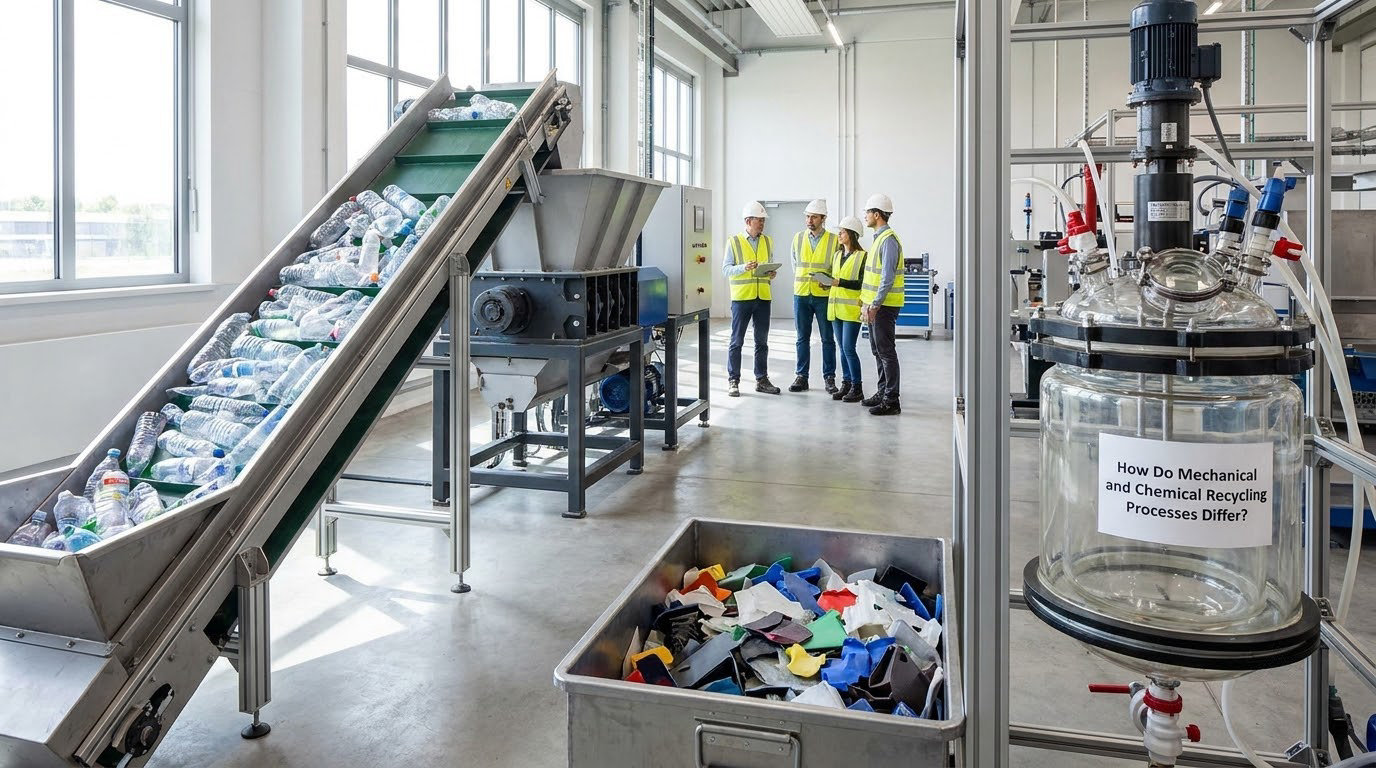
The difference shows up first in what the plant can accept. A mechanical line is a precision instrument that fails on mixed input. A chemical plant is a digestion system built to tolerate input most facilities would refuse.
Consider a practical manufacturing case. A detergent brand has two waste streams coming out of its filling operation: a clean flow of clear PET bottles destined for the grocery channel, and a mixed flow of flexible film, label liner and off-spec packaging. Route the PET through mechanical recycling and it comes back as rPET pellet suitable for another bottle, at the lowest cost per tonne available and with a well-trodden supply chain behind it. Route the mixed film through the same line and the sorters throw most of it out as residual.
Feed the mixed film to a depolymerisation plant instead. The sorters are not involved, so multilayer construction stops being a problem, and the additives come out with the polymer rather than staying trapped in it. What you get back is a feedstock that competes with virgin resin on quality. The trade is capital, heat and a narrower set of proven plants.
Structurally, the two also differ on polymer design. A mechanical line is built around one known chemistry. A depolymerisation plant is built to break a family of chemistries, which is exactly why it can accept streams a mechanical line rejects and also exactly why its output needs a purification step before it is usable.
Which Plastics Can Each Recycling Method Handle?
Mechanical recycling works best on the common thermoplastics when they arrive separated and reasonably clean. PET from bottles, HDPE from milk jugs and detergent bottles, and PP from containers and caps all have mature mechanical loops, and these are the streams most likely to be recycled again and again in practice.
It struggles where construction or contamination defeats sorting. Multilayer pouches combine several polymers with adhesives in a bond that optical sorters cannot read. Filled, soiled or pigmented flexibles get rejected at the sorting stage rather than the melting stage. Any stream where a small amount of the wrong polymer poisons a batch is a poor mechanical candidate.
Chemical recycling widens the addressable set considerably. Mixed polyolefin film, multilayer structures, pigmented and degraded material, and plastics already through two or three mechanical cycles all fall inside its scope. As a plastics expert put it in a Green Room AMA thread, the mechanical route tends to be low energy but gives a comparatively lower-quality product, whereas chemical recycling aims to produce virgin-quality material — which is precisely the trade you make when you accept dirtier feedstock.
One practical note on feedstock selection. Polyolefins, meaning PE and PP, carry a high hydrogen-to-carbon ratio and yield the most oil under pyrolysis. PVC and PET in the same feed complicate the output, and chlorine in particular is corrosive enough to require pretreatment and careful output control. Feedstock quality, not plant design, is often what determines whether a chemical line runs well.
Mechanical vs Chemical Recycling: Output Quality and Performance
This is where the two pathways separate most clearly, and it comes back to molecular weight. Mechanical recycling keeps most of the original chain but shortens it slightly every time, while chemical recycling discards the chain entirely and builds a new one at full length.
Molecular weight retention. Repeated heating and shear in mechanical processing breaks chains and causes oxidation, so recycled resin from a mature stream carries a shorter average chain than virgin material. Chemical recycling starts from monomers, so the new polymer’s molecular weight is set by the polymerisation run rather than inherited from the waste.
Additive load. This is the quiet reason mechanical material keeps degrading. Pigments, stabilisers, flame retardants and processing aids do not leave during melting, so they concentrate cycle after cycle until they affect properties. Participants in the r/PureCycle discussion make this the core of the argument for chemical recycling: it takes the polymer back without the additive baggage, which is the thing that ends the mechanical loop early.
Colour consistency. Mechanically recycled material typically arrives lighter and less uniform, since pigments survive the melt and background tint builds up. Chemically derived resin is made to specification, so colour is added deliberately at the compounding stage.
Contamination control. Sorting and washing remove most contaminants in a mechanical line, but traces carry through. Chemical processes strip contaminants along with the additives, which is what makes virgin-equivalent output achievable rather than aspirational.
Applications. For food-contact packaging such as PET beverage bottles, mechanical bottle-to-bottle is well established and lower cost, and it remains the default. For automotive components, chemical and medical applications, and multilayer flexible structures, virgin-equivalent quality from depolymerisation is the realistic route, because the incoming material could never be mechanically recycled in the first place.
Cost, Scale, and Environmental Impact Compared
Mechanically, the cost story is straightforward. Melting plastic takes far less energy than cracking it, plants are cheaper to build, and the supply chain is decades old. Chemical recycling inverts every one of those advantages: higher capital per plant, higher energy demand, chemical inputs, and a smaller number of facilities in operation.
The environmental comparison is where honest analysis gets hard, and where confident claims are worth distrusting. Life cycle assessment results swing on system boundaries. If you compare polymer-to-polymer chemical recycling against mechanical recycling on the same clean feedstock, mechanical usually wins on energy. If you compare it against landfill or incineration for mixed, unrecyclable multilayer waste, chemical can win comfortably, because the alternative is not a competing process but disposal.
That framing is the practical one. Chemical recycling only makes sense environmentally when the feedstock genuinely has no mechanical route, and when the output is re-polymerised into plastic rather than burned for energy. Run pyrolysis to displace virgin and it looks one way; run it as a low-value residue treatment alongside a working mechanical line and the numbers get much less flattering.
Yield matters in the same way. Mechanical lines lose material at the sorting stage, discarding rejects to landfill. Chemical plants lose material in the purification and cracking steps, and lose everything if the output is sold as fuel. Whether a given plant clears an environmental bar depends on its yield, its energy source and where its product ends up, not on the label on the plant.
Scalability is the other open question. Mechanical capacity exists at scale in most developed markets. Chemical capacity is real but thin, concentrated in a handful of large plants, and its long-run cost trajectory depends on how cheaply new plants can be built and financed. Treat current chemical output volumes as a snapshot rather than a ceiling.
Which Should You Choose?
Choose mechanical recycling when the material is a clean, sorted thermoplastic and quality can drop one step without breaking a specification. This covers most bottle-to-bottle PET, HDPE containers, PP caps, and construction profiles. It is cheaper, lower carbon, and proven at scale, so any conversation that starts elsewhere is usually a discussion in search of a solution.
Choose chemical recycling when sorting is impossible or the material has already been cycled. Multilayer pouches, mixed flexible film, heavily pigmented plastics, and material several generations into a mechanical loop all fit here. It is also the sensible answer for automotive and chemical-grade applications that need virgin-equivalent properties.
Plan for both when you are a packaging engineer or procurement lead. A realistic recycled-content target combines mechanical material for the clean fraction with chemical-derived material for the difficult fraction. Operators like Loop Industries pitch this as a loop system, but the logic holds regardless of branding: your target is met when the easy streams stay mechanical and the hard streams are not left behind.
A few questions to ask any supplier before you commit. Which pathway produced the resin, and from what feedstock? Is the recycled content physically traceable or claimed through mass balance accounting, where recycled volumes are distributed across output by bookkeeping rather than physical tracking? What percentage of the material has been through the process before? And does the plant have independent verification, or only a supplier declaration?
If you are sorting household plastic instead, the resin identification code inside the recycling triangle on the item tells you the polymer. Items coded 1 for PET, 2 for HDPE and 5 for PP have the best odds of a mechanical loop. Anything with multiple layers, foil or a mix of materials is realistically a chemical feedstock or a residual, and belongs where your local collection tells you rather than in a hopeful bin.
Frequently Asked Questions
What is the difference between mechanical and chemical recycling?
Mechanical recycling re-melts sorted plastic waste into new pellets without changing its chemistry, so quality drops slightly with every cycle. Chemical recycling breaks the polymer chain down into monomers or intermediate feedstocks, strips the additives, and builds new resin that matches virgin quality. In short, one reshapes the material and the other rebuilds it.
What are the three main types of recycling?
The three commonly cited types are mechanical recycling, which physically re-melts sorted waste; chemical recycling, which depolymerises plastics back to monomers using heat, solvents or catalysts; and biological or organic recycling, which uses microorganisms to break down organic material such as food waste or paper. Mechanical is by far the largest in volume today.
Is chemical recycling just burning plastic with extra steps?
It can be, if the output is sold as fuel, because burning releases the carbon permanently. That is not the design intent. A polymer-to-polymer route feeds pyrolysis oil or purified monomers back into new plastic, keeping the carbon in the chain and stripping the additives. The distinction between plastic-to-fuel and plastic-to-plastic is the fairest test of any claim you read.
Which plastics are best suited to chemical recycling?
Polyolefins, meaning PE and PP, are the most pyrolysis-friendly because their high hydrogen-to-carbon ratio yields the most oil. Mixed films and multilayer pouches are good candidates since mechanical sorting cannot handle them anyway. PVC and PET complicate a feed through chlorine and oxygen content, so they need pretreatment and tighter output control.
How many times can plastic be mechanically recycled?
Practically speaking, two to three cycles for most common plastics. Each pass exposes the material to heat and shear, which shortens the polymer chain while pigments, stabilisers and other additives stay behind and accumulate. Once the chain is too short or the additive load too high, the material loses the properties its next application needs and drops out of the loop.
Can chemical recycling replace mechanical recycling?
No, not in the near term. Mechanical recycling is cheaper, lower energy and already operates at scale, and it handles the large volume of clean streams that make up most recoverable plastic. Chemical recycling exists for the residual streams mechanical cannot touch. A realistic recycled-content target uses both rather than picking one.
If you take one thing from this: start with mechanical recycling for anything clean, sorted and single-polymer, because it is cheaper and lower carbon at scale. Bring in chemical recycling for the streams sorting cannot rescue — multilayers, mixed films, and material already cycled two or three times. And when a supplier quotes recycled content, ask how it is verified, because the difference between physical traceability and mass balance bookkeeping is the difference between a real claim and an accounting entry.