
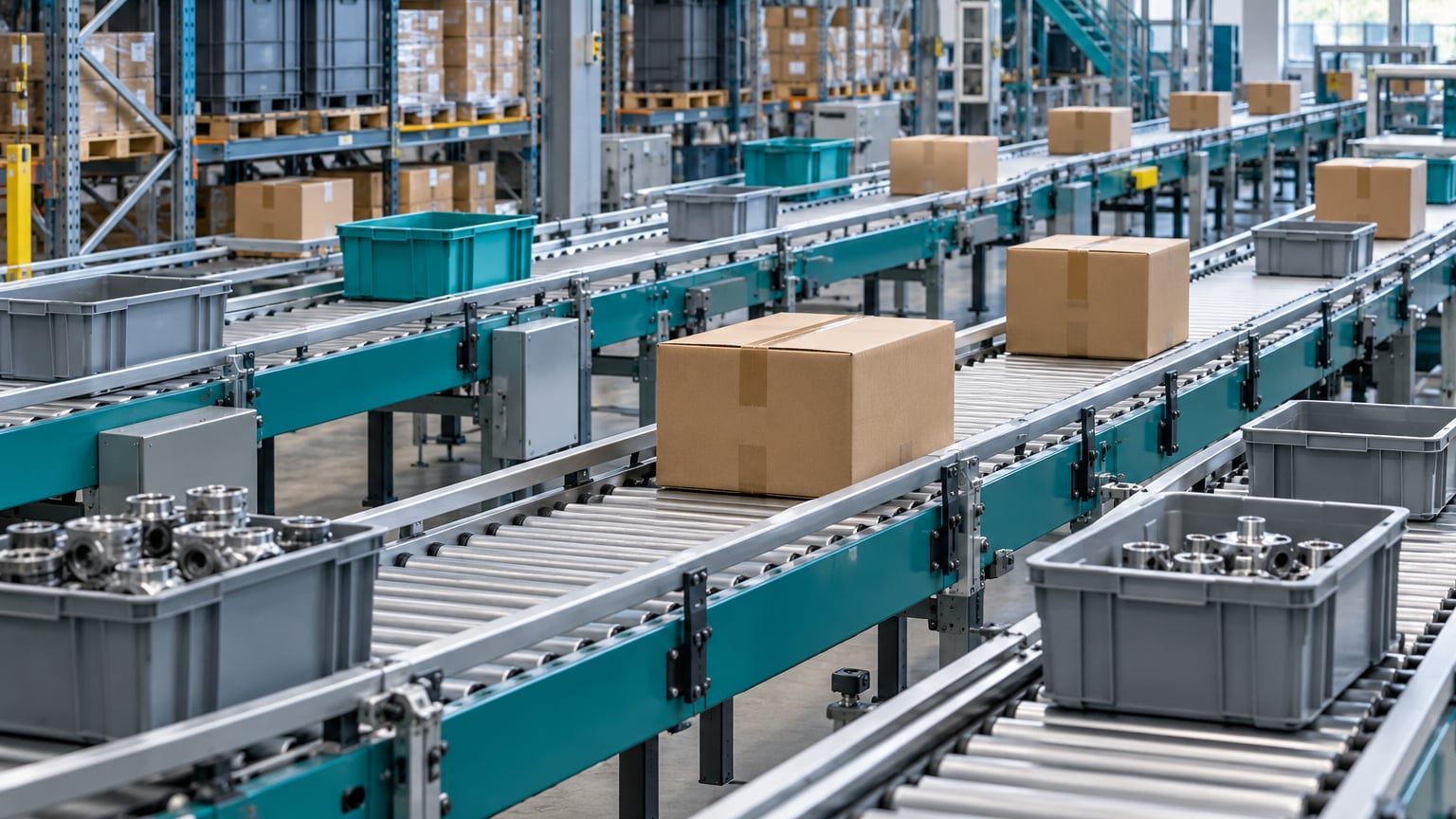
A conveyor system is a moving loop — belt, rollers, chain, screw or air — stretched between drive components, used to carry material continuously from one point to another without manual handling. If you are comparing types of conveyor systems for a plant, warehouse or distribution center, the cut that matters first is the product itself: flat-bottomed items, loose bulk material, or something hanging in a carrier.
Below are the 12 conveyor families you will actually be choosing between, what each one carries, and where it earns its keep. I have written it for the person who has to sign off on the purchase, so every section ends with the limitation that decides the deal.
Table of Contents
- 12 Types of Conveyor Systems at a Glance
- 1. Belt Conveyor Systems
- 2. Roller Conveyor Systems
- 3. Slat or Drag Chain Conveyors
- 4. Screw or Auger Conveyors
- 5. Pneumatic Conveyors
- 6. Chain Conveyor Systems
- 7. Sorting Conveyor Systems
- 8. Gravity Conveyor Systems
- 9. Telescopic Conveyor Systems
- 10. Vertical Conveyor Systems
- 11. Overhead Conveyor Systems
- 12. Portable Conveyor Systems
- How to Choose the Right Conveyor for Your Operation
- Frequently Asked Questions
- What are the four main types of conveyors?
- Which conveyor type is most common in warehouses?
- What are the disadvantages of roller conveyors?
- Should I use a gravity roller conveyor or a powered roller conveyor?
- How do you keep a conveyor from slipping on an incline?
- How much maintenance do conveyor systems need?
- Conclusion
12 Types of Conveyor Systems at a Glance
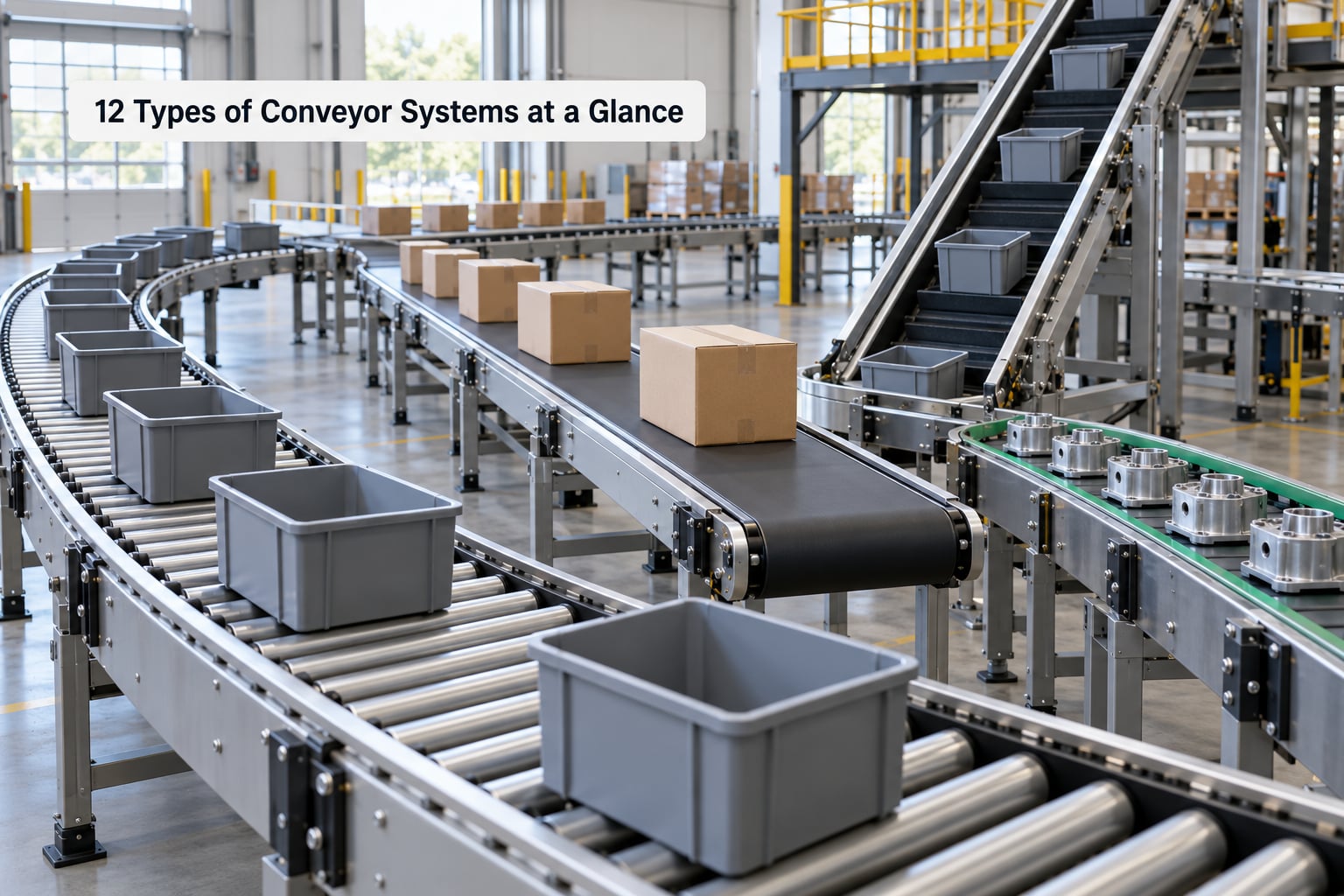
Here is the short version. Each line gives the mechanism and the payload, and the table underneath adds direction, the main operating advantage, and the situation each family fits best.
- Belt conveyor: a continuous loop of fabric, rubber or plastic over pulleys, carrying cartons, bags, parcels and loose bulk material.
- Roller conveyor: rows of tubes or axles that carry rigid, flat-bottomed loads by gravity or by driven rollers.
- Slat or drag chain conveyor: steel slats pulled by a chain, moving pallets, drums, bins and equipment on impact duty.
- Screw or auger conveyor: a rotating helical flight inside a tube or trough moving powders, pellets, granules and small parts.
- Pneumatic conveyor: air flow in tubing that carries lightweight parts, dust-prone powders and sealed packaged items.
- Chain conveyor: one or more parallel chains carrying slats, flights or attachments for long, continuous or awkward loads.
- Sorting conveyor: carriers or cartons on a tracking loop, read by barcode scanners and pushed to chutes by diverters.
- Gravity conveyor: unpowered rollers, wheels or skate wheels that move totes and carts downhill or across a level run.
- Telescopic conveyor: a belt on a wheeled base that extends into a trailer for loading and unloading.
- Vertical conveyor: spirals, reciprocating lifts and continuous elevators that move loads straight up or down between levels.
- Overhead conveyor: a suspended monorail or trolley line that carries carriers above the work area, leaving the floor clear.
- Portable conveyor: a mobile unit with its own frame and wheels, used for temporary or shifting transfer work.
| Conveyor type | Suitable materials or loads | Typical direction | Key operating advantage | Best used when |
|---|---|---|---|---|
| Belt | Cartons, bags, parcels, loose bulk | Horizontal or incline | Continuous flow at low cost per foot | Packaging lines, pick stations, inbound |
| Roller | Totes, trays, rigid boxes, pallets | Horizontal or incline | Item-level control, easy accumulation | Warehouse transfer between pick and pack |
| Slat or drag chain | Pallets, drums, bins, equipment | Horizontal or incline | Absorbs heavy impact loads | Assembly lines and pallet transfer |
| Screw or auger | Powders, pellets, granules, chips | Horizontal, incline, vertical | Enclosed, dust-controlled transfer | Food, chemical, plastic regrind |
| Pneumatic | Light parts, powders, sealed packs | Any, through tubing | No floor footprint, no product contact | Clean rooms, plants with no floor space |
| Chain | Heavy, awkward, continuous loads | Horizontal, incline, vertical | Carries hanging or bulky attachments | Automotive, battery, washer lines |
| Sorting | Parcels, cartons, returns | Horizontal loop | Thousands of destinations per hour | Distribution centers and hubs |
| Gravity | Totes, carts, drums, packaged goods | Incline decline or level | No power, almost no maintenance | Any floor plan with a downhill run |
| Telescopic | Cartons, sacks, bags, loose cases | Horizontal, extendable | Reaches inside a trailer | Dock operations and outbound shipping |
| Vertical | Totes, cartons, sacks, bulk | Vertical | Small footprint for a big rise | Multi-level buildings and mezzanines |
| Overhead | Hanging carriers, parts in process | Any, suspended | Floor stays clear for people and carts | Assembly lines, garment, clean rooms |
| Portable | Bags, cartons, bulk, scrap | Horizontal or incline | Moves to wherever the work is | Loading, temporary transfers, seasonal volume |
One thing to keep in mind before you start comparing. The table gives you the right family, not the right machine. Two belt conveyors with the same width can differ wildly in capacity, because the drive, the belt carcass and the loading pattern decide most of it, and any supplier sizing a quote by width alone is guessing.
1. Belt Conveyor Systems
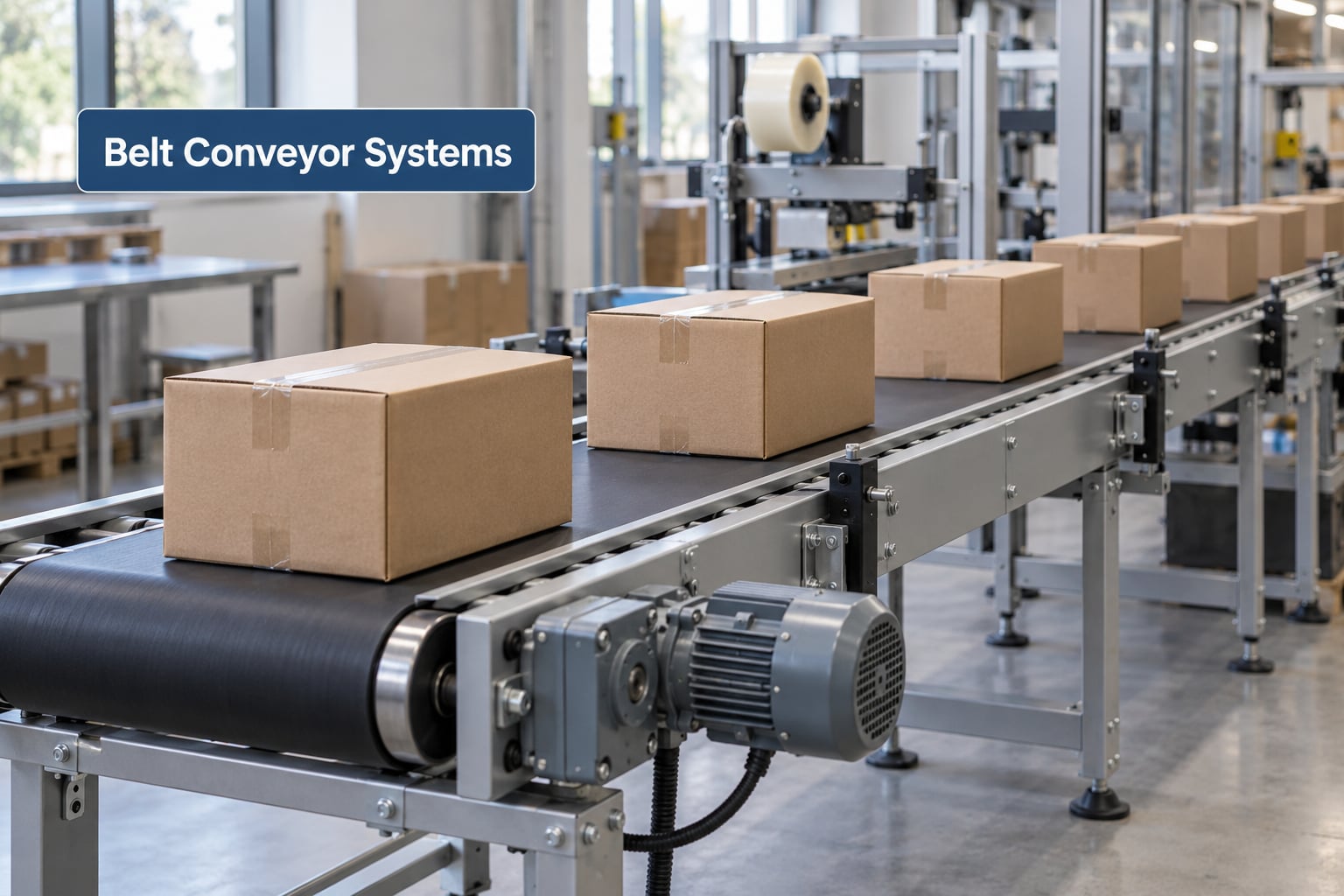
Belt conveyors are the most common conveyor system in plants and warehouses because they do the widest range of work for the least money. A drive motor turns the head pulley, the loop travels over a tail pulley, and a take-up unit keeps the belt taut. The load rides on the top run and comes back underneath on the return run.
Speed control is the part people get wrong. A variable frequency drive on the motor is cheap and gives you a real range, but the belt still has a usable speed band. Move a heavy load too fast and it skids; too slow and gaps open up behind it.
Incline is the real constraint. Sloped belt runs need a textured or rough cover to grip, and even then boxes and totes slip. Cleated belts solve it by carrying the product up in pockets, at the cost of more power and a bigger footprint. Angle limits also tighten as the load gets lighter and slicker.
Belt conveyors suit packaging lines, parcel induction, and any flow of cartons, bags or bulk material. If your material is rigid and flat-bottomed, rollers are usually cheaper and easier to accumulate; if it is loose, the belt wins immediately. See how the eight wastes of lean manufacturing apply once motion is no longer manual.
2. Roller Conveyor Systems
Roller conveyors carry anything that has a flat bottom and rolls rather than slides. Tubes or axles sit in side frames, spaced closely enough for the smallest load you will put on them. Most installations mix sections, with a belt or screw section inserted where the product changes.
Gravity roller relies on a slight downward slope, typically 2 to 4 degrees, and works best when the load is dense and moves steadily. Powered roller, driven by a motorized driven roller or a drive belt, works across level runs and handles lighter, more varied product. Accumulation roller uses one-way clutches or logic so items can queue without pushing each other.
The main limitation is product contact. Every roller is a surface that collects wear, dust and damage, and every gap between rollers is somewhere a small part can escape. That is why roller lines get guarded at transfer points and fitted with dead plates between sections.
3. Slat or Drag Chain Conveyors
Slat conveyors bolt or weld steel slats to a chain and drag them along a bed, so the load rides on a rigid steel surface rather than a tensioned belt. Drag chain designs attach the chain to the product itself, which is common on pallet lines and automotive assembly.
They exist because they absorb punishment. A dropped tote, a drum set down hard, a pallet that is not quite square — none of that is a problem for a slat conveyor, and all of it is a problem for a belt. Load capacity on this family runs well into the thousands of pounds per linear foot.
The trade is noise and maintenance. Chain drives need lubrication, tension adjustment and periodic link inspection, and the impact noise travels through a plant. For a quiet area with delicate product, this is usually the wrong family.
4. Screw or Auger Conveyors
A screw conveyor moves material with a rotating helical flight inside a pipe, tube or U-trough. The pitch sets the rate: a short pitch holds more material back and moves it slower, a long pitch moves faster. Flexible screw conveyors use a coiled inner screw inside a flexible casing so the unit can follow a curved route.
Choose the pitch for the material, not the length. Fine powders flood and compact, and need a short pitch with a controlled feed rate at the inlet. Pellets and granules flow freely and tolerate a longer pitch. Capacity is a function of screw diameter, speed and pitch, and a supplier who quotes capacity without material density is guessing.
Enclosed tube construction keeps dust contained, which is a real advantage in food, chemical and pharmaceutical plants, and it makes cleaning easier. The limit is that screws do not handle large lumps, fluffy material or anything that bridges.
5. Pneumatic Conveyors
Pneumatic conveyors move material through tubing with air, so the product never touches a belt and the system takes up almost no floor space. Vacuum systems use suction to pick material up, and positive pressure systems use a blower to push it, typically in short horizontal runs of a few feet.
They handle lightweight, aerodynamic material well: empty cartons, film, small plastic parts, powders and dust-prone granules. Tubing can route around obstacles, over equipment and through walls. A vacuum unit that picks up a carton or part and releases it into a bin needs very little space and very little support.
The practical drawback is troubleshooting. When a line plugs, the failure is inside sealed tubing that most operators cannot see, and the cause is often a moisture or humidity change in the material. Filters, ducting and blower sizing also need attention, and getting the balance wrong means the system either does not lift enough or blows the material apart. It is a strong choice in plants where floor space is genuinely scarce.
6. Chain Conveyor Systems
Chain conveyors use one or more parallel chains as the pulling element, with slats, flights or attachments fixed to them. A single vertical chain with a horizontal flight is the classic tote or drum conveyor; two parallel chains support a full-width slat deck for boxes and bundles.
Attachments are the reason to choose chain. You can hang a tote, a hook, a shelf or a work fixture from it and carry that station around the plant, which is why automotive, battery and appliance lines are built this way. Because the deck itself can be stationary, a part can be worked on without the whole line stopping.
Chain wear is the trade. Links stretch, wear pins elongate, and lubrication intervals are short compared to belts. Noise travels through the frame, so chain lines usually sit in their own area rather than beside an inspection bench.
7. Sorting Conveyor Systems
Sorting conveyors route product to many destinations on one loop. A shoe sorter runs a flat belt with pucks or shoes that tilt and push cartons sideways into chutes. A cross-belt sorter carries each item on its own small belt that travels along a main loop, which handles mixed, non-conforming shapes. Pop-up diverters lift a single item straight up, and merge lines bring several feeds into one induction line.
Each item is identified by a barcode scanner and tracked by photo eyes as it moves, so the control system knows exactly where it is. Throughput on this family is set by loop speed and loop length, and a longer loop holding more carriers means more items per hour, which is why parcel hubs tend to have very long loops.
Sortation only works as well as the data behind it. The conveyor has to talk to the warehouse management system, and an integration problem is more common than a hardware problem. If you are planning one, map the software side early, and read how machine vision inspection systems handle another common in-line check on the same kind of flow.
8. Gravity Conveyor Systems
Gravity conveyors need no motor at all. Weight does the work: totes, carts, drums and packaged goods roll downhill on gravity rollers, skate wheels or a ball-transfer table, and a slight pressure keeps items moving across a level run.
The design rule is simple and unforgiving. A loaded tote needs a consistent downhill run, and a light tote needs more slope than a heavy one because rolling resistance is a larger share of its weight. Segments, curve sections and side transfers all add drag, so a long flat stretch may need powered assists. Once you do need power, you are describing a powered roller conveyor with extra steps.
The appeal is the operating cost. With no drive, no motor and no controls, there is very little to maintain, and gravity sections are the cheapest way to buffer and accumulate work. Most gravity lines end up needing a drive at the discharge end, so plan the pull location before you lay out the slope.
9. Telescopic Conveyor Systems
Telescopic conveyors live at the dock. A belt is mounted on a tube that extends hydraulically or manually into a trailer, so the last few feet of loading happen inside the trailer rather than over the dock edge. Most run around 30 to 40 feet extended and retract to a much shorter base length, which matters in a tight dock.
They handle cartons, sacks, bags and cases, and the belt speed is set to match the loading rate rather than a conveyor-line speed. Controls are usually a simple up-down switch and a variable speed dial, with an optional light and audible alarm for the person inside the trailer.
Watch the compatibility details: belt width against the trailer opening, the lift mechanism against your dock height, and the extension range against trailer depth. A telescopic unit solves a one-foot reach problem badly and a ten-foot reach problem perfectly, so measure before you order.
10. Vertical Conveyor Systems
Vertical conveyor systems move loads straight up or down where floor space runs out. Four families cover most needs. A reciprocating lift pushes and pulls a platform between two levels and is the most flexible, with the smallest footprint. A spiral conveyor wraps a belt or chain around a vertical helix and takes a longer route but leaves the center open. A continuous elevator uses a belt or chain in a closed loop between an upper and lower pulley. A pneumatic lift uses an air column to raise a load, with almost no moving mass.
Footprint is the trade. A reciprocating lift needs a shaft or opening roughly the size of the load, and a spiral needs a helix that is wider than the load by enough for the curve. A continuous elevator sits in a small footprint but requires a fixed head and boot height, so ceiling and floor penetration become real construction decisions.
Load profile matters as much as weight. A continuous elevator handles a steady stream; a reciprocating lift handles batches and one-off awkward loads, and nothing in between. Continuous systems run quieter, reciprocating systems flex more.
11. Overhead Conveyor Systems
Overhead conveyors hang above the work area. A monorail carries a trolley with a hook or hanger, and a power-and-free trolley line lets independent carriers accumulate and release one at a time. A takt line indexes the whole carrier to a fixed position on a timed cycle, so work happens at a repeatable pace.
The advantage is floor space. Because the load never touches the ground, the area underneath stays clear for people, pallets, carts and workbenches, and an overhead line can cross a walkway without a guardrail in the way. Powder coat, stainless tubing and sealed hangers give cleanroom and food-compatible versions. Overhead is also the natural choice when the product must be hung, such as garment, die cast, electronics wash and assembly work.
The limits are the ceiling. Structure, clearance and hanger adjustment all depend on the building, and a line that needs a deep drop or a long vertical lift is cheaper to build on the floor. Track sections also need attention after any impact, since a bent rail puts the whole line out of alignment.
12. Portable Conveyor Systems
Portable conveyors are the ones that move. Most are a belt on a wheeled chassis with a hand crank for incline, and they come as gravity-only or powered units in lengths from around 10 feet to more than 100 feet, with some models that stack sections to grow.
They earn their place around loading, truck-to-bin transfer, temporary transfer during a reconfiguration, and seasonal or peak volume work. A powered portable at 100 feet can feed a bagging or palletizing line from a floor pile without any permanent structure. Because it is a machine rather than a fixed installation, it also goes to the next job when the first one is done.
Two things decide the buy-versus-rent call: how many hours a year it will run, and who maintains it. A unit running a few weeks a year is rarely worth owning, while one working a full shift every day is usually cheaper owned. Whatever you choose, look for a chassis that handles uneven dock concrete and a belt that can be swapped without a special tool.
How to Choose the Right Conveyor for Your Operation
Start with the product, not the conveyor. Write down the smallest and largest dimensions, the weight, whether the bottom is flat or irregular, whether it is fragile, dusty, greasy or sealed, and whether it is hot. This is where material handling systems for resin and similar bulk flows differ from parcel handling, and the answers eliminate most of the 12 families immediately.
Next, set the operating requirements.
- Throughput: how many pieces per hour, and how much variation there is in arrival rate.
- Direction and distance: horizontal run length, any rise or fall, and whether the path must go up at the end rather than the start.
- Space: floor footprint, ceiling height and clearances. Clearance and ceiling height are underestimated far more often than load capacity.
- Accumulation: whether items queue without pushing each other, or whether the line can block.
- Environment: washdown and sanitation needs, dust, temperature, static, and whether a cleanroom or hygienic design is required.
- Ergonomics: the heights people will pick at, and how far someone has to reach or twist per shift.
- Controls: simple on-off, variable speed, or PLC control tied to barcode scanners and a warehouse management system.
Then look at the two costs people forget. Spare parts and maintenance: belts wear, chains stretch, roller bearings fail, and a line that runs two shifts a day has a different duty cycle than one that runs an hour. Power draw, which is easy to measure. And safety: guarding at nip points, emergency stop pull cords the length of the line, and a lockout procedure, with the guarding and pull-cord placement confirmed with whoever signs off on safety in your plant.
Finally, price the total cost over the life you expect, not the purchase line. A cheap conveyor that needs a new belt every year or two is a more expensive conveyor. Ask each supplier for the operating duty, the documented speed and load capacity, the maintenance schedule, and the parts they will guarantee to keep on the shelf. Then have the final selection checked by a supplier or a plant engineer before you buy, because a wrong fit costs far more than a slow quote.
Frequently Asked Questions
What are the four main types of conveyors?
Grouped by drive and load, the four main families are: belt conveyors for cartons, bags and loose bulk material; roller conveyors for rigid, flat-bottomed loads; chain conveyors for heavy, awkward or hanging loads; and enclosed bulk conveyors such as screw, auger or pneumatic systems for powders, granules and lightweight parts. Sortation and gravity systems are usually treated as variations of the first two.
Which conveyor type is most common in warehouses?
Roller conveyor is the most common in warehouses, because most warehouse product is rigid, flat-bottomed and moves short distances between pick, pack and shipping. Belt conveyor is the most common across all facilities, especially in packaging and parcel handling, since it also carries loose bulk material. Most real lines use both, switching where the product changes.
What are the disadvantages of roller conveyors?
The main drawbacks are product contact and clearance. Every roller collects dust and wear, and the gaps between rollers can lose small parts, which is why transfer points need guards and dead plates. Roller lines also do not move loose, dusty or unevenly bottomed material well, and they generally cost more per foot than a basic belt conveyor.
Should I use a gravity roller conveyor or a powered roller conveyor?
Use gravity when you have a consistent downhill run and the loads are dense enough to keep rolling, since it needs no power and almost no maintenance. Use powered when the run is level, the path is long, the product is light or awkward, or you need controlled accumulation and starts. Many working lines mix both: gravity in the buffering sections, powered for the main line.
How do you keep a conveyor from slipping on an incline?
Slipping on an incline usually comes down to three things: a smooth belt, too much speed, or a load that is too light. Specify a textured or rough belt cover, reduce the incline or the belt speed, and add cleats for a steeper rise or for round, slick product. Also check that the load is spread evenly across the belt width rather than riding on one edge.
How much maintenance do conveyor systems need?
It depends on the type and on the duty. Belts need tension checks, tracking adjustments and periodic replacement; chains need lubrication, tensioning and link inspection; rollers need bearing replacement as they wear; screw conveyors need drive and bearing checks. In practice, most warehouse conveyor damage comes from product impact and misalignment rather than wear, so guarding, dead plates and clear operating limits matter more than the belt specification.
Conclusion
Choosing among these 12 types of conveyor systems comes down to four steps. Start with the product and the load, not the category name, because the shape and weight of what you are moving eliminates half the list on its own. Then compare the operating requirements: throughput, direction, incline, footprint, ceiling clearance and accumulation.
From there, weigh the real operating costs — maintenance interval, spare parts, energy, guarding and training — rather than the purchase line alone. And before you commit, have a supplier or a plant engineer check the final choice against your actual load, your floor plan and your safety requirements. That conversation takes an hour and it is the cheapest insurance in the whole project.