
In lean manufacturing, waste means any activity that uses time, money, materials, or labour without adding value a customer would pay for. Lean sorts that waste into eight types, remembered as DOWNTIME, and the job of a plant team is to find the one that is costing the most and remove it first.
Most sites list those eight types and stop there. That is the easy part. The harder, more useful question is which of them is eating your capacity right now, and how you tell the difference between two that look alike on paper, like motion and transport, or overprocessing and defects.
This guide walks through all eight, with a worked plant example for each, then gives you a repeatable way to find the ones you are actually paying for. Updated for 2026, and written for plant managers, supervisors, and improvement leads who have to run this on a real floor rather than in a slide deck.
Table of Contents
- Lean Manufacturing Waste Types at a Glance
- The 8 Wastes Explained, One by One
- How Do You Identify Lean Waste on a Production Floor?
- How Can You Reduce Each Lean Manufacturing Waste Type?
- How Do You Prevent Waste from Returning?
- What Mistakes Cause Lean Improvements to Fail?
- Frequently Asked Questions
- What Should You Do First?
Lean Manufacturing Waste Types at a Glance
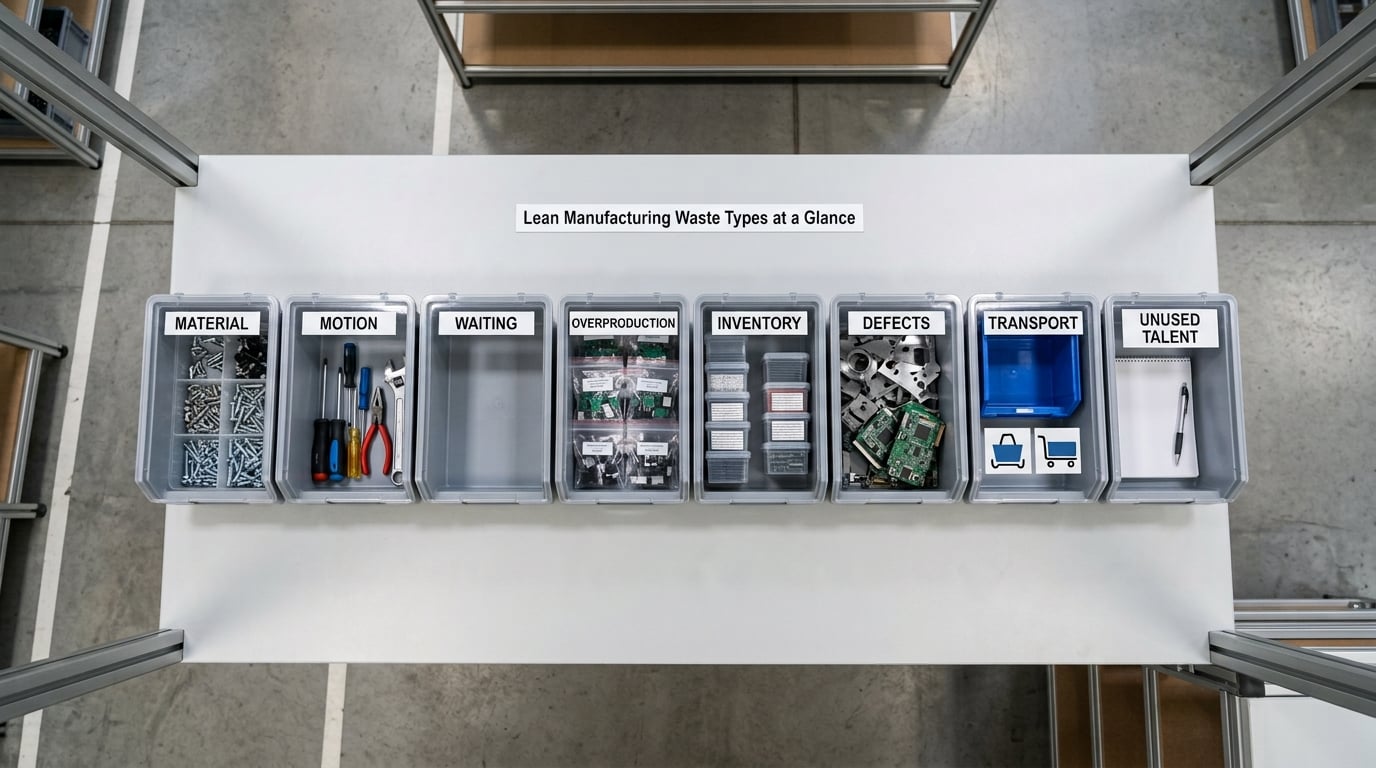
Here are the eight waste types, what each one means in plain language, what usually causes it, and where you will spot it on a plant floor. Read the last column first when you walk a line. Waste is easier to find where it lives than where it is defined.
| Waste type | What it means | Typical cause | Where it shows up |
|---|---|---|---|
| Overproduction | Making more, faster, or earlier than the customer asked for | Optimistic forecasts, batch scheduling, local efficiency targets | Between the bottleneck and the shipping dock |
| Waiting | Time lost when a machine, part, or approval is not there yet | Unplanned downtime, missing parts, sign-off queues | At cells that starve for material |
| Transportation | Moving parts, tools, or paperwork without adding anything | Spread-out layouts, temporary staging, batch queues | Long forklift loops between departments |
| Overprocessing | Steps, checks, or tolerances tighter than the customer requires | Over-specified drawings, redundant approvals, copied legacy steps | Inspection benches and paperwork loops |
| Inventory | More material, work in process, or finished goods than the flow needs | Long supplier lead times, large batch sizes, uncertain demand | Staging areas, supermarkets, the storage room |
| Motion | Walking, reaching, bending, and searching to do the job | Poor tool and fixture placement, oversized parts | Inside a cell, at the operator’s bench |
| Defects | Scrap, rework, returns, and the inspection needed to catch them | Unstable process, unfixed root causes, drifting inputs | At the rework bench and the returns door |
| Unused talent | Ideas, skills, and judgement nobody asks for | Narrow job descriptions, blame culture, slow change approvals | Everywhere a small decision gets escalated |
Two mnemonics are worth knowing by heart. TIMWOOD gives the seven wastes in their original form: Transportation, Inventory, Motion, Overproduction, Waiting, Overprocessing, Defects. DOWNTIME rearranges the same list alphabetically and adds the eighth: Defects, Overproduction, Waiting, Non-utilised talent, Transportation, Inventory, Motion, Extra processing.
That is where the 7-versus-8 confusion comes from. The seven-waste list omits unused talent, and most textbooks on the Toyota Production System teach it that way. A nine-waste version is also in circulation, where energy is added as the ninth waste on top of the eight. Neither count is wrong; they are different frameworks. Most plants that run improvement work on the floor use the eight-waste DOWNTIME list, because unused talent is what tells you why the other seven keep coming back.
The 8 Wastes Explained, One by One
What Are the 8 Lean Manufacturing Waste Types?
Overproduction is producing more units, faster, or sooner than customers require, and it is the waste that generates several of the others. A press that runs a batch of 500 when the schedule only needs 300 creates work-in-process, it creates a queue in front of the next operation, and it creates pressure that shows up as shortcuts and defects later on.
Worked example: an assembly line takt of 30 seconds means 120 units an hour. If the cell upstream runs press cycles at 140 an hour because the press operator is measured on machine utilisation, that output is overproduction, not productivity. The extra 20 an hour lands in a queue, the line downstream starves anyway, and the buffer between the two operations grows until someone schedules an inventory reduction project to fix a problem the schedule created.
The countermeasure is almost never telling people to work faster. It is demand checks, smaller batch sizes, a pull signal instead of a push schedule, and measuring the whole line rather than the machine. Overproduction is also the hardest waste to see, because the output looks like success.
What Counts as Waiting Waste?
Waiting is any time a machine, a part, a person, or an approval is not ready, so the work sits. Unplanned downtime, a missing component, a quality hold, a late engineering sign-off, or a slow changeover all produce it.
Worked example: a packaging cell loses 70 minutes a shift to a 15-minute changeover that has grown to 90 minutes because the previous job’s fasteners are still in the fixture and the new job’s are in a drawer on the other side of the plant. Over a three-shift day that is roughly three and a half hours of paid waiting per week, on a line that then runs two hours early and finishes the shift with a pile of unlabelled finished goods.
To tell a necessary wait from a broken process, ask one question: does the wait exist because the customer physically needs time, or because two activities that could be next to each other are not? Setup, approval, and material arrival waits are usually the second kind. A cure cycle, a paint dry, or a customer-specified hold is the first, and no amount of improvement will remove those.
How Do You Recognize Transportation Waste?
Transportation waste is moving materials, parts, finished goods, tools, or information between places when they could stay where they are. Double handling, temporary staging areas, long forklift routes between departments that sit fifty feet apart, and shipping product to a remote inspection station all count.
Worked example: a machined part travels from the saw to the wash station, back to a temp table, into the deburr booth, then across the aisle to the press, and finally to the assembly line. The physical move takes about twelve minutes per piece, the part gets handled four times, and each handoff is a chance for a mix-up or a scratch. Nothing about that path serves the customer.
The test is simple. If you deleted a move and nothing downstream changed, it was transportation waste. If a move is required but happens more than once, or happens to a temporary location, the fix is a layout change. Cells arranged in process order, point-of-use staging, and a rule that nothing is set down on the floor usually beat any amount of faster forklifts.
What Is Processing Waste in Lean Manufacturing?
Processing waste, often called overprocessing, is doing more than the job requires. Extra steps, redundant inspections, repeated measurements, an approval from a department that adds no information, or machining a hole to a tolerance the drawing never needed all fall here.
Worked example: a shaft arrives at final inspection with a requirement for one diameter check. The operator measures it, records it, then measures it again with a different instrument because the first reading looked odd, then walks the part to engineering for a disposition that engineering signs without looking. That added six minutes per part, on a job that needed ninety seconds, and none of it protects the customer. A control plan and a defined reaction plan would have removed the second measurement and the walk.
Overprocessing is easy to confuse with defects, and the difference matters. A re-inspection triggered by a bad part is defect waste. A re-inspection triggered by a lack of trust in the process is processing waste. The cure for the first is root-cause analysis and mistake-proofing; the cure for the second is a defined control plan and standard work.
What Is Inventory Waste and Why Is It Costly?
Inventory covers raw materials, packaging, spare parts, work in process between operations, and finished goods sitting past the point the customer needed them. Excess inventory is waste because the customer pays for none of it, and it costs space, capital, and attention.
It also hides information. A large buffer in front of a machine makes lead time impossible to see, defects get discovered days later instead of at the station that made them, and a broken process looks like a smooth one because nothing ever runs out. When demand changes, the same inventory that protected you becomes the write-off.
Worked example: a shop keeps a 400-piece queue of work in process between machining and assembly. Each piece carries material, labour already spent, and floor space. The queue exists because a customer once missed a forecast by a week and the supervisor decided the buffer was insurance. Now the floor cannot tell whether the machining cell is fast or slow, because a week of output is hidden behind the queue, and the safety answer is now a permanent cost.
Reductions come from pull signals, smaller lots, setup time reduction so small batches stay small, and setting a cap on what is allowed to sit between two steps. Fixing the constraint that created the queue comes first.
What Is Motion Waste?
Motion waste is the movement a person makes inside their own task: walking to a shared tool, reaching across a bench, bending to a low rack, twisting to load a fixture, searching for a gauge. The part did not move, but time and energy did.
This is different from ergonomic risk, though the two often arrive together. Ergonomics asks whether a lift will hurt someone. Motion waste asks whether the lift was necessary at all. A well-lit, safe workstation can still be pure motion waste if the operator crosses the cell six times per part, and fixing the layout typically fixes the strain as a side effect.
Worked example: an assembly operator takes 25 seconds per unit fetching spring washers from a rack at the far wall, a torque driver from a cart, and a fixture from behind the machine. That is about four minutes of every eight-minute cycle spent moving rather than assembling. Bring the washers to point of use with a small bin, mount the driver on a balanced arm, and fix the fixture at bench height, and the same operator builds more units in a shorter cycle without working faster.
Watch for it during a time study, not from a distance. Follow one part for one cycle and count how many hands and feet actually touch it.
What Is Defects Waste?
Defects waste covers scrap, rework, sorting, the inspection and testing that exists only to catch problems, warranty returns, and the phone calls when a customer finds something you did not. To a lean team, every one of those is non-value-added activity created by a process that is not yet in control.
Lean is not about accepting defects or slowing down inspection to hit a number. A plant with a 4 percent defect rate that hides the rework in a night shift is not lean, it is just less visible. The goal is a process stable enough that checking every part is unnecessary.
Worked example: a weld cell produces roughly 3 percent porosity, and a quality inspector catches it after the part reaches assembly. That means 97 good parts go through a queue behind inspection, the backlogged parts get expedited, and the operator who produced the porosity is never told. Root cause analysis eventually lands on a gas flow setting that drifts when the ambient temperature drops. A fixture that will not accept an out-of-range setting would have stopped it at the station.
The order of work matters. Standardise the work, find the root cause, mistake-proof the failure mode, then reduce the inspection. Removing the inspection first just moves the problem to the customer.
Why Is Unused Talent a Manufacturing Waste?
Unused talent is the ideas, judgement, and problem-solving capacity that never gets asked for. It appears when the job description is narrow, when the person closest to the work is not consulted before a change, when a suggestion goes nowhere for months, or when the same experienced operator has done an unofficial fix for a year that nobody has written down.
It is the hardest waste to measure and often the one that unlocks the rest. Almost every improvement idea in a plant comes from someone who has to live with the process every day. If their ideas die, the plant buys training, automation, and consulting to recover thinking that was already on the floor at no cost.
Four patterns show up most often. People are told what to do but not why, so they stop looking for improvements. Changes are imposed from outside the area, so the area stops offering ideas. Problems are treated as blame, so the person who knows the cause stops saying it out loud. Skills are narrow, so one absence stops a line that four people could cover.
Worked example: an operator has been hand-stacking parts into cartons in a fixed sequence for two years because the fixture was never adjusted to accept the mixed cartons. A cross-training and layout session with a maintenance tech and the packaging lead changed the sequence and cut two minutes off the cycle. Nobody in the office had known. That knowledge was the waste, and it was the cheapest thing available to the plant.
How Do You Identify Lean Waste on a Production Floor?
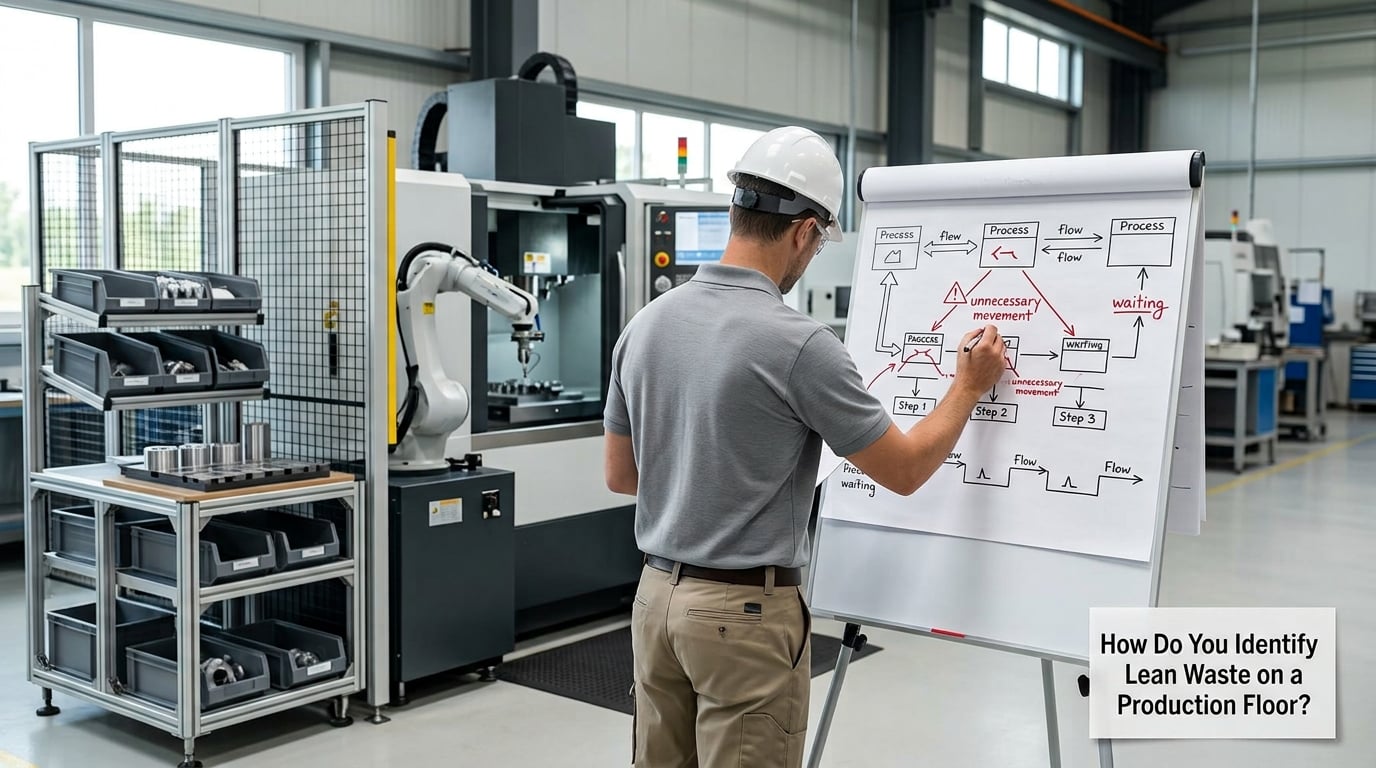
You find waste by following the work, not by asking whether it exists. The method below takes a full shift for one value stream and produces a short list you can act on. It is more useful than a wall chart of the eight wastes, because it produces evidence instead of recognition.
1. Map the current state before you walk. Draw the value stream on paper: every process from receiving to shipping, with the cycle time, the changeover time, the number of people, and the distance material travels. Mark the step with the longest total elapsed time. That step is your starting point, not necessarily the one to fix first.
2. Walk the line and follow one part. Time how long a single unit actually takes from start to finish, including the time it sits still. Most plants discover the answer is several times longer than the sum of its cycle times, and the difference is where waiting and inventory live.
3. Separate three kinds of activity. For every step on the map, decide whether it is value-added, necessary non-value-added, or pure waste. The table below makes the call less arbitrary.
| Activity type | What it means | Examples on a shop floor | Can it go? |
|---|---|---|---|
| Value-added | The customer pays for the change, right now, at the current specification | Cutting a part to drawing, welding a seam, filling a bottle | Only by changing what the customer orders |
| Necessary non-value-added | Someone would call it waste, but removing it breaks a legal, safety, or setup requirement | A cure cycle, a required inspection, a safety lockout, some setup steps | Not yet. Reduce it, do not delete it |
| Pure waste | No customer value, no requirement, no purpose | Double handling, searching for a tool, waiting for a signature, storing what nobody ordered | Yes, and this is where the savings are |
4. Interview the people doing the work. Ask each operator three questions: what slows you down most, what do you do that you think is pointless, and what breaks most often. Write the answers down verbatim. This is where unused talent becomes visible, and it is the cheapest data you will collect all day.
5. Check the numbers before you commit. Confirm what you saw with data: defect and rework records, on-hand inventory by location, changeover times, downtime logs, and lead time from release to ship. If the observation and the record disagree, the record is usually the thing that needs fixing.
Do the whole thing for one value stream before you widen the scope. A plant that maps three lines at once usually ends up with a list nobody owns.
How Can You Reduce Each Lean Manufacturing Waste Type?
Each waste has a matching countermeasure, and the useful habit is to match them rather than reach for a general improvement programme. Pick one waste, pick its tool, and set a number you can check next week.
Overproduction: set production to a real demand signal, split big lots into smaller runs, and measure the whole line’s output instead of each machine’s utilisation. Where a downstream operation is the constraint, pace upstream work to it with a pull signal.
Waiting: schedule preventive maintenance against observed failure patterns, count changeovers and cut them, pre-stage material at the point of use, and remove the approval steps that sit between an operator and a routine decision. Track the longest wait in the day, not the average.
Transportation: rearrange the line in process order, set a rule that nothing waits on the floor, and bring tools, fixtures, and consumables to the station that uses them. Look for the handoff that happens more than once and remove one of the moves.
Overprocessing: compare each drawing and each check against what the customer actually specified, delete the steps that trace back to nobody, and write a control plan so inspection is proportional to risk. Document the reaction plan before you remove a check.
Inventory: put a cap on work in process between steps, reduce setup time with SMED so small batches become practical, and coordinate deliveries with the schedule so material arrives when it is needed. Fix the constraint that forces the queue before you cut the queue.
Motion: do a time study on one cycle per operator, then reset the workstation. Parts within arm’s reach, shadow boards for tools, balanced arms for drivers, and a fixed height for the work remove steps from the cycle instead of asking the operator to hurry.
Defects: standardise the work, run a root cause analysis on the worst repeat offender, and mistake-proof the failure mode with a fixture that physically will not accept a wrong part. Reduce inspection only after the process holds steady for weeks.
Unused talent: give operators authority inside a defined area, run short improvement sessions on the floor rather than in a meeting room, and act on one suggestion per session in front of the person who raised it. Cross-train so no single absence stops a line.
How Do You Prevent Waste from Returning?
Waste comes back for a predictable reason: the process that let it happen was never given an owner or a standard. A countermeasure that survives is usually the boring one.
Write the improved method into standard work and let the work change, not the person, when the day goes sideways. Then check it on a layered audit, where a supervisor, a manager, and an operator each walk the same few points at different frequencies and compare notes. Put a small number of measures where the work happens, on a board in the cell, updated by the team rather than reported upward at month end.
Give each measure an owner and a review rhythm. When a number moves, ask what changed and whether the change stuck. When a countermeasure is added, record the date and the expected result so you can tell improvement from a good month.
Most important, keep the operators involved after the launch. The person who suggested the change will spot it drifting before a monthly report does, and the moment improvements stop paying them back, unused talent goes straight back to being waste.
What Mistakes Cause Lean Improvements to Fail?
Most lean programmes do not fail on the tools. They fail on a handful of predictable mistakes, and they are worth recognising early because the symptoms look like progress for a while.
Cutting inventory before quality is stable. Leaner stock removes the buffer that was hiding a broken process. Take it away first and the same defects now stop the line, so the team blames lean and the inventory goes back.
Automating an unstable process. New equipment makes a variable process faster and slightly more expensive. The variation was always there; now it runs at speed, and the capital is already spent.
Treating people as a cost line. If the improvement comes with a headcount target already decided, the floor stops contributing ideas, because contributing ideas is what got someone looked at. Unused talent then protects itself by saying less.
Imposing solutions without frontline input. A layout, a standard, or a new procedure written in an office and announced at a shift meeting will be worked around, quietly and consistently, and the workaround will be more expensive than the original problem.
Attacking all eight wastes at once. Improvement attention is finite. Pick the one waste that is constraining flow and work it until it stops being the constraint.
Measuring department efficiency instead of flow. A department can hit its target while the line gets slower, because the batch leaving it is bigger. Lead time from start to finish is the measure that tells the truth.
Saving money that costs safety or quality. Removing a guard, skipping a required check, or shortening a cure to save minutes is not a countermeasure. It is a transfer of the cost to someone else, and it comes back with interest.
Frequently Asked Questions
What are the 8 wastes of lean manufacturing?
The eight are overproduction, waiting, transportation, overprocessing, inventory, motion, defects, and unused talent. The list is usually remembered as DOWNTIME. Toyota’s original seven-waste list left out unused talent, which is why some textbooks say seven, and some add energy as a ninth.
What is the most common lean waste?
It depends on the plant, but waiting and inventory usually win the count. In job shops, waiting dominates, because setup, approvals, and missing material stop work far more often than people expect. In high-volume lines, inventory and overproduction tend to rank highest, because long batch sizes hide every other problem behind the queue.
How do you measure manufacturing waste?
Measure it in the terms the waste creates: lead time versus cycle time for waiting, scrap and rework rate for defects, on-hand inventory by location for inventory, changeover time for waiting and overprocessing, and distance walked per cycle for motion. A time study of one cycle per operator catches the rest before the accounting does.
Is unused talent considered a lean waste?
Yes. Unused talent is the eighth waste in the DOWNTIME list, even though it was missing from the original seven-waste version. It covers ideas, judgement, and problem-solving that never gets asked for, usually because the job is narrow or the person who spotted the problem was never asked. It is also the waste that causes several of the other seven to persist.
How can a company reduce manufacturing waste without reducing quality?
Work on the process, not on the check. Standardise the work, find the root cause of a repeat defect, and mistake-proof the failure mode so the wrong part cannot be built or the wrong setting cannot be used. Quality improves because variation falls, and you can then reduce the inspection that was standing in for trust.
What Should You Do First?
Map the value stream for one product, from receiving to shipping, and write down the total elapsed time next to the sum of the cycle times. The difference is your first waste hunt.
Then follow one part through the line and time the waits. Ask the operators what is pointless and what slows them most, and write the answers down word for word. Pick the single waste with the biggest number attached to it, choose the one countermeasure that targets it, and run it on one cell for two weeks. Review the number before you widen the scope.
That is how the eight lean manufacturing waste types become a diagnosis instead of a poster. One waste, one tool, one number you can check next week.