
Weatherability testing methods explained in one line: they expose a material to controlled or natural versions of sunlight, moisture and heat, then measure how the material changed. Engineers use that to rank formulations, qualify suppliers and catch degradation before a part reaches a customer. This guide walks through the main methods, the standards behind them and how to read a report.
If you work with injection-molded parts, painted components or anything else that lives outdoors, the useful question is never “does it pass weathering.” It is “does it change in the ways my service environment will actually change it.” As of 2026, that still comes down to matching the test to the failure mechanism you are worried about.
Table of Contents
- Weatherability Testing Methods at a Glance
- What Does Weatherability Testing Measure?
- Which Failures Can a Weatherability Test Reveal?
- What Are the Main Weatherability Testing Methods?
- How Do Accelerated Laboratory Tests Simulate the Weather?
- How Does Fluorescent UV Lamp Testing Work?
- What Is Xenon Arc Lamp Testing?
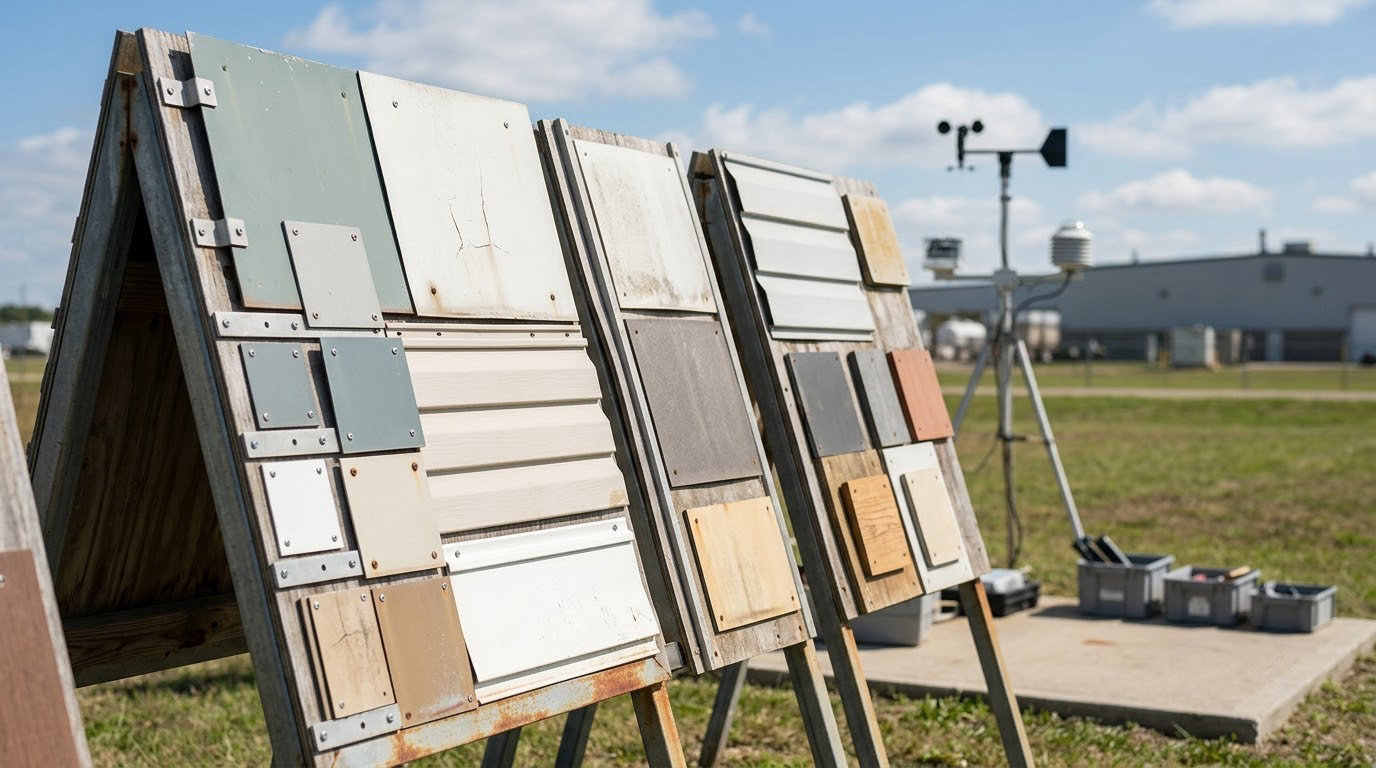
- How Do Outdoor Exposure Tests Work?
- How Do Moisture, Heat, and Thermal-Cycling Tests Differ?
- How Do You Choose the Right Test for a Plastic Part?
- Which Standards and Equipment Are Commonly Used?
- How Should Test Specimens Be Prepared?
- How Do You Interpret and Report Weatherability Test Results?
- What Are the Limitations of Accelerated Testing?
- Frequently Asked Questions
- Which test is best for plastic weatherability?
- Is UV exposure alone enough to predict outdoor plastic failure?
- How long does accelerated weatherability testing take?
- What is the difference between ASTM G154 and ASTM G155?
- Do colorants and additives change weathering test results?
- Can laboratory weatherability results be used to guarantee service life?
- Conclusion
Weatherability Testing Methods at a Glance
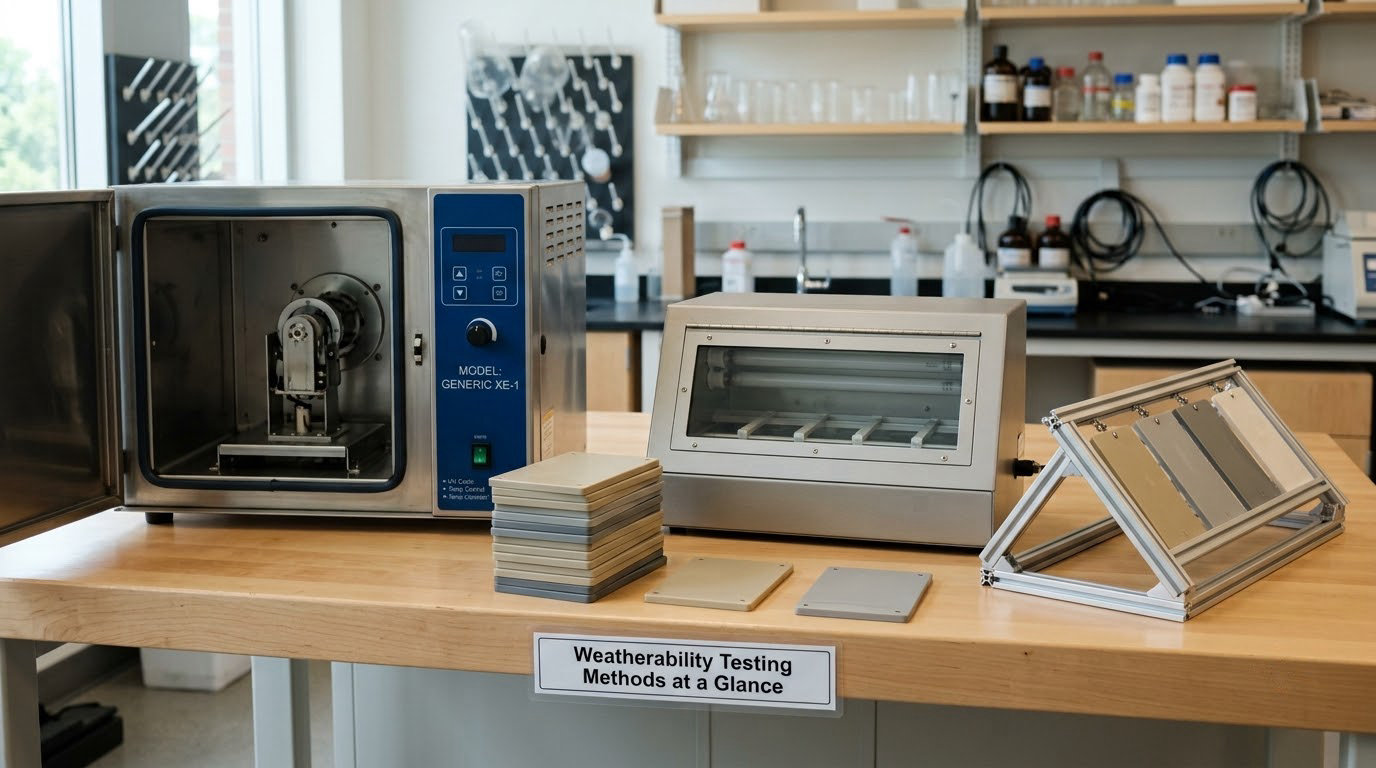
Five method families cover most plastic weathering work. Each one stresses the specimen differently, so they answer different questions.
| Method | Exposure mechanism | Typical standards | What it measures | Best used for |
|---|---|---|---|---|
| Fluorescent UV | UVA or UVB lamps plus condensation | ASTM G154, ASTM D4587, ISO 4892-3, ISO 16474-3 | Color, gloss, chalking, cracking | Plastics, coatings, screening and formulation ranking |
| Xenon arc | Filtered full-spectrum arc lamp, controlled irradiance and humidity | ASTM G155, ISO 4892-2, SAE J2527, J1885, J1960 | Appearance plus mechanical retention | Automotive exterior, appearance-sensitive parts |
| Carbon arc | Carbon or filtered tungsten arc | ASTM D4303 and related legacy practices | Lightfastness, fading | Narrow legacy and textile applications |
| Natural outdoor exposure | Real sunlight, rain, dew and seasonal temperature | ASTM G7, G24, G90, G201, ISO 877 series | Everything, including things a chamber cannot reproduce | Correlation data, final substantiation |
| Combined environmental | Humidity, heat aging, thermal cycling, spray, freeze-thaw | ASTM D618, D570, D793, MIL-STD-810H, RTCA DO-160 | Moisture uptake, expansion, seal and coating degradation | Complementing any UV exposure |
What Does Weatherability Testing Measure?
Weatherability is the ability of a material to resist the combined effects of sunlight, heat, moisture, wind and temperature swings over time.
The word “combined” carries most of the meaning. Ultraviolet radiation alone rarely destroys a part on its own; it breaks polymer chains or degrades a pigment until the material can no longer take the stress that moisture and daily cycling keep applying.
That is where weatherability testing differs from the rest of your test program. A tensile test tells you the material’s strength on the bench. A chemical immersion test tells you how it responds to a specific fluid. Neither tells you what six seasons of sun and rain will do to color, stiffness or a molded-in stress.
What weatherability testing measures is change: color difference, gloss loss, surface cracking, chalking, loss of impact strength, dimensional drift and adhesion loss between a coating and its substrate.
Which Failures Can a Weatherability Test Reveal?
The point of any exposure test is to surface failures you would otherwise find in the field, and each mode of failure has its own signature in the data.
- Discoloration and yellowing from pigment or matrix degradation, measured as color difference under ASTM D2244 conditions.
- Gloss loss and surface chalking as the resin erodes and exposes filler or pigment particles.
- Embrittlement and cracking, especially on thin sections, ribs and highly stressed molded features.
- Loss of impact strength or elongation measured before and after exposure.
- Warpage and dimensional change from moisture uptake and thermal expansion over many cycles.
- Coating and seal degradation: blistering, loss of adhesion measured by ASTM D3359 cross-cut, and cohesive rather than adhesive failure.
A whitening haze after a few hundred hours of fluorescent UV exposure on an unpigmented polymer is usually surface chalking. The same part showing a fine crack network around a gate is telling you something else entirely, and no color meter will show it to you.
What Are the Main Weatherability Testing Methods?
Four groups cover the field. Accelerated laboratory tests compress years of stress into weeks using lamps, condensation and controlled heat. Natural outdoor exposure puts specimens on a rack under real sky for months or years, and it is the only method that captures regional atmosphere and seasonal variation. Combination tests run weathering alongside humidity, thermal cycling or salt spray to reproduce the interactive stresses of coastal, vehicle or building environments. Specialist equipment handles the rest, including through-window exposure, immersion cycling and altitude or thermal shock testing.
Most programs use more than one. A typical plastic qualification runs fluorescent UV for mechanism and ranking, then confirms the winning material with outdoor exposure. The methods worth understanding are the ones that match the question the lab has to answer, not simply the ones with the most impressive lamp on the box.
How Do Accelerated Laboratory Tests Simulate the Weather?
A chamber creates environmental stress by cycling independent variables rather than replaying a real weather pattern.
Light arrives from lamps at a controlled irradiance, measured in watts per square meter per nanometer at the specimen plane. Temperature is controlled by air, by the chamber walls and by a black panel thermometer that tracks how hot a dark specimen actually gets. Moisture enters as high humidity, as condensation on cooled specimen surfaces, or as a spray of water, and freezing stages add expansion stress on top.
Those variables repeat on a schedule. An exposure cycle might run eight hours of irradiation followed by four hours of condensation, then repeat, with the sequence chosen to resemble the duty cycle you care about.
Because the schedule is a design choice rather than a natural outcome, laboratory results are evidence about specific mechanisms under specific conditions. They are not a direct prediction of service life in a particular city.
How Does Fluorescent UV Lamp Testing Work?
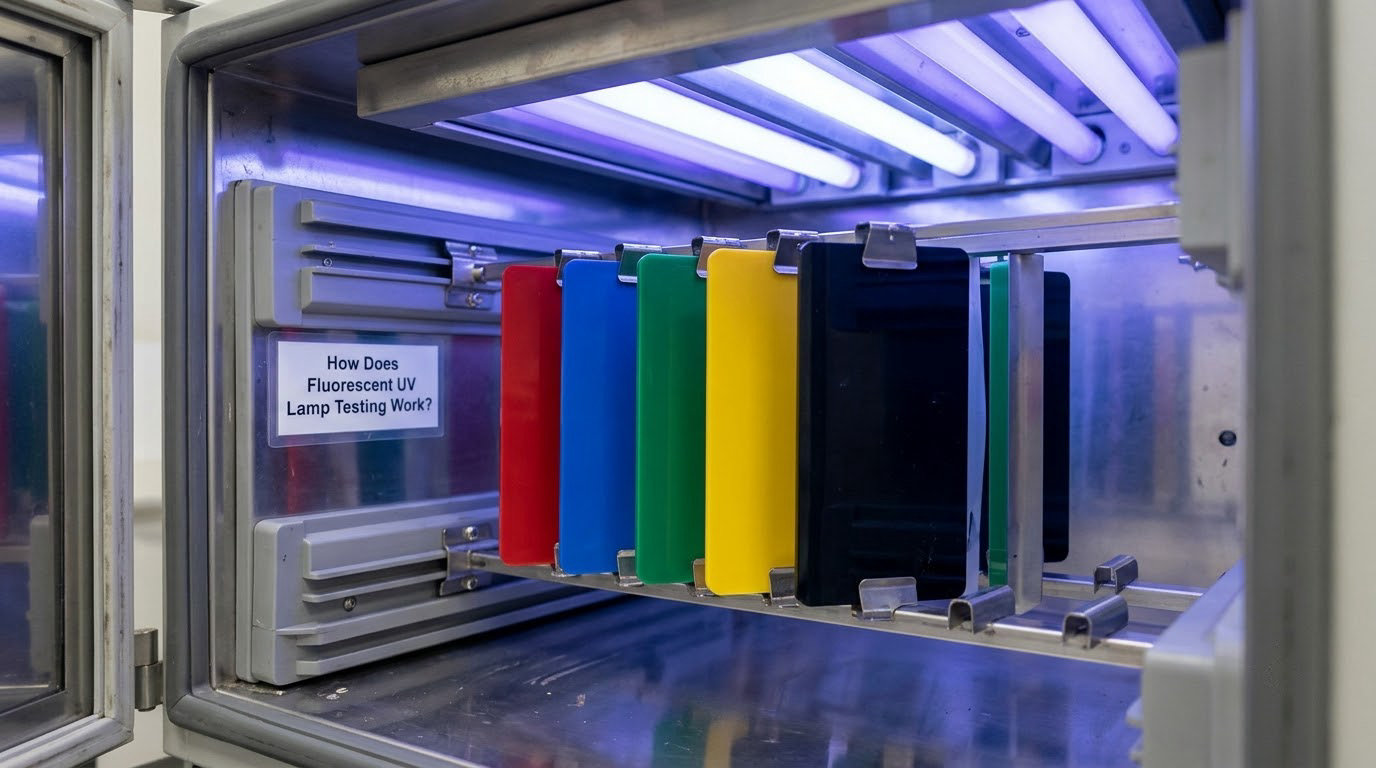
Fluorescent UV testing uses banks of lamps arranged in rows above vertical specimen holders, with condensation delivered onto the cooled specimen faces during dark stages.
Three lamp families matter. UVA-340 simulates the longer-wavelength ultraviolet present in sunlight through window glass and is the usual choice for outdoor plastics and coatings. UVA-351 emits a broader, slightly more aggressive shortwave output and accelerates screening work. UVB-313 is shortwave-only, intended for laboratory screening of materials that see little or no sunlight in service.
ASTM G154 defines the practice, and it defines several numbered cycles rather than one single test. The standard tells you which cycle applies; it does not tell you the answer to your product question.
Reports worth reading name the lamp family, the cycle, the irradiance basis and the black panel temperature. A report that only says “tested to ASTM G154” is not interpretable.
What Is Xenon Arc Lamp Testing?
Xenon arc testing uses a filtered arc lamp that reproduces a wider slice of the solar spectrum than any fluorescent lamp, with irradiance, chamber temperature and humidity cycle controlled to a defined profile.
The filters matter as much as the lamp. Through-window glass, outdoor sunlight and sunlight behind tinted automotive glass are three different spectral targets, and the filter choice changes the degradation rate and sometimes the mechanism.
Because a xenon chamber reproduces light, heat and moisture together at realistic ratios, it suits automotive exterior programs, where the industry standards SAE J2527, SAE J1885 and SAE J1960 each define a specific light, humidity and thermal profile.
Automotive work usually pairs xenon exposure with mechanical and appearance measurements afterward, so the result covers both looks and function.
How Do Outdoor Exposure Tests Work?
Outdoor exposure places specimens on racks at an established exposure site, facing a defined orientation, sometimes through glass, for a set duration.
ASTM G90 covers outdoor weathering of materials with solar exposure, G24 covers methods for exposing specimens under natural sunlight and G7 covers outdoor exposure of plastics and elastomers. ISO 877 covers the equivalent outdoor methods. Each describes orientation, rack construction, duration and inspection frequency.
Site choice changes everything downstream. South Florida sites deliver high irradiance, high humidity and salt air, so they are harsher than temperate locations and reach failure sooner. A temperate site takes longer but may expose different mechanisms, because ultraviolet dose and moisture exposure rarely scale together.
Outdoors is slow and expensive per sample, so labs usually reserve it for correlation runs and final substantiation rather than early screening.
How Do Moisture, Heat, and Thermal-Cycling Tests Differ?
These tests isolate one stressor at a time, and they answer questions that a UV chamber cannot. Humidity exposure, ASTM D618, holds specimens at elevated temperature and relative humidity to drive moisture absorption into the polymer matrix, which reveals swelling, dimensional change and blistering in coatings. Heat aging, ASTM D3045 among others, exposes material to elevated temperature in air to isolate thermal oxidation and long-term thermal stability. Temperature cycling moves specimens between hot and cold holds with defined dwell times and ramp rates, driving differential expansion between a part, its coating and its seals, and exposing interfacial stress and seal degradation. Freeze-thaw and water spray add phase-change and wetting effects, useful where parts see wet-and-cold cycles, water exposure or road salt.
Pick these based on the failure you are chasing. If parts flex repeatedly while absorbing moisture, cycling matters more than lamp hours.
How Do You Choose the Right Test for a Plastic Part?
Work backwards from the failure, not forwards from the equipment.
Weatherability testing methods explained: from question to acceptance criteria
Start by writing the question in one sentence. “Will the color hold for three years on an Arizona parking deck” is testable. “Is the part weatherable” is not. Then name the failure mode you expect, the environment that causes it, and the property the customer cares about.
Next, match the service environment to the mechanism. Sunlight with rain points to a UV and condensation cycle. Sunlight behind glass suggests a through-window profile. Coastal service adds salt spray. A part that sees repeated thermal swings on a vehicle needs cycling as well as light.
Then set acceptance criteria before the run, not after. Decide what change in color, gloss or retained strength is acceptable and what the evaluation method is. If you cannot state a threshold and its basis, the result will be argued about rather than used.
Finally decide where the work happens. In-house equipment pays off when you screen many formulations on a recurring cycle and need tight control of specimen geometry. Third-party labs, ideally accredited to ISO/IEC 17025, make sense for formal qualification, unfamiliar standards and any result that has to survive a customer audit, because they bring experience with method subtleties and independent documentation.
Results still mean nothing without proper mechanical baselines. Our guide to ASTM D638 tensile testing covers the measurement side, and shipping and handling stresses are a separate question handled in ISTA testing protocols explained.
Which Standards and Equipment Are Commonly Used?
Most weatherability standards fall into three families: ASTM and ISO practices that describe apparatus and exposure, and industry specifications that define a fixed cycle for a specific application.
| Standard | Light source | Water delivery | Typical scope |
|---|---|---|---|
| ASTM G154 | Fluorescent UVA or UVB | Condensation or spray | Nonmetallic materials, general practice |
| ASTM D4587 | Fluorescent UV | Condensation or spray | Paints and coatings |
| ASTM G155 | Xenon arc | Humidity or spray | Nonmetallic materials, general practice |
| ASTM G151 | Fluorescent UV | Condensation plus other stress | Combined exposure stress |
| ISO 4892-2 | Xenon arc | Humidity or spray | Materials general guidance |
| ISO 4892-3 | Fluorescent UV | Condensation | Plastics and polymers |
| ISO 16474-3 | Fluorescent UV | Condensation | Paints and coatings |
| ISO 877-1 to -3 | Outdoor sunlight | Natural | Outdoor exposure methods |
| SAE J2527, J1885, J1960 | Xenon arc | Humidity | Automotive exterior components |
| AATCC 16.3, GMW3417 | Xenon arc | Humidity | Textiles and automotive materials |
| MIL-STD-810H, RTCA DO-160 | Various | Humidity and cycling | Environmental stress for aerospace and defense equipment |
Two cautions. First, ISO 4892-3 and ISO 16474-3 look almost identical but apply to different material scopes, plastics and polymers versus paints and coatings. Second, editions get revised, so confirm the applicable edition with the lab and, where a customer specification exists, with the customer before testing begins.
On equipment, the decision follows the method: a fluorescent UV chamber with controlled condensation, a filtered xenon arc weatherometer with humidity control, or outdoor racks. Irradiance measurement and calibration records are the features worth paying attention to.
How Should Test Specimens Be Prepared?
Most disputed weathering results trace back to specimen preparation rather than to the chamber. Specimens should come from the real process, using production tooling, cycle time, cooling and pack as applied to the shipped part, because a laboratory plaque tells you about the material, not about your part.
Record the resin grade, colorants, masterbatch ratio, UV absorbers, stabilizers and glass or mineral filler. Orientation matters, since properties differ between molded directions, so machine the specimens in a consistent direction and keep the gating and wall thickness representative.
Condition specimens to a defined equilibrium before baseline measurement, take a full baseline set including color, gloss and mechanical properties, and keep at least three replicates per condition. Label everything with material, orientation, position in the chamber and date, because chamber position affects dose and a lost label invalidates a whole run.
How Do You Interpret and Report Weatherability Test Results?
Read results against the baseline you took before exposure, not against an absolute number. Color change is reported as a color difference value with the instrument, geometry and illuminant specified, since one number means different things under different viewing conditions.
Gloss is measured at a stated geometry, so compare like geometry only. Chalking is rated against a reference scale, adhesion uses the cross-cut method, and cracking is documented by photograph with a consistent severity scale. Mechanical retention is usually reported as a percentage of the unexposed value, which makes the control specimen as important as the exposed one.
Reports should name the standard and edition, lamp or lamp family, cycle, irradiance basis, chamber position, inspection intervals and individual replicate values alongside the average. If a result matters commercially, that documentation is the deliverable. When results go sideways, working through root cause analysis methods for manufacturing defects usually shows whether the problem is the material, the process or the test itself.
What Are the Limitations of Accelerated Testing?
Acceleration changes the ratio between stressors, and a compressed schedule can rank materials differently than nature would. A faster cycle may drive a degradation mechanism that barely matters in service, or suppress the slow mechanism that actually ends the part’s life.
The familiar shortcut that a fixed number of chamber hours equals a fixed number of outdoor years has no general basis. Conversion depends on the specific polymer or coating, the target failure mode, the light spectrum, the site latitude and altitude, and the season the outdoor comparison covered. Practitioners on engineering forums keep returning to the same point: accelerated data has to be correlated against outdoor data for that same material and failure mode before any service-life claim is credible.
Ask the lab to put the correlation data in writing before you buy the cycle, because it is rarely offered by default. Accelerated testing is strongest as a screening and ranking tool, and as a way to reproduce a mechanism quickly. Field data remains the only credible basis for a warranty period.
Frequently Asked Questions
Which test is best for plastic weatherability?
For most plastic weathering programs, fluorescent UV exposure under ASTM G154 or ISO 4892-3 is the starting point because it is fast, inexpensive and good at ranking formulations by mechanism. Choose xenon arc under ASTM G155 or ISO 4892-2 when appearance and a fuller solar spectrum matter, which is common in automotive work. Confirm outdoor correlation before using either for a service-life claim.
Is UV exposure alone enough to predict outdoor plastic failure?
No. Ultraviolet exposure alone rarely reproduces service failure, because moisture, heat and temperature cycling do most of the physical work once the matrix is degraded. A realistic program combines a light exposure cycle with condensation or humidity, and adds thermal cycling where the part sees temperature swings. Parts near salt or water need spray or immersion exposure as well.
How long does accelerated weatherability testing take?
Screening runs commonly last a few hundred hours, qualification programs run into the low thousands, and severe qualification cycles can go further. Outdoor exposure takes months to years and is usually run in parallel rather than as a replacement. Choose duration from the question and the acceptance criterion you set, and avoid extending a cycle past the point where the failure mechanism has already appeared.
What is the difference between ASTM G154 and ASTM G155?
G154 uses fluorescent UVA or UVB lamps with condensation and is the faster, lower-cost option for plastics and coatings screening. G155 uses a filtered xenon arc lamp with controlled irradiance, temperature and humidity, which reproduces a wider part of the solar spectrum. G155 is the usual choice for automotive exterior programs, where standards such as SAE J2527, J1885 and J1960 specify the profile.
Do colorants and additives change weathering test results?
Yes, and often more than the base resin. Pigments, UV absorbers, stabilizers and fillers determine whether a part fades, chalks or embrittles, so testing an unpigmented laboratory plaque tells you about a different material than the one you ship. Test the production color, the production masterbatch ratio and the production process. A small additive change can reorder results across an entire comparison.
Can laboratory weatherability results be used to guarantee service life?
Not on their own. Accelerated results support screening, ranking and qualification against a written specification, and they become service-life evidence only when correlated against outdoor or field data for the same material and failure mechanism. Publish the correlation, the site, the season and the measured property. Without that, a warranty period based on chamber hours alone will not hold up.
Conclusion
Start with four written items before you book any chamber time: the service environment, the failure mechanism you expect, the applicable standard and edition, and the property plus threshold that count as a pass. Weatherability testing methods explained properly means the method follows those four items, not the other way round. Once they are written down, picking between fluorescent UV, xenon arc, outdoor exposure and cycling tests takes minutes rather than weeks.