

A medical grade plastic is a resin or compound that has been formulated, tested and documented to meet defined requirements for biological safety, sterilization, chemical and physical performance, and regulatory traceability for a specific medical use. The label on its own means nothing, because suitability depends on contact type, contact duration, and the sterilization route the part will see.
Below is the framework I use when helping teams decide whether a candidate polymer belongs in a device. It is written for the people who get the question after design has started: engineers, quality managers, buyers and regulatory staff.
Table of Contents
- Medical Grade Plastics Requirements Explained
- What Makes a Plastic Suitable for Medical Devices?
- How Biocompatibility and Chemical Safety Are Assessed
- Common Medical Plastic Families and Their Requirements
- Sterilization, Cleaning, and Environmental Aging
- What Manufacturers Must Document and Control
- How to Select and Validate a Plastic for a Medical Device
- Medical Grade Plastic Requirements for Packaging and Manufacturing
- Where to Start With Your Material Program
- Frequently Asked Questions
Medical Grade Plastics Requirements Explained

There is no single certificate called medical grade. What exists is a set of requirements, each governed by a different standard or regulation, and each proven with a specific piece of evidence. A supplier that cannot name which requirement they mean by medical grade is telling you they have marketing copy, not a qualification package.
It helps to separate four ideas that get run together constantly. Material suitability is whether the polymer performs physically and chemically in your part. Device safety is whether the finished, sterilized part is safe for the patient or user who touches it. Regulatory compliance is whether the evidence is complete enough for the intended market and submission path. Manufacturing quality is whether the supplier can repeat the same result on lot number forty as on lot number one. A material can score well on the first three and fail badly on the fourth.
Here is how the four requirement pillars map to the standards and to the paperwork you should expect to see.
| Requirement pillar | What it covers | Governing framework | Evidence a supplier should supply |
|---|---|---|---|
| Biological safety | Cell toxicity, irritation, sensitization, and where relevant systemic toxicity | ISO 10993 series, starting with ISO 10993-1 | Biological evaluation report or biological evaluation plan referencing the specific grade and coloring |
| Sterilization compatibility | Resistance to steam, ethylene oxide, gamma or e-beam without unacceptable property loss or residues | ISO 11135, ISO 11137, ISO 17665, material supplier data | Validated cycle counts, aging data, and residue limits for the intended route |
| Chemical and physical performance | Chemical resistance, dimensional stability, hydrolysis resistance, mechanical retention, optical clarity | Material datasheet, ISO 527, ISO 1183, application-specific testing | Resin grade datasheet plus test reports on the molded part, not just the pellet |
| Regulatory and traceability | Lot identity, restricted substances, change control, quality system | ISO 13485, 21 CFR 177.2600 for food contact, REACH, RoHS where applicable | Certificate of analysis per lot, ISO 13485 certificate, change notification agreement, restricted substance declaration |
One correction worth making early: the FDA does not approve plastics. FDA regulates devices, and separately regulates food-contact substances. A claim of FDA approved plastic is either shorthand for one of those two things or simply wrong, and it should never appear in a specification you intend to defend in a file.
What Makes a Plastic Suitable for Medical Devices?
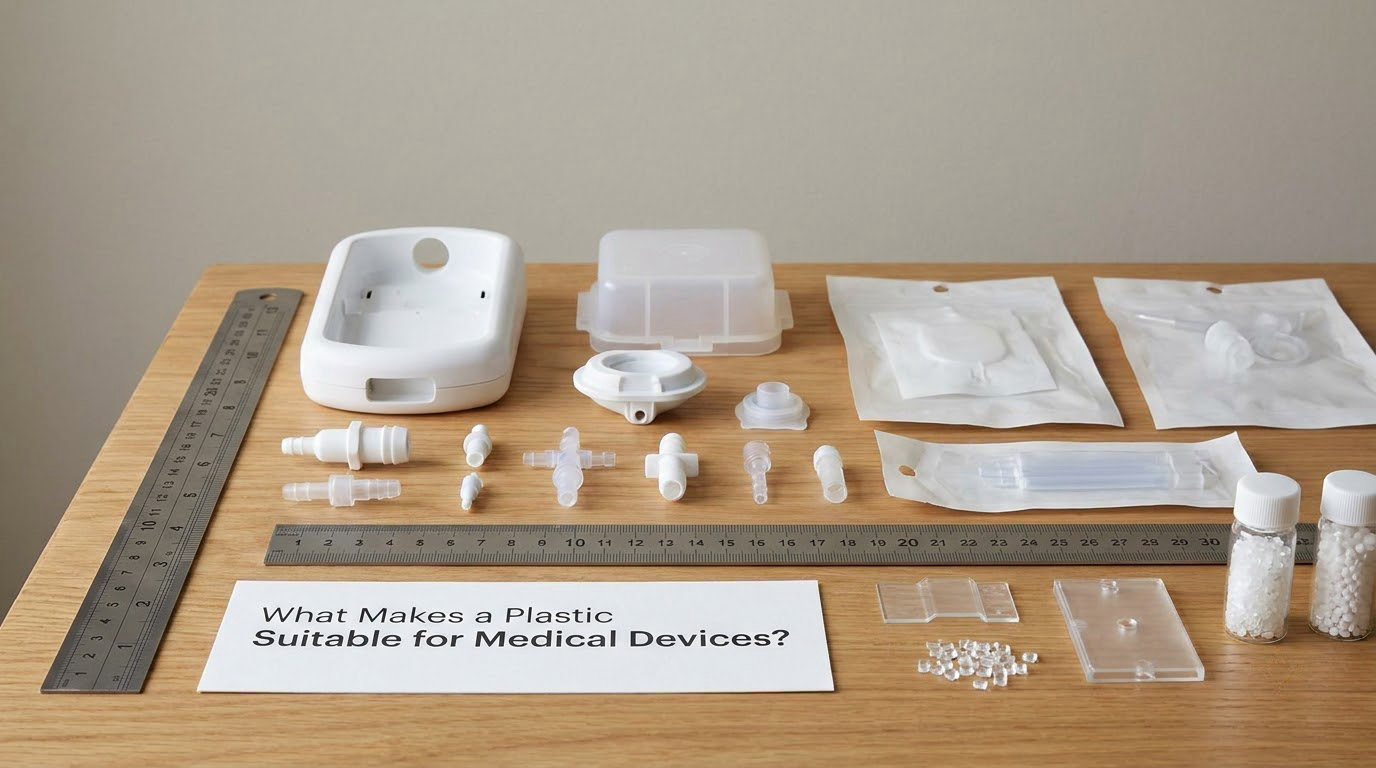
Beyond the standards, a material has to survive the actual job. I break the practical requirements into eight, and every selection review I have seen go wrong skipped at least one of them.
Biological safety for the intended contact. Skin contact, mucosal contact, blood contact and implant contact are different claims with different evidence behind them. A grade with a short-duration skin contact report is not a long-term blood contact material.
Chemical resistance. Your device gets hit with cleaning agents, disinfectants, saline, lipid-based products and often a drug formulation. The part that survives the bench test can still be attacked by a specific formulation over time.
Dimensional stability. Dimensional change between molding and use changes seal force, catheter stiffness, connector fit and clearances. Pay attention to shrinkage and to moisture uptake, which is the reason polyethylene and polyamide parts behave differently in a humid supply chain than in a dry mold.
Sterilization compatibility. This is where most late-stage surprises come from, and I cover it in detail further down.
Mechanical performance across the life of the device. Creep matters more than tensile strength in a lot of molded parts. A clip, a hinge or a snap-fit that passes a short pull test can sag on the shelf at body temperature for two years.
Purity and additive control. Pigments, glass or mineral fibre reinforcement, and processing aids are part of the material, not decoration. Additives frequently drive the extractables profile, and a pigmented grade usually needs its own biological evaluation rather than inheriting the natural one’s.
Traceability. You should be able to name the resin manufacturer, the grade, the plant, the lot and the certificate of analysis behind any part you ship. If your supplier cannot connect a shipped lot to a CoA, that is a supplier qualification problem, not a paperwork preference.
Fitness for the contact duration. Transient, short-term, long-term and permanent contact each carry a different evidence burden. Choosing a material before you have decided which of those applies is choosing blind.
How Biocompatibility and Chemical Safety Are Assessed
Biocompatibility is assessed against a specific finished device, not against a pellet in a lab. ISO 10993-1 sets the framework: you describe the material, the contact type, the duration and the route, and that description determines which parts of the series apply. ISO 10993-5 covers cytotoxicity, and it is usually the first test run because it is fast and it gates the rest.
On top of that sit two studies that catch what cell tests miss. Extractables are what you can pull out of the material using a solvent simulating body conditions over a set temperature and time. Leachables are what actually migrates out of a finished, sterilized device during use. The first is a screening exercise on the material; the second is a study of the assembly, packaging included.
Toxicological risk assessment then asks whether the detected compounds matter at the detected levels, considering the contact route and the duration a real patient is exposed to. This is where a residual sterilant or a trace additive can be acceptable in a short-term device and unacceptable in a permanent implant, with the same resin.
The finished part is where surprises live. Add a black colorant for a housing and you have changed the extractables profile. Mold in a different plant, use a different screw and barrel polish, or apply a different cleaning process, and the surface that touches the patient is no longer the surface somebody tested.
A useful rule from my own review experience: assume the raw resin data is a starting point only, and budget for at least one biological evaluation on the assembled, sterilized part. Devices where I skipped that step are the ones that generated the most awkward questions later.
Common Medical Plastic Families and Their Requirements
Families get selected on two axes at once, what the material does mechanically and what it does to the patient. The table below covers the ones you will actually be choosing between, along with the limitation that usually drives the final call.
| Polymer family | Typical medical use | Where it earns its place | Deciding limitation |
|---|---|---|---|
| Polycarbonate (PC) | Housings, instrument covers, connector bodies, transparent fluid components | High stiffness, dimensional stability, optical clarity, short-term steam tolerance | Brittle under sustained stress, sensitive to cleaning chemicals, needs impact modifiers in some grades |
| ABS and medical-grade ABS | Diagnostic device housings, clamps, internal structural parts | Easy to mold, good surface finish, economical | Butadiene content drives odor, extractables and yellowing; rarely chosen for long-term body contact |
| PMMA | Optics, sight glasses, cell culture and lab consumables, housings | Excellent clarity and UV stability, low water uptake | Brittle, poor heat resistance, scratches easily |
| Polypropylene (PP) | Syringe components, connectors, caps, laboratory consumables | Chemically inert, low density, well tolerated by repeated autoclave cycles in many grades | Lower stiffness, more prone to creep, and prone to stress cracking with certain solvents |
| Polyethylene (PE, UHMWPE) | Catheters, tubing, containers, wear parts, orthopaedic components | Flexibility, chemical resistance, low friction, biocompatible grades available for long contact | Gas permeability, adhesive bonding is difficult, and melt strength limits thin-wall molding |
| PVC and flexible PVC compounds | IV bags and tubing, catheters, fluid containers | Flexible, economical, well characterized in device applications | Plasticizer migration, and clear flexible PVC yellows under gamma irradiation; DEHP content is a regulatory focus |
| Polystyrene (PS) and impact PS | Laboratory consumables, diagnostic cartridges, housings | Clarity, rigidity, low cost, USP Class VI grades widely available | Brittle, poor chemical resistance to solvents, not for load-bearing or impact conditions |
| Polyetheretherketone (PEEK) | Implantable and instrument components, high-load connectors | Mechanical strength, chemical resistance, sterilizable, very low extractables | Cost, high processing temperature, and demanding mold tooling |
| Silicone (VMQ and other elastomers) | Seals, gaskets, tubing, catheter tips, keypads | Flexibility, biocompatibility, low tack, temperature stability | Fillers must themselves be compliant; peroxide-cure residues and platinum-group metals are restricted in some applications |
| Thermoplastic elastomers (TPE, TPV, TPU) | Cable insulation and jackets, soft-touch grips, diaphragms, gaskets | Elastomeric behavior from a single molding process, wide hardness range, often PVC- and latex-free | Property drift after sterilization, and hardness must be matched to the specific contact classification |
| PTFE and fluoropolymers | Catheter liners, seals, fluid path parts, cable | Outstanding chemical resistance, low friction, biologically inert | Difficult to bond and process, creeps under load, and can off-gas during processing |
Two questions come up constantly. Is ABS plastic medical grade? The honest answer is that ABS comes in biocompatible grades that can pass ISO 10993 cytotoxicity and irritation endpoints for defined contact durations, while commodity ABS is not, and ABS is rarely the right choice for implant or long-term internal contact because of the butadiene it inherits. And medical grade is not the same as food grade, even though a resin can sometimes carry both: 21 CFR 177.2600 addresses food contact, which is a different question from body contact over time.
Sterilization, Cleaning, and Environmental Aging
A material that performs perfectly as molded can fail after sterilization, and this is where a lot of device programs get their surprises. The four common routes act very differently on a polymer chain.
| Sterilization method | What it does to polymers | Typical mitigation |
|---|---|---|
| Moist heat (autoclave) | Hydrolysis-driven loss of molecular weight and stiffness, warping, stress cracking in presence of moisture | Use a hydrolysis-resistant grade, control moisture pickup, and validate at the actual cycle count |
| Ethylene oxide | Relatively gentle on the polymer, but leaves residuals; can embrittle or stress-crack some materials over time | Aeration controls, residual limits set in the cycle validation, and post-cycle aging |
| Gamma irradiation | Chain scission and crosslinking: yellowing, embrittlement, loss of elongation in many grades | Specify a gamma-stable or irradiated-material-optimized grade; sterilize as early in the process as possible |
| E-beam | Similar chain-level effects to gamma, but dose is delivered by a different mechanism and penetrance varies with part density | Dose mapping for the load configuration, low-dose-capable grades, minimizing polymer dose |
| UV or repeated chemical disinfection | Surface degradation, gloss loss, additive leaching, stress cracking from cleaners | Chemical resistance testing against the actual disinfectant and concentration used in practice |
The number of cycles matters as much as the method. Suppliers quoting fifteen or more autoclave cycles are describing a specific tested condition at a specific temperature; a device that will be reprocessed twenty times needs its own data, not the supplier’s. For single-use devices that are never sterilized, aging still applies: shelf life is a real test program of accelerated and real-time conditions, and polymers can creep or discolor on a warehouse shelf.
What Manufacturers Must Document and Control
Requirements only exist if someone holds evidence, and the evidence trail is where a manufacturer either passes or fails review. I ask for the following, and I ask for it before a material is committed to a design, not after.
- Certificate of analysis for each lot, tied to the lot number on the shipment.
- The exact resin grade, plant of manufacture, and the additive and colorant package.
- ISO 13485 certification for the manufacturing site, with scope that actually covers the material.
- Biological evaluation or test reports at the part level, tied to the finished device configuration.
- Sterilization compatibility data at the dose or cycle count you intend to use.
- Restricted substance declarations covering REACH SVHC, RoHS where applicable, and any phthalate, latex or animal-derived content.
- A change notification agreement, with lead time, so a resin formulation change does not arrive as a surprise in your line.
- Traceability records that let you walk backward from a shipped device to the resin lot.
Processing records sit alongside these on the manufacturing side: drying parameters, melt temperature, cycle time, and inspection results. For a material with moisture sensitivity, the drying record is not administrative detail, it is the difference between a stable part and a batch of rejects that everyone will spend a day explaining.
One more thing I insist on, because it has saved more than one launch: the supplier’s change notification terms in writing, and a rule that any change is re-qualified before release, never after. A resin that behaves identically in a tensile test can behave differently in a finished device when the colorant package changes.
How to Select and Validate a Plastic for a Medical Device
This is the workflow I give teams that are starting from scratch, and it runs in this order because each step narrows the next.
Step one: define the contact profile. Write down every surface that touches a person, a fluid or a drug, the duration, and the route. If you cannot fill that in, you cannot select a material.
Step two: shortlist families, not brands. Pick three or four polymer families that plausibly meet the mechanical duty, then discard early.
Step three: review supplier data critically. Check whether the biological data covers your contact duration and whether the sterilization data covers your route. Data for a different device is a data point, not a qualification.
Step four: test the finished component. Cytotoxicity and chemical characterization on the molded part, with the real colorant, the real additives and the real process.
Step five: challenge it. Run the actual cleaning regimen, the actual sterilization route and an aging study, then re-measure the properties the design depends on.
Step six: document the decision and its evidence. A written rationale naming the rejected options and why protects you later, when somebody asks why you did not use the cheaper resin.
Step seven: monitor after approval. Track supplier change notices, and re-run a defined subset of the test program when the resin, the colorant, the plant or the process changes.
The supplier questionnaire in the previous section is the same list, reordered for a buyer to send out. In practice, the fastest way to read a supplier is to ask which of those eight items they can send today, and watch the answer.
Medical Grade Plastic Requirements for Packaging and Manufacturing
Packaging carries requirements that the device itself does not, and mixing the two up is common. A sterile barrier system has to hold its seal through distribution, resist moisture, and not introduce anything into the device. A drug-contact container has to protect the formulation, which is often the more sensitive of the two.
For the barrier, seal integrity and seal strength matter more than the resin’s headline properties: the seal must survive handling, and the barrier must keep out moisture and oxygen at the intended shelf life. Permeation matters for anything moisture sensitive, and a plastic that is perfectly fine in a dry molded part can be the wrong choice for a blister or a bottle closure.
Migration is the parallel test on the packaging side, and it runs in both directions. Components can migrate into the drug, and the drug can absorb or attack the container, which is why compatibility testing with the actual formulation belongs in the plan. Printing inks, adhesives and labels are part of the food-contact or drug-contact surface in most jurisdictions, so their compliance cannot be assumed from the base resin. Particulate control, because molded and packaged parts are handled in clean conditions, and a supplier that cannot describe its own cleaning regime has not fully described its contamination controls.
On the supply chain side, a medical polymer program is a second- and third-source conversation rather than a single-quote purchase. Lead times on specific grades stretch during formulation changes, and a resin with a narrow supplier base is a schedule risk even when the price looks attractive. Ask what happens to your qualification if that grade is discontinued, and get an answer before you need it.
Where to Start With Your Material Program
If you take three actions this quarter, make them these. Write the contact profile first, because it determines the test battery and most expensive mistakes happen before that page exists. Request the eight documents in the checklist from at least two suppliers and compare what comes back, since that comparison tells you more than any datasheet. Then budget for one biological evaluation on the finished, sterilized part, because resin data alone will not cover your assembly.
The rest of the requirements, sterilization compatibility, dimensional stability, additive control and traceability, are real but they are downstream of those three. Get the framework right first and the material choice usually takes care of itself.
Frequently Asked Questions
What makes a plastic medical grade?
A plastic is medical grade for a specific use when it meets defined requirements for biological safety, sterilization compatibility, chemical and physical performance, and regulatory traceability, and when a supplier can show evidence for each. The term is not a certification. Suitability depends on the contact type, the contact duration and the sterilization route, so the same resin can be suitable for a short-term skin contact device and unacceptable for a long-term implant.
Is ABS plastic medical grade?
It depends on the grade and the use. Medical suppliers offer ABS grades formulated and tested for defined contact durations, and these can pass cytotoxicity and irritation endpoints under ISO 10993. Commodity ABS is not medical grade, and ABS is rarely chosen for long-term internal contact or implant applications because the butadiene content affects odor, extractables and yellowing. Treat ABS as a housing and internal-structure material unless testing says otherwise.
Is USP Class VI a certification?
No, and this one causes real problems in specifications. USP Class VI is a classification in the United States Pharmacopeia administered through approved third-party laboratories, based on in vivo implantation testing. Saying a material is USP Class VI certified is technically incorrect. It also covers a different scope than ISO 10993, which is the biological evaluation framework most device programs rely on, and passing one does not substitute for the other.
Is medical grade plastic the same as food grade plastic?
Not the same, though one resin can carry both designations. Food contact is addressed in the US by 21 CFR 177.2600 and similar rules elsewhere, focused on migration under defined food simulants and use conditions. Medical use asks about body contact over time, cytotoxicity, sterilization effects and device performance. Food-contact compliance is a useful signal of composition control, but it is not evidence of suitability for patient contact.
Is there an FDA approval for medical plastics?
No. The FDA does not approve plastic materials as a class. It regulates medical devices, and it separately regulates food-contact substances. A device built from compliant material still has to go through its own pathway, in the US a 510(k), De Novo or PMA depending on classification and risk. If a supplier advertises FDA approved plastic, ask which of those two contexts they mean, because the answer is usually marketing language rather than a regulatory status.
What should I request from a medical grade resin supplier?
Ask for the certificate of analysis for each lot, the exact resin grade and manufacturing plant, the ISO 13485 certificate for that site, biological evaluation data at the part level, sterilization compatibility data at your cycle or dose, restricted substance declarations for REACH and RoHS, and a written change notification agreement. Add lot traceability records and confirmation of any latex, phthalate or animal-derived content. A supplier that answers all eight quickly is telling you something useful about its quality system.