
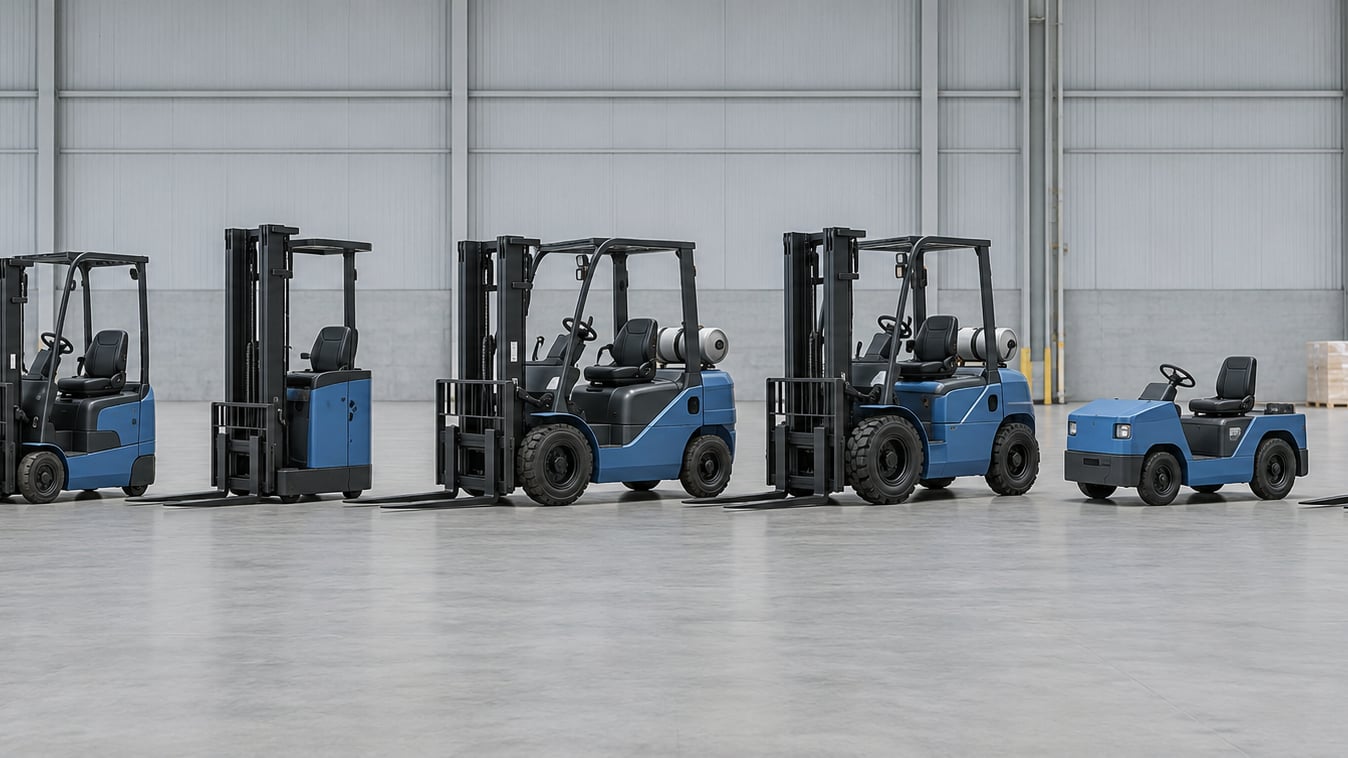
Forklift classes and types explained in one line: OSHA divides powered industrial trucks into seven classes, numbered 1 through 7, grouped by power source, tire type, and the environment they are built to work in. The class number tells you what powers the truck and how it is constructed, not what it can lift. Get that straight and the rest of the buying decision falls into place quickly.
Why the split exists at all. A 3,000-pound cushion tire propane rider in a food plant and a 12,000-pound rough terrain forklift on a lumber yard have nothing in common except the word forklift, so rules, training records, insurance, and maintenance schedules are written against the class rather than the shape. The framework comes from OSHA’s powered industrial truck definitions in 29 CFR 1910.178, with the finer sub-grouping supplied by the Industrial Truck Association (ITA).
Table of Contents
- Forklift Classes and Types Explained at a Glance
- What Is a Forklift Class?
- Forklift Class 1: Electric Motor-Powered Trucks
- Forklift Class 2: Electric Motor-Powered Narrow Aisle Trucks
- Forklift Class 3: Electric Motor-Powered Hand Trucks
- Forklift Class 4: Internal Combustion Trucks With Cushion Tires
- Forklift Class 5: Internal Combustion Trucks With Pneumatic Tires
- Forklift Class 6: Tow Tractors and Tuggers
- Forklift Class 7: Rough Terrain Forklifts
- ITA Lift Codes: The Numbering Inside Each Class
- How to Identify Your Forklift’s Class
- Forklift Types by Configuration and Application
- Counterbalance, Reach Truck, or Order Picker?
- Electric vs Internal Combustion, Cushion vs Pneumatic Tires
- How to Choose the Right Forklift for Your Operation
- Do You Need Training and Certification for Each Class?
- Forklift Safety and Operating Requirements
- Frequently Asked Questions
- Conclusion: Start With the Work, Then Choose the Class
Forklift Classes and Types Explained at a Glance
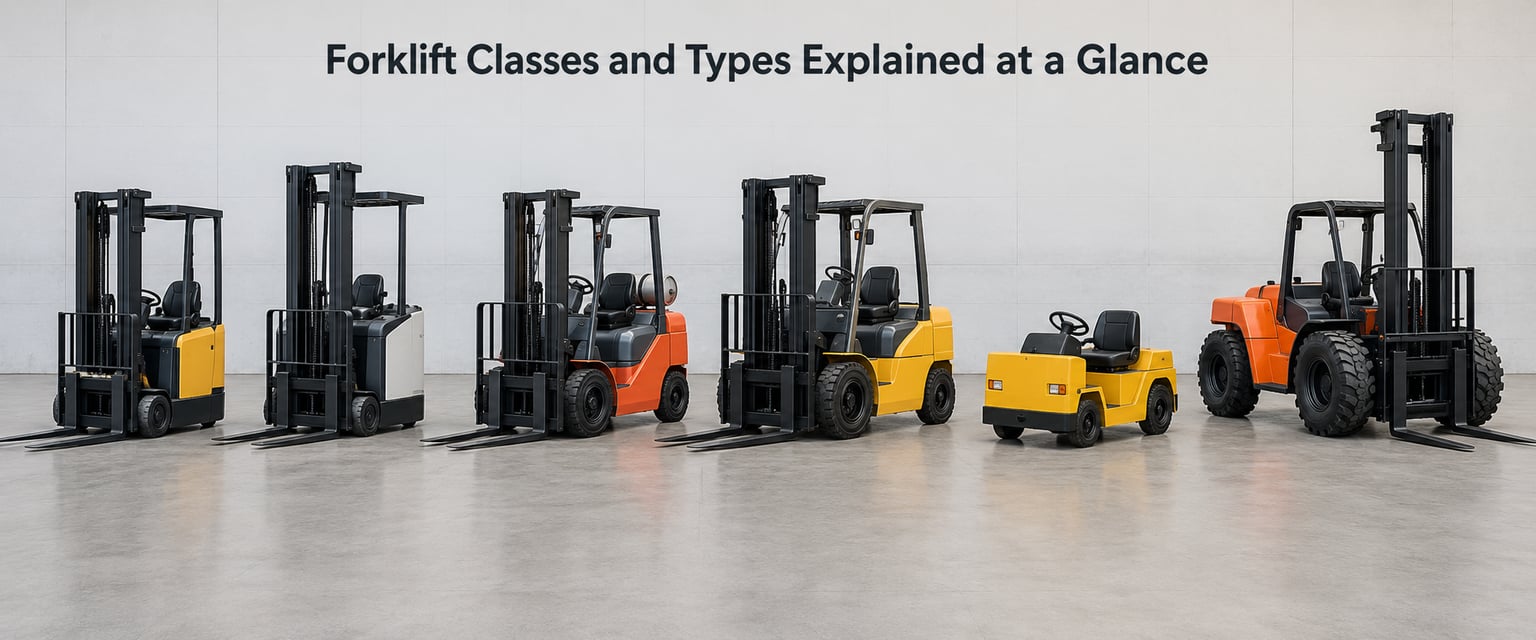
This is the whole classification on one screen. Read across each row: power source, then tires, then where the truck belongs.
| Class | Power source | Tire type | Where it belongs | Typical example |
|---|---|---|---|---|
| Class 1 | Electric motor, including battery and fuel cell | No tire restriction stated in the definition | Indoor, clean-air spaces | Electric counterbalanced rider truck |
| Class 2 | Electric motor, including battery and fuel cell | Solid tires (polyurethane) | Narrow aisles with guided racking | Narrow aisle reach or turret truck |
| Class 3 | Electric motor, including battery and fuel cell | Pneumatic or semi-pneumatic | Indoor floor-level handling | Walkie pallet jack, hand-rider |
| Class 4 | Internal combustion engine | Cushion (solid) tires only | Indoor, smooth sealed floors | Propane counterbalanced rider |
| Class 5 | Internal combustion engine | Pneumatic tires only | Outdoor yards, docks, gravel | Diesel or LP gas pneumatic counterbalance |
| Class 6 | Electric motor or internal combustion engine | Pneumatic tires only | Indoor transport, towing | Tow tractor or tugger |
| Class 7 | Internal combustion engine | Pneumatic tires only | Rough outdoor terrain | Rough terrain forklift |
Two details in that table cause more confusion than anything else. Classes 1, 2, and 3 are all electric and differ mainly by tire type, not by fuel. And Class 6 trucks tow; they do not lift forks under a load, so a lot of people assume they sit outside the rules.
What Is a Forklift Class?
A forklift class is a power and construction grouping, not a ranking. Nothing about it says one class is bigger or better than another, and a Class 7 rough terrain machine can have less usable indoor capability than a Class 1 electric rider.
Three things sit outside the class system, and mixing them up is the most common source of confusion in training rooms:
- Body style — counterbalance, reach, straddle, order picker, side loader, turret, telehandler.
- Lift mechanism — standard mast, extendable or free-lift mast, pantograph, swing mast.
- ITA lift code — the sub-number that describes how the truck handles the load (unit height, go-up-over-the-obstacle, straddle, mast and truck combined, platform).
So a narrow aisle reach truck is Class 2 because it is electric with solid tires, and it is also a reach truck by configuration, and it may carry ITA lift code 2. All three statements are true at the same time.
Forklift Class 1: Electric Motor-Powered Trucks
Class 1 covers motorized power trucks with electric motors, including battery-powered, battery-plus-fuel-cell, and other electric motor trucks, with no tire restriction written into the definition. In practice these are the electric counterbalanced riders and three-wheel electrics you see in warehouses, hospitals, and food plants. There are no tailpipe emissions, so they are the default choice indoors.
Charging drives the decision here. Older units use flooded lead-acid batteries on a 24, 36, or 48-volt system that need watering, a ventilated charging room, and a weekly equalizing routine. Lithium-ion packs need less floor space, charge faster, and tolerate partial charging, but the truck has to be built for them from the start. ITA lift codes 1, 4, 5, and 6 sit inside this class, which is why Class 1 spans unit-height counterbalances and high-lift straddle units.
Forklift Class 2: Electric Motor-Powered Narrow Aisle Trucks
Class 2 is electric with solid tires, and the solid tire is the whole point. A rigid polyurethane tire cannot be punctured, carries a higher load rating than a comparable pneumatic, and rolls quietly, so the classification naturally collects the machines that work in aisles as tight as 8 to 10 feet inside guided narrow aisle racking.
These trucks have the tightest turning radius in the business. That comes at a cost in stability over uneven floors, which is why a solid-tire Class 2 belongs on a sealed, level slab and nowhere else. The most common configurations are the reach truck (stand-up and sit-down) and the turret or side loader, which pivots the operator and the mast out sideways to pick from both sides of a narrow aisle.
Forklift Class 3: Electric Motor-Powered Hand Trucks
Class 3 is electric with pneumatic or semi-pneumatic tires, and the members are the trucks you walk behind: the walkie pallet jack, the hand-rider, and the platform pull-style units. The defining feature is that their forks stay close to the floor, so the load is dragged and steered rather than raised. Their rated capacity is real, but their usable lift height is effectively zero, and their reach is defined by a draw bar pull figure rather than a lift height.
Pedestrian-controlled versions are steered by a tiller bar and need plenty of room behind the operator, which is why many of them carry a dead-man switch on the handle. The class is the only OSHA forklift class that includes equipment most operators never think of as a forklift at all, even though it sits in the middle of the numbering.
Forklift Class 4: Internal Combustion Trucks With Cushion Tires
Class 4 is an internal combustion engine truck with cushion tires only, and a cushion tire is a solid rubber or polyurethane tire that is inflated to a few hundred PSI around a hollow core. It is not a car tire and it cannot be repaired like one. The result is zero flats, a very high load rating for the amount of floor space it takes, and smooth operation on a sealed warehouse floor.
Propane and LP gas are the usual fuels here, and the engines are smaller than the diesel units in Class 5. The trade is real: no charge plug, no charging room, a full tank of onboard energy, and lower fuel bills, in exchange for exhaust, noise, and the need for ventilation indoors. Cushion tires are the deciding factor, and a Class 4 truck taken onto gravel will destroy the tire in a week.
Forklift Class 5: Internal Combustion Trucks With Pneumatic Tires
Class 5 is an internal combustion engine truck with pneumatic tires only. The air-filled tire gives it ground clearance and shock absorption that cushion tires cannot match, which is why Class 5 is the outdoor class: loading docks, gravel yards, construction approaches, and anything else with rough surfaces. Diesel dominates long-haul and high-duty-cycle work, while LP gas runs shorter duty cycles and lighter loads.
If your operation keeps one truck on a dock apron and another in a warehouse, the pair is usually a Class 5 outside and a Class 4 or Class 1 inside, and the two are separate machines with separate training records. The higher fuel range of a Class 5 removes mid-shift refuelling as a scheduling problem, which is worth real money on a two-shift operation.
Forklift Class 6: Tow Tractors and Tuggers
Class 6 is motorized power trucks with electric motors or internal combustion engines, with pneumatic tires only, used primarily for towing a non-powered load on a draw bar. A tow tractor and a tugger are the same idea: no forks lifting a pallet, a pin hitch or a connection point instead, and a train of carts behind. Operators are often surprised to learn they still fall under the powered industrial truck training requirement.
The draw bar pull figure on the data plate is the number that matters here, not a load capacity in pounds on forks. Tuggers running down fixed warehouse lanes often use a drawbar pull figure of 5,000 pounds or more to haul long cart trains, and anything under a specific draw bar pull threshold falls in a different certification bucket in some jurisdictions. Class 6 machines are a fleet tool, not a lifting tool, and specifying them as a substitute for a forklift is the fastest way to buy the wrong truck.
Forklift Class 7: Rough Terrain Forklifts
Class 7 is rough terrain forklifts with pneumatic tires only. The tires are the formal requirement; the practical signature is the tall ground clearance, oversized tires, and a frame that clears broken ground, which is why they do not share the geometry of a warehouse counterbalance.
Typical work is construction sites, lumber yards, agriculture, and heavy outdoor material handling. You will see them loading hay bales, moving pipe and timber, and setting forms. A Class 7 is overkill indoors and a liability in a 10-foot aisle, but on gravel it is the only one of the seven that makes sense.
ITA Lift Codes: The Numbering Inside Each Class
The ITA lift code is the sub-number people mix up with the class. A lift code describes the load-handling mechanism; a class describes power and tires. Lift codes 1 through 6 are the common ones in US training:
| Lift code | What it describes |
|---|---|
| 1 | Unit height, counterbalanced |
| 2 | Unit height, not counterbalanced |
| 3 | Go-up-over-the-obstacle |
| 4 | Straddle legs or high lift straddle |
| 5 | Truck and mast combination with a retractable mast |
| 6 | Platform or side loader |
Codes above 6 cover turret and other specialized pickup arrangements. Read the pairing this way: a cushion tire propane counterbalance in Class 4 is usually lift code 3, because the operator goes up over the load as it lifts; a pneumatic counterbalance in Class 5 is usually lift code 1, unit height counterbalanced; a reach truck is lift code 2; and Class 7 rough terrain machines run codes 1 or 2. Outside the US, other schemes apply: South Africa’s Occupational Health and Safety Act organizes lift trucks into sixteen capacity-based F codes rather than these power-based classes, so a certificate or manual from another country will not line up one to one with OSHA numbers.
How to Identify Your Forklift’s Class
Most people do not need to guess. Every powered industrial truck carries a certification and data plate, and the employer’s classification duty under 1910.178 rests on reading it. Work through these steps in order:
- Find the data plate on the mast, dash, or side panel and read the model designation and serial number.
- Identify the power source physically: a battery compartment and charger connection means electric, a fuel tank and exhaust means internal combustion.
- Check the tires. Solid rubber or polyurethane means Class 2, cushion tires mean Class 4, pneumatic or semi-pneumatic narrows it to Class 3, 5, 6, or 7.
- Look at the frame and the height of the ground clearance. A truck that straddles its load is a straddle, a truck with a pivoting mast is a turret, and a tall clearance frame is a rough terrain machine.
- Use the manufacturer’s serial number decode chart or call the dealer to confirm before you record a training category.
If the plate is missing, faded, or repainted over, the truck still has to be classified and the employer needs a documented way to do it, which is why most sites keep the serial numbers and classes in a fleet register rather than relying on the physical label alone.
Forklift Types by Configuration and Application
Class tells you what powers the truck. Configuration tells you what shape it is. These are the configurations that cover most operations:
- Counterbalance — the standard rider truck with a rear counterweight, usable in nearly any straight aisle.
- Three-wheel electric — a counterbalance with a single front wheel, a very tight turning circle, and a shorter wheelbase that some prefer in tight indoor aisles.
- Reach truck — a Class 2 machine with a tall mast and a stand-up or sit-down cab that straddles the load, reaching into narrow aisle racking.
- Straddle and high lift straddle — legs that run down both sides of the load, allowing a pallet to be picked from the floor with no apron, then lifted above head height.
- Order picker and stock picker — a guided truck that lifts the operator to the picking face, used for one-by-one SKU collection at height.
- Turret and side loader — a pivoting cab and mast that swing sideways to work both sides of a narrow aisle without turning around.
- Rough terrain and telehandler — outdoor machines with long reach for lumber, pipe, and bulk material.
- Walkie behind and powered pallet truck — Class 3 units for floor-level moves at the dock and the staging lane.
Counterbalance, Reach Truck, or Order Picker?
These three get mixed together because they all sit in the same broad powered industrial truck family and all appear in a 40-foot aisle. They are not interchangeable, and the differences show up in the floor plan before they show up on a purchase order.
| Factor | Counterbalance | Reach truck | Order picker |
|---|---|---|---|
| Mast | Standard two-stage or three-stage mast | Tall, often pantograph, with forward reach | Mast rises with the operator cab |
| Operator position | Seated, facing forward | Seated or stand-up, facing forward | Seated in a guarded cab, lifted to the face |
| Turning radius | Standard, needs turning space at aisle ends | Very tight | Very tight, guided by racking |
| Aisle needs | About 10 to 12 feet typical | About 8 to 10 feet with guided aisles | About 8 to 10 feet with guided aisles |
| Load handling | Full-height picks, back-tilt for stability | Full-height picks, reach allows overhang | One pallet or cart at a time at height |
| Best environment | General warehouse, mixed aisles | Very narrow racking, high SKU count | Pick-to-cart and parts picking at height |
The rule of thumb I use with clients: if the aisle is a real aisle with cross-aisle turning room, a counterbalance is cheaper to buy and cheaper to maintain. If the aisle is narrow and the racking is guided, a reach truck pays for itself in rack space. If the work is picking individual cartons at head height, you need an order picker, and no amount of aisle width changes that.
Electric vs Internal Combustion, Cushion vs Pneumatic Tires
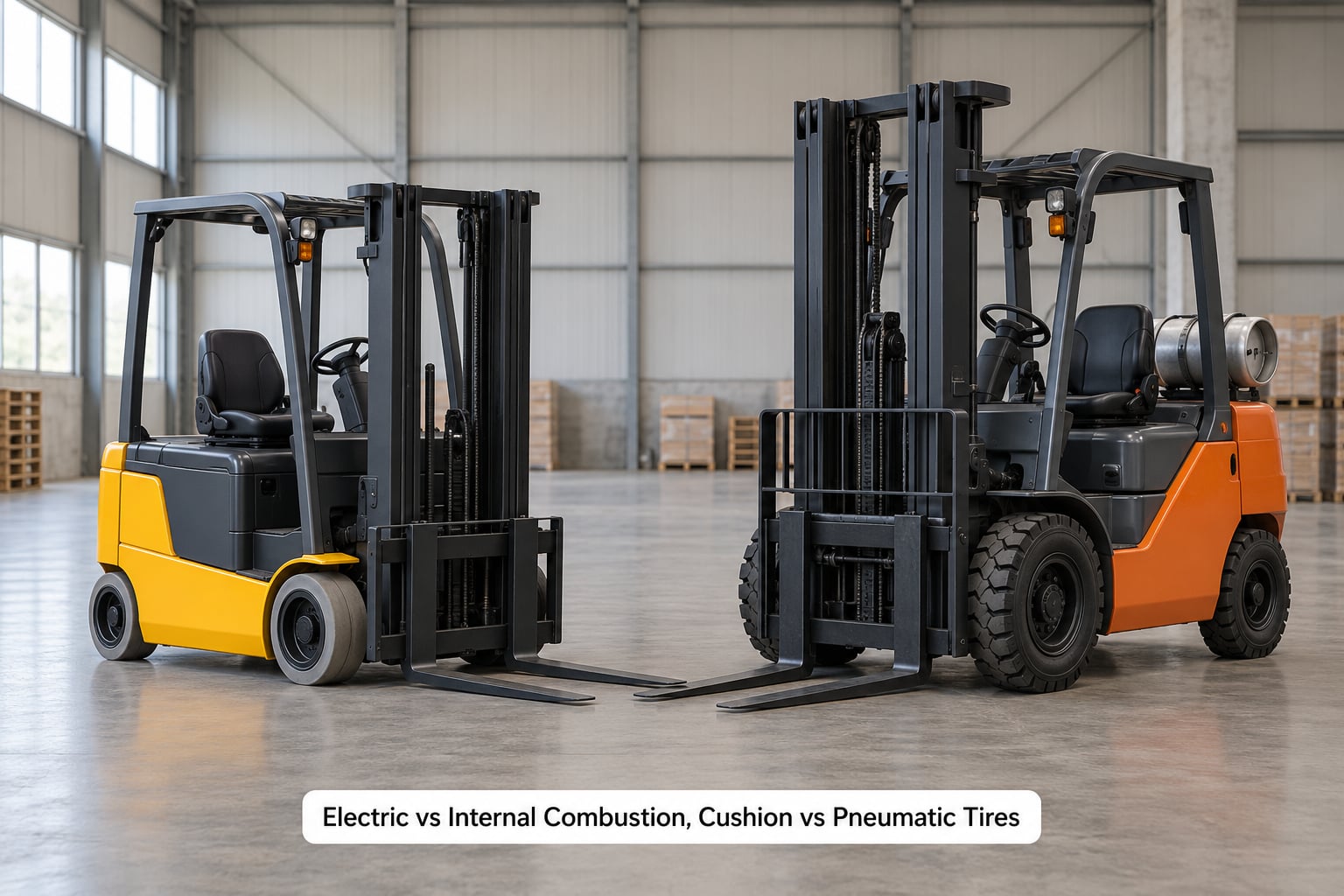
These are two separate arguments, and buyers who merge them end up with the wrong truck. Power is decided by the environment and the shift pattern. Tires are decided by the floor.
| Factor | Electric (Class 1, 2, 3) | Internal combustion (Class 4, 5) |
|---|---|---|
| Emissions | Zero tailpipe emissions, safe indoors | Exhaust, so enclosed space needs ventilation |
| Energy | Opportunity charging or a battery change mid-shift | Tank of propane on the truck, or diesel refuelling |
| Upfront cost | Higher, plus charging infrastructure | Lower, no charging room needed |
| Running cost | Electricity, battery maintenance, eventual pack replacement | Fuel, oil, engine maintenance, more moving parts |
| Floor | Sealed, level, clean | Cushion tires indoors, pneumatic outdoors |
| Best fit | Indoor, multi-shift, clean product, food and cold storage | Outdoor, docks, short duty cycles, no charging room |
Cushion tire versus pneumatic tire is the other axis. Cushion tires are quiet, flat-proof, and load-efficient on a smooth slab, and they are the only internal combustion option allowed in Class 4. Pneumatic tires handle impacts, gravel, and mud, and they are the requirement in Classes 5, 6, and 7. Most mixed-environment fleets simply run both and assign them to fixed zones.
How to Choose the Right Forklift for Your Operation
Walk these in order and the class usually decides itself. If your operation already has an upstream flow feeding the forklift bay, our guide to material handling systems for resin explained covers the same decisions one stage upstream.
- Document your loads. Weight, footprint, and how often the heaviest load actually comes up. Get the number from real shipping records, not from a recollection.
- Measure the load center and lift height. Capacity falls as the load moves forward from the fork face, so a long pallet in a high rack is a smaller capacity truck than the same pallet on the floor.
- Measure your aisles and your floor. Narrowest aisle, turning space at the ends, ramp angles, and whether the surface is sealed or gravel.
- Count shifts and hours. A second shift on battery power means charging windows, opportunity charging, or a battery change area, and that changes the economics of the whole purchase.
- Check the power infrastructure. Floor space and a dedicated circuit for a charger, or a place to park a propane exchange cage and a diesel tank.
- Plan the attachments early. A clamp, a side shift, or a 6-foot mast changes capacity, hydraulics, and training, so it belongs in the specification, not the accessory order.
- Cost it over the whole life. Purchase price is one line. Electricity versus propane and diesel, battery replacement, tire wear, service contracts, and operator hours are the other lines. It is worth reading lean manufacturing waste types explained alongside this, because an idle truck waiting on a charger is one of the eight wastes in disguise.
Do You Need Training and Certification for Each Class?
OSHA treats this as the employer’s duty rather than a license you buy once. The employer has to obtain information on the types of powered industrial trucks in use, evaluate whether an operator is competent for the specific truck, train to the applicable OSHA and manufacturer requirements, certify that training in writing, and re-evaluate the operator at least every three years. A practical test and a workplace evaluation are part of it, not an optional extra.
The honest answer to the question operators keep asking is that one certificate rarely covers the whole yard. An electric reach truck and a pneumatic counterbalance are different enough in geometry and controls that many employers treat adding one as a reason for practical retraining, and an outdoor yard running a Class 5 alongside an indoor Class 4 usually needs training documented for both. Buying multi-class training as a bundle is generally less expensive than adding endorsements one at a time later, and that is the part most first-time operators wish someone had told them before they paid for a single-class card.
State-plan states run their own approved programs, and the paperwork from one jurisdiction does not transfer. Outside the US, the answer changes again: South Africa uses OHS Act classifications and lift codes rather than OSHA numbering, so a local training provider is the only place to confirm what a given certificate covers.
Forklift Safety and Operating Requirements
A class number does not make a truck safe. The operating rules are the same in principle across all seven classes and they come from the manufacturer’s manual and your site rules, not from this article. Facilities that handle the equipment around the forklift rather than the forklift itself should read our machine guarding requirements explained: OSHA guide as well.
- Read the capacity plate and the load center chart before the first lift, and treat the reduced-capacity figure for a raised load as a limit, not a guideline.
- Run a pre-shift inspection every shift and record it: tires, forks, mast chains, hydraulics, brakes, steering, horn, lights, and any fluid leaks.
- Keep the load low while travelling and lower it before turning, backing, or entering a racking aisle.
- Use an operator restraint, keep a clear view of the load path, and never travel with the forks raised to eye level.
- Separate pedestrians from mobile equipment with physical barriers and marked walkways at the loading dock and blind corners.
- Train on the specific truck in the specific shift pattern, and retrain when the class, the configuration, or the guard changes.
- Keep ventilation in place anywhere an internal combustion engine runs, and keep charging areas dry and ventilated.
Frequently Asked Questions
What are the 7 classes of forklifts?
OSHA groups powered industrial trucks into seven classes. Class 1, 2, and 3 are electric, separated mainly by tire type: no tire restriction, solid tires, and pneumatic or semi-pneumatic respectively. Class 4 is internal combustion with cushion tires, Class 5 is internal combustion with pneumatic tires, Class 6 is a tow tractor or tugger that pulls rather than lifts, and Class 7 is a rough terrain forklift with pneumatic tires. The ITA sub-codes inside each class describe the lift mechanism.
What is considered a class 4 forklift?
A class 4 forklift is an internal combustion engine truck fitted with cushion tires only, meaning solid rubber or polyurethane tires inflated around a hollow core rather than air-filled ones. The cushion tire is the defining feature, and it limits the truck to smooth, sealed indoor floors. Propane and LP gas are the usual fuels, which is why class 4 trucks suit warehouses and food plants where ventilation is available and outdoor running is rare.
What are class 3 forklifts?
Class 3 is the hand truck class: motorized power trucks with electric motors and pneumatic or semi-pneumatic tires. The members are walkie pallet jacks, hand-riders, and platform pull-style units, most of them pedestrian-controlled by a tiller bar. Their forks stay near the floor, so the load is steered and dragged rather than raised, and capacity is described by draw bar pull rather than a meaningful lift height. Many operators do not think of them as forklifts at all.
Is an electric forklift better than a propane forklift?
Neither is better in the abstract. Electric wins indoors, in clean-air spaces, on multi-shift operations that can support charging, and wherever exhaust is not permitted. Propane wins outdoors, on short duty cycles, and at sites with no room for a charging area, because a full tank of onboard energy means no plug. The deciding questions are the environment, the shift pattern, and whether the floor can support the tire type each one needs.
Are there different types of forklift certification?
Yes, because training is tied to the specific truck. In the US, OSHA makes certification an employer duty covering the powered industrial trucks in use at that site, with practical testing, written records, and re-evaluation at least every three years. Programs differ by class and configuration, so a narrow aisle reach truck and a rough terrain machine are normally separate endorsements. Outside the US the schemes differ entirely, with South Africa using OHS Act lift truck codes rather than OSHA numbering.
What is the difference between a counterbalance forklift and a reach truck?
A counterbalance forklift carries its load on forks balanced by a rear counterweight, which gives it high residual capacity and lets it travel with the load raised. A reach truck is a class 2 machine with solid tires and a tall mast that straddles the load and leans forward to pick, which lets it work in aisles of roughly 8 to 10 feet. The trade is capacity and versatility against a very tight turning radius and the rack space it saves.
Conclusion: Start With the Work, Then Choose the Class
Write down your loads, lift heights, aisle widths, floor surfaces, shift pattern, and available power before you look at a single class. Those seven facts decide the class almost on their own: sealed floor and clean air point to Class 1 or 2, smooth indoor floor plus propane points to Class 4, rough outdoor ground points to Class 5 or 7, and pulling carts means Class 6. Then confirm it against the data plate of the truck you are actually buying, and document the class in your training records so the file and the yard agree.