
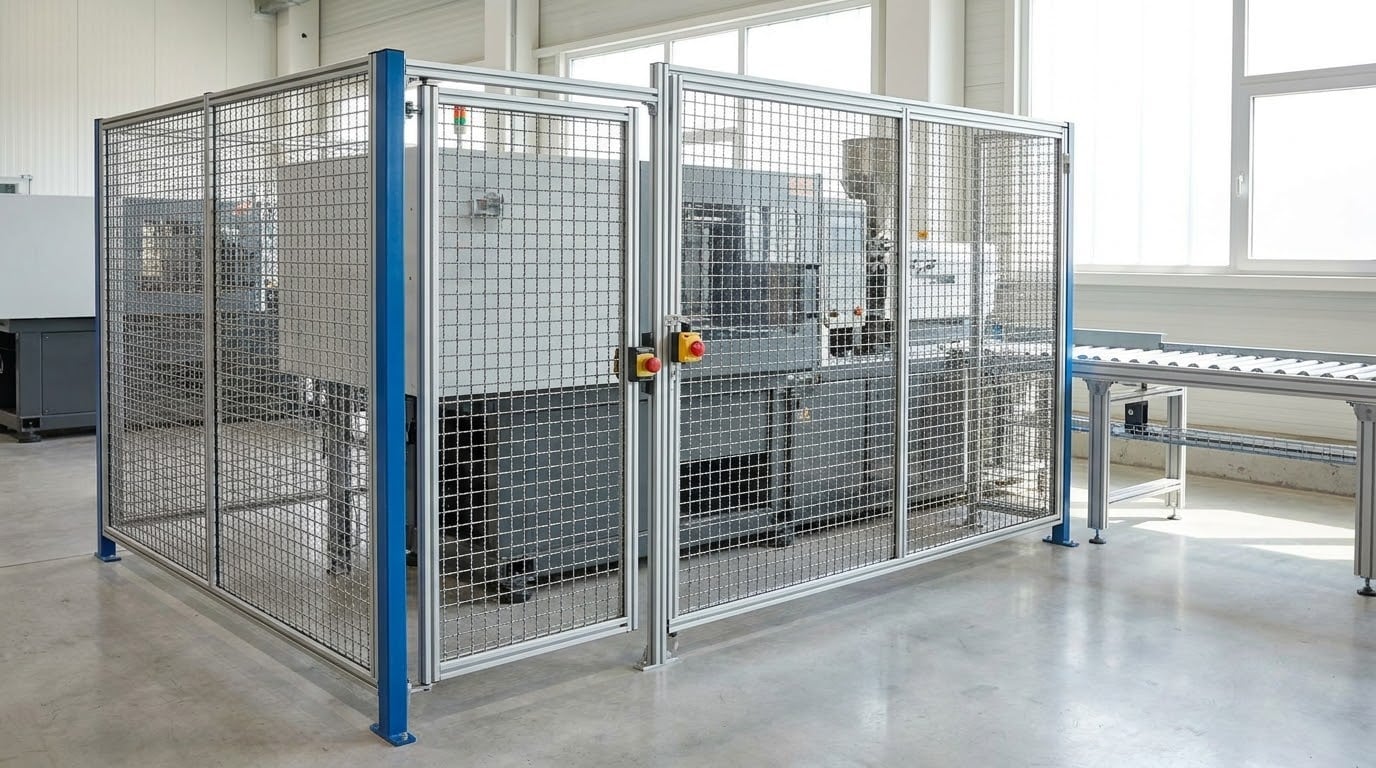
Machine guarding requirements come down to one federal rule for general industry: 29 CFR 1910.212, which sits inside 1910 Subpart O along with the lockout/tagout and mechanical power transmission standards. It requires one or more guarding methods on machines so no employee can put a hand, arm, foot or clothing into a danger zone while the machine runs. How a plant builds those guards is governed by risk assessment rather than a single dimension, so what follows covers the OSHA floor first and then the practical choices behind it.
Table of Contents
- Machine Guarding Requirements at a Glance
- What Does OSHA Require for Machine Guards?
- How Do You Perform a Machine Guarding Risk Assessment?
- What Are the Best Types of Machine Guards?
- What Are OSHA Guard Clearance and Openability Requirements?
- What Materials and Design Features Make a Proper Guard?
- Do Safety Interlocks Need to Be Used on Every Machine?
- How Should Machine Guards Be Inspected and Documented?
- Common Machine Guarding Mistakes to Avoid
- What Do OSHA and ANSI Standards Mean for Manufacturers?
- Machine Guarding Requirements for U.S. Plastics Plants
- Frequently Asked Questions
- Machine Guarding Compliance Starts with the Risk Assessment
Machine Guarding Requirements at a Glance
| Requirement | Source | Who owns it | Record to keep |
|---|---|---|---|
| One or more methods of machine guarding on hazards | 1910.212(a)(1) | Employer / EHS | Written guarding program |
| Guards afford protection from hazards including point of operation, ingoing nip points, rotating parts, flying chips and sparks | 1910.212(a)(2) | Machine owner / maintenance | Machine guarding survey |
| Power transmission apparatus guarded | 1910.212(a)(3) | Maintenance lead | Transmission guard checklist |
| Guards secure, durable, creating no new hazard, allowing safe operation and lubrication | 1910.212(a)(4) | Guard designer / maintenance | Risk assessment per machine |
| Guards affixed to the machine where possible, secured elsewhere if attachment is not possible | 1910.212(a)(5) | Maintenance lead | Attachment verification at install |
| Point of operation guarded on the machines named in the rule | 1910.212(a)(3)(iv) | Production supervisor | Operator interface verification |
| Fixed machinery anchored | 1910.212(b) | Facilities / maintenance | Anchor inspection record |
| Energy control before any guard removal or service | 1910.147 | Authorized employee only | LOTO procedure and log |
| Operators trained on the safeguard and its limits | 1910.212 plus program duty | Supervisor | Training record with dates |
Two things are easy to miss in that table. First, OSHA sets performance outcomes, not drawings, so a plant has to document why the guard it chose works for that machine. Second, the named-machine list in 1910.212(a)(3)(iv) is a floor, not a ceiling. Anything else with a hazard that the risk assessment identifies needs protection too.
What Does OSHA Require for Machine Guards?
29 CFR 1910.212 opens with a general duty. One or more methods of machine guarding must be provided to protect the operator and other employees in the machine area from hazards including point of operation, ingoing nip points, rotating parts, flying chips and sparks.
Read that carefully, because it does two things at once. It fixes the outcome, meaning no body part in the danger zone during the operating cycle. And it names the hazard families that count: point of operation, nip points, rotation, and anything thrown from the machine.
Point of operation
The point of operation is wherever work happens on the machine: the cutting zone of a saw, the die area of a press, the tool end of a mill. Hands go here by design, so guarding has to stop access without stopping the work.
Power transmission apparatus
This is the mechanical chain that drives the machine: belts, pulleys, chains, gears, shafts, couplings, flywheels, cranks, cams, connecting rods and spindles. Projecting keys, set screws and clamps get named explicitly, because they are the pieces that catch clothing and drag a person in.
Other moving parts
Anything else that moves and can hurt someone counts. Reciprocating slides, transverse carriages, powered rollers and forming rolls all fall here. Each plant has its own list, and it belongs in the written program.
The 1910.212(a)(3)(iv) clause names specific machines whose point of operation must be guarded: horizontal and vertical boring mills, milling machines, power saws, jointers, band saws, belt saws, guillotine cutters, shears, alligator shears, power presses, power-operated forging hammers, mechanical power presses, press brakes, friction brakes, flying butts, stationary or revolving drums, barrels and containers, power-driven milling, turning and boring machines, power-driven planers, jointers, and similar machines. Similar is doing real work in that sentence.
One more clause closes the scope. Anchoring fixed machinery is required so the whole machine cannot move if a force is applied. A free-standing saw on a smooth floor is a violation waiting for a forklift.
How Do You Perform a Machine Guarding Risk Assessment?
OSHA does not publish an opening-size table or a required guard design for your machine. The assessment is how you get to a defensible answer, and the process repeats per machine, not per site.
- Map the machine. Walk it end to end at 360 degrees and list every place a person can put a body part in: front, back, top, underside, overhead and both sides.
- Identify the hazard at each access point. Rotating, reciprocating, transverse, cutting, punching, shearing, bending, plus flying debris, hot surfaces, sharp edges and electrical parts.
- List the energy sources. Electrical, mechanical, hydraulic, pneumatic, thermal, gravity, stored pressure and residual energy in the part or workpiece.
- Judge reachability. Ask what a person can actually get to, not what the drawing shows. Body-part access through an opening decides the whole design.
- Record the existing controls. Presence sensing, interlocks, two-hand controls, restraints, light curtains, scanners, and any pullback or catch arrangement already fitted.
- Look at foreseeable misuse. Reaching over a low guard, tying off a part, feeding scrap by hand, defeating an interlock with a magnet or cable tie, running the machine with a panel off.
- Estimate the risk. Severity plus likelihood plus frequency of exposure, then select the safeguard that drops the risk rather than one that is simply cheap.
- Verify after installation. Cycle the machine, test every interlock with the safety device tester, and confirm nothing interferes with production, lubrication or die changes.
Step six is where most failed programs live. A guard that makes the job unreasonably slow or dangerous will get bypassed within a week, and a bypassed guard is an unguarded machine as far as the inspection record is concerned.
What Are the Best Types of Machine Guards?
The most reliable guard is the one that stays in place and needs no action from the operator. Everything below is legal; what differs is the effort each one demands and the failure modes it tolerates.
| Guard type | How it satisfies 1910.212 | Where it works | Limitation |
|---|---|---|---|
| Fixed guard | Physical barrier affixed to the machine, no operator action needed | Long production runs, low part-change frequency | Slows setup, cleaning and die changes |
| Adjustable / self-adjusting guard | Barrier that tracks the work zone automatically | Small presses, saws with varying stock | Moving parts of its own, needs inspection |
| Interlocked guard | Guard position stops or disables the hazardous motion | Frequent access, robotics and press cells | Needs a safety-rated circuit and a tested switch |
| Presence-sensing device (light curtain, scanner) | Detects a body part and triggers a safe stop | Open access designs where a barrier blocks the job | Blind spots, muting logic, requires risk assessment |
| Trip device | Shuts the machine down instantly on contact | Foot and hand presses, high-injury applications | Must be hardwired or safety-rated, no standard wiring |
| Two-hand control | Machine runs only while both hands are held on the buttons | Hand-operated presses, foot-treadle alternatives | Needs anti-tie-down, timed anti-repeat |
| Restraint system | Prevents the operator from reaching in by limiting body position | Loading and sorting stations | Restricts the operator, does not stop the machine |
| Catch guard | Catches or contains thrown parts, chips and sparks | Grinding, high-speed cutting, milling | Does not prevent body-part contact |
| Pullback and pushback device | Physically pulls or pushes hands clear of the point of operation | Foot treadles, hand-fed work | Requires careful adjustment to the stroke |
Most plastic and metal plants end up with a mix. A fixed perimeter guard around the clamp area of a molding machine, an interlocked door at the operator interface, presence sensing along the conveyor approach, and two-hand or trip devices on any hand-fed press.
What Are OSHA Guard Clearance and Openability Requirements?
There is no single OSHA opening size for every machine guard, and anyone quoting one universal number is oversimplifying. The requirement is outcome-based: the opening must not permit a body part to reach a hazard, and the closer the hazard, the smaller the opening has to be.
The one number in the standard is specific. Where the periphery of a fan blade is exposed to contact, it must be guarded so the opening does not permit contact with the blade periphery. Where a fan is located below 7 feet above the floor, the guard must prevent a hand from reaching the blade periphery.
The old one-half inch rule of thumb is the most misused idea in this area. It came from legacy documents and shows up in vendor catalogs as a universal figure. It is not a safe blanket for a modern reach-distance assessment, and treating it that way can leave a large opening beside a slow-moving hazard that a hand can simply reach into.
What actually governs the design is reach distance. As the distance between the opening and the hazard grows, the acceptable opening grows with it, and the accepted methods come from ISO 13849 and the ANSI B11 series rather than from the CFR. Where an opening cannot be sized to keep fingers out, close it with mesh, polycarbonate or expanded metal sized to the reach analysis.
Guards also have to control where a person can put their hand, not just how large the gap is. A guard that can be swung open on a hinge during a cycle is not a guard, it is a suggestion.
What Materials and Design Features Make a Proper Guard?
Guards must be secure against the machine and afford the operator protection from hazards including those created by cutting, punching, shearing, bending or any similar operation. It must create no hazard itself and must not interfere with the work. That is the legal frame; here is what it means in a shop.
- Strength and durability. Built for normal operating conditions, not for a compliance photo. Sheet steel over structural framing, or polycarbonate where visibility matters.
- Secure attachment. Affixed to the machine where possible. If attachment is not possible, secured elsewhere so it cannot be displaced in normal use.
- No new hazard. No sharp edges, no projecting hardware, no trap points, no pinch created at the mounting, nothing that produces dust or debris.
- Visibility. Guards that hide the work get removed. Wire mesh, expanded metal or clear polycarbonate usually beats an opaque plate on inspection or assembly stations.
- Maintenance and lubrication access. A guard that blocks a grease fitting gets taken off, so design the access in from the start.
- Inspection visibility. You need to see the mounting, the interlock actuator and the fasteners. Lifting the guard for every check means it will not get checked.
- Electrical features. Interlock and sensing circuits belong in a safety-rated control circuit, not in the general machine control wiring.
- No interference. Guards must not interfere with the work or the machine’s operation. A guard that fouls the stroke or scrapes the floor is a guard that comes off.
Do Safety Interlocks Need to Be Used on Every Machine?
No. Interlocks are one safeguarding method among several, and the right choice depends on how often the machine must be accessed and how far the hazard sits from that access.
Keep three things separate. A guard interlock is a safety-related device that stops hazardous motion when the guard opens. A presence-sensing device detects a person without any guard present. A process interlock is a control function that stops the cycle for reasons that have nothing to do with personal safety, such as a part not presenting.
Interlocks must fail safe. Open the circuit and the machine goes to a safe state, not to a run state. A duct-taped switch or a magnet holding a tongue closed is not an interlock, and any plant that has one is documenting a known hazard rather than a control.
Interlocks can also fail quietly. Guard position switches drift, light curtains get blinded by a dusty molding area, scanners get nudged out of alignment. That is why they need scheduled functional testing, defect reporting, and a clear rule that a failed interlock takes the machine out of service rather than being bypassed until the next shift.
What an interlock never does is replace the evaluation. Fitting a light curtain does not tell you the reach distance was right, and adding an interlock to a badly designed guard does not make the opening safe.
How Should Machine Guards Be Inspected and Documented?
OSHA requires guards to be in place and functional while the machine runs. Keeping them there is a program, not a purchase. A defensible program has four layers.
Pre-use checks
A short operator check before the shift: guards present, fastened, no visible damage, interlock functional, no bypass device in place. Short enough to actually happen, recorded on a card or in a log.
Scheduled inspections
Risk-based intervals set by the guarding program. Monthly for high-hazard machines like presses and robotic cells, quarterly for conveyors and saws, annually as a baseline for everything else, and after any change to the machine.
Guard removal and lockout/tagout
This is the most misunderstood requirement in the whole topic. A guard may be removed, but only under a documented procedure: the machine is shut down, hazardous energy is controlled under 1910.147, and the authorized employee installs a personal lock. The guard goes back on before the machine returns to production, and the affected employees are told when it is back in service.
Records
Keep the written guarding program, the per-machine risk assessment, inspection results including defects found, repair and replacement records, out-of-service tagging logs, lockout/tagout procedures and logs, and training records showing who was trained on which safeguard. When a machine is moved, modified or has a retrofit installed, the assessment gets redone.
If the plant also moves resin and pellets around, material handling systems for resin explained covers the conveying side that guards attach to.
Common Machine Guarding Mistakes to Avoid
Most citations come from a short list of repeating behaviours, and every one of them has a fix.
- The removed or defeated guard. A panel sitting on the floor beside the machine. Fix: a documented removal procedure, out-of-service tagging, and a plan that makes the guard fast to put back.
- Openings sized by habit. Mesh copied from another machine. Fix: reach-distance analysis per access point.
- Bypass during cleanup. Changeover and scrap removal are when most amputations occur. Fix: interlocked access or a catch arrangement that works with the machine stopped.
- Improvised substitutes. Plastic sheeting, packing tape over an interlock switch, a bent sheet-metal plate. Fix: remove it, and fix whatever operational problem made it tempting.
- Fragile or unreported interlocks. Fix: safety-rated circuit, scheduled test, and a no-questions-asked out-of-service path.
- Incomplete lockout coverage. Guards removed while pneumatic or stored energy is still live. Fix: a machine-specific energy control procedure, not a plant-wide generic one.
- Records that do not match the floor. A checklist listing machines that were moved, sold or reconfigured. Fix: reconcile the guarding inventory against the actual asset list each quarter.
What Do OSHA and ANSI Standards Mean for Manufacturers?
OSHA is the law. ANSI B11 and the ISO standards are consensus documents, and a plant is not cited for violating them directly. But they are the technical basis courts and safety professionals rely on when deciding whether a guard was adequate, and they make a risk assessment far easier to defend.
The pieces that come up most often:
- ANSI B11 series — machine-specific guidance for presses, forging machines, saws, cutting tools and robots. It is the practical starting point for what a machine-specific guard should look like.
- ISO 14120 — guards and interlocks, general principles for design and selection. Useful for deciding between a fixed barrier and an interlocked one.
- ISO 13849-1 — safety-related parts of control systems, including performance level and category for interlock circuits. This is how you justify the reliability of a safety-rated guard circuit.
- ISO 14119 — interlocking devices, covering interlocks, guard locking and the defeat risks you have to design out.
- ANSI Z535.1 — safety colors and markings, which is where guard identification and hazard marking come from.
None of these replace the employer’s duty to evaluate the actual machine in front of you. They tell you what a well-designed solution looks like so the evaluation is defensible rather than improvised.
Machine Guarding Requirements for U.S. Plastics Plants
Plastics plants carry a mix that general machine guarding guidance rarely addresses, because the hazards are mechanical and thermal at the same time.
Molding machines. The clamp area is the dominant point-of-operation hazard: platens close at speed under pressure. Guard the clamp zone, interlock the door and the safety gate, and keep the lockout procedure specific to the injection, screw and clamp circuits separately. Hot runners and melt breakaway add serious burn risk that a perimeter guard does not address, so heat guarding and melt-drip control belong in the same risk assessment.
Extrusion and forming. Augers, rolls and calender nip points draw in from almost any direction. Die areas on forming rolls need guarding sized so no hand reaches the roll gap, and rolls that draw a hand in are better solved by restraint or pullback than by mesh alone.
Conveying and feeders. Belt drives, pulleys and takeoff sprockets need power transmission guarding, and screw feeders and hopper access points need guarding against the rotation hazard and the pellet flow. Our OSHA requirements for a plastics plant covers the rest of the plant compliance picture beyond guarding.
Trimming and assembly. Trimmers, hot runners and powered fixtures get improvised guarding fastest. The press type matters here: if you are choosing between hydraulic and electric, how to select a hydraulic vs electric molding machine affects which clamp guarding and interlock architecture you will end up living with.
Robot cells. Robot motion is the hazard, not the tool. That means safeguarding or presence sensing across the whole approach envelope, a safe speed or safe monitored stop during access, and guarding that does not let anyone step into the swept path during a recovery.
Frequently Asked Questions
Can a machine guard be made from plastic or sheet metal?
Material alone does not decide it. 1910.212(a)(4) requires guards to be secure and durable under normal operating conditions and to create no hazard of their own. Polycarbonate and acrylic are widely used for viewing panels and light-curtain protection because they resist impact and stay clear. Plain sheet metal is common for frames and transmission covers, but thin unbraced sheet alone is rarely adequate for a point-of-operation barrier where impact loading is possible. Thicker plate, structural framing, and correctly sized fasteners do more for compliance than the material name does. Where a corrosive washdown environment exists, verify the material against the chemical exposure before specifying it.
Is a safety interlock required for every hazardous machine?
No. An interlock is one safeguarding method among several, and OSHA does not name it as the only acceptable control. Choose it where frequent access is genuinely required and a fixed guard would be removed constantly, and use a fixed barrier where access is infrequent. What the standard does require is that whatever method you choose prevents the operator from reaching the hazard during the operating cycle, and that any interlock used is part of a safety-rated control circuit, is fail-safe, is tested on a schedule, and has a defect reporting procedure. Fitting an interlock to a poorly sized opening does not make the machine safe.
What are the OSHA opening limits for machine guards?
There is no single universal opening limit in the regulation. The requirement is that the opening must not allow a body part to reach a point of operation or rotating part while the machine runs. The one specific dimension in 1910.212 relates to fan blades: where a fan is located below seven feet above the floor, the guard must prevent a hand from reaching the blade periphery. Many plants still work to the older one-half inch rule of thumb, but that figure is a legacy reference rather than a general clearance table. Size openings from a reach-distance analysis based on the hazard type and its distance from the opening, and close gaps with mesh or polycarbonate where a reach remains possible.
When are temporary guards acceptable during maintenance?
Temporary or partial guards are acceptable only when a documented procedure exists and hazardous energy is controlled. Under the guarding requirement, a guard may be removed if it creates a hazard or interferes with normal operation, but removal should follow a written procedure and the machine must be locked out under 29 CFR 1910.147 before any body part enters the danger zone. Only authorized employees perform that work, personal locks are applied, and the guard goes back on before the machine returns to production. Affected employees get told when the machine is back in service. Routine practice of running a press or saw with a panel removed is the single most common repeat citation in this area.
What machine guarding records should a U.S. manufacturer keep?
Keep the written machine guarding program, a per-machine risk assessment for every guarded machine, the guarding survey or audit results, scheduled inspection records including defects found, repair and replacement records, out-of-service tagging logs, machine-specific lockout/tagout procedures and application logs, and training records showing which employees were trained on which safeguard and when. Reconcile the list of guarded machines against the actual asset register on a schedule, because a checklist that still lists a machine you sold or moved is the weakest document in the set. Redo the assessment after any retrofit, relocation or change of guarding method, and keep the reasoning with the record.
Machine Guarding Compliance Starts with the Risk Assessment
The rule is short and the work is not. Here is the order that gets a plant from a gap to a defensible program.
- Identify every hazardous energy source and every access point, machine by machine, at 360 degrees.
- Assess reachability at each access point and size openings from that analysis rather than from a legacy rule of thumb.
- Select a safeguard rated for that hazard and that access frequency, and put it in a safety-rated circuit where electronics are involved.
- Verify it does not interfere with production, lubrication, cleaning or die changes, because a guard that gets in the way will be defeated.
- Train operators on the safeguard and on its limits, and give them a way to report a failed device without a fight.
- Inspect on a risk-based schedule, test every interlock functionally, and document what was found and what was repaired.
- Document the decision and keep it with the machine, so the next inspector reads your reasoning and not just your checklist.
Start with the machines where access is frequent, because those decide whether the program holds. Everything else follows from the same process.