
If you need one material for a precision gear train or a dry-running bearing, pick acetal (polyoxymethylene, POM). If the part sees shock loads, abrasion or sustained heat, pick nylon (polyamide, PA6 or PA66). For most mixed gear trains, using one of each is the strongest answer.
That is the short version. The long version is that acetal and nylon fail in opposite ways, and neither failure is obvious from a data sheet. Acetal is stiff, dimensionally stable and fatigue-resistant, but it is notch-sensitive and gives up its strength above roughly 85 to 90 °C. Nylon absorbs water, swells, softens and takes a set, but it shrugs off impacts, resists abrasion better and keeps useful strength about 20 to 30 °C higher.
So this is not a search for the strongest plastic. It is a search for the material whose weakness your part never touches. A data sheet describes a part sitting still at 23 °C in dry air, and almost nothing you build looks like that.
Below I cover the properties that move the decision, three worked calculations you can run on your own numbers, and the failure symptoms that tell you which material you picked wrong. The failure symptoms are where acetal vs nylon for gears and bearings usually goes wrong, because both materials fail quietly before they fail loudly.
Table of Contents
- Acetal vs Nylon for Gears and Bearings at a Glance
- What Is Acetal, and How Does It Perform in Gears and Bearings?
- What Is Nylon, and How Does It Perform in Gears and Bearings?
- Acetal vs Nylon: Strength, Stiffness, and Dimensional Stability
- Wear, Friction, and Long-Term Durability
- Moisture, Temperature, and Chemical Resistance
- Machinability, Molding, and Manufacturing Cost
- Which Acetal or Nylon Grade Is Best for a Specific Part?
- Which Should You Choose?
- Frequently Asked Questions
- Conclusion: Choose by Operating Conditions, Not by Material Name
Acetal vs Nylon for Gears and Bearings at a Glance
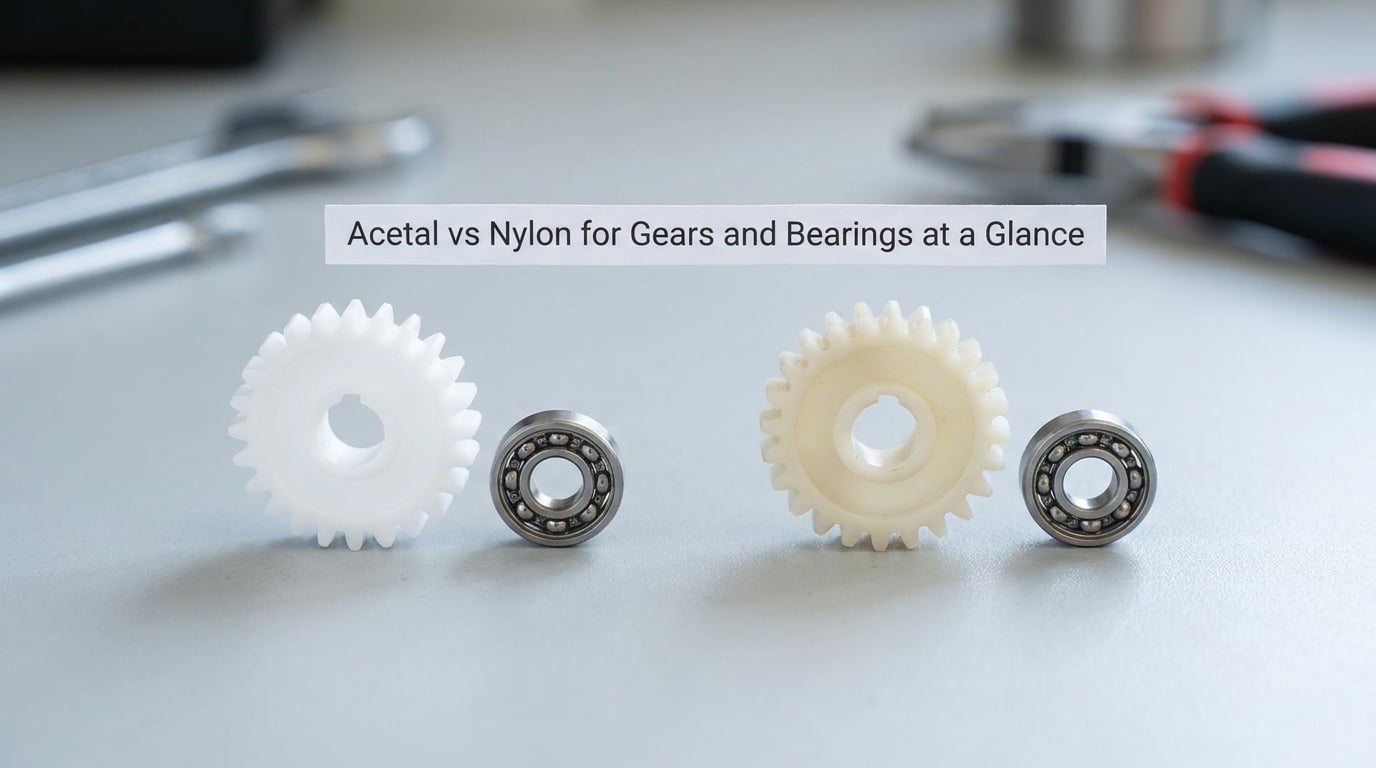
Acetal wins for precision, dimensional stability and fatigue life. Nylon wins for temperature, impact toughness and abrasion resistance. Choose acetal when tolerance, backlash and quiet running matter more than heat and shock; choose nylon when the part gets wet, hot, dirty or knocked about.
| Property | Acetal (POM) | Nylon PA66, dry as molded | Nylon PA66, conditioned at 50% RH |
|---|---|---|---|
| Moisture absorption, by weight | about 0.2% | about 2.5% | about 7 to 8% at saturation |
| Dimensional stability | Excellent, tight tolerances hold | Fair, swells noticeably | Poor, dimensions move with humidity |
| Long-life fatigue allowable (10^7 cycles) | roughly 30 MPa | roughly 25 MPa | roughly 20 to 22 MPa |
| Continuous service temperature | about 85 to 90 °C | about 100 to 105 °C | same ceiling, lower stiffness |
| Coefficient of friction against steel | about 0.15 to 0.25, stable | higher and moisture-dependent | higher still, film stabilised |
| Unlubricated PV capability | Good | Moderate | Moderate |
| Abrasion and galling resistance | Moderate | Good | Good |
| Impact and shock tolerance | Poor, notch-sensitive | Excellent | Excellent |
| Creep and stress relaxation | Moderate | Significant | Significant |
| Machining behaviour | Stable, holds detail, needs sharp tools | Forgiving, gummy if dull | Same as dry, dimensions already moved |
| Typical applications | Precision gears, meter gears, cages, valves, low-friction bushings | Larger gears, rollers, wear strips, conveyor parts, cam followers | Same, sized with the swollen condition in mind |
These are representative handbook figures for common grades, not certified design allowables. Published numbers are usually measured dry at 23 °C, which describes a part sitting on a bench, not a gear turning at 70 °C in a humid plant. Confirm anything you rely on against the datasheet for the exact grade.
What Is Acetal, and How Does It Perform in Gears and Bearings?
Acetal is polyoxymethylene, abbreviated POM, and sold under trade names such as Delrin, Celcon and Hostaform. It is a semi-crystalline thermoplastic with a very low amorphous fraction, and that small amorphous fraction is the whole story: almost no absorbable water, almost no dimensional movement, and a predictable friction surface.
Two variants exist. The homopolymer has the higher stiffness and the higher melt flow, and it is the version most often specified for precision gearing. The copolymer sacrifices a few points of stiffness for noticeably better resistance to strong alkalis, chlorine and hot water, which is why it shows up in faucets, medical devices and anything washed down with caustic cleaners.
For gear and bearing work, acetal’s strengths are concrete. It machines to a tight, repeatable tolerance and stays there. Its coefficient of friction against steel sits around 0.15 to 0.25 and barely moves with humidity, so a dry bearing runs quietly in any weather. It takes a 10^7-cycle bending stress near 30 MPa before you have to worry about tooth root cracking.
The weaknesses matter just as much. Acetal is notch-sensitive, so a sharp internal corner left by a mill or a feed mark at the root fillet becomes a crack initiation site. Continuous service temperature tops out near 85 to 90 °C, and if a gear generates enough frictional heat to run past that, strength collapses quickly. In strong acids, or in chlorine-rich washdown environments with the homopolymer, the surface can degrade.
What Is Nylon, and How Does It Perform in Gears and Bearings?
Nylon is polyamide, and the grades you will meet in gearing are PA6 and PA66, sold under names such as Zytel. It is also semi-crystalline, but its molecular structure holds hydrogen bonds that attract water, so nylon is hygroscopic by nature. That single fact explains most of the differences you will argue about in a design review.
Nylon absorbs roughly 2.5% of its weight at 50% relative humidity and can reach 7 to 8% at saturation. As it takes up water, it gains toughness and loses stiffness, so the tensile and flexural numbers on a datasheet describe two different materials. The dry column is the one printed in bold; the conditioned column is the part that actually runs in your machine.
What nylon gets right is toughness and temperature. It absorbs shock loads without cracking, it tolerates continuous service temperatures around 100 to 105 °C for unfilled grades, and it resists abrasion and galling better than acetal, which is why conveyor rollers, wear strips and dirty-machine bushings tend to end up as nylon. PA12 takes the least moisture of the common polyamides, at the cost of lower strength and a harder-to-buy grade.
What it gets wrong is precision. A nylon gear that passes on the bench in dry air can bind weeks later once it has equilibrated with a humid plant floor. Nylon also creeps under sustained load, so a bore, keyway or press fit that was tight on assembly can be loose after months, and a large nylon gear needs a bigger diameter than the arithmetic suggests to stay out of the creep range.
Acetal vs Nylon: Strength, Stiffness, and Dimensional Stability
Acetal is roughly three times stiffer than conditioned nylon, and that gap drives most of the tolerance story. Under load, stiff materials deflect less, so teeth engage more predictably and bearing clearances stay where you drew them. Creep tells the rest of the story: nylon continues to deform under a held load long after acetal has settled, so sustained bores, keyways and press fits favor acetal.
Plastics have no true endurance limit, so any fatigue figure must be read at a cycle count. At 10^7 cycles the picture is roughly 30 MPa for acetal against 25 MPa for dry nylon 6/6 and 20 to 22 MPa for conditioned nylon. That is a 1.4 to 1.5 advantage for acetal, which is enough to change a gear from marginal to comfortable, but it is not a five-fold difference. Do not oversell it in a review.
Worked check 1: will moisture eat your backlash?
Take a 50 mm pitch diameter PA66 gear meshing with a second gear of the same material, running in a plant at 50% relative humidity. Nylon’s linear swell in that state works out to roughly 0.175% of the dimension.
On a 25 mm pitch radius that is 0.0438 mm of radial growth per gear. Two meshing gears each grow by that amount, so the centre distance between them increases by about 0.0875 mm. The backlash closes by 0.0875 mm.
If you designed 0.12 mm of backlash, 0.0325 mm is left, a loss of about 73%. The gear still runs, quietly, until it binds. Now run the same check on an acetal pair: swell is roughly an order of magnitude smaller, and your backlash barely moves. This is the single most common real-world failure in this whole material family, and it is entirely avoidable by designing clearance for the conditioned state.
Worked check 2: tooth root stress with the Lewis form equation
The Lewis form equation is still the fastest way to compare the two materials on a spur gear tooth. For a 20-tooth gear at module 1.5 with a 10 mm face width, the form factor works out to 0.1084, giving a section modulus of 10 × 1.5 × 0.1084, or 1.626 mm². Multiply that by a 10^7-cycle allowable of 30 MPa for acetal and you get an allowable tangential tooth force of about 48.8 N. For conditioned nylon 6/6 at 21 MPa the same gear gives about 34 N.
Now apply your actual duty. If the measured tangential load at running speed is 35 N, acetal gives a safety factor of 1.4 and conditioned nylon gives 1.02, which is no safety factor at all. The gear that runs comfortably in acetal for a decade runs on the edge in nylon, and nylon is the material that softens further on a hot day.
Note the sensitivity. Change the face width from 10 mm to 15 mm and the nylon safety factor moves to about 1.5, which is a cheaper fix than a material change if your tooling will allow the wider gear. A larger root fillet radius, which costs nothing at design time, buys more than the material swap does. This is exactly the kind of calculation that belongs in a design review rather than after a field failure.
Wear, Friction, and Long-Term Durability
The PV limit is the number that governs unlubricated bearings, and it is worth defining properly. PV is the product of contact pressure and sliding velocity. The limit is the highest PV a material sustains in continuous dry running before frictional heat builds faster than it can escape, and the part runs away. Because both pressure and speed appear, a bushing can be fine at low speed and destroyed at three times the speed with the same load.
Worked check 3: a dry bushing on a steel shaft
Take a 20 mm shaft running in a 50 mm long unfilled bushing, loaded at 1000 N and turning at 290 rpm. Contact pressure is 1000 N divided by the projected area of 20 × 50 mm, which gives 1.0 MPa. Surface speed is pi times 0.020 m times 290 divided by 60, about 0.30 m/s. The PV product is therefore 0.30 MPa·m/s.
That is an aggressive figure for an unfilled dry-running thermoplastic against steel, and the unfilled grade is out. Three fixes work: lengthen the bushing to 75 mm, which drops pressure to 0.67 MPa and PV to 0.20; move to a PTFE-lubricated grade, which raises the ceiling several-fold; or increase shaft diameter so projected area grows faster than load.
Always take the limit from the grade’s own datasheet, because internally lubricated grades sit several times above unfilled ones. Suppliers publish them in mixed units, and one academic caution is worth repeating: MoS2 and PTFE additives that improve sliding wear can make rolling contact worse, so a grade chosen for a thrust washer is not automatically the right grade for a roller.
The second rule is the mating pair. Never run like-on-like. Two acetal surfaces or two nylon surfaces in sliding contact transfer material onto the counterface, weld locally and gall, which is the most repeated design mistake in this material family.
| Mating pair | Result | Verdict |
|---|---|---|
| Acetal on acetal | Material transfer and galling, heat builds fast | Avoid |
| Nylon on nylon | Same transfer mechanism, worse in heat | Avoid |
| Acetal on nylon | Quiet running, wear spreads across both parts | The classic dry pair |
| Acetal on steel | Low, stable friction, good transfer film | Good |
| Nylon on steel | Wears faster but survives dirt and shock | Good for dirty duty |
| Glass-filled nylon on acetal or steel | Stiffer and harder, but the glass abrades the counterface | Use with a hardened or sacrificial shaft |
Counterface finish matters more than most datasheets admit. A finished steel shaft between 0.2 and 0.8 µm Ra gives a stable transfer film. A freshly ground, mirror-smooth shaft sometimes squeals until the film forms and then goes quiet, which is normal break-in behaviour rather than a fault. Conversely, a rougher shaft keeps abrading the plastic and shortens life.
Here is how the symptoms usually point back to the cause.
| Symptom | Likely cause | What to change |
|---|---|---|
| Binds only on humid days | Nylon conditioning swelling into the mesh | Design backlash for the conditioned state, or move to acetal |
| Squeals, then goes quiet | Transfer film forming on a smooth shaft | Nothing, if temperature and clearance stay in range |
| Continuous squeal and wear | Bushing exceeds its PV limit | Lengthen it, lighten the load, or lubricate the grade |
| Crack at the tooth root | Cyclic bending above the fatigue allowable, often started by tool marks | Raise the root fillet radius, reduce load, or use a tougher grade |
| Hole grows loose over time | Nylon creep and stress relaxation at the bore | Use acetal, add a metal sleeve, or size the interference differently |
| Wear track on the plastic only | Too hard a counterface, glass fill abrading steel | Lower the fill, or change the shaft material and finish |
Moisture, Temperature, and Chemical Resistance
Moisture is the number one decider, and it cuts both ways. Around 0.2% at 50% RH, acetal is effectively dimensionally inert, which is why fluid meter gears and appliance timers hold their calibration. Nylon’s 2.5% at the same humidity is a different order of magnitude, and the parts change size to match.
That said, absorbed water is not purely a defect in an unlubricated bearing. A mildly damp nylon surface boundary-lubricates itself, and some designers deliberately use nylon’s moisture uptake to quiet a dry bushing in a humid environment. The catch is that the same water costs you stiffness, so the part can go from quiet to loose as humidity climbs. In a food-processing or washdown setting, acetal copolymer is usually the calmer choice; in a dirty conveyor line where nobody minds dimensional drift, nylon is fine.
Do not machine nylon and call it done. Condition the blank or molded part to the service humidity before final machining, then size the bore and mesh for the conditioned condition. Conditioning a finished part after assembly is the classic field failure: over-hydrated nylon shrinks back, so a bore that fitted dry ends up loose once damp. Either way works, as long as you pick one state and hold it through the last machining step.
Temperature sets the other boundary. Unfilled acetal is a 85 to 90 °C continuous-use material, unfilled nylon runs to about 100 to 105 °C, and filled grades shift those ceilings slightly in either direction. Gear and bearing failures near the ceiling are usually thermal runaway, where flash temperature at the tooth flank or bushing surface exceeds the material rating before the bulk temperature reads high on a thermometer.
Chemically, the split is clean enough. Nylon handles oils, fuels, greases and many solvents well, which is why it works in automotive and machinery environments. Acetal handles weak acids, alkalis and bleach better than nylon, with the copolymer grade clearly ahead in alkaline service. Both need checking against the specific cleaning regime in a food plant, and both need UV stabilisers for outdoor service, since neither survives long-term sunlight unfilled.
Machinability, Molding, and Manufacturing Cost
Acetal machines cleanly and predictably. It holds a fine surface finish, it does not swell much, and it produces a chip that will not gum the cutter, though it does need sharp tooling because it work-hardens. Nylon is the more forgiving material to machine, cutting fine with modest feeds, but a dull tool leaves a fuzzy surface and the finished part has already moved dimensionally by the time you measure it.
Achievable tolerance follows from stiffness and stability rather than from machinability alone. Acetal will hold something like a few hundredths of a millimetre on a gear bore year after year. Conditioned nylon on the same feature needs a wider band, and a glass-filled grade buys stiffness back at the price of a harsher, more abrasive cut that dulls tools quickly.
On molding, acetal flows into thin sections and long flow paths cleanly, with minimal weld-line weakness. Nylon’s wider processing window is friendlier on older tooling, and cast nylon lets you machine large gears and rollers that will not come out of an injection mold at any sensible size.
Cost follows the resin. Acetal typically sits below PA66 and above PA6 in price per pound, and filled and lubricated grades cost more than their unfilled equivalents. Total cost per part is where the ranking flips, though: acetal cuts faster to tolerance, so it is cheaper to machine, and it removes the engineering time spent on conditioning discipline and clearance compensation. A nylon part that needs extra machining allowance for final cleanup and a conditioning step has quietly given back the resin saving before it reaches the customer.
Shape availability follows similar lines. Both come as bar, plate and tube in common sizes, but round tube in the larger diameters matters for bushings and rollers, and plate in thick sheet matters for large gears. If your part is bigger than the sizes a supplier carries, that alone ends the discussion. As of 2026, check the current size list for the exact grade rather than assuming, because the ranges differ between unfilled, glass-filled and lubricated versions.
Which Acetal or Nylon Grade Is Best for a Specific Part?
Once the material family is settled, the grade usually decides whether the design works. Every filler or lubricant improves one property and taxes another, so the right question is which property is limiting your part.
| Grade | Choose it when | What you give up |
|---|---|---|
| Unfilled acetal (POM-C or POM-H) | Precision gears, valve parts, meter gears, low-friction cages | Impact toughness and heat; it cracks rather than bends |
| PTFE-lubricated acetal | Dry sliding bearings and bushings with no lubricant access | Strength drops, shrinkage on molding is higher, and it is more expensive |
| Unfilled PA66 | Larger gears, cam followers, wear strips, rollers in dirty service | Dimensional stability and creep resistance |
| MoS2-lubricated nylon | Sliding wear where load is moderate and heat is controlled | Can perform worse in rolling contact; check the wear data |
| Glass-filled nylon (20 to 30%) | Dimensional stability is needed on a nylon part, such as a large gear or a moulded fitting | Abrasive against soft mating members, poor ductility, dull tooling |
| PA12 or PA46 | You need nylon toughness with far less moisture swing | Lower strength than PA66 and a harder grade to source |
| Food-contact grade | Washdown, food processing, medical devices | Verify the specific grade’s compliance listing rather than assuming the family is approved |
Two cautions carry over from that table. A filled grade is dimensionally better and mechanically worse, so glass-filled nylon inside a precision mesh will eventually wear the gear it drives. And a lubricated grade is a bearing answer, not a gear answer, because the strength you give up is exactly the strength your tooth roots need.
Which Should You Choose?
The decision is much faster if you split the question by application rather than by properties. Precision gear trains, fluid meters, camera mechanisms, appliance timers and medical dosing pumps want acetal. Large conveyor gears, wear strips, cam followers, rollers in dirty service and shock-loaded couplings want nylon. Most all-plastic trains do best with one of each, so the pinion drives a different material from the gear it turns.
| Application | Pick | Why |
|---|---|---|
| Precision gear train, tight backlash, variable humidity | Acetal | Swells about an order of magnitude less, so the mesh holds |
| Large power-transmission or conveyor gear | Nylon, or glass-filled nylon | Toughness, abrasion resistance and a higher temperature ceiling |
| Unlubricated sleeve bearing on steel | PTFE-lubricated acetal | Stable low friction with a raised PV limit |
| Bushing in a dirty, wet or food-processing environment | Nylon, conditioned and sized for it | Survives washdown and dirt, self-lubricates when damp |
| Roller in a dry conveyor | Nylon or PA12 | Abrasion resistance matters more than precision here |
| Gearbox running above 90 °C | Nylon, filled, with a heat check | Acetal loses strength past its continuous-use ceiling |
| Cam follower or shock-loaded part | Nylon | Absorbs impact without cracking |
| Mixed-material gear pair | One acetal, one nylon | Wear spreads across both parts instead of one galling surface |
If you still cannot decide, run these two lists against your design. Choose acetal when the tolerance is tighter than 0.1 mm, when humidity swings hard, when the run is quiet-critical, when the load is cyclic rather than sustained, or when the part runs dry against steel. Choose nylon when the part sees impact, when it runs above 90 °C, when it lives in dirt or washdown, when the gear is large enough that creep dominates, or when the shock tolerance matters more than the tolerance.
Checking acetal vs nylon for gears and bearings before you commit
Before ordering any resin, write down eight things: the peak and continuous load, the running speed, the temperature at the contact, the humidity range, whether lubrication is available, the acceptable wear rate, the tolerance you must hold over the product’s life, and the annual volume. Volume decides the manufacturing route: thousands of parts go to molding, dozens go to machining, and a prototype may start as a print.
Then test one representative grade from each material you are considering, and measure what your datasheet cannot. Run the mechanism in a chamber at the high-humidity end of its range and watch the backlash. Run it at the hot end and watch for flash temperature. Push it past the expected load once, because the way it fails tells you more than the way it succeeds. If a maker’s approach is printing rather than machining, acetal and nylon filament behave differently again, with nylon’s layer adhesion being the deciding factor on a tooth root.
Pick the material whose weakness your test does not find. That is the whole decision, and it takes an afternoon instead of a field failure report.
Frequently Asked Questions
Is acetal better than nylon for precision gears?
For tight-backlash gear trains, yes. Acetal absorbs about 0.2% moisture at 50% relative humidity against roughly 2.5% for PA66, so a 0.12 mm backlash on a 50 mm gear survives the season instead of losing most of it to swelling. It is also stiffer, machines to a tighter band, and carries about 30 MPa at 10^7 cycles against 20 to 22 MPa for conditioned nylon.
Is nylon suitable for gears that operate underwater?
Yes, with the right design. Nylon is used for underwater gears and rollers because it is hygroscopic but chemically stable in water, and it swells slightly rather than cracking. Size the backlash and the bore for the fully saturated state, since a submerged part reaches roughly 7 to 8% moisture by weight. Acetal is the alternative when you need the size not to change at all.
Which material is better for high-load gear applications?
Acetal, for sustained and cyclic load, because it is about three times stiffer and holds a higher fatigue allowable. The gap narrows on impact, where nylon’s toughness wins outright. Neither is the answer for genuinely high torque, though: check the face width, raise the root fillet radius, and consider whether a metal pinion in a plastic gear set reduces the tooth stress before you change material.
Can acetal or nylon be used for bearing cages and rollers?
Both are standard cage and roller materials. Acetal is the usual pick for precision cages because of its stiffness, low friction and dimensional stability, and a PTFE-lubricated acetal grade covers dry sliding cages. Nylon suits cages in wet or dirty service, and works well for conveyor rollers where abrasion resistance beats precision. Avoid running either material against itself, as the pair will gall.
Is nylon more cost-effective than acetal for small parts?
Per pound of resin, nylon is often the cheaper option, so raw material cost alone can favour it. Per finished part, acetal frequently wins, because it cuts faster, holds tolerance without extra stock, and does not need a conditioning step before final machining. The honest comparison is total cost per good part, and for small precision parts the resin saving is usually the smaller number.
Conclusion: Choose by Operating Conditions, Not by Material Name
Acetal and nylon are not a good-better-best pair. Acetal is the precision and stability material, and nylon is the toughness and temperature material, and most of the confusion in a design review comes from quoting a nylon number measured dry at 23 °C while the part runs warm and damp.
So document your load, speed, temperature, humidity, lubrication, wear rate, required precision and production volume first, then test one representative grade of each against those conditions. Whichever material shows no weakness under your actual numbers is the right one, and the other one becomes a well-understood alternative rather than a guess.