
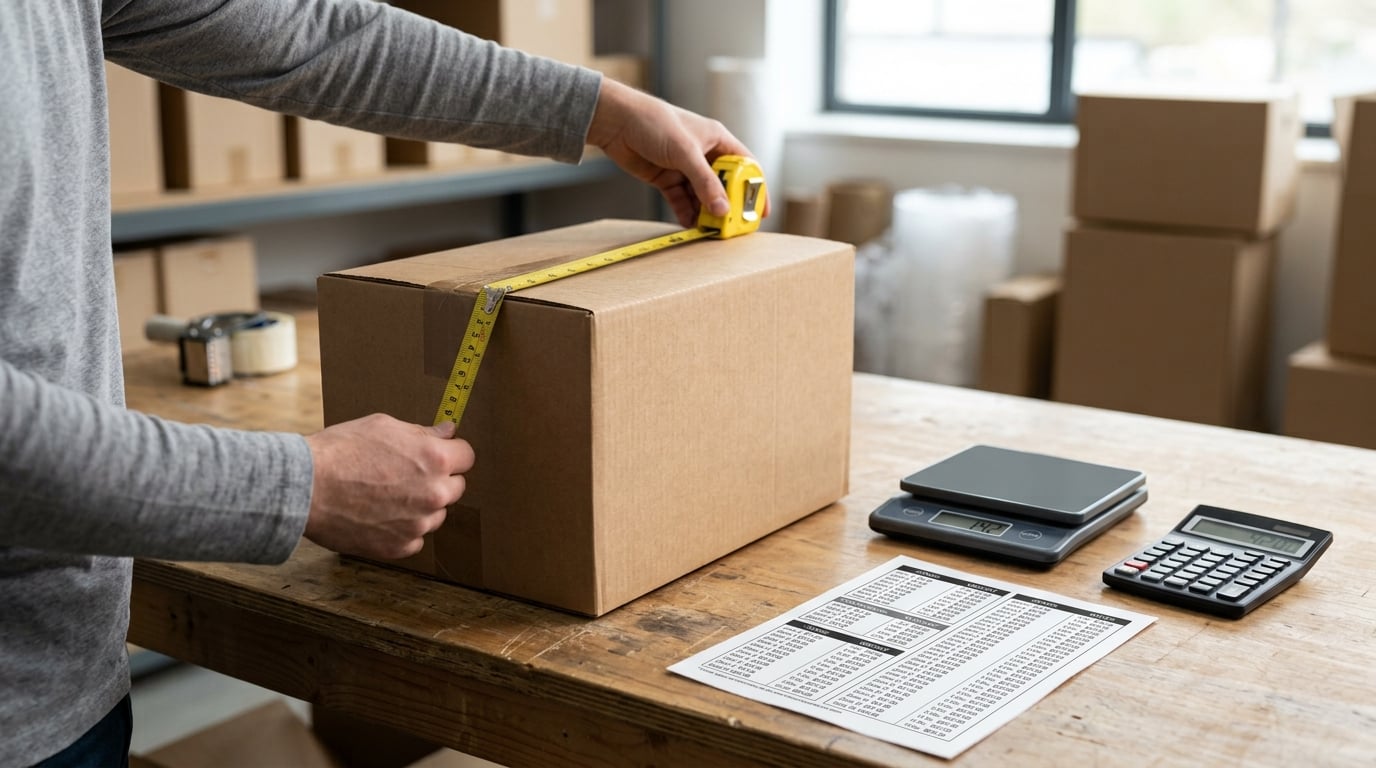
Packaging dim weight cost is the money a carrier charges for the space your box takes up, not just what is inside it. You get it in three moves: multiply length by width by height, divide by the carrier’s DIM divisor, and compare the result to the actual weight. Whichever number is bigger becomes the billable weight, and the rate attached to that number is your shipping cost. The whole job takes about ten minutes per package once you have the measurements and the right rate sheet.
The reason this matters is that a 4 lb box of pillows and a 4 lb box of dumbbells are not the same shipment. One ships on its actual weight, the other ships on a dimensional weight that could be triple the real number. Sellers on r/Etsy and r/EtsySellers describe the same surprise repeatedly: the label quote looked fine, then the invoice came in higher, and the extra inch of box height was usually the culprit.
Table of Contents
- What You Need to Calculate Packaging Dim Weight Cost
- Step-by-Step: How to Calculate DIM Weight
- Frequently Asked Questions
- What is packaging dim weight cost?
- How is dimensional weight different from actual weight?
- Which carrier divisor should I use for my package?
- Can dimensional weight be reduced by changing the packaging?
- Should fuel and residential delivery fees be included in the estimate?
- When is a dimensional-weight calculator unreliable?
- Conclusion
What You Need to Calculate Packaging Dim Weight Cost
You need four things, and two of them are rate information rather than measurements. Get these straight before you start, because an error in the divisor produces a number that looks plausible and is completely wrong.
- Packaged dimensions in inches: the outside of the box as it will be handed to the carrier, including any bulges, labels, tape and protrusions.
- Actual weight in pounds: the packed, sealed parcel on a scale, not the product’s shipping weight from a spec sheet.
- Carrier, service and rate type: FedEx, UPS or USPS, and whether you are on retail, daily or contract pricing. The rate type changes the divisor.
- The DIM divisor for that combination, plus the base rate per pound and the current surcharge table.
You also want a tape measure, a scale accurate to a tenth of a pound, and a calculator. That is the whole toolkit. Everything else in this guide is arithmetic on those four inputs.
Step-by-Step: How to Calculate DIM Weight
Six stages, in this order. The order matters because rounding before dividing changes the answer, and picking the divisor before picking the rate type means you will redo the math.
How to Measure the Package Correctly
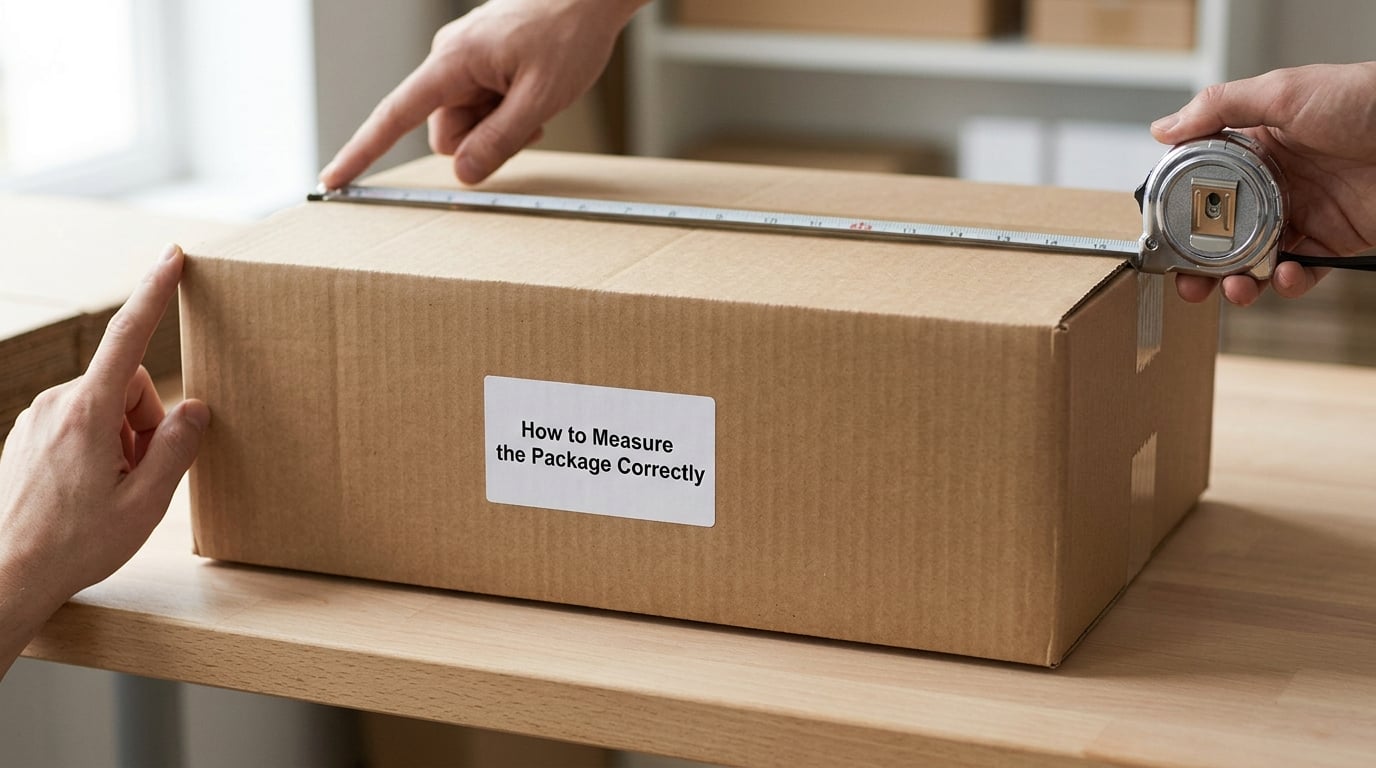
Measure the packed exterior, not the product. Carriers measure the carton as it arrives on their scale, and the tape sits on the box, not on the item inside it. If your void fill is inflating the sides, those are the dimensions you use.
Measure length as the longest side on the horizontal plane, width as the second longest on that same plane, and height as the vertical side. A box standing on its end is a different parcel than the same box lying flat, and you should always measure it the way it will ship. For irregular shapes, carriers typically take the longest point in any direction, so a bowed or overstuffed soft mailer can measure larger than the printed dimensions suggest.
How to Calculate Dimensional Weight
Multiply the three rounded dimensions to get the cubic volume, then divide by the divisor. The formula is the part worth writing down:
DIM weight = (Length × Width × Height) ÷ DIM divisor
Volume (cubic inches) = L × W × H
Round each dimension up to the next whole inch before multiplying. A box measuring 32.25 × 12.5 × 12.5 becomes 33 × 13 × 13, and only then do you multiply: 33 × 13 × 13 = 5,577 cubic inches. This is the step most guides skip, and it is the step that reproduces the carrier’s actual number.
Round the final DIM result up to the next whole pound too. So does a 5,577 ÷ 139 result of 40.12 lb bill as 41 lb. Carriers round up; they never round down in your favor.
How to Apply the Carrier Divisor and Rate to Get Packaging Dim Weight Cost
The divisor converts volume into weight, and the rate converts weight into money. The divisor is not universal, which is where most estimates go wrong. Here is the reference table, verified in 2026 and subject to annual change by the carriers:
| Carrier / rate type | DIM divisor | Notes |
|---|---|---|
| FedEx (US, all services) | 139 | Same divisor across Ground, Express and Home Delivery |
| UPS retail / public rates | 166 | The divisor most people quote from memory |
| UPS daily / contract rates | 139 | Lower divisor means a higher DIM weight than retail |
| USPS | 166 | Applies to packages over 1 cubic foot; see the exception below |
| Canada Post | 169 | Used in conjunction with Canadian surcharges |
| Purolator | 172.8 | Results often round to a decimal; round up to the next pound |
| International air freight | 6,000 | Cubic centimeters ÷ 6,000 = volumetric weight in kg, per IATA convention |
That 139-versus-166 gap is worth pausing on. The same box can produce a higher billable weight on your daily UPS rate than on the retail rate at the counter, purely because the divisor is lower. Check the rate type on your contract before you commit to a number.
USPS has one exception that catches small sellers out. A package that is both under one pound and under one cubic foot is billed on actual weight, no DIM calculation. Over one cubic foot, the 166 divisor applies in full.
Once you have billable weight, multiply it by the carrier’s rate for that service and weight break. A worked example makes the whole chain concrete. Take a 24 × 18 × 5 inch box weighing 3 lb, which is a common size for apparel or a small home good:
| Carrier and rate type | Cubic volume | DIM weight | Billable weight (actual 3 lb) |
|---|---|---|---|
| FedEx 139 | 2,160 cu in | 15.5 rounds to 16 lb | 16 lb |
| UPS retail 166 | 2,160 cu in | 13.0 rounds to 14 lb | 14 lb |
| UPS daily 139 | 2,160 cu in | 15.5 rounds to 16 lb | 16 lb |
| USPS 166 | 2,160 cu in | 13.0 rounds to 14 lb | 14 lb |
A 3 lb shipment billed at 16 lb is the whole problem in one row. Multiply that billable weight by the per-pound rate for the service, and you have your base transportation charge before a single surcharge is added.
How to Add Freight, Handling, and Accessorial Charges
The per-pound multiplication is the floor of the cost, not the cost. Five surcharges show up on most invoices:
- Fuel surcharge is a percentage applied to the combined total, which usually means base charge plus surcharges, not just the base.
- Oversize applies once any dimension crosses the carrier’s threshold, which for many services is 130 inches when length plus girth is used, or simply a single side over a set width.
- Additional handling is charged for shapes that cannot be stacked or conveyed normally: long tubes, bulky items, irregular boxes.
- Unexpected carrier surcharge (UCS) can appear after the fact for a package that was rated one way and delivered another. It is the one that provokes the most seller confusion, because it arrives with no line item on the original label.
- Residential and delivery appointment fees apply based on the destination, and a remote-area fee may stack on top of them.
Treat all of these as estimates. An estimate uses published surcharge percentages applied to your calculated billable weight; the invoice uses what actually happened on the route. The gap between the two is normal and usually small, but on a large-volume account it is worth reconciling monthly rather than at year end.
How to Compare Actual Weight and Dimensional Weight
The carrier bills whichever is greater. There is no blending, no averaging, and no negotiation of the two numbers at the counter. That single rule is the takeaway most worth remembering from this whole guide.
The practical test is density: divide actual weight by cubic volume to get pounds per cubic foot, then compare that to the divisor. At 139, you need roughly 12 lb per cubic foot to break even. At 166, roughly 10 lb. Below that line, DIM wins and your cost is driven by box size. Above it, actual weight wins and you are paying for the product. Sellers on shipping forums describe discovering this only after a customer complains about the shipping charge, which is the expensive way to learn it.
Package type also changes the rules. A box is measured on all three dimensions. A poly mailer is treated as a rectangle but must be flexible, and a rigid or bulged mailer gets measured at its fullest points. Flat rate boxes are a different regime again: the box has a fixed published rate and no DIM or weight calculation, which is exactly the appeal.
Once you know which weight is driving the bill, the only lever left is arithmetic. If DIM is the driver, dividing the excess DIM cost by the number of orders in a case pack tells you whether redesigning the packaging pays for itself. If actual weight is the driver, the packaging is already efficient and the money belongs in negotiating the rate instead.
Common Mistakes in DIM Weight Calculations
These are the errors that produce estimates off by 20 percent or more, with the fix for each.
- Measuring the product instead of the packed box. Fix: measure the sealed carton, tape included.
- Forgetting to round each dimension up first. Fix: round L, W and H separately, then multiply.
- Using 166 when your UPS account is on daily rates at 139. Fix: identify the rate type before you calculate anything.
- Overlooking the USPS under-1-lb and under-1-cu-ft exception. Fix: check both thresholds, not just volume.
- Stopping at the base rate. Fix: add fuel on the combined total, plus oversize and handling where they apply.
- Comparing quotes that include different packaging or services. Fix: normalize to the same packed box and service before comparing.
- Stripping protective material to save DIM. Fix: do the math on damage first. One extra inch of void fill costs a fraction of what a single return costs, and returns also carry the customer service time and a review that never comes back.
One more practical note on packages, not parcels. Amazon FBA and the other marketplaces grade inbound boxes into size tiers and charge overage on anything that crosses a tier boundary, so the same rounding rules apply before the box ever reaches a carrier. A carton one inch over a tier line can cost several dollars per unit, which is usually more than the DIM charge it would incur through a carrier.
You can skip all of this by hand in a spreadsheet. In Google Sheets or Excel, =ROUNDUP(ROUNDUP(L,0)*ROUNDUP(W,0)*ROUNDUP(H,0)/139,0) gives the FedEx billable DIM weight directly, and swapping 139 for 166 or 172.8 handles the other carriers.
Frequently Asked Questions
What is packaging dim weight cost?
It is the portion of a shipping charge tied to the volume your package occupies rather than its contents. Carriers convert cubic inches to a comparable weight using a DIM divisor, then bill whichever is higher, that dimensional number or the actual scale weight. So a light, bulky box can cost more to ship than a heavy, compact one of the same actual weight.
How is dimensional weight different from actual weight?
Actual weight is what the scale reads. Dimensional weight is a calculated number derived from the package’s length, width and height divided by a carrier divisor. They measure two different things, and carriers bill the greater of the two as billable weight. Actual weight dominates for dense goods like tools; dimensional weight dominates for pillows, bedding, art prints and other bulky items.
Which carrier divisor should I use for my package?
Match the divisor to the carrier and the rate type, not to a generic number. FedEx uses 139 for US services. UPS uses 166 on retail rates and 139 on daily and contract rates. USPS uses 166 above one cubic foot. Canada Post uses 169 and Purolator 172.8. Carriers revise these periodically, so confirm against your current rate sheet before you commit to a quote.
Can dimensional weight be reduced by changing the packaging?
Yes, usually by shrinking the packed dimensions rather than the product. Right-sizing the box, moving to a poly mailer for soft goods, flat-packing, and replacing bulky void fill all reduce the cubic volume and therefore the dimensional weight. One caution: do not cut protective material purely to save DIM. A single damaged-item return costs far more than the DIM you saved.
Should fuel and residential delivery fees be included in the estimate?
Include them if you want a number you can budget against, because fuel is charged as a percentage of the combined base-plus-surcharge total and can move monthly. Residential and remote-area fees depend on the destination, so include them only for shipments going to those addresses. For a single estimate, state clearly which surcharges you included so the number can be reconciled later.
When is a dimensional-weight calculator unreliable?
It is unreliable whenever it takes a rounded-up divisor and a raw volume, or applies a single divisor to every carrier. It also fails on irregular packages, where the longest point in any direction may exceed the nominal dimensions, and it cannot predict surcharges such as oversize, additional handling or an unexpected carrier surcharge. Treat any output as a planning estimate rather than a quoted rate.
Conclusion
Calculating packaging dim weight cost comes down to a fixed sequence: measure the sealed box, round each dimension up, multiply for cubic volume, divide by the divisor that matches your carrier and rate type, round up again, take the greater of that and the actual weight, then multiply by the per-pound rate and add surcharges on the combined total.
Start by confirming the divisor and rate type for your own account, since that is the input most often wrong and the one that silently changes every number downstream. Once you know which weight is driving the bill, you can decide whether the money belongs in a smaller box or in a better rate.