
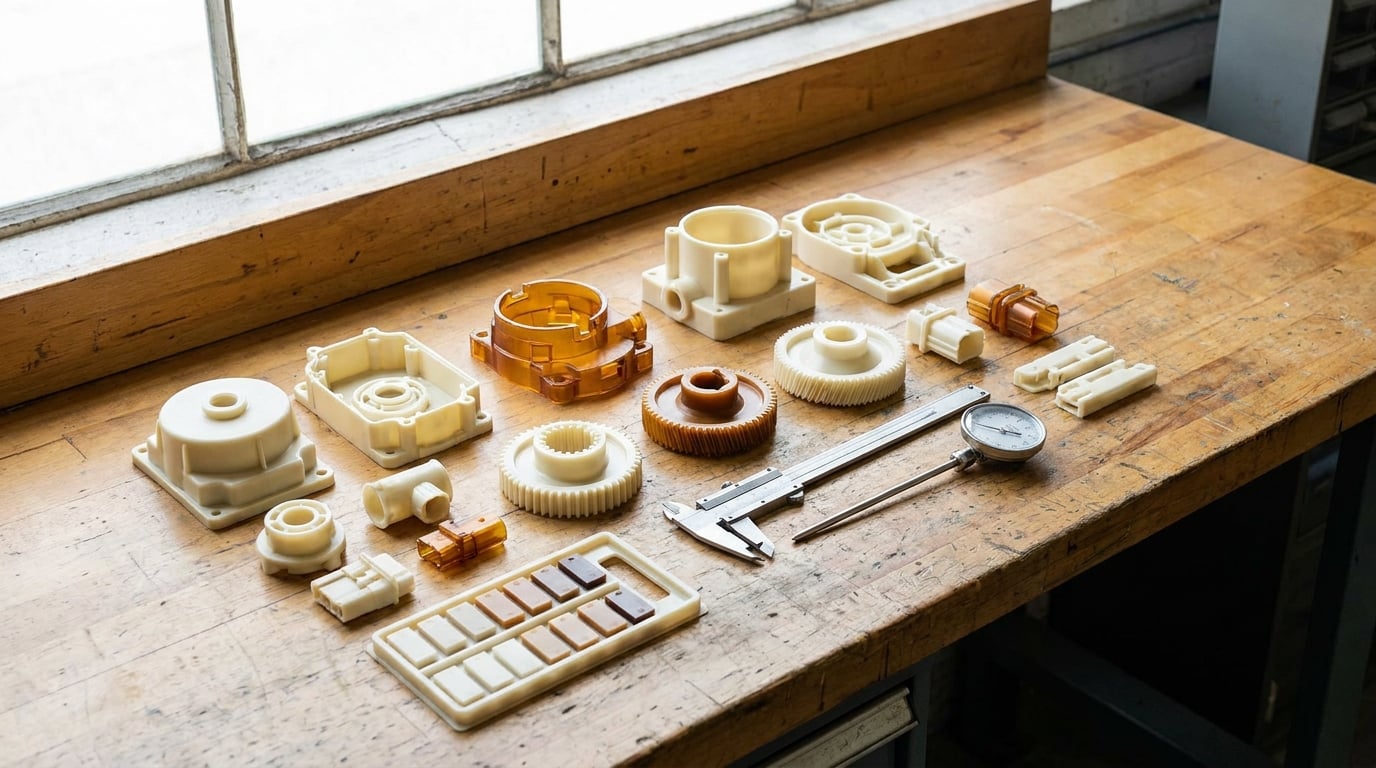
PEEK vs ULTEM comes down to one question: how hot does the part actually get, and for how long. PEEK is the choice for sustained service above about 200 °C and for hot, chemically aggressive environments; ULTEM (polyetherimide) is the choice for parts that top out below roughly 170 °C and need better dimensional stability, easier machining, and a lower resin cost. Most specifications get this wrong by chasing the glass transition number instead of the service conditions.
That distinction matters more than any single datasheet figure. Both are aromatic high-performance thermoplastics, both are inherently flame retardant, and both are far more expensive than commodity plastics. They behave very differently once a part is loaded and heated for thousands of hours.
Table of Contents
- PEEK vs ULTEM for High Temperature Parts at a Glance
- What Are PEEK and ULTEM?
- PEEK vs ULTEM for High Temperature Parts: Temperature Resistance
- PEEK vs ULTEM: Strength, Stiffness, and Mechanical Performance
- PEEK vs ULTEM: Chemical, Moisture, and Environmental Resistance
- PEEK vs ULTEM: Processing, Machining, and Manufacturing
- PEEK vs ULTEM: Cost, Availability, and Part Design
- Which PEEK or ULTEM Application Fits Best?
- Which Should You Choose?
- Frequently Asked Questions
- Conclusion: Start With the Service Conditions
PEEK vs ULTEM for High Temperature Parts at a Glance
The table below is the working summary. Values are typical ranges for unfilled grades taken from published supplier data, and they shift with grade, filler, and test method. Always check the technical data sheet for the exact grade you intend to specify.
| Property | PEEK (polyetheretherketone) | ULTEM (polyetherimide, PEI) | What it means for your part |
|---|---|---|---|
| Polymer structure | Semi-crystalline aromatic thermoplastic | Amorphous aromatic thermoplastic | Crystallinity is the single biggest behavioural difference |
| Glass transition temperature (Tg) | About 143 °C | About 217 °C | ULTEM softens at a higher Tg, PEEK keeps working above it |
| Melting behaviour | True melting point around 343 °C | No sharp melt point; softens progressively | PEEK can be welded and re-formed; ULTEM cannot be remelted cleanly |
| Continuous service temperature | Roughly 250–260 °C | Roughly 170–200 °C, grade dependent | PEEK wins decisively for continuous heat |
| Short-term peak exposure | Good to roughly 300 °C for brief duty | Typically limited to about 240–260 °C | Both tolerate short spikes above continuous rating |
| Heat deflection temperature at 1.82 MPa | Around 140–160 °C unfilled, higher with reinforcement | Around 200 °C for ULTEM 1000 and 1010 | HDT under load is the number that matters for mounted parts |
| Tensile strength, unfilled | Roughly 90–100 MPa; about double when carbon reinforced | Roughly 85–110 MPa depending on grade | Comparable in the base resin; reinforcement changes the game |
| Tensile modulus | About 4 GPa unfilled, 12–18 GPa carbon reinforced | About 3 GPa | Reinforced PEEK is the stiff choice for structural brackets |
| Elongation at break | Roughly 15–20% unfilled, much lower reinforced | Roughly 30–40%, ductile and forgiving | ULTEM absorbs impact and assembly stress better |
| Coefficient of thermal expansion | About 45–50 ppm/K below Tg | About 47–58 ppm/K | Both are dimensionally stable, but match the housing metal |
| Water absorption | Roughly 0.3–0.5% | Roughly 0.25–0.3% | Both are low; conditioning shifts dimensions slightly |
| Limiting oxygen index / UL94 | LOI around 30–35, V-0 at thin sections | LOI around 30–35, V-0 at thin sections | Neither needs a flame retardant additive |
| Sterilisation | Handles repeated 134 °C autoclave cycles | Generally specified for 121 °C cycles | Decisive for reusable medical instruments |
| Main processing routes | Injection molding, compression molding, extrusion, CNC machining, AM | Injection molding, extrusion, sheet forming, CNC machining, AM | Both mold; PEEK needs tighter control on cooling |
| Relative resin cost | 2–3x ULTEM per pound by one database; 40–100x commodity plastics by another | Cheaper than PEEK; commonly 20–40% less by supplier accounts | Published ratios disagree, so get quotes for your own part |
| Best fit | Hot structural parts, chemical exposure, aerospace, oil and gas, sterilisable tools | Electrical insulation, housings, medical devices, semiconductor handling, precision machined parts | Temperature decides it far more often than price does |
What Are PEEK and ULTEM?
PEEK is polyetheretherketone, a semi-crystalline aromatic thermoplastic sold by several suppliers including Victrex and several converted-material houses. The crystalline phase is what makes it interesting: it acts as a physical crosslink that holds the material together well above its glass transition temperature.
ULTEM is SABIC’s trade name for polyetherimide, usually shortened to PEI in engineering drawings. ULTEM is fully amorphous, which means no crystalline phase and no sharp melting point. It is transparent in thin sections, processes cleanly, and is the default choice in electrical insulation.
Manufacturers reach for either one when commodity plastics fail. A nylon or ABS bracket warps or softens long before these resins notice. A thermoset such as an epoxy or phenolic would handle the heat, but it cannot be moulded efficiently at volume, cannot be re-melted for recycling, and cannot be machined to a good finish as easily.
Both are also easy to sterilise, inherently flame retardant, and radiolucent enough for imaging. PEEK is used in load-bearing spinal implant components; ULTEM is used in sterilisable trays and combination medical devices. That combination of strength, heat resistance, and cleanability is not cheap, and it is why these two resins are worth choosing deliberately rather than by default.
PEEK vs ULTEM for High Temperature Parts: Temperature Resistance
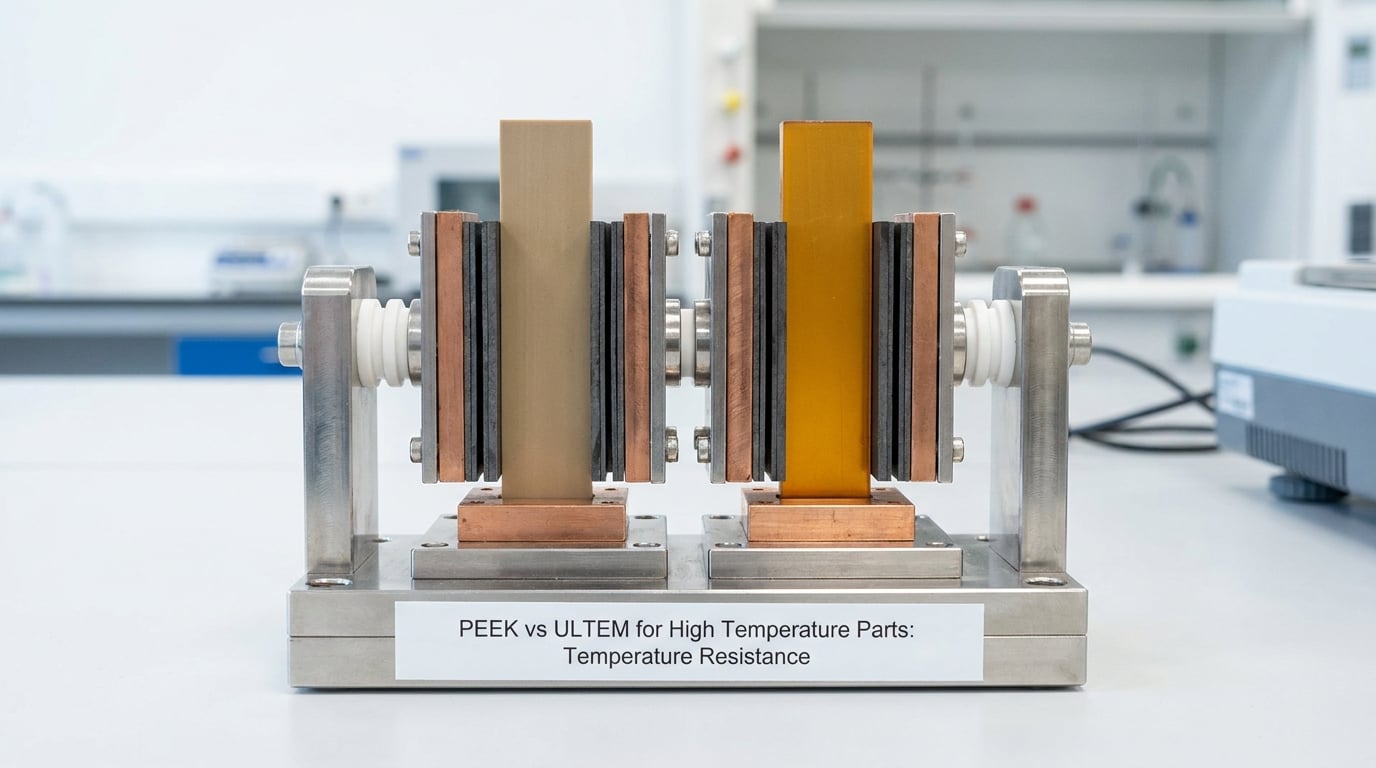
This is where the two materials part company, and it is the number most often quoted incorrectly. PEEK stays rigid and load-bearing continuously to roughly 250–260 °C. ULTEM is generally specified for continuous service in the 170–200 °C range depending on grade, even though its glass transition sits much higher at about 217 °C.
ULTEM’s higher Tg is real, and it does not make ULTEM the hotter material. An amorphous polymer loses stiffness sharply and without warning as it passes through Tg, so engineers back well off the number to leave margin for creep and for sustained loading. PEEK passes through its own Tg at 143 °C and keeps working, because the crystalline fraction carries the load once the amorphous glass softens.
Frequently confused terms: Tg, HDT, melting point, and continuous service temperature
- Glass transition temperature (Tg) is where an amorphous polymer’s stiffness drops off. For PEEK it is about 143 °C; for ULTEM about 217 °C. Tg on its own is a weak predictor of service capability.
- Heat deflection temperature (HDT) is measured under a fixed small load, typically 1.82 MPa. It tells you more about structural use than Tg does, because it includes the effect of the material softening under stress.
- Melting point applies to PEEK only, around 343 °C. ULTEM has no true melting point; it decomposes before it flows, which rules out remelting and re-forming scrap.
- Continuous service temperature is the engineering working figure: the temperature a part can hold for years, load and environment included. This is the number to specify against.
Thermal ageing closes the gap between the two. PEEK in continuous hot service eventually embrittles and loses elongation, so the safe design temperature is set below the melting-adjacent figure, not at it. ULTEM shows a similar effect, and in sustained heat near its limit it will sag under even modest clamping forces. Where a part sees thermal cycling rather than steady heat, both materials benefit from a design that lets the part expand into its mount rather than against it.
What PEEK vs ULTEM does above the glass transition temperature
Above Tg, reinforced PEEK keeps most of its stiffness because crystallinity holds the structure. This is why PEEK wins for hot bushings, gears, impellers, and down-hole components where the part is both hot and loaded. ULTEM above its Tg behaves like any amorphous thermoplastic: soft, creeping, and eventually unusable under continuous stress, even though it will not melt.
The practical takeaway for PEEK vs ULTEM for high temperature parts is simple. If the part spends its life above roughly 200 °C while carrying load, PEEK is the answer. If the part sees 150 °C peaks and a service temperature near 100 °C, ULTEM is usually the smarter specification, because you get the performance you need at a lower material cost and better machining behaviour.
PEEK vs ULTEM: Strength, Stiffness, and Mechanical Performance
Base resins are closer in strength than most comparisons suggest. Unfilled PEEK and ULTEM 1000 both sit around 90–110 MPa tensile. The separation comes from reinforcement and from ductility, not from headline strength.
Carbon-fibre reinforced PEEK is a different material class in practice, running roughly 12–18 GPa in flexural modulus against about 3–4 GPa for unfilled grades. That stiffness-to-weight ratio is why reinforced PEEK is standard for aerospace brackets, thermal isolators, and structural fittings where distortion under load is unacceptable. The trade-off is brittleness: elongation drops to a few percent, so holes, threads, and sharp corners need generous radii to avoid cracking.
ULTEM stretches roughly 30–40% before it breaks, which makes it far more forgiving. Snap-fit arms, press-fit features, and parts that take a shock load are much safer in ULTEM, and stress concentrations get stress-relieved rather than propagated. Where a part must survive handling, assembly, or a drop, that ductility is worth more than a few extra megapascals of tensile strength.
Creep is the deciding factor in sustained hot service. Creep is the slow, permanent deformation of a material under constant load, and it accelerates sharply with temperature. A ULTEM part at the top of its rating can creep measurably under clamping force or bearing preload. PEEK’s crystalline structure resists it far better at the same temperature, which is why hot wear components, gears, and seals lean PEEK.
For additively manufactured parts there is one more trap. Printed parts are anisotropic: layer direction is stronger and stiffer than the cross-layer direction, and this anisotropy grows in semi-crystalline PEEK because it crystallises rapidly and unevenly on cooling, which also drives warping and internal stress. Orient the load path with the layers, and post-anneal printed PEEK where stiffness matters.
PEEK vs ULTEM: Chemical, Moisture, and Environmental Resistance
Both resins resist oils, fuels, hydraulic fluids, and most organic solvents, and neither requires a halogenated flame retardant. The differences show up at the extremes rather than in everyday service.
PEEK has the broader chemical envelope, particularly against strong acids and hot, high-pressure steam. It is the standard choice for chemical process equipment, down-hole oil and gas components, and semiconductor wet-process parts. ULTEM is good with acids and aliphatic solvents but is attacked by strong alkalis and by hot, wet steam over long exposures, and some aromatic solvents and chlorine-bearing chemicals will stress-crack it.
Moisture uptake is low in both, at under half a percent by weight, so conditioning changes dimensions by very little. Conditioning time still matters. PEEK is more robust in wet heat at moderate humidity and less robust in prolonged boiling water; the classic failure pattern is a gradual loss of properties over many wet cycles rather than an immediate one. If your part lives in steam, test several hundred cycles before you trust the data sheet.
For sterilisation, PEEK is the more capable material. Repeated 134 °C autoclave cycles are routinely specified for PEEK, while ULTEM is generally accepted only for 121 °C cycles. Both yellow slightly after many sterilisation cycles, and both are radiolucent enough to appear in imaging, which matters for implants and for parts seen on a radiograph during a procedure.
PEEK vs ULTEM: Processing, Machining, and Manufacturing
Both materials injection mould well, and both can be extruded. PEEK requires higher melt temperature, tighter control of cooling, and careful drying, because the resin is hygroscopic and moisture causes hydrolysis and black specks. Compression moulding is common for PEEK preforms and is a practical route for short runs of complex parts. ULTEM flows more readily and shapes more gently, which makes it forgiving in thin-wall and complex-geometry mouldings.
Machining is where ULTEM has the clearer advantage. It cuts at lower power, leaves a better surface finish, and wears tooling far less than PEEK, which is a genuinely abrasive resin. Thin ULTEM parts stay dimensionally accurate through machining because the material has low thermal expansion while the tool cuts. PEEK machines well too, but it needs sharp carbide tooling, a flood coolant, and slow feeds, or it will work-harden and gum the cutter. Both are stable to machine dry, which is one reason they are chosen for vacuum-compatible hardware.
Weldability favours PEEK. Both can be joined by friction welding and hot-plate techniques, and PEEK’s true melting point makes that process predictable; ULTEM cannot be remelted, so joining is limited. Adhesive bonding works acceptably on both if the joint is properly surface-conditioned.
3D printing windows and the chamber temperature trap
If additive manufacturing is on the table, the chamber temperature decides the outcome more than the material does. A practitioner on r/AdditiveManufacturing raised exactly the right concern: a ULTEM part printed in a chamber that never approaches the glass transition point does not reach the properties of an injection-moulded one, and you get a weak part rather than an obvious failure.
For reference, one Duet3D forum thread reports usable PEEK windows around 90 °C for low-quality prints and roughly 125 °C for higher quality, and ULTEM needing at least about 150 °C on the lower-temperature grade and around 200 °C for the higher-temperature grade. Note that even the best of those figures sits below PEEK’s Tg, which is why printed PEEK is typically annealed post-print. The same forum material and the wider practitioner community repeatedly flag cost: high-temperature machines and these filaments are a large investment for a prototype, and a machined or moulded part is often cheaper at low volume. One r/AdditiveManufacturing thread on replacing a Fortus 400 asks whether running ULTEM is a necessity at all, which is the right question to ask first.
Whichever route you pick, dry the resin properly and keep it dry. Moisture pickup is a top cause of wasted material and failed parts with both polymers, and the cost of that mistake is much higher with these resins than with commodity filament.
PEEK vs ULTEM: Cost, Availability, and Part Design
Published cost comparisons for PEEK vs ULTEM disagree badly, and it is worth saying so plainly rather than picking the most dramatic number. One engineering-plastics database puts PEEK at roughly 2–3x the cost of ULTEM per pound. A supplier FAQ page in this space quotes 40–100x more per pound than commodity plastics while putting ULTEM at 20–40% below PEEK. Both can be true at once: the ratio depends entirely on what you compare against.
The number that matters is cost per accepted part, not cost per pound. Run a simple model: material cost times scrap rate, plus cycle or machine time, plus the finishing steps. PEEK machinability is slower and it generates more chip volume, so labour and consumables rise. ULTEM’s lower resin cost and easier machining often make it cheaper per part even at the same geometry, until the service temperature forces PEEK anyway.
Design considerations follow from the material. Both need wall thickness generous enough to avoid creep-driven distortion under clamp load, and both need a coefficient of thermal expansion matched to whatever they are bolted into, usually an aluminium housing. Where a ULTEM part is loaded in compression near its service limit, add a radius at every transition. Where reinforced PEEK carries a structural load, specify the fibre direction, and design fastener holes with generous edge distances. For thermal cycling, minimise the number of press-fit interfaces; bonded joints survive cycling better than rigid ones.
Availability is worth checking early. ULTEM is broadly available in sheet, rod, and injection moulding grades from many suppliers. PEEK is available but concentrated in fewer sources, and reinforced PEEK compounds are narrower still. Lead times on either can move with industry cycles, so confirm material source before committing to a design.
Which PEEK or ULTEM Application Fits Best?
Electrical insulation: ULTEM wins. It is the default for high-voltage components, terminal blocks, coil bobbins, and high-frequency parts, combining V-0 flammability, good dielectric properties, and the dimensional stability needed for fine-pitch features. PEEK is used in electrical applications too, but mostly where heat plus load dominates.
Semiconductor and vacuum hardware: PEEK leads where the part sees aggressive chemistry, and ULTEM leads where dimensional precision and clean handling matter. PEEK is the norm for chemical delivery and wet-process components; ULTEM is widely used for wafer-handling and vacuum hardware where transparency and machinability help assembly.
Aerospace: reinforced PEEK takes the load-bearing brackets, fittings, and thermal isolators, including outgassing-sensitive and cryogenic applications where ULTEM is not suitable. ULTEM covers interior trim, electrical housings, and radome-adjacent parts where flame performance and light weight matter more than stiffness at heat.
Medical devices: the split follows sterilisation temperature. Reusable instruments autoclaved at 134 °C belong in PEEK. Devices and housings sterilised at 121 °C, or that need transparency for inspection, are usually ULTEM, which is also the resin behind many combination plastic-and-metal medical platforms.
Chemical processing, oil and gas, and high-temperature wear: PEEK is the standard answer for pump parts, valve components, seals, bushings, and down-hole pieces, because it combines high continuous service temperature with excellent chemical resistance and low creep. ULTEM appears in chemical equipment only where temperatures stay modest and the part is not continuously loaded.
When neither PEEK nor ULTEM is the right answer
Sometimes the honest answer is that both are wrong for the job. PPS (Ryton) is the cheaper semi-crystalline option with strong chemical resistance when you do not need PEEK-level temperature capability. LCP (Vectra) gives lower moisture uptake and better dimensional stability for tight-tolerance electrical parts. Vespel polyimide handles continuous service far above either of these, for semiconductor and aerospace hardware where nothing else survives. Torlon PAI fills the gap between PEEK and Vespel in wear and structural applications. PFA and PTFE serve extreme chemical and low-friction duty. Naming these early saves weeks of chasing the wrong resin.
Which Should You Choose?
Run the selection in this order, and you will usually have an answer before you talk to a supplier.
- Write down the full operating envelope. Peak temperature, continuous temperature, time at temperature, and whether the part is loaded. Peak alone will mislead you in both directions.
- Compare that envelope to continuous service ratings. Above roughly 200 °C continuous, or hot plus continuously loaded, PEEK. Below roughly 170 °C continuous with tight tolerances and electrical duties, ULTEM.
- Check the chemical and moisture environment. Hot steam, strong alkalis, aggressive solvents, and prolonged wet heat push you toward PEEK and may push you off both polymers.
- Check the sterilisation or regulatory requirement. 134 °C autoclave cycles point to PEEK. 121 °C cycles and transparent housings point to ULTEM.
- Decide the process and volume. Moulding at volume makes either resin cheap per part. Machining prototypes is fine. Additive manufacturing is worth it when geometry is complex and volume is low, but only on a machine that holds chamber temperature near Tg.
- Price the accepted part, not the pound. Include scrap, cycle time, tooling, and finishing. The cheaper resin is not automatically the cheaper part.
- Request samples and test before you release the drawing. Ask the supplier for coupons or small parts in the exact grade, then run your own thermal and chemical exposure test.
If the results are close, specify the one you can actually source repeatably and validate. A material you can buy, machine, and inspect beats a marginally better resin with a long lead time.
Frequently Asked Questions
Is Ultem a better material than PEEK?
Not in general – it depends on service temperature. ULTEM is better when the part runs below roughly 170 °C continuously, needs transparency, tight dimensional stability, easier machining, or must be sterilised at 121 °C. PEEK is better above roughly 200 °C continuous, under sustained load at heat, in aggressive chemicals, or for 134 °C autoclave cycles. ULTEM is genuinely the better value choice far more often than manufacturers suggest.
What temperature can PEEK withstand?
PEEK is generally specified for continuous service up to about 250–260 °C, with brief excursions above 300 °C tolerated. It melts around 343 °C, and its glass transition is only about 143 °C, but crystallinity keeps it rigid well past that point. Use the continuous service rating for design, not the melting point, and check the specific grade’s data sheet.
What are the disadvantages of PEEK?
Cost is the first one, then machinability. PEEK is roughly 2–3x ULTEM per pound by common database accounts and far above commodity plastics, it is abrasive to cut and needs sharp tooling with coolant, it cannot be remelted cleanly, and moisture must be controlled during processing. Reinforced grades lose ductility and become crack-sensitive at sharp corners, and unfilled PEEK creeps more than you would expect under sustained hot load.
Is PEEK harder than Delrin?
As a material class, yes. PEEK is a rigid semi-crystalline aromatic thermoplastic with a flexural modulus in the low GPa range, while Delrin (acetal homopolymer) is a more compliant engineering plastic that machines beautifully and has very low friction. For wear, use a PEEK grade formulated for it, and consider filled acetal or a dedicated bearing polymer rather than plain Delrin in demanding conditions.
Is ULTEM or PEEK more expensive?
PEEK, consistently. Published ratios vary widely – one database puts PEEK at 2–3x ULTEM per pound, while supplier sources also quote PEEK at 40–100x commodity plastics and ULTEM 20–40% below PEEK. None of those numbers tell you cost per finished part, so quote the actual geometry in both materials before deciding, since PEEK also machines more slowly and more wastefully.
Can PEEK be machined?
Yes, and parts are routinely machined from PEEK rod and plate. Use sharp carbide tooling, moderate-to-slow feeds, and generous coolant, because PEEK is abrasive and will work-harden if it overheats. It machines stably dry if vacuum-compatible chips are needed. ULTEM is easier to cut, gives a better finish, and wears tooling less, so for a purely machined part at similar service temperature, ULTEM is often the cheaper route.
Conclusion: Start With the Service Conditions
PEEK vs ULTEM for high temperature parts is settled by the operating envelope, not by the highest number on the datasheet. Continuous service above roughly 200 °C, or sustained load combined with heat, points to PEEK. Modest service temperatures with tight tolerances, electrical duties, transparency, or easier machining point to ULTEM.
Document the peak temperature, the continuous temperature, the duration, the load, the chemicals, and the moisture conditions for your part, then validate the specific grade against your own test conditions. Ask for material samples, run a thermal and chemical exposure test, and confirm the grade on the drawing. A specified, tested, and repeatable resin beats a nominally better one every time.