
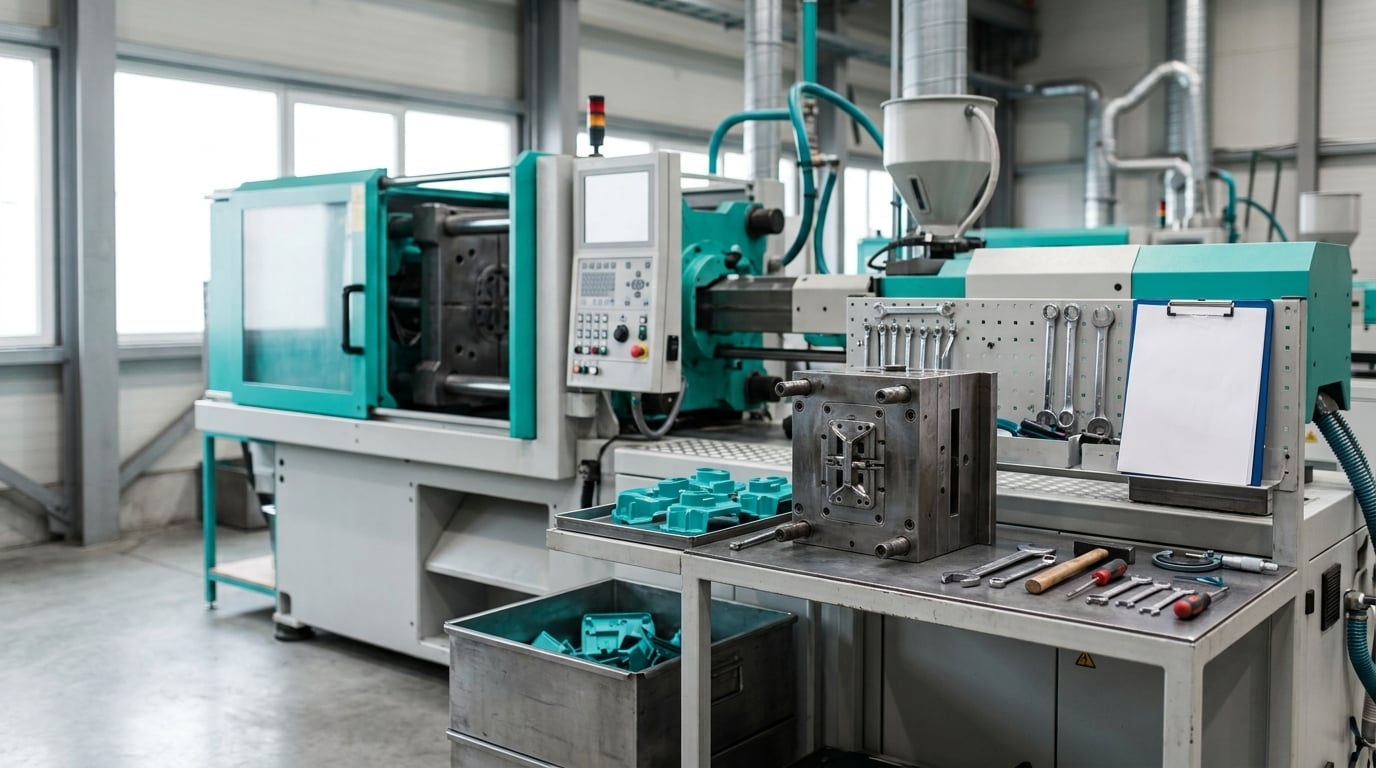
SMED, or Single-Minute Exchange of Die, is a lean method for cutting equipment changeover time down to single-digit minutes by moving as much setup work as possible out of the window where the machine is stopped. Setup reduction and SMED explained properly means knowing which tasks are internal, which are external, and how to measure both before you start changing anything.
That matters on plastics and packaging lines because every minute of changeover is capacity you paid for and did not use. A plant running a two-hour changeover every week has quietly told its customers it cannot promise anything in less than a week. This guide walks through the method, the measurement, and a worked example.
Table of Contents
- What Is Setup Reduction and SMED?
- How Does SMED Work?
- Internal vs. External Setup Work
- The Four SMED Stages in Practice
- How to Measure Setup Reduction
- Setup Reduction Example for Plastics Manufacturing
- Common Setup Reduction Mistakes
- Frequently Asked Questions
- Conclusion: Start With One Measurable Changeover
What Is Setup Reduction and SMED?
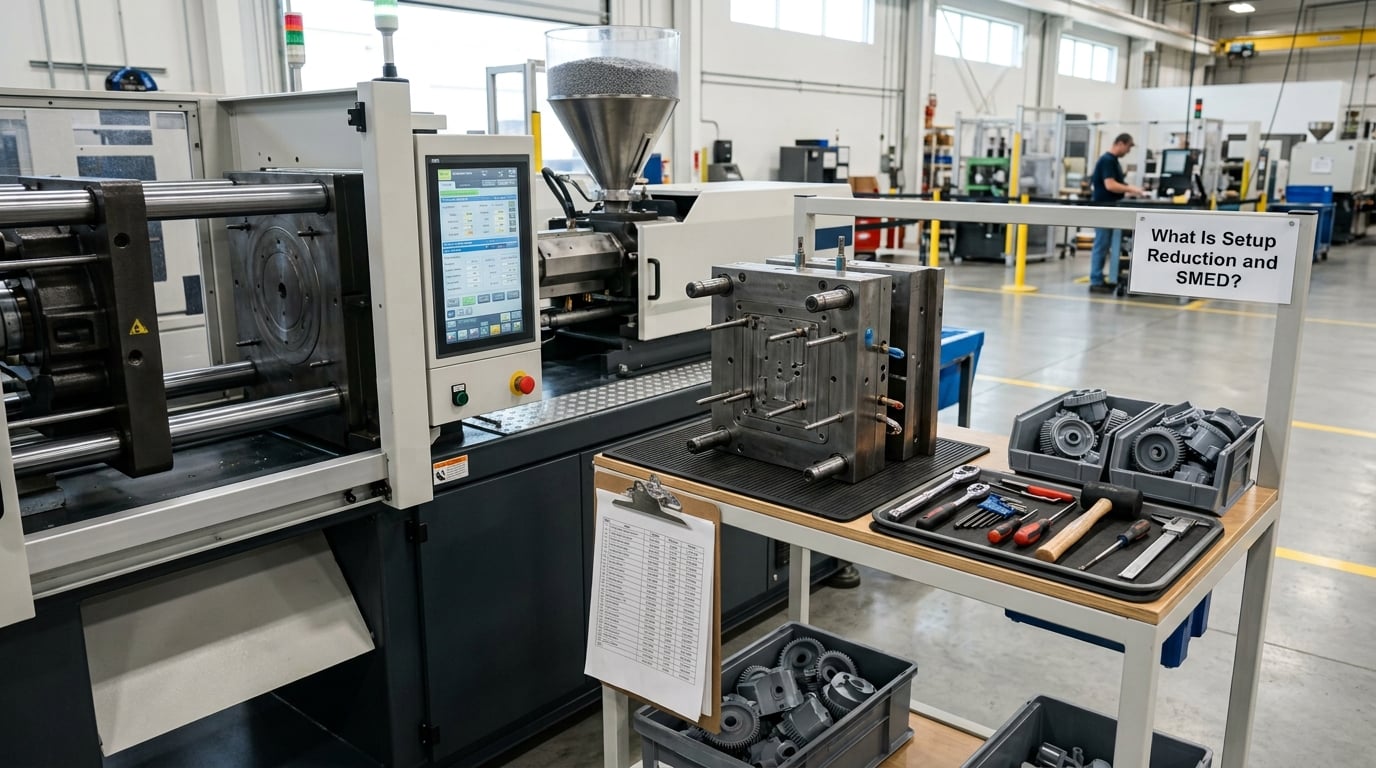
Setup reduction is any effort to shorten the time between running one product and running the next one properly. SMED is the specific method most teams mean when they say setup reduction, and it was developed by Shigeo Shingo, who worked inside the Toyota Production System and documented how Japanese plants cut die change times from hours to minutes.
The name is aspirational rather than literal. Shingo’s target was single-digit minutes, but he also warned that a few processes have a physical floor that no amount of technique will go below. A press with a heavy die that must be lifted and a mold that has to reach temperature will not get to 90 seconds just because a team reads the right book.
Changeover time, setup time and run time are different things
Run time is the good part, when the machine is making sellable output. Changeover time is everything from the last good part of the previous run to the first good part of the next run. Setup time is a broader word that some plants use for any preparation, whether or not the machine is stopped, which is why two teams can report very different numbers for what sounds like the same activity.
That ambiguity is a genuine problem in the field. Practitioners argue about whether setup time and changeover time are the same thing, and until a plant picks one definition and writes it down, comparing this month to last month is guesswork.
Why a plastics plant cares more than most
Plastics operations change molds, colors, insert sets and packaging formats far more often than a simple assembly line. Molds carry heat and pressure history, so a new mold needs purging, preheating and trial shots before anyone can call the parts good. Packaging lines change film, label stock and carton size on short runs. All of that is changeover time, and all of it lands on the same availability number in OEE.
How Does SMED Work?
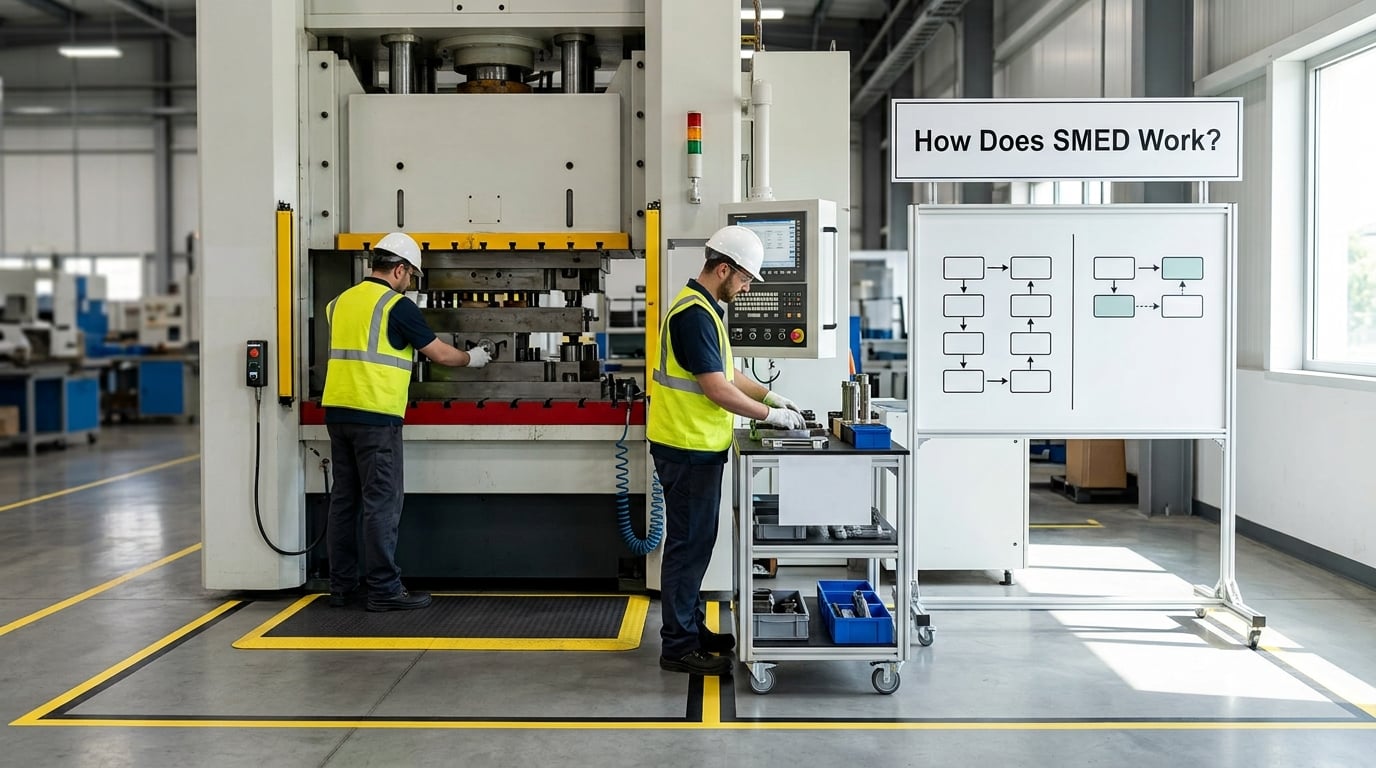
SMED works in four moves: observe the changeover honestly, separate internal work from external work, convert as much internal work to external as the process allows, then streamline what remains and lock it in as standard work. Everything else people call SMED is detail inside one of those four moves.
You will see the method described as three stages, four stages, five stages or six steps depending on the source. Shingo’s original framing is three stages: observe and separate, convert internal to external, then streamline and standardize. The four-stage version splits the first stage into observing and then separating, which in practice is what most teams end up doing anyway.
That naming variance is not a problem as long as you know the underlying sequence is identical. If a consultant arrives with a five-step deck, check that steps two and three still mean separate, then convert.
Internal vs. External Setup Work
Internal setup work can only be done while the machine is stopped or unable to produce. External setup work can be done while the machine is running the previous job, or before the previous job even ends. The whole method rests on this distinction, and almost every gain comes from moving a task across that line.
The physical test is simple: if the machine would produce a good part while you do the task, it is external. If it would make a scrap part or risk a crash, it is internal. A mold swap on an injection press is internal because the machine cannot cycle with the old mold half-attached. Preheating a replacement mold in a preheater bay is external, because nothing on the press is touched.
| Setup task | Machine stopped? | Classification | Where it can move |
|---|---|---|---|
| Preheating the replacement mold in a preheater | No | External | Keep external, start it two hours early |
| Pulling the old mold and setting it on the stand | Yes | Internal | Cannot move; streamline with a lifting device |
| Loading inserts and core pins into the mold | No, if done off-line | Usually internal | Duplicate the mold off-line, load it in one piece |
| Setting color masterbatch and feeder settings | No | External | Stage at the material station in advance |
| Mounting the mold on the platens | Yes | Internal | Cannot move; parallelize with a second crew |
| Purging the barrel before first shot | Yes | Internal | Reduce by matching colors or pre-purging |
| First article inspection and dimension check | Yes | Internal | Stage gauges, use known-good settings, pre-stage samples |
| Changing film roll and label stock on a packaging line | Yes | Internal | Pre-thread spare reels and stage splice tape |
Read that table and a pattern shows up. Most of the time is not in the physical work of mounting a mold. It is in waiting for someone to find a wrench, waiting for the crane, waiting for the right color, and waiting while an operator adjusts a process that was never set the same way last time.
The Four SMED Stages in Practice
Stage 1: Observe and record every element
Stand at the machine, film a complete changeover, and write down each step with its time. A documented changeover usually turns out to hold 30 to 50 separate elements, and most teams are surprised that the ones they argue about are a small slice of the total.
Get the baseline before anyone knows they are being measured. The moment an operator knows the changeover is being timed, it gets faster, and that observed number is not real. Note the management decision this stage forces: where does the time actually go.
Stage 2: Separate internal from external work
Mark each of those 30 to 50 elements as internal or external using the machine-stopped test. This is mostly bookkeeping, and it is where most SMED projects stall because the list stops at the classification step and nobody owns the follow-through.
The decision here is which external work has to be pulled earlier, and who does it. If the answer is that the same operator who runs the machine will do the external work, something has to give, because that operator is already busy producing the last good part.
Stage 3: Convert internal work to external work
Now move tasks. Pre-heat molds off-line. Build inserts into a duplicate mold off-line so the whole set arrives as one piece. Stage the changeover cart with every tool, gauge and fastener the job needs before the machine stops. Pre-thread spare film reels and label stock on the packaging line.
The decision is whether the conversion needs money. Advance preparation and staging cost nothing but planning. Duplicate tooling, quick-release clamps and preheaters cost something. Most plants that stall at stage 3 have spent capital on a fast die mount while the mold was never preheated.
Stage 4: Streamline what stays internal, then standardize
Whatever cannot leave the stopped window has to get shorter. Replace bolts that take twenty turns with functional clamps and quick-release fasteners. Replace trial-and-error adjustment with known-good settings written on a card. Run two crews in parallel where guards and lockout-tagout allow it. Mark visible centerlines so the mold is not being hunted into position.
Then write the whole sequence down as standard work and post it at the machine. A 45-minute changeover that only the one experienced operator can perform is a 45-minute changeover that reverts the week after the event ends. This is the stage consultants cover least, and it is the one that decides whether the gain lasts.
How to Measure Setup Reduction
Measure from the last good part to the first good part. That boundary is the single most useful definition in this topic because it stops teams from quietly redefining a win as whatever window they find flattering.
A changeover worksheet needs a few specific fields, and it is fine to run this on paper for a pilot.
- Date, machine, product from, product to so you can later slice the data by variant.
- Start time at the last good part of the outgoing run, with the reason if it was early.
- Element log: every step, its start and finish, and whether it is internal or external.
- Stopcode on every wait: waiting for crane, waiting for material, waiting for the next operator, searching for a tool. Unmeasured waiting is where most of the hidden time lives.
- First good part time, which is the finish line, not first shot.
- Quality result: first article pass, number of adjustments to get there, scrap generated during setup.
- Who did it, because changeover results swing hard by shift and by person.
Time spent on the last good part matters as much as the element log. An element that takes two minutes on average but eats twenty minutes when the fixture is missing is your real problem, and only per-element timing will show it.
One caution: the first changeover after a team starts watching will be faster for reasons that have nothing to do with your improvements. Get a real baseline from the previous two or three weeks of production records, not from a filmed run.
Setup Reduction Example for Plastics Manufacturing
Here is a realistic shape for a two-hour injection molding changeover, drawn from the kind of situation plants in plastics actually run: a 300-ton press alternating between a black housing and a blue cap, changing inserts on both, on a schedule that triggers twice a day.
The observed changeover was 118 minutes. Purge and heat time alone accounted for 41 minutes, and the team found 26 minutes of unrecorded waiting spread across the rest of it.
| Changeover element | Before | After | Change made |
|---|---|---|---|
| Mold preheating | 31 min, started after the old mold came out | 0 min in the stopped window | Replacement mold preheats in the bay from the start of the previous run |
| Insert loading | 22 min at the machine | 4 min at the machine | Duplicate mold built and loaded off-line, swapped as a unit |
| Die mounting and alignment | 18 min | 9 min | Quick-release clamps, visible centerlines, known-good shim settings |
| Waiting for crane and tooling | 26 min unmeasured | 2 min | Changeover cart staged and checked before the last good part |
| Purge and first shots | 14 min | 7 min | Matched colors between the two jobs, barrel warmed during the mold pull |
| First article check and adjustment | 7 min | 4 min | Gauges pre-staged, known-good settings card at the machine |
| Total | 118 min | 26 min | 78% reduction |
Twice-daily changeovers on that press stop eating the shift. What the plant gained is not really the 26 minutes, it is the ability to run both products in lot sizes the schedule actually needs instead of building a day of black housings to make the changeover pay for itself.
Note what the money went into: a preheater, a duplicate mold and a set of quick-release clamps. The waiting time and the trial-and-error shots were free to fix, and they were the bigger half of the total. If the plant had bought the clamps first and left the waiting in place, the result would have been much less impressive and much harder to sustain.
Common Setup Reduction Mistakes
Measuring only the total
If the only number on the board is 118 minutes, nobody can tell you what to fix. The element log is what turns a frustrating total into a list of targets, and it is the first thing to insist on when a team resists the project.
Skipping standardization
This is the mistake that quietly eats the gains. A fast changeover that lives in one operator’s head is not a process change, it is a staffing dependency. When that person is on holiday, the time goes back up and nobody can say why. Written standard work, a posted sequence and a known-good settings card are what turn a result into a standard.
Preparing tools too late
External work scheduled at the moment the machine stops is not external, it is just internal work with better PR. The cart gets staged before the last good part or the mold does not get preheated at all.
Changing one thing at a time across six months
Sequential improvement on a live line is how a project dies. The team changes the fasteners this month, the staging next quarter, and never sees a meaningful number to justify the next round. Pick a date, do the free improvements together, measure once, and let the result fund the capital request.
Ignoring safety and quality to hit a number
Parallel crews, pre-run equipment and preheated molds all introduce real risk, and the fastest way to lose a plant manager’s support for the whole program is a recordable incident during a changeover. Guards and lockout-tagout stay in place. First article inspection does not get shortened to save ninety seconds, because a bad first good part makes the whole measurement meaningless.
Assuming every process can hit single digits
Some changeovers have a floor set by physics: thermal mass, crane cycle time, mandated safety checks, or a first article that takes longer than the target. A plastics tool that must be purged and brought to temperature has a real floor. Write that floor down, agree it with the customer of the process, and celebrate hitting it rather than chasing a number that was never available.
Frequently Asked Questions
What are the three stages of SMED?
Shigeo Shingo’s original method has three stages. First, observe the changeover and separate every element into internal work that needs the machine stopped and external work that does not. Second, convert as much internal work to external as possible by preheating, pre-staging and building tooling off-line. Third, streamline the internal work that remains, using quick-release fasteners, parallel crews and known-good settings, then lock the sequence in as standard work.
What are the differences between internal and external activities in SMED?
Internal setup work can only be done while the machine is stopped or cannot produce a good part, such as mounting a mold on the platens or purging the barrel. External setup work can be done while the machine runs the previous job, such as preheating a replacement mold in a preheater bay or staging tools on a changeover cart. The test is simple: if the machine would still make a good part while you do the task, it is external. Most SMED gains come from moving internal tasks across that line.
Is SMED lean or six sigma?
SMED is a lean method, not a Six Sigma one. It comes out of the Toyota Production System and belongs to the same family as 5S, standard work and total productive maintenance. Six Sigma attacks variation and defects statistically, which is a different job. In practice the two get used together: SMED cuts the time, and basic process capability work keeps the parts good once the tool is running.
How much time can SMED save on a changeover?
Teams running a first SMED event commonly cut changeover time by 50 to 75 percent, and published results range from a three-hour changeover reaching 45 minutes to a 90-minute changeover reaching 20 minutes. The size of the win depends on how much of the original time was waiting, searching and trial-and-error, because those are the parts that fall away fastest.
Does SMED require capital investment?
No, and starting with capital is a common mistake. Staging tools on a changeover cart, writing down known-good settings, preheating molds and eliminating waiting cost nothing but planning. Money helps later, on duplicate tooling, quick-release clamps, lifting devices and preheaters, but those pay off far better once the free improvements have already removed the waiting and the searching.
Why do changeover times get worse again after a few months?
Because the improvement lived in an event rather than in a standard. Once the team disperses, the sequence drifts back to whatever the fastest experienced operator does, new hires are never shown it, and the staging habit fades first because it is the easiest thing to skip. Fix it with written standard work posted at the machine, a changeover worksheet that gets filled in every time, and a short check of real changeover times each month.
Conclusion: Start With One Measurable Changeover
Pick the changeover that costs you the most and happens most often. Watch three of them without announcing anything, log every element with its time, and mark each one internal or external. Run one trial where the external work is done early and the waiting is stopped, then check the first good part as carefully as you ever have.
That is setup reduction and SMED explained in practice. The math is simple enough to write on a whiteboard: minutes saved multiplied by changeovers per year equals capacity you can now promise a customer. The part that is hard is writing the sequence down and keeping it, and that is the part worth doing first.