
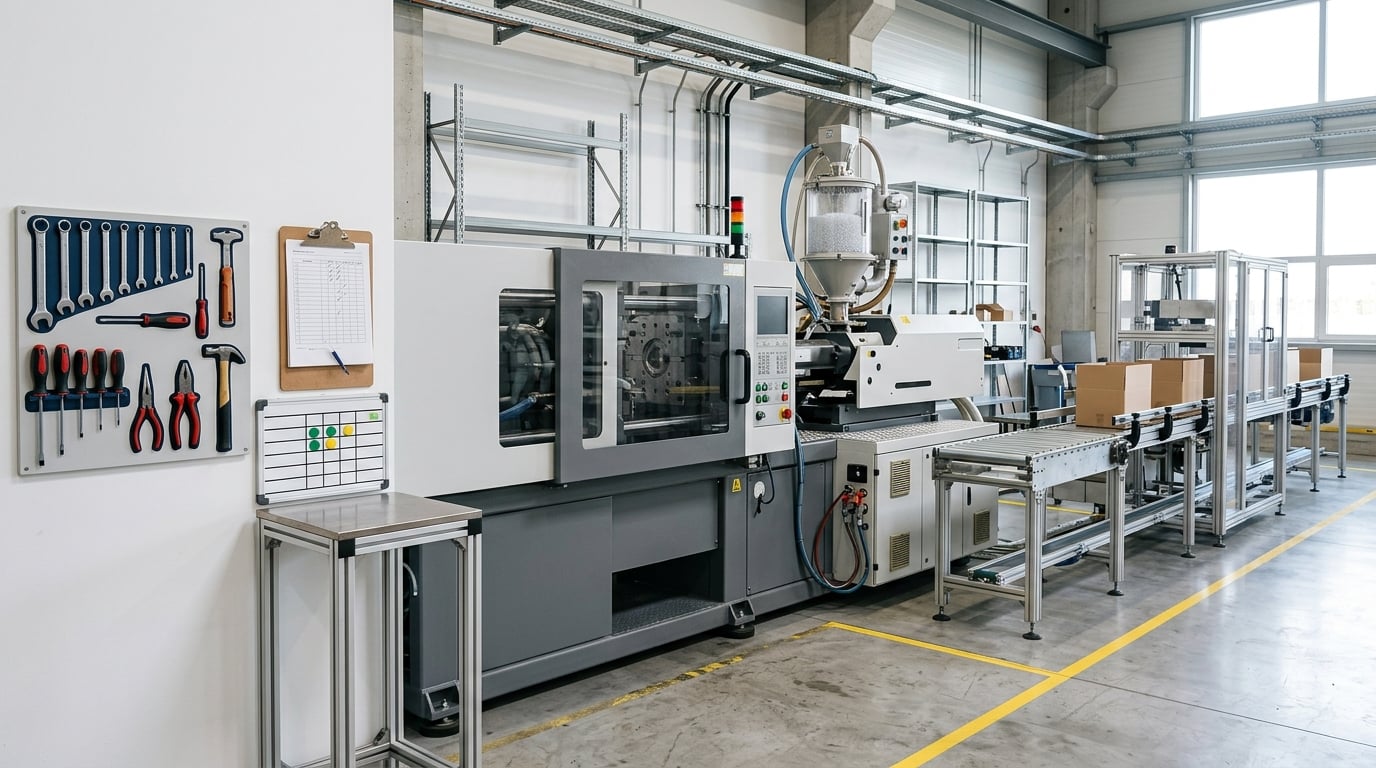
Total Productive Maintenance (TPM) is a maintenance strategy that maximizes equipment effectiveness by having everyone who works with a machine take shared responsibility for keeping it productive. Operators, maintenance technicians, engineers and managers all own part of it, instead of a specialist department carrying the whole load alone.
That is the short version. The rest of this guide explains where the framework came from, what the eight pillars actually involve, how the work shows up in OEE numbers, how to roll it out on one line without wrecking the plant, and where programs like this usually go wrong.
Table of Contents
- What Is TPM Total Productive Maintenance?
- Why Does TPM Matter for Manufacturing Plants?
- What Are the 8 Pillars of TPM?
- How Do TPM, TBM, and Preventive Maintenance Differ?
- How Do You Implement TPM in a Manufacturing Plant?
- What TPM Metrics Should You Track?
- How Can TPM Improve OEE Without Creating More Work?
- What Are the Most Common TPM Mistakes?
- Frequently Asked Questions
- What is TPM total productive maintenance in simple terms?
- What are the 8 pillars of total productive maintenance?
- What is the difference between TPM and preventive maintenance?
- How long does it take to implement TPM?
- Who owns TPM in a manufacturing plant?
- Is TPM still relevant with predictive maintenance and TPM 4.0?
- Conclusion
What Is TPM Total Productive Maintenance?
Total Productive Maintenance is a structured approach to eliminating equipment losses by moving routine care to the people who run the equipment. It is not a repair strategy, and it is not a software product. It is an operating system for a production line, built around eight pillars of work that share one goal: zero breakdowns, zero defects, zero accidents.
The distinction from reactive maintenance is the whole point. Reactive maintenance means the machine runs until it fails and someone fixes it. TPM means operators notice a loose bolt, a rising temperature or a sensor fault during a normal check, because that check is written into their standard work.
Preventive maintenance sits in the middle. Schedules tell a technician to service a machine on a calendar interval regardless of its actual condition. TPM keeps preventive work but adds condition-based judgment, operator ownership and continuous improvement on top of it.
Where TPM Came From and Why It Still Works
Seiichi Nakajima, a TPM engineer at Nippondenso, developed the system in Japan between 1950 and 1970 while troubleshooting production losses at a plant that had started from postwar rubble. Nippondenso formally introduced it in 1971, and the Japan Institute for Plant Management later turned it into the eight-pillar structure used today.
The reason it travels well is that it fits how factories are actually staffed. Most plants cannot hire their way out of downtime. TPM attacks losses using people already on shift, which is why small shops and multinationals can both run it.
Why Does TPM Matter for Manufacturing Plants?
Because scheduled production time is rarely equal to productive time. A machine can be running and still contribute nothing: it is stopped for a changeover, creeping along below rated speed, or producing parts that go straight into the reject bin. TPM puts names and numbers on those gaps and gives the plant a method for closing them.
In a healthy operation you would expect to see several things move in the same direction once maintenance maturity improves:
- Fewer breakdowns and shorter emergency repairs
- Shorter changeovers after standard work is set for setup and minor stops
- Lower scrap and rework, because conditions are checked rather than assumed
- Fewer emergency spare part calls and less overtime on maintenance
- Higher OEE, driven mostly by availability rather than by buying new machines
- Operators who own the equipment instead of calling someone to hand over a fault
The realistic starting point for many plants is that availability sits in the 70s, performance in the 80s and quality in the 95s. Multiplied together, that is roughly 53% OEE. World-class operations reach 85% or better.
| Approach | Trigger | Who does the work | Typical weakness |
|---|---|---|---|
| Reactive or run-to-failure | Failure | Maintenance only | Unplanned downtime, emergency repairs, rising damage |
| Preventive | Calendar interval | Maintenance only | Serviced machines that do not need it, missed schedules |
| Predictive or condition-based | Sensor or vibration data | Maintenance and engineering | Costs, data quality, still no operator involvement |
| TPM | Condition plus routine checks | Operators, maintenance, engineering, management | Needs sustained management attention to survive |
What Are the 8 Pillars of TPM?
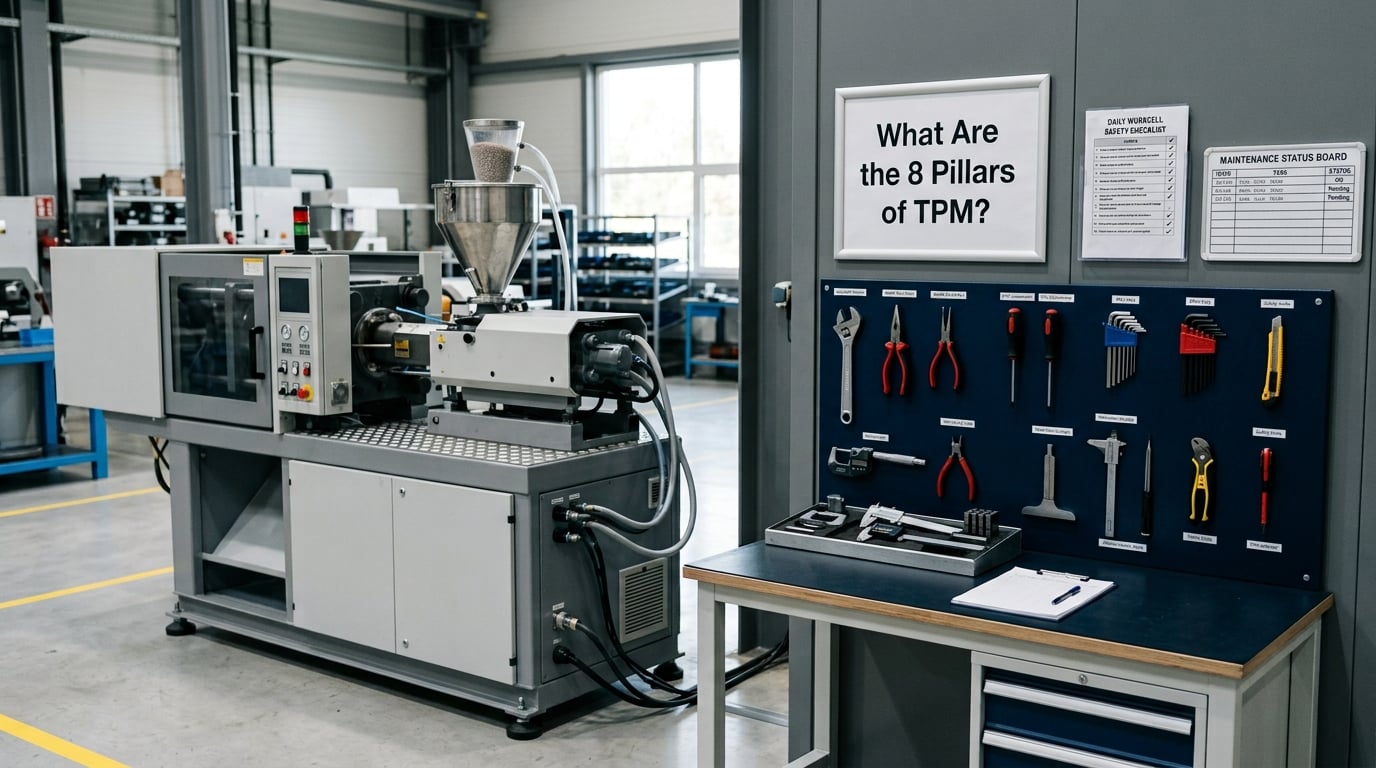
The eight pillars work as a set. The maintenance pillars hold the equipment up, the improvement pillars attack the losses those pillars expose, and the training pillar keeps the whole system fed with people who can run it.
1. Autonomous Maintenance (Jishu Hozen)
Operators take ownership of routine daily tasks: cleaning, tightening, lubricating, checking levels and inspecting for defects. The goal is to restore and maintain basic machine condition and to catch abnormal conditions early. It attacks breakdowns, small stops and the quality problems caused by dirt and debris.
2. Planned Maintenance
Maintenance schedules, spare part management and service planning move onto a planned, scheduled basis so machines are serviced at defined intervals based on time, running hours or cycles. It attacks breakdowns and reduces the reactive firefighting that eats a maintenance team’s week.
3. Focused Improvement or Kobetsu Kaizen
Small cross-functional teams attack a specific, quantified loss, usually on the line’s bottleneck machine, for a short burst. Analysis is tightly time-boxed. It attacks whatever the loss study pointed at: chronic micro-stops, changeover time, or a defect that never gets below two percent.
4. Quality Maintenance
The plant defines what quality means at each machine, then controls it through conditions rather than inspection alone. Zero defects come from stable process conditions, not from adding more inspectors. It attacks startup rejects, process defects, scrap and rework.
5. Early Equipment Management
Also called lifecycle or LCC management. Reliability is designed into equipment before it is bought and maintained through its whole life, with lessons from the floor feeding back into specifications and supplier discussions. It attacks the losses that get locked in at the purchase order.
6. Training and Education
Skills matrices, one-point lessons and competency assessments for operators, maintenance staff and supervisors. It attacks the variation that comes from people doing the same job differently on every shift.
7. Safety, Health and Environment
Near misses, incident analysis, hazardous area management and environmental compliance handled through the same team structures. It attacks the human and regulatory losses that no production number records.
8. Administration and Office TPM
Ordering, scheduling, engineering change and administration get the same treatment: measure the loss, run a focused improvement event, standard the fix. It attacks administrative losses that quietly set the factory up for downtime.
Who Owns Each Pillar?
“Team involvement” is where most programs go vague. Naming an accountable role per pillar is what separates a live program from a poster on the wall.
| Pillar | Accountable role | Key activities | Loss it attacks |
|---|---|---|---|
| Autonomous maintenance | Production supervisor | Daily operator checks, cleaning, tagging, abnormality escalation | Breakdowns, small stops |
| Planned maintenance | Maintenance manager | Schedules, spares, kitted jobs, planned versus reactive split | Breakdowns, overtime, emergency spares |
| Focused improvement | Team leader or engineer | Loss analysis, root cause, standard work update | Changeover time, micro-stops, speed loss |
| Quality maintenance | Quality manager with production | Process condition standards, parameter control, defect elimination | Startup rejects, scrap, rework |
| Early equipment management | Engineering or plant manager | Specifications, acceptance criteria, lifecycle cost input | Reliability locked in at purchase |
| Training and education | HR or training lead | Skills matrix, one-point lessons, certification | Operator variation |
| Safety, health, environment | EHS lead | Near-miss reporting, risk assessment, containment | Accidents, incidents, environmental events |
| Administration TPM | Department manager | Office loss analysis, scheduling and ordering improvements | Administrative delay and rework |
How Do TPM, TBM, and Preventive Maintenance Differ?
TPM is broader than any single maintenance technique. Preventive maintenance, time-based maintenance and predictive maintenance are tools that fit inside it. Choosing between them is a false choice; the useful question is which mix your equipment and your staffing can sustain.
Time-based maintenance (TBM) runs on elapsed time or cycle counts and suits machines whose failure pattern does not vary with condition. Preventive maintenance is the broader calendar-driven discipline, and its weakness is familiar: schedules get skipped, then get rebuilt from scratch, then drift again.
Predictive maintenance uses vibration, temperature, oil analysis or motor current to catch degradation early. It works well on rotating equipment and high-cost assets, and it is expensive on anything low-value or low-criticality.
Reliability-centred maintenance goes further than TPM in one respect: it applies a formal logic to decide whether failure matters, whether it is age-related, and which of the four strategies fits each component. Many plants use RCM analysis on critical equipment and TPM as the plant-wide culture around it.
TPM has one thing none of the others do: it deliberately pushes routine work to the operator. That is also where it fails, if operators see it as extra cleaning duty with no say in the equipment.
How Do You Implement TPM in a Manufacturing Plant?
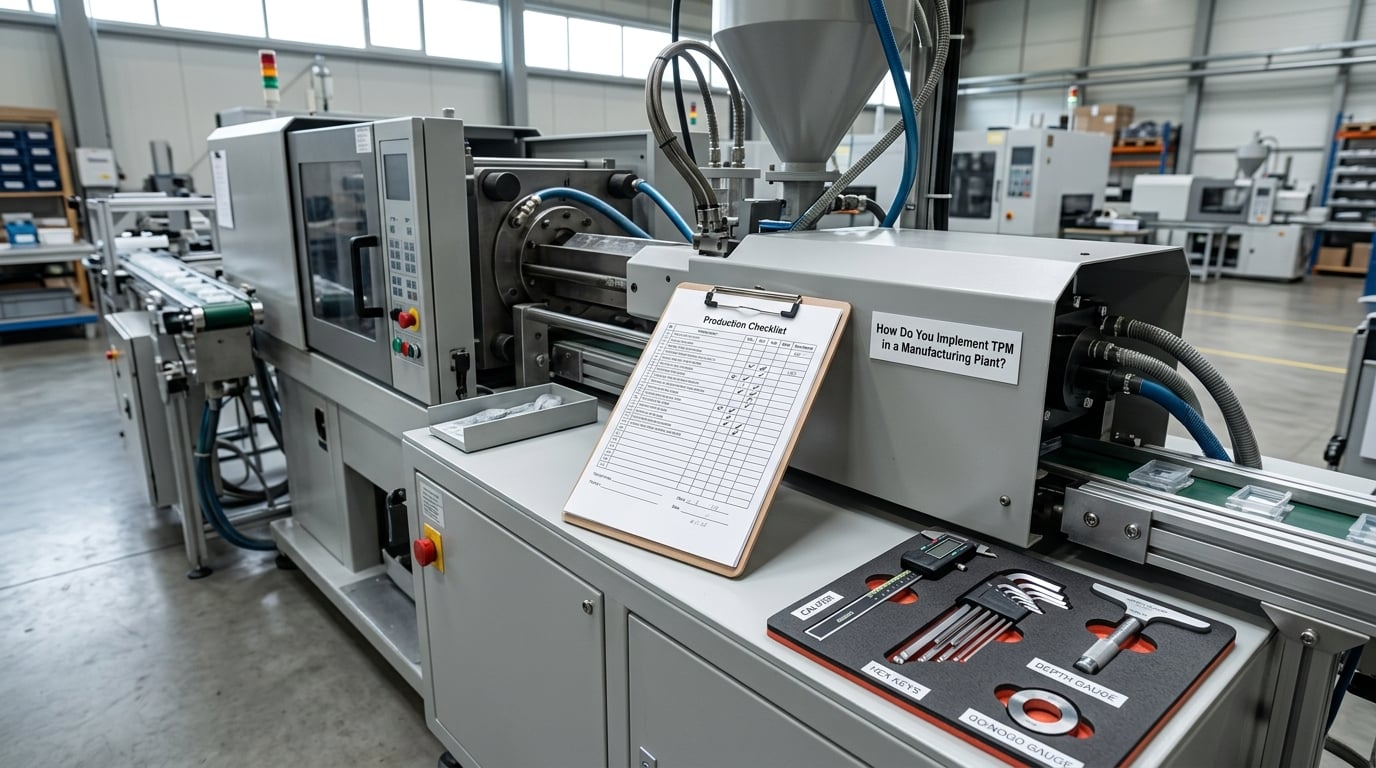
Implementation is not the interesting part. What works is a specific sequence, done on one line, with numbers that move before anything is announced plant-wide.
- Get leadership commitment in writing. A named executive sponsor attends steering meetings and answers for the results. If the plant manager cannot say why the line was chosen, stop and fix that first.
- Establish a baseline. Measure OEE on the target line before anything changes. Breakdowns, micro-stops, changeover time and reject rates by shift and by machine. Without a baseline there is no argument later.
- Form the team. Cross-functional and cross-shift: operators from all shifts on the machine, a maintenance technician, an engineer, quality and a supervisor. People who do the work belong in the room.
- Pick the pilot line. Choose the bottleneck or the line with the loudest loss, not the tidiest. A quick win on a constrained machine shows up in the plant output the same week.
- Run an equipment effectiveness audit. Observe a full shift at the machine, list every loss event, and sort them into the Six Big Losses. Time the changeover. Count the stops under two minutes separately from the breakdowns.
- Restore basic machine condition. Before any improvement work, fix what maintenance has been tolerating: guards, sensors, loose fittings, lubrication points, leaking fittings, worn tooling, missing labels. A dirty, broken machine produces bad data.
- Write standard work. Turn the best observed cleaning, inspection and changeover method into a one-page standard with photos. Attach it at the machine. One-point lessons teach the abnormal-condition check.
- Train everyone on the line. Not a briefing, a hands-on session with the standard work in hand. Run skills checks and record them on a matrix.
- Plan the maintenance. Rebuild the preventive schedules so they are realistic and scheduled against production. Separate planned work from breakdown work in the CMMS so the ratio is visible.
- Audit and sustain. Hold a sustaining audit on a fixed cycle, review OEE at the same meeting every week, and fold results back into standard work. Gaps between audits are where programs quietly die.
A 90-Day Pilot Plan for One Line
Days 1 to 15 are measurement and team formation. Days 16 to 45 are machine restoration and standard work, with operators writing the checks rather than receiving them. Days 46 to 75 are the first focused improvement events on the largest single loss, typically changeover time or micro-stops. Days 76 to 90 are the audit, the written summary of what changed, and the decision to extend to a second line.
That last document matters more than people expect. A pilot that produces a clear before-and-after OEE number is what funds the next line.
What TPM Costs and What Staffing It Needs
TPM is not free. Training hours pull experienced technicians off the tools for a period, and maintenance spend usually rises in the early stages because the schedules that were being skipped are now being honored. Benchmarks cited from the Marshall Institute put the training effort increase at roughly 10 to 20 percent, with maintenance costs running about 15 percent above the previous baseline before losses start falling.
Staffing depends on the target. A typical pilot needs one leader with roughly a quarter of their time, a maintenance technician per two or three target machines, and engineer support on a part-time basis. The plant manager needs the authority to stop a line for a standard maintenance window, which is the resource people forget to budget for.
What TPM Metrics Should You Track?
Track a small set and review them in the same meeting every week. A wall of thirty indicators produces no decisions.
| Metric | What it tells you | How it is used |
|---|---|---|
| OEE | Availability multiplied by Performance multiplied by Quality | The headline number for the line and each machine |
| Availability | Planned production time minus downtime, as a percentage | Is the equipment there when you need it? |
| Performance | Actual output against ideal rate for running time | Are we running fast, or creeping? |
| Quality | Good parts as a percentage of total produced | Are we producing value or scrap? |
| MTBF | Average time between failures | Long-term reliability trend |
| MTTR | Average time to repair a failure | How fast the plant recovers, and whether spares and skills are the constraint |
| Planned maintenance compliance | Share of scheduled jobs completed on time | Whether the schedule is realistic and respected |
| Micro-stop count | Number of stops under two minutes | The loss most often missed and most often recoverable |
| Changeover time | Minutes per changeover by machine and product | The target for focused improvement on mixed lines |
| Scrap and rework | Quantity and cost rejected | Quality maintenance progress |
| Near misses and recordables | Safety events by shift and cause | Whether safety work is real or paperwork |
| Cost of poor quality | Scrap, rework, warranty and emergency maintenance cost | Turns quality and reliability into a financial argument |
MTBF and MTTR together are worth watching closely, because a rising MTBF with a flat MTTR means reliability work is working, while both drifting the other way tells you the crew is exhausted or the spares situation is broken.
How Can TPM Improve OEE Without Creating More Work?
OEE is the single number that carries the program: Availability multiplied by Performance multiplied by Quality. Because it multiplies, small gains compound. A line running 95% availability, 95% performance and 95% quality produces 85.7% OEE, which is already near the world-class benchmark of 85%. Drop any one factor to 90% and the total falls to about 73%.
That arithmetic is also why TPM can add work and still reduce it. Take a plastics line switching between two moulds on an extrusion cell.
Autonomous cleaning and inspection each shift pull chips and dust out of the feed throat, which removes the startup rejects that were showing up in the first fifteen minutes of every run. Availability moves a little because fewer sensor faults trip a stop. Performance moves because the standard changeover work cut the die swap from a forty minute scramble to a fifteen minute checklist.
Quality maintenance tightens the barrel-zone temperature window so the process sits inside spec rather than hovering at its edge. Focused improvement then takes the largest remaining loss, which at that point is usually startup scrap, and works it for a week. Nobody was hired, and the line gained hours of good output.
The work moves, though. Operators spend fifteen minutes a shift on checks that previously did not happen. That time is real, and it is the trade: replacing a fifty minute breakdown once a week with fifteen minutes a day is a good deal for the plant.
What Are the Most Common TPM Mistakes?
1. Treating it as a maintenance department project. If the maintenance supervisor owns the program alone, it dies at the first busy week. Corrective action: the executive sponsor chairs the steering committee and the line supervisor owns autonomous maintenance in the org chart.
2. Launching plant-wide on day one. Big-bang rollouts burn the goodwill of everyone who was supposed to do the work, and staff stop recognising how their jobs were described before. Corrective action: one pilot line, ninety days, measured numbers, then extend.
3. Copying tools without context. Checklists lifted from another plant describe machines that are not yours. Corrective action: write standard work from what your operators were actually observed doing, with photos of your equipment.
4. Turning autonomous maintenance into cleaning. This is the failure practitioners complain about most often, and it is why TPM programs quietly stop moving OEE. Cleaning is part of it; abnormality detection and condition restoration are the point. Corrective action: measure micro-stops and early abnormality response alongside the housekeeping checklist.
5. Skipping training to save money. Untrained operators follow the standard incorrectly and then stop trusting it. Corrective action: budget the training hours up front and record competency on a skills matrix.
6. Relying on numbers nobody trusts. OEE figures pulled from a CMMS that operators update at the end of the shift will be wrong in a predictable direction. Corrective action: verify the data by hand for one shift, then fix the collection point.
7. Declaring victory and leaving. The program board stays in the canteen with dates from two years ago and nobody updates it. The test is simple: if the board is stale, the program is stale. Corrective action: fixed audit dates, OEE on the same weekly agenda, and visible follow-through on actions.
Frequently Asked Questions
What is TPM total productive maintenance in simple terms?
Total Productive Maintenance is a way of running a factory where everyone who touches equipment shares responsibility for its condition. Operators do daily checks, cleaning and minor adjustments, maintenance handles planned work, and engineers attack the biggest losses. The aim is fewer breakdowns, fewer defects, fewer accidents and higher OEE, without adding headcount.
What are the 8 pillars of total productive maintenance?
The eight pillars are autonomous maintenance, planned maintenance, focused improvement, quality maintenance, early equipment management, training and education, safety health and environment, and administration and office TPM. The first two keep equipment healthy, the next two remove losses, and the last four keep the system sustainable and expandable.
What is the difference between TPM and preventive maintenance?
Preventive maintenance services equipment on a fixed calendar interval and is run by the maintenance department. TPM is much wider: it keeps preventive work but adds operator ownership, condition-based judgment, quality maintenance, focused improvement events and training. One is a schedule for technicians, the other is a way of running the whole plant.
How long does it take to implement TPM?
A single pilot line usually shows measurable change within ninety days if basic machine condition is restored quickly. Full plant rollout takes years because each line needs its own baseline, standard work and training. Practitioners often compare the process to a gym habit rather than a project with an end date.
Who owns TPM in a manufacturing plant?
Ownership is shared but named. An executive sponsor chairs the steering committee, the production supervisor owns autonomous maintenance, the maintenance manager owns planned maintenance, and quality owns quality maintenance with production. Leaving ownership with the maintenance supervisor alone is the most common reason programs stall.
Is TPM still relevant with predictive maintenance and TPM 4.0?
Yes, and the two are complementary. Condition monitoring and sensor data sit inside planned maintenance and early equipment management rather than replacing them. TPM still supplies the human layer: operator checks, standard work, focused improvement on what the data reveals, and the training that keeps people engaged with the equipment.
Conclusion
Pick one constrained line this month and measure its OEE before you change anything. Then restore basic machine condition on it, write the cleaning and inspection standard work with the operators who run that machine, and revisit the number in ninety days.
TPM total productive maintenance explained in one line is this: it is not a repair project, it is how the plant runs day to day. The gains come from shared ownership, a small set of honest numbers reviewed every week, and the discipline to keep the audit cycle running long after the launch party is over.