
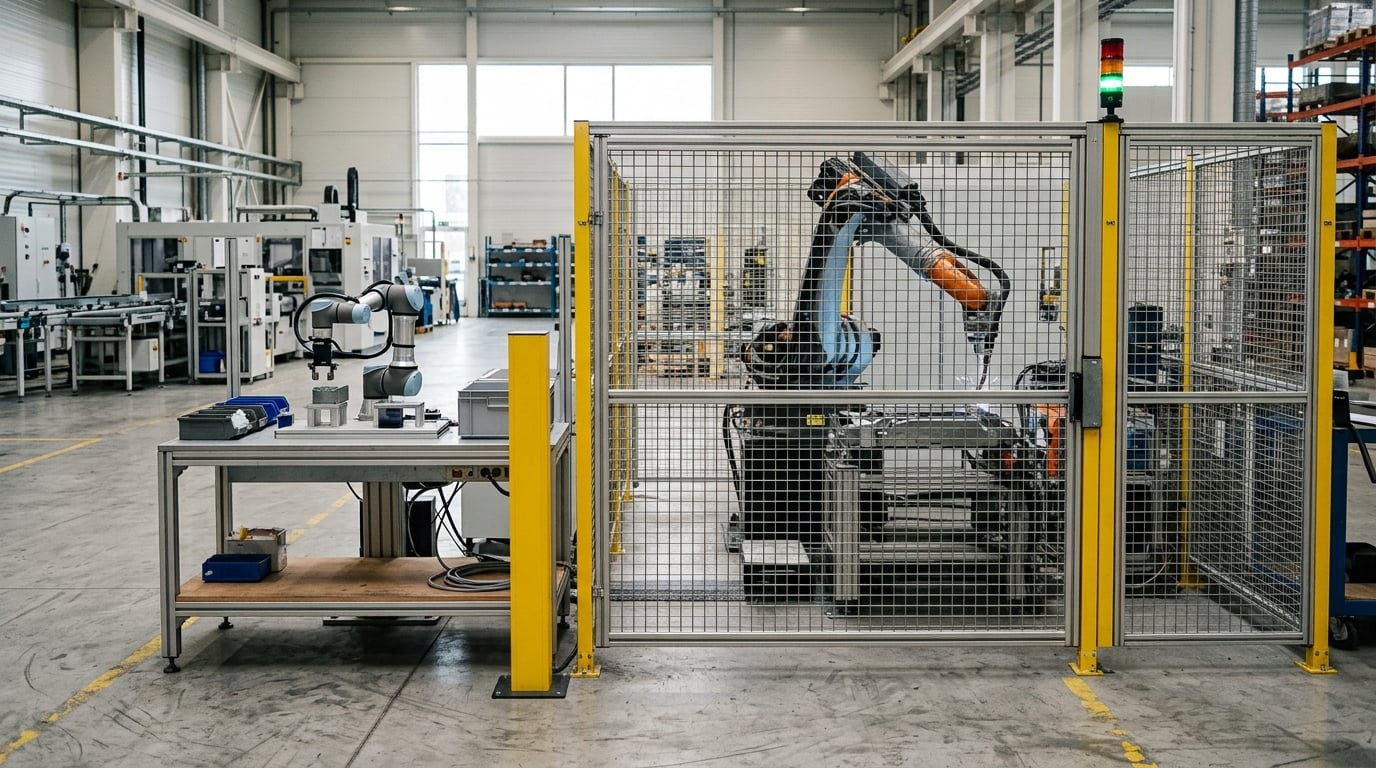
Collaborative robots vs industrial robots differences come down to one question: does a person share the workspace with the machine? A cobot is built to work beside people using force, speed and power limits, while a traditional industrial robot runs faster, lifts more, and gets fenced off from everyone.
That single design decision cascades into everything else: how the cell is guarded, who programs it, what it costs to install, and whether it still makes sense after the first product change. A cobot is not simply a small industrial robot, and the label tells you nothing on its own about whether a cell is safe.
This guide covers the differences that decide a purchase: safety method, speed and payload, repeatability, programming effort, footprint, installed cost and payback. It also covers the case where neither robot class is the right answer, because a shop with a 60-second part matrix rarely improves with a 6-axis arm.
Last updated October 2026.
Table of Contents
- Collaborative Robots vs Industrial Robots Differences at a Glance
- What Is the Difference Between a Collaborative Robot and an Industrial Robot?
- How Safety and Human Collaboration Differ
- Collaborative Robots vs Industrial Robots: Speed and Repeatability
- What Flexibility and Programming Differences Matter
- How Application Requirements Change the Choice
- How Integration, Maintenance, and Staffing Compare
- Collaborative Robots vs Industrial Robots: Cost and Expected Return
- Collaborative Robots vs Industrial Robots: Which Should You Choose?
- Frequently Asked Questions
- Are collaborative robots less accurate than industrial robots?
- Can traditional industrial robots work safely beside human operators?
- How do you calculate the return on investment for a collaborative robot?
- Does a collaborative robot need safety fencing?
- Which type of robot is better for heavy-duty, high-volume production?
- Conclusion: Start With the Task and Risk
Collaborative Robots vs Industrial Robots Differences at a Glance
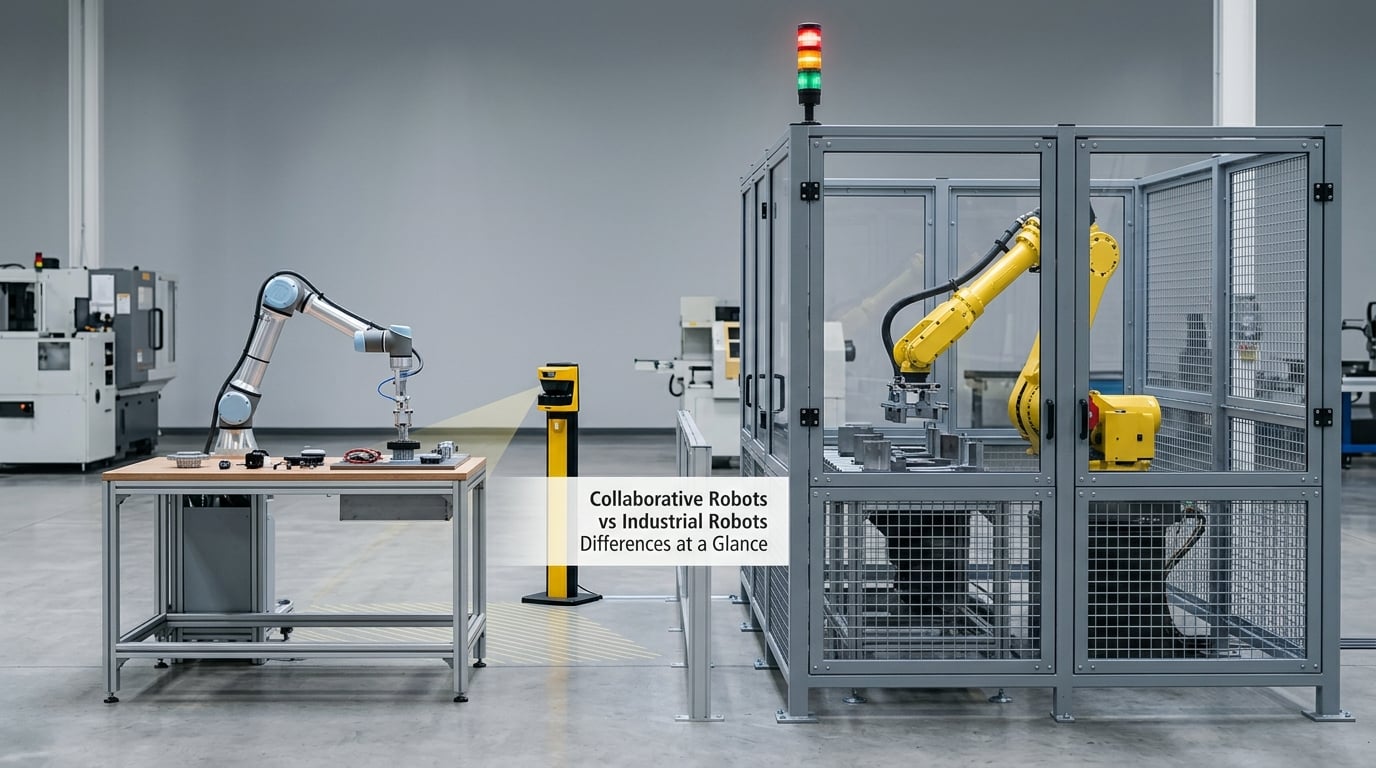
Here is the short version. The numbers below are typical operating ranges, not guarantees; model specifics vary widely inside each band.
| Criterion | Collaborative robot (cobot) | Traditional industrial robot |
|---|---|---|
| Safety method | Force, speed and power limits; may run in a shared workspace | Physical guarding, interlocks and light curtains; people kept out |
| Typical TCP speed | Up to roughly 1 m/s in many applications | Around 2 to 4 m/s, faster for positioning moves |
| Common payload range | About 0.5 kg to 20 kg for most collaborative arms | Under 1 kg to several hundred kg |
| Typical reach | Around 500 mm to 1300 mm | Around 500 mm to 3000 mm and beyond |
| Repeatability | Often 0.02 mm to 0.1 mm | 0.01 mm to 0.1 mm, tighter on high-end models |
| Programming | Hand guiding, drag-and-drop interfaces, some code | Teach pendant, offline programming, code or PLC logic |
| Footprint | Compact, often bolted to an existing bench | Larger, with space for guarding and a fenced envelope |
| Best production profile | High-mix low-volume, frequent changeovers | High-volume, stable, long unattended runs |
| Payback driver | Labour hours replaced, short deployment time | Cost per part at volume, uptime across shifts |
Five differences carry most of the weight in a buying decision:
- Safety. Cobots limit contact force so a risk assessment can permit people nearby; industrial robots move at full programmed power and are protected by fencing and interlocks.
- Speed and power. Cobots are typically slower and lighter; industrial robots run faster cycles, lift more and reach further.
- Programming. Cobots can often be taught by hand in minutes; industrial robots usually need a programmer, a teach pendant and often offline simulation.
- Flexibility. Cobots are redeployed between tasks in hours on a shared bench; industrial robots are built into a fixed cell that costs money to move.
- Cost and return. A cobot usually costs less in hardware and far less in installed labour, but an industrial robot wins cost per part once volumes get high and utilisation is near continuous.
What Is the Difference Between a Collaborative Robot and an Industrial Robot?
A collaborative robot is an arm designed to operate in a shared workspace with people. It is built with force and torque sensing at the joints, a rounded shape that avoids pinch points, and a control system that limits speed and power on contact.
A traditional industrial robot has no such intrinsic limit. It executes a programmed path at full speed and weight capacity, which is exactly why it delivers better cycle times and why safety depends entirely on keeping people out of its envelope with guards, interlocks and presence sensing.
One correction worth making early: collaborative operation is not a property of the robot alone. It is a property of the robot, the tooling, the process and the application together, and it is confirmed by a documented risk assessment under ISO 10218 and the technical specification ISO/TS 15066.
So a cobot is not a small industrial robot with a friendlier colour scheme. It trades peak performance for a safety envelope that makes human proximity plausible. An industrial robot trades nothing and is fenced instead.
The boundary also blurs in practice. Speed-limited industrial arms with safety scanners are increasingly sold into applications that look collaborative, and some hybrid cells use a fenced robot for the fast part of the cycle and a cobot for the presentation part. Ask which mode the machine runs in and how the risk assessment treats it, not which brochure it came from.
How Safety and Human Collaboration Differ
This is the defining difference, and everything else follows from it. An industrial robot is dangerous by design until it is enclosed; a cobot is designed so that the residual contact risk can be reduced enough for a person to be present at all.
For a conventional cell, safety comes from separation. Perimeter fencing with interlocked doors, light curtains on open access, safety mats on the floor and an emergency stop reachable from outside keep hands out of the working envelope. The robot runs at full speed because nothing human is ever inside.
For a collaborative cell, safety comes from limiting what the robot can do to a person. ISO/TS 15066 defines four collaborative application types, and they are worth knowing by name because integrators specify against them:
The four collaborative application types under ISO/TS 15066
- Safety-rated monitored stop. The robot stops completely when a person enters the collaborative workspace and is released by an operator or by a validated presence-sensing device. Motion is not shared.
- Hand guiding. A person takes hold of the arm and leads it, for example to add a finishing pass. The robot moves only under direct human force.
- Speed and separation monitoring. Sensors such as a safety laser scanner track the distance to the nearest person and limit the robot’s speed to keep enough separation, ramping down as someone approaches and stopping if they get close.
- Power and force limiting. The robot’s contact force against the body is capped by a combination of force sensing, rounded geometry and reduced mass, so contact is tolerable rather than injurious.
Most collaborative cells in small and medium manufacturing use power and force limiting, sometimes combined with speed and separation monitoring so the arm can run fast when the area is clear and slow when it is not.
Here is the part vendors skip: a cobot designation is not a safety approval. A risk assessment under ISO 10218-1 may still require a light curtain, a safety mat, a speed limit or restricted access, because a sharp workpiece, a hot part or a heavy tool changes the risk even if the arm itself is compliant.
One more practical constraint that surprises first-time buyers: the collaborative limit applies to the whole system, not the arm in isolation. A heavy gripper, a welding torch or a rotating tool extends the effective mass and changes the force limits, which may force you to drop to a smaller model or slow the cycle.
Collaborative Robots vs Industrial Robots: Speed and Repeatability
Industrial robots are faster, and for high-volume work that difference decides the answer. A conventional arm routinely makes positioning moves at 2 to 4 m/s and can be tuned to hold that pace around the clock, while many collaborative applications are run at or below about 1 m/s, with reduced speed through approach and infeed zones.
Payload and reach follow the same pattern. Most collaborative arms cover roughly 500 mm to 1300 mm and handle up to around 20 kg, which is enough for machine tending, screwdriving, light assembly and small welding. Above that, you move into heavy palletizing, large part handling and full-body work, which is industrial territory.
Repeatability is the number practitioners actually argue about, and it is worth separating from accuracy. Repeatability is how tightly the arm returns to the same taught point again and again. Accuracy is how close that point is to a real-world datum. Both classes routinely quote repeatability in the 0.02 mm to 0.1 mm band, with the tightest industrial models reaching 0.01 mm.
So the honest answer on accuracy is that the difference is smaller than the marketing implies. Where users notice a real gap is in fine positioning behaviour at speed: an industrial arm can approach quickly and then settle precisely with tuned motion profiles, while a cobot often has to approach slowly because the force limit restricts momentum near the part.
For a screw or a tight-tolerance insert, that approach profile can be the limiting factor. If your cycle is dominated by careful placement rather than by travel distance, a conventional robot with positioners and fixtures usually handles the work better.
There is overlap, and it grows every year. Heavy collaborative arms and speed-limited industrial arms now sit in the same payload band, so the class label is a weaker predictor than the model datasheet. Judge the model on cycle time for your part, not on its category.
What Flexibility and Programming Differences Matter
The gap that most affects day-to-day work is programming effort. A cobot is built to be taught rather than programmed.
Hand guiding is the headline method: switch the arm into a compliant mode, push the tool to the point, step through the sequence, and store it. Most operators can do this after a short training session, which means a new SKU can be taught on the floor during a changeover instead of scheduled with an integrator.
Graphical interfaces that sit on top of that flow take it further, with drag-and-drop blocks for common patterns such as pick, place, move relative and wait for a signal from a machine. Some collaborative platforms also accept general-purpose code for vision-guided or more intricate logic.
Traditional robots still use a teach pendant, and a lot of programme work still means writing code in the manufacturer’s language or in a PLC structure, often with offline simulation first to catch collisions and cycle problems before the arm moves. That is a real cost in hours, not a criticism of either approach.
Flexibility follows from that. A cobot can be unbolted from one bench and set up on another, which is the core of the high-mix low-volume case: short runs, frequent changeovers and no dedicated automation engineer on site. A fenced industrial cell is integrated into its position, with guards, conveyors and utilities routed around it. Moving one is a project, not a redeployment.
The collaborative robots vs industrial robots differences that matter most
On the collaborative robots vs industrial robots differences question that matters most in practice, the honest summary is this: a cobot trades cycle time and future flexibility in one direction, and trades programming labour, redeployment time and integration effort in the other. High-mix work with frequent changeovers usually comes out ahead; stable, repetitive volume usually does not.
End-of-arm tooling is the quiet variable in all of this. Grippers, screwdrivers, welding torches and vision systems are where compatibility actually bites, and it is where a supposedly plug-and-play cell can turn into a custom project.
How Application Requirements Change the Choice
Requirements beat categories. The same task can justify either robot class depending on cycle time, quantity and the risk of the process, and it is easier to work backwards from the process than forwards from the label.
| Task | Usually the better fit | Why |
|---|---|---|
| Machine tending | Cobot | Short cycles, frequent part changes, works beside an operator at the machine door |
| Precision assembly, screwdriving | Cobot | Small payload, human-scale work, easy redeployment between variants |
| Electronics finishing | Cobot | Low mass, delicate parts, mixed model families on the same bench |
| Inspection and quality control | Cobot | Works with a human inspector, low force and predictable cycle |
| Small welding cells | Cobot | Reasonable reach for small parts, no enclosure needed in low-fume areas |
| High-volume welding | Industrial robot | Duty cycle, dual tables, fume extraction and deposition rate |
| Palletizing heavy cases | Industrial robot | Payload above the collaborative band, sustained high throughput |
| High-speed packaging line | Industrial robot | Cycle time and synchronization with fixed conveyor timing |
| Hazardous or dusty process | Industrial robot, enclosed | Enclosure protects the machine and the process, not just the operator |
Two conditions decide most cases. If your process risk is high, if the part is heavy, or if the cycle has to run through several shifts at a fixed rate, the industrial robot is the right answer. If the work changes often, shares a bench with a person, or is the kind of job a machine operator currently does half an hour at a time, the cobot usually wins.
Changeover frequency is the variable most people underweight. A job that switches between eight part numbers a week makes tooling and guarding the enemy, not cycle time. A job that runs the same part for two years makes those same costs amortize quickly.
Machine tending deserves a specific note. It is the most common first application for a cobot and usually a good one, because the human already works at that machine, the payload is modest, and the payback is counted in operator hours returned to value-adding work. The counter-case appears when loading and feeding remains manual after the robot is installed, which is common and worth checking before you sign anything.
How Integration, Maintenance, and Staffing Compare
Integrated cost, not arm price, is where the two classes separate most, and it is where purchasing decisions go wrong.
Footprint is the first visible difference. A cobot on a bench needs little more room than the bench, though a safe layout still needs room for the operator to stand and reach. An industrial cell needs space for the robot, its fenced envelope, a maintenance aisle, a controller cabinet and a way to get material in and finished product out.
Guarding is the next line. A collaborative application may still need light curtains or a safety mat, but it rarely needs a full fence, which cuts steel, floor space and material-handling design in one move. Conventional cells treat fencing as a fixed cost with no exceptions.
Utilities and networking follow. Both classes need power, compressed air for some end-of-tooling, and a network path to the plant PLC or MES. A collaborative arm more often ships with the controller integrated and connects over standard industrial ethernet, while a large industrial robot may need a dedicated cabinet, safety PLC and more commissioning time to bring online.
Staffing is the quieter difference. A cobot cell is usually run and reprogrammed by existing operators or a maintenance technician. A fenced cell tends to need someone who understands robot programming and safety systems, which is a different and often more expensive skill to find.
On maintenance, the arm itself is rarely the problem. What catches people is calibration after a collision, backup and restore of controller files, spare joint modules, and a spare-parts list held by a distributor who may not stock the part. Confirm the service model and the mean time to a replacement part before you buy, because downtime costs the same for both classes.
The installed-cost model to use is straightforward: arm plus end-of-tooling plus guarding plus fixtures plus integration labour plus software plus safety validation plus training, amortized over realistic annual hours rather than theoretical hours.
Collaborative Robots vs Industrial Robots: Cost and Expected Return
Arm price alone is the least useful number in this comparison, and it is the one vendors lead with. A low-cost arm with custom tooling, a guard and 200 hours of integration can cost more than a pricier arm that ships ready to work.
The cost drivers run in opposite directions. A collaborative cell tends to cost less in hardware, needs less guarding, integrates faster, and can usually be maintained by people already on staff. It carries more risk in throughput, because slower cycles mean fewer parts per hour.
An industrial cell costs more in hardware, guarding, fixtures, footprint and integration effort, and needs specialist labour to program and maintain. In return it produces more parts per hour and stays productive for longer stretches, which is where the return comes from.
That makes volume the variable that decides most of these decisions. Low-volume work with a handful of skilled operators benefits from fast deployment and easy redeployment. High-volume work benefits from cycle time, because every second shaved off the cycle multiplies across the year.
Utilisation matters as much as cycle time. A cell that runs four hours a day on a two-shift operation is not going to repay a two-shift investment no matter how cheap the arm was. Before doing any arithmetic, work out annual productive hours and the realistic percentage of time the cell will actually be producing rather than waiting on a machine change or a fixture swap.
A simple payback model is: total installed cost divided by annual gross saving, where the saving is (labour hours replaced times loaded hourly cost) plus (material yield improvement) plus (avoided scrap) minus (maintenance and consumables). For a high-volume line, add avoided cost per part from lower cycle time. Run it at 60 percent and 80 percent of expected hours, and see whether the answer still holds at the lower number.
There is a fourth cost people forget: the cost of getting the application wrong. A cell that never reaches production pays nothing back at all, and a slow cell keeps the machine idle while it works.
Collaborative Robots vs Industrial Robots: Which Should You Choose?
Choose a cobot when the work changes often, shares space with people, involves a payload in the low kilograms, and needs to be running within weeks rather than quarters. Choose an industrial robot when the part never changes, the cycle time is the constraint, the payload is heavy, the process is hazardous, or the line must run unattended across shifts.
Worked cases make it concrete. A machine shop running short CNC jobs benefits from a cobot tending two machines and freeing an operator from loading, because the work is varied and the payload small. A contract packer moving cases by the pallet loses money with a cobot on cycle time and loses on payload, so an industrial robot is correct. A welding shop doing small brackets in short runs can go either way, and the deciding question is fume extraction and duty cycle rather than payload.
Before you commit, work through this checklist:
- Write down the cycle time the process actually needs, measured rather than estimated.
- Record the payload, the reach and the required repeatability, including tolerance on the part rather than on the taught point.
- List the process hazards: sharp edges, hot parts, welding, dust, noise, cutting tools.
- Count how often the part or task changes in a year.
- Decide what labour the cell is meant to return to production, and confirm the operator hours it actually removes.
- Budget the installed cell, not the arm, and run a documented risk assessment before assuming no fence is needed.
When neither robot class is the answer
Plenty of applications that get quoted a cobot are better served by something simpler. A linear actuator or a pick-and-place unit that moves in one axis can be cheaper, faster and more accurate than a six-axis arm. SCARA and Cartesian gantry robots dominate high-speed pick and place for the same reason.
There is also the custom mechanism case: a purpose-built slide, dial or fixture-driven jig that a shop can machine in-house often beats a general-purpose arm on cost and cycle time, even counting guarding. The question to ask any supplier is simple: what is this robot being compared against, and has that alternative been costed too?
One more failure mode worth naming, because it happens more often than the technology debates suggest: buying a cobot that never gets deployed. Teams buy one during a reshoring push, then the work that justified it never arrives, and the arm sits in a corner. A written application with a real part, a real cycle time and a named owner for the project prevents this better than any model selection does.
Frequently Asked Questions
Are collaborative robots less accurate than industrial robots?
Not in repeatability. Both classes commonly quote 0.02 mm to 0.1 mm, with the tightest industrial models reaching 0.01 mm. The difference users feel is in motion behaviour: an industrial arm can approach a part quickly then settle precisely, while a cobot often has to approach slowly because the contact force limit restricts momentum near the workpiece. For fine placement work, that approach profile matters more than the repeatability figure.
Can traditional industrial robots work safely beside human operators?
Yes, but not by relying on the robot itself. A conventional robot moves at full programmed power, so safety comes from separation: interlocked fencing, light curtains, safety mats and restricted access, all verified by a risk assessment. Some cells add a monitored stop or speed limiting when an operator must enter the envelope. A cobot achieves proximity through built-in limits instead, which is the real difference between the two classes.
How do you calculate the return on investment for a collaborative robot?
Divide the total installed cost by the annual gross saving. Installed cost includes the arm, end-of-tooling, guarding, fixtures, integration labour, software, safety validation and training, not just the arm. The saving is operator hours replaced at loaded hourly cost, plus material yield gains and avoided scrap, minus maintenance and consumables. Run the model at 60 percent and 80 percent of expected annual productive hours to see whether the case survives the realistic case.
Does a collaborative robot need safety fencing?
Often not, and that is the main cost and footprint advantage, but it is never automatic. A risk assessment under ISO 10218-1 and ISO/TS 15066 determines what the specific application needs. A cobot running power and force limiting beside a person may need nothing more than a marked floor area, while a cobot handling a sharp or heavy workpiece may still require a light curtain, a safety mat or a speed limit. The collaboration mode used changes the answer entirely.
Which type of robot is better for heavy-duty, high-volume production?
A traditional industrial robot, in most cases. It offers greater payload, longer reach, faster cycle times and duty cycles suited to running across shifts, which lowers cost per part once volume is high. The collaborative advantage is flexibility and fast deployment, and that advantage fades as production becomes stable and repetitive. A cobot is the stronger choice when the task changes often, not when the same part runs around the clock.
Conclusion: Start With the Task and Risk
Document the requirements before you look at robots: real cycle time, payload, required repeatability, the hazards of the process, how often the part changes in a year, and which operator hours the cell is meant to return to production. Those six numbers decide the collaborative robots vs industrial robots differences in practice, and they are the same regardless of which brands you end up quoting.
Then compare shortlisted models against a documented risk assessment, costed as an installed cell rather than an arm. If the work is varied and shared with people, a cobot usually wins on speed to production and redeployment. If it is heavy, hazardous or measured in parts per hour across shifts, an industrial robot wins and keeps winning. And if a linear axis or a purpose-built jig does the job for less, pick that instead.