
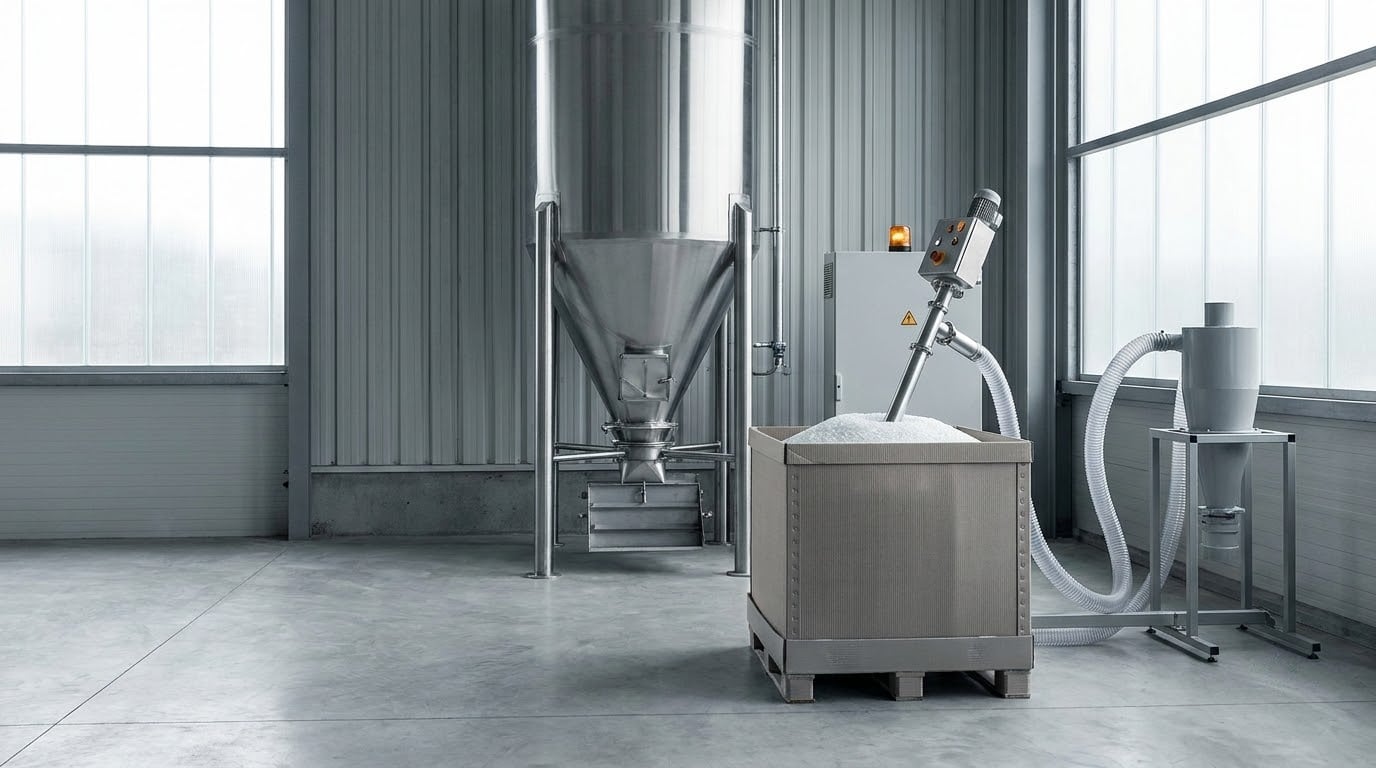
Storage architecture is a five-to-ten year decision for a plastics plant, not a purchase order. A silo converts recurring freight, packaging and handling cost into installed capital, while a gaylord box keeps that cost recurring and keeps your options open. Almost every plant eventually runs a mix of the two.
Last reviewed in October 2026. This comparison is written for plant engineers, production managers and purchasing teams who already know what a vacuum loader and a hopper dryer are.
The short version: a silo is a fixed welded steel vessel that gravity-feeds resin to the machines, and a gaylord is a pallet-mounted box of roughly 2,000 to 3,000 lb that gets unloaded by vacuum loader, suction wand, or hand tipping. Silos suit high-volume, few-grade production. Gaylords suit low volume, many grades, and plants without silo infrastructure.
Table of Contents
- Silo vs Gaylord Resin Storage Tradeoffs at a Glance
- How Silo and Gaylord Storage Change Resin Handling
- Silo Storage: When Bulk Resin Handling Wins
- Gaylord Storage: When Flexibility and Simplicity Win
- Upfront Cost and Total Cost of Ownership
- Throughput, Labor, and Production Flow
- Contamination, Moisture, and Material Quality Risk
- Safety, Cleanliness, and Regulatory Requirements
- Footprint, Capacity, and Future Expansion
- Which Should You Choose?
- Frequently Asked Questions
- Which storage method is cheaper for resin?
- Can a manufacturing facility use both silos and Gaylords?
- Are silos better for contamination-sensitive resin?
- How much space does a Gaylord of plastic resin require?
- When does a silo system justify its higher upfront cost?
- What information is needed before switching resin storage formats?
- Conclusion
Silo vs Gaylord Resin Storage Tradeoffs at a Glance
This table is the decision in fourteen rows. Read the two right-hand columns against your own plant before reading anything else on the page.
| Criterion | Silo | Gaylord |
|---|---|---|
| Capital cost per pound stored | High and paid once, including foundation, unloading and dust collection | Near zero, carried inside the material price you pay anyway |
| Freight cost per pound inbound | Bulk truck or railcar, lowest per pound, but only in bulk quantities | Palletised freight plus a packaging premium, and you pay it every time |
| Installed footprint per pound stored | Vertical, so a small floor area holds a lot of material | Needs dock space, forklift lanes and a staging area for full and empty containers |
| Usable versus nameplate capacity | Typically 70 to 80 percent usable after cone dead volume and heel material | The whole box is usable, but partial draws leave a residue you cannot get out |
| Feed mechanism simplicity | Slide gate or rotary valve, gravity or vacuum feed, almost no moving parts at the source | Every box needs a loader, cyclone receiver or a person with a knife |
| Handling labour per delivery | One receiving event for thousands of pounds | Forklift placement, staging, box opening and cleanup on every delivery |
| Contamination exposure | Closed vessel, few open transfers, dust concentrated at fill | Open tops, cut liners, floor spillage and material open to the room |
| Moisture exposure for hygroscopic grades | Sealed once filled, so good, though fill dust and seal condition still matter | Heat-stitched liner keeps material sealed until opened, then partially drawn boxes breathe |
| Grade flexibility and changeover | Slow and expensive, with a purge quantity that never fully leaves the vessel | One box per grade, so sequencing is quick and the residue is small |
| Access to small lots and spot resin | Ties you to bulk commitments per grade | Keeps the spot market and specialty grades reachable in pallet quantities |
| Inventory visibility | Continuous, through level sensors, load cells or weigh hoppers | A count of boxes with blind gaps between deliveries |
| Expansion path | New vessel, new foundation, new construction window | Add a dock position and another supplier order |
| Maintenance burden | Filters, feeders, seals, level sensors and periodic structural inspection | No fixed equipment to service, just liner, pallet and housekeeping damage |
| Combustible dust and code exposure | Dust generation at fill, so collection and suppression design matter, and the vessel is a fixed installation | Many small quantities spread around a room, so housekeeping and carrying capacity carry the risk |
Three rows decide more cases than the other eleven combined: pounds per month per grade, number of grades, and how many machines share the material network. If your numbers on those three are small or mixed, the other rows will not rescue the decision.
How Silo and Gaylord Storage Change Resin Handling
The two formats are not really two containers. They are two different material-handling systems that happen to start at a storage point, and that is where the silo vs gaylord resin storage tradeoffs actually live.
What changes day to day
A silo is a fixed source. A vacuum system, an auger or a central pump station pulls from it through a fixed line, and the number of manual actions per pound of resin drops close to zero. Resin arrives by bulk truck or railcar, gets filtered into the vessel, and sits sealed until a gate opens.
A gaylord is a series of sources. Each box is a separate batch with a separate label, and material reaches the machine through a loader, a wand, a cyclone or a pair of hands. You gain batch-level traceability and lose the fixed point that automation depends on.
The variables worth measuring first
Before comparing equipment, get four numbers out of purchasing and production: monthly pounds per grade, number of grades in rotation, number of machines sharing the network, and available headroom above the staging area. Add a fifth: how often a grade change happens, including colour and regrind changes.
Those five numbers decide the format. Capital budgets, vendor quotes and floor plans come afterwards.
Silo Storage: When Bulk Resin Handling Wins
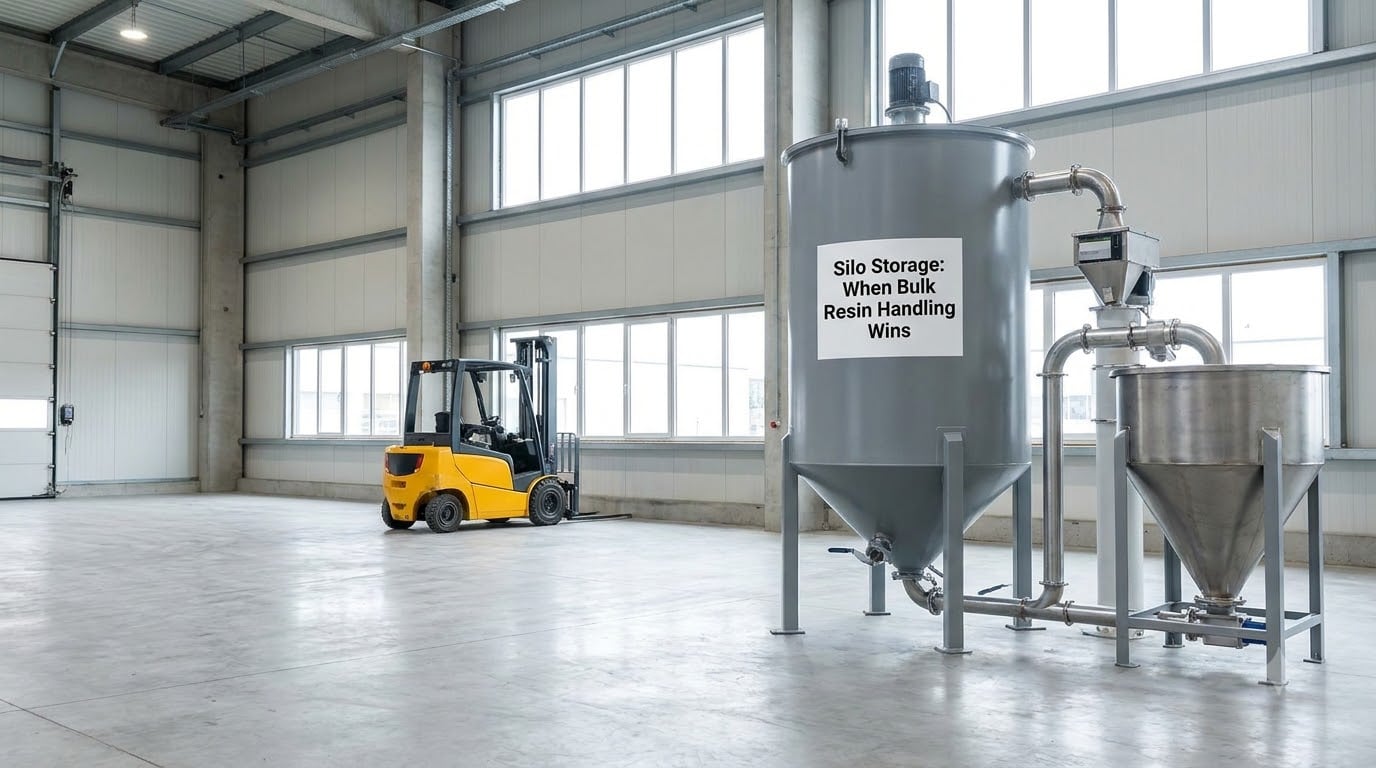
Silos win when a plant consumes one grade steadily enough that a receiving event and a staging area are costing more than the installed system.
What a silo installation actually involves
The vessel is welded steel, spiral-wound or structural, with a cone bottom and a gated discharge. Spiral steel silos are common at larger capacities, and published catalog sizes for one supplier’s line run from 1,818 to 5,558 cubic feet in an 11 foot 6 inch diameter body, which tells you how much vertical space this class of equipment claims.
Around the vessel sit the items people forget in the quote: a foundation and structural support, a fill method that suits your delivery mode, bin vent filters and dust collection, level indication, access ladders and platforms, service clearances, and a discharge device. Rotary feeders or slide gates sit at the cone, and a bridge breaker or vibrator is worth specifying for grades that arch.
Where bulk resin handling pays off
Three profiles make a silo an easy decision. A machine running around the clock on one grade converts every receiving day into saved forklift time and saved packaging. A compounding or extrusion line pulling steady pounds per hour cares far more about uninterrupted draw than about spot-market access. And a contamination-sensitive operation benefits because resin never sits open in a room while it waits for a forklift.
A word on level indication, since it is easy to leave out. A continuous level signal turns inventory from a weekly guess into a number your ERP can reconcile, and a weigh hopper or load-cell base does it accurately. Gaylord storage gives you a box count, which is honest but coarse.
Gaylord Storage: When Flexibility and Simplicity Win
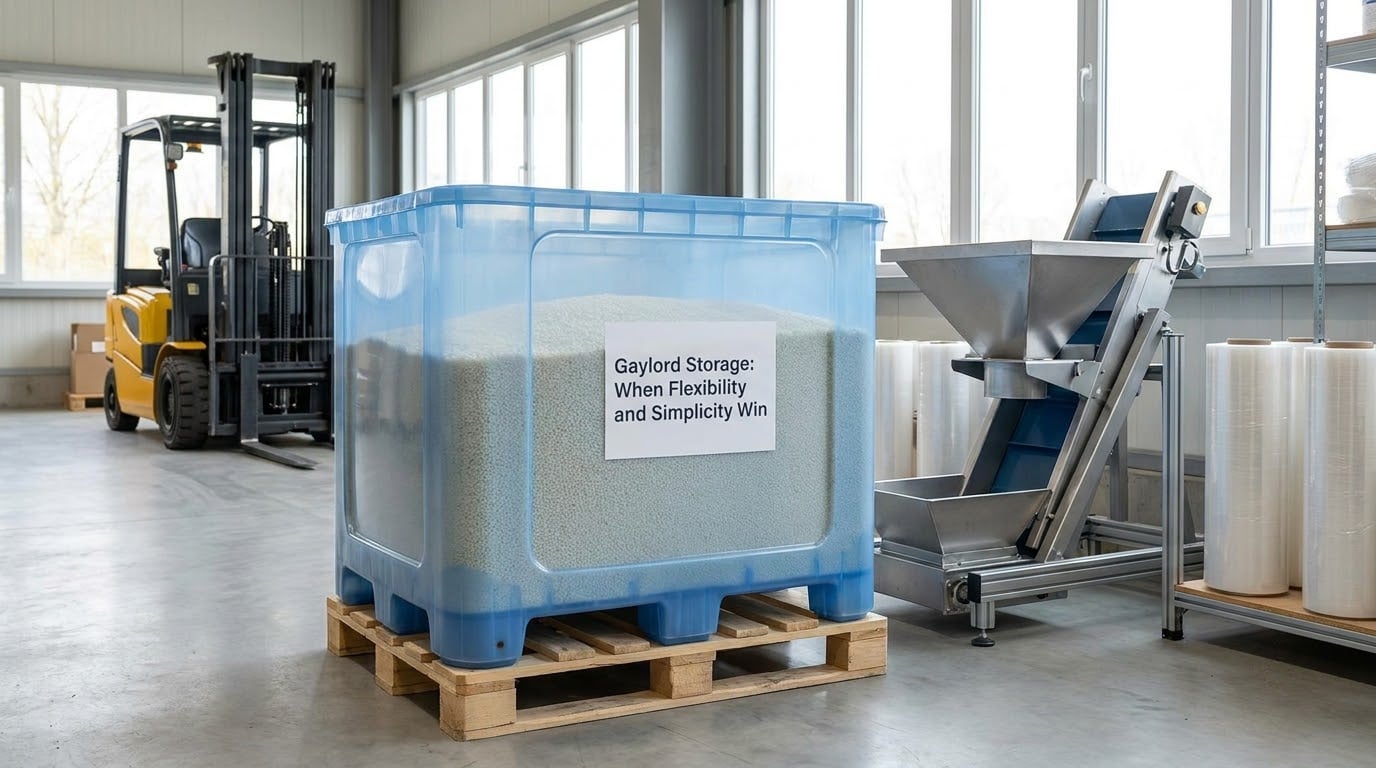
Gaylords win when volume per grade is modest, grades rotate often, and the plant has no reason to build infrastructure it will not fill.
The receiving chain, end to end
A box arrives on a pallet, gets fork-lifted into a marked staging position, and waits there. At the machine a vacuum loader with a suction wand draws pellets out to a cyclone separator and receiver, or a bag-dumping station does the same job mechanically. Some small operations still cut the liner and tip by hand, which works until someone cuts a bag over a dirty floor at the end of a long shift.
Afterwards the empty pallet, liner and any spilled pellets leave with the general waste stream. The industry calls this same object a gaylord, a gay lord, an IBC tote, an octabin or a pallet box, and the difference is naming rather than function.
Operating profiles that suit pallets
Pallets suit a shop running many grades in small quantities, a plant that adds machines gradually rather than all at once, and any operation that needs a specialty or colour grade the supplier will not sell in bulk. They also suit sites with no headroom above the dock and no appetite for foundation work, which covers a lot of small and mid-size plants.
The honest downside is that a pallet-based plant is a plant where someone is always moving resin by hand or forklift. That is a labour cost you can measure, and it is the number the silo case is built on.
Upfront Cost and Total Cost of Ownership
The useful question is cost per pound handled over several years, not the price of a vessel. Silos move cost from the recurring column to the capital column, and gaylords do the opposite.
| Cost element | Silo | Gaylord | Timing |
|---|---|---|---|
| Equipment and installation | Vessel, foundation, unloading package, dust collection, controls | Dock setup, staging markings, possibly a dumping station | One time |
| Packaging per pound | Minimal, bulk material has no liner or box | Liner, box, pallet and stretch wrap on every pound delivered | Recurring |
| Inbound freight per pound | Lowest, because one bulk delivery replaces many pallets | Higher, because the truck carries air and packaging | Recurring |
| Receiving and handling labour | Periodic bulk unload and inspection | Forklift moves, staging, box opening, cleanup | Recurring |
| Maintenance | Filters, feeders, seals, sensors, structural checks | Liner and pallet replacement, housekeeping | Mixed |
| Material loss and spillage | Small, mostly at fill and in the cone heel | Noticeable, at every box opening | Recurring |
| Empty container handling | Not applicable | Return, reuse or disposal of boxes and pallets | Recurring |
Where the crossover sits
A silo pays back when the recurring cost it removes, freight premium plus packaging plus handling labour plus spillage, exceeds the installed capital amortised over the years you will use it. That crossover is volume-driven and grade-count-driven, and it moves as your production schedule moves.
The inverse case matters just as much. Below the crossover, silo capital is stranded: a vessel sized for 200,000 lb a year that runs at 40,000 lb a year still costs the same to run, still needs filters, still needs inspection, and still occupies the floor it was poured for. Plenty of plants buy that outcome and then wonder why the equipment never paid for itself.
So run your own numbers rather than trusting a general rule. The variables to substitute into a simple model: monthly pounds per grade, delivered cost per pound, container capacity, receiving labour rate, forklift availability, capital budget, and years of service you will realistically get.
Throughput, Labor, and Production Flow
Throughput in a silo plant is limited by the feed device, the line and the dryer, not by storage. A rotary feeder meters a steady draw that a hopper dryer downstream can be matched to, and a full vessel removes the stop-start pattern you get when a machine waits on a forklift.
Gaylord throughput is bounded by how fast you can unload boxes. One vacuum loader with a wand is fast for a machine that runs constantly and slow for a cell with three machines sharing one hopper. Add a dumping station or a central vacuum system and the difference narrows, which is exactly why so many plants end up with a central pump station, a manifold and selection valves regardless of where the material came from.
Three production variables move the answer more than equipment choice does. Machine count drives whether one shared source pays for central conveying. Schedule stability drives whether you need buffer capacity at all, since a plant that runs three shifts needs a different safety factor than one that runs two shifts and stops. Changeover frequency drives residual quantity, because a silo purge is measured in hundreds of pounds and a box changeover is measured in the few pounds left in the last container.
Contamination, Moisture, and Material Quality Risk
Neither format is clean by default. They fail differently, and the symmetric view matters when you are weighing one against the other.
Silo exposure
Resin is enclosed for most of its life, so room contamination is low. The risk concentrates at fill, where dust escapes during bulk unloading and where filters load up. Bridging and arching in the cone leave heel material that never discharges, and that residue is the usual source of cross-contamination on a grade change. A poorly sealed fill or a worn filter defeats the enclosure argument entirely, so seal condition belongs on a routine inspection list.
Gaylord exposure
A box is open at the top once the liner is cut or the flap is opened, and pellets are exposed to whatever the room contains. Liner tears, damaged pallets and crushed boxes during handling produce spillage that gets walked on. Partially drawn boxes sit open for days, and a staged box in an unmarked lane is how a black masterbatch ends up feeding a clear part.
Shared risks
Hygroscopic grades such as PET, PA and ABS pick up moisture in any container, and the fix is a drying system with the right dew point, not a better storage vessel. Fines, dust and angel hair are generated by every transfer step, and both formats need a purge procedure and a written changeover discipline. A magnetic separator at the machine catches metal, not contamination, so it does not replace handling discipline.
The generalisation worth carrying: bags cut open and tipped by hand at every machine are one of the most common contamination routes in a plant, and closed transfer is the cheapest contamination control available.
Safety, Cleanliness, and Regulatory Requirements
Storage format changes the safety profile more than it changes the compliance profile, and I am deliberately not prescribing what any site must do. Codes, permits and employer obligations vary by jurisdiction and by facility, so confirm them with your own authorities and qualified professionals.
With pallets, the recurring exposures are manual handling, forklift traffic in a staging area, falling boxes from bad stacking, and cut-resistant hazards when liners are opened. With silos, the recurring exposures are working at height during inspection, confined-space considerations around vessels and pits, stored pressure and dust during filling, and pinch points at gates and feeders. Both need guarding, housekeeping and a written sequence for changeover and cleanout.
Plastic pellets are a combustible dust, and the amount you have in one place affects how seriously a facility plans for that. Bulk quantities in a fixed vessel raise dust generation at fill and put a larger single inventory at stake, while many small boxes spread the material and lean on housekeeping. National guidance on combustible dust hazards, including OSHA and NIOSH resources, and the applicable fire codes are the right reference points for a site doing this analysis.
Footprint, Capacity, and Future Expansion
Capacity gets quoted as nameplate volume, and usable capacity is always lower. The gap is the cone and the material that will not discharge, so plan on roughly 70 to 80 percent of nameplate for a cone-bottom silo and treat any vendor figure at the higher end as optimistic.
The sizing calculation runs: usable pounds equals cubic feet multiplied by bulk density multiplied by fill factor. Plastic pellets sit in the general range of 30 to 40 lb per cubic foot depending on grade and packing, and the fill factor is the same 0.70 to 0.80 mentioned above.
A worked example using published catalog dimensions. At 1,818 cubic feet, a bulk density of 35 lb per cubic foot and a fill factor of 0.75, usable capacity is about 47,700 lb. At 5,558 cubic feet with the same assumptions, it is about 145,900 lb. If your real grade bulks differently, or if your experience shows heavier bridging than the catalogue assumes, adjust the factors rather than the vessel.
Then size in days of cover rather than in cubic feet. A silo should hold enough material to cover supplier lead time plus a safety buffer, and a plant that receives weekly against a resin supplier with a long lead time needs more capacity than the same plant receiving daily. Add several days of extra cover for a grade you cannot readily replace, and be honest about how quickly you can add the next vessel.
Gaylord sizing is a different mental model entirely. You are counting containers, dock positions and staging lanes, not filling a volume, so the question becomes how many boxes you receive per week and where they stand between arrival and the machine. Most pallet plants need dedicated, marked lanes per grade, because a tidy staging area is a quality control.
On expansion, silos are harder to add and easy to extend once you have planned the structural envelope and the headroom. Gaylords expand by adding a dock position and another supplier relationship. That flexibility is a genuine asset for a plant adding machines over five years rather than all at once.
Which Should You Choose?
Choose by operating profile, not by equipment preference. The table below is the short version of the decision, and the framework after it is how I would walk a plant through it.
- Continuous high-volume, single grade: silo. The receiving and handling savings alone carry the capital.
- Many grades, modest volume each: gaylord. Purity of batch identity and quick changeover beat density of storage.
- Low volume or an uncertain schedule: gaylord. There is no penalty for having flexibility you have not used yet.
- Contamination-sensitive product: silo with closed transfer, and only if the volume justifies it.
- No headroom and no appetite for foundation work: gaylord, without much debate.
- Adding machines over several years: hybrid. Gaylord inbound feeding a central vacuum system, silos added for the top two or three grades.
A decision framework in six steps
- List monthly pounds for each grade. If the largest grade does not move a meaningful volume every week, stop and choose gaylord.
- Count the grades in rotation. If the tail is long and each grade is small, silo the head grades and pallet the tail.
- Count the machines that share the material network. Six or more is where central conveying and bulk storage start to pay for themselves.
- Check headroom and floor area above the staging zone. If the vertical envelope is gone, the silo option is not a real option.
- Check capital availability against the amortisation period you would accept on infrastructure, not on tooling.
- Count changeovers per month, including colour and regrind. Frequent changeover plus a silo means a purge quantity you should price into every grade switch.
Take the resulting numbers into a vendor application review as a documented list, not a verbal description. Ask each supplier to show usable capacity for your specific bulk density, draw rate for your specific feed device, and what is excluded from the installation scope. A selector or a quote is preliminary guidance, not a final specification, and no reputable supplier should treat it as one.
Frequently Asked Questions
Which storage method is cheaper for resin?
Neither is cheaper in general. A silo costs more upfront and less per pound over time; a gaylord costs less upfront and more per pound on every delivery. The crossover sits where the freight, packaging and handling cost you remove each month exceeds the installed capital amortised over your service life. Below that volume, silo capital is simply stranded.
Can a manufacturing facility use both silos and Gaylords?
Yes, and most growing plants should. A common pattern is gaylord inbound feeding a central vacuum system that draws from several storage points, with silos added later for the two or three highest-volume grades. Silos for the head grades give steady draw and low handling cost, while gaylords for the long tail of specialty grades preserve batch identity, quick changeover and access to small-lot resin.
Are silos better for contamination-sensitive resin?
They reduce exposure rather than eliminating it. A closed vessel means resin is not sitting open in a room, and dust is generated mainly during fill. New risks appear instead: bridging leaves heel material in the cone that can cross-contaminate a grade change, and a worn seal or loaded filter defeats the enclosure. Closed transfer, a purge procedure and routine seal inspection do the actual work.
How much space does a Gaylord of plastic resin require?
A full box of roughly 2,000 to 3,000 lb sits on a standard pallet footprint, but the space you actually need is much larger. Budget the dock door, forklift turning room, and one marked staging lane per active grade, with separate space for empties, liners and pallets. That staging area, not the box itself, is the constraint most pallet-based plants run out of first.
When does a silo system justify its higher upfront cost?
When one or two grades are consumed steadily enough that packaging, freight premium and handling labour add up to more than the annualised capital. Steady draw matters as much as volume, because a full vessel feeds a line without stopping for a forklift. The investment also earns its keep where product contamination is expensive or where six or more machines share one material network.
What information is needed before switching resin storage formats?
Bring monthly pounds per grade, the number of grades in rotation, machines sharing the network, changeovers per month, available headroom and floor area, your capital budget, and the bulk density of the grades you run. Add current receiving labour hours and observed spillage. Vendors can size a vessel from those numbers in a day, and cannot size one without them.
Conclusion
The rule is short. High volume in few grades with steady draw and clean overhead space justifies a silo; everything else is better served by pallets, and the boundary moves as your production does.
Start with the numbers rather than the equipment. Document monthly pounds per grade, grade count, machines on the shared network, receiving labour hours and available headroom, then compare the installed capital of a silo against the five-year freight, packaging and handling cost of the equivalent gaylord volume.
For most processors adding machines over time, the correct answer is not one or the other. Run gaylord inbound into a central vacuum system, add silos for the two or three grades that justify them, and revisit the boundary every year your volume changes.