

Here is the short version: the FDA does not approve, certify, or license food contact plastic products, and there is no document called an FDA food grade certificate. What the FDA does is authorize individual food contact substances — resins, additives, coatings, adhesives, and pigments — for stated uses under specific conditions, and then place the burden of proving your article matches that authorization on the manufacturer. Last reviewed against FDA materials current as of October 2026.
That distinction is where most confusion starts, and it shapes everything else in this guide. Once you understand that the FDA regulates substances and conditions of use rather than finished products, the rest of the food contact plastics FDA requirements fall into a workable order: identify the substance, find its authorization, match your conditions of use, and keep the records that show you did.
Table of Contents
- What Are the Food Contact Plastics FDA Requirements?
- Which FDA Rules Apply to Your Plastic Product?
- How the FDA Food Contact Substance Framework Works
- What Compliance Evidence Should Manufacturers Maintain?
- How Do FDA Food Contact Rules Differ by Resin and Additive?
- Do Food Contact Plastics Need FDA Approval or a Label?
- How Are Temperature and Time Conditions Evaluated?
- What Triggers a New Compliance Review?
- What Are the Most Common Compliance Mistakes?
- Frequently Asked Questions
- Does FDA approve every food contact plastic product?
- What documentation should a supplier provide for food contact plastics?
- Are food contact declarations the same as FDA certificates of compliance?
- Does recycled plastic require different FDA compliance evidence?
- When does a material or process change require reassessment?
- Are food contact plastic labels required?
What Are the Food Contact Plastics FDA Requirements?
A food contact substance is any substance intended to touch food during manufacturing, processing, packing, packaging, transporting, or holding. Plastics are a subset, and they reach the market through one of three routes:
- Listed in 21 CFR — the substance already has a regulation, most often in Part 177 for polymers, and you follow its stated specifications, limitations, and conditions of use.
- Generally Recognized as Safe (GRAS) — a manufacturer or its supplier concludes, with supporting safety data or a notice to FDA, that the substance is generally recognized as safe for the intended food contact use.
- Food Contact Notification (FCN) — the manufacturer submits identity, intended use, chemistry, migration data, and a toxicological assessment, and the FDA reviews it and posts the effective notification in a public inventory.
Whichever route applies, the manufacturer must verify that the article as produced meets the specifications and limitations of the applicable authorization. Sellers sometimes get asked for an FDA certificate, and no such document exists for food contact plastics.
Which FDA Rules Apply to Your Plastic Product?
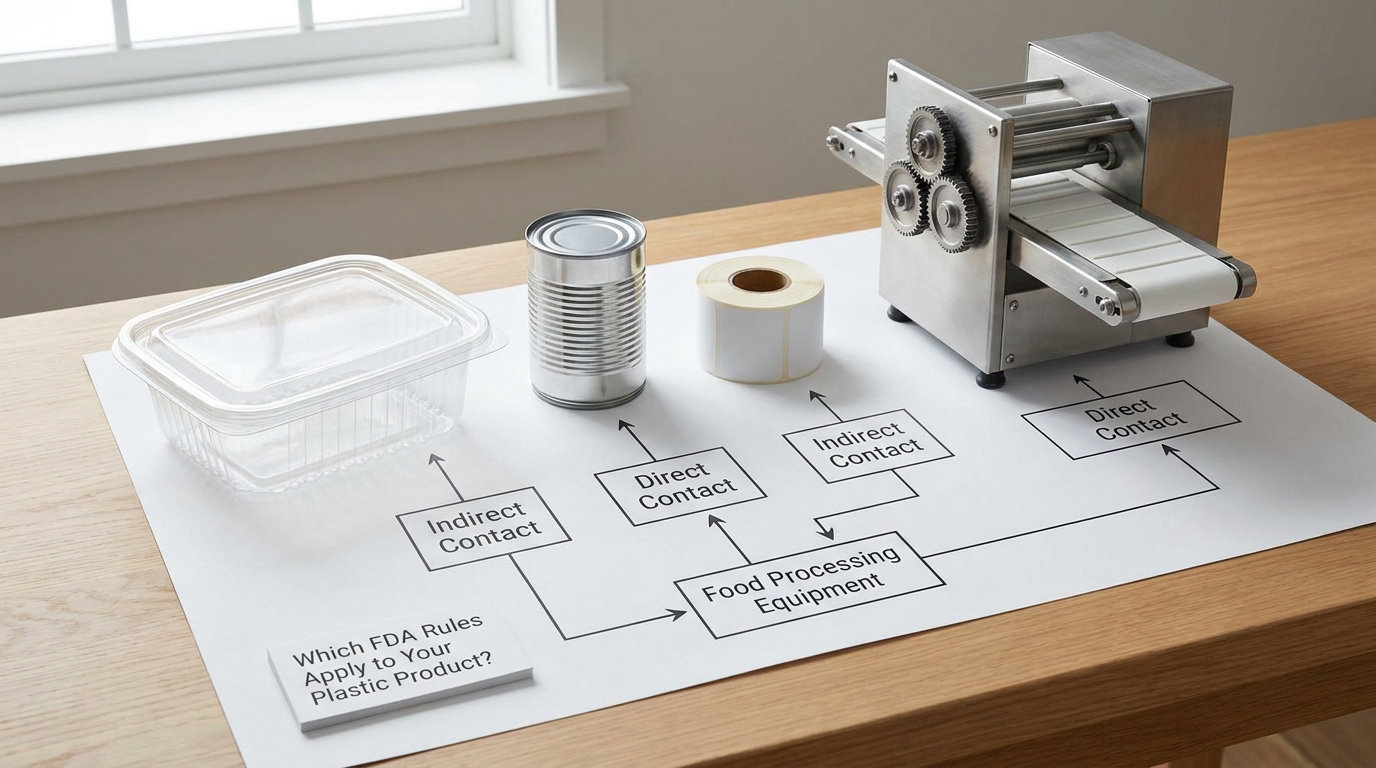
The category your plastic falls into decides which requirements you inherit, and the category is set by how the material touches food and for how long.
Direct food contact
Containers, bottles, trays, films, cutlery, straws, and closures that touch food directly are the strictest case. The full identity, composition, and conditions of use must be authorized, and migration under your worst-case exposure has to stay within limits.
Indirect food contact
Processing equipment, conveyor belts, hoses, and sealing surfaces that contact food during handling fall under the same regulatory framework as an indirect food additive. The material is still a food contact substance even though the food never touches the finished package.
Coatings, adhesives, labels, and seals
A printed label, a pressure-sensitive adhesive, a can lacquer, or a gasket liner is a separate substance with its own authorization. A plastic bottle with an unapproved label adhesive is not a compliant package, no matter how well the resin is documented. Labels that only contact the outside of the package fall outside food contact rules, but “indirect” is a narrow word: adhesives, inks, and release-liner residues that can transfer to food are still in scope.
Article and supply-chain role
FDA rules follow the substance, not the company. The importer, the converter who inject-molds the tray, the film extruder, and the brand that fills it each hold part of the compliance obligation, and all of them need documentation that matches what they actually did.
How the FDA Food Contact Substance Framework Works
The legal engine is section 409 of the Federal Food, Drug, and Cosmetic Act, which treats substances that may migrate into food as indirect food additives. The FDA then sets the identity, purity, and use conditions for each substance through regulation in Title 21 of the Code of Federal Regulations, or through a notification that enters the effective inventory when the agency finds the supporting data support the intended use.
| Route | What it rests on | Typical evidence | Best fit |
|---|---|---|---|
| Existing 21 CFR listing | An existing regulation in Parts 174-179 | Specification sheet, supplier declaration of compliance | Common resins like polyethylene, polypropylene, PET, polycarbonate |
| GRAS | General recognition of safety for the intended use | Published use history, expert consensus, or a GRAS notice with supporting data | Substances with long food use history not yet listed in the CFR |
| Food Contact Notification | An effective FCN posted in the FDA inventory | Chemistry profile, migration testing across the conditions of use, toxicological risk assessment | New additives, novel coatings, blends, or recycled feedstocks |
Two structural rules sit underneath all three routes. First, 21 CFR Part 174 sets good manufacturing practice and record-keeping obligations that apply to producers of food contact substances, which is why records are a legal requirement and not just good housekeeping. Second, 21 CFR Part 189 lists substances that are prohibited from use as food contact materials, and those are absolute, not conditional.
Authorization is also specific. An effective notification describes one substance, one set of manufacturing inputs, and a stated food contact use with defined conditions. It is not a general endorsement of a resin family.
What Must Food Contact Plastic Manufacturers Do?
Regulation only works if someone on your side holds the process together. In practice that means a documented chain of controls, and most of it is straightforward once written down.
- Resin selection against a named authorization — record the exact CFR section or FCN number your base resin is covered by, not the generic polymer family.
- Incoming material review — check each lot of resin, masterbatch, and additive against the approved specification before it enters production.
- Formulation and specification management — keep a controlled formulation sheet listing every component and the range allowed for each, including pigment loadings and any processing aids.
- Change control — no supplier, grade, or composition swap without a review of whether the authorization still covers it.
- Supplier documentation — collect declarations of compliance, safety data sheets, and batch certificates of analysis before purchase approval, and re-collect them when a supplier changes.
- Traceability — link finished articles back to resin lots so a problem can be scoped to customers and production dates.
- Production controls — hold the documented conditions (temperature, residence time, and similar processing parameters) that the authorization and your migration data assume.
- Record retention — keep the compliance file for the period your customer or regulator requires; many buyers ask for the life of the product plus a defined tail.
What Compliance Evidence Should Manufacturers Maintain?
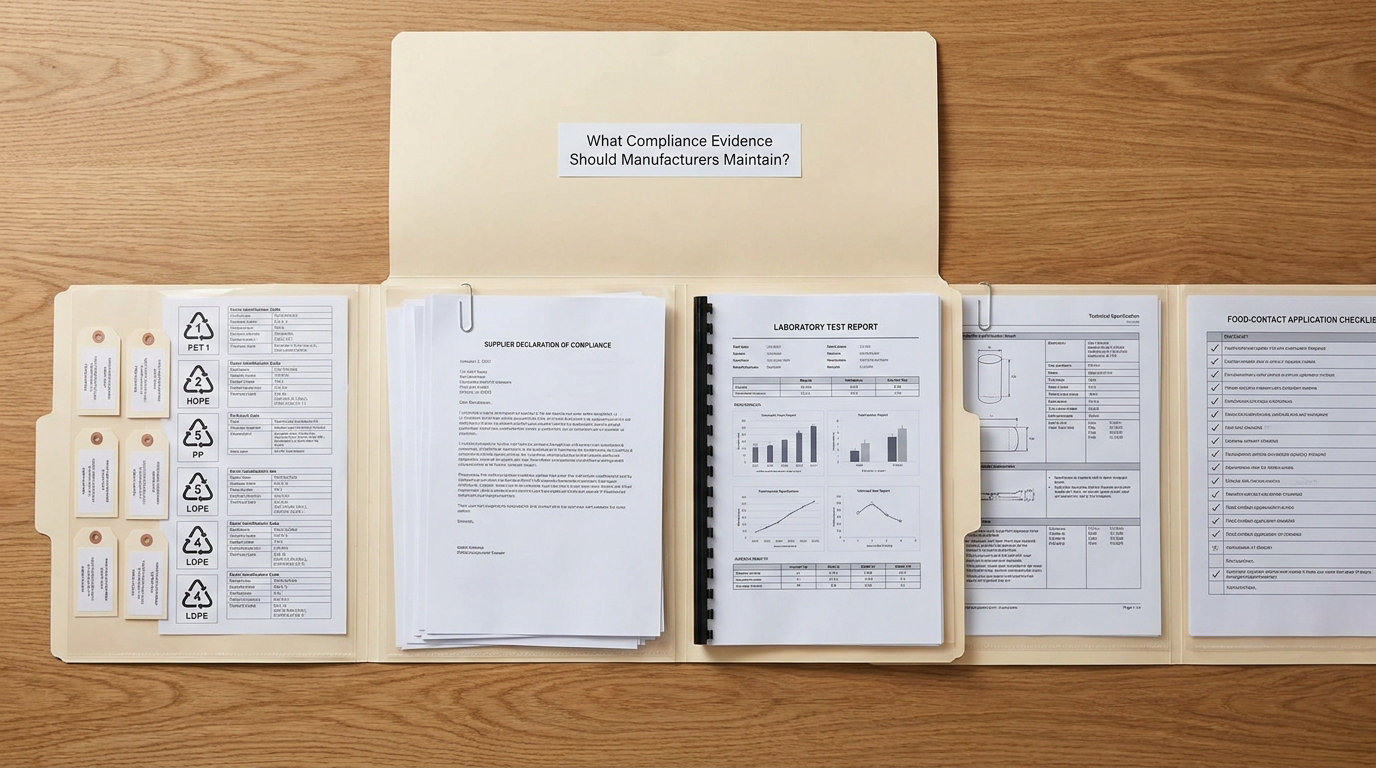
Assemble one file per material and per application, and update it when anything changes. A workable file usually contains:
- Material identity and the authorization reference: CFR section number or FCN number, with the intended use description.
- The supplier’s declaration of compliance, stating which authorization the material is covered by.
- Composition information: the full additive list with percentages, and any statement about non-intentionally added substances.
- Batch-specific certificate of analysis, dated and traceable, rather than a generic undated report.
- Migration or extractives testing performed under conditions at least as severe as your actual use.
- Toxicological risk assessments where the authorization or your buyer requires them.
- Your own specification, finished article drawing, and change log.
Know what each document does and does not prove. A safety data sheet describes hazard handling and is not a compliance document. A certificate of analysis confirms what the resin maker measured in that lot; it does not confirm food contact authorization. A third-party lab report, from a recognized laboratory such as SGS, Intertek, TÜV Rheinland, or UL Solutions, tells you the migration results under the conditions tested. A declaration of compliance is the supplier’s assertion that the material meets a named authorization. None of them is an FDA approval, and the combination is what a serious buyer reviews.
One distinction forum discussions keep circling is worth stating plainly: binding rules and guidance are not the same thing. The CFR and the Federal Food, Drug, and Cosmetic Act carry legal force. FDA guidance documents explain how the agency applies them and are recommendations, not enforceable law by themselves. Non-binding does not mean optional, though — a facility that ignores its own approved operating procedures can still be found in violation of good manufacturing practice requirements.
How Do FDA Food Contact Rules Differ by Resin and Additive?
Authorization attaches to a specific base resin meeting defined specifications, not to a polymer name on a datasheet. Two polyethylene grades can sit under different limits for residual catalysts, extractives, and use temperature, and both are called polyethylene on a purchase order.
Then there are the other half of the formulation. Colorants, stabilizers, antioxidants, slip agents, and processing aids are each assessed on their own merits, which is why a “natural” or recycled-looking tray can create compliance work that a clear unfilled one does not. Coatings add another layer: an epoxy can lining or a printed surface is a separate substance with its own authorization, and it can carry restrictions on the food types it may contact.
Recycled content is the case buyers probe hardest. Post-consumer resin is authorized only through a recycling process that FDA has evaluated, and the safety argument rests on controlled source material, adequate sorting, and demonstrated contaminant removal, typically shown through challenge testing with surrogate contaminants. A recycled resin without that chain of evidence is not automatically prohibited, but you cannot simply assume an authorization carries over from virgin material.
Non-intentionally added substances are the remaining piece. NIAS are impurities, degradation products, or residuals that nobody added on purpose, and a modern assessment looks at them rather than ignoring them.
For orientation, here is how the polymer sections of Part 177 are organized. Treat this as a map and confirm the current text before you rely on it.
| 21 CFR section | Polymer family | 21 CFR section | Polymer family |
|---|---|---|---|
| 177.1010 | Polyethylene | 177.1660 | Polysulfone |
| 177.1020 | Polypropylene | 177.1680 | Polyurethane |
| 177.1040 | Polystyrene and rubber-modified polystyrene | 177.1720 | Cellulosics |
| 177.1060 | Polyoxymethylene | 177.1780 | Melamine |
| 177.1310 | Polyethylene terephthalate (PET) | 177.1800 | Vinyl chloride |
| 177.1320 | Polybutylene terephthalate | 177.1810 | Phenolic resins |
| 177.1360 | Polyethylene phthalate polymers | 177.1820 | Polyetherimide |
| 177.1400 | Polyvinyl chloride (PVC) and vinyl resin copolymers | 177.1840 | Polyamide |
| 177.1420 | Polychlorotrifluoroethylene | 177.1850 | Polyaryletherketone |
| 177.1440 | Polyoxymethylene copolymers | 177.1860 | Polyetheretherketone |
| 177.1460 | Polyvinyl alcohol | 177.2000 | Synthetic aromatic olefin polymers |
| 177.1480 | Polymethyl methacrylate (acrylic) | 177.2260 | Coatings on polyolefin articles |
| 177.1520 | Acrylic and modified acrylic | 177.2400 | Vinyl resin and vinyl acetate copolymers |
| 177.1560 | Polyphenylene sulfide | 177.2450 | Acrylic and modified acrylic resins |
| 177.1580 | Polycarbonate | 177.2460 | Rigid, flexible, and semi-rigid PVC |
| 177.1630 | Polyphenylene sulfide and related | 177.2600 | Ethylene vinyl acetate copolymers |
Do Food Contact Plastics Need FDA Approval or a Label?
No, and this is the most expensive misunderstanding in the category. There is no premarket approval step for a food contact plastic article, no FDA certificate of compliance to display, and no approval mark to put on a package. The FDA authorizes substances; the manufacturer and the brand decide whether their article conforms to those authorizations, and they are the ones who carry the risk if it does not.
That is why a declaration of compliance from a supplier is the document that matters, and why a supplier who cannot name the CFR section or FCN number behind their claim is telling you something. Buyers on marketplace forums report the same pattern repeatedly: a listing says FDA approved or FDA certified, the paperwork behind it does not exist, and nobody can verify the underlying authorization.
Marking and labeling rules do exist, but they are narrow. FDA food contact substance regulations can permit or require identifying information on articles intended for repeated use at elevated temperatures, so that a consumer knows the article is for food use only and for what maximum temperature. This is a use restriction, not a seal of approval, and it applies to a small defined set of repeat-use articles rather than to food packaging generally.
Also separate the US frame from others. California Proposition 65, state restrictions on PFAS in food packaging, and European rules such as EU Regulation 10/2011, the German LFGB, and the EU Packaging and Packaging Waste Regulation impose their own obligations that a US authorization does not satisfy. If you sell into those markets, you need both sets of evidence.
How Are Temperature and Time Conditions Evaluated?
Every authorization is written against conditions of use, and those conditions drive the testing. The same resin can be fully lawful for refrigerated storage and outside its authorization for hot fill, because heat and time accelerate migration and thermal degradation differently.
The variables that get evaluated include contact temperature, contact duration, the food type, and whether the article is single-use or repeat-use. Hot fill at high temperature, storage of acidic or fatty foods, and reheating in a microwave each stress a material in a different way than chilled water or dry goods. A material authorized for one food type may carry a limitation for another, which is why the food your customer actually stores in the container belongs in your specification, not just the container description.
Testing follows from those conditions. Overall migration testing measures the total mass of material that can move out of the article into food or a food simulant, and specific migration testing looks at named substances with their own limits. Extractives and non-intentionally added substance screening look at what comes along for the ride. Testing must be run at conditions equal to or more severe than your use, otherwise the result tells you nothing useful.
There is a practical side to this too. Sellers tell each other that a material can be chemically safe and still be outside its authorized use, which is why a test report alone does not make a product compliant. The document that closes the gap is a declaration naming the authorization and the conditions it covers.
What Triggers a New Compliance Review?
Treat compliance as per configuration rather than per brand. A review is due whenever any of the following changes:
- Resin manufacturer, grade, plant, or feedstocks.
- Supplier, even when the material name looks identical.
- Any formulation component, including pigment, colorant, additive, or processing aid, and their loading ranges.
- Coatings, inks, adhesives, or seal materials, and their thicknesses.
- Recycled content, including the collection source and the recycling process used.
- Conversion process, equipment, and processing parameters.
- Intended use: temperature, time, food type, or single-use versus repeat-use.
- Product design changes that alter wall thickness, headspace ratio, or contact area.
A resin from the same supplier can stop being covered if the authorization you relied on expires or is amended, so review dates belong in the specification too. When a change is material, tell your customers, and give buyers something concrete: the new declaration of compliance, a revised specification, or a summary of why the substitution does not change the food contact profile.
What Are the Most Common Compliance Mistakes?
Most problems show up as paperwork gaps rather than as chemistry failures.
- Relying on vague declarations — a letter saying the material is food grade, with no authorization reference, no additives list, and no conditions of use.
- Accepting a generic compliance letter that covers an entire product family instead of the specific grade in your article.
- Unverified recycled-content claims — recycled resin supplied without the recycling-process evidence that supports its use in food contact.
- Mismatched conditions of use — a material specified for chilled storage and then used for hot fill or microwaving.
- Missing traceability — finished goods that cannot be tied back to resin lots when a question arises.
- First-batch-only testing — a single early test report standing in for every lot produced since, which is a practice buyers on seller forums complain about directly.
- Assuming nobody checks — the belief that the FDA never inspects food contact items. Whether or not an inspection ever happens, customers, class-action plaintiffs, and importing-country authorities do check, and the records you skipped are exactly what they ask for first.
- Single-claim compliance — treating BPA-free or food grade as the goal instead of a full match to a named authorization.
Two questions to ask any supplier, whichever material you are buying: which 21 CFR section or FCN number covers this exact grade, and what are the authorized conditions of use? If the answer is a logo instead of a number, you have your answer about the file.
Frequently Asked Questions
Does FDA approve every food contact plastic product?
No. The FDA authorizes food contact substances for specific identities, uses, and conditions, but it does not approve, certify, or license finished plastic products. Nobody can hand you an FDA approval letter for a container, tray, or bottle. Compliance happens on your side of the supply chain, by matching your article to the applicable 21 CFR section or effective Food Contact Notification.
What documentation should a supplier provide for food contact plastics?
Ask for the authorization reference first, meaning a specific 21 CFR section or FCN number, then a declaration of compliance naming that authorization. Add a full additive list with percentages, a batch-dated certificate of analysis, a safety data sheet, and a migration test report run under conditions at least as severe as your use. A letter saying only that the material is food grade is not usable documentation.
Are food contact declarations the same as FDA certificates of compliance?
No certificate of compliance exists for food contact plastics, so a declaration cannot be a version of one. A declaration of compliance is the supplier’s own signed statement that the material meets the specifications and limitations of a named authorization. It carries legal weight in the sense that a mismatch can be held against you, and it is your evidence, not the FDA’s.
Does recycled plastic require different FDA compliance evidence?
Yes. Recycled resin used in food contact needs evidence tied to a specific evaluated recycling process, including controlled source material, adequate sorting, and demonstrated contaminant removal shown through challenge testing with surrogate contaminants. That basis does not transfer automatically from virgin resin, so treat a recycled material without that documentation as an open question rather than a shortcut.
When does a material or process change require reassessment?
Reassess whenever the resin source, supplier, grade, colorant, additive, coating, adhesive, recycled feedstock, conversion process, plant, or intended use changes. In practice that means any formulation edit, a switch to a recycled feedstock, or a move from chilled storage to hot fill. Document the review, and notify customers whose compliance file changes as a result.
Are food contact plastic labels required?
For most food packaging, no label is required and no approval mark exists. A few regulations permit or require identifying information on certain repeat-use articles intended for food use at elevated temperatures, so users know the article is for food only and what maximum temperature it tolerates. That is a use restriction, not a seal of approval, and it does not cover containers, films, or trays.
Start with one hour of work: pick your highest-volume article, identify the exact resin grade, find its authorization in the FDA inventory of food contact substances listed in 21 CFR or the inventory of effective FCNs, and check the conditions of use against how that item is actually used. Fix any mismatch before you place the next order. Then re-check on a schedule, because authorizations get amended and state rules such as PFAS restrictions keep moving.