
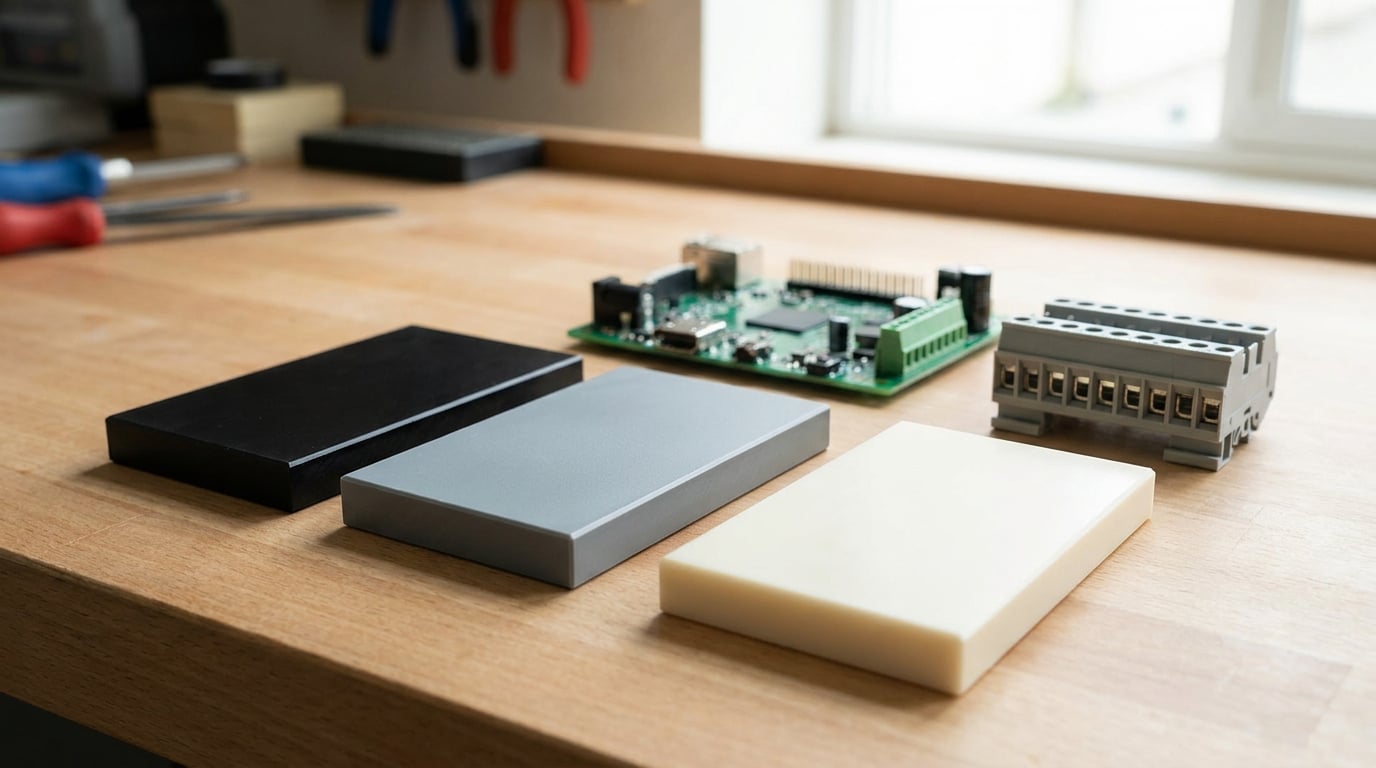
A flame retardant plastic is an engineering polymer that resists ignition, self-extinguishes once the flame source is removed, and limits how fire travels across its surface. In electronics, that rating is graded on a defined specimen thickness under UL 94, so a material is only ever as good as the thickness it was tested at.
What follows is the working reference I hand to hardware engineers and buyers: what the term actually means, which polymer families are used for enclosures, connectors and cable, how the chemistry works, and how to write a specification that survives contact with a compliance engineer. No product pitches, just the decision points.
Table of Contents
- What Are Flame Retardant Plastics for Electronics?
- Why Electronics Designers Use Flame Retardant Plastics
- How Flame Retardancy Works
- Flame Retardant Plastics for Electronics Explained: Common Polymer Families
- Additive vs. Reactive Flame Retardants
- UL 94, LOI, and Other Flame Tests
- Which Safety Standards Apply to Electronics Plastics?
- How to Select the Right Flame Retardant Plastic
- Flame Retardancy and Sustainability Tradeoffs
- Common Mistakes in Flame Retardant Material Selection
- Frequently Asked Questions
- Is UL 94 V-0 the same as fireproof?
- What is the best flame retardant plastic for an electronics enclosure?
- Are halogenated flame retardants unsafe?
- Does flame retardant affect electrical insulation?
- Can recycled plastic meet UL 94 V-0 requirements?
- What information should a supplier provide before material approval?
- Conclusion: Start with the End-Use Fire Requirement
What Are Flame Retardant Plastics for Electronics?
A flame retardant plastic is a polymer that self-extinguishes within a specified time and stops burning once its ignition source is removed, measured by the UL 94 vertical burn test. Flame retardant grades are either inherently resistant to combustion or modified during compounding with flame retardant additives.
Three boundaries matter here. First, flame retardant is not fireproof. The material slows combustion and reduces flame spread; it does not survive an extended fire. Second, self-extinguishing is a laboratory behaviour, not a guarantee. A rating describes one specimen geometry, one thickness, one orientation. Third, the rating attaches to the material at that thickness, not to your part. A 2.5 mm wall in a 3 mm housing has no rating of its own, because thin sections burn differently.
The same words get used loosely in purchasing conversations, so it helps to separate three claims that are often confused.
| Term | What it claims | How it is measured | Typical example |
|---|---|---|---|
| Flame retardant | Self-extinguishes within a set time; flame does not sustain once the source is removed | UL 94 HB, V-2, V-1, V-0 at a stated thickness | FR PC/ABS enclosure, UL 94 V-0 at 1.5 mm |
| Flame resistant | Resists flame spread for a period without self-extinguishing completely | Often nothing formal; a commercial or marketing term | A cladding described as flame resistant with no test report |
| Heat resistant | Holds mechanical properties at elevated temperature | Heat deflection temperature, glass transition temperature, continuous use temperature | PPS terminal block rated for continuous service well above 100 degrees Celsius |
Heat resistance and flame behaviour are separate axes. A grade can be heat resistant and burn readily, or flame retardant and soften under load. Most electronics materials need both, which is why PBT and PPS show up so often where both matter.
Why Electronics Designers Use Flame Retardant Plastics
Electronics is an unusually dense ignition source. A populated board, a lithium cell pack, a mains power supply and a connector block put a lot of stored energy into a small volume, and a failure such as a shorted capacitor or an over-heated transformer can start a fire in seconds.
Untreated thermoplastics behave badly in that situation. They soften, melt and drip, and flaming drips carry fire to whatever sits below the part. A flame retardant grade changes that sequence: it holds shape longer, it stops burning, and it generates less heat and often less smoke, which buys time for a fuse, a thermal cutoff or a person holding the device.
The engineering argument is fault containment rather than fire prevention. You are not trying to make the device fireproof. You are trying to stop one component-level failure from becoming a device-level or room-level event.
Where flame retardant plastics for electronics do the most work
- Enclosures and housings for mains-powered and battery-powered equipment, where a rating is usually a pass or fail line item in the certification file.
- Connectors and terminal blocks, where thin-wall sections need a rating at low wall thickness and creepage tracking matters at the same time.
- Printed circuit board covers, standoffs and insulating barriers inside power supplies and inverters.
- Cable insulation and outer jackets, including low smoke zero halogen formulations for building and transport installations.
- Power supply and transformer housings, which routinely operate near their thermal limit.
- Battery pack housings for portable devices, e-bikes and vehicles, where cell vent events need a controlled response.
- LED drivers and luminaires, and telecommunications and network equipment where a fault means equipment loss across a site.
How Flame Retardancy Works
Combustion is a self-sustaining chain reaction. Fuel breaks down into volatile gases, those gases mix with oxygen, and free radicals (hydroxyl and hydrogen) regenerate at the flame front, keeping it alive. Flame retardants attack that loop at four points.
- Endothermic cooling. Mineral fillers such as aluminium trihydrate and magnesium hydroxide absorb heat as they decompose, and the released water vapour dilutes the combustible mix. Typical loadings are high, often 40 to 65 percent, so the compound becomes rigid and less impact resistant.
- Char barrier formation. Intumescent systems based on ammonium polyphosphate with a carbon source and a blowing agent expand into an insulating char layer that shields the remaining polymer. Expandable graphite works on the same idea, swelling to two or three hundred times its original volume, and is useful in thin-wall housings.
- Gas dilution. Nitrogen-based systems release inert gases, and endothermic decomposition simply displaces oxygen, lowering the local oxygen concentration below the level that sustains burning.
- Radical scavenging. Halogenated systems release hydrogen halide on heating, which captures the hydroxyl and hydrogen radicals that drive the reaction. Antimony trioxide is normally paired with brominated compounds as a synergist. Certain phosphorus systems also interrupt the chain reaction in the condensed phase.
Two things get missed. The mechanism only works if the additive survives processing and remains well dispersed, so a poor dispersion shows up as a worse rating rather than a visible defect. And geometry matters as much as chemistry: a thin section reaches burning temperature before the protective char layer can build, while a thick, reinforced section does not.
Flame Retardant Plastics for Electronics Explained: Common Polymer Families
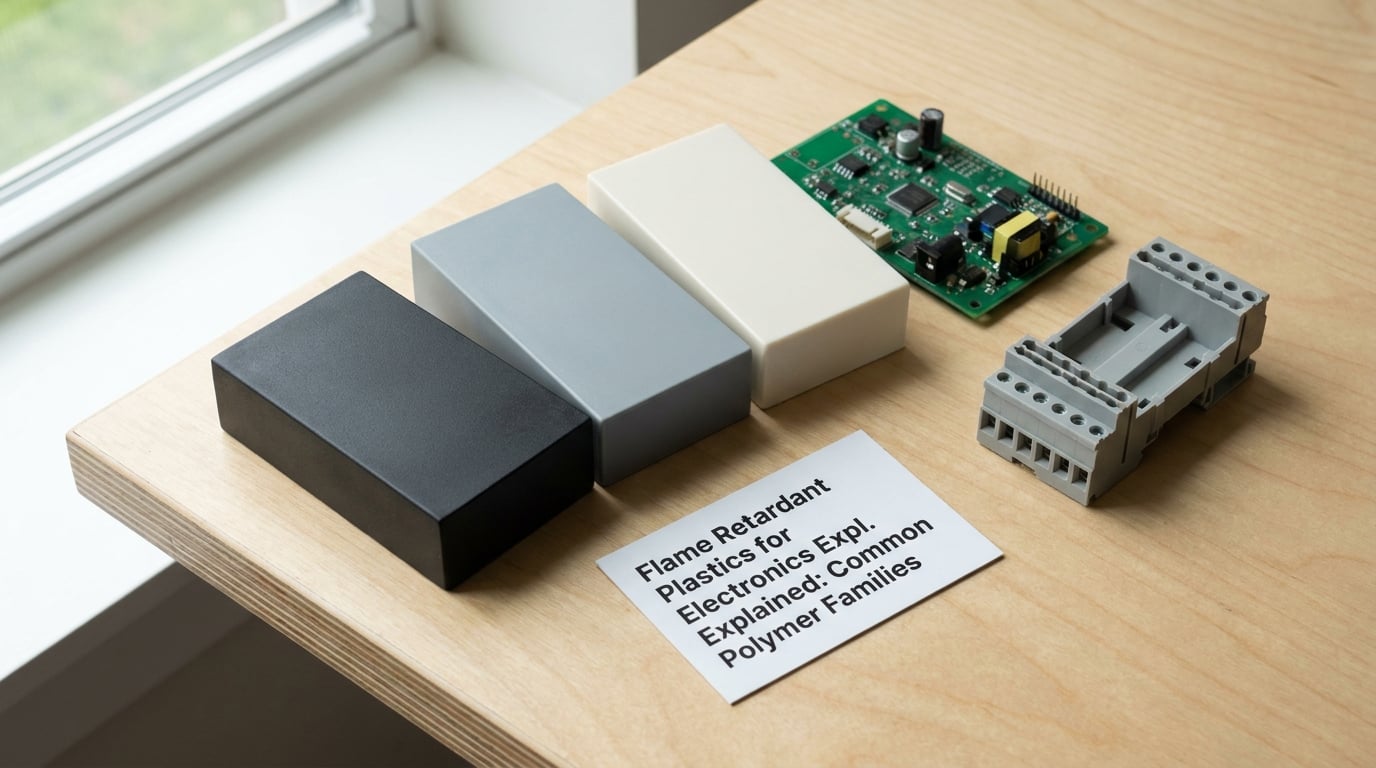
Most electronics plastics are commodity polymers made flame retardant by compounding, except in the case of inherently flame retardant families such as polyarylethersulfone and some phenolics. The table below compares the families an electronics designer actually specifies.
| Material | Strengths | Limitations | Typical electronics part | Processing note |
|---|---|---|---|---|
| PC/ABS | Good impact strength, stiffness and mouldability; wide range of FR grades including halogen-free | Varies with grade; some formulations need higher wall thickness for V-0 | Domestic appliance and instrument enclosures, drive housings | Dry before moulding, injection moulded, usually at 230 to 280 degrees Celsius |
| Polycarbonate | High dimensional stability, clarity, long-term creep resistance, high dielectric strength | Brittle in thin sections, scratches easily, sensitive to some solvents | Transparent covers, LED lenses, high-voltage insulator parts | Needs thorough drying and a high barrel temperature; hydrolysis is the main scrap cause |
| FR ABS | Easy to mould, good surface finish, cost-effective at volume | Lower heat resistance and creep than PC blends | Instrument casings, internal covers, consumer device housings | Simple injection moulding, wide processing window |
| PBT and PET | Low moisture uptake, good chemical resistance, stable dimensions, low creep at temperature | Brittle in unreinforced form; glass fibre raises warpage | Connector housings, terminal blocks, relay and coil bobbin parts | Dry and mould at moderate temperatures; glass fibre grades need careful gating |
| PA6 and PA66 | Excellent toughness, wear resistance and thin-wall capability | Moisture uptake changes dimensions and mechanicals; needs FR grades rather than standard | Connector housings, terminal blocks, wire guides | Condition before moulding; moisture must be controlled to keep dimensions stable |
| PPS | Very high heat resistance, inherent FR behaviour, chemical and dimensional stability | Brittle, expensive, high processing temperature, limited supplier breadth | High-voltage insulators, transformer and motor components, ignition parts | Moulded above 280 degrees Celsius, often with glass or carbon fibre reinforcement |
| PEEK | Exceptional temperature, chemical and mechanical capability | Very high cost, hard to process, limited volumes | High-temperature electrical insulators and semiconductor handling parts | Requires high melt temperature and careful moisture control |
| LCP | Extreme stiffness and dimensional stability, very low creep, good FR behaviour | Brittle, anisotropic, weld lines are weak, expensive | Fine-pitch connectors, RF housings, coil bobbins | Moulded at high temperature with careful flow and gate placement |
| Phenolic and epoxy systems | Very low smoke, excellent char formation, used where toxicity matters | Thermoset, no melt flow, high tooling and cycle cost | Recessed and internal insulation, transformers, motor slot insulation | Compression or transfer moulded, secondary operations often needed |
A few practical notes from working with these grades. Glass fibre reinforcement improves stiffness and heat deflection temperature but can make thin-walled parts warp and can suppress a rating at the minimum wall thickness. Pigments and masterbatches are chosen for compatibility with the flame system; an unmatched colour concentrate can change the burn behaviour, so colourants belong in the compound, not added at the moulding machine.
Additive vs. Reactive Flame Retardants
Additive flame retardants are blended into the polymer during compounding, usually at 5 to 60 percent loading. Reactive flame retardants are built into the polymer chain, replacing part of the backbone or a side group, so they cannot migrate out.
| Aspect | Additive system | Reactive system |
|---|---|---|
| Flame performance | Highly adjustable; strong V-0 achievable in most host polymers | Typically V-2 to V-0 depending on chemistry and grade |
| Mechanical properties | High loadings stiffen the part and cut impact strength, for example 15 percent red phosphorus with 5 percent melamine cyanurate in PA6 reaching V-0 at 1.6 mm while retaining roughly 80 percent of its tensile strength | Little or no filler penalty because the retardant is part of the chain |
| Appearance | Fillers can dull colour, cause haze and make thin wall flow harder | Clearer and more consistent colour, useful for light lenses |
| Processing | Needs good dispersion; some systems are corrosive to tooling or sensitive to residence time | Handled like the base polymer |
| Regulatory data | Supplier must document the combination, which narrows the data you can reference to that formulation | Copolymer is defined precisely, so the datasheet is more transferable |
| Cost | Higher loading means more material cost plus processing cost | Usually higher resin cost, offset by better properties and less finishing |
Most designers end up on additives, because the resin and the flame system are bought together as a compounded grade. Reactive systems show up where clarity, thin walls or very low smoke drive the design.
UL 94, LOI, and Other Flame Tests
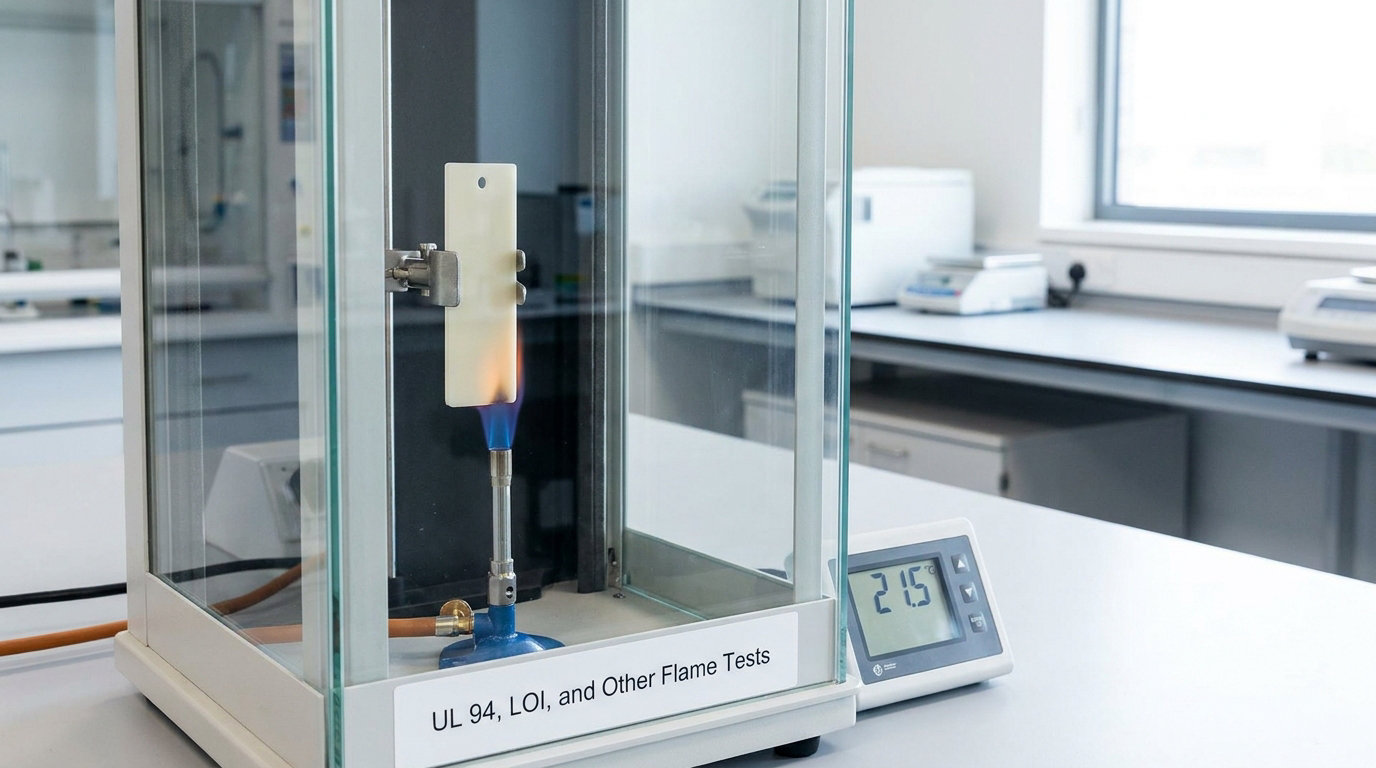
UL 94 is the flammability standard almost every electronics material is quoted against. It describes how a material behaves when a small flame is applied to a defined specimen. The vertical burn tests (V-0, V-1, V-2) hold the specimen vertically and measure how quickly flame stops and whether flaming drips ignite cotton below.
| Rating | Flame or afterflame time | Flaming drips allowed | What it means in practice |
|---|---|---|---|
| HB | Slows to a stop; rate of burn measured in mm per minute | Yes | Runs at a slow, steady rate. A minimum rating, not a flame performance goal |
| V-2 | Stops within 60 seconds | Yes | Self-extinguishes, but drips can carry fire |
| V-1 | Stops within 30 seconds | No | Self-extinguishes quickly with no flaming drips |
| V-0 | Stops within 10 seconds | No | The baseline most electronics specifications ask for |
Three rules of thumb prevent most arguments. A rating is only valid at the thickness it was granted, so a V-0 at 1.5 mm tells you nothing about a 0.8 mm wall. It is granted to a specific natural colour, and adding a different pigment can invalidate it. And it is granted to a material, not a moulded part, so gates, ribs, wall variation and assembly changes still need validating.
Other tests answer questions UL 94 does not:
- Limiting oxygen index (LOI), per ASTM D2863, reports the concentration of oxygen at which a specimen will just sustain a flame. Higher is better, but the test flame is small and slow, so a high LOI does not guarantee good behaviour in a real enclosure fire.
- Cone calorimetry measures heat release rate and total heat release under a controlled irradiance, closer to real fire conditions. Peak heat release rate is the number most engineers look at.
- Smoke density and gas toxicity measurements, such as the EN 45545 series for rail, address what a burn test ignores. A material can pass UL 94 and still produce dense corrosive smoke.
- Comparative tracking index (CTI) and dielectric tests describe electrical behaviour, not flame behaviour, and they are where FR grades differ from the base resin.
No single number establishes fire safety. A specification that quotes only a V-0 rating is telling you about flame persistence and dripping, and nothing about heat release, smoke or electrical behaviour under arc tracking.
Which Safety Standards Apply to Electronics Plastics?
The applicable standard comes from the finished product, not from the material. The same PC/ABS grade can be approved in one product and rejected in another because the product standard calls for a different fire test.
| Standard or regulation | Applies to | What it asks of the plastic |
|---|---|---|
| UL 94 | Any plastic part; the base flammability classification | HB, V-2, V-1 or V-0 at a stated thickness, plus colour and rating recognition |
| IEC 60601-1 | Medical electrical and electronic equipment | Material flammability requirements in combination with oxygen enrichment in patient environments |
| IEC 60335-1 | Household and similar appliances | Fire and burning behaviour of plastic parts, including enclosures and insulation |
| IEC 62368-1 | Audio, video and information and communication technology equipment | Flammability of materials and component safeguards, with emphasis on fire enclosures |
| Automotive customer specifications | Vehicle electronics, connectors, EV battery housings | Often higher heat and lower smoke requirements than UL 94, plus company-specific tests |
| IEC 62619 and UN 38.3 for batteries | Lithium battery packs and their housings | Cell-level safety plus pack-level thermal propagation requirements, which shape the housing material choice |
| EN 45545 | Rail rolling stock | Smoke density, toxicity and flammability sets, stricter than UL 94 alone |
| FAR 25.853 | Aerospace interior materials | Passes in a specific cabin altitude and humidity chamber, far above basic flammability |
| RoHS, REACH, TSCA | Substances, not flammability | Restrict specific chemicals including certain brominated flame retardants; these are substance compliance items handled alongside the fire requirement |
Note the split. Fire performance comes from the product safety standard. Chemical restrictions come from substance regulation. A material can satisfy one and fail the other, and conflating them causes delays late in a programme.
UL 94 itself is revised on a schedule, and the current edition matters when you are matching a supplier certificate to an internal specification. UL 94 Ed. 7-2023 is the edition suppliers reference most often as of 2026. Always ask for the edition on the test report, not just the grade.
How to Select the Right Flame Retardant Plastic
- Start from the end-use standard. Identify the product standard that governs the device, then read what it asks of materials before you look at any datasheet. Everything downstream depends on this.
- Set the required rating and the thickness. Write V-0 at 1.5 mm minimum, not simply V-0. Check the real wall thickness of your part including ribs and the thinnest section, then require a rating at or below that.
- Add the substance requirements. Halogen-free, PFAS-free, or a named approved list. Decide this early, because it changes the candidate list completely.
- Shortlist polymer families against the mechanical and thermal load. Continuous use temperature, heat deflection temperature at the actual wall, impact requirement, and creep over time. A material that meets the fire rating and creeps out of position is not a candidate.
- Check the electrical properties next. Dielectric strength, dielectric constant, dissipation factor, and CTI, plus creepage and clearance across the moulded part. Fillers used for flame performance can raise dielectric constant and reduce tracking resistance, so use the values for the specific FR grade, not the base resin.
- Confirm the processing route. Injection moulding, compression moulding or extrusion, the required drying step, the fill level, and the tooling wear implications. Some mineral-filled systems are abrasive.
- Demand certification evidence. A UL recognised component mark or Yellow Card entry for the exact grade, colour and thickness, plus a current certificate. Ask for the continuous use temperature rating too, since it is a separate recognition from the flammability rating.
- Validate the moulded part. Run the test on production geometry, not on a coupon. Changing gate position, wall thickness, colour or an added label, tape or coating can alter the result.
- Then look at total cost. Material price per kilogram matters less than scrap rate, cycle time, rework and the cost of a certification failure after tooling is committed.
Write the specification so a second supplier can quote against it. That means grade family, rating with thickness, colour, continuous use temperature, CTI or dielectric requirement, the recognition mark you need, and the parts the recognition must cover.
Flame Retardancy and Sustainability Tradeoffs
Fire performance and environmental profile pull in different directions, and the sensible position is that neither halogenated nor halogen-free chemistry is automatically the right answer.
Brominated systems with antimony trioxide remain among the most effective at achieving V-0 at thin wall thickness, but combustion and thermal decomposition of some brominated compounds produce corrosive hydrogen halide gases, and certain brominated flame retardants are restricted or proposed for restriction under RoHS and REACH. Halogen-free systems avoid that gas profile and tend to produce less smoke, and phosphorus, nitrogen, mineral and expandable graphite chemistry now reaches V-0 in many common polymers. They usually need higher loading or a thicker wall to get there, and the mechanical cost is real.
For end of life, two points are worth weighing. Recycled content and flame retardancy pull apart, because contaminants and variable prior heating reduce rating consistency, though recycled grades certified to a specific thickness do exist. And halogenated compounds complicate e-waste recycling, because sorting and thermal processes have to manage bromine in the stream. Halogen-free compounds are generally easier in that respect.
PFAS-free flame retardant chemistry is now an active formulation trend, driven by restriction proposals that would otherwise catch fluorinated additives used in some polymer and cable formulations. If your product could be caught by a future restriction, ask the supplier what the flame system contains instead of the fluoropolymers separately.
Common Mistakes in Flame Retardant Material Selection
Treating V-0 as noncombustible. V-0 means the flame goes out within ten seconds and there are no flaming drips. It is not a fire rating for a fully involved fire, and a moulded part with poor geometry can still spread flame. Fix: state heat release, smoke and geometry requirements separately.
Comparing ratings without controlling thickness. A V-0 at 0.8 mm and a V-0 at 3.0 mm are not equivalent in design terms, because your part has one wall thickness. Fix: require the rating at or below your minimum wall.
Overlooking electrical and mechanical requirements. Flame packages change dielectric constant, tracking resistance, stiffness and impact strength. Fix: evaluate the FR grade datasheet, not the base resin datasheet.
Trusting a supplier label without current documentation. A grade name in a catalogue is not a certification. Fix: request the recognised component mark reference, colour, thickness and edition of the test report, dated within the last few years.
Deciding from laboratory data alone. Coupon results do not describe your part. Fix: test production geometry with the real gate layout, colour, label and coating, and treat post-moulding decoration as part of the risk, since solvent-based paints and some labelling adhesives are flammable.
Confusing the product standard with substance regulation. Teams chase a chemical list when the blocker is a fire test, or assume a passing fire test satisfies RoHS. Fix: track compliance for flammability and for substances as two separate lines with separate evidence.
Frequently Asked Questions
Is UL 94 V-0 the same as fireproof?
No. V-0 means a specimen stops flaming within ten seconds and produces no flaming drips when tested under UL 94 at a stated thickness. The material can still burn under sustained heat and can still release considerable heat, smoke and corrosive gases. Fireproof describes an assembly-level performance under a defined fire test, not a plastic rating.
What is the best flame retardant plastic for an electronics enclosure?
It depends on the end-use standard, wall thickness and thermal load. PC/ABS is the usual starting point for consumer and instrument housings, PBT for connector housings needing low creep, PPS for high-temperature parts, and phenolic or epoxy systems where smoke density matters most. The right choice is the family that holds its rating at your minimum wall thickness and its properties at your maximum internal temperature.
Are halogenated flame retardants unsafe?
It depends on the specific substance and how it is used. Some brominated flame retardants are restricted under RoHS and REACH, and thermal decomposition of halogenated compounds can release corrosive hydrogen halide gases during a fire. Others remain in use because they achieve thin-wall ratings that few alternatives match. Ask the supplier for the exact flame system and check substance compliance separately from flammability.
Does flame retardant affect electrical insulation?
Yes, it can. Flame systems change dielectric constant, dissipation factor, dielectric strength and comparative tracking index, because fillers and reactive additives alter the polymer structure. Glass fibre reinforcement also affects insulation coordination across the moulded part. Always specify the electrical requirements against the actual flame retardant grade rather than the base resin datasheet.
Can recycled plastic meet UL 94 V-0 requirements?
It can, but it is harder. Recycled content introduces contamination and variable thermal history, which reduces rating consistency, and the rating must still be certified for the specific grade, colour and thickness. Many suppliers offer recycled grades with a lower or thickness-limited rating. Ask what the certified minimum thickness is and what fraction of the compound is post-industrial or post-consumer material.
What information should a supplier provide before material approval?
Ask for the full datasheet with continuous use temperature, heat deflection temperature and electrical properties; the UL recognised component mark or Yellow Card reference including colour and minimum thickness; the edition of UL 94 used for the test; a current declaration covering RoHS and REACH with the specific flame system named; processing guidance for drying, temperature and residence time; and confirmation of which parts the recognition covers.
Conclusion: Start with the End-Use Fire Requirement
The sequence that works: identify the product standard that governs the device, fix the required rating together with the thickness at which it must hold, shortlist the polymer families that survive the thermal and mechanical load at that thickness, verify current certification and test data for the exact grade and colour, then validate the moulded part before committing to production. Get the order wrong and you will spend months chasing a material that was never the right answer to the question.