
An antimicrobial additive in plastics is an active agent compounded into the polymer during manufacturing so the finished surface inhibits the growth of specified bacteria, fungi, mould and algae. It is not automatically a disinfectant, and how well it performs depends on the active chemistry, the loading, the resin, the processing history, and the test method used to measure it. This guide walks through the choices an engineer or buyer actually has to make.
The word antimicrobial covers a wide range of claims, and most of the confusion in this field comes from those claims drifting apart. An additive that suppresses fungal growth on a shower wall is doing something quite different from a coating sold as a hospital-grade disinfectant, and the paperwork behind the two is not the same.
So it helps to separate three categories before going further. A preservative protects the material itself. A treated article carries a biocidal function under the EU framework, where the article is treated rather than the active being approved as a standalone product. A public-health claim asserts that people will not get sick from touching the surface, and that is the hardest category to defend. Most commercial plastic additives sit in the first two.
The rest of this article covers mechanisms, chemistries, processing, loading, testing and regulatory checks in the order those decisions come up. Guidance here is current as of 2026; rules in this space do change, so verify status for your product and market before you commit to a specification.
Table of Contents
- Antimicrobial Additives in Plastics Explained
- How Do Antimicrobial Additives Work in Plastics?
- What Are the Main Types of Antimicrobial Additives?
- Which Plastic Additive Chemistry Fits Each Application?
- How Are Antimicrobial Additives Added During Plastic Manufacturing?
- How Much Antimicrobial Additive Should a Plastic Contain?
- Can Antimicrobial Plastics Be Recycled or Reground?
- How Do You Test Whether an Antimicrobial Plastic Works?
- What Safety and Regulatory Checks Matter?
- Frequently Asked Questions
- Do antimicrobial additives in plastics kill all bacteria and viruses?
- Is antimicrobial-treated plastic automatically safe for food contact?
- How long does the antimicrobial effect last in a molded plastic part?
- Can antimicrobial additives affect a plastic’s mechanical properties?
- How do you compare test data from different suppliers?
- Conclusion
Antimicrobial Additives in Plastics Explained
Put simply, an antimicrobial additive is a biocide dosed into a polymer melt so that the finished part reduces microbial growth on its exposed surface for the useful life of the product. Because the active is inside the matrix rather than sitting on top of it, it cannot be wiped away with a routine cleaning cycle, which is the practical difference between an additive and a coating.
Performance is not a property of the additive alone. Six variables move the result more than most buyers expect: the active chemistry, the concentration of that active, the polymer it sits in, the melt temperature and residence time it survived, the surface finish and geometry of the part, and the conditions of the test that measures it. Change any one of those and the same additive can produce a very different number.
Worth stating plainly: antimicrobial additives complement cleaning, they do not replace it. They live on the surface between cleaning cycles, slowing the growth that would otherwise stain, smell and degrade the part. Any supplier that tells you otherwise is selling you a claim, not a material.
How Do Antimicrobial Additives Work in Plastics?
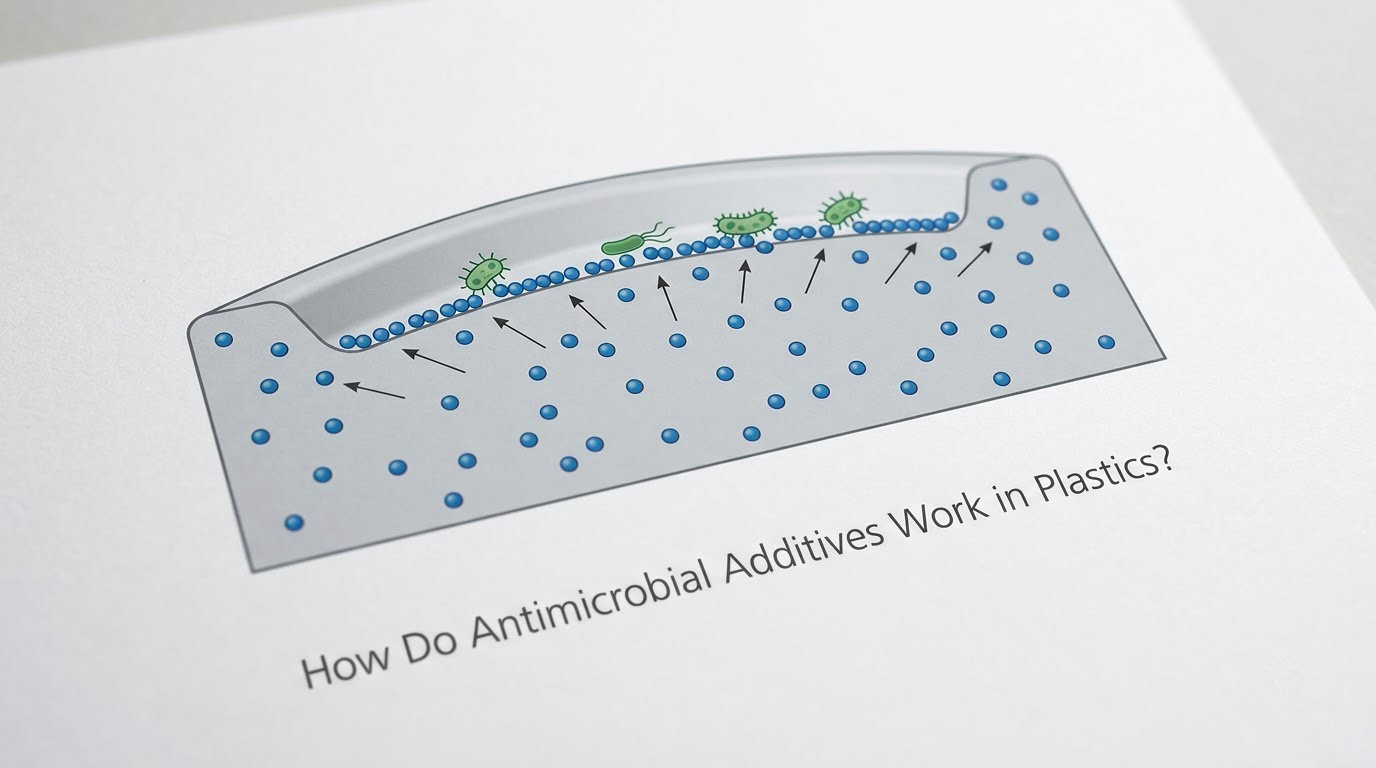
Most additive antimicrobials act at the surface, not in the bulk of the part. The active is dispersed through the melt during compounding, and over time a small fraction reaches and concentrates at the surface, where a microorganism would land. Only organisms that make contact with that surface are affected, which is why performance depends heavily on the surface-to-volume ratio of the part.
That single fact explains a lot of confusing test results. A thin film has far more surface per gram than a thick moulded housing, so the same loading can look dramatic in one and disappointing in the other. A fibre or nonwoven, with almost no bulk and enormous surface, sits at the opposite extreme.
Chemically, actives attack a cell through one of a handful of targets. Some disrupt the cell membrane, letting the contents leak out. Others block protein synthesis at the ribosome, or interfere with nucleic acid synthesis so the organism cannot replicate. Some inhibit cell wall construction. Metal systems such as silver ion chemistry work at very low concentration by damaging enzymes and membrane proteins, which is part of why they are dosed in such small amounts.
There is an important distinction here between preventing growth and disinfecting a surface. An additive is good at the first: it slows or suppresses what lands on a clean surface, giving the surface more time between cleaning cycles. It is not a disinfectant, and it will not reliably sanitise an already contaminated surface. If your product needs disinfection, that is a validated cleaning or disinfection step, not an additive.
What Are the Main Types of Antimicrobial Additives?
Six chemistries cover most commercial plastic additive programmes. Each trades off breadth of organisms against colour, cost, thermal stability and regulatory paperwork.
| Active chemistry | Mechanism | Typical delivery | Strengths | Limitations |
|---|---|---|---|---|
| Silver ion, often silver zeolite | Releases silver ions that disrupt enzymes and membrane proteins | Masterbatch, dispersion | Broad spectrum, effective at low loading, heat stable | Colour and haze in clear polymers, cost, environmental scrutiny |
| Zinc pyrithione | Metal-chelate that interferes with membrane function and enzyme activity | Masterbatch, powder | Strong antifungal profile, good colour stability | Narrower spectrum, sensitivity to process conditions |
| Isothiazolinones | React with cellular thiol groups and disrupt metabolism | Liquid concentrate, masterbatch | Broad antibacterial and antifungal activity, low loading | Thermal sensitivity in high-temperature polymers, regulatory restrictions in some applications |
| Thiabendazole | Inhibits fungal growth through metabolic interference | Masterbatch | Targeted fungal control, works in low concentration | Limited antibacterial activity |
| Organic acids and their salts | Acidification of the surface and disruption of enzymes | Masterbatch, powder | Well understood toxicology, food contact options exist | Mild activity, wash-off of surface-bound acid over time |
| Quaternary ammonium compounds | Disrupt cell membranes on contact | Masterbatch, coating | Fast contact kill, useful in coating systems | Generally poor thermal stability in melt processing |
| Chitosan | Polymer that binds cell membranes and disrupts transport | Powder, aqueous dispersion | Biodegradable, metal-free, film-forming | Less consistent dosing, limited activity in dry conditions |
Metal oxide systems such as zinc oxide and copper sit between the metal and organic categories, offering antifungal performance with a familiar regulatory history. Antimicrobial coating systems are a different delivery model entirely: the active sits on the surface as a layer, which gives faster initial activity but no protection once that layer is abraded or cleaned off.
Note what none of these chemistries can promise on their own. Suitability for food contact, medical use or a public-health claim is never a property of the chemistry alone. It depends on the specific substance, the concentration, the intended conditions of use and the jurisdiction.
Which Plastic Additive Chemistry Fits Each Application?
Antimicrobial Additives for Food-Contact Plastics
Food contact is the application where documentation matters most and marketing language matters least. You need an authorisation for the specific substance at the specific concentration, plus migration data for the finished article, not just for the neat resin. Ask the supplier which market authorisation they hold, then have your compliance team confirm it independently rather than taking a declaration on trust.
Antimicrobial Additives for Medical Devices
Device housings and patient-contact components add a second layer: biocompatibility and, often, a validated cleaning regime that the additive must survive. Hospitals will also scrutinise any public-health claim, since surface antimicrobials in clinical settings have been debated since the idea that treated surfaces could contribute to resistance gained attention. Expect to defend a product-protection claim rather than a claim about infection rates.
Antimicrobial Additives for Packaging
Thin films and sheets are the easiest place for an additive to look good on paper and the hardest place to trust it. Surface area is high, so activity is genuinely there, but the film is thin enough that migration, taste effects and regulatory treatment of the wrapped food all become live issues. Active packaging that deliberately releases a preservative into the package contents is a different technology again, with its own regulatory route.
Antimicrobial Additives for Industrial Components
Industrial parts rarely touch food or skin, so the selection is driven by environment: moisture, temperature, wear and how often the surface gets cleaned. Water tanks, plumbing parts, outdoor enclosures and moulded components that sit in wet service are the classic cases. Here an unfavourable property change, such as a viscosity shift or a colour shift in a dark part, usually matters more than the last decimal place of a log reduction.
How Are Antimicrobial Additives Added During Plastic Manufacturing?
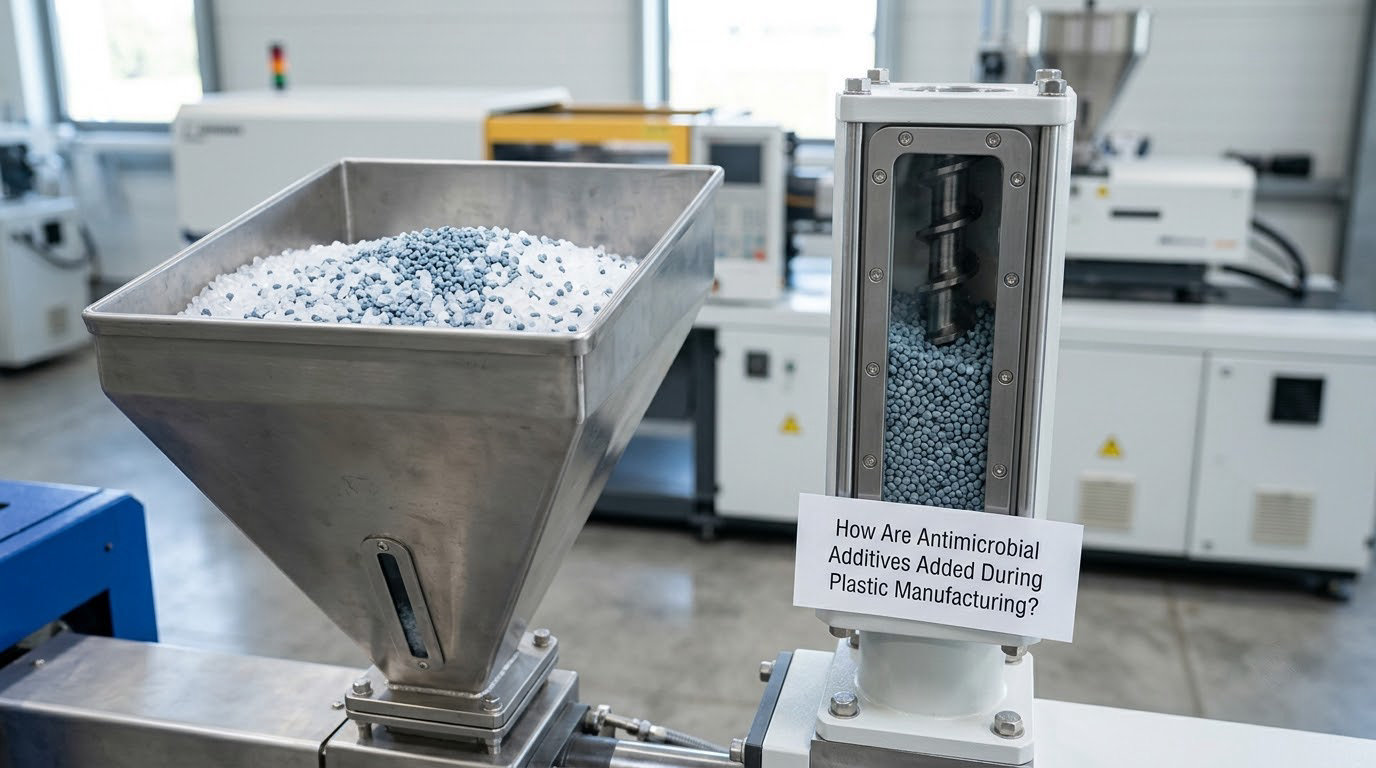
Most programs use a masterbatch: the active at a high concentration, dispersed in a carrier resin chosen to match your base polymer, then dosed at low addition rate during extrusion or moulding. Matching the carrier to the base resin is not optional. A mismatch shows up as haze, flow differences and visible speckle long before anyone tests for microbial activity.
Direct powder dosing suits some processes where the active is already fine and stable, and liquid concentrates work where the additive would otherwise degrade in the melt or where a very low, very even dosage is needed. Post-mould surface treatments are a separate approach, useful on parts that will not go through a compounding step.
Four things go wrong most often. Poor dispersion gives you agglomerates and visible defects, so twin-screw compounding and the correct screw element arrangement matter. Excess shear and residence time push melt temperature above what the active tolerates, which silently costs you activity. Dosing by weight alone is not enough on a line with variable throughput, and gravimetric dosing is usually the fix. And pellets must be dried properly, since some actives are moisture-sensitive and hydrolysed resin changes flow.
The supplier’s recommended carrier and addition rate should govern your formulation. If your process cannot hold those conditions, the answer is a different additive, not a fudged dosage. Once a line is running, treat dosing as a controlled parameter and trend it the way you would any other, alongside your existing SPC charts for injection moulding.
How Much Antimicrobial Additive Should a Plastic Contain?
There is no universal loading recommendation, and any supplier that gives you one without asking about your polymer, part geometry and test method is selling you their formulation rather than answering your question. What a supplier can legitimately give you is a starting range for a specific active in a specific resin, expressed either as a percentage of the concentrate or as ppm of active.
The number moves with several variables. Active concentration matters more than total additive weight, so a low-loading concentrate and a high-loading powder are not interchangeable. Surface availability drives the result: same loading, different result on a film and a solid housing. Process losses through volatilisation, degradation or purge mean the dose in the hopper is not the dose in the part. And higher loading shows up in colour, haze, odour, melt viscosity and mechanical behaviour before it shows up as extra activity.
That last point catches people out. A concentrate that looks transparent in a thin lab plaque can raise viscosity enough to change fill behaviour in a complex tool, and any shift in flow or cooling affects dimensional consistency against your plastic part tolerance standards. Start from the supplier’s technical data, run it on your own equipment, then validate the finished part rather than extrapolating from neat resin data.
Can Antimicrobial Plastics Be Recycled or Reground?
Yes, usually, but not automatically at the same performance level and not without testing at your actual reuse ratio. Regrind carries thermal history, and an active that degrades with heat has now been exposed more than once. Sorting also matters: a reclaim stream that includes parts coated with a different additive can change the effective chemistry in ways nobody has characterised.
Two further issues complicate it. Contamination control in the reclaim stream affects both the additive loading and the colour of the end product. And where the active works by surfacing over time, repeated regrinding dilutes it, so the activity per unit of material falls as the reuse ratio climbs even if the concentration in the feed looks right.
Where your customer requires recycled content and an antimicrobial claim, treat those as two requirements to be met together. Run prototypes at the real reuse ratio, with the real processing conditions, and test the finished articles rather than the pellets.
How Do You Test Whether an Antimicrobial Plastic Works?
Testing splits into screening methods and application-specific validation, and confusing the two is how inflated claims get repeated. Screening methods compare a treated sample against an untreated control under defined conditions of inoculum, humidity, temperature and contact time, then report a log reduction or viable count difference. They are useful for ranking candidates. They are not proof that your finished product resists growth in service.
Know what you are reading when you see a number. Common screening standards include ISO 22196 and JIS Z 2801 for measurement of antibacterial activity on plastics and nonwovens, ASTM E2180 for non-leaching antibacterial finish behaviour, and time-kill methods that measure actual kill kinetics rather than growth inhibition. A two-log reduction under a 24-hour incubation tells you about one set of organisms, one inoculum level and one surface condition. It does not tell you what happens after six months of handling.
So validate on the final production part, with its real surface finish, colour and additive package, its real cleaning history, and the conditions it will actually meet. If the part also has to survive transport and handling, that is a separate trial; our ISTA testing protocols guide covers how distribution stress is set up.
Always run a treated and an untreated control side by side. A supplier who cannot supply an untreated control for your exact geometry is not measuring your part.
What Safety and Regulatory Checks Matter?
Four areas need attention: toxicological assessment of the active, migration behaviour from the finished article, worker exposure during compounding, and the regulatory route for the market you sell into. Rules differ sharply by region, so treat the following as orientation rather than legal advice, and have your compliance team verify current requirements.
In the European Union, a plastic article carrying a biocidal function generally falls under the treated article provisions of the Biocidal Products Regulation, where the supplier’s active holds an approval and the article maker carries specific labelling and risk-assessment duties. In the United States, treated article exemption rules under FIFRA sit alongside EPA registration requirements that apply depending on the claim, and public-health claims pull you into a different and heavier regulatory category than product-protection claims do. Food contact adds its own layer: FDA listings or an applicable food contact notification in the US, and EFSA assessment or national implementation of an authorised substance in Europe.
Claims are where most marketing outruns the evidence. Protecting the product against microbial growth, controlling odour and extending colour retention are product-protection claims. Claiming reduced infection risk is a public-health claim with a different evidential bar. Restrict substances lists and nanomaterial scrutiny also matter, particularly for silver systems, where questions about release into food and the environment have been raised in peer-reviewed literature and trade press.
Finally, ask what happens to the active as it decomposes during processing and end of life. That is a real question with real answers, and suppliers who address it are rarer than they should be.
Frequently Asked Questions
Do antimicrobial additives in plastics kill all bacteria and viruses?
No. Additives are tested against a specified list of organisms under defined conditions, not against every pathogen. Some are tuned mainly for fungi or mould, others for a narrower set of bacteria, and viruses are usually outside the scope of plastic additives entirely. Ask a supplier which organisms their data covers, at what inoculum level and contact time, and whether the finished part was tested or just the resin.
Is antimicrobial-treated plastic automatically safe for food contact?
Not automatically. Suitability depends on the polymer, the specific additive, its concentration, the intended use, migration behaviour and the rules of the market you sell into. What matters is the authorisation held for that substance at that loading, plus migration data for the finished article rather than the neat resin. Have your compliance team confirm the listing rather than relying on a supplier declaration.
How long does the antimicrobial effect last in a molded plastic part?
For as long as the active remains available at the surface, and that is a moving target. Surface enrichment takes time, while abrasion, repeated cleaning, UV exposure, humidity and thermal history all reduce what is left. Some chemistries are deliberately designed to be non-leaching and stay locked in the matrix, which tends to give steadier long-term behaviour. Only testing on your part, over your service life, answers the question.
Can antimicrobial additives affect a plastic’s mechanical properties?
They can, and buyers often discover this late. Higher loadings, coarser particle sizes and a poor carrier match can change melt viscosity, tensile and impact behaviour, shrinkage and surface appearance, even when the antimicrobial performance looks excellent. A colour shift or haze in a clear product is usually the first symptom. Run mechanical and optical checks on the same plaques you use for antimicrobial testing.
How do you compare test data from different suppliers?
Ignore the headline percentage and compare the method. Look for a named standard, the organisms used, inoculum level, contact time, humidity, temperature, whether the sample was the finished part or a lab plaque, and whether an untreated control ran alongside. Two suppliers can both report a large reduction and mean completely different things. Ask for the raw report, and for the aged-sample result rather than only the 24-hour figure.
Conclusion
The decision follows a fixed order. Define the organisms you actually care about and the environment the part will sit in. Shortlist chemistries compatible with your polymer and process. Collect the supplier’s technical data and the regulatory documentation for your market. Trial the compound on your own equipment at your own settings. Then validate the finished part against a matched untreated control using a method you can name in a specification.
If you take one action from this guide, make it the next one: request a sample of the shortlisted concentrate and mould a small set of treated and untreated plaques from your own tool. That single trial tells you more about colour, dispersion, flow and processing tolerance than any datasheet, and it takes less time than most teams expect.