
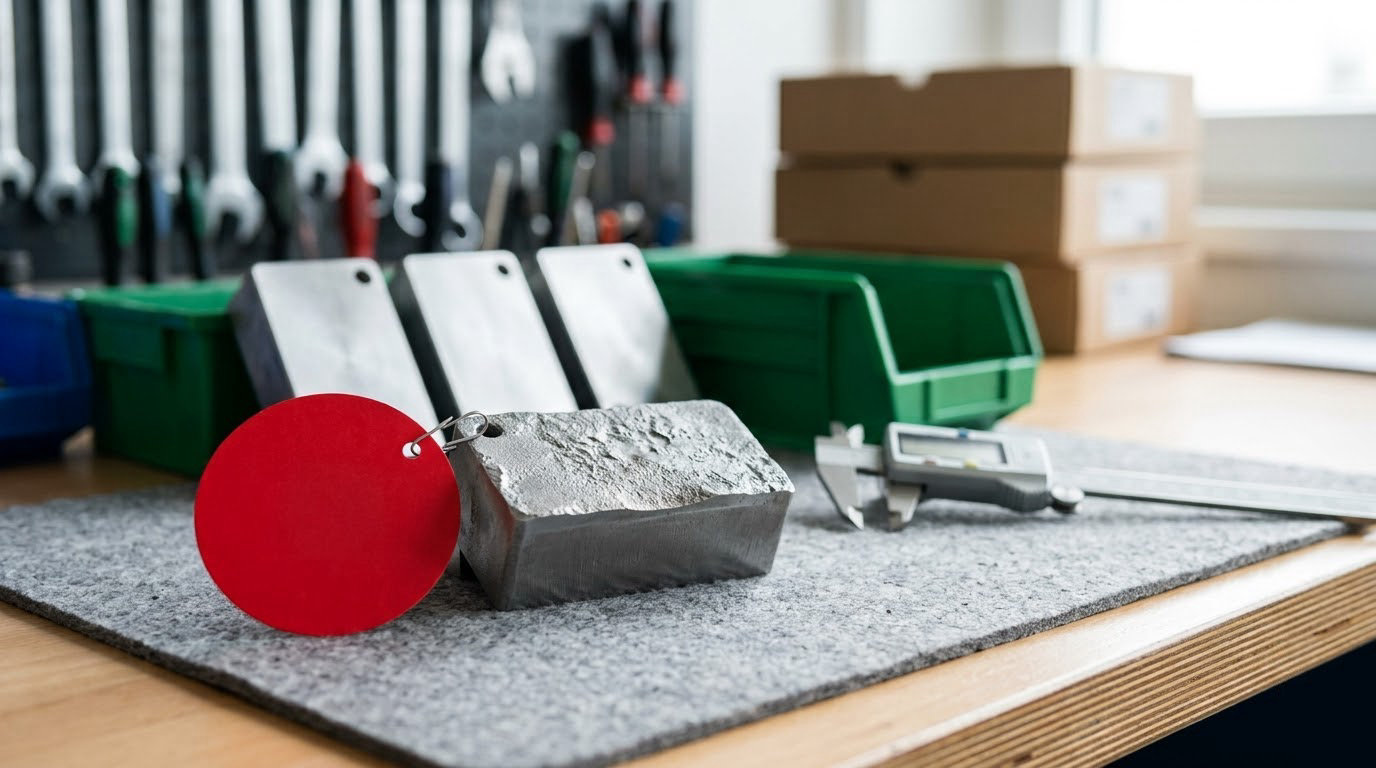
To handle nonconforming material, you identify the failure, physically tag and segregate the affected material, contain the extent, record it as a nonconformance, decide a disposition through someone authorized to make that call, and re-inspect corrected material before it goes anywhere near a customer. ISO 9001 clause 8.7 asks for exactly that much, no more.
It is not a complicated procedure. It is the discipline of doing six things in order, every time, with a record at each step. Most plants that struggle with nonconforming material do not have a technology problem. They have a sequence problem: they start the root cause investigation while bad parts are still on the line, or they let a supervisor sign a use-as-is because the form was sitting right there.
For an injection molder or a packaging converter, this whole process usually runs in under an hour for a single lot, plus whatever time the disposition itself takes. Budget a shift for a plant-wide bracket, and much longer when customer notification is required. Below is the workflow, then the paperwork that has to exist afterwards.
Table of Contents
- What You Need
- Step-by-Step: How to Handle Nonconforming Material
- Common Mistakes
- Frequently Asked Questions
- What is the difference between quarantine and rejection for nonconforming material?
- Who has authority to approve a use-as-is concession?
- Is re-inspection required after every rework operation?
- How long can nonconforming material stay in quarantine before it must be dispositioned?
- What is required after corrective action is taken on a nonconformity?
- What is the difference between a nonconformance report and a corrective action request?
- Conclusion
What You Need
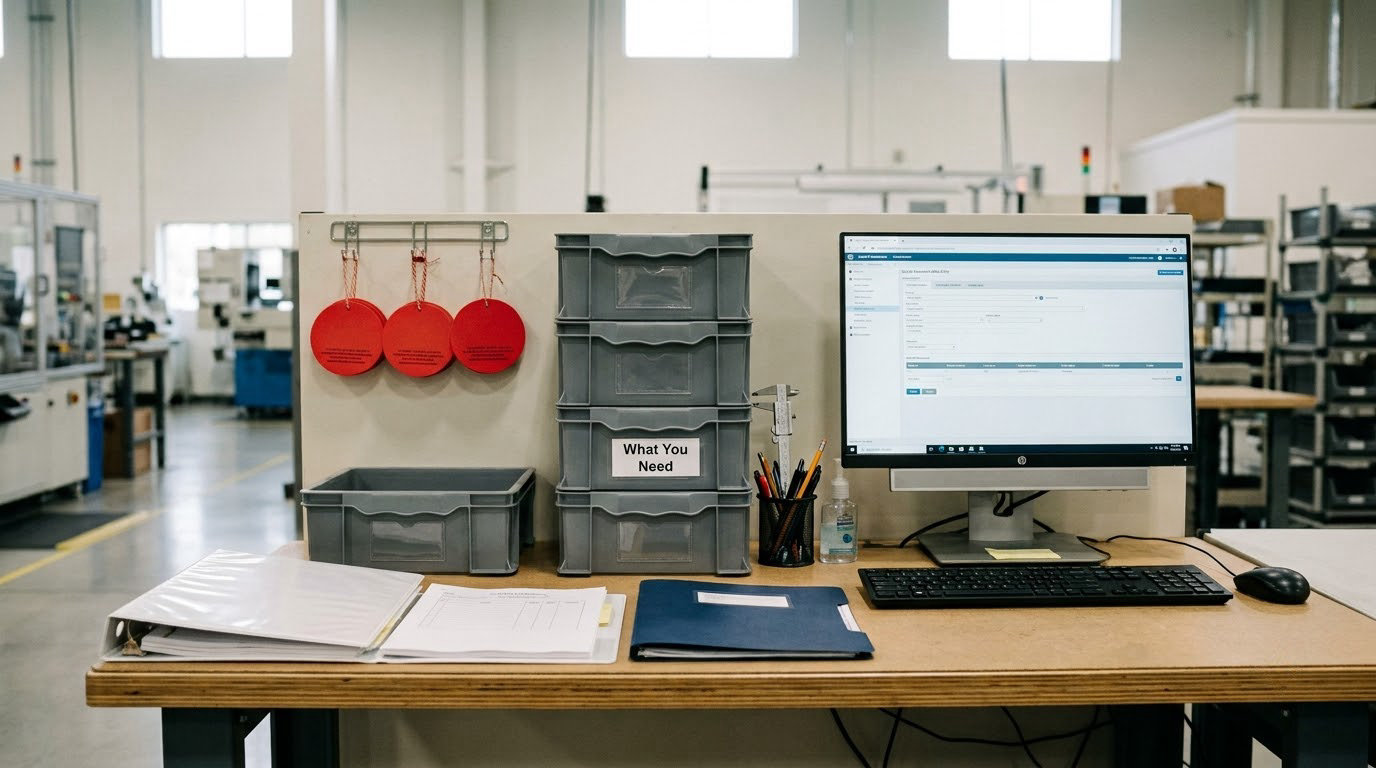
You cannot run this process on a whiteboard and good intentions. Before you handle your first nonconformance of the week, these five things need to exist:
- A written procedure. One page is enough to start. It names who identifies, who contains, who dispositions, and what the authority levels are.
- A nonconformance form. Paper or electronic, but with fixed fields: material, defect, quantity, lot or batch number, location, date, inspector, and objective evidence.
- Trained personnel. Everyone who touches material has to know what a hold tag means, including the night shift operator and the picker.
- Identification tools. Red hold tags, quarantine labels, and a marker that stays legible after a forklift truck clips the tote.
- A physical location. A designated quarantine or rejection area that is not the corner of the warehouse closest to the shipping door.
Also useful: access to your ERP or inventory system so you can actually block the material, and a list of escalation contacts. If nobody on your team can produce a record on demand within an hour, the other four items do not matter yet.
Step-by-Step: How to Handle Nonconforming Material
Identify and Document the Nonconformance
The record comes before the tag, not after. When an inspector or operator finds material that does not meet the drawing, the spec, or the work instruction, the first output is a nonconformance report with the facts in it.
Fill in what the material is, what is wrong with it, how many pieces or how many kilos are affected, the lot or batch number, where it physically is right now, the date, and who found it. Attach objective evidence where you can: a photo of the flash on the runner, a gauge printout, a set of measured values, the calibration record for the instrument used.
You will know the step worked if someone who was not on the floor can read the record and know exactly which material to go looking for. Half of all nonconformance pain comes down to records that say “bad parts” without a lot number.
Contain and Segregate the Nonconforming Material
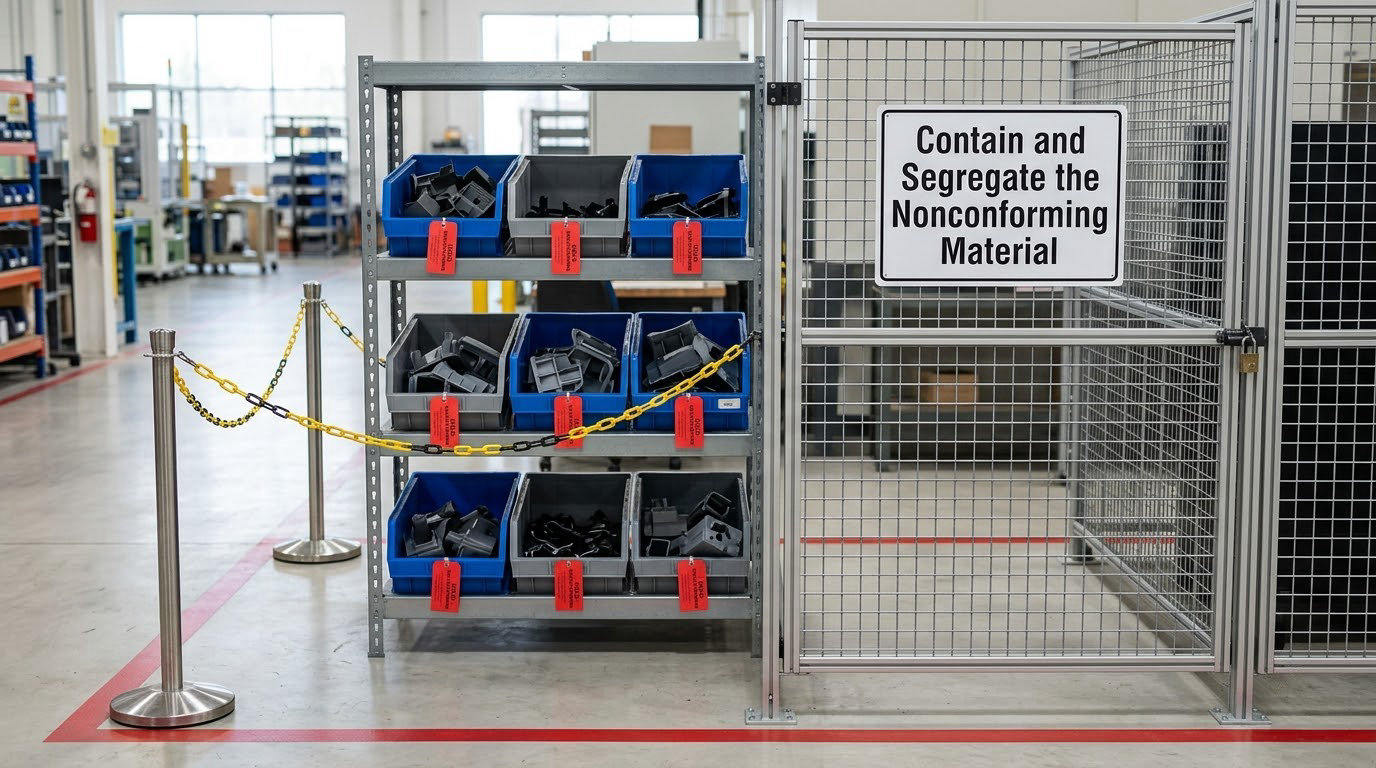
Now stop the material from doing any more work. Physically remove it from the flow, label it, tag it, and secure it in the designated quarantine area. In a plant running injection molding, that means red tags on the tote, a status change in the inventory system, and a physical move to the cage or the marked-off floor space.
How you handle nonconforming material physically matters more than most procedures admit. The common failures are predictable: an untagged bin of rejects beside the good-parts bin, a HOLD label written in marker on a pallet wrap, quarantine quietly used as overflow storage when the real racks are full, and a rework bench where corrected parts sit in the same tote as parts still waiting for a decision.
Containment also means blocking the material electronically. If your ERP can flag an inventory hold, set it the same shift. A system that records a rejection but still lets the order pick, move and ship is worse than no system, because it looks like control.
Evaluate the Cause and Extent
Next, work out how far the problem reaches. Quality and operations look at the defect, the process, the tooling, the material lot and the shift pattern, and they bracket the exposure: which lots ran on the same tool, in the same time window, from the same resin lot, before and after the suspect piece.
This is where the containment boundary gets set. Bracket too narrow and you ship the same defect twice. Bracket too wide and you are sorting 20,000 good parts because one cavity ran cold. A documented boundary, with the reason it was drawn where it was, is worth more than a perfect root cause that arrives six weeks later.
Write down whether this looks like a contained material issue or a process failure. A single carton with a delaminated print face is contained. Sink marks showing up across three molds and two resin lots is a process problem, and it needs a corrective action record opened behind the nonconformance.
Choose and Approve a Disposition
Every nonconformance ends in one of a small number of dispositions, and the choice is never made by whoever found the defect. The practical options: use-as-is (also called a concession or deviation), rework, repair, reclassify or downgrade, return to supplier, scrap, or hold for further review.
Each one carries a different authority level and a different evidence requirement. Use-as-is on a cosmetic defect may sit with the quality engineer; use-as-is that affects a customer drawing needs the customer. Rework on a cosmetic flaw is routine. Rework on a structural feature is a design decision, not a shop-floor one.
Record the disposition, the rationale, the deciding authority and any concession number on the nonconformance report. If the failed requirement belongs to the customer, get their written concession before the material moves, not after you have shipped it and apologised.
Implement and Verify the Disposition
Execute the disposition without mixing streams. Reworked material goes back with a status that says reworked pending verification, into a separate area from the parts still waiting for a decision. Scrap gets destroyed or rendered unusable in a way that prevents accidental re-entry into the good stream, and the destruction is recorded.
Then verify. Corrected material gets re-inspected against the same acceptance criteria as the original, by someone who did not do the rework. Injection molding is unforgiving here: grinding the flash off a part can thin the wall below tolerance, so the re-inspection has to check the dimension the flash implied, not just look at the surface.
Rework is not repair. Rework brings the product back to full conformance to the original requirement. Repair brings a product that no longer meets the original requirement but is made acceptable by a documented, usually customer-approved repair scheme. Keeping those two apart on your form is one of the cheapest clarity improvements you can make.
Close the Record and Address Recurrence
Before you release, downgrade or destroy anything, reconcile the quantities. The number dispositioned should equal the number identified, and the difference should be zero or explained in the record. Partial-lot failures are the ones that go wrong: 400 pieces bad out of 2,000 in the run, and nobody wrote down what happened to the other 1,600.
Attach the evidence trail: rework instructions used, re-inspection results, scrap or return documentation, concession approvals. Update the affected records, then open a corrective action record when the cause is systemic rather than a one-off. Root cause analysis is a clause 10.2 activity, separate from the containment work in clause 8.7, and mixing the two is how plants end up investigating for six weeks while bad material sits in the cage.
Finally, share it. Defect data that never leaves the quality office fixes nothing. The same short shot on the same tool in two different molding cells is a control plan problem, not two coincidences.
Common Mistakes
Informal identification. Verbal tells, marker writing on a pallet wrap, or a bin nobody labeled. Fix it: a tag design with fixed fields, attached to every affected unit or container, plus the record number written on the tag itself.
Quarantine used as storage. The area fills with acceptable material waiting for rack space, and the actual nonconforming material ends up mixed in. Fix it: physical boundary markings, an inventory system location that only hold items can occupy, and a weekly check that the quarantine location count matches open hold records.
Unapproved use-as-is decisions. The form gets signed by whoever was walking past. Fix it: a written authority matrix naming the people who can approve each disposition type and at what level, with customer approval required where the requirement is the customer’s.
Missing quantity reconciliation. Identified quantity and dispositioned quantity never get compared, so partial lots leak. Fix it: reconciliation is a required close-out field, and an open NCR cannot be closed without it.
Treating everything as a supplier problem. Incoming material gets an NCR and the internal process that produced the failure never gets examined. Fix it: classify the nonconformance by source, and route internal ones to the process that made them.
Root cause before containment. The investigation starts while suspect material is still being shipped. Fix it: containment has to be physically complete before the investigation is scheduled.
Two habits catch most of the rest. Walk the floor monthly and pick up any hold item, then ask the nearest person what it is and where its record is. Every tag should have a record, and every record should have physical parts behind it. Where those two directions break, that is your audit finding, before an auditor finds it.
Frequently Asked Questions
What is the difference between quarantine and rejection for nonconforming material?
Quarantine is a controlled holding status for material whose conformance is still being decided. Rejection is the end state: the material has been dispositioned and will not be used as originally intended, whether that means scrap, return to supplier, or reclassification to a different, clearly marked use. In most systems quarantine is a zone, rejection is a status, and material can move from one to the other only with a recorded disposition.
Who has authority to approve a use-as-is concession?
Authority comes from your written concession matrix, not from seniority in the room. A cosmetic deviation inside internal tolerance may sit with a quality engineer; a concession that affects a customer drawing, a safety feature or a regulatory requirement needs the customer in writing before the material moves. Record the deciding person’s name and any customer concession number on the nonconformance report so the decision can be traced later.
Is re-inspection required after every rework operation?
In practice, re-inspect any reworked material against the original acceptance criteria before release, and have it done by someone who did not perform the rework. Rework is not always visibly reversible: removing flash from a molded part can thin a wall below tolerance, and a cosmetic repair can hide an underlying dimensional problem. Where your customer or standard specifies full re-inspection or sampling, that level governs.
How long can nonconforming material stay in quarantine before it must be dispositioned?
No standard sets a universal number, so your own procedure has to. Set an aging limit, escalate before it is reached, and track it. Most plants find that items sitting beyond the limit share the same causes: no one owns the decision, the authority needed was not available, or the evidence to choose between dispositions was never collected. An aging report is the fastest way to see which one is true for you.
What is required after corrective action is taken on a nonconformity?
Verify effectiveness, not just completion. Review the actual results of the corrective action against what the problem looked like before, confirm the identified cause was the real cause rather than a convenient one, and confirm the change holds over a reasonable period rather than a single good week. Evidence of effectiveness, the review date and the reviewing person all belong in the record, because that is what an auditor asks for first.
What is the difference between a nonconformance report and a corrective action request?
A nonconformance report documents a specific event: material that did not meet a requirement, its quantity, its location and what was done with it. A corrective action request addresses the cause behind a pattern, and asks why it happened and what change stops it from recurring. Most mature systems raise both from one detection, but they close separately. Root cause work belongs to the corrective action record, not to the containment and disposition steps.
Conclusion
If you are starting from scratch, do four things this week. Write down who identifies, who contains and who approves a disposition. Put a real quarantine area somewhere physical and mark it. Print a nonconformance form with the fields above and use it for one live event. Then walk the floor with a list of open hold items and confirm that every tag has a matching record.
That last habit is where most of the value sits. Knowing how to handle nonconforming material is not really about the paperwork; it is about being able to say, at any moment, where suspect material is, who decided its fate, and what evidence supports that decision. If the answer takes more than a minute, the process is not running yet.