
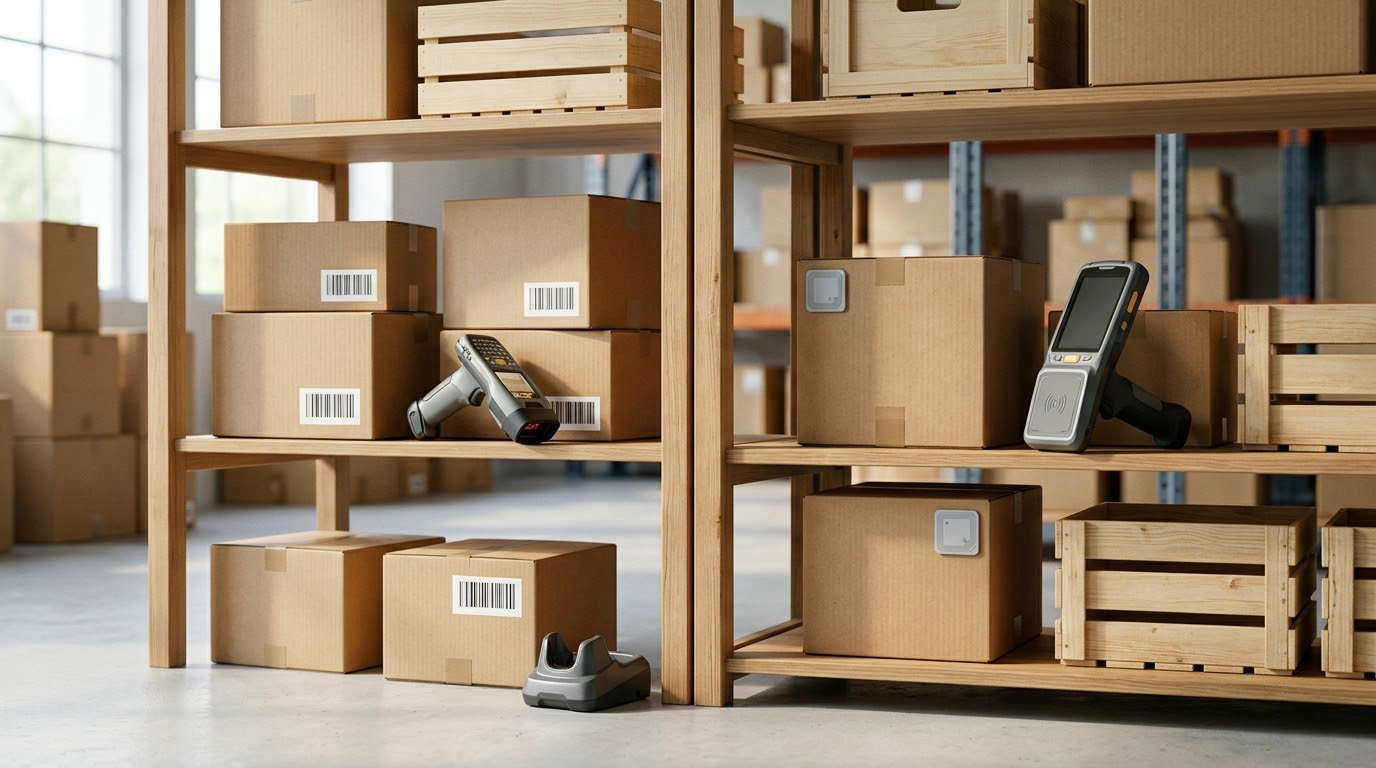
The short answer: if nobody at your operation is bottlenecked on scanning things one at a time, printed barcodes remain the better buy. RFID vs barcode for inventory tracking really comes down to movement volume, item value, and how much of your inventory is hidden inside boxes or shrink-wrapped pallets.
A barcode is printed ink that a laser or camera scanner reads optically, one item per trigger pull, with a direct line of sight. An RFID tag is a chip and antenna that a reader detects over radio waves, in bulk, without line of sight. That single difference drives everything downstream: cost per item, how fast you can count, and how well you can see what is inside a carton.
Most operations end up running both. Here is where each one wins, where it quietly fails you, and how to tell which problem is actually worth solving.
Table of Contents
- RFID vs Barcode for Inventory Tracking at a Glance
- How RFID and Barcodes Track Inventory
- Read Speed, Range, and Accuracy Compared
- RFID vs barcode for inventory tracking: Cost and ROI
- Durability and Inventory Accuracy Compared
- Data Capacity and Bulk Scanning
- Deployment, Integration, and Scalability
- Which Tracking Method Works Best by Use Case?
- Which Should You Choose?
- Frequently Asked Questions
- Conclusion: Start With the Inventory Bottleneck
RFID vs Barcode for Inventory Tracking at a Glance
| Criterion | Barcode | RFID | Likely winner |
|---|---|---|---|
| How it is read | Light reflected off printed ink | Radio signal from a chip and antenna | Neither, they are different jobs |
| Line of sight | Required, every scan | Not required | RFID |
| Typical read range | A few inches to a couple of feet | Near field a few inches, mid range a few feet, long range up to tens of feet | RFID |
| Items per sweep | One, occasionally a few 2D codes at once | Dozens to hundreds in a single read | RFID |
| Cost per item | A fraction of a tag, printed in bulk on one pass | Several times more per tag | Barcode |
| Hardware cost | Handhelds, fixed scanners, phone cameras | Handhelds plus fixed portals, tunnels and antennas | Barcode |
| Data capacity | Short identifier string, up to a few thousand characters in 2D | Identifier plus kilobytes of rewritable memory on some tags | RFID, though rarely decisive |
| Survives rough handling | Scuffs, tears and solvent wipe out a label | Potted or ruggedised tags tolerate heat, moisture and washdown | RFID |
| Environmental limits | Needs a clean, angled surface | Metal and liquid detune or block the signal | Barcode, on tough environments |
| Maintenance | Reprint damaged labels, keep scanners clean | Tune antennas, manage dead zones, replace batteries in active tags | Barcode |
| Security exposure | Copied by photographing a label | Cloneable unless locked, readable by any nearby reader | Neither, both need controls |
| Best applications | Retail checkout, small catalogues, low-value mixed inventory | Palletised and hidden inventory, high-value assets, apparel, cold chain | Depends on throughput |
One note on that table: a barcode is not a lesser identifier. A 2D code holds more printed characters than most applications ever need, and a barcode label can be read by a phone camera with no hardware purchase at all.
How RFID and Barcodes Track Inventory
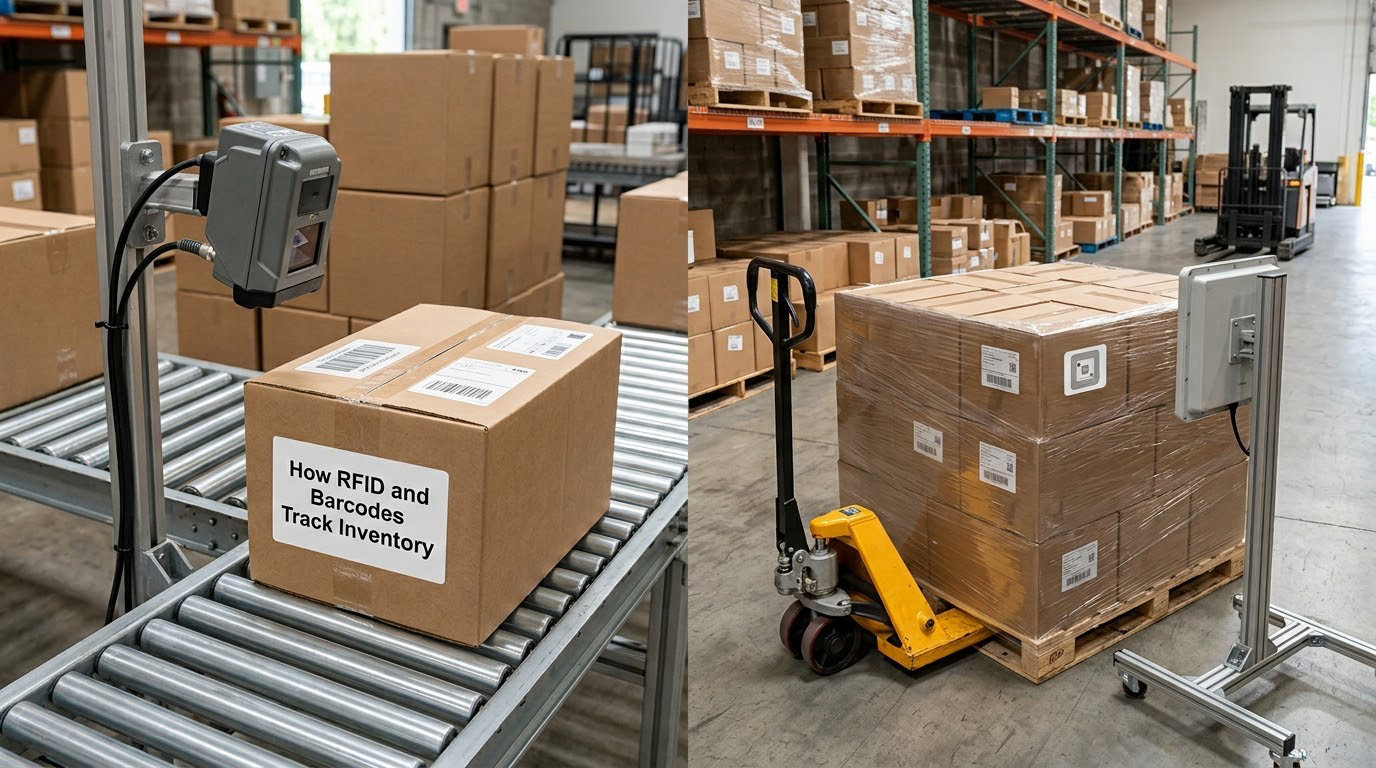
How RFID and barcodes track inventory end to end
A barcode workflow starts with the identifier itself. A 1D code such as UPC-A or EAN-13 holds roughly a dozen digits, the retail number printed on the carton. Code 128 is the workhorse inside a warehouse because it encodes any alphanumeric string, including a serial number and a lot code. A 2D symbol such as a QR code or Data Matrix carries hundreds to a few thousand characters, which is how smaller packs get a full manufacturer, batch and expiry record in one scan.
The scanner fires a laser or a white LED array, reads the reflected pattern, and turns it into text. That text goes to a warehouse management system or ERP, which matches it to a SKU and updates on-hand quantity. Every one of those steps is a human-initiated event, and every one of them takes a second or two per item.
RFID replaces the printed pattern with a chip and a printed or etched antenna. A passive tag has no battery; it harvests power from the reader’s electromagnetic field, wakes up, and broadcasts its identifier. An active tag carries its own battery and transmitter, which is how you get read ranges measured in tens of feet for pallets and returnable transport items.
Concretely, a receiving clerk with a handheld scanner verifies an inbound pallet by reading each carton label into a receiving screen, and the system tells them what is short. With RFID, the same pallet passes through a portal as the truck is unloaded and the reader logs every tag inside the wrap in one pass, whether the cartons face the door, sit at the bottom, or are upside down.
Both identifiers ultimately resolve to the same database. The difference is how many of those lookups a person has to perform.
Read Speed, Range, and Accuracy Compared
This is where the two technologies separate fastest. A handheld barcode operator might read 30 to 60 items a minute reliably, and considerably more when scanning a printed sheet. An RFID read zone captures a pallet’s worth of tags in the same time it takes to drive a forklift through a doorway.
Range depends on frequency band, and band choice is not a detail you can skip. UHF in the 860-930 MHz range is the default for pallets and cases because it reads several feet and penetrates cardboard. Near-field and mid-range readers are tuned for tighter, more controlled zones. The failure modes matter more than the headline range.
Which RFID frequency band reads best near metal and liquid
| Band | Typical read distance | Reads well around | Watch out for |
|---|---|---|---|
| Low frequency, roughly 125 kHz | A few inches to a foot | Metal, liquids, livestock and harsh industrial settings | Short range, slower reads, higher tag cost |
| High frequency, roughly 13.56 MHz | A few inches | Close-range tagging, metal-adjacent items, access control | Very short range, mostly near-field work |
| Ultra high frequency, 860-930 MHz | Several feet, further when tuned | Cardboard cartons, pallets, apparel, case-level tracking | Detuning next to metal, water or wet surfaces |
| Active UHF | Tens of feet | Returnable transport items, yard and trailer tracking, live location | Battery life, higher cost per tag, containment |
Metal reflects radio energy instead of absorbing it, and liquids absorb it. That is why a UHF tag applied flat to a steel drum can read at a fraction of its rated range, or not at all. Tag datasheets list the material they are tuned for, and ruggedised versions are potted in plastic or ceramic to survive impact and washdown. Match the tag to the material before you match it to the reader.
What a read-rate percentage actually means for a count
Vendors quote read rates of 98 or 99 percent, and those numbers are measured in controlled conditions with tags correctly oriented. Applied to a real count, they land differently. A 99 percent read rate across 20,000 items means roughly 200 unidentified items, and a cycle count built on that assumption quietly carries a couple of hundred phantom discrepancies every pass.
Two other errors show up in live zones. Duplicate reads happen when two overlapping antennas pick up the same tag, and dead zones happen where a pallet is turned sideways or a metal rack blocks the field. That is why a well-run deployment tunes antennas so zones do not overlap, and why you should measure read performance in your own aisles with your own products before anyone talks about rollout.
Barcode accuracy has a different failure mode. A smudged or torn label produces a hard miss with no partial credit, but the miss is visible and fixable: reprint it. An undetected RFID miss looks like missing inventory.
RFID vs barcode for inventory tracking: Cost and ROI
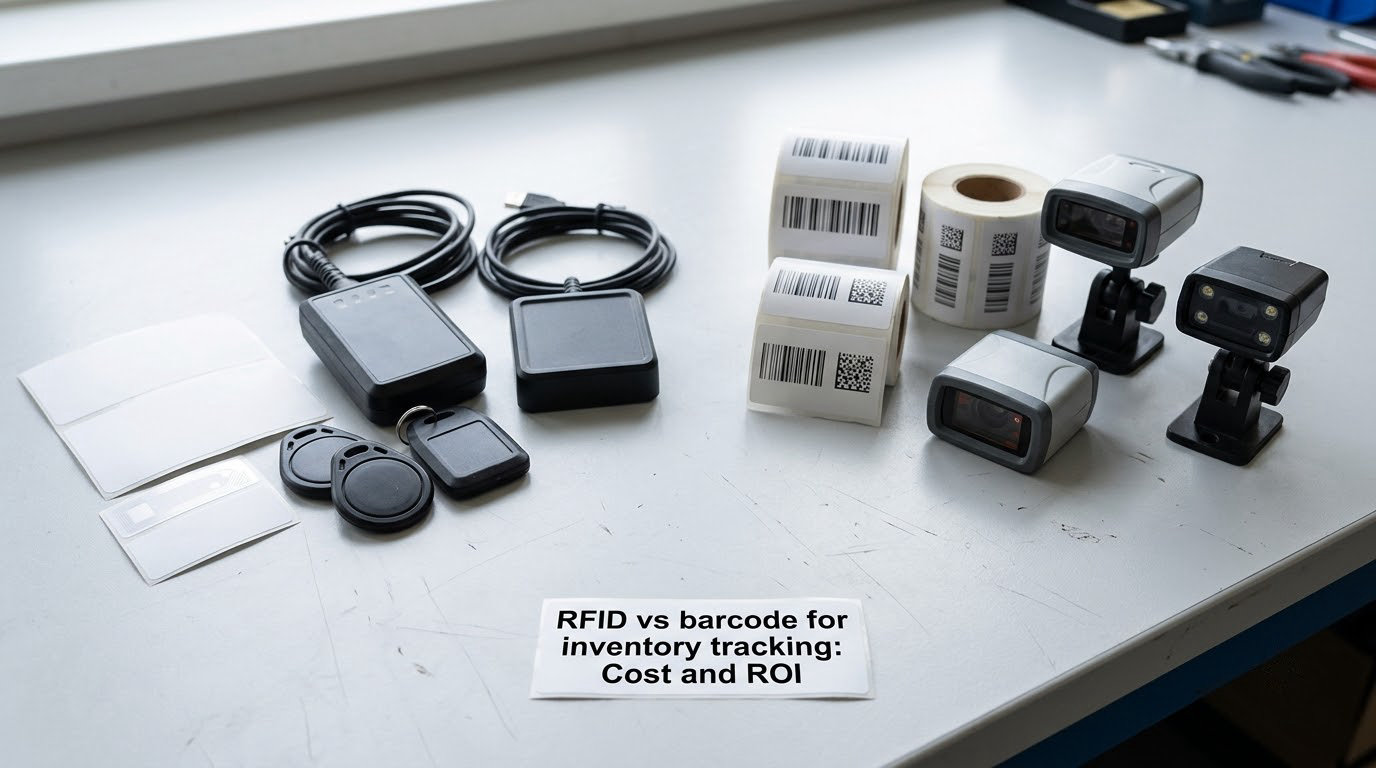
Per item, printing a barcode label is dramatically cheaper than buying an RFID tag. That is the fact almost every comparison leads with, and it is the fact most often misused, because it stops before the interesting costs.
How RFID vs barcode costs compare in practice
RFID adds cost in four places, not one. The tag itself costs several times more than a printed label. Application stops being a print job and becomes a task: someone or a machine attaches, encodes and verifies a tag, and for a high-SKU operation that labour line dwarfs the tag. Hardware moves from handheld scanners to fixed portals, tunnels and antenna arrays that need power, mounting and tuning. Middleware becomes mandatory, because something has to filter duplicate reads, sort real events from noise, and hand clean data to your WMS.
What RFID takes away is labour at scale, and that is where the return comes from. Walk a 2,000-SKU area with a handheld and you are looking at a full shift of counting. Drive a pallet through a portal and the same area is a fraction of that. Whether that labour saving repays the hardware depends on how many counts you run in a year and what an hour of counting time is worth in your operation.
When the cheap label is the wrong answer
Judge the system on the total, not the line item. If you count weekly, ship thousands of cases a day, or lose margin every time an order is picked from a bin that is empty, the per-tag premium stops being the deciding number.
The calculation gets simpler if you count what a shift of scanning really returns. Two operators walking racks for four hours will cover less ground than a forklift through a portal in under an hour, and the portal produces a record without anyone transcribing anything. On high-value apparel, pharmaceuticals or tools, one lost or mislocated item can cover the cost of tagging an entire category.
There is a floor worth naming: a low-value SKU you only touch twice a year is very hard to justify tagging, however fast the reader is. Track it by barcode and spend the tag budget where loss actually shows up in the numbers.
Durability and Inventory Accuracy Compared
A printed label lives on the surface of the item, so abrasion, solvents, moisture and repeated handling all end in the same failure: an unreadable code. RFID tags can be potted, laminated, sewn into a hem or embedded under a surface, which is why they win on washdown environments, returns and rewearable containers.
Accuracy is a separate argument and often the weaker one. People repeat the claim that RFID is more accurate, but neither technology is more truthful than the process feeding it. Barcode systems lose accuracy through skipped scans, scanned-but-unposted transactions and mislabelled stock. RFID systems lose it through missed reads, ghost reads from adjacent zones, and the assumption that a clean read means a complete pallet when the wrap was torn at the corner.
Process design usually matters more than the tag. Segregating a staging area so a pick list is confirmed before the bin is closed, or counting a zone after every aisle is emptied, will beat both technologies’ hardware limits. Barcode discipline, though, is a behaviour you have to train and re-train. A portal is easier to enforce because the conveyor does not wait for a person to look up.
Data Capacity and Bulk Scanning
The common claim that barcodes store only about twenty characters is true for UPC-A and EAN-13 and wrong in general. Code 128 encodes up to 128 ASCII characters, and a QR code or Data Matrix symbol holds well over a thousand characters, which is more than most inventory records need at the point of scan.
RFID tags do store more. A typical EPC Gen2 tag carries a small identifier plus a user memory area, and some formats give you kilobytes you can rewrite and use for inspection notes, temperature history or sensor readings. That capacity is real, and it is still rarely the deciding factor. Most warehouses use the tag as a key into the database, not as the database.
Where the difference is decisive is the sweep. RFID collects every tag inside the field at once, so a receiving check, a cycle count or a dispatch verification becomes one event instead of several hundred. Barcodes generally need an individually oriented scan per item, and 2D codes help only when several are printed together and aimed at the same imager. Nobody scans the inside of a shrink-wrapped pallet with a barcode.
For a small catalogue moved by hand, one-at-a-time scanning is not a burden worth engineering away. That is the case where the bulk advantage buys nothing.
Deployment, Integration, and Scalability
A six-step rollout
- Pick the problem, not the technology. Write down the counting, receiving or locating task that costs you the most hours or the most margin. That becomes the pilot’s success test.
- Run a pilot on real movement. Tag a representative mix of products, including awkward ones on metal or liquid, and run them through your actual aisles and dock rather than a bench test.
- Choose tags and band for the material. Match the tag form factor to the surface, the storage environment and whether the item is returnable.
- Place readers and tune the field. Overlapping antennas cause duplicate reads, so map zones for separation, kill dead spots at rack faces and doorways, and confirm coverage at the speeds you actually run.
- Connect middleware to the WMS or ERP. Filtering, event de-duplication and write-back all happen here. Test exception handling before volume, because a portal that floods the system with false movements is worse than no portal.
- Roll out by zone, not by slogan. Start with a value stream that pays back clearly, then extend. Keep the barcode path intact for everything else.
Portals and tunnels suit receiving docks, conveyor checkpoints and dispatch lanes where a pallet cannot be stopped or turned. Handhelds cover cycle counts, picking and bin-level work. Manufacturing kitting benefits from tagging work-in-progress containers so a kit does not stall waiting for a missing component. Returnable transport items are the clearest RFID case, because the asset is physically large, repeatedly moved, and expensive to lose track of.
Two things surprise people. First, existing barcodes and existing WMS integrations survive an RFID move almost untouched, because the RFID read is translated into the same identifier the system already understands. Second, a phone camera reads barcodes but cannot reliably read passive UHF tags, so if a workforce plans to self-serve, you are buying dedicated RFID-capable handhelds, not reusing existing phones.
Which Tracking Method Works Best by Use Case?
| Use case | Better fit | Why |
|---|---|---|
| Small business, modest order volume | Barcode, mainly 2D | Low tagging volume will not repay tag cost, and phone cameras already scan both codes |
| Retail store and checkout | Barcode at the till, RFID optional for back stock | Checkout needs a printed code customers can see and staff can re-print |
| Distribution centre, high throughput | RFID plus barcodes | Portals verify cases at dock doors, barcodes still drive picking |
| Manufacturing kitting | RFID on containers, barcodes on parts | Work-in-progress moves in bulk and stalls the line when a kit is incomplete |
| High-mix, small-order facility | Barcode heavy | Counting is occasional and per-item value is low |
| Apparel and loss prevention | RFID | Tagged items sit inside garments where no label can be seen or scanned |
| Pharmaceuticals and cold chain | RFID, with sensors on active tags | Item-level history and handling data matter more than the identifier |
| Tools, equipment and returnable transport items | RFID, active for yard travel | Assets are shared, moved outdoors and costly to write off |
The hybrid model is the honest answer for most operations. Barcodes identify individual products at picking, packing and checkout, where a readable code and a human decision still matter. RFID or a comparable automatic layer tracks pallets, containers, cages and assets above the item level, where the volume and the hiding place make manual capture impractical.
That split also keeps migration cheap. You can add tags to a high-value category or a single zone this year, and the rest of the catalogue keeps working on the labels you already print.
Which Should You Choose?
Choose RFID if you are counting a large catalogue frequently, if your inventory is palletised, shrink-wrapped or otherwise invisible to a scanner, if counting labour is your biggest operational cost, or if you track returnable containers and high-value assets across a site.
Choose barcodes if you move modest volume, if most of your catalogue is low-value, if you need a code a customer or cashier can see and re-print, if your environment is wet, dirty or abrasive and you have no budget for ruggedised tags, or if you are starting from nothing and want a working system this month.
Use both if you have a receiving dock, a conveyor or a yard as well as pick faces. Tag the moving units at the unit above item level, keep printed codes everywhere a person works, and let each technology do the job it is good at.
Before buying anything, document your most expensive counting, receiving or locating problem in hours and in error rates. Run one pilot zone with your own products, your own racks and your own movement pattern, and measure the read rate and the hours saved yourself. Vendor projections are useful for framing the question. They are not a substitute for your own dock.
Frequently Asked Questions
Is RFID more accurate than barcoding for inventory tracking?
Not automatically. RFID removes the skipped scan, because a zone reads every tag inside it, but it introduces missed reads near metal and liquid and duplicate reads where antennas overlap. Barcode systems lose accuracy through unposted transactions and worn labels, which are easier to spot and reprint. Both depend on process discipline, and a disciplined barcode count often beats a poorly tuned RFID zone.
Can RFID and barcode systems be used together?
Yes, and most mature operations run both. Middleware translates RFID reads into the same identifiers the warehouse management system already handles, so existing barcode integrations keep working. A common pattern is printed codes for picking and checkout, with tags on pallets, cages, apparel and returnable containers. Both feed the same record, so the two systems never fight over the numbers.
How much does RFID cost compared with barcoding?
Per item, RFID is several times more expensive than printing a label, and hardware costs more too because you add portals, antennas and middleware. The gap closes when you count the labour RFID removes: a handheld count of a large area takes hours, a portal takes minutes. Decide with your own count frequency and hourly labour cost rather than with a unit price comparison.
Does RFID work without line of sight?
Yes, that is the defining advantage. A radio reader detects tags inside closed cartons, under shrink wrap, mixed in a pallet or hidden in garment folds, provided the material does not block the signal. Metal reflects radio energy and liquids absorb it, so those items need a different tag design or a different frequency band, usually low frequency near the surface.
Which inventory items should receive RFID tags?
Start with the categories where loss is measurable and counting is frequent: pallets and cases, returnable transport items, tools and equipment, high-value apparel, and anything stored out of scanner sight. Tag selectively rather than universally, because tagging every low-value SKU rarely repays the tag and application labour. Keep printed barcodes on the long tail of the catalogue.
Conclusion: Start With the Inventory Bottleneck
Barcodes are the economical default, and they stay there for good reason: they cost almost nothing per item, any camera can read them, and a damaged label is fixed with a reprint. RFID is strongest where the economics change, which means frequent bulk scans, concealed contents, costly cycle counts, and assets that physically leave the building and come back.
Most teams do best by running both, letting printed codes handle item-level work and tagged assets handle the volume above it. Before you buy a reader, write down the counting, receiving or locating task that costs you the most hours or the most margin, and test one zone against that number. The bottleneck decides the technology, not the other way round.