
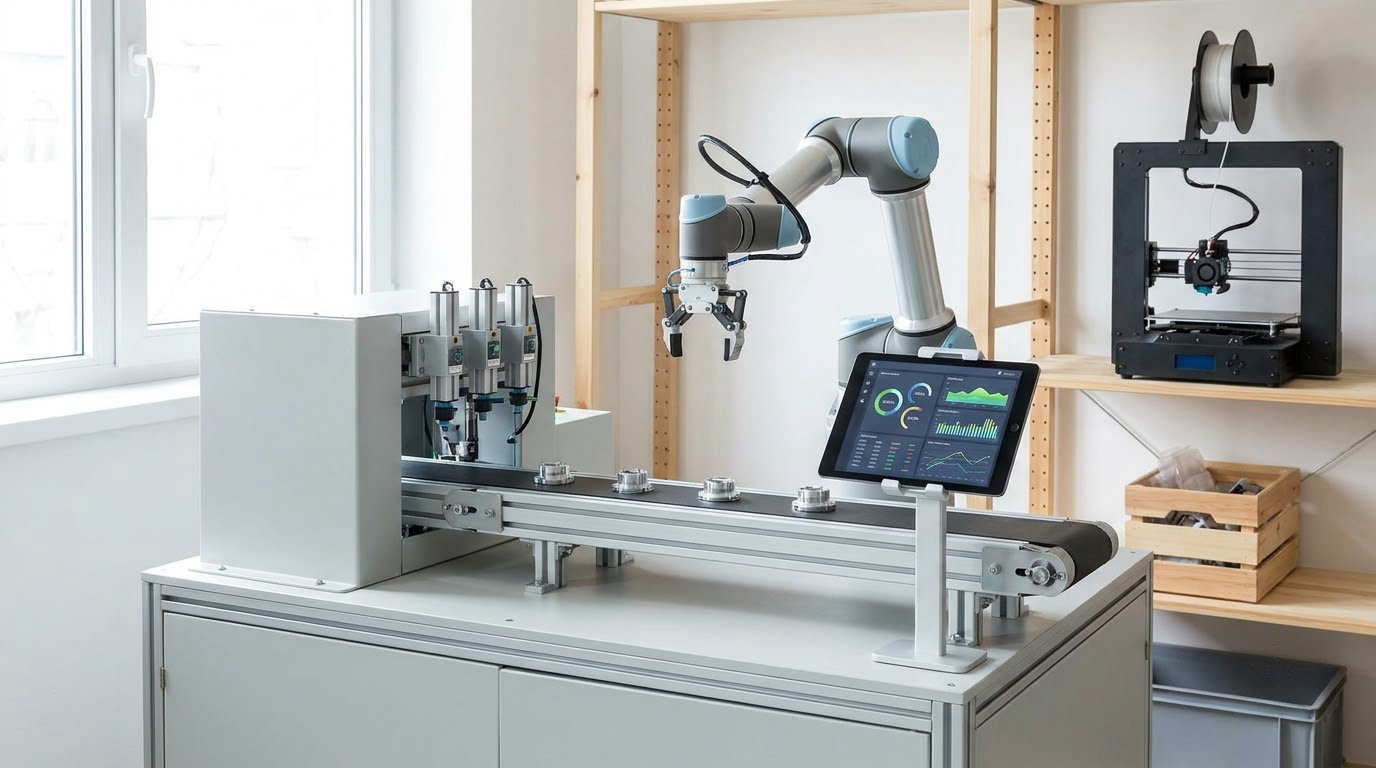
Industry 4.0 explained for small plants comes down to one idea: connecting machines, sensors and software so a plant can see what is happening in real time and act on it. Instead of guessing why a press ran slow last Tuesday, you have the cycle data. Instead of finding out a batch was out of spec after it shipped, you see the drift while the run is still going. For a shop with 20 to 150 people, that visibility is the whole game.
The term gets used loosely, usually by vendors selling something. Stripped back, Industry 4.0 is the fourth phase of industrial development, and the useful part for a small manufacturer is a short list of technologies you can adopt one at a time, each one paying for itself or being dropped.
This guide covers what the technologies are, what they cost you in effort, and the order that works best when you don’t have a corporate technology budget. Updated for 2026.
Table of Contents
- What Is Industry 4.0?
- How Industry 4.0 Differs from Earlier Manufacturing Models
- Why Industry 4.0 Matters for Small Plants
- Core Industry 4.0 Technologies for Small Manufacturers
- Sensors and the industrial internet of things
- Edge gateways and connectivity
- Cloud computing and data platforms
- Analytics and big data
- Artificial intelligence and machine learning
- Digital twins
- Robotics and collaborative robots
- Predictive maintenance
- Digital work instructions and traceability
- Cybersecurity for operational technology
- Where to Start: A Low-Risk Industry 4.0 Roadmap
- How to Choose Industry 4.0 Projects With the Best Payback
- Industry 4.0 for Small Plastics Manufacturing Plants
- Common Mistakes When Adopting Industry 4.0
- How to Build an Industry 4.0 Business Case
- Frequently Asked Questions
- Can you explain Industry 4.0 in a simple way?
- Do small manufacturers need Industry 4.0?
- How much does Industry 4.0 cost for a small plant?
- What should a small plant implement first?
- Does Industry 4.0 require replacing old equipment?
- Is Industry 4.0 the same as smart manufacturing, and is the term still current?
- Conclusion
What Is Industry 4.0?
Industry 4.0 is the use of connected sensors, software and data to run a plant more accurately in real time, so machines report their own condition, decisions get made from live information instead of memory, and downtime, quality and output become measurable instead of estimated.
That definition matters more than the label. The label came out of German government research in the 2010s, and the World Economic Forum later popularised the “fourth industrial revolution” framing to describe a wider shift toward cyber-physical systems, where physical processes and computing systems are designed together.
Here is what it is not. Industry 4.0 is not the same as robots, and buying a robot does not make a plant Industry 4.0. It is not a mandate to run a lights-out factory, and it does not require replacing the machine you bought in 1998. A plant running an injection molder with an air-line flow switch feeding a shared dashboard has Industry 4.0 in it. A plant full of collaborative robots with no data leaving the cell does not.
The honest version is that this is a gradual upgrade path, not a switch you flip. Most small plants get value from three capabilities: knowing what is happening, understanding why, and acting sooner. Everything else is a later step.
How Industry 4.0 Differs from Earlier Manufacturing Models
Each revolution changed what a factory’s core problem was. Mechanisation replaced muscle, mass production replaced craft sequencing, and computerisation replaced paper travellers. Industry 4.0 is the first phase where the plant’s own data starts driving decisions.
| Revolution | Core change | Key technologies | Era |
|---|---|---|---|
| Industry 1.0 | Mechanisation, water and steam power | Mechanical production, factory lines | Late 1700s to early 1800s |
| Industry 2.0 | Mass production and electricity | Assembly lines, production cells, electrical machinery | Late 1800s to 1930s |
| Industry 3.0 | Computerisation and control | PLCs, CNC, SCADA, industrial automation, MES software | 1950s to 2000s |
| Industry 4.0 | Connected, data-driven operations | IIoT sensors, analytics, digital twins, robotics, AI | 2010s onward |
Most small plants are not starting from zero. If you have CNC machines, a barcode system and an ERP package, you already hold most of Industry 3.0. Industry 4.0 is the layer that connects those assets and makes the data useful, so your existing equipment investment stops being a black box.
Industry 5.0 is the proposed next phase, and it puts people back at the centre: human-centred manufacturing, mass customisation, and machines that assist workers rather than replace them. Very little of it is deployed in production cells yet, so treat 5.0 as a design principle for how you introduce technology rather than a buying plan.
Why Industry 4.0 Matters for Small Plants
The business case is narrower than the marketing and much easier to defend. Small plants compete on responsiveness and cost per part, and both are limited by information that arrives late.
- Unplanned downtime. Trade coverage of Industry 4.0 frequently cites McKinsey benchmark ranges of 30 to 50 percent downtime reduction at plants that instrument their equipment. The gain comes from turning a breakdown into a scheduled fix.
- Throughput and labour productivity. The same research is commonly cited for 10 to 30 percent throughput gains and 15 to 30 percent labour productivity improvement, driven by better scheduling and fewer manual data entry steps.
- Quality. Process variables logged per part mean a drifting barrel temperature or a worn die shows up as a trend rather than as a customer complaint.
- Changeover and quoting speed. Real cycle times make it possible to quote accurately and to promise a delivery date you have evidence for.
- Supply chain coordination. Shared production data reduces the guesswork in lead times, buffer stock and expediting.
- Lower waste. Scrap, rework and energy per part all become line items on a dashboard instead of annual audit surprises.
Manufacturers report a more modest but very real benefit too: they can finally argue with a number instead of a story. One company cited in trade press saw a double-digit improvement in man-to-machine ratio after adding monitoring, machine tending and optical inspection. That is the shape of a win a small plant can repeat.
Core Industry 4.0 Technologies for Small Manufacturers
Industry 4.0 explained for small plants starts with a shorter technology list than most vendors will show you. These are the ones that have a practical application in a plant with mixed, older equipment.
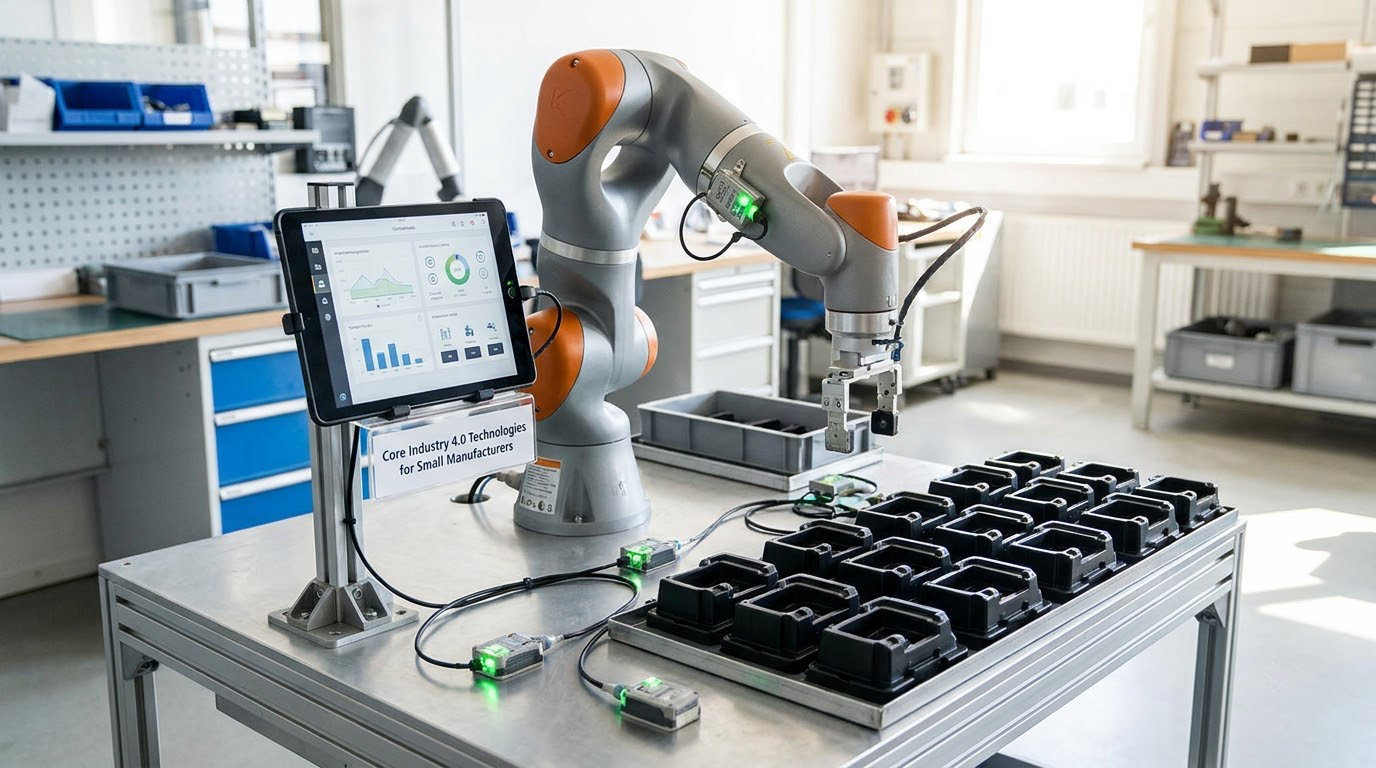
Sensors and the industrial internet of things
A sensor turns a physical condition into a number a system can read. Vibration, temperature, pressure, current draw, cycle counts. Mounted on an older machine, a handful of them can report run state, cycle time and stoppage reasons without touching the machine’s controls. This is the most common low-risk entry point, and machine monitoring on a small shop floor usually pays back inside a year.
Edge gateways and connectivity
A gateway is the translator between the plant floor and your software. Legacy machines rarely speak modern network protocols, so a gateway polls the controller over its existing serial or Ethernet port and republishes clean data using an open standard such as OPC-UA. This is the piece that makes retrofitting an old press or mill realistic instead of theoretical.
Cloud computing and data platforms
Storing production data off-site gives a small plant access to storage and processing it could not justify owning, and it makes data available to people in different buildings or different time zones. Some plants keep sensitive process data local and send summaries to the cloud, which is a sensible compromise when data security matters.
Analytics and big data
Analytics is where raw readings become a decision. Spreadsheet work like sorting a week of cycle times by shift and comparing against a scrap log is a perfectly good first version. The value is in repeating it consistently and noticing the pattern, not in owning a particular platform.
Artificial intelligence and machine learning
Machine learning on a plant floor usually means models that spot a deviation earlier than a human reviewing charts. Vibration signatures on a bearing, drift in a process variable, a slightly rising scrap rate by shift. The honest limit is that these models need clean, consistent historical data, and small plants often lack that until sensors have run for months.
Digital twins
A digital twin is a live simulation of a process, used to test a change before you make it on the real machine. A small plant can get a simplified version: a model of a moulding cycle used to trial cooling settings without scrapping material. Full physics-accurate twins are still expensive and largely out of reach below a certain plant size.
Robotics and collaborative robots
Cobots are designed to work next to people without a cage, which makes them viable for repetitive handling or inspection in a low-volume plant. They are also the most expensive step in this list, and the wrong first purchase for a shop that cannot yet measure where its cycle time goes.
Predictive maintenance
This is the outcome most plants are really buying: a warning before a failure instead of a repair after it. It depends on everything above it, since a model can only predict what the sensors actually measure. Start with one asset that has failed repeatedly and has the data to support it.
Digital work instructions and traceability
Running the current work instruction on a tablet at the machine, with the operator signing off each step, cuts setup errors and gives a record of who did what. Traceability is the same idea extended outward: which resin lot, which tool, which shift, which finished part. For plants serving medical, automotive or food customers, this is often the first requirement and the first win.
Cybersecurity for operational technology
Every sensor you add is a new thing exposed to a network. Small plants are a soft target precisely because nobody is watching. Network segmentation between the plant floor and the office network, strong passwords on every device, and a documented backup of machine control software go a long way without a large budget.
Where to Start: A Low-Risk Industry 4.0 Roadmap
Phased adoption beats a big-bang revamp, because each stage produces savings that help fund the next. The consensus in practitioner discussions is the same: start where data is already being produced and the decision is already being made badly.
Phase 1: Visibility
Instrument two or three machines, not the whole plant. Pick the asset that is the bottleneck, the one with the worst scrap, or the one that breaks most. Log cycle time, run state and stoppage reason, then put the data on a screen the shift lead actually looks at. Nothing changes about how the machine is controlled.
Phase 2: Connectivity
Once people trust the numbers, connect them to the rest of the business. Spreadsheets and paper travellers get replaced by system-generated records, and the ERP or scheduling tool starts reflecting what the floor is really doing. This is also where a quality or traceability module earns its keep, because the data already exists.
Phase 3: Intelligence
Only after phases one and two are steady does predictive maintenance, scheduling optimisation or AI-assisted process control make sense. At this point you have the historical data, the process knowledge and the people who know the process. Skipping ahead usually means buying software with nothing to analyse.
For the first 90 days, a workable plan looks like this: spend weeks one and two confirming a baseline by hand, so you know today’s cycle time and scrap rate rather than assuming them. In weeks three to five, install sensing on one or two machines and set up a shared dashboard. Weeks six to eight cover daily review habits, where the team looks at the data at shift handover and asks why a number moved. Weeks nine to twelve produce a written result, including what did not work, which becomes the business case for phase two.
On retrofitting older equipment: check whether the machine exposes any digital output at all before assuming it does. A gateway can usually handle machines with a serial port, dry contacts, or a cycle counter taken from a relay. A machine with no controller, or a controller nobody still has documentation for, may need a different approach such as an external vibration or current sensor that measures the load rather than reading the control system. In the United States, the Manufacturing Extension Partnership centres and NIST MEP offer free or low-cost technical advice on exactly these retrofits, and most local community colleges run short manufacturing technology courses.
How to Choose Industry 4.0 Projects With the Best Payback
The best first project is the one where a named person already makes a bad decision every week because the data does not exist. Ask the operators, engineers, quality manager and plant leadership separately what they cannot see right now, and where the answers agree.
Then rank candidate projects against measures the plant already reports: unplanned downtime hours, scrap and rework as a share of material, labour hours per unit, energy per unit, changeover time, and first-pass yield. If a project cannot be tied to one of these, it is a project to wait on.
One caution from SME discussions worth repeating: pilots stall when the measured win is only a modest improvement in something like inventory turns. Set the target metric before the pilot and agree what counts as a success, so a 30 percent cut in downtime on a bottleneck is visible rather than buried in a general improvement in morale.
Industry 4.0 for Small Plastics Manufacturing Plants
Plastics plants have a specific set of variables worth instrumenting, which makes them unusually good candidates for a focused first pilot.
- Injection moulding. Log cycle time, cavity pressure or hydraulic pressure trend, and barrel zone temperatures per run. Short shots and flash usually show up as a drift across a run, not as a single bad part.
- Extrusion. Monitor motor load, melt temperature and pressure together. Pull rate versus screw load is a leading indicator that die or screen changes are needed.
- Changeovers. Time each step from tool change to first good part. Small plants consistently find that the setup is longer than anyone remembers, and that fixing it beats adding capacity.
- Assembly and kitting. Digital work instructions and barcode confirmation of the right components reduce misbuilds and the rework that follows.
- Packaging and material handling. Weight verification and label scanning at pack-out catch label and lot errors that traceability requirements would otherwise catch in the field.
- Finished-part traceability. Linking resin lot, machine, mould, cavity and shift to the shipped part is one of the strongest business cases in a small plant, because it turns a customer audit from a scramble into a lookup.
Common Mistakes When Adopting Industry 4.0
Most failed projects share a handful of avoidable causes, and none of them are technology failures.
Buying before defining the problem. A solution chosen at a trade show or by a well-meaning vendor creates work without a target. Define the measurable outcome first and let vendors prove they can hit it.
Automating a process that is already broken. Making a chaotic process faster just produces scrap faster. Stabilise the process before instrumenting it, and use the data to find which step needs fixing.
Starting with robots. A cobot on a misaligned conveyor is a very expensive way to keep a problem. Start with visibility, and automate once the process is understood.
Big-bang rollouts. Attempting a full plant conversion at once puts every operator, every shift and every order on the line at the same time, and production grinds to a halt while people work out the new system.
Ignoring OT security. The cheapest fix is not to connect a plant network to the office network at all. Segmenting them costs little and removes most of the exposure.
Measuring technical outputs only. Uptime percentages and data counts are not results. The measure is scrap, cost per part, on-time delivery or downtime hours.
How to Build an Industry 4.0 Business Case
Ownership rarely rejects Industry 4.0 on principle. Projects get rejected because the numbers cannot be checked.
Build the case in this order. First, record the baseline by hand for two to four weeks: cycle time, downtime reasons, scrap rate, changeover minutes, energy per run. Handwritten counts of actual events beat a figure pulled from memory in a meeting. Second, list the full cost, not just the hardware, which includes installation, integration, training, production downtime during installation, subscription renewals, and the internal time your own people will spend. Third, estimate the savings from the baseline rather than from a supplier’s claim, and express them as hours or material per year.
Then calculate a simple payback: total cost divided by annual savings. Present it as a range, using a conservative and an optimistic case, and show what assumption each case depends on. If the pessimistic case still clears your threshold, the project is defensible.
Finally, write down what would make you stop. A pilot with a defined end date, a named owner and a written result is far easier to approve than an open-ended programme, and it produces the reference data that makes the next approval straightforward.
Frequently Asked Questions
Can you explain Industry 4.0 in a simple way?
Industry 4.0 means using connected sensors, software and data so machines report their own condition and decisions are made from live information. A temperature probe, a cycle counter and a shared screen are enough to start. You do not need a new plant, a new software platform or a robot to take part.
Do small manufacturers need Industry 4.0?
No small plant needs to implement the whole framework. What most need is a way to see what their machines and process are doing, because right now that knowledge lives in operators’ heads. A monitoring system on your bottleneck machine usually answers that, and the remaining phases can wait years.
How much does Industry 4.0 cost for a small plant?
Cost depends almost entirely on scope. Instrumenting two or three machines with sensors and a gateway plus a dashboard is a modest project, while a plant-wide manufacturing execution system or robotic cell is a capital decision. The realistic approach is to fund each phase from the savings the previous phase produced, rather than raising capital up front.
What should a small plant implement first?
Start with visibility on the asset that limits you most, such as the bottleneck machine or the one with the worst scrap rate. Log cycle time, run state and stoppage reason, review the output at shift handover, and keep it running for a quarter. The result becomes the baseline that every later project is measured against.
Does Industry 4.0 require replacing old equipment?
No. Most plants run a mix of old and new machines, and an edge gateway can read cycle counts and run state from existing controller ports using open standards such as OPC-UA. Where a machine has no usable output at all, an external sensor on vibration, temperature or current draw can still provide useful data.
Is Industry 4.0 the same as smart manufacturing, and is the term still current?
Smart manufacturing describes the goal of running a plant with live data, so in practice the two terms describe the same shift. The label is still widely used by researchers and government programmes, even though vendors have moved on to terms like digital manufacturing and the intelligent factory. The underlying capabilities have not changed.
Conclusion
Pick one measurable operational problem this week. Write down today’s numbers by hand, instrument the single machine or process behind it, and run the smallest pilot that can show a change within a quarter. That is Industry 4.0 explained for small plants in practice: a baseline, one sensor, one review habit, and a decision about the next phase based on evidence rather than a brochure.