
An NDA protects confidential information; a tooling ownership clause establishes title to the physical mold, die or fixture. NDA and tooling ownership in manufacturing contracts are two separate legal functions, and treating one as a substitute for the other is the most expensive mistake a buyer makes. This guide sets out which document each provision belongs in, when title actually moves, and what to check before anyone signs.
This is general guidance on how these documents are usually written, not legal advice. Rules on title, property and contract formation vary by state and country, so have counsel review terms for your situation.
Table of Contents
- NDA and Tooling Ownership: Quick Guide
- How Do NDAs and Manufacturing Contracts Work Together?
- What Information Should an NDA Cover?
- Who Should Own Injection Molding Tooling?
- Who Pays for Tooling and How Is Ownership Earned?
- When Does Title to the Tool Transfer?
- What Clauses Should Cover Tool Maintenance and Storage?
- How Do the Parties Handle Tool Changes and Revisions?
- What Happens When the Supply Relationship Ends?
- How Should Contracts Address NDA Exceptions and Duration?
- NDA and Tooling Ownership Checklist Before Signing
- Frequently Asked Questions
- Does paying for a mold mean the buyer owns it?
- Can one NDA protect both confidential information and tooling?
- Who owns changes made to a mold after launch?
- How long should tooling be kept after the contract ends?
- Does ownership of tooling include the CAD files and drawings?
- Can an NDA prevent a manufacturer from using general knowledge learned during production?
- Conclusion
NDA and Tooling Ownership: Quick Guide
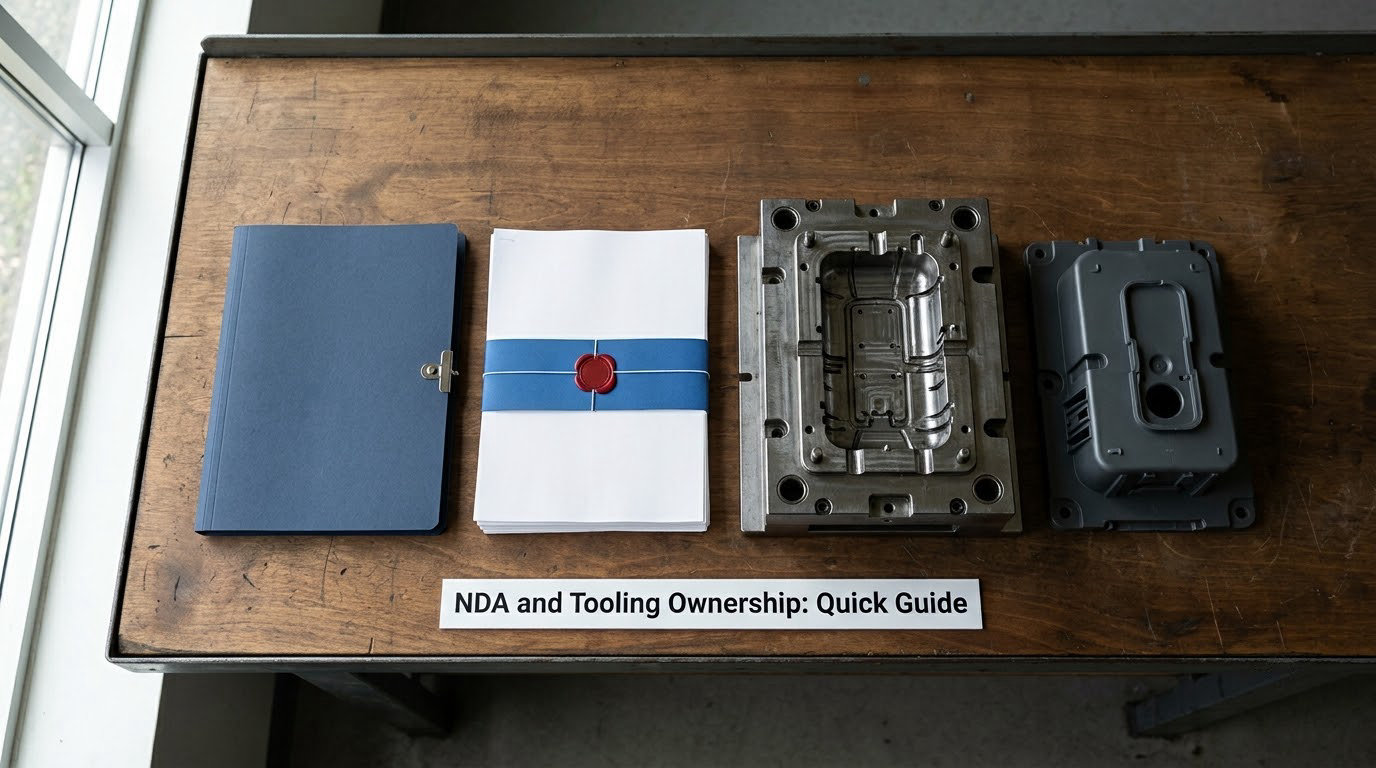
Each provision belongs in exactly one document, and the split is easy to get wrong. Confidentiality duties live in the NDA. Title to the mold, payment triggers, maintenance, insurance and retrieval rights live in the manufacturing agreement or a tooling addendum.
| Provision | What it covers | Where it belongs |
|---|---|---|
| Definition of confidential information | Drawings, CAD files, bills of material, recipes, pricing, quality data | NDA |
| Permitted use and disclosure limits | Purpose-based use, need-to-know representatives, return of materials | NDA |
| Exceptions and survival period | Public domain, prior known, independently developed, compelled disclosure | NDA |
| Ownership declaration | Title to the mold, dies, fixtures, jigs and gauges, named by asset number | Manufacturing agreement |
| Title transfer trigger | The event that moves title: deposit, T1 shot, acceptance or final payment | Manufacturing agreement or addendum |
| Non-use prohibition | Supplier may not run buyer-owned tooling for other customers | Manufacturing agreement |
| Storage, maintenance and life tracking | Inspection schedule, insert replacement, shot counts, records | Manufacturing agreement |
| Insurance and marking | Buyer named as loss payee, asset tag and engraving on the tool | Manufacturing agreement |
| Retrieval on exit | Deadline, condition, documentation, crating and freight, authorized collector | Manufacturing agreement |
| Insolvency carve-out | Tool treated as buyer property held in bailment, not supplier inventory | Manufacturing agreement |
If a row is missing from your contract, the practical answer is that the supplier keeps the tool.
Myths worth retiring before you sign
- False: paying for a mold in full makes it yours. Payment is evidence of intent, not a transfer of title. Title transfers when the contract says it does.
- False: a signed NDA protects the mold. An NDA protects information. Steel does not become secret because drawings are secret.
- False: a non-disclosure, non-use and non-circumvention agreement covers the tool. It covers the design and the deal. It says nothing about who owns the steel.
- True: a mold you paid for and cannot retrieve is the single most common dispute in outsourced manufacturing.
How Do NDAs and Manufacturing Contracts Work Together?
An NDA governs information. A manufacturing agreement governs goods, tooling, price, delivery and risk. They run on different clocks and protect different assets, so a well-drafted program uses both rather than one document trying to do two jobs.
The distinction matters because a mold is a physical asset, not confidential information. Ownership of a physical asset moves by title, by delivery and by the law of the place where the tool sits, not by keeping a secret.
The four documents buyers usually end up with
Non-disclosure agreement
A two-way or one-way promise about information: what counts as confidential, who may see it, for what purpose, and for how long after the relationship ends. It is a contract, enforceable as one.
Non-disclosure, non-use and non-circumvention agreement
Adds two promises on top of confidentiality. The recipient may not use your design to develop competing goods, and may not go around you to sell the finished product directly. Still an information-side document.
Manufacturing agreement
The commercial contract: specifications, pricing, lead times, quality, inspection, warranty, delivery, and everything about the physical tools, including who owns them and how they come back.
Tooling addendum or bill of sale
A short signed document that lists each tool by asset number and moves title on a stated date. Useful when the manufacturing agreement is long and the payment milestones live somewhere else.
Where NDA and tooling ownership in manufacturing contracts meet
They meet in exactly one place: the moment your drawings leave your control. Before that, you can protect a design by holding it. After you send CAD files, a process sheet or a first sample to a molder, an NDA is the only thing standing between that information and a competitor’s project. That is also why the order of signature matters, which is covered in the checklist later in this guide.
When one contract expires and the other keeps running
Set the NDA term independently of the supply term, and let the confidentiality duties survive expiry by a stated period. Many NDAs say confidentiality lasts for the term of the NDA itself, which quietly ends the protection on the day your supply agreement stops. Three to five years after last disclosure is a common starting point; product designs that never leave your building need nothing.
What Information Should an NDA Cover?
An NDA for manufacturing should cover the categories of information that actually reach a supplier, plus the exclusions that make it enforceable. A generic definition of “confidential information” invites an argument later.
Categories worth listing by name
- CAD files, 2D drawings, 3D models, tolerance callouts and print packages
- Bills of material, material selections and supplier lists
- Mold designs, cavity layouts, process sheets, cycle time and parameter data
- Recipes, formulations and process settings for anything food, cosmetic or chemical adjacent
- Quotations, unit pricing, volume forecasts and cost models
- Test results, quality records, audit findings and corrective actions
- Software, firmware, control code and any custom scripts running on the line
- Launch schedules, volumes and business plans
Exclusions that protect the agreement
Carve out information that is public through no fault of the recipient, already lawfully known before disclosure, independently developed without use of the confidential information, or lawfully received from a third party. Require the recipient to prove each exclusion with contemporaneous records. An NDA with no carve-outs is easier to sign and much harder to enforce.
Use, disclosure and return
Limit use to evaluating, quoting and producing the named parts. Restrict disclosure to employees and subcontractors who need it and who are bound by the same terms. Add return or certified destruction on request, and state plainly that ownership of the information itself never transfers. Keep a copy of everything you hand over, with a dated transmittal record.
Who Should Own Injection Molding Tooling?
The buyer should own production tooling whenever the buyer funds it and intends to move production later. Supplier-owned tooling only makes sense when the supplier built it as part of a broader commercial arrangement and the parts can be made elsewhere without it.
Customer-funded tooling
You pay for the mold, you own it from the moment the contract says so. This is the normal structure for custom parts, and it is what gives you the ability to dual-source or leave. Expect some suppliers to negotiate for a longer build period before they accept it, which is reasonable.
Supplier-funded or amortized tooling
The supplier builds the tool and recoups its cost through the part price over a stated volume, usually twelve to thirty-six months of production. This suits a supplier who wants a committed run and a buyer who is still validating demand. Read the amortized portion carefully: it should stop when the agreed volume is reached, and the ownership position at that point should already be written down. How bridge tooling works for low volume production is worth reading if your volumes are still uncertain.
Shared or joint ownership
Works when both parties have genuinely funded the tool and both need it. It needs a written split: who may use it, who pays for a second cavity, who may license it, and what happens when one party exits. Joint ownership without those rules is just a dispute waiting for a trigger.
How the supply model changes the default
Under an OEM arrangement the buyer supplies the design and funds the tool, so buyer ownership is the sensible default. Under an ODM arrangement the supplier owns the base mold and charges a modification fee to run your version, which is a legitimate model and needs a written license to use your parts on it. Under pure contract manufacturing the tool follows who paid for it, which is exactly why the contract has to say so.
Who Pays for Tooling and How Is Ownership Earned?
Tooling is almost always quoted and paid separately from parts, and the payment milestones are what determine when ownership moves. Getting the tooling quote on its own line is the first step.
A typical structure: a tooling quotation naming the mold number, cavity count, steel and estimated life; a deposit at order; progress payments at design freeze, steel cutting and T1 shot; acceptance after first article inspection; a final payment at acceptance; and a separate production price per piece.
Two habits cause most of the trouble. First, deposit paid before the ownership terms are signed. Second, a tooling fee buried inside the piece price with no asset identified, so nobody can tell which steel belongs to whom. How to calculate injection molding tooling cost breaks down the line items that should appear in that quote.
Decide deliberately whether ownership arrives at signing, at deposit, at T1 acceptance or at final payment. Whichever you pick, write the asset number next to the trigger so the transfer identifies a specific tool rather than “the mold described herein”.
When Does Title to the Tool Transfer?
Title transfers on the date your contract specifies. Without a specified event, courts and suppliers tend to read silence against the buyer.
Three things get confused here and need three separate sentences in the contract. Title is legal ownership. Possession is where the tool physically sits, which is almost always the supplier’s plant. Risk of loss shifts independently, typically when the tool is delivered to a carrier for shipment or when parts ship to you.
Common trigger events: on execution, on payment of the deposit, on acceptance of the T1 shot, on final payment, or on delivery to the buyer’s nominated carrier. Whichever one you choose, avoid a formulation where title transfers on final payment but the buyer has no way to verify final payment was made.
Under UCC Article 2 in the United States, shipment of goods can pass title by agreement regardless of payment, which is one more reason the trigger should be explicit rather than assumed.
Ownership of the tool is also separate from ownership of the parts it makes, the drawings that define it, and any software embedded in the controls. Those need their own clauses. A transfer-of-title clause covering “all tooling and related materials” can quietly sweep in the CAD files, so exclude design data explicitly if you intend to keep ownership of it.
What Clauses Should Cover Tool Maintenance and Storage?
The maintenance clause decides who pays for wear, and wear is the cheapest dispute to avoid. Define routine care, inspection intervals, life tracking and who pays for inserts and repairs.
- Inspection cadence. A named interval, with a record the buyer can request, such as a quarterly tool condition report.
- Life tracking. Shot counts or cycle counts against an estimated mold life agreed when the tool was quoted, so end-of-life is a number rather than an argument.
- Consumable inserts. Name them and say who buys and owns them. Replaceable inserts are the most common surprise repair charge.
- Normal wear versus damage. The supplier pays for damage caused by poor practice; the buyer pays for normal wear, and the contract should say which side each lands on.
- Storage conditions. Climate control, off the floor, separated from the supplier’s own tooling, and not lent out or moved without written consent.
- Refurbishment and modification. Who approves, who pays, and whether a refurbishment extends the agreed life.
Inspection records overlap with the dimensional data you already specify for the parts. GD&T basics for plastic parts explains how drawings and measured features connect to the tool’s condition.
Insurance belongs here too. Require the supplier to name you as loss payee on the tooling policy, and ask for a certificate once a year. It costs nothing to ask and it tells you whether anyone is thinking about the tool.
How Do the Parties Handle Tool Changes and Revisions?
Tool changes need a process, because a change made under pressure is how uncontrolled spend starts. Require a written engineering change notice with a revised estimate and a revised delivery date before any work begins.
Decide four things in advance: who absorbs the cost of a change caused by a supplier error, who pays for changes caused by a design revision, whether the buyer may direct small changes under a spending threshold, and how much downtime the change causes in production.
Keep revisions connected to the asset record. If a revision adds a cavity, a core or a slide, the tool that emerges is a different asset from the one described in the original schedule, so issue an updated schedule showing the current configuration and any parts that have become obsolete.
One line is worth adding explicitly: design updates made after launch remain subject to the confidentiality terms and do not become supplier property merely because they were made on supplier equipment.
What Happens When the Supply Relationship Ends?
Exit is where good intentions fail, because the agreement is usually silent at the exact moment you need it. Write the retrieval procedure before you ever want to use it.
Set a deadline from written request, commonly around thirty days, and add a remedy for delay. State who pays crating and freight, whether the supplier may charge storage fees and at what rate, and what condition the tool must be in at pickup. Photographs at handover help, as does a signed transfer receipt naming the asset.
Give the buyer the right to nominate an authorized representative to collect the tool, and require the supplier to release it without asserting any lien, offset or retention right against disputed invoices. That last sentence prevents a small billing dispute from holding a mold hostage.
Decide what happens to tools you do not want back: a buy-sell option at a stated formula, continued storage on the supplier’s books, or deactivation and disposal with written confirmation. If you might reuse a tool, ask about access to a duplicate, since building a second cavity is often cheaper and faster than shipping steel across an ocean.
How Should Contracts Address NDA Exceptions and Duration?

Exceptions decide whether the NDA holds up, and duration decides whether it still matters after the program ends. Write four exceptions and one survival period.
Public domain. Information that becomes public without breach. Prior known. Already lawfully in the recipient’s possession, evidenced by dated records. Independently developed. Built without reference to the confidential information, which needs design notebooks and code history to support. Compelled disclosure. Required by a court or regulator, with notice to you where lawful so you can seek protective treatment.
For duration, set the agreement term and separately set the confidentiality survival period running from the date of last disclosure, not from the signing date. Add a return-or-destroy obligation on request, with an option to retain one archival copy held under the same restrictions.
Be careful with residual knowledge clauses. A broadly drafted residuals provision can hand back the operating knowledge you actually care about, so either exclude tooling process knowledge and design intent or specify what may be retained.
Finally, include remedies. Injunctive relief for breach of confidentiality is standard and shows a court that damages alone would not make you whole. Confidentiality duties that you never enforce are the fastest way to lose them.
NDA and Tooling Ownership Checklist Before Signing
Run this list before the tooling deposit goes out, not after the first dispute. Almost every item here takes minutes to confirm when the steel is still being ordered, and months to fix once it is running.
Identify the assets
- Every mold, die, fixture, jig and gauge listed by asset number, not described vaguely
- CAD files, drawings and software listed separately with their own ownership terms
- Cavity count, estimated life and consumable inserts noted per tool
Set the value events
- Tooling quoted separately from piece price, with steel and cavity count shown
- Payment milestones written down, with a stated ownership trigger attached to one of them
- Title, possession and risk of loss each defined separately
Protect the tool in practice
- Asset tag or engraving applied with your name and tool number
- Storage separated from the supplier’s own inventory and not moved without consent
- You named as loss payee, with an annual certificate
- Inspection and shot-count records you can request at any time
- Express prohibition on running the tool for other customers
- Insolvency clause treating the tool as your property held in bailment
Protect the information
- Definition of confidential information tailored to manufacturing, not boilerplate
- Four exclusions written, with a burden of proof on the recipient
- Purpose-limited use, need-to-know disclosure, return on request
- Survival period counted from last disclosure, not from signing
Plan the exit and the argument
- Retrieval deadline, condition, documentation, crating and freight responsibility
- Authorized collector named; no lien or offset permitted to delay release
- Governing law, venue or arbitration forum, and notice addresses
- Termination assistance: last time buy, quantities, records and part pricing after exit
Frequently Asked Questions
Does paying for a mold mean the buyer owns it?
Not automatically. Payment in full is evidence of intent, not a transfer of title. Title passes when the contract says it passes, and most agreements tie that moment to a written event such as acceptance of the first shot or final payment. If the contract is silent, the supplier will usually argue it kept ownership. Write the trigger and name the tool by asset number.
Can one NDA protect both confidential information and tooling?
It can mention tooling, but it cannot do the job. An NDA restricts what a party may learn, disclose or use. Ownership of a steel mold is transferred by title, which is a different legal mechanism and needs its own clause in the manufacturing agreement or a tooling addendum. Treat them as two documents in one package, signed together.
Who owns changes made to a mold after launch?
Usually the tool’s existing owner, including revisions, new cavities, cores and slides funded during the program. The clause that matters is a written engineering change process requiring notice, a revised estimate and approval before work starts. Add language that design updates remain subject to confidentiality and do not become supplier property because the work happened on their equipment.
How long should tooling be kept after the contract ends?
Pick a defined period, such as ninety days from written request, rather than leaving it open. During that window the supplier stores, maintains and preserves the tool, and may charge storage at a stated rate. Buyers switching suppliers are usually advised to recover tooling before announcing exit intent, since ownership is the most common point of contention.
Does ownership of tooling include the CAD files and drawings?
Only if the contract says so. A broad clause covering tooling and related materials can sweep in design data, so list CAD files, drawings and software separately with their own ownership and license terms. The buyer usually wants the design to stay with the buyer, plus the right to have a fresh model built for a second source.
Can an NDA prevent a manufacturer from using general knowledge learned during production?
No. An NDA covers specific confidential information, not the skills and general know-how a plant gains from running parts. What it can do is bar use of your drawings, parameters and designs for any purpose beyond the named parts. If process know-how matters, address it separately with an explicit non-use provision rather than relying on confidentiality alone.
Conclusion
Start by inventorying what you actually have: a list of the confidential information you send, and a list of the physical tools you fund. NDA and tooling ownership in manufacturing contracts are two lists, and once they are written down separately the drafting gets much easier.
Then document every transfer event, from the tooling deposit to acceptance to the exit deadline, and put the NDA in place before any CAD file leaves your building. Get the ownership language agreed before the steel is ordered, not after.