
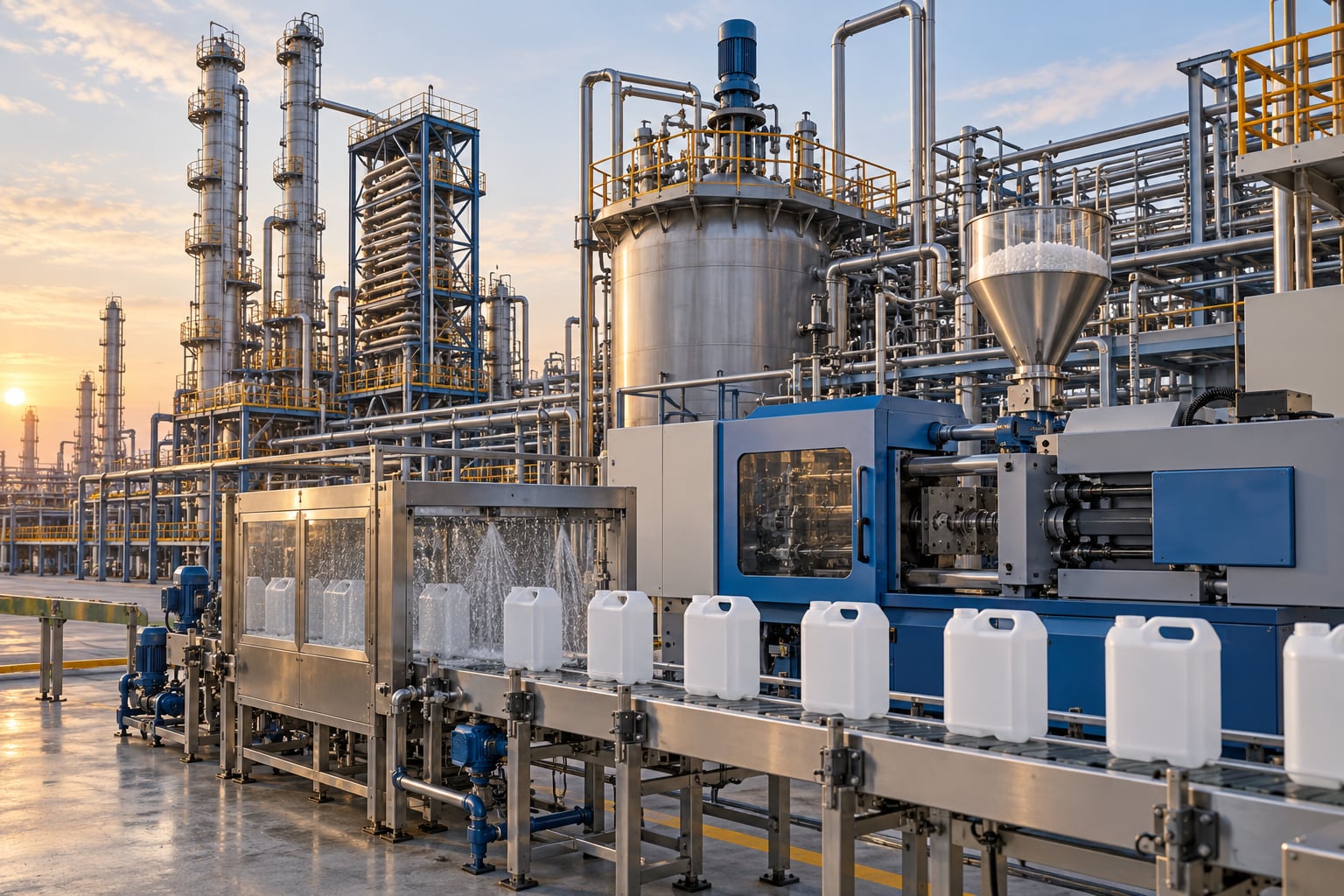
Here is how plastic is made from oil step by step: crude oil or natural gas liquids are refined and steam-cracked into small hydrocarbon molecules such as ethylene and propylene, those molecules are joined into long polymer chains, and the chains are blended with additives and pelletised into a resin that a moulding shop then shapes under heat and pressure. Most of what people picture as a plastic bottle or crate comes out of that chain.
The part people usually get wrong is the middle. Plastic is not a leftover stream from making fuel, and the finished product is not pure polymer. It is a deliberately produced engineering material, and understanding each stage makes resin codes, recycling streams and part performance much easier to reason about.
Table of Contents
- What Does It Mean to Make Plastic from Oil?
- The Main Plastic Manufacturing Stages at a Glance
- How Plastic Is Made from Oil Step by Step
- 1. Extracting Crude Oil and Natural Gas Liquids
- 2. How the Oil Is Refined and Cracked into Monomers
- 3. Producing and Purifying the Monomer Feedstocks
- 4. Polymerizing Monomers into Plastic Resin
- 5. Compounding Resin with Additives
- 6. Shaping the Plastic into a Product
- 7. Cooling, Finishing, and Converting the Part
- 8. Inspecting and Testing the Finished Plastic
- Which Plastic Resin Is Made from Which Feedstock?
- What Is the Role of Oil in Plastic Manufacturing?
- How Much Energy and Material Is Used?
- Frequently Asked Questions
- Conclusion: Start with the Resin and Its End Use
What Does It Mean to Make Plastic from Oil?
Making plastic from oil means converting a naturally occurring mixture of hydrocarbons into long-chain molecules that can be melted and shaped. Crude oil is a bundle of molecules ranging from light gases to heavy residues, and none of them is plastic. The plant has to sort, break and rebuild them.
Three transformations do the real work. Fractional distillation separates useful fractions from the crude. Steam cracking chops large molecules into small, reactive ones. Polymerisation then links those small molecules into chains long enough to have useful strength and melt flow.
Oil is not the only feedstock. Natural gas liquids — mostly ethane and propane — can be cracked directly, and some regions do exactly that, which is why plenty of US polyethylene never touches a barrel of crude. Coal-to-chemicals routes exist too, and a small share of polymer comes from recycled material or bio-based feedstocks.
One correction worth making early: plastic is not a free byproduct of gasoline refining. Naphtha crackers run because someone wants ethylene, not because the fraction was unwanted. Those crackers can be shut down and ethylene production stops, which is the opposite of a leftover.
The Main Plastic Manufacturing Stages at a Glance
| Stage | What happens | Main input | Output |
|---|---|---|---|
| Feedstock extraction | Hydrocarbons are recovered and moved to a refinery or cracker complex | Crude oil, natural gas liquids | Crude, ethane, propane |
| Refining and cracking | Distillation separates fractions; steam cracking breaks them into small molecules | Naphtha, ethane, propane | Ethylene, propylene, aromatics |
| Monomer production | Olefins and aromatics are purified and routed to reactors | Cracked gases and liquids | Reactor-grade monomers |
| Polymerisation | Monomers link into long chains under heat, pressure and catalyst | Monomers, catalyst | Molten polymer |
| Compounding | Additives, colour and reinforcement are mixed into the base resin | Polymer, masterbatch, fillers | Specification-grade resin |
| Pelletising | Extruded strands are cooled and chopped | Molten compound | Resin pellets |
| Shaping | Pellets are melted and formed in a mould, die or parison | Pellets, heat, pressure | Part in production geometry |
| Finishing | Cooling, gate removal, trimming, printing, assembly | Warm part | Finished component |
| Inspection | Dimensional, visual, mechanical and barrier checks | Finished part | Accepted or quarantined lot |
| Distribution | Parts are packed and shipped to assembly or distribution | Accepted parts | Product on the shelf |
How Plastic Is Made from Oil Step by Step
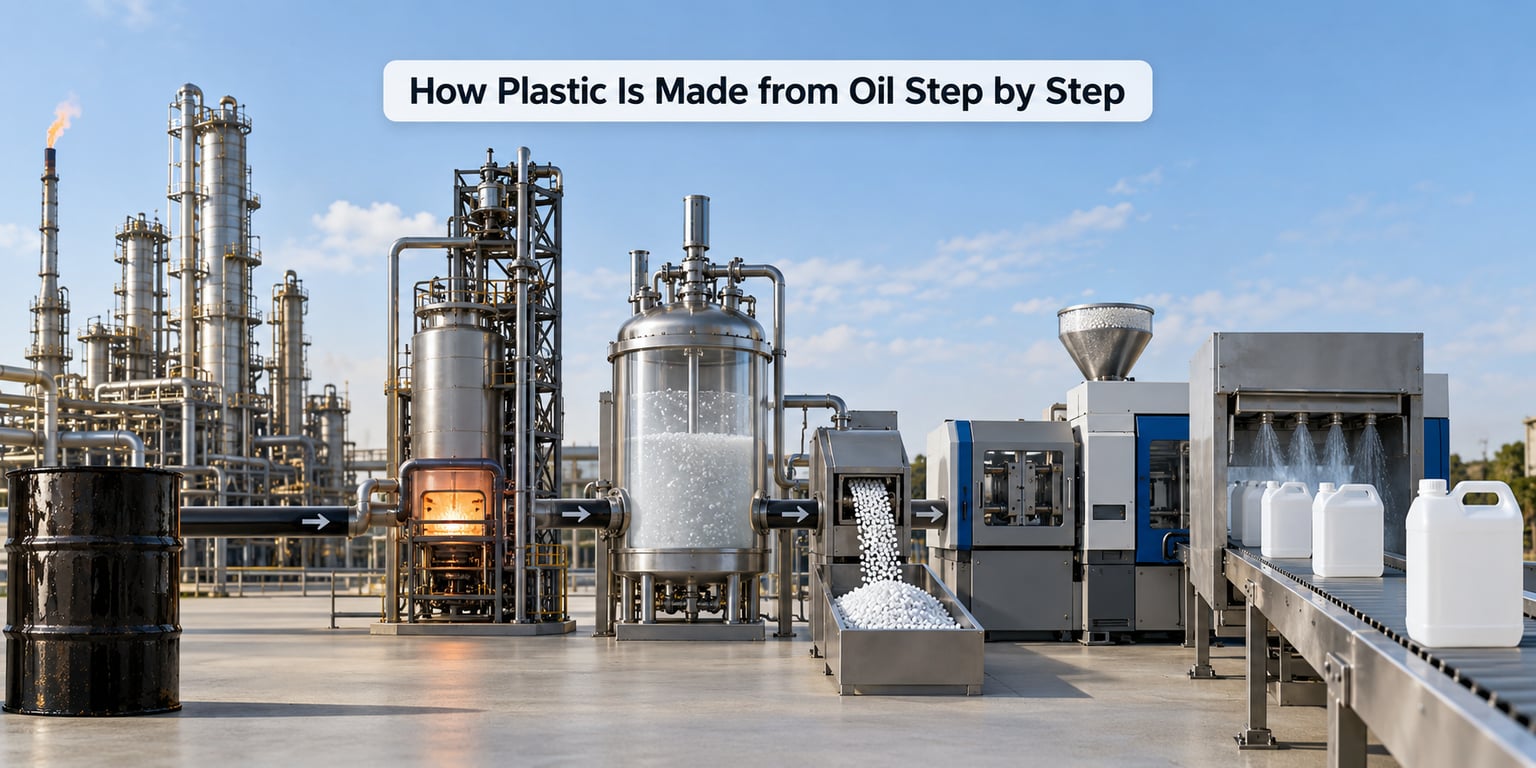
1. Extracting Crude Oil and Natural Gas Liquids
Everything starts with getting hydrocarbons out of the ground or off a gas stream. Crude comes up through wells and moves by pipeline, tanker or rail to a refinery. Associated gas from the same field is separated into natural gas liquids such as ethane, propane and butane.
Ethane and propane are worth singling out. Because ethane molecules are small and already close to ethylene, a cracker fed with them needs less energy and yields a very high proportion of ethylene. That is the reason many Gulf Coast crackers run on gas liquids rather than liquid feedstocks.
The material arriving at a refinery or cracker is not uniform, and process plants handle that variability by running continuous distillation rather than batch reactions. Composition matters all the way down to the final pellet grade.
2. How the Oil Is Refined and Cracked into Monomers
A crude distillation tower heats the crude and separates it by boiling point into fractions: naphtha, kerosene, gas oil, residue. The petrochemical interest concentrates in the lightest fractions, because those hold the small molecules needed for plastics.
Steam cracking is the step that most people cannot picture. Liquid feed is vaporised, mixed with superheated steam and pushed through a coil of very hot metal tubing — roughly 800 to 900 degrees Celsius — for a fraction of a second. Large molecules fall apart. Long chains become short, and short chains become unsaturated molecules such as ethylene, propylene and butylene. A large share of the feed ends up as fuel gas instead, which is why crackers are usually built next to a refinery that can use it.
Fluid catalytic cracking performs a similar job on heavier liquid fractions, using a zeolite catalyst to make gasoline-range olefins. Catalytic reforming runs alongside it, rearranging naphtha into aromatics such as benzene, toluene and xylene, the building blocks for styrene and PET.
Nothing about this is refining-for-fuel’s-leftovers. The crackers exist to make these molecules on purpose.
3. Producing and Purifying the Monomer Feedstocks
Cracked output is a mixed stream, so it goes through separation and purification before any polymer reactor sees it. Gases are scrubbed, dried and compressed; liquids are fractionated again. Polymer-grade ethylene needs to be extremely clean, because impurities like oxygen, water or acetylene interfere with the catalyst and end up as gels or chain defects in the finished resin.
Other routes run in parallel. Chlorine from the chlor-alkali cell combines with ethylene to give vinyl chloride, the monomer for PVC. Benzene plus propylene gives cumene and then phenol and acetone for some thermosets. Para-xylene comes out of the aromatics stream and pairs with ethylene and glycol to build PET.
This is also where a plant decides whether it is making a commodity chemical or a specialty one. The same cracker can feed several downstream units, and each one values the monomers differently.
4. Polymerizing Monomers into Plastic Resin
Polymerisation is where small molecules become plastic. The monomer molecules link end to end, sometimes thousands of times, forming chains whose length and branching set the resin grade. For PE and PP, that joining is an addition polymerisation: nothing is expelled, the chain simply grows.
Condensation polymerisation works differently. PET and polycarbonate release a small molecule — water or HCl — as the chain forms, so the chemistry has to remove it continuously or the molecular weight never climbs. Chain length matters enormously downstream, because chain length drives melt strength, toughness and how fast the material flows in a mould.
Reactor designs vary. Tubular reactors with high-pressure recycle loops suit polyethylene; slurry, gas-phase and loop reactors cover polypropylene and their many grades. Coconstellated plants may run several lines side by side on the same cracker feed.
A related distinction matters for recycling. A thermoplastic softens when reheated and can be remelted; a thermoset cures once into a crosslinked network and will not flow again. That single structural fact explains most of the sorting rules you see at recycling facilities.
5. Compounding Resin with Additives
Base polymer from a reactor is rarely a usable material on its own. Compounding mixes it with the additives that decide how it behaves, how long it lasts and what it looks like.
- Stabilisers — antioxidants and UV stabilisers slow oxidative breakdown, which is what stops a part from becoming brittle in sunlight.
- Impact modifiers — rubbery phases that absorb a hit and prevent cracking, especially in packaging.
- Plasticisers — flexible PVC is roughly one third plasticiser by mass; without it the material is rigid and brittle.
- Pigments and masterbatch — colour concentrates, dosed at small percentages and back-mixed for even dispersion.
- Fillers and reinforcement — glass fibre, talc, calcium carbonate and mineral filler can make up roughly half of a product’s mass and cut cost per part dramatically.
- Lubricants, compatibilisers and flame retardants — processing aids for the mould and performance additions for the service.
So when a moulder quotes a material, they are quoting a compounded specification, not a pure polymer. If a part has to handle a chemical at temperature, our guide on how to select a plastic for chemical resistance walks through matching that chemistry to the right base resin.
After mixing, the compound is extruded as strands, cooled in water and chopped into pellets. Those pellets are the currency of the trade — the material a moulder buys by the bag or the tonne.
6. Shaping the Plastic into a Product
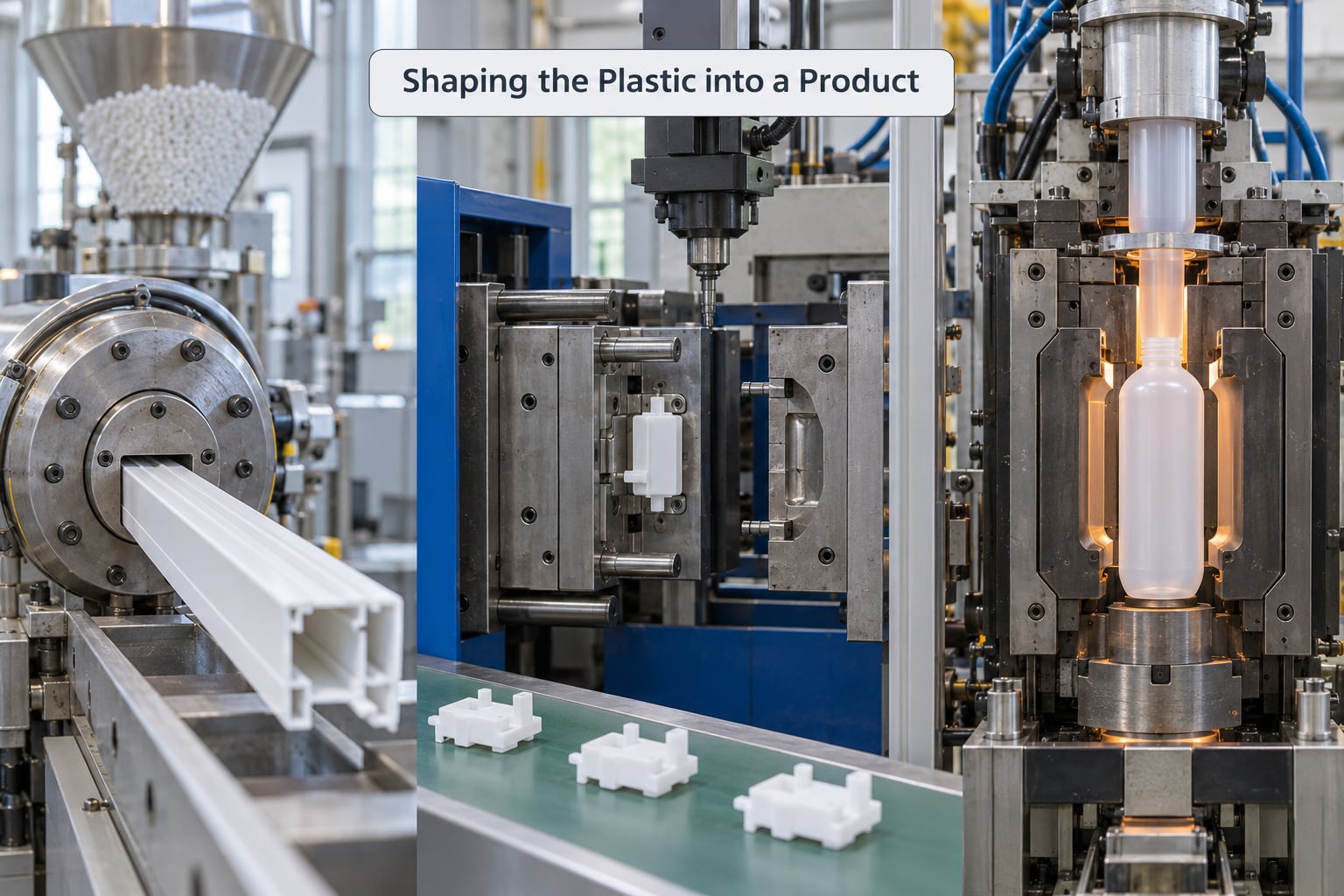
Shaping is where the resin stops being raw material. The route depends on geometry, volume and cycle time.
Injection moulding is the workhorse for complex, hollow parts. Pellets go down the throat, a screw melts and doses them, and a screw ramp forces a shot through the runner into a steel tool. Clamps hold the tool shut, the part cools, ejectors push it out, and the cycle restarts. Short cycles and repeatability are why this route dominates housings, caps and containers.
Extrusion melts the resin continuously and pushes it through a die, producing a profile of constant cross-section: pipe, tube, window frames, sheet or film. Adding a second die downstream turns that into blown film for bags.
Blow moulding makes hollow containers. A preform is heated, a parison is stretched into a two-part mould, and compressed air inflates it into shape. Bottle production runs in the thousands per hour.
Thermoforming heats a sheet until soft and presses it into a mould, then trims it — the approach behind trays and clamshell packaging. Fibre processing pulls molten resin through spinnerets into filaments that get bundled into yarn, carpet or chopped strand for reinforcement.
Rotational moulding, compression moulding and reaction injection moulding cover the corners: very large hollow parts, thermoset components and thin-walled parts with long fibres.
7. Cooling, Finishing, and Converting the Part
The part leaves the tool warm and dimensionally unstable, then finishes cooling and crystallising as it sits on the conveyor. The gate and runner are cut off and that scrap goes straight back into the grinder, so the material is reprocessed rather than binned.
Finishing covers printing, labelling, painting, ultrasonic or hot-plate welding, insert moulding and assembly. On a line making film or sheet, converting means slitting, corona treatment, winding onto reels or cutting to size.
Cooling time is a genuine constraint, not a formality. In thick sections the core holds heat long enough that the part can come out dimensionally out of spec, which is why cooling channels and cycle-time planning get so much attention on a moulding cell.
8. Inspecting and Testing the Finished Plastic
Inspection confirms the part matches its drawing and its material specification. Common checks:
- Dimensional — gauge pins, optical measurement and CMM readings on critical features.
- Visual — flash, sink marks, weld lines, voids, scratches and colour.
- Mechanical — tensile, flexural and impact testing on coupons or critical assemblies.
- Barrier and aging — permeation for packaging, and accelerated weathering or thermal cycling.
- Process — melt flow index and density checked against the incoming resin certificate.
Our piece on plastic part tolerance standards explained covers how tight those dimensions need to be, and how to test plastic parts for impact resistance covers the drop and instrumented tests. A failure traced back to the wrong resin grade is common, so good teams check material certificate against part performance rather than treating failures as isolated.
Which Plastic Resin Is Made from Which Feedstock?
| Resin | Resin code | Monomer and route | Typical properties | Typical products |
|---|---|---|---|---|
| PET | 1 | Para-xylene plus ethylene and glycol; condensation polymerisation | Clear, tough, good barrier, fibre-forming | Beverage bottles, trays, polyester fibre |
| HDPE | 2 | Ethylene from ethane or naphtha cracking; addition polymerisation, little branching | Stiff, dense, chemically resistant, strong | Milk jugs, drums, pipe, bottles |
| PVC (unplasticised / rigid) | 3 | Vinyl chloride from ethylene plus chlorine; addition polymerisation | Rigid and strong, or flexible when plasticised | Pipe and profiles, cable, window frames, cladding |
| LDPE | 4 | Ethylene; branched chains, addition polymerisation | Flexible, clear, good sealing | Stretch film, bags, liners |
| PP | 5 | Propylene from naphtha or propane cracking; addition polymerisation | Rigid, fatigue resistant, heat tolerant, low creep when reinforced | Housings, caps, crates, automotive parts, fibre |
| PS | 6 | Styrene from benzene; addition polymerisation | Rigid, clear, low cost, brittle unless modified | Packaging, cups, insulation, moulded parts |
| ABS and other engineering thermoplastics (PA, PC, POM, PBT) | 7 | Multiple: acrylonitrile, butadiene, styrene; nylon from caprolactam; PC from bisphenol A and phosgene | High stiffness, impact strength, dimensional stability, temperature range | Automotive and electronics housings, gears, medical and engineering parts |
| PLA and other bioplastics | Not assigned | Lactic acid or starch from renewable feedstock | Biodegradable under industrial composting conditions | Compostable liners, coated packaging |
Codes are regional and worth checking before you sort a bin. In North America the common set is 1 for PET, 2 for HDPE, 3 for PVC, 4 for LDPE, 5 for PP, 6 for PS and 7 for everything else, and a 2 on a bottle is usually HDPE rather than any polyethylene. In Europe the same polymers usually carry 1, 2, 3, 4, 5, 6 and 7 as well, but LDPE and LLDPE are often marked 4 alongside 2, and a number on a part is a family hint, not a full specification. PLA and most other bioplastics have no universal code, which is exactly why they end up in a separate specialist stream.
What Is the Role of Oil in Plastic Manufacturing?
Oil’s role ends at the monomer. It supplies the carbon and hydrogen that become ethylene and propylene, but the plastic molecule itself is assembled in a polymerisation reactor, not in a refinery. Once the monomer exists, the origin of its carbon matters much less than its purity.
That also explains why plastic is cheaper than people expect. Crude is a commodity priced by the barrel and sold in huge volumes, and only a fraction of a barrel’s energy content ends up in the polymer. Most of the oil’s mass ends up as fuel. Add the rest of the cost — cracking, polymerisation, compounding, energy, conversion, finishing — and resin per kilogram is a modest part of a finished part’s cost.
Alternatives exist on paper and are narrower in practice. Coal-to-olefins works where coal is cheap. Bio-based polymers from starch, sugar cane or vegetable oil compete in thin films and coated packaging, where compostability is worth paying for, but they rarely match a commodity polyolefin on price or on processing rate. Recycled resin has grown a lot, and it competes well in non-critical applications; its limitation is that each pass through heat slightly reduces molecular weight.
How Much Energy and Material Is Used?
Most of the energy goes into heat. Distillation needs sustained heat to separate fractions, steam cracking runs at roughly 800–900 degrees Celsius to break the feed apart, and polymerisation reactors hold the melt at temperatures set by the polymer. Each stage adds to the previous one, so refining and cracking together dominate the thermal load of the whole chain.
Material loss happens at several points. Steam cracking converts a large share of its feed into fuel gas rather than monomers. Purification removes impurities. Condensation polymerisation expels water or HCl. In moulding, the gate, runner and any rejected parts are ground and fed back, so the material loops around.
That last point is where the material picture changes most. A household product is not 100% polymer — glass fibre, mineral filler, plasticiser, pigment and stabilisers often account for a large share of its mass, which is one reason the fossil carbon in a given part is lower than its total weight suggests.
Frequently Asked Questions
How is plastic produced from oil?
Crude oil is distilled to recover naphtha, or natural gas liquids such as ethane and propane are used directly. That feedstock is steam-cracked at high temperature to break large hydrocarbons into small molecules like ethylene and propylene. Those monomers are purified, then polymerised into long chains, compounded with additives and pelletised. A moulder then melts the pellets and shapes the part by injection, extrusion or blow moulding.
Is plastic a byproduct of refining oil for fuel?
Not really. Naphtha crackers and gas crackers are run deliberately to produce ethylene and propylene. If the cracker shuts down, monomer production stops immediately. Treating plastic feedstocks as free leftovers gets the logic backwards: plants are designed around producing these molecules on purpose, and they are the highest-value products coming out of a barrel of crude.
Why is plastic cheap if it is made from oil?
Because oil is only one line in a long cost chain, and only part of it reaches the polymer. A barrel of crude yields many different products, and the fraction used for plastics is a portion of that. Refining, steam cracking, polymerisation, compounding and shaping each add cost, and per kilogram the resin itself is a modest share of what a finished moulded part costs to produce.
Is it true that 99% of plastic is made from fossil fuels?
Roughly right for conventional production worldwide. The overwhelming majority of plastic is made from oil, gas or coal-derived feedstocks. The exceptions are bio-based and compostable polymers made from starch, sugar or lactic acid, plus recycled material, which together remain a small share of total output. The figure varies by year and by how recycled feedstock is counted.
Can plastic be made without oil?
Yes, in limited volumes and mainly for specific applications. Bio-based plastics from starch, sugar cane, corn or vegetable oil work for compostable liners, coatings and some packaging. Coal-to-chemicals routes exist where coal is cheap. Recycled resin is another route, though each reprocessing pass slightly shortens polymer chains. None of these replace polyolefins at commodity scale on price or processing rate.
How bad is pyrolysis for the environment?
Pyrolysis heats plastic waste to high temperature without oxygen to break chains back into smaller hydrocarbons that can re-enter the petrochemical chain. Chemically it works, but it is energy-intensive and hard on the economics because waste plastic is dispersed, dirty and low value. It is not a mainstream disposal route yet, and it competes with mechanical recycling for the cleaner plastic streams.
Conclusion: Start with the Resin and Its End Use
How plastic is made from oil step by step comes down to three transformations: distillation to find the useful fractions, steam cracking to break them into reactive monomers, and polymerisation to join those monomers into long chains, followed by compounding and shaping. Everything after that is converting a specified material into a part that meets its drawing.
So settle four things before you choose a material: which polymer properties the service demands, which monomer route supplies it, which shaping process suits the geometry and volume, and what the inspection plan has to prove. Start with the resin and its end use, and the rest of the chain becomes a fairly straightforward decision.