
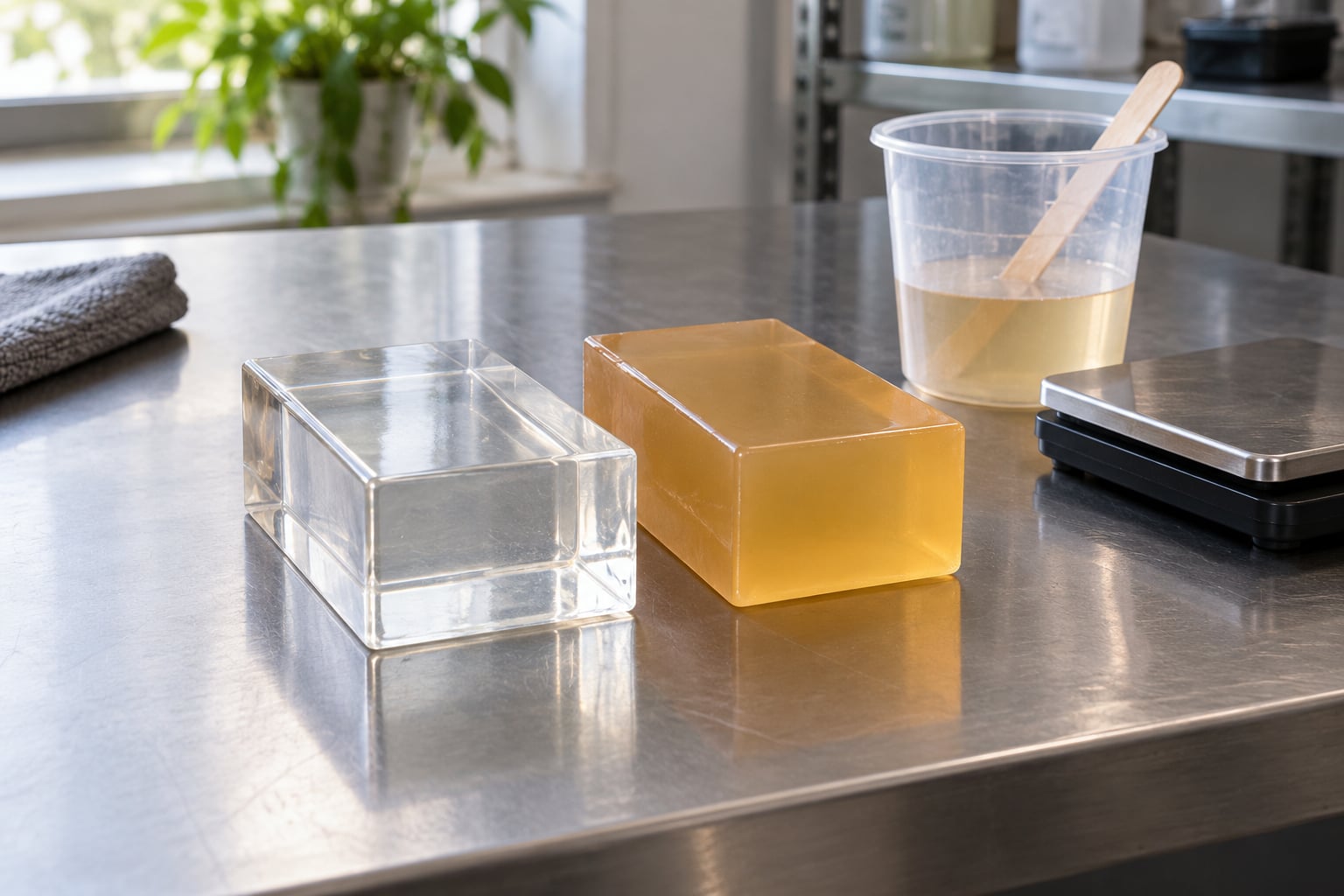
Epoxy resin is usually the stronger, stiffer and more dimensionally stable of the two, which makes it the default choice for rigid parts, tooling, electronics encapsulation and demanding adhesive joints. Polyurethane resin is more flexible, more impact resistant and far better at holding color under sunlight, so it wins for bumpers, seals, vibration isolation and any finish that will sit outdoors.
Neither one is universally better. Both are families of chemistry rather than single formulas, and the gap between a cheap casting epoxy and a toughened structural epoxy is wider than the gap between epoxy and polyurethane at the same price point. That is why a decision made at the family level often goes wrong on the shop floor.
This guide compares epoxy resin vs polyurethane resin on mechanical behavior, adhesion, curing, environmental resistance and total-use cost, then turns that into a selection workflow you can run on a real part. What matters at this stage is getting the requirements written down properly before you compare suppliers, because most of the misleading claims in this space trace back to data sheet language nobody decoded.
Table of Contents
- Epoxy Resin vs Polyurethane Resin at a Glance
- What Is Epoxy Resin?
- What Is Polyurethane Resin?
- Epoxy vs Polyurethane: Chemical and Mechanical Properties
- Epoxy Resin vs Polyurethane Resin: Adhesion and Surface Preparation
- Epoxy Resin vs Polyurethane Resin: Curing, Processing, and Production
- Epoxy Resin vs Polyurethane Resin: Chemical, UV, and Temperature Resistance
- Epoxy Resin vs Polyurethane Resin: Cost and Supply Considerations
- Where Epoxy Resin Wins
- Where Polyurethane Resin Wins
- How to Choose Between Epoxy and Polyurethane Resin
- Which Should You Choose?
- Frequently Asked Questions
- Is epoxy resin stronger than polyurethane resin?
- Which resin is more flexible: epoxy or polyurethane?
- Which resin bonds better to metal and plastic?
- Is polyurethane resin better for outdoor or UV exposure?
- Can epoxy and polyurethane resins be machined after curing?
- How should a manufacturer prototype epoxy versus polyurethane?
- Conclusion
Epoxy Resin vs Polyurethane Resin at a Glance
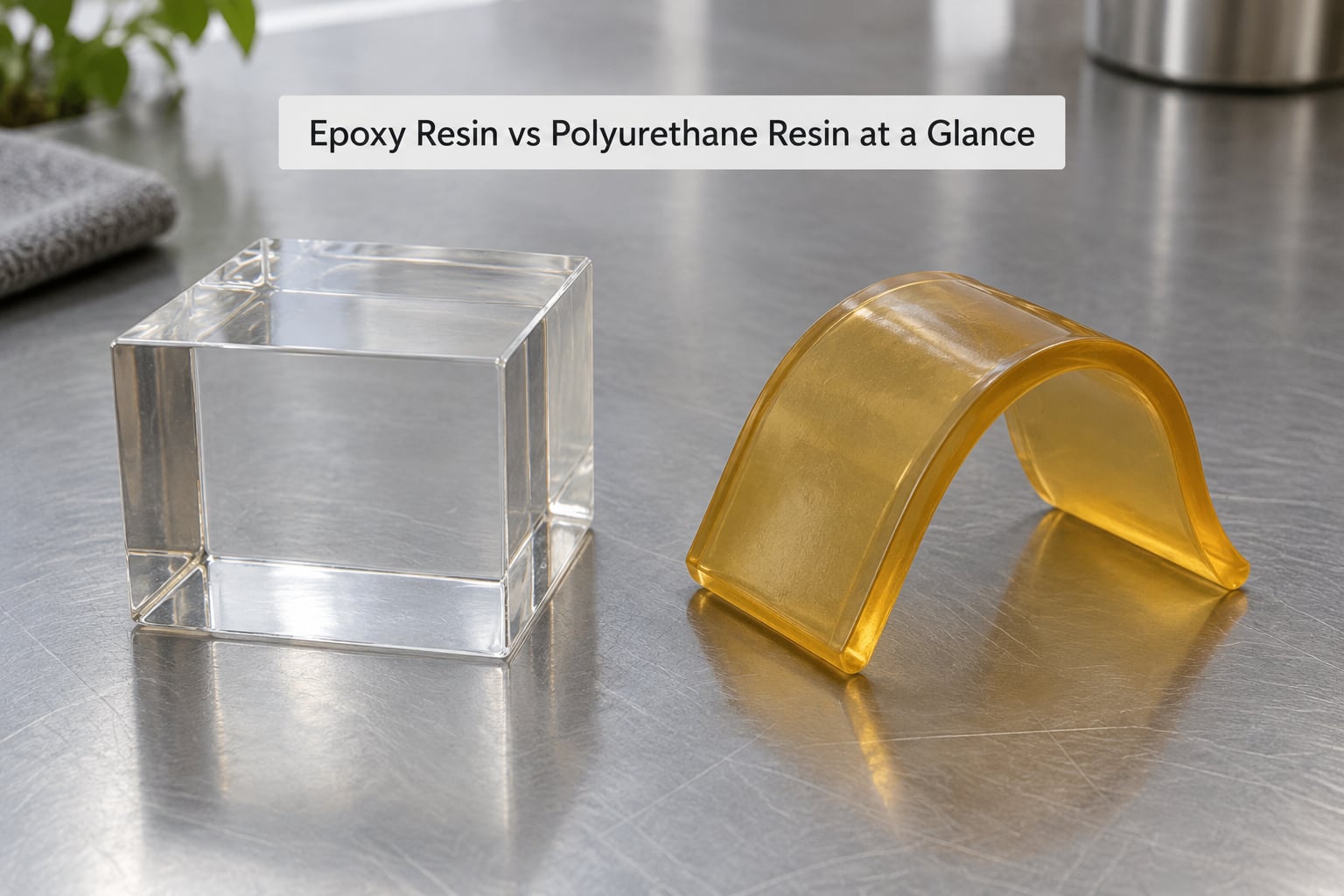
Neither material is universally better: epoxy is generally stronger and more dimensionally stable, while polyurethane is usually more flexible, more impact resistant and better suited to elastomeric or coating work. The table below is the decision summary. Values are typical and supplier-dependent, so treat them as ranges rather than specifications.
| Criterion | Epoxy resin | Polyurethane resin |
|---|---|---|
| Chemical family | Epoxide rings cross-linked by amines or anhydrides | Urethane linkages from isocyanate and polyol reaction |
| Mechanical behavior | High modulus, rigid, low creep | Lower modulus, flexible to semi-rigid, higher elongation |
| Adhesion | Very strong to prepared metals, concrete and some plastics | Good to prepared substrates, better on flexible films and metals |
| Curing behavior | Ambient to post-cure, long full cure, exotherm in thick sections | Faster film cure, moisture sensitive, spray or cast application |
| Temperature resistance | Higher usable range, better dimensional stability when hot | Moderate, softens earlier, degrades with heat exposure |
| Chemical resistance | Strong against acids, alkalis, fuels and solvents depending on hardener | Good against oils, fuels and abrasion, weaker against strong acids and alkalis |
| UV and weathering | Yellows and chalks unless specifically UV stabilized | Aliphatic grades hold gloss and color far better |
| Processing | Casting, laminating, coating, bonding, potting, machining after cure | Spraying, casting, molding, coating, flex casting, molding |
| Ideal applications | Tooling, molds, rigid composites, structural joints, electronics protection | Bumpers, seals, liners, wear parts, vibration mounts, outdoor coatings |
| Main limitations | Brittle, UV sensitive, long cure, moisture in thick pours | Lower rigidity, heat sensitivity, moisture sensitivity during cure, odor and VOC load |
Two rows do most of the work in practice. If your part needs to flex, absorb impact or stay colored in sunlight, polyurethane moves to the front. If it needs to hold a tolerance under load, resist creep and bond hard, epoxy moves to the front.
What Is Epoxy Resin?
Epoxy resin is a thermosetting polymer that cures into a hard, rigid, dimensionally stable material through a chemical reaction with a curing agent. The reactive part is the epoxide group, a three-membered ring that opens and links to neighboring molecules to build a cross-linked network you cannot melt back down.
In practice you will meet two forms. Liquid systems are a Part A resin and a Part B amine or anhydride hardener, mixed by weight at a ratio that is usually 1:1 but sometimes 3:1 or 4:1. Solid systems are films, prepregs or powders that are heated under pressure. Liquid systems dominate casting, bonding, coating and electronics work, and they are what most buyers mean when they say epoxy resin.
The important thing to internalize is that epoxy is a family, not a formula. A filled, toughened, high-modulus epoxy and a low-viscosity craft epoxy share a name and almost nothing else. Reinforcement changes stiffness and thermal behavior, filler changes viscosity and cost, and the curing agent changes chemical resistance and cure profile more than most buyers expect. It is worth walking through [How to Read a Resin Spec Sheet: A Buyer’s Guide](https://venchurs.com/how-to-read-a-resin-spec-sheet/) column by column before you compare grades, since the wording differs between suppliers even when the test method is identical.
Engineers specify epoxy for rigid composite tooling, high-performance adhesives, floor and coating systems, electronics potting and encapsulants, and high-performance mold making. The reasons are consistent: low creep under sustained load, high compressive strength, strong adhesion to prepared surfaces and good resistance to a wide range of solvents and fuels.
What Is Polyurethane Resin?
Polyurethane resin forms when an isocyanate reacts with a polyol to create urethane linkages. That single chemistry spans rigid foam, semi-rigid elastomer and soft rubber-like material, which is why people say urethane, polyurethane and PU when they may be talking about quite different products.
There is a second split that matters more than hardness. Aliphatic polyurethanes use isocyanates that do not discolor under UV, so they hold gloss and color. Aromatic polyurethanes use isocyanates based on benzene ring chemistry, and they yellow in sunlight. That single detail decides outdoor projects before any other property enters the conversation.
Forms vary widely. Spray and cast elastomers, rolled and knife-applied coatings, two-part molded systems and one-component moisture-curing finishes all sit inside this family. Typical uses include flexible cast parts, seals and gaskets, bumpers and guards, vibration isolators, wear pads and liners, protective coatings, and rigid or semi-rigid molded and cast components.
Aromatic grades cover more industrial work because they are cheaper and cure faster in thin films. Aliphatic grades cost more and cure more slowly, and they are what you specify when color retention matters more than cure speed.
Epoxy vs Polyurethane: Chemical and Mechanical Properties
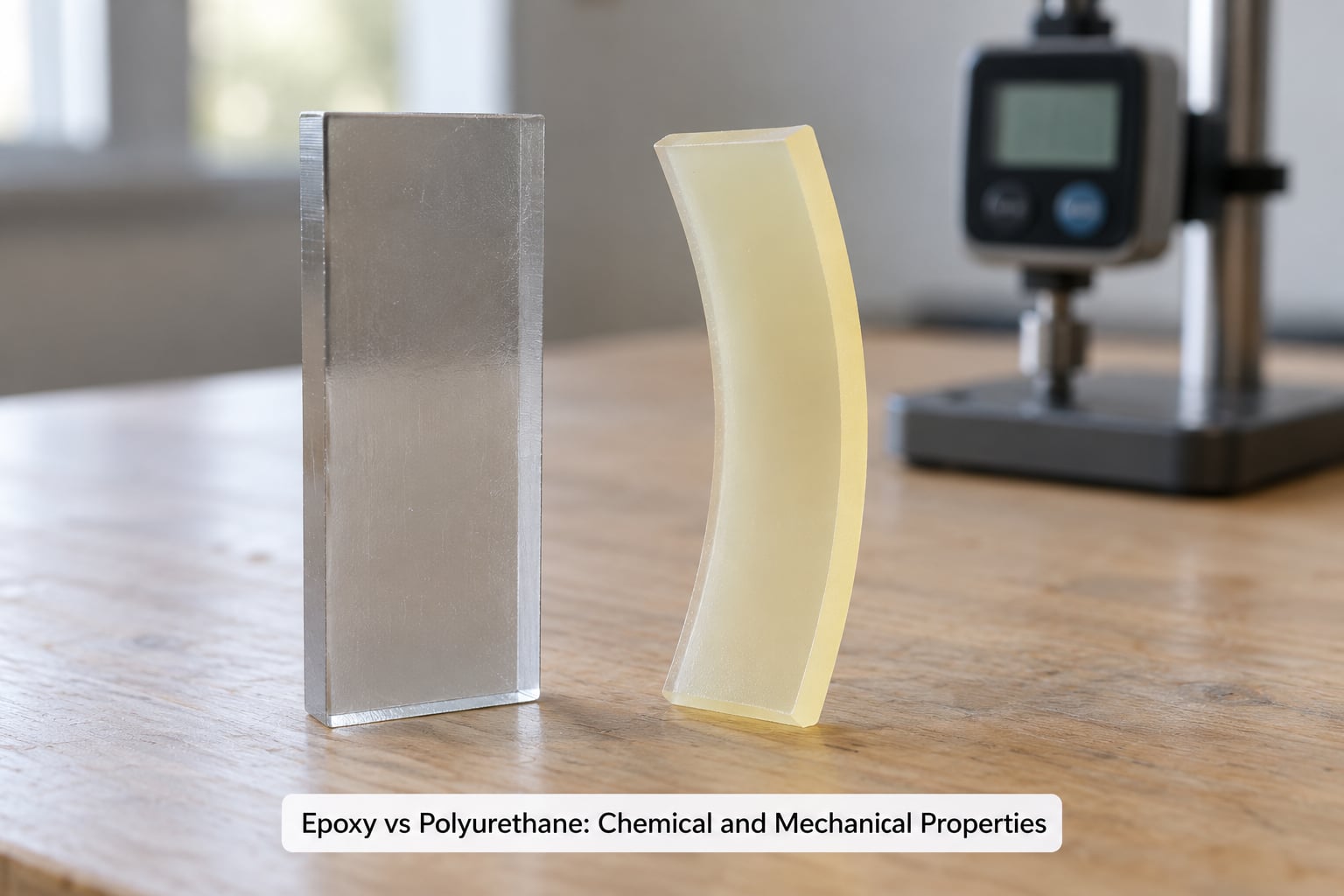
Epoxy generally has the higher modulus and the better compressive strength, while polyurethane generally stretches further and survives impact better. The table gives qualitative bands for unfilled or lightly filled systems, because reinforcement and hardener chemistry move the numbers by a wide margin.
| Property | Epoxy resin | Polyurethane resin |
|---|---|---|
| Tensile strength | Typically higher in rigid grades, reduced by filler | Lower raw value, retained under strain and impact |
| Compressive strength | High, favored for fixtures and tooling | Lower, recovers after load removal |
| Modulus and stiffness | High and stable over time | Lower, tunable from semi-rigid to soft |
| Elongation at break | Low; unmodified grades are brittle | High in elastomeric grades |
| Impact resistance | Good when toughened, poor when not | Excellent; absorbs energy without cracking |
| Fatigue behavior | Good in steady load, sensitive to sharp notches | Better under repeated flexing and cyclic loading |
| Abrasion and wear | Good with hard filler, wears at edges under point load | Very good in soft elastomeric grades, preferred for wear pads |
| Creep under sustained load | Very low, the main reason tooling uses epoxy | Noticeable, flexes under constant force |
| Dimensional stability | Excellent, holds tolerance and flatness | Changes shape with temperature and load |
| Hardness | Often expressed on a Mohs or Rockwell scale, very hard | Shore A or Shore D, tunable across a wide band |
Epoxy resin vs polyurethane resin strength and stiffness
On a bare tensile number, rigid epoxy usually wins. The practical difference is what happens after the load is applied. Rigid epoxy holds its dimension indefinitely under steady load because the cross-linked network does not flow, while polyurethane slowly takes a set, which matters for gaskets and anything that must return to shape.
The reverse is true for shock. A dropped tool on a rigid epoxy fixture produces a clean brittle chip. The same drop on a polyurethane guard pad is absorbed and the pad survives, which is why impact-exposed parts usually get polyurethane even when the numbers on the data sheet look worse.
Hardness numbers are also not comparable across the two families. Epoxy suppliers quote Rockwell or Mohs, polyurethane suppliers quote Shore A or Shore D, and converting between them is guesswork. Ask each supplier for the test method and the substrate used before comparing anything.
Epoxy Resin vs Polyurethane Resin: Adhesion and Surface Preparation
Epoxy generally bonds better to metals, concrete and rigid plastics after proper preparation, and polyurethane generally bonds better to flexible films, elastomers and lightly prepared metal. Neither will rescue a contaminated surface, and both fail predictably when preparation is skipped.
Epoxy has an unusually strong affinity for metal and concrete, and its gap-filling behavior on porous substrates is a real advantage on wood and concrete where a thin film must bridge small voids. Its weakness is brittleness: a rigid epoxy on a part that flexes will crack at the bond line and take the coating with it, because the failure mode is cohesive inside the epoxy.
Polyurethane tolerates movement. It has lower peel strength on rigid substrates but bridges cracks and flexes with the part, which is why it is preferred where thermal expansion or vibration is part of the design. Because it is softer, the same bond can creep under sustained load, and a polyurethane adhesive on a hot metal surface can fail early.
What surfaces will epoxy not stick to?
Epoxy poorly bonds to polyethylene and polypropylene because those polyolefins have no polar surface chemistry, and to fluoropolymers such as PTFE. It is also unreliable on flexible vinyl, silicone, waxed or oily surfaces, and on anything with a silicone or fluorinated release agent still present. Aged or chalky paint, loose mill scale, rust and existing polyurethane also cause trouble.
A practical preparation sequence: clean and degrease, abrade to a fresh profile, remove all dust, dry fully, then apply a primer or adhesion promoter where the supplier calls for one. Test on a real production substrate rather than a coupon, because a coupon tells you about the material and a production panel tells you about your process.
Polyurethane over epoxy works when the epoxy is fully cured, scuff-sanded to a matte profile and cleaned, because intercoat adhesion depends on mechanical keying rather than chemical bond. Applying polyurethane over epoxy too early is a common cause of peeling, and it is the single most reported PU-over-epoxy problem in user forums.
Epoxy Resin vs Polyurethane Resin: Curing, Processing, and Production
Epoxy is generally the easier material to control in a controlled environment, and polyurethane is generally the faster one to get handling strength in a thin film. The difference shows up most clearly in thick sections, where epoxy exotherm can ruin a large pour.
Epoxy mixing ratios are exact by weight, and pot life ranges from a few minutes for fast-curing hardeners to many hours for long-pot-life systems. Full cure commonly runs to several days before full chemical resistance and load capability are reached, so a part handled at 24 hours may still be developing properties. Thick sections generate heat, and in a deep pour that exotherm can boil the resin or cause internal cracking, which is why high-modulus epoxies are often poured in lifts or post-cured.
Polyurethane in thin films cures faster and exotherms less dangerously because the section is thin. But the isocyanate component reacts with moisture in the air, so humidity above roughly 60 percent can cause carbon dioxide bubbles in the film, and surface moisture on the substrate creates the same defect. That is why aliphatic grades, which cure more slowly, are also less forgiving of a damp shop.
| Processing factor | Epoxy resin | Polyurethane resin |
|---|---|---|
| Mix accuracy | Ratio-critical, weigh by mass | Ratio-critical, spray or metered mix |
| Pot life | Wide range, select the hardener to suit the job | Often shorter in 1:1 cartridges, longer in 100:1 spray |
| Handling strength | Hours to a day depending on hardener | Hours in thin films, faster in some two-part systems |
| Full cure | Several days, sometimes a week, often post-cured warm | Days, faster with warm and dry conditions |
| Exotherm risk | Real in thick pours, manage with lifts or post-cure | Low in films, higher in thick castings |
| Viscosity range | From very thin to heavily filled pastes | From spray thin to thick cast elastomers |
| Humidity effect | Amine blush and slow cure in damp conditions | Direct outgassing and bubbles from moisture |
| Secondary finishing | Machining, drilling, sanding, polishing, painting | Molding, trimming, painting, overmolding, cannot be machined easily |
Machining is another split worth planning around. Cured epoxy machines well with carbide tooling and holds a fine edge, which makes it a practical choice for fixtures that get drilled and reworked. Polyurethane elastomers gum cutting tools and spring back at the cut, so you size holes with allowance rather than to final dimension, and you trim flexible parts on a bandsaw or knife instead.
Epoxy Resin vs Polyurethane Resin: Chemical, UV, and Temperature Resistance
Epoxy usually resists a broader range of chemicals, and aliphatic polyurethane usually survives sunlight and weather far better. Neither resists everything, so exposure type matters more than any single rating.
Read resistance data by exposure mode. A material rated for splash contact may fail under continuous immersion, and a coating that tolerates an acid at room temperature can be attacked by the same acid warm. Suppliers rate immersion, splash and full immersion separately, and the number you need is the one for your actual service condition.
| Exposure | Epoxy resin | Polyurethane resin |
|---|---|---|
| Water and salt water | Good in immersion grades, can absorb moisture over time | Good film resistance, check hydrolytic stability in long immersion |
| Fuels, oils, hydraulic fluid | Very good, a traditional strength | Good, varies by polyol and isocyanate |
| Solvents | Wide range, aromatic and ketone resistance depends on hardener | Moderate, many aromatic grades are attacked by strong solvents |
| Acids | Generally strong, system dependent | Poorer at strong concentrations, especially aromatic grades |
| Alkalis | Generally good, epoxy is a common choice for alkali service | Poor to fair, a common failure point |
| Abrasion and wear | Good with hard filler, edges wear under point load | Excellent in elastomeric grades |
| UV and sunlight | Yellows and chalks unless UV stabilized | Aliphatic grades hold gloss and color, aromatic yellows |
| Heat | Higher usable range, post-cure improves it | Softens earlier, degrades with sustained heat |
| Thermal cycling and shock | Brittle systems can crack on rapid swings | Flexible systems absorb the mismatch |
| Outdoor weathering | Needs a topcoat or UV package | Good on aliphatic grades, needs maintenance on gloss retention |
On UV exposure, the mechanism is worth knowing. Epoxy that is left bare develops a yellow cast and a chalky surface as the aromatic portion of the chemistry breaks down under light, which shows most on clear castings and pale colors. Aliphatic polyurethane is engineered so the cross-link does not absorb that light, so it is the normal answer for a clear casting, a colored part or any finish that stays outside.
For fully exposed outdoor parts, a topcoat is usually the practical answer regardless of base resin. An epoxy body with a UV-resistant topcoat gives you the structural build and appearance at once, and it is the standard hybrid build. Also control your layout so overspray from one operation cannot settle on uncured work from another, because crossover contamination between the two families is a common and avoidable source of rejects, and the controls for it are laid out in [How to Prevent Resin Contamination in the Plant](https://venchurs.com/how-to-prevent-resin-contamination-in-the-plant/).
Epoxy Resin vs Polyurethane Resin: Cost and Supply Considerations
Per-pound resin cost is the least useful number in this comparison, because the two materials end up in different kinds of jobs with different cost structures. Compare cost per finished part, including everything required to produce an acceptable part.
Epoxy jobs carry more material cost and less labor risk. Rigid parts, tooling and encapsulated assemblies are relatively predictable: mix, cast or dispense, post-cure, then finish or machine. Scrap comes mainly from mix ratio errors, exotherm in thick sections, and contamination, so training and accurate weighing matter more than the price of the resin.
Polyurethane jobs usually cost less in material and more in process. Aliphatic grades carry a higher material cost than aromatic ones, and spray systems need capital equipment, air preparation and a controlled booth. The offsetting advantage is thinner films, faster handling strength, and less rework when a part flexes instead of cracking.
Items that change the comparison: reinforcement such as fiber or filler, the hardener or isocyanate component, mold and tooling expense and its expected life, labor rate and cure time, scrap rate, machining and secondary coating, maintenance and recoating intervals, and volume purchasing terms. Supplier pricing varies widely by grade and region, so production teams should request landed US quotes and compare cost per finished part on identical parts, cured to the same specification.
Where Epoxy Resin Wins
Epoxy is the better choice when the part is rigid, heavily loaded, dimensionally critical, permanently bonded or needs to resist creep, chemicals and heat rather than flex and impact.
Composite tooling and fixtures are the clearest case. A filled epoxy jig holds its shape through repeated machining cycles, resists cutting fluids and solvents, and does not creep under clamping force. Mold making follows the same logic, and so does laboratory and tooling fixtures where a part has to stay within tolerance over time.
Electronics encapsulation is the second clear win. Epoxy flows around components, cures hard, resists most fluxes and solvents, and can be formulated for thermal conductivity or flame rating. A soft encapsulant that flexes is less useful because it allows mechanical movement at the die and components.
Demanding adhesive joints are the third. Where both substrates are rigid and the load is shear or peel in the plane of the joint, epoxy gives the higher strength and lower creep. Bonded assemblies in metal fabrication, composite layups and repair work generally follow this rule.
The limits are equally clear. Rigid epoxy has low elongation, so it cracks rather than yielding when overloaded, and that sudden failure gives no warning. Unmodified epoxies also have limited solvent resistance, which is why a secondary coating is often specified over them.
Where Polyurethane Resin Wins
Polyurethane is the better choice when the part must flex, absorb impact, resist abrasion, stay colored in sunlight or isolate vibration.
Elastomeric parts are the obvious group. Bumpers, guards, seals, gaskets, liners, vibration mounts and wear pads all want a material that deforms and recovers, and rigid epoxy in those roles produces cracked, unusable parts. Users building handheld and sporting equipment have reported polyurethane handles that survive drops that would shatter a comparable epoxy part.
Protective and decorative coatings are the second group. Where a part faces UV, abrasion and handling, aliphatic polyurethane gives better color retention and gloss than a bare epoxy finish, and it is thinner, so less material is needed for the same protection.
Flexible tooling is the third. Simple molds, form liners, flexible duplicate tooling and impact-resistant helpers are all cases where a hard epoxy would crack under handling loads.
The limits are structural. Polyurethane has lower stiffness and lower compressive strength, and it takes a permanent set under sustained load. Aromatic grades yellow. Heat sensitivity rules it out of high-temperature service, and some formulations carry a strong odor and a high VOC load, so ventilation and respiratory protection are not optional. Long-term aging also varies with the polyol, isocyanate and stabilizer package.
How to Choose Between Epoxy and Polyurethane Resin
The fastest way to choose is to eliminate, not to compare. Run the requirements in order and drop whichever family fails first, then test only what survives.
Start with stiffness and movement. If the part deflects, cycles between loaded and unloaded, or must bridge a moving crack, polyurethane is in. If the part holds a tolerance under sustained load or carries compressive forces through its body, epoxy is in.
Then check environment. Continuous chemical contact favors epoxy, with the hardener chosen for that specific chemical family. Sunlight and outdoor weathering favor aliphatic polyurethane, or epoxy with a UV-resistant topcoat. High service temperature favors epoxy. Thermal shock favors the more flexible system.
Then check the process. Thick castings, deep pours and post-cured rigid parts suit epoxy. Thin films, sprayed coatings, molded elastomers and fast-turn flexible parts suit polyurethane. If your shop cannot control humidity below 60 percent or cannot run heated dry air for a two-component spray, account for that before specifying an aliphatic system.
Then check the substrate. Polyolefins, fluoropolymers and release-agent-contaminated surfaces need plasma treatment, flame treatment or a tie coat for either resin. Flexible substrates and wood that will move need polyurethane or a toughened epoxy, not a rigid one.
Finally, build a small representative test rather than trusting a data sheet. Cut parts from the real production geometry, with real fillets and real edge conditions, cure them under actual shop conditions, then put them through the loads and exposures they will meet. Coupon tests tell you about the material. Part tests tell you about your process.
Record what you learn in the specification, including the surface preparation steps, mixing equipment, cure schedule, post-cure temperature, test method and the failure mode you saw. That record is what lets your purchasing team get comparable quotes later, and it is the same information a supplier needs in order to recommend a grade. If your purchasing team also carries a recycled-content or sustainability target, treat recycled-content resin as a separate qualification exercise rather than a drop-in swap, since filler content and viscosity change the processing behavior; [How to Source Recycled Resin for Production: Proven Guide](https://venchurs.com/how-to-source-recycled-resin-for-production/) covers what to ask a supplier before you accept a recycled grade.
Which Should You Choose?
Choose epoxy for rigidity, strength, dimensional control, tooling and demanding bonds. Choose polyurethane for flexibility, impact absorption, abrasion resistance and elastomeric performance outdoors.
Concrete floors and industrial floors, electronics potting, composite tooling, laboratory fixtures and bonded metal assemblies sit on the epoxy side. Bumpers, seals, wear liners, vibration mounts, cast flexible parts and any exterior coating that must keep its color sit on the polyurethane side.
Hybrid builds are often the correct answer rather than a compromise. A filled epoxy body gives stiffness, thickness and load capacity, while an aliphatic polyurethane topcoat supplies color retention and wear resistance over it. This is standard practice on exposed floors and exterior castings, and it also solves the UV problem without giving up the structural build.
Two more cases worth naming. When requirements are borderline, test both rather than arguing theoretically, because the gap between adjacent grades on the same family is often bigger than the gap between families. And where outdoor exposure is total and long-term, a polyaspartic or polyurea coating is worth evaluating as a modern alternative, since those chemistries cure fast and hold color well, though they sit outside this two-way comparison.
Frequently Asked Questions
Is epoxy resin stronger than polyurethane resin?
For rigid grades, epoxy usually shows higher tensile and compressive strength and a much higher modulus, so it wins in load-bearing and tooling work. Polyurethane is weaker in those numbers but absorbs impact and repeated flexing far better, and it recovers shape after a load is removed. Strength alone rarely decides the choice, because a stronger but brittle epoxy part usually fails sooner in service than a flexible polyurethane one.
Which resin is more flexible: epoxy or polyurethane?
Polyurethane, by a wide margin. Elastomeric polyurethane grades stretch several hundred percent before breaking and return to their original shape, while unmodified epoxy typically elongates only a few percent before cracking. Toughened epoxies with flexible additives narrow the gap, but if your part needs to bend, stretch or survive repeated flexing, polyurethane is the only sensible starting point.
Which resin bonds better to metal and plastic?
Epoxy generally bonds better to clean, abraded metals, concrete and rigid plastics, and its gap-filling behavior on porous substrates is a real advantage. Polyurethane bonds well to prepared metal and flexible films and tolerates movement, which is why it is preferred where the substrate flexes. Neither adheres reliably to polyethylene, polypropylene or PTFE without flame or plasma treatment, so substrate testing is essential.
Is polyurethane resin better for outdoor or UV exposure?
Yes, but only an aliphatic grade. Aliphatic polyurethane is formulated so its cross-linked structure does not absorb ultraviolet light, so it resists yellowing and gloss loss far better than epoxy. Aromatic polyurethane yellows just like epoxy, since both rely on light-absorbing chemistry. For fully exposed outdoor parts, epoxy with a UV-resistant polyurethane topcoat is a common and durable build.
Can epoxy and polyurethane resins be machined after curing?
Cured epoxy machines well with carbide tooling, holds a sharp edge and tolerates drilling, tapping and reworking, which is why it suits fixtures and jigs. Cured polyurethane is different: elastomeric grades gum cutting tools, spring back at the cut and shed heat, so you size holes with machining allowance and trim flexible parts on a saw instead. Plan the process before specifying the material.
How should a manufacturer prototype epoxy versus polyurethane?
Cut parts from real production geometry rather than flat coupons, include actual fillets and edges, and cure them under real shop conditions including actual humidity and temperature. Then expose them to the loads, chemicals and weather they will meet, and record the failure mode as well as the time to fail. Compare cost per acceptable finished part, not material cost per pound, before you commit a specification.
Conclusion
The selection rule is short: rigidity, dimensional control, tooling and hard bonds point to epoxy, while flexibility, impact absorption, abrasion and outdoor color retention point to polyurethane. Do not decide at the family level in your head.
Write down the mechanical and environmental requirements first, eliminate whichever resin fails an early requirement, then test representative parts under the loads and service conditions the part will actually face. That test result is what turns the comparison into a specification, and it is what makes the next quote conversation short.