

A corrugated board grade is not a quality ranking. It is a shorthand that tells you what the sheet is made of: which liner and fluting medium are bonded together, which flute profile formed the wave, and what strength rating the board carries. Once you can read those three pieces of information, choosing a board for a shipping carton or a retail tray stops being guesswork.
The trouble is that most people learn the codes backwards. They see “32A” stamped on a box, assume A is better than B, and spec from the letter. This guide takes the manufacturing side of the subject and turns the codes into decisions you can defend, so you can decode a grade stamp, compare flute options, and match strength to an actual load.
Table of Contents
- What Are Corrugated Board Grades?
- Corrugated Board Grades Explained: How to Read a Grade
- What Does ECT Mean in Corrugated Packaging?
- Common ECT Ratings at a Glance
- How Flute Type Changes Corrugated Board Performance
- What Liner Weight and Grade Codes Tell You
- Singlewall, Doublewall and Triplewall Boards
- Which Corrugated Board Grade Should You Choose?
- How Board Grade Affects Cost and Sustainability
- Frequently Asked Questions
- Conclusion: Start with Performance, Not the Grade Code
What Are Corrugated Board Grades?
A grade is a complete specification of one sheet of corrugated board. It identifies the liner and medium combination, the wall structure and flute profile, and the strength rating the mill certified the board to. It is a description of materials and measured performance, not a tier from bad to good.
Two things that people call “grade” are not the grade at all. Box style is one: RSC and HSC describe the shape of the blank, not the board in it. And finished box performance is the other: a box built from a well-specified board can still fail, because geometry and joint quality matter as much as the sheet.
So treat grade as an input. The performance you actually get is that input multiplied by box dimensions, print and converting quality, moisture, and how the box is handled in transit.
Corrugated Board Grades Explained: How to Read a Grade
Grade information lives in two places: the manufacturer’s certificate (the cert) that ships with the order, and the certificate stamp printed on the box itself. Read the stamp first, then confirm against the cert. A box bought from a distributor may carry no stamp at all, which is a good reason to keep the cert on file.
Typical stamp lines look like this, though the order varies by converter:
- Strength line: “32 ECT” or “44 ECT”, sometimes with a BCT figure alongside
- Size line: inside dimensions in inches or millimetres
- Style and combination: “RSC”, then a combination such as “48-26C-44”
- Cert line: the manufacturer’s certificate number and a box maker’s certificate reference
Now the labels themselves. “32A” is shorthand where 32 is the edge crush value and A describes the outer liner. “44B” is the same construction idea with a heavier rating and a different liner class. “20 ECT” is an older North American convention where the number is ECT in pounds per inch, just written in a different order. None of these strings ranks against each other, and a two-letter code from one converter can mean something different at the next plant.
What you should not do is infer a grade by looking at a box. Wall thickness, flute count and liner quality all fail to reveal strength reliably under any lighting, and a thin, badly glued box often feels heavier than a good one. The cert is the document; the eye is not the test.
Corrugated Board Grades Explained by Certificate Markings
Three worked examples show how the pieces fit together on a real label.
Example one: “32 ECT, 200 BCT, 48-26C-44, RSC”
The 32 ECT figure is the board’s edgewise compressive strength in pounds per inch. The 200 BCT number is the expected compression strength of the finished box in pounds, which is lower than the raw board figure because box geometry and joints always subtract something. The combination 48-26C-44 breaks down as a 44 lb outer liner, a 26 lb C-flute medium, and a 48 lb inner liner, giving a singlewall C-flute sheet a little under 4 mm thick. A box on this spec is a normal e-commerce shipping carton: light enough to stay a low parcel, strong enough for palletised freight for several days.
Example two: “44 ECT, BC flute, 32-44B-32”
Two 32 lb liners with a 44 lb B-flute medium between them make a doublewall sheet roughly 7 mm thick. The 44 ECT rating reflects two fluted layers working together. This is the workhorse spec for heavier goods, longer storage, and pallet stacking where a singlewall C-flute box started to bow out.
Example three: “20 ECT, E flute, 32-26E-40”
A 20 ECT singlewall E-flute sheet is about 1.5 mm thick. You see it in die-cut retail trays, mailer boxes, and small shippers where the box is boxed once and handled a handful of times, not stacked under pallets. The lower rating is appropriate to the job, not a compromise.
One caution on all three: a combination string describes materials, not certified performance. Only the ECT figure carries a tested value.
What Does ECT Mean in Corrugated Packaging?

ECT is the Edge Crush Test, a laboratory measurement of how much force a one-inch strip of board carries on its edge before it crushes. It is reported in pounds per inch in North America and in kilonewtons per metre almost everywhere else, so 32 ECT is roughly 5.6 kN/m. The test is run to a standard method, and a mill that certifies a grade has measured it rather than estimated it.
Here is the part people get wrong. ECT measures the board, edgewise, in isolation. It does not tell you how much weight your finished box will carry. That is BCT, box compression strength, and it depends on the board’s ECT multiplied by its caliper and the box perimeter. A 32 ECT board in a long, narrow box will hold a different load than the same board in a cube, even though the grade is identical.
ECT also says nothing about puncture resistance, which is what the Mullen burst test covers. For a box full of soft goods that will be dropped, burst can matter more than ECT. For a box under a pallet, ECT and geometry are what you are actually relying on.
Common ECT Ratings at a Glance
These are the ratings you will meet most often. The liner combinations are typical rather than exclusive, and the same ECT value can be reached with different materials.
| ECT rating | Metric equivalent | Typical board construction | Common application |
|---|---|---|---|
| 20 ECT | 3.5 kN/m | Singlewall E or F flute, 32 lb liners | Die-cut retail trays, small mailers, padded shippers |
| 23 to 29 ECT | 4.0 to 5.1 kN/m | Singlewall E or B flute, 32 lb liners | Light e-commerce parcels, garment and shoe shippers |
| 32 ECT | 5.6 kN/m | Singlewall C flute, 44 lb outer liner | General shipping cartons, palletised freight for short trips |
| 40 to 44 ECT | 7.0 to 7.7 kN/m | Doublewall BC or EB flute, 32 to 44 lb liners | Heavier goods, warehouse storage, multi-week transit |
| 48 to 55 ECT | 8.4 to 9.6 kN/m | Doublewall BC flute, heavier liners | Industrial parts, drum-shaped or awkward loads, tall stacks |
| 67 to 112 ECT | 11.7 to 19.6 kN/m | Doublewall or triplewall with heavy liners | Heavy duty shipping, export freight, engineered loads |
Read that table carefully and you will notice the trap. One ECT value does not identify a board grade. A 44 ECT board could be a doublewall BC sheet or a heavy singlewall construction, and the two behave very differently in a long shipment. Always pair the ECT number with the flute and wall construction before you accept a spec.
How Flute Type Changes Corrugated Board Performance
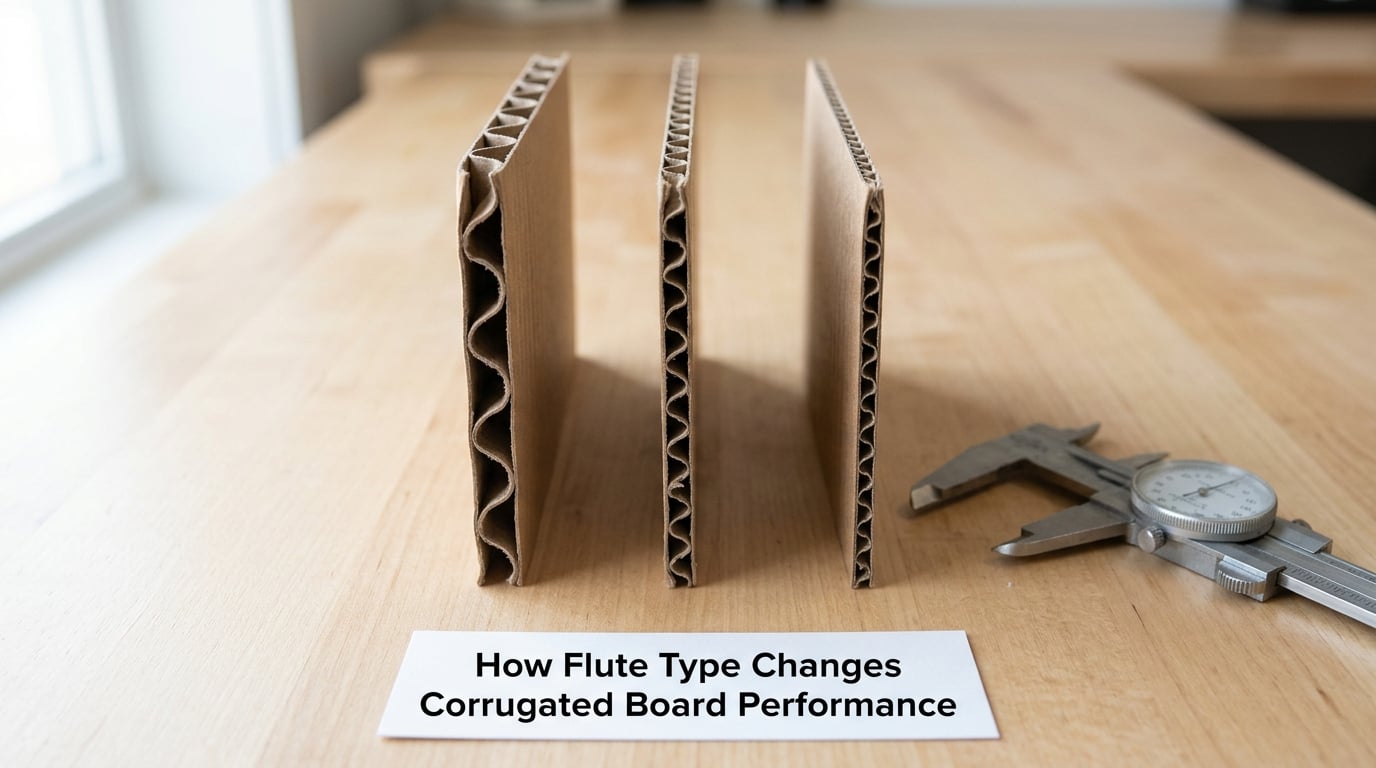
Flute is the wave pressed into the medium between the liners, and its profile changes the board in five ways at once: thickness, how much board the wave consumes, cushioning, printability, and how the sheet runs through converting equipment.
| Flute | Height (mm / inches) | Take-off factor | Character | Best fit |
|---|---|---|---|---|
| C | about 4.0 mm / 0.157 inch | 1.42 | Most widely used singlewall flute | General shipping cartons, palletised freight |
| B | about 3.1 mm / 0.122 inch | 1.30 | Finer wave, more sheets per area | Die-cuts, small shippers, sheet capacity |
| E | about 1.5 mm / 0.059 inch | 1.27 | Thin, printable, folds well | Retail trays, sleeve and mailer cartons |
| A | about 4.8 mm / 0.189 inch | 1.58 | Large waves, heavy take-off | Doublewall with C or B, cushioning packs |
| BC | about 7.1 mm / 0.280 inch | 1.55 | Doublewall, C outer and B inner | Heavy duty shipping, long transit |
| EB | about 4.8 mm / 0.189 inch | 1.38 | Doublewall with a printable E face | Printed cases with heavy duty |
| BE | about 4.8 mm / 0.189 inch | 1.38 | E face on the outside for print | Retail and case packs needing graphics |
The take-off factor is the one nobody explains well. It is the amount of flat board the wave consumes to produce one unit of fluted sheet, and it drives both material cost and how many blanks fit on a converting sheet. A flute with a high take-off wastes more board per square meter, which is part of why an A-flute doublewall costs more than a BC doublewall of similar thickness.
When should you change flute? Two situations justify it. First, when you need a printable surface, moving to an E or BE face buys you a smooth, flat printing surface instead of a rippled one. Second, when the load is cushioning-driven rather than compression-driven, a larger flute such as A absorbs more shock across a wider range. For pure stacking strength, adding a second wall usually beats changing flute.
What Liner Weight and Grade Codes Tell You
Liners do the heavy structural work, which is why liner weight is usually the number that changes when a spec gets stronger. In North America a 32 lb liner is a common starting point, 44 lb is a step up, and 48 lb is where heavy-duty work usually lands. The same papers are quoted in GSM elsewhere: 32 lb is roughly 125 GSM, 44 lb about 170 GSM, and 48 lb about 185 GSM.
What the liner is made of is a separate decision. Kraft is made from long fibre and is the strongest and most moisture-resistant option. Test liner, typically made from recovered fibre, costs less and prints well enough for the inside face. White top is a bleached sheet over a recycled body, chosen when the outside needs to look retail-ready rather than when strength matters most.
Then there are the letters. An A, B or C face in US boxmaking refers to a specific liner class, not a size or a strength score, and the alphabetical order does not run from good to bad in the way people assume. Alphanumeric codes that look precise, such as those old-style C-flute designations, are meaningful mainly to the mill that issued them. If a code is not on the cert, ask the supplier rather than guessing.
Singlewall, Doublewall and Triplewall Boards
Wall count is the number of fluted layers bonded together, and it is the single biggest driver of thickness and cost.
- Singlewall is one fluted layer between two liners, roughly 1.5 to 4 mm thick. This covers most shipping cartons, retail trays and mailers.
- Doublewall is two fluted layers and three liners, roughly 6 to 8 mm thick. Used for heavier goods, longer storage, and stacks under load.
- Triplewall is three fluted layers and four liners, 10 mm and up. Reserved for heavy industrial freight, export shipments and engineered loads.
This is where the ply confusion starts. A singlewall board has three paper layers, which is why some sources call it 3-ply, and other sources simply call it singlewall. Doublewall is described as 5-ply or as BC doublewall, and triplewall as 7-ply. The ply count describes paper layers; the wall count describes fluted layers. Neither is wrong, and both terms are used inconsistently in the trade, so spec the wall construction and the ECT rather than the ply.
Wall count is not a strength tier on its own either. A well-made 44 ECT doublewall and a heavier singlewall can land in the same ECT range while behaving differently under shock and in humid conditions.
Which Corrugated Board Grade Should You Choose?
Start from the load and work backwards. The sequence that works for most specifications goes like this.
- Define the load. Product weight, distribution of that weight, and whether boxes are stacked, palletised, or shipped one at a time all change the answer. A 30 lb product that rides a pallet for 10 days needs more than the same 30 lb going through a parcel carrier.
- Set the box dimensions. Compression strength scales with perimeter and caliper, so a long slender box is weaker than a square one carrying identical contents. Very large boxes need more board than small ones holding the same weight.
- Check moisture exposure. Corrugated loses strength as relative humidity rises, and the effect is material. Warehouses, ocean freight and unrefrigerated summer staging all call for a margin. Board also creeps under sustained load, so anything stored for months needs headroom over the short-term rating.
- Decide how it is handled. Machine packing at high speed, manual hand packing, and conveyor-fed lines all tolerate different flute and liner choices, because the same board folds and creases differently.
- Match the print requirement. If the box carries graphics or a label that must read cleanly, an E or BE face or a white top liner buys surface quality that strength ratings alone will not deliver.
- Account for product fragility. Fragile goods shift the priority from compression to cushioning and burst resistance, which points toward a larger flute and inner protection rather than a heavier grade.
- Confirm the distribution method. Parcel, LTL, rail and ocean freight each have different time under compression and different handling, and the longest journey sets the requirement.
Two safety habits pay for themselves. Specify a BCT minimum alongside the ECT, so the box is judged on finished performance rather than on board alone. And ask the converter to confirm the box meets the standard compression test method, such as ASTM D642 for shipping containers, so everyone is working to the same measurement.
How Board Grade Affects Cost and Sustainability
Cost in corrugated is largely a function of how much board a box uses, and board use follows the spec. A higher ECT almost always means heavier liners or an extra wall, and heavier liners mean more fibre per square meter. Flute choice adds a second lever, because a high take-off factor consumes more flat board for the same finished area. That is why a heavier grade costs more per box and why a thinner flute on a lighter box can be the cheaper option even when the flute sounds more impressive.
Converting efficiency follows too. Die-cut blanks waste material that a simple slotted carton does not, so box style and grade interact. A freight optimisation angle is often worth more than a board change: getting cube efficiency and pallet utilisation right can remove more freight cost than shaving a grade, and it costs no extra material.
On the environmental side, keep the claims specific. All these boards are largely recyclable in practice, and recycled-content liners are common on the inner face. But recovered fibre has a shorter fibre length, which is exactly why a test liner needs more basis weight to reach the same ECT as a kraft liner. A board specified heavier for sustainability reasons can genuinely use more material than the kraft equivalent. Compare at equal ECT, not at equal sheet thickness, and ask your supplier for the actual recycled content rather than accepting a general claim.
Frequently Asked Questions
Is a higher corrugated board grade always better?
No. A higher grade means more board weight and higher cost, and it can be the wrong choice. Thin E-flute is right for a die-cut retail tray that gets boxed once, and a heavy 112 ECT triplewall is waste on a light parcel. Grade should follow the load, the box dimensions, the storage duration and the handling. Over-specifying adds material and freight cost without protecting anything the product needs protected.
What is the difference between ECT and box compression strength?
ECT is a property of the board, measured in pounds per inch or kilonewtons per metre by crushing a one-inch strip on its edge. Box compression strength, or BCT, is the finished box’s total resistance in pounds or kilograms-force, and it depends on ECT, board caliper and box perimeter. The same ECT board in a large box and a small box gives two different BCT figures, which is why quoting ECT alone does not guarantee a load.
Can two corrugated boxes have the same ECT but different grades?
Yes, and it happens often. A 44 ECT doublewall BC sheet and a 44 ECT heavy singlewall construction can share the same rating while using entirely different materials, thicknesses and flute profiles. They behave differently under shock, in high humidity and on a converting line. Always record the flute, wall construction and liner weights alongside the ECT figure, and check that the cert lists all three.
What does the number in a grade code like 32A mean?
In the common shorthand, 32 is the edge crush value in pounds per inch and A describes the outer liner class. The letter is a liner grade, not a size or a quality rank, and the order runs from strong to weak in some conventions. These codes are not standardised across every converter, so treat them as a starting point for a conversation rather than a specification, and confirm against the box certificate.
How should corrugated boxes be stored to preserve their performance?
Store them flat, in a dry building, well away from any floor or outside wall that can wick moisture. Corrugated loses strength as humidity rises and creeps under sustained load, so avoid tall stacks of filled cases left standing for months with no air movement. Keep boxes off damp concrete, rotate stock so older cases move first, and let conditioned board acclimatise before it goes into high-value automated packing equipment.
Conclusion: Start with Performance, Not the Grade Code
Reading corrugated board grades explained comes down to three numbers on one line: the flute, the liner weights, and the ECT rating. Once you can read those, the code letters stop mattering.
Here is the first thing to do tomorrow. Write down the load, the box dimensions, the storage time and the shipping method, then ask your converter for a spec that includes a minimum box compression strength next to the ECT. Compare two or three material options at that performance level rather than comparing grade codes, and put the decision on geometry and freight efficiency before you spend more per box.
Updated for 2026. Grade conventions vary between converters and regions, so confirm any specification against the certificate that ships with the board.