
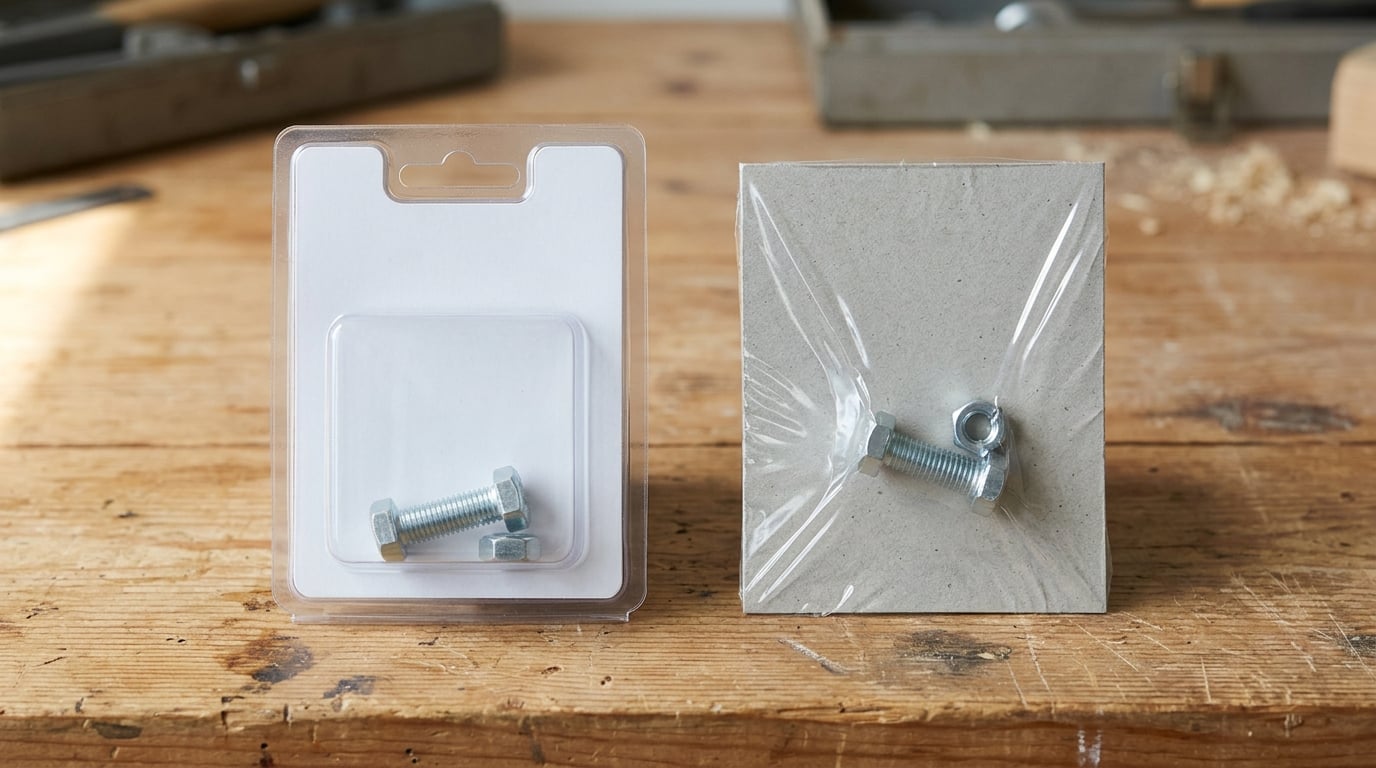
Blister packaging vs skin packaging turns on one mechanical difference. Blister film is pre-formed into a rigid cavity before the product goes in; skin film is heated and drawn onto the product after it is placed. Blister wins on protection, shelf life and retail structure. Skin wins on visibility, close conformity and cost at low volume.
That difference cascades into everything else: tooling, film choice, machine cost, defect rate and how the pack behaves on a peg hook. This guide is for brand owners, product managers, packaging engineers and sourcing leads who have to specify one. It was refreshed for 2026 against current converter practice.
Table of Contents
- Blister Packaging vs Skin Packaging at a Glance
- How Do Blister Packs and Skin Packs Work?
- What Are the Main Differences?
- Which Package Offers Better Product Protection?
- Which Is Better for Presentation and Visibility?
- What Materials Are Used in Each Format?
- How Do Cost and Production Requirements Compare?
- Which Format Is Easier to Recycle or Dispose Of?
- Which Should You Choose?
- Frequently Asked Questions
- Conclusion
Blister Packaging vs Skin Packaging at a Glance
These twelve rows are enough to make the call on most products. Beyond them, the deciding factors are usually a barrier specification or a volume number.
| Attribute | Blister packaging | Skin packaging |
|---|---|---|
| How the film takes shape | Heated and pressed into a negative mold, forming a cavity before the product is placed | Heated film draped over the product after placement, then collapsed by vacuum |
| Rigidity | Rigid. Holds its shape empty or full | Flexible. Conforms tightly to the product |
| Mechanical protection | High. Resists puncture, compression and abrasion | Low. Film tears easily on a sharp edge |
| Air removal | Optional. The cavity is usually air-filled | Essential. The vacuum is what forms the pack |
| Sealing method | Heat-sealed to a paperboard card, foil lid or a second film | Heat-sealed to a coating on a porous or pinhole-perforated board |
| Tamper evidence | Strong. Visible deformation and seals that resist casual opening | Moderate. Damage is obvious, but film can be lifted and resealed |
| Best-suited shapes | Small, regular, flat items: tablets, trays, fasteners, blades, batteries | Bulky, irregular and assembled products with height or curves |
| Typical film | Rigid PVC, PET, PETG or PP, often barrier-coated | LDPE, ionomer or PET drape film |
| Typical backing | Carded packaging: printed paperboard, or foil lidding on a card | SBS or paperboard carrying a heat-seal coating |
| Equipment | Thermoformer, former die, sealer, die cutter | Film heater, vacuum chamber, sealing bar, trim station |
| Tooling | Custom mold plus custom die cuts | Custom board die cut and sealing profile |
| Typical use | Unit-dose pharma, medical devices, retail hardware, electronics accessories | Hardware kits, tools, fresh produce, batteries, promotional kits |
One naming note, because it trips up almost everyone new to this. Several sources list skin blister packaging as a type of blister pack. It is better understood as a neighbouring format: both are carded packaging, and the practical test is whether the plastic was shaped before or after the product went in.
How Do Blister Packs and Skin Packs Work?
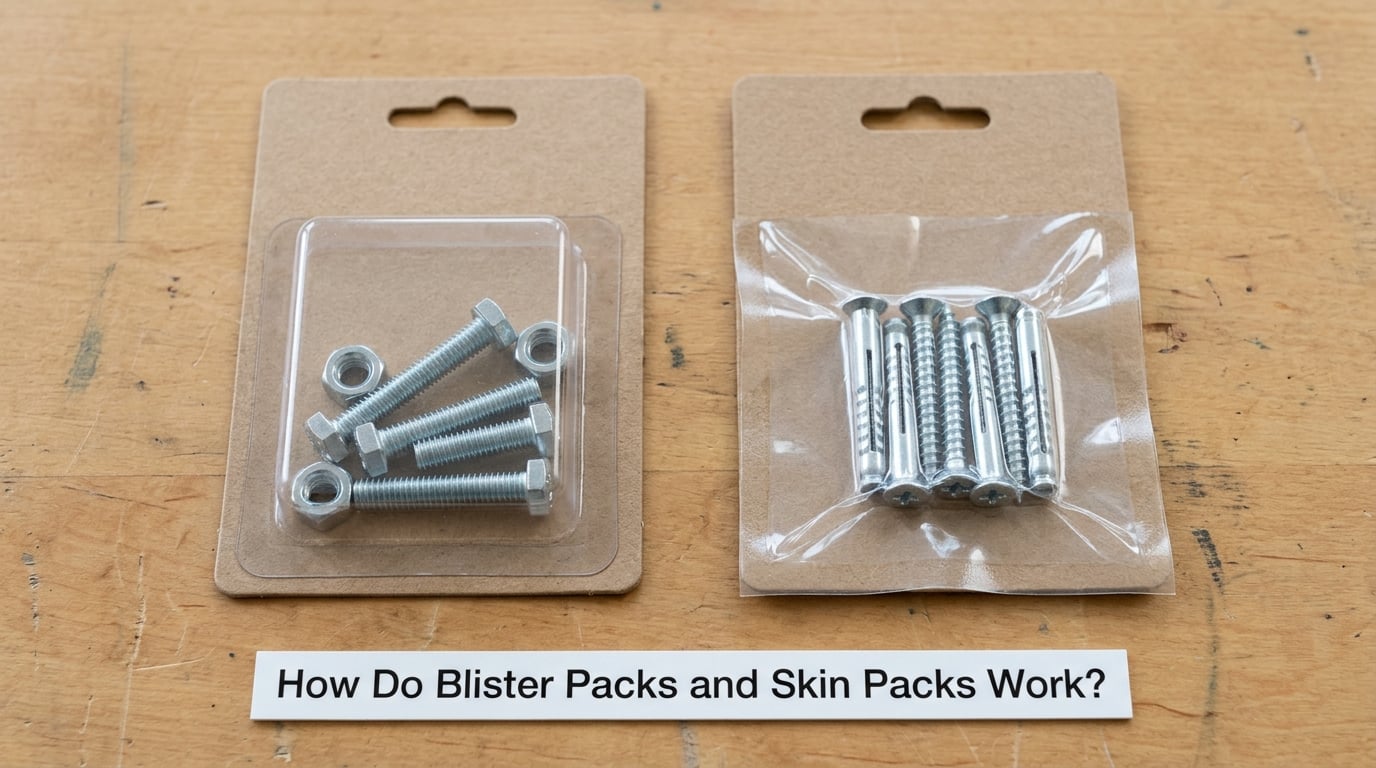
How a blister pack is made
A blister line forms plastic first and packs second. The order matters more than anything else in this comparison.
- A plastic web, typically 200 to 300 micron PVC or a PET-based sheet, is heated over a heating block until it softens.
- It is drawn down onto a negative mold, often with plug assist, to create a cavity with a flat flange around it.
- The product is placed into the cavity, by hand, by vibratory bowl feeder, or by a vision pick-and-place head.
- A printed card, a foil lid or a second film is heat-sealed onto the flange at a controlled temperature and dwell time.
- The pack is die cut to final size, with a hanging hole, keyslot or euro-slot if it is for peg-hook retail.
The common blister sub-types are the clamshell (hinged two halves), the face-seal blister (a shallow cavity heat-sealed to card, common for small hardware), the full-shear blister (cavity trimmed flush to the product outline for clean visibility), the folded blister (card folded around the pack), and the straight carded blister.
How a skin pack is made
A skin packaging machine reverses that order. The product goes down first, and the film is formed around it.
- The product is placed on a board that is either porous SBS stock or paperboard punched with pinhole perforations, and coated with a heat-seal lacquer.
- A film, commonly LDPE, ionomer or PET, is held above the board and heated until soft.
- The film is lowered onto the product and a vacuum is drawn through the board, so air escapes and the film collapses onto the product surface.
- The film bonds to the heat-seal coating around the product, creating a sealed pack with almost no trapped air.
- Excess film is trimmed off, and a die cut adds a hanging hole or a shaped outline.
Vacuum skin packaging (VSP) is the same idea with a controlled modified atmosphere for food, where a vacuum is not the only goal. Ambient skin packing, used for hardware and tools, only needs the vacuum for form and seal.
What Are the Main Differences?
The structural difference shows up in eight places. Formation order, as covered above, drives most of the others.
Structure. A blister has two discrete components: a formed plastic shell and a backing. A skin pack is one continuous film bonded to a board, so it has no seam crossing the face of the product.
Appearance. Blister film is thermoformed sheet that stays flat outside the cavity, so it prints and displays as a rigid card. A skin pack looks softer, with a slight pillow effect over the product’s high points.
Visibility. Both show the product, but a full-shear blister exposes the entire outline while a skin pack shows only what the film can drape onto without bridging. Bridging happens on deep gaps and fine features, and those areas look frosted rather than clear.
Tamper evidence. A blister seal is a wide, continuous bond. Pulling at it deforms the flange visibly. A skin pack seal is a narrower band around the product, and an experienced hand can lift film and reseal it.
Shape retention. A filled blister keeps a fixed depth and profile whether it is full or empty, which suits shelf planograms. A skin pack holds whatever shape the product gives it.
Insertion. Blister cavities are sized so the part drops in a fixed orientation, usually with a rail or pocket that resists misloading. Skin packing places the part by hand or fixture, so orientation control is a process problem rather than a package feature.
Drainage. A skin pack can hold liquid against the board if a product is wet or chilled. A blister cavity keeps liquid in a defined pocket, which is one reason fresh meat and produce often run skin rather than carded blister.
Sharp and heavy products. Rigid blister film will not form to an irregular outline; pointed corners also act as stress risers where the web was stretched during forming. Skin film conforms beautifully but has almost no puncture resistance, so a sharp edge in a skin pack is a defect waiting to happen.
Blister Packaging vs Skin Packaging by Product Shape
Shape is usually the fastest way to decide, and it overrides every other consideration.
Flat, regular, shallow items go to blister. Tablets, coin cells, razor blades, cable ties, washers, small connectors and printed pouches all sit well in a shallow face-seal cavity, hold their shape in transit, and print well on a card.
Bulky and tall items go to skin. Drill bits, sockets, pliers, a torque wrench, a small motor, a cable coil: a cavity deep enough for these becomes a bulky, expensive carton and a deep draw that stresses the web. A skin pack follows the tool’s own outline and ships in a thinner box.
Irregular, contoured or fragile items also favour skin, with caveats. Graphite rings, gaskets, seals and moulded plastic parts are exactly what a skin pack is good at, since the film reaches into recesses. The risk is load shifting between film and board if the part moves during vacuum draw, which causes a wrinkle over the highest point.
Products with unsupported areas are the hard case for both. A cavity deeper than the part leaves an air gap the customer can press on, and a skin film spanning a deep gap bridges and hides detail. The fix for blister is a stepped cavity or a support insert; the fix for skin is a film thickness and board choice matched to the gap.
Which Package Offers Better Product Protection?
Blister packaging protects better, and it is not close on mechanical performance. The cavity is a rigid shell with a defined wall thickness, so it spreads a point load instead of concentrating it and takes scuffs from a shelf edge.
Compression matters for blister trays and for anything shipped in a carton that gets stacked. Puncture resistance matters for sharp hardware. Abrasion matters for coated lenses and printed surfaces. Skin film, usually a thin polyethylene or ionomer drape, is a membrane rather than a shell, and one sharp corner under tension can open a tear that runs the length of the pack.
Where skin packaging wins is air and moisture exclusion. A good vacuum removes almost all headspace, which slows oxidation and gives fresh food a usable display life. It also makes the product visible in a way a semi-opaque barrier laminate cannot match.
Where blister wins is barrier specification. Barrier grades are a real, quantified category: 250 micron PVC sits around 3.0 g/m2/day water vapour transmission and roughly 20 cc/m/day oxygen transmission, a PVC/PVDC duplex drops to 0.25 to 0.65 and 0.1 to 1 respectively, and PCTFE-coated structures reach 0.06 to 0.40. If a shelf-life number has to be defended to a regulator, that is the language the pack speaks.
One honest downside of blister’s stronger seal is openability. Seals tough enough to deter tampering are hard to open, and clamshell injuries in US emergency rooms run to roughly 6,000 visits a year. That is a genuine reason to pick a peel-open or tear-notch design over a full clamshell for consumer goods.
Which Is Better for Presentation and Visibility?
Skin packaging shows more of the product, blister packaging sells more per unit of shelf space.
Skin film drapes to the outline, so there is no printed card between the shopper and the item. For a tool, a watch, a cosmetic container or anything bought on looks, that is the deciding factor, and it photographs well for online listings and unboxing content.
Blister wins on the printed surface. A card gives you a full face for branding, instructions, a barcode and compliance text, plus a hanging hole or euro-slot for a peg hook. A skin pack board can be printed too, but the visible area is smaller and the film often scuffs faster than a rigid flange.
Package bulk matters at the shelf and in the carton. A deep blister cavity adds dead volume, and it is dead volume in every box and every pallet. Skin packing keeps the pack close to the product, which usually means fewer cubic feet per unit shipped.
What Materials Are Used in Each Format?
Materials selection is where the two formats diverge most, because a drape film and a thermoforming sheet are engineered for opposite jobs.
| Structure | Typical barrier performance | Where it fits |
|---|---|---|
| Rigid PVC, 200 to 300 micron | About 3.0 g/m2/day WVTR and 20 cc/m/day OTR | General consumer goods, hardware, unit dose where cost rules |
| PVC/PVDC duplex | 0.25 to 0.65 WVTR and 0.1 to 1 OTR | Moisture-sensitive products, longer shelf life targets |
| PVC/PCTFE | Down to 0.06 to 0.40 WVTR | High-barrier applications, moisture-sensitive sterile items |
| PET, PETG or PP sheet | Clean, chlorine-free, lower barrier than coated PVC | Food contact, medical trays, sustainability-led specs |
| Cold form foil (aluminium) | Near-total oxygen and moisture barrier | Highest protection requirements, medical and sterile |
| LDPE, ionomer or PET drape film | Chosen for conformity and melt strength, not barrier | Skin packs for hardware, tools and produce |
Rigid PVC wins on cost and on formability, and it is collapsible enough to push a tablet through, which is the whole point of a push-through pack. Its liability is chlorine: PVC has a poor image in disposal streams, and barrier coatings make the structure harder to recycle.
PET and PP are cleaner from a chlorine and recycling standpoint. PETg and COP and COC are common in medical and pharmaceutical tray work because they run through sterilization and gamma or ethylene oxide without complaint.
For skin packaging, the film is usually LDPE for economy and easy melt, ionomer where stretch and draw-down around a hard product matter, and PET where clarity and dimensional stability matter more than cost. Backings are porous SBS or perforated paperboard with a heat-seal lacquer, and the perforation is what lets the vacuum pull air through the board in the first place.
That board is also the format’s weak point for recyclability, since a heat-seal coating on a paper substrate complicates repulpability.
How Do Cost and Production Requirements Compare?
Cost here is a volume question, not a per-unit question, and any single verdict without a volume is misleading.
Both formats carry custom tooling. A blister needs a custom mold and custom die cuts; a skin pack needs a custom board die cut and a tuned sealing profile. That fixed cost is amortized over every unit, so at a few hundred units it dominates the unit cost entirely, and at several hundred thousand a month it is nearly invisible. This is the band where small-batch users feel the real pain.
Blister lines run fast once set, because forming, sealing and die cutting happen in sequence without a vacuum cycle. Skin packing adds a film-heating step, a vacuum dwell and a trimming operation, so the cycle is longer, and the machine cost is higher because of the vacuum system, heater and sealing bar.
On materials, the two can go either way. Blister spends on rigid film plus card, and the film is measured in hundreds of microns. Skin spending is mostly board and a thin drape film, so consumables per unit are often lower. What skin adds is board, and the board has to be printed and perforated, which is where a skin pack’s cost quietly climbs.
Defect rate is the cost line that most surprises people. A wrinkled or torn skin pack is scrap, and a contaminated seal area stops a line until someone cleans the sealing bar. A blister that forms slightly off-register is also scrap, but the failure modes are more predictable once the former and dwell time are dialled in.
So the practical rule: at low volume, skin packaging usually wins on total landed cost because it avoids a full thermoforming line; at sustained high volume, the per-unit gap narrows and blister’s faster cycle and stronger presentation start to pay for the capital.
Which Format Is Easier to Recycle or Dispose Of?
Neither format is a single material, and both are genuinely awkward.
A blister pack pairs a plastic shell with a paperboard card or a foil lid, and the card is only recyclable once the plastic is removed, which nobody does at the kerb. Barrier coatings such as PVDC and PCTFE make the plastic harder still. Foil lidding is a different recycling stream entirely.
A skin pack has the same structural problem in a thinner form: plastic film over a paper board. The film is often a polyethylene, which is theoretically the friendliest plastic in the set, but the heat-seal lacquer on the board and the fact that the two are bonded together make separation a manual job.
Neither should go in a household recycling bin. For commercial volumes, check what your converter does, and check what your local facility actually accepts, because film and multi-layer structures are excluded from a lot of programmes. Reduced film gauge and mono-material structures are where both formats are heading, and they are worth asking about at specification stage rather than after the artwork is locked.
Which Should You Choose?
Match the format to the product and the channel, and the decision gets easy.
Choose blister packaging for:
- Unit-dose pharmaceuticals and push-through packs, where barrier and child-resistance figures have to be defended
- Medical device trays and sterile-barrier kits
- Small flat retail items that need a printed card, a barcode and a peg hook: batteries, blades, cables, connectors, light fittings
- Anything that ships in a mixed carton where compression and puncture resistance matter
- High-value items where a visibly disturbed seal is the point
Choose skin packaging for:
- Tools and hardware with height or an irregular profile: sockets, bits, pliers, wrenches, abrasives
- Kits and multi-part assemblies where a buyer should see every component at once
- Fresh produce, meat and deli items where visible product drives the sale and a vacuum extends display life
- Batteries, cables and small electronics accessories that look better photographed without a card over them
- Promotional and merchandise kits where appearance beats rigidity
Switch away from skin packaging when: the product has a sharp or pointed corner, the pack is being dropped or stacked hard, the film is bridging a deep recess, or the seal band is being contaminated. A torn skin pack reads to a customer as a used or unsafe item, and that is a bigger problem than a millimetre of extra packaging.
A short checklist to hand a converter: product dimensions and weight, the sharpest edge on the part, required shelf life and storage conditions, annual volume, retail channel, and any recyclability or material restriction in your market.
Frequently Asked Questions
Is skin packaging stronger than blister packaging?
No. Blister packaging is materially stronger because the film is thermoformed into a rigid cavity with a defined wall thickness, so point loads and scuffs spread across the shell. Skin film is a thin membrane draped over the product, so a sharp edge under tension can open a tear. Where skin packaging does better is air removal: the vacuum pulls almost all headspace out, which slows oxidation in fresh food.
Which packaging is cheaper for small orders?
Skin packaging is usually cheaper below a few thousand units, because the tooling is a board die cut and a sealing profile rather than a custom thermoforming mold and a dedicated sealing line. The capital equipment difference matters less than the tooling spread over a small run. Both formats also carry real scrap risk, and at low volume a defect rate can erase a per-unit saving entirely, so quote on landed cost.
Can blister packaging be used for food products?
Yes. Food uses PET, PETG, PP and cold form foil structures as readily as pharmaceutical PVC, and PET and PP avoid the chlorine question entirely. Barrier-coated structures are used where shelf life targets demand it. The decision usually comes down to whether you need a printed card and a rigid display, or whether you want the product visible and air excluded for a fresher look on the shelf.
What products are best suited to skin packaging?
Bulky, irregular, contoured or assembled products with height, curves or deep recesses. Tools, sockets, drill bits, cable coils, graphite rings, gaskets, multi-part kits and fresh produce all drape well. The format is a poor fit for anything with a sharp or pointed edge, because the thin film has almost no puncture resistance once it is tensioned over the product.
Is skin packaging recyclable?
Not in a household bin. A skin pack is a thin plastic film heat-sealed to a paper or SBS board with a lacquer coating, and bonded combinations like this have to be separated before either stream can be processed. For commercial volumes, ask your converter what they take back and check what your local facility accepts, since most domestic programmes exclude film and multi-layer structures.
How do I choose between a paperboard blister and a plastic blister?
Decide on the barrier requirement and the consumer open first. A paperboard card with a plastic cavity suits hardware and dry goods where cost and print area matter. A foil-backed or all-plastic laminate is for anything where moisture, oxygen or light control drives the shelf life and where a specifier will ask for barrier figures. Then check the seal design, because a very strong blister seal is a real injury and usability problem.
Conclusion
For blister packaging vs skin packaging, the rule is simple. Specify blister when you need structured presentation, a printed card, quantified barrier and resistance to puncture or crushing. Specify skin when you need the product fully visible, close conformity to an irregular shape and the lower landed cost of a short run. Then order samples from two converters, run your own drop and seal tests, and let your defect rate settle the choice before you sign tooling.