
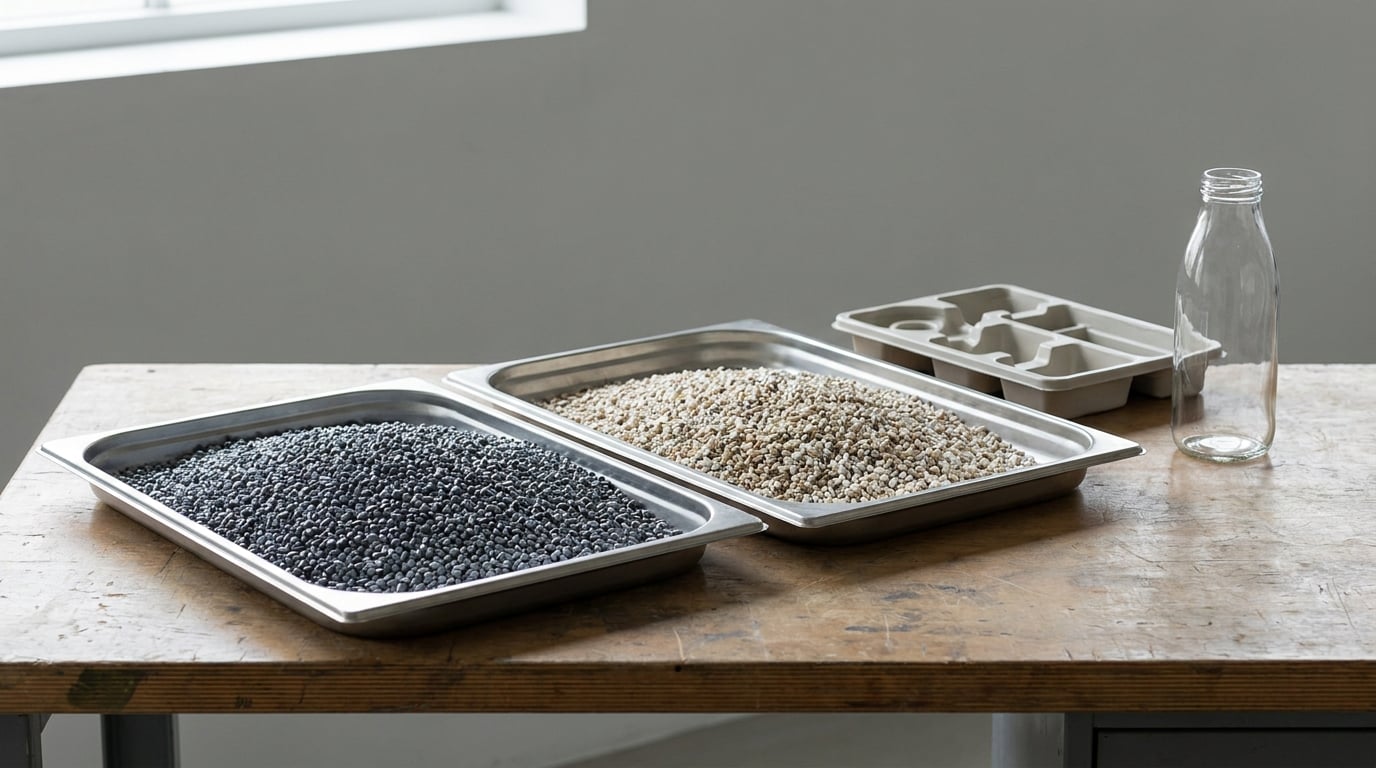
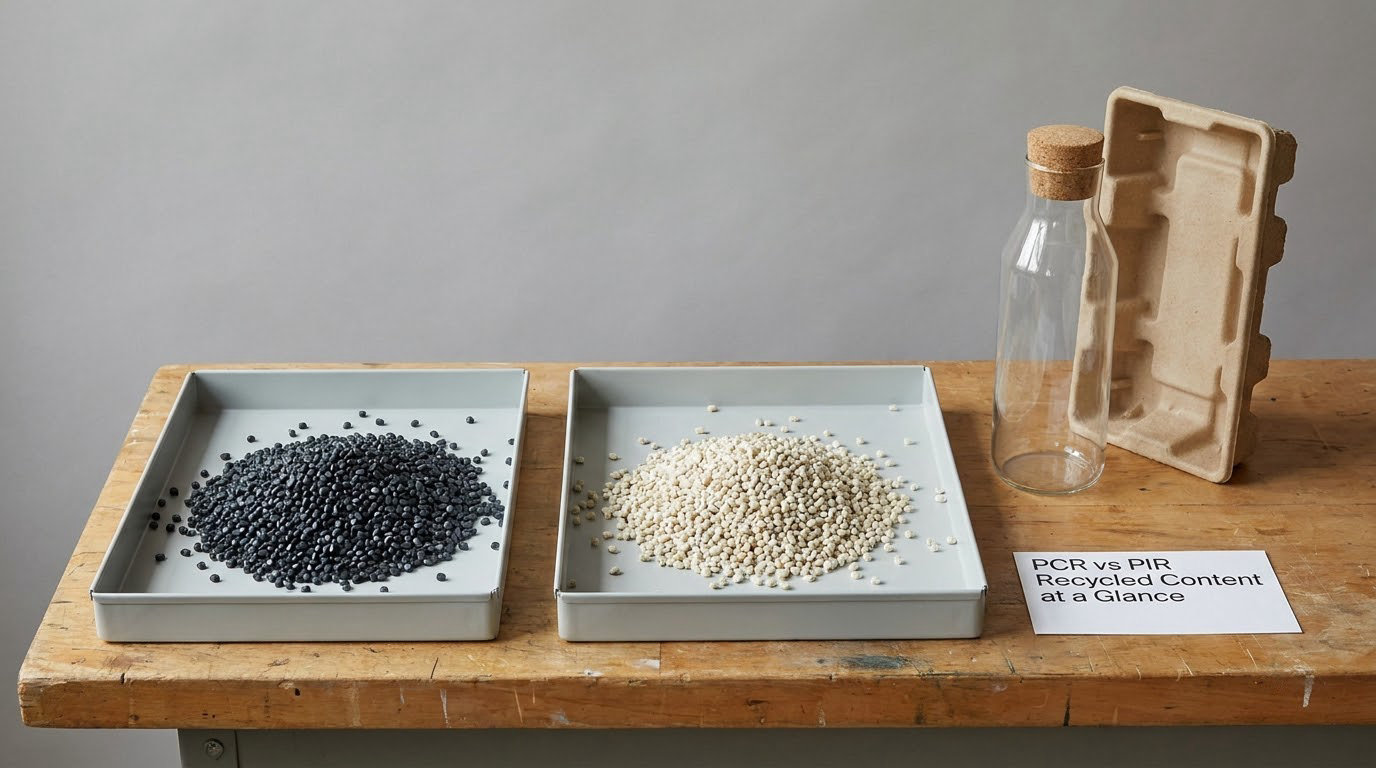
Here is PCR vs PIR recycled content explained without the jargon. PCR (post-consumer recycled) is material recovered from products households and businesses already used and discarded. PIR (post-industrial recycled) is scrap pulled out of the manufacturing process itself, before it ever reaches a shopper.
Both count as recycled content, and both displace virgin resin. Only one of them comes out of the waste stream, and that single fact drives price, batch consistency, which mandates you can meet, and what you are allowed to print on the pack.
Table of Contents
- PCR vs PIR Recycled Content at a Glance
- What Is PCR Recycled Content?
- What Is PIR Recycled Content?
- PCR vs PIR: Source and Consistency
- PCR vs PIR: Performance and Processing
- PCR vs PIR: Applications and Best Fits
- PCR vs PIR: Cost and Availability
- PCR vs PIR: Environmental Impact and Claims
- PCR vs PIR: How to Choose for Your Product
- Which Should You Choose?
- Frequently Asked Questions
- Which is better, PCR or PIR recycled plastic?
- Can PCR and PIR recycled content be used in food packaging?
- Does PIR recycled plastic perform as well as PCR?
- How do I verify the recycled content of a plastic resin?
- Can manufacturers blend PCR and PIR recycled content?
- Why does recycled plastic vary in color and odor between batches?
- Conclusion
PCR vs PIR Recycled Content at a Glance
| Criterion | PCR (post-consumer recycled) | PIR (post-industrial recycled) |
|---|---|---|
| Source | Used goods collected after they reach the end user | Cutting waste, regrind, start-up and reject parts from inside a plant |
| Where it enters the supply chain | After distribution and consumption, via collection and sorting | Before distribution, diverted at the production line |
| Typical polymers | PET, HDPE, PP, PS, plus paper, cardboard, glass and aluminum streams | Same polymer families, but the exact grade is known in advance |
| Consistency | Varies by collection region, season and sorting line | Highly consistent because the input is specified |
| Contamination risk | Higher; requires washing and decontamination | Low; usually already clean and single-polymer |
| Processing behavior | More filtration, wider melt tolerance, tighter QC | Runs close to virgin regrind behavior |
| Typical applications | Nonfood packaging, fibers, industrial components, automotive and construction parts | Nonfood packaging, rigid industrial parts, furniture, automotive interiors, pipe and profiles |
| Cost positioning | Higher, and more exposed to feedstock swings | Lower, and easier to contract around |
| Best use | Verified waste diversion and circular-economy positioning | Controlled production loops, high recycled-content totals, tight color specs |
| Regulatory standing | Counts toward most recycled-content and packaging mandates | Counts as recycled content but rarely satisfies a post-consumer minimum on its own |
What Is PCR Recycled Content?
Post-consumer recycled content is defined in ISO 14021:2016 as material collected from consumer end-uses and recycled into new products. The word that matters is end-use: the material has already done its job in a household, a shop or a workplace, and someone threw it away.
That means the feedstock arrives mixed. Bottles, tubs, film, caps and labels from thousands of households land in the same collection stream, often with paper, glass, metal and food residue attached. A material recovery facility sorts it, balers ship it, and a reprocessor washes, decontaminates, granulates and melts it back into usable regrind or flake.
PET, HDPE and PP are the workhorse streams because they have the volume and the market pull. Polystyrene and multi-layer flexible film are harder, since laminated structures have to be separated before the polymers can be recycled again.
What Is PIR Recycled Content?
Post-industrial recycled content is material diverted from the manufacturing process itself, before it ever leaves the factory and before it is used as a consumer product. Think injection molding runners and gating, thermoform cutting waste, film trim, off-spec batches and start-up scrap.
ISO 14021:2016 also draws a line here: material reworked, regrind or scrap generated within the manufacturing process of a product is not counted as post-industrial recycled content when that material does not leave the original process chain. In plain terms, an internal closed loop is efficient waste reduction, not a recycled-content claim on a pack.
That exclusion is why a genuine PIR grade is usually a scrap stream that gets collected, processed and sold as material in its own right, rather than simply ground up and fed back into the same press.
PCR vs PIR: Source and Consistency
PIR is the more predictable feedstock, because the producer already knew the polymer, the grade and the pigment before the material ever became scrap. Color, melt flow and contamination all stay inside narrow bands, which is exactly what a high-volume line needs to avoid constant process adjustment.
PCR is messier by nature. Batch color shifts with the collection region and the time of year, and contaminant levels move with sorting quality. A line running PCR usually spends more effort on incoming inspection, melt filtration and color matching between batches.
PCR vs PIR: Performance and Processing
Neither source is automatically the better resin. What changes with recycled feedstock of either type is process behavior: odor, melt strength, filtration load, and how much tolerance you build into drying and set-up.
PCR often needs higher melt temperatures to clean up residual contamination, and it can carry a faint odor that matters in food-adjacent and indoor applications. Material with multi-layer or incompatible residues left in also shows up as black specks and gel particles, which is a filtration problem before it is a quality problem.
PIR regrind is usually mono-material and low-contaminant, so it drops into a process much closer to virgin resin. That is a real advantage, but it is an advantage of the specific feedstock, not of the label: a poorly sorted PCR stream will behave worse than a well-controlled PIR stream in the same part.
PCR vs PIR: Applications and Best Fits
PCR vs PIR recycled content by material family
Availability differs a lot by polymer, so the feedstock question is partly a material question. In PET, PCR flake is widely available and a mature market, while PET PIR is common where bottle-to-bottle lines run in-house. HDPE and PP sit in the same position, with color grades more abundant than natural ones.
Polystyrene gives strong PCR supply in North America and more limited food-grade applications. For paper and cardboard, recycled mill scrap is abundant while post-consumer fiber depends on collection rates; recycled paper and board also carry fiber length reduction and a contamination profile that rules out some food-packaging uses. Glass and aluminum have long-running closed-loop systems where the post-consumer stream is the dominant source.
Where each feedstock fits best
Nonfood packaging is the natural home for both. PIR suits rigid industrial components, furniture and construction profiles, and automotive interiors where a controlled color and a repeatable melt matter more than a waste-stream story. PCR is the stronger fit when a program needs verified post-consumer percentages, fiber applications, or parts that demonstrate genuine diversion.
Regulatory and aesthetic requirements decide the rest. Direct food contact needs a decontamination step and, in most jurisdictions, regulatory approval of the specific process, which narrows the supplier list sharply for both feedstocks.
PCR vs PIR: Cost and Availability
Quoting a number here would do you a disservice, because recycled resin pricing moves with regional collection volumes, oil and virgin resin prices, and grade availability. The purchasing factors below are the ones that actually move the total.
Grade and color matter: a natural, sorted, single-polymer grade is worth more than a mixed dark one. Volume and contract length matter, since a converter that can commit to a steady monthly tonnage usually buys differently from one placing spot orders. Sorting costs sit upstream in PCR and get passed through in the price, while logistics distance to the plant matters for bulky, low-value regrind.
The hidden cost is qualification time. A recycled grade that fails a trial run costs more than the resin did, because you pay twice: once for the material, once for the downtime and the rework.
PCR vs PIR: Environmental Impact and Claims
Neither feedstock is impact-free, and both deserve honest framing. PIR prevents manufacturing waste from becoming waste at all, which is genuinely valuable, and it displaces virgin resin. What it does not do is remove plastic from the end-of-life stream, because that plastic was never in it.
PCR does remove material from the waste stream, which is why most recycled-content mandates and packaging rules are written in terms of post-consumer content. Trade press has been pressing on exactly this point: the recurring call in the sector is for companies to substantiate recycled content percentages rather than assert them, and buyers now expect to see the split between post-consumer and post-industrial.
Label wording carries its own exposure. A pack that says made with recycled plastic may be describing a PIR-only part, and green-claims checklists circulated in the industry treat recycled content as its own risk category, recommending wording that names the percentage, the material and the basis, for example contains 30 percent post-consumer recycled plastic by weight. Under the US FTC Green Guides and emerging EU green-claims rules, a vague or unsubstantiated environmental claim is the kind of thing regulators and competitors look at.
One asymmetry catches people out: recycled content does not mean recyclable. A multi-layer or pigmented pack can contain recycled material and still be unrecoverable in a real sorting system.
PCR vs PIR: How to Choose for Your Product
A short selection process saves more money than negotiating the price ever will:
- Write the requirement first. Application, food contact or not, cosmetic color tolerance, and the recycled-content percentage you actually need.
- Decide whether the percentage must be post-consumer. If a mandate, tax incentive or customer scorecard says so, PIR cannot fill that gap on its own.
- Ask each supplier for the PCR and PIR split, not just a total.
- Request third-party verification where the claim matters: APR PCR Certification, Global Recycled Standard or SCS Global Services are the routes buyers typically accept, and UL 2809 applies to specific assessed applications.
- Ask for chain-of-custody documentation tied to the plant and resin lot you will actually receive, not a generic certificate.
- Run a processing trial on both grades with your own settings, and measure rejects and cycle time rather than trusting a datasheet.
- Do a material health audit before setting long-term targets, the way most experienced procurement teams do.
What 20% PCR means on a label
It means 20 percent of the total product weight is post-consumer recycled material, with the remaining 80 percent virgin or other material. The number is a weight percentage of the whole, not of the recycled portion, and it is calculated on the finished article including additives and labels in most frameworks. It also says nothing about how much post-industrial material sits in the other 80 percent.
Which Should You Choose?
Choose PCR when the program needs verified post-consumer feedstock, a documented waste-diversion story, or compliance with a post-consumer minimum. Expect to pay more for it, spend more process attention on it, and treat the documentation as part of the material.
Choose PIR when the material comes from a controlled production loop and consistency is the priority: tight color specs, repeatable melt, high total recycled content, and parts where the post-consumer percentage is not the deciding metric.
Use a blend when neither pure grade solves the problem. Converters mix feedstocks deliberately to hit a high total recycled content while holding appearance and cost in range, and then report the split honestly.
Frequently Asked Questions
Which is better, PCR or PIR recycled plastic?
Neither is better in the abstract; they suit different jobs. PCR comes from the waste stream, so it proves diversion and satisfies post-consumer mandates, but it varies between batches and costs more to process. PIR comes from factory scrap, so it is cleaner and more consistent, which suits tight color and volume work. Many converters run both.
Can PCR and PIR recycled content be used in food packaging?
Both can, but both need a decontamination step and regulatory approval of the specific process before direct food contact. Some packaging uses stay non-food. Food-contact recycled grades are narrower and costlier to qualify, and recycled paper and board can also be unsuitable for food packaging because of fiber shortening and residual contaminants. Ask for the approval covering your exact use.
Does PIR recycled plastic perform as well as PCR?
Often yes, and frequently more predictably. Because the input polymer and pigment are known in advance, PIR regrind is usually mono-material and low-contaminant, so it runs close to virgin behavior with less filtration and odor. A badly sorted PCR stream will behave worse than a well-controlled PIR stream. Performance depends more on the specific grade than on the label.
How do I verify the recycled content of a plastic resin?
Ask for the PCR and PIR split by weight, the calculation method, and chain-of-custody documentation that traces to the specific plant and resin lot. Look for third-party certification such as APR PCR Certification, the Global Recycled Standard or SCS Global Services when the claim is consumer-facing. A generic certificate that does not name your lot is not verification.
Can manufacturers blend PCR and PIR recycled content?
Yes, and it is common commercial practice. Blending lets converters reach a high total recycled content while holding color, odor and cost within a workable range. The only rule is disclosure: report the post-consumer and post-industrial split rather than a single blended percentage, because a total recycled figure that is entirely post-industrial cannot support a PCR claim.
Why does recycled plastic vary in color and odor between batches?
The feedstock changes, and that is the honest answer. PCR depends on what consumers put into the collection stream, so color and contamination shift with region, season and sorting quality, and multi-layer residues show up as specks and odor that need higher melt temperatures to clean up. PIR is steadier because the producer specified the input, though a poorly controlled stream still varies.
Conclusion
Write the specification first: application, food contact or not, color tolerance, required percentage, and whether that percentage must be post-consumer. Then ask two suppliers for comparable PCR and PIR data, request samples with the PCR and PIR split and chain-of-custody documentation attached, and run a trial on your own equipment before you commit. Requirements in this space shift, so check the current text of any rule you rely on as of 2026.