

FIFO vs LIFO vs FEFO inventory methods decide which stock leaves your warehouse first, and that single choice shapes your cost of goods sold, your tax bill, and how much product you throw away. The short version: FIFO ships the oldest receipts first, LIFO ships the newest receipts first, and FEFO ships whatever expires soonest first. Most manufacturing operations run a mix of all three without calling it that.
I’ve sat through a lot of ERP go-live meetings where the costing method got bolted on at the last minute. The teams who pick a method per inventory category — instead of one setting for the whole plant — end up with cleaner numbers and fewer expired lots. Here’s how each method actually behaves on the floor.
Table of Contents
- FIFO vs LIFO vs FEFO Inventory Methods at a Glance
- What Is the Difference Between FIFO, LIFO, and FEFO?
- How FIFO Works in Manufacturing Inventory
- How LIFO Works in Manufacturing Inventory
- How FEFO Works for Perishable or Date-Sensitive Inventory
- Which Method Produces the Most Accurate Inventory Costs?
- What Is the Impact on Profit, Taxes, and Financial Statements?
- How Do FIFO, LIFO, and FEFO Affect Obsolescence and Traceability?
- Which Method Is Best for Raw Materials, Packaging, and Finished Goods?
- What Are the Implementation and Control Risks?
- FIFO vs LIFO vs FEFO: Which Inventory Method Should You Choose?
- Frequently Asked Questions
- Conclusion
FIFO vs LIFO vs FEFO Inventory Methods at a Glance
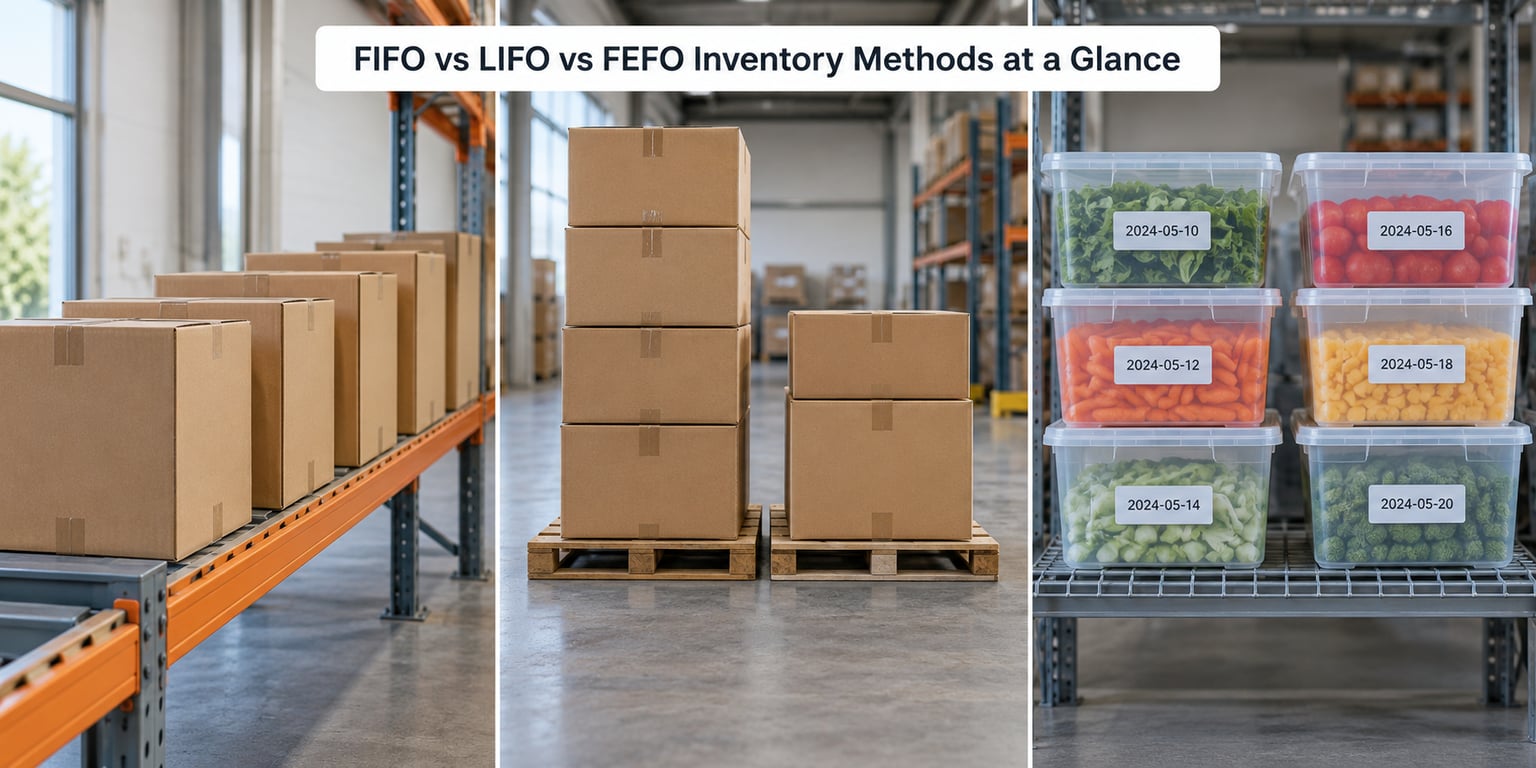
| Criterion | FIFO | LIFO | FEFO |
|---|---|---|---|
| Cost basis | Oldest unit cost | Newest unit cost | Oldest unit cost, oldest expiry |
| Typical inventory | Finished goods, components, packaging | Bulk liquids, loose resin, yard stock | Adhesives, coatings, chemicals, food |
| Best use case | General cost flow and repeatable picking | Tax modelling under inflation | Any shelf-limited material |
| Main advantage | Matches physical reality, simple to audit | Keeps gross profit steady in rising prices | Cuts expiry write-offs to near zero |
| Main drawback | Old costs inflate COGS in inflation | Old cost layers distort the balance sheet | Needs lot and expiry capture at goods-in |
| US financial reporting | Permitted | Not permitted | Permitted |
| Data you must capture | Receipt date and lot | Receipt date and lot | Expiry date, lot, sometimes retest date |
| Physical handling | Old stock forward, face to rack | Newest on top, oldest at the base | Oldest expiry to the pick face |
| Obsolescence risk | Low for standard parts | High — buried stock stays at old cost | Low, if the data is clean |
| Racking fit | Flow-through, push-back | Deep-lane, block stacking | Flow-through with date-sorted slots |
| Switching difficulty | Low | High — prior periods restate | Medium — needs historical dates |
That single-column view is the fastest way to shortlist a method. The rows that usually decide it are expiry data, physical layout, and whether the number has to survive an audit.
What Is the Difference Between FIFO, LIFO, and FEFO?
The three methods differ on one question only: which unit gets consumed next. Everything else — reporting, layout, software — follows from that choice.
FIFO: first in, first out
Units are issued in the order they were received. The oldest layer of stock costs out first, and the newest cost sits in ending inventory. This mirrors how material physically moves in most plants.
LIFO: last in, first out
Units are issued in reverse receipt order, so the newest cost layer becomes cost of goods sold and the oldest cost layer stays stranded in ending inventory. Physically, the oldest material has to stay put while newer material moves around it.
FEFO: first expired, first out
Units are issued by earliest expiration date, regardless of when they arrived. It is a rotation rule first and a costing rule second, though most systems apply FIFO costing to whatever lot FEFO selects.
Two accounting setups apply underneath whichever rotation you pick. Under a perpetual system, COGS updates with every transaction. Under a periodic system, COGS is computed once at period end. Same rotation, different timing of the numbers your controller sees.
How FIFO Works in Manufacturing Inventory
FIFO assigns the earliest purchase cost to the units leaving inventory. Say you buy 1,000 units of resin at 1.20 each in January, then 1,000 more at 1.35 each in March. Ship 1,200 units in April and FIFO costs out 1,000 at 1.20 and 200 at 1.35 — COGS of 1,470. The remaining 800 units stay in inventory at 1.35.
On the floor, FIFO only works if the physical movement matches the accounting. Most plants run it with a receipt-date queue in the ERP, reinforced by slotting so older lots sit closer to the pick face. Pallets are loaded with the oldest at the front of the lane, and new receipts go behind. Some operations add colour-coded monthly labels to the rack face, which works surprisingly well in a warehouse without a WMS.
Flow-through racking helps here. Because units travel from receiving to shipping in one direction, staff never have to reach past newer stock to reach old stock.
How LIFO Works in Manufacturing Inventory
LIFO assigns the most recent cost to whatever leaves. Using the same resin example, shipping 1,200 units costs out 1,000 at 1.35 and 200 at 1.20 — COGS of 1,590. Ending inventory drops to 800 units at 1.20, a figure that says very little about what that material would cost you to buy today.
The inflation effect is the whole reason anyone considers it. When input costs climb, LIFO pushes the newest, higher costs into COGS, gross profit stays steadier, and reported taxable income stays lower. In flat or falling price years, that advantage disappears and the trapped old layers become a liability.
Here’s the compliance split most US manufacturers get wrong. Under US GAAP, LIFO is not permitted for financial reporting. Under the Internal Revenue Code, a taxpayer may elect LIFO for tax purposes if it files the required election and obtains IRS consent to change later. Internationally, IFRS prohibits LIFO outright. So a plant can perfectly legally manage stock on a LIFO basis operationally while reporting to shareholders under FIFO — you just have to keep the two ledgers apart.
How FEFO Works for Perishable or Date-Sensitive Inventory
FEFO sorts stock by expiry date and issues the earliest expiring lot first. In regulated settings the sort key may not even be the printed expiration date. Common substitutes: a retest or re-evaluation date on stability-tested chemical inventory, a release date after quality inspection, or a cure date on resins that need conditioning before use.
Worked example: two drums of adhesive lot A received in January with an expiry in March, and lot B received in April with an expiry in September. A July job that consumes 50 litres takes all 50 litres from lot A. FIFO would have made the same call here, which is exactly the trap. Now reverse it — lot A received in March (expiry July), lot B received in January (expiry April). FIFO takes lot B; FEFO takes lot A, and the risk of a scrapped drum disappears.
The rule only works if the dates were captured accurately at goods-in. Practitioners running FEFO in Dynamics 365 or SAP report that the hard part is receiving discipline, not configuration. Goods sitting in staging for a week before formal receipt shift the dates and quietly break the rotation.
Which Method Produces the Most Accurate Inventory Costs?
Accuracy depends entirely on price behaviour and turnover. There is no universally best answer.
- Stable input prices: FIFO and weighted-average cost give near-identical results. LIFO also lines up well.
- Rising prices: LIFO COGS tracks what you most recently paid, so it reflects current replacement cost. FIFO COGS rises too, just with a lag.
- Falling prices: the pattern flips. FIFO keeps newer, cheaper costs in ending inventory; LIFO leaves dear old layers there and needs a write-down.
- Mixed product costs in one location: no rotation method rescues you. Accurate costing needs lot-level costing, not a queue.
- Rapid turnover: FIFO stays accurate because most units sell before prices move much. The longer stock sits, the more the number drifts.
For most plants, FIFO is the most accurate default simply because it is the only one of the three where the accounting answer and the physical answer are the same.
What Is the Impact on Profit, Taxes, and Financial Statements?
The method moves cost between two lines: cost of goods sold and ending inventory on the balance sheet. Under FIFO in a rising-cost year, COGS rises and reported gross profit falls, while ending inventory sits at recent, higher costs. Under LIFO, the reverse happens and the gap between the two cost bases is disclosed as a LIFO reserve.
Tax follows COGS, so LIFO generally defers tax during inflation. Analysts who want to compare a LIFO company against a FIFO company typically add the after-tax LIFO reserve back to net income to approximate FIFO earnings.
Keep two things separate. Operational costing decisions — which material to consume first to protect quality, which to write off — belong to the plant. Financial reporting belongs to the controller and the auditor. Many manufacturers manage stock FIFO on the floor and cost it FIFO on the books, with FEFO enforced as a quality rule on specific materials.
Worth knowing: the four common inventory valuation methods are FIFO, LIFO, weighted average (AVCO), and specific identification. FEFO is not a fourth valuation method — it sits on top of one of the first two.
How Do FIFO, LIFO, and FEFO Affect Obsolescence and Traceability?
FIFO is the natural answer to obsolescence because it moves the oldest stock out first. That matters most for electronics and components, where the risk is technological rather than chemical — a part that was current when you bought it may be superseded before you sell it.
FEFO targets a different risk: shelf life. It only outperforms FIFO when expiry dates are reliable and the oldest-expiring lot is genuinely reachable at the pick face. If short-dated stock is discovered during picking rather than before, FEFO has already failed.
LIFO is the worst of the three for obsolescence. Old layers sit at the base of the pile, priced at old cost, and nobody moves them because moving them raises COGS. In a yard with bulk liquids, that pattern gets worse every year.
For traceability, serial and lot tracking is what matters, not the rotation method. A recall still means quarantining every lot of a component regardless of how you cost it. Quality holds and inspection-release dates do interact with FEFO directly, because a lot on hold may carry the earliest expiry date but cannot be issued until the hold clears.
Which Method Is Best for Raw Materials, Packaging, and Finished Goods?
- Resin and pellets: FIFO, with FEFO where supplier dates are captured. Long shelf life means obsolescence drives the choice, not expiry.
- Chemicals, adhesives, coatings: FEFO. Shelf life, retest dates and cure dates all make receipt order irrelevant.
- Packaging film and printed cartons: FIFO, plus FEFO for anything printed with a customer-specific date code.
- Fasteners and standard components: FIFO. Value is low and turnover is fast, so rotation matters less than accurate counts.
- Work in process: FIFO by routing step date. Each queue needs its own timestamp or the cost rolls forward incorrectly.
- Finished goods: FIFO, with FEFO on any SKU carrying a warranty-driven expiry window.
Segmenting your SKUs with ABC inventory analysis makes this decision faster, because it tells you which items deserve lot-level date tracking in the first place.
What Are the Implementation and Control Risks?
- Configuration drift: the costing method set globally when every SKU needs something different. Configure per item group instead.
- Lot mixing in one location: loose partial lots defeat both FIFO and FEFO. Insist on full-location discipline or dedicated slots.
- Blocked access to old stock: newer pallets in front of the ones that must move first. Slotting and flow-through layouts fix this.
- Negative inventory: an uncorrected stockout makes the system fall back to a default cost silently. Monitor it as a control metric.
- Year-end adjustments: manual true-ups at period end defeat the point of the method. Reconcile lot balances instead.
- Receiving timestamps: goods staged before receipt shifts every downstream date.
- Returns: put returned stock back at its original receipt date, not the return date, or your rotation quietly resets.
- Switching methods: changing method restates prior periods and shifts valuations. Treat it as a project, not a setting.
None of this needs expensive software. Colour-coded monthly labels, a printed rotation board, and a weekly exception report work in a small warehouse. Barcode versus RFID choice is a separate decision — our RFID vs barcode comparison covers when each pays off — and it only matters once lot and date capture is reliable.
Counting discipline matters more than method choice. Cycle counting versus full physical counts decides whether your quantities are trustworthy enough for any rotation to work.
FIFO vs LIFO vs FEFO: Which Inventory Method Should You Choose?
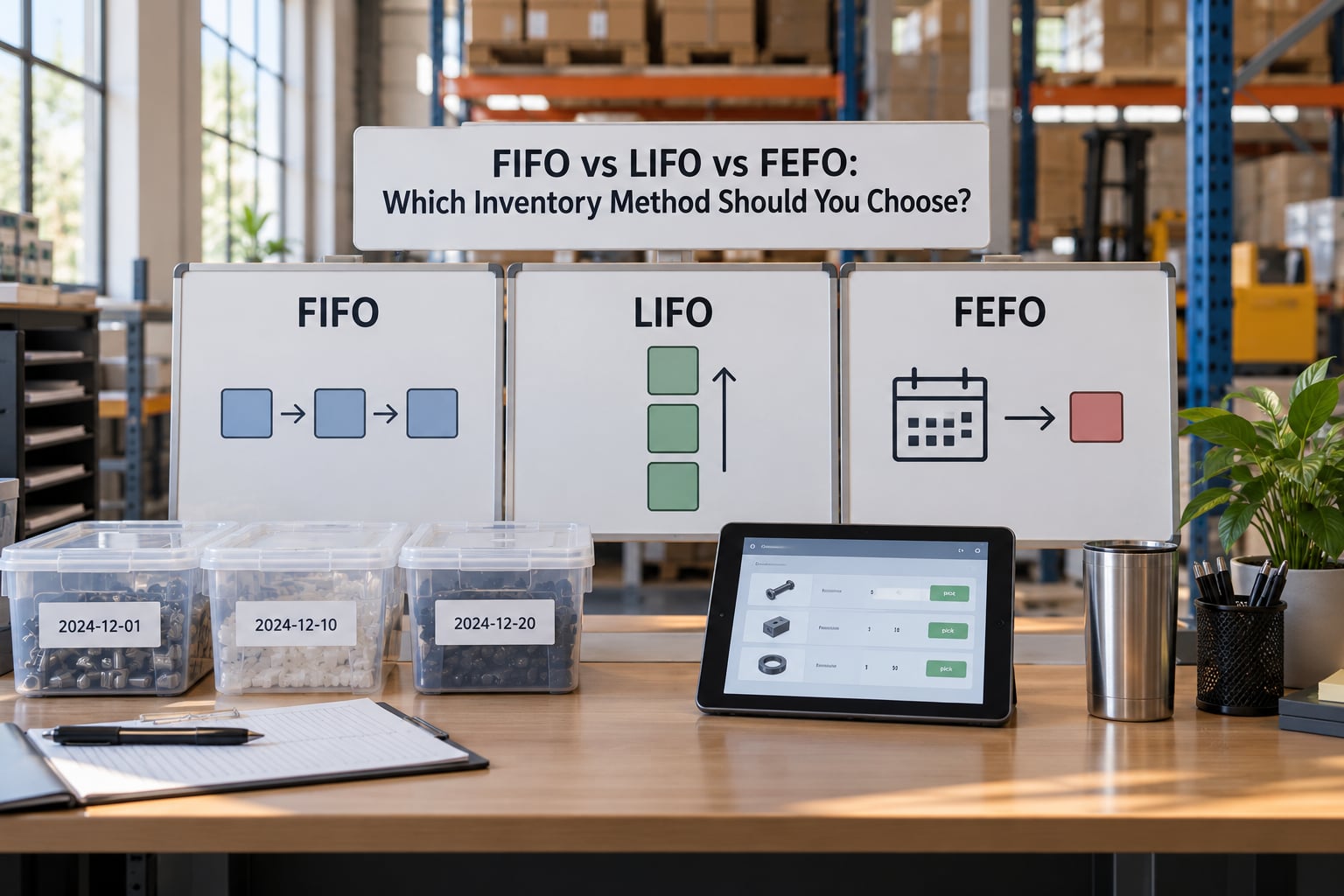
Choose FIFO for general cost flow, finished goods, and anything where you want the accounting answer to match the physical one. Choose FEFO for any material with a real expiry, retest or release date — food, chemicals, adhesives, coatings, and pharma, where regulators often require it. Choose LIFO mainly for tax modelling under inflation, where the US rules permit the election, and keep it out of your financial reporting.
A quick decision framework:
- Does the item have a legally or contractually defined expiry? Yes, set FEFO.
- No expiry, but a retest, cure or inspection-release date? Set FEFO on that date.
- Neither, and the item turns over fast? FIFO.
- Bulk material sitting long enough for costs to drift? FIFO for reporting, LIFO only as a tax sensitivity case.
- Regulated industry? Check whether your guidelines already mandate FEFO before configuring anything.
Implementation checklist: classify SKUs by date behaviour, set the method per item group rather than globally, confirm receipt and expiry capture at goods-in, slot locations so the correct lot sits at the pick face, train pickers on the reason rather than the rule, then run a 30/14/7 day expiry exception report weekly for the first two months.
Frequently Asked Questions
Is FIFO or FEFO better for a manufacturing warehouse?
For most plants it is not either or. FIFO handles components, packaging and finished goods where the risk is obsolescence. FEFO handles adhesives, coatings, chemicals and food, where a shelf limit sets the order. Many operations run both at once by item group. Decide per SKU based on whether a real expiry, retest or release date exists.
Can a US company use LIFO for internal inventory costing?
For internal and management reporting, yes. For financial statements prepared under US GAAP, no, LIFO is prohibited. For federal tax purposes it is permitted only with a formal election filed with the IRS and consent required to change later. IFRS prohibits LIFO entirely. Rules vary by country, so confirm with your accountant before relying on it.
Does FEFO assign the oldest production date or expiration date?
Usually the expiration date, but the sort key depends on what the date represents. Stability-tested chemical inventory often uses a retest date, resin may use a cure date, and material awaiting inspection uses a release date. The rule is to expire on the date that best limits risk in your process, which is why FEFO configurations vary so much between industries.
Should FIFO, LIFO, or FEFO be used in an ERP system?
Set it per item group rather than one global default, because a plant holding both resin and two-part adhesives cannot be served by a single rule. Confirm that lot and date capture happen at goods-in, since FEFO depends entirely on that data. Also decide early whether operational rotation and financial costing will be reported separately, which is common practice.
Which inventory method is best for plastics manufacturing?
FIFO for resin and pellets, where long shelf life makes obsolescence the real risk rather than expiry. FEFO for anything with a supplier shelf life, retest date or cure requirement. Many extruders add a third rule for regrind and quarantined material, which moves on its own schedule and needs a method configured separately from virgin resin.
Conclusion
FIFO is the sensible default for most manufacturing inventory, FEFO is the right answer the moment a real expiry or retest date exists, and LIFO belongs in tax analysis rather than your financial statements. Instead of arguing for one method across the whole plant, sort your SKUs by cost behaviour, shelf life and traceability needs, then configure the method per item group in your ERP. Start with the two categories that carry the most risk — anything with a shelf life and anything slow-moving sitting in the yard.