
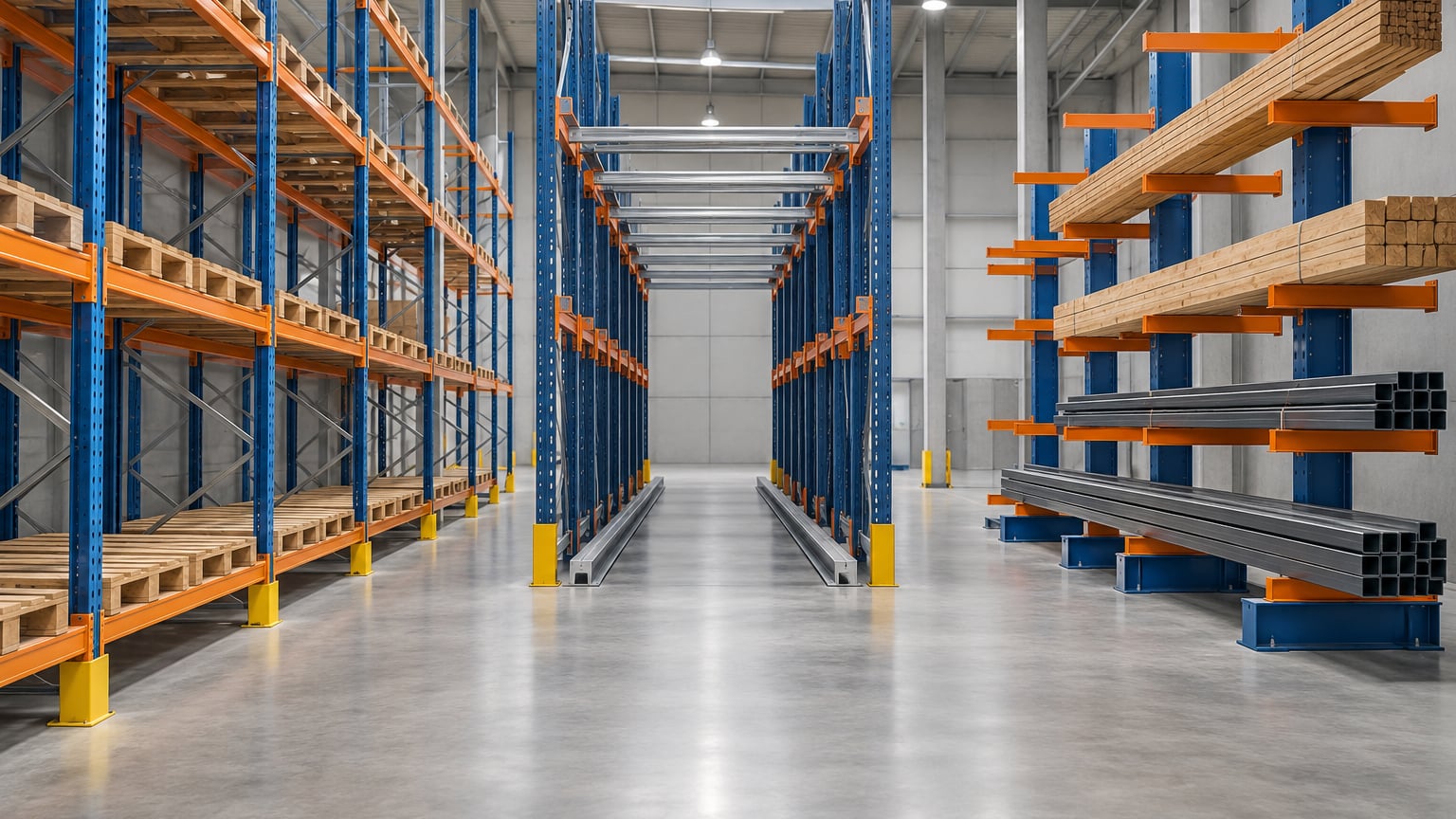
Pallet racking systems are engineered steel or modular frames that store goods on standardised pallets in horizontal bays and vertical levels, organised in rows so forklifts, reach trucks or automated shuttles can load and retrieve each pallet. Warehouse racks are usually called pallet racking or pallet racks. The type you choose sets how many positions fit in the building, how fast you can reach any one of them, and what happens to stock rotation.
Most people first assume one type is simply better. It isn’t. Every system trades storage density against selectivity, and the right trade depends on how your inventory actually moves rather than on how it looks in a catalogue.
This guide walks through the main rack types in plain terms, then shows how to pick between them and what has to be true before pallets go up on the beams.
Table of Contents
- Types of Pallet Racking Systems at a Glance
- What Is Pallet Racking and Why Does Rack Type Matter?
- Selective Pallet Racking
- Drive-In and Drive-Through Racking
- Pallet Flow Racking
- Cantilever Racking
- Rack-Mounted and Automated Storage Systems
- How to Choose the Right Pallet Racking System
- Pallet Racking Safety and Operational Considerations
- Frequently Asked Questions
- What are the different types of pallet racking systems?
- What are the racks in a warehouse called?
- What are the OSHA rules and requirements for pallet racking?
- What are the best types of heavy-duty racking systems for warehouses?
- What are the requirements for installing pallet racking?
- How much do warehouse racks typically cost?
- Conclusion
Types of Pallet Racking Systems at a Glance
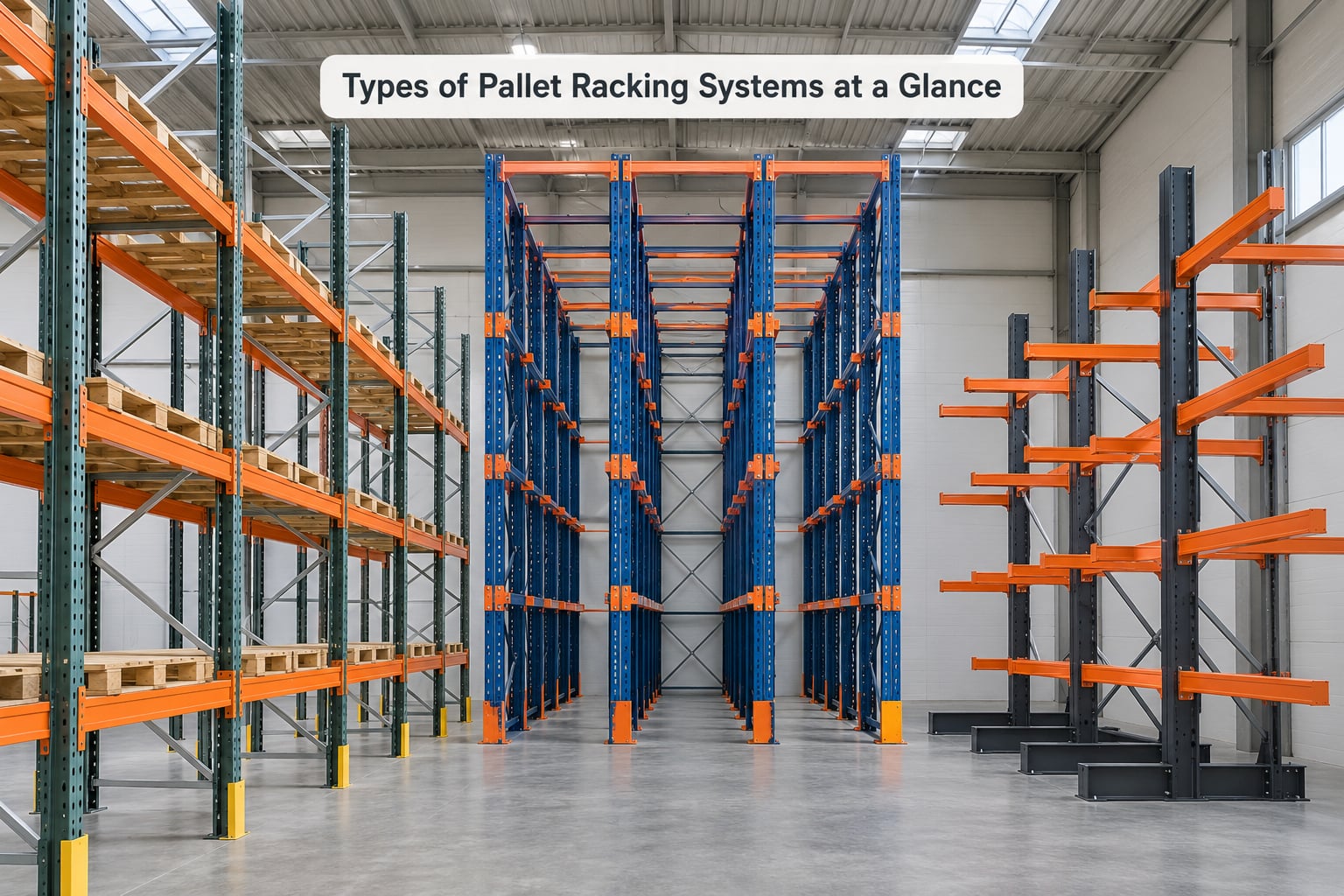
The table below sets the common pallet racking types against the four things that decide whether a system fits: how densely it stores, how directly you can reach a pallet, how stock rotates, and what equipment it demands.
| Rack type | Storage density | Selectivity | Stock rotation | Equipment needed | Best fit |
|---|---|---|---|---|---|
| Selective pallet racking | Low to medium | 100% | Flexible | Counterbalance forklift, reach truck | Mixed SKU, high-variety inventory |
| Double-deep selective | Medium | Partial (front pallet blocked by rear) | Flexible | Long-reach or double-reach forklift | Mid-volume SKUs with few variants |
| Drive-in / drive-through | High | Low, LIFO only | LIFO | Counterbalance forklift | Few SKUs, large quantities |
| Push-back racking | High | Low | LIFO or FIFO with limits | Counterbalance forklift | Reserve storage behind the pick face |
| Pallet flow (pallet live) | High | Last position only | FIFO | Forklift to load, pick face at front | Dated, perishable, FIFO-controlled goods |
| Narrow aisle / very narrow aisle | High vertical | 100% | Flexible | Reach truck, turret or man-up truck | Tall buildings, small floor area |
| Mobile pallet racking | High (no fixed aisles) | Adjustable | Flexible | Rail-guided or rail-free base | Cold stores, high-cost cubic metres |
| Cantilever racking | Medium (non-pallet) | Full arm access | Flexible | Forklift or long-reach truck | Lumber, sheet goods, pipe, furniture |
| Multi-tier / mezzanine | Very high (vertical) | 100% per level | Flexible | Forklift plus order picker | Limited floor area, low headroom |
| Shuttle / AS/RS | Very high | Automated | Programmable | Automated shuttles and conveyors | High-throughput, high-volume operations |
What Is Pallet Racking and Why Does Rack Type Matter?
A pallet rack is a frame of two uprights joined by horizontal beams, forming bays that hold one or more pallets per level. Two or more bays side by side form a row, and rows are laid out with aisles between them so a truck can reach in.
Roll-formed frames use shaped steel punched with slots for beam hooks and are light, cheap and quick to install for lighter loads. Welded structural frames use heavier plate, handle higher capacities and impact, and are the right call for wide aisles, tall bays, seismic zones or forklifts that hit the uprights regularly.
Three variables decide which rack wins for a given space:
- Density — how many pallet positions fit in the available cubic metres.
- Selectivity — how directly you can reach one specific pallet without moving others first.
- Throughput — how quickly goods move in and out per shift.
Gravity, rails, shuttles or mobile bases push, roll or carry pallets deeper into a row. That raises density and lowers selectivity. Everything else in this guide is a variation on that one trade.
One more distinction trips people up. A rack type is the storage mechanism itself (selective, drive-in, flow, cantilever). A rack configuration is how those racks are arranged in the building — single deep, back-to-back, double deep, drive-in rows, block-stacked. A specifier who confuses the two ends up comparing a narrow aisle layout against a drive-in system as if they were the same category.
Selective Pallet Racking
Selective pallet racking gives you direct access to every pallet position in the rack, with no other pallet in the way. Upright frames are spaced to suit your pallet size, beams carry the load, and wire decking or pallet supports sit between them.
Standard GMA pallets at 48 x 40 inches fit a roughly 108 inch bay; a 48 x 45 inch pallet needs a wider frame, and europallets at 1200 x 800 mm need their own sizing. Getting bay width wrong is the most common sizing mistake in a new warehouse.
A typical bay holds 4 to 8 pallets across, and 2 to 5 beam levels vertically, depending on the load. Each level’s capacity is set by the beam span and the material, which is why a supplier should publish capacity per beam level rather than a single number for the whole rack.
Selective racking is the default choice for most warehouses because it handles mixed SKUs, changes with demand, and stays flexible as your inventory shifts. The cost is aisle width: counterbalance trucks need roughly 11 to 13 feet of aisle, and each aisle is floor space you could otherwise be storing into.
Double-Deep and Back-to-Back Selective Racking
Double-deep selective racking stores pallets two positions deep, with a second row of frames behind the first. Access stays 100% selective from both sides, and density rises because two frames share one aisle. Back-to-back is a similar arrangement where rows are paired with a shared flue space, which some insurers require for sprinkler coverage.
Going two deep removes the ability to reach the back pallet without first pulling the front one. The equipment usually has to change too, so it suits a middle band of velocity: fast movers still earn their money with single-deep, while slow movers can sit two deep where nobody needs them often.
Drive-In and Drive-Through Racking
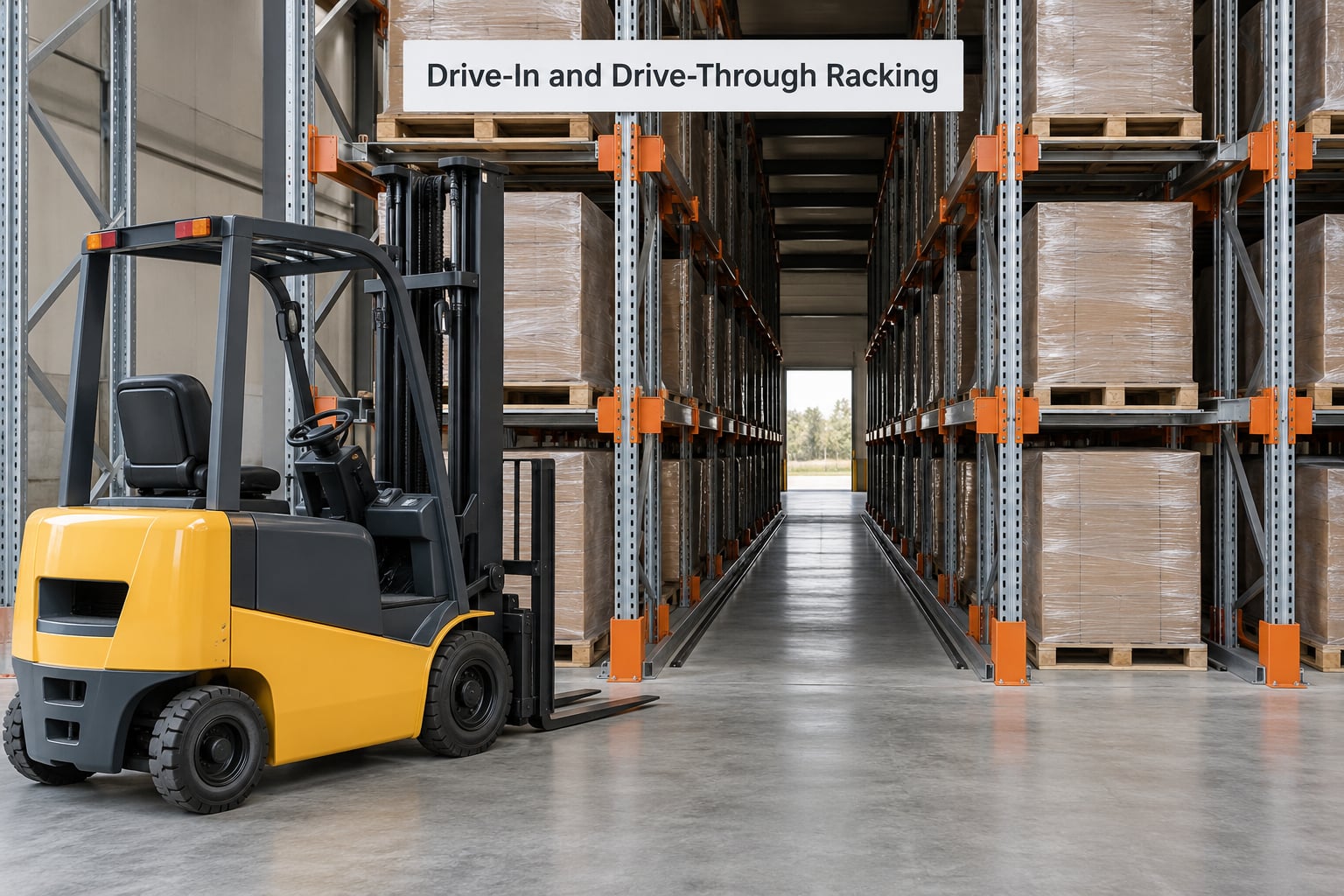
Drive-in racking removes the fixed pallets and lets the forklift drive into the lane itself. Rails guide the wheels, pallets stack on rails instead of beams, and the loading depth is set by rail length. You can hold two to six pallets deep, and nothing is picked from the front row.
Drive-through works the same way except each lane has an opening at the far end, so the forklift drives in and straight back out. Where drive-in blocks at the end of the lane, drive-through lets you keep loading from the far side too, which suits a high-volume operation with trucks working both ends of an aisle.
Both systems only work when the front pallet is the first one out, because nothing else can be reached. That makes them strictly LIFO. They suit few SKUs held in large quantities — resin, drums, long-run components — and they are a poor match for dated or FIFO-controlled stock.
The other tradeoff is damage. Pallets sit on rails rather than beams, so forklift strikes hit the rack structure, and any impact needs inspection before the lane goes back into use.
Pallet Flow Racking
Pallet flow racking, also called a pallet-live system or gravity flow rack, stores pallets on inclined tracks so each new pallet pushes the row forward automatically. Loading happens at the back, picking happens at the front, and FIFO rotation happens with no operator effort at all.
Two versions dominate. Roller flow lanes use steel or gravity rollers, hold more pallets per lane, and need a slight incline control to stop pallets running too fast. Pallet flow frames with rails suit pallet stacks that stay intact. Push-back racking holds the pallets in their own bays and lets the operator push back one pallet at a time, so it is cheaper to add but slower to rotate.
Flow racking needs discipline at the loading end. Nobody can reach a pallet except the front one, so replenishment has to happen before the lane empties, and the load rate has to roughly match the pick rate.
It earns its cost in food, beverage and dated goods, where rotation is a legal and brand requirement rather than a preference. If you store resin, film or chemicals, it is worth understanding how your material handling systems for resin explained guide maps onto the load profiles you are actually running.
Cantilever Racking
Cantilever racking has no pallets and no beams — just arms cantilevered from upright columns, with front and back rest bars stopping loads rolling off. It exists because pallets are the wrong tool for long or awkward loads.
Typical cantilever applications are lumber and timber in bundles, sheet materials like plywood and MDF, steel bar and pipe, and flat-pack furniture or appliances. Loads sit on arms of different lengths, so a 20 foot sheet can share a run with a 6 foot bundle without any load blocking the one behind it.
Two configurations matter. Front-to-back cantilever is the simple version for one-sided retrieval, with a support post every few feet. Full double-sided cantilever has arms projecting both directions from one column line, halving the upright count and doubling the run length.
Rack-Mounted and Automated Storage Systems
Narrow aisle racking is still selective racking, just laid out with tighter aisles and taller uprights. A reach truck, turret truck or order picker works down aisles of about 6 to 8 feet instead of 12, which means far more racking in the same footprint. Very narrow aisle goes tighter still and needs specialised guided trucks or automated shuttles.
Mobile pallet racking puts the whole rack on rails or rail-free guides and slides it along an aisle to open up the position you need. Fixed aisles disappear, so storage density rises sharply. Operators on cold-store forums consistently point to mobile racking for exactly that reason: refrigerated cubic metres are expensive, and a fixed aisle in a freezer is wasted money all year.
Shuttle racking replaces the forklift inside the rack with a powered shuttle that moves pallets along rails and lifts them to the right level. An AS/RS goes further, running cranes or shuttles under software control with conveyors on both ends.
These systems raise throughput and density, and they raise the capital, the controls complexity and the maintenance load at the same time. Automation also constrains the building — clear heights, floor flatness and fire protection all have to suit the system, which is why retrofitting is often harder than it looks.
How to Choose the Right Pallet Racking System
Work through these six criteria in order. The first two settle the question in most warehouses before you ever look at a rack drawing.
- SKU velocity profile. How many pallets move per day, and what share of them are picked weekly versus yearly? High count and variety points to selective. Low count with deep quantities points to drive-in or push-back.
- Stock rotation requirement. If anything is dated, FIFO is not optional and flow racking moves to the front of the list. If everything is lot-tracked but not date-controlled, push-back can work.
- Load shape and weight. Pallets on beams, or long loads on arms? Heavy single pallets point to structural frames and reinforced beams. Non-standard or oversized loads usually mean cantilever or a custom hybrid.
- Equipment you already own. Drive-in, push-back and flow lanes work with a standard counterbalance forklift. Narrow aisle requires new trucks, new operator training and a new spare parts budget.
- Space and clear height. Floor area and aisle width decide horizontal density; building height decides vertical density. Measure usable clear height against the highest beam level plus sprinkler clearance before you design.
- Growth and equipment life. Racking usually outlasts the fleet that fills it. If you expect to add automation in five years, bay geometry and floor flatness should suit it now.
Practical experience is worth weighing here. Operators in materials-handling forums describe double-deep and push-back racking changing the daily picking rhythm, and the change in discipline is the real adoption cost — fewer misplaced pallets, but a stricter rotation habit.
If pallets are moving between your rack and outbound trucks often, load securing is part of the same system. Our guide to stretch wrap vs shrink wrap for pallet loads covers how wrap choice affects stacking quality, and how to choose a pallet pattern for shipping covers the deck and overhang decisions that determine your bay width.
Pallet Racking Safety and Operational Considerations
Collapsed racking is among the most cited causes of warehouse injury, and almost every collapse traces back to a load that exceeded the rack, an impact nobody reported, or a rack that was never engineered in the first place.
Load capacity and placards. Every rack should carry a placard showing its capacity and who approved it. If your racking has no placard and no engineering sign-off, that is the first thing to fix — operators on safety forums describe finding loads stacked above head height on racks that had never been load-tested.
Anchoring and floor loading. Uprights must be anchored to the slab, and the slab itself has to carry the point load plus the rack plus the load. Seismic anchoring requirements vary by region and matter more than most buyers expect. Column guards at aisle ends are cheap next to a forklift strike.
Inspection. OSHA 1910.176 covers the general duty that materials must be stored so they do not collapse or tip. Rack inspection is the practical version of that duty, and the Rack Manufacturers Institute (RMI) publishes the standard most US operations follow: damage inspection at least every regular shift where forklift traffic is involved, by trained personnel, with every damaged component tagged and taken out of service until repaired.
That last detail is where failures hide. Damaged beams get replaced while the upright they were welded to stays, so the remaining structure carries a load it was never rated for. Partial retrofit of mixed-age racks is a genuine problem, and the fix is engineering assessment, not another bracket.
Clearances and fire protection. Rack height and sprinkler clearance are negotiated with your fire protection provider under NFPA 13. Raising racks can force sprinkler relocation, and in cold stores the fire suppression design often dictates the aisle width you end up with.
Operator discipline. Trucks, load ratings, and the difference between reaching into a bay versus entering a drive-in lane all need to be in training, not folklore. Mixed old and new racking in one warehouse should be treated as one structure when assessing damage.
Frequently Asked Questions
What are the different types of pallet racking systems?
The main pallet racking systems are selective, double-deep selective, drive-in and drive-through, push-back, pallet flow (pallet-live), narrow and very narrow aisle, mobile pallet racking, cantilever, multi-tier and mezzanine, and automated shuttle or AS/RS storage. They differ mainly in how a pallet enters the bay, how densely pallets are stored, and how directly each position can be reached.
What are the racks in a warehouse called?
They are called pallet racks or pallet racking systems, and the frames are uprights, with the horizontal members called beams. Each pair of uprights forms a bay, each beam pair forms a beam level, and a run of bays forms a row. Steel shelving or static shelving is the usual term for non-pallet storage in the same building.
What are the OSHA rules and requirements for pallet racking?
OSHA 1910.176 requires materials to be stored so they do not collapse, tip or fall, which in practice means racks rated and marked for their load, anchored properly, and inspected for damage. Most US operations follow the Rack Manufacturers Institute guidance: regular inspections by trained personnel, immediate tagging and removal of damaged components, and a documented repair and re-approval process.
What are the best types of heavy-duty racking systems for warehouses?
For heavy loads, structural welded frames beat roll-formed frames because the plate absorbs impacts and carries higher per-level ratings. Drive-in and double-deep layouts suit few SKUs in deep quantities, while selective racking keeps access direct. Cantilever takes long heavy loads such as steel bar or timber bundles that overhang a standard bay.
What are the requirements for installing pallet racking?
You need an engineered layout with a floor loading assessment, uprights anchored to the slab to manufacturer and seismic specification, correct bay width for your pallet size, load placards on every rack, and clearances agreed with your fire protection provider under NFPA 13. Commissioning should include a documented load test or engineering sign-off before pallets are stored above head height.
How much do warehouse racks typically cost?
Cost is driven far more by configuration than by steel weight. Selective racks are the cheapest per pallet position, while double-deep, drive-in, flow, narrow aisle and automated systems all trade capital cost for density. The variables that move the number most are bay width, level count, rack height, anchoring requirements, and the extent of fire protection and sprinkler relocation work.
Conclusion
Start with inventory movement, not with a rack drawing. Sort your SKUs by how often they are picked and whether anything is date-controlled, then match those two facts to a rack type. Everything after that — density, selectivity, equipment changes, cost per position — follows from that one decision. Get it signed off by a qualified engineer before pallets go up, and document the load rating on the rack itself.