
A gemba walk checklist is a structured observation sheet leaders carry onto the shop floor to check safety, standard work, 5S, quality, flow, and machine condition against a written standard, then log what they saw as assigned actions. It turns a loose conversation with an operator into evidence a team can act on within days.
Gemba is Japanese for “the real place.” Go to gemba is the habit of going there yourself instead of reading a report about it, and genchi genbutsu means going to the source to see the truth for yourself. Those ideas came out of the Toyota Production System, and they are the whole reason the walk has to happen at the machine, not in a conference room.
The checklist itself is not the point. The point is that the walk produces a closed loop: observe, record, assign, verify. Shops that skip the loop end up with a binder full of observations and a floor that quietly stops answering questions.
Table of Contents
- What You Need Before the Walk
- Step-by-Step: Run a Manufacturing Gemba Walk
- 1. Define the walk objective and scope
- 2. Review safety, quality, and process standards
- 3. Prepare the route and observation form
- 4. Enter the gemba walk with operators
- 5. Observe the actual work and record facts
- 6. Test conditions and ask clarifying questions
- 7. Capture improvement opportunities
- 8. Close the loop after the walk
- Common Mistakes and How to Fix Them
- Frequently Asked Questions
What You Need Before the Walk
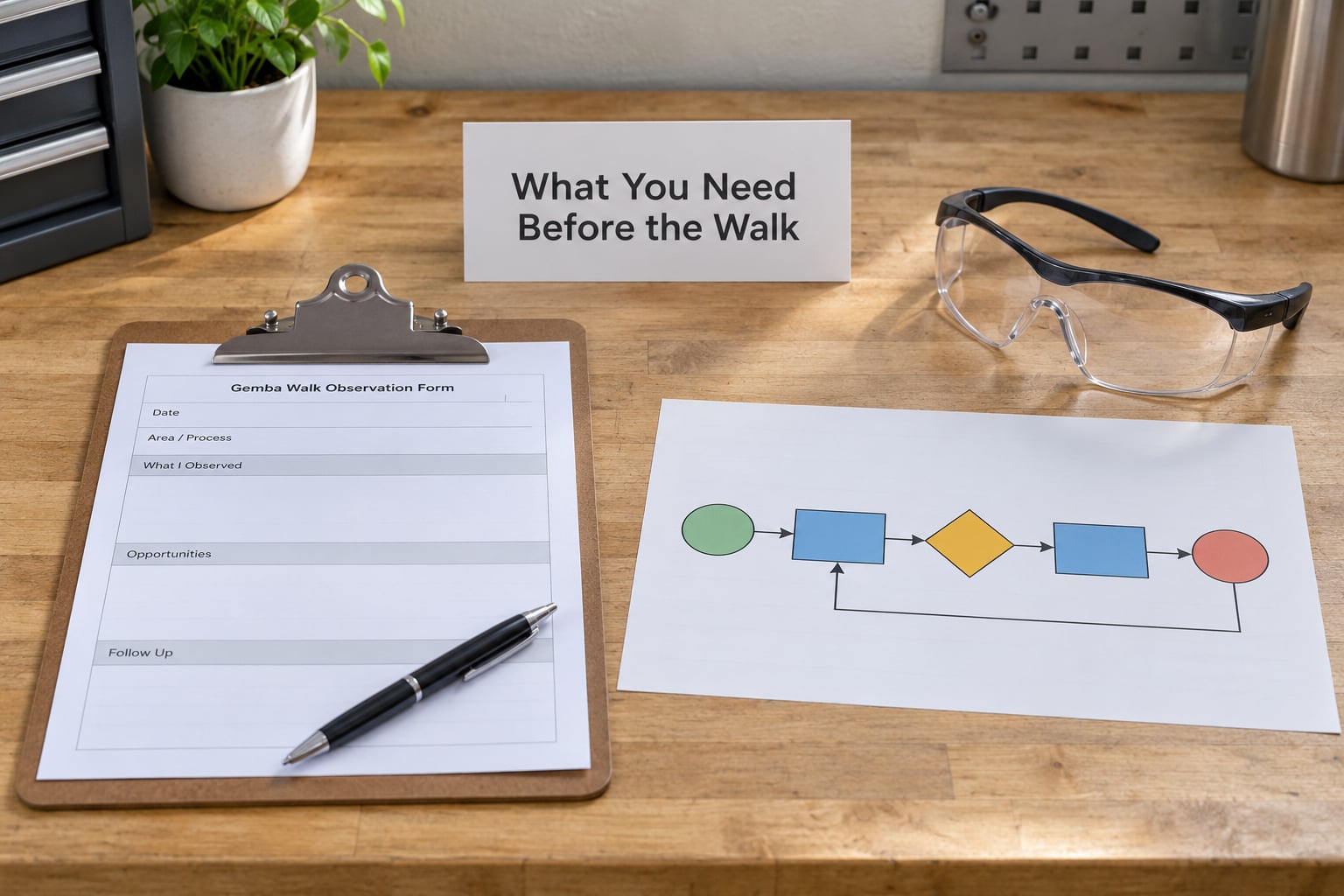
A gemba walk checklist works best when it is prepared like a job traveler, not scribbled on the back of a notepad at the machine. Six things matter.
A walk route. Sketch the physical path before anyone puts on safety glasses. Decide the order of stations, roughly how long you will spend at each one, and where you will start and finish. On a mixed shop floor, start downstream and work back toward the start of the value stream so you can see where material piles up and where it stops moving.
Safety and process criteria. Write down what good looks like. For safety that means the current SOPs, lockout requirements, guarding rules, PPE standard, and ergonomic limits. For process it means the cycle time standard, the control plan, the quality checks, and the expected staffing for the shift you are walking. If you cannot name the standard, you are not checking anything, you are just looking around.
A clipboard or a digital form. Paper still works well for short daily walks, especially on lines where nobody carries a device. Digital forms win when you need photo capture, timestamps, offline work in low-signal areas, or automatic routing to an owner. Choose one and stick with it, because switching formats between walks kills the trend data.
Standard work references. Bring the current version, not the one in someone’s head. A dated standard work sheet, the latest control plan, and the open corrective action list from the last walk tell you in seconds whether yesterday’s fix actually held.
Observation labels. Agree on a small vocabulary before you start so notes can be counted later. Most teams land on a handful: safety risk, standard work gap, quality issue, flow or waiting, 5S breakdown, equipment concern, improvement idea. Free-text notes are still welcome, but every entry should carry one label.
A follow-up process that already exists. Decide before you walk where findings go, who triages them, and when you will review. Thirty minutes in a huddle within 48 hours beats a beautifully formatted sheet that sits in a shared drive for a month.
Timing matters too. A single operator-cell walk should fit in 30 to 60 minutes. A whole-line walk with a cross-functional group is closer to an hour and a half. Longer than that and attention drops, especially on night shift.
Step-by-Step: Run a Manufacturing Gemba Walk
1. Define the walk objective and scope
Pick one process or one problem, not the whole plant. “Walk the assembly area” is too broad to produce anything. “Find why we are still hand-screwing brackets after the torque station” is a scope someone can close.
Write the objective in one sentence and name the area, the shift, and the people who need to be there. Production supervisor plus one operator from the cell is usually enough. Add quality or maintenance when the problem crosses departments.
How to know it worked: everyone on the walk can state the objective in the same words before you step onto the floor. If you cannot, tighten it.
2. Review safety, quality, and process standards
Read the standards you are about to check against, and pull the open actions from the previous walk. Cross-referencing the last findings takes two minutes and tells you whether the last improvement actually took hold.
Standard work is the reference for sequence and cycle time. The control plan is the reference for where quality checks belong. Your ergonomic and manual handling limits are the reference for whether a lift is safe. Prior corrective actions tell you what somebody already claimed was fixed.
Record on the form what document and revision you used. Six months from now, a missing revision number turns a fair conversation into an argument.
How to know it worked: you can name the specific document and version behind every line item on your checklist.
3. Prepare the route and observation form
This is the step where the gemba walk checklist actually gets built for the day. Lay out the observation points along your route, then match a checklist category to each one.
- Safety: guarding intact, emergency stops reachable and tested, clear egress, PPE worn correctly, no trip hazards, lockout procedures posted.
- 5S and housekeeping: tools returned to shadow boards, aisle markings honored, scrap contained, cables managed, shadow boards current.
- Standard work: documented sequence matches what the operator is actually doing, cycle time samples match the target, deviations have a visible reason.
- Quality: checks happening at the control plan points, records complete, defects contained and traceable, right-first-time holding.
- Flow and productivity: waiting time between steps, queue sizes at the bottleneck, changeover readiness, unplanned stoppages and their causes.
- Equipment: abnormal noise or heat, leaks, coolant and air pressure, sensors and lights functioning, preventive maintenance current.
- Engagement: whether operators raise issues unprompted, whether improvement ideas are visible and tracked.
Assign note-takers if you have three or more people. One person watching while another writes works better than one person trying to do both.
How to know it worked: your form covers every observation point on your route with no blank sections, and you know who is writing.
4. Enter the gemba walk with operators
Tell the cell you are coming and why, preferably a shift or two ahead. Supervisors report that sending the topic of your visit the day before roughly doubles the quality of the answers you get, because people arrive with examples ready instead of on the spot.
Open by saying what you are there to learn, not what you are there to check on them. Ask operators to describe the work while you watch. Stay out of the way physically, keep your hands off the parts, and do not correct anyone mid-task.
Ask open questions and stay quiet afterwards. “How long does that usually take?” gets a real number. “Are you having trouble here?” gets a polite no.
How to know it worked: operators describe their own process in more detail than the documented standard does.
5. Observe the actual work and record facts
Separate what you see from what you think it means. “Cycle time on part 3 ran about 15 seconds over target in four of five samples” is a fact. “The operator is slow” is a conclusion, and conclusions taken from a 60-second sample are usually wrong.
Quantify where you can. Time a few cycles. Count parts in the queue. Note the machine state when a stoppage starts and what happens immediately before it. Record the location and the clock time next to every observation so the shift lead can reconstruct it later.
Sample across the whole observation window rather than the first thirty seconds. Setup, end-of-run cleanup, and the tail of a shift all hide losses that a quick glance misses.
How to know it worked: someone who was not on the walk could read your notes and know exactly where to look.
6. Test conditions and ask clarifying questions
Anything unusual deserves a second look. Ask whether the condition is normal or a one-off. Repeat an observation at a different point in the run or on the other shift, because a bottleneck that shows up on days only points at a schedule or staffing problem, not a machine problem.
Keep pulling at why. Five Whys is enough for a walk, and any deeper work belongs in a separate root cause session with the people who own the process.
Ask what the person wishes they had time to fix. That question regularly produces more improvement ideas in a shift than a full audit does.
End the questioning with the meta-question: what did I not ask that I should have? It surfaces the gaps in your own form and is the fastest way to fix the checklist for the next walk.
How to know it worked: you can separate system causes from individual behavior, and you know which questions you should have asked.
7. Capture improvement opportunities
Every finding on the gemba walk checklist needs six fields to survive the week: what was observed, the evidence, the impact, any immediate containment, an accountable owner, and a next step with a date.
Containment happens on the spot for anything with an immediate safety or quality risk. Stop the hazard, isolate the affected material, notify the supervisor. The rest waits for the debrief, ranked by risk first and impact second.
Group symptoms without losing detail. If five observations all point at the same waiting step, one improvement idea with five pieces of evidence beats five separate tickets that nobody owns.
Log suggestions the team chose not to pursue, with the reason. That record is what stops the same idea being re-proposed every quarter.
How to know it worked: each action has one name and one date against it, and nobody can say who owns it.
8. Close the loop after the walk
Debrief within 15 minutes if you can, with the people who were on the walk. Read back what you recorded and let them correct it while it is fresh. Send the summary out within 48 hours, every time, including the walks where the news was good.
Rank the opportunities, assign owners, and set dates. Small fixes close inside a week; larger ones need a plan and a check-in date rather than an open-ended promise.
Then verify. Walk back to the same observation points after a month and compare. Closed actions that regressed are a signal that the fix needed a standard change, not just a one-time correction.
Track a small set of numbers for the program: walk frequency, findings per walk, percentage of actions closed on time, average days to close, and the number of ideas that came from operators. Trends across walks tell you far more than any single sheet.
How to know it worked: the same operators volunteer information sooner on the next walk, and your action list is shorter than it was last month.
Common Mistakes and How to Fix Them
Running it as an inspection. The moment people hear the walk is a check on them, they switch to inspection behavior and the useful information stops. Say explicitly that the walk is about the process, that no individual performance is being scored, and keep that promise for several months before anyone believes it.
Writing observations like opinions. “Operator seems disengaged” cannot be acted on. “Operator checked incoming parts twice during a 20-minute window because the receiving screen was not visible from the station” can be fixed this week. Push the team to describe the system, not the person.
Interrupting the work. Stopping a cycle to ask a question teaches people to hide the problem until the leader walks away. Batch your questions, watch a full run, and keep disruption to under a couple of minutes at a station.
Solutioning before you understand. The suggestion that pops into your head mid-observation is usually wrong, and offering it early ends the conversation. Write suggestions for later and let the operator who owns the work finish describing it first.
Leaving operators off the walk. A cross-functional group of managers alone finds surface issues and misses the real ones. Put at least one person who does the work on every walk, and rotate who leads it so it does not become one leader’s pet project.
Dropping findings after the debrief. This is the one that quietly kills gemba walk programs. If three walks in a row end with no visible change, people stop investing an hour of their week. Close at least one item from every walk, and report back on it at the next huddle, even the small ones.
Rushed walks. A twenty-minute dash through a line is a tour, not a gemba walk. If time is short, walk fewer stations properly rather than more stations superficially.
One habit fixes several of these at once: send the topic and two or three open questions to the area a day ahead. Better answers, less interruption, and the walk starts as a conversation instead of a surprise.
Frequently Asked Questions
How long should a gemba walk take?
Most single-cell or single-process walks take 30 to 60 minutes, with 5 to 10 minutes at each observation point. A full production line with a cross-functional group usually runs 60 to 90 minutes. Longer walks lose attention, so narrow the scope and walk again rather than pushing past two hours.
Who should be part of a gemba walk?
Keep the group small: the person who owns the process, one or two operators from that process, and a specialist when the issue crosses departments, such as quality, maintenance, or safety. Rotate who leads the walk so it does not become one manager’s project, and always include someone who does the work.
How often should we conduct gemba walks?
Weekly short walks of 30 minutes tend to sustain engagement better than occasional two-hour tours. Daily huddle-level checks work for fast-moving lines, while a monthly full cross-functional walk suits slower processes and new programs. Consistency of follow-up matters more than the exact interval you pick.
What should I record on a gemba walk checklist?
Record the location, time, and shift, then for each finding note the category label, the observed fact in numbers where possible, the immediate risk, an owner, and a next step with a date. Capture photos and cycle-time samples. Skip anything you cannot hand to someone else and act on without asking you what you meant.
How do you score or rank gemba walk findings?
Rank by risk first, then by operational impact. Safety hazards and quality escapes go to the top regardless of size. Below that, score each item on severity, frequency, and effort to fix, and give every item an owner and a date. Resist a numeric scoring formula until you have three or four walks of baseline data to compare.
How do you turn gemba walk observations into improvements?
Debrief within 15 minutes, send the summary out within 48 hours, and rank items by safety risk then impact. Assign one accountable owner and a date per action, close the small ones fast, and schedule a follow-up walk to the same observation points after about a month. Track closure rate so the program has a number worth defending.
Start with one process this week. Pick a station, bring an operator, use the seven categories above as your gemba walk checklist, and close one finding within 48 hours. Repeat it next week with the same points and the same form, and the pattern in the data will tell you where the real loss is hiding.