
Manufacturing cost per unit is the total cost of producing one good unit — direct materials plus direct labor plus manufacturing overhead — divided by the number of good units the period produced. To calculate it, price every input per unit, add the three components, adjust for scrap, then divide. Every figure in this guide is in US dollars.
The order of operations matters more than the arithmetic. Most costing errors come from dividing by units started instead of good units shipped, or from leaving tooling and freight out of the model and being surprised by them later.
Finish in about an hour if your production records are in decent shape. If nobody is tracking cycle times or machine hours, the first pass is really a data-collection project, and it will take longer.
Table of Contents
- What You Need
- Step-by-Step: How to Calculate Manufacturing Cost per Unit
- 1. Define the Unit and Production Basis
- 2. Calculate Direct Material Cost
- 3. Calculate Direct Labor Cost per Unit
- 4. Add Machine and Manufacturing Overhead
- 5. Include Tooling, Quality, Packaging, and Logistics
- 6. Apply Scrap, Yield, and Volume Assumptions
- 7. Validate the Unit Cost and Compare It with the Target
- Worked Example: A Molded Plastic Enclosure
- Common Mistakes
- Frequently Asked Questions
- What is the formula for calculating the average manufacturing cost per unit?
- Is total manufacturing cost the same as COGS?
- How do you calculate a predetermined overhead rate?
- How much scrap and rework should I add to the unit cost?
- Should tooling, packaging and freight be in manufacturing cost per unit?
- How does volume change the cost per unit?
- Start With Your Own Production Data
What You Need
Gather these before you open a spreadsheet. Anything missing gets estimated, and estimates are where the argument with your accountant starts.
- Bill of materials with the standard quantity per unit and the current purchase price for each item.
- Routing or process sheet showing how many hours each part spends at each station, and which are operator versus machine hours.
- Loaded labor rates by department, including wages, payroll taxes, benefits and any shift premium.
- Overhead budgets by department: depreciation, electricity, maintenance, supervision, facility cost, insurance and property tax.
- Actual production counts for the period — units started, units completed, units rejected and units reworked.
- Tooling and packaging records, including the cost of the tool and the number of units it will produce over its life.
- Written assumptions for anything you estimate: yield, efficiency, volume for the period, and which costs belong in the model.
Write the assumptions down before you calculate. When the result is 4% off target, the assumption list tells you where to look, and a written list settles disagreements faster than a spreadsheet full of mystery constants.
Step-by-Step: How to Calculate Manufacturing Cost per Unit
1. Define the Unit and Production Basis
Fix the unit of account first. One finished good piece is the usual choice, but a batch, a case, or one good unit after rework are all legitimate bases — as long as the basis matches how you quote and how you invoice.
Then set the production quantity and the time period. A quarter of production data gives a steadier number than a single week, because a week with a machine down skews everything that gets allocated across it.
Decide whether you divide by units started or units that passed final inspection. For pricing and product profitability, good units is the right divisor, because a customer never pays for your scrap.
2. Calculate Direct Material Cost
Direct material cost per unit is the standard quantity of each input times its current price, plus a scrap allowance:
Material cost per unit = (standard quantity × unit price) × (1 + scrap factor)
The scrap factor is the difference between material issued and material that ends up in a good unit. If you issue 1,000 pounds of resin for 960 finished pieces, your factor is about 4%.
Include everything that physically becomes the product or ships with it: resin, components, fasteners, labels, print, and the packaging that protects the part. If a glue gun and a box both go out the door with the item, both belong in this line.
3. Calculate Direct Labor Cost per Unit
Direct labor per unit is the hands-on time each unit consumes multiplied by the loaded rate for the department that does the work:
Labor cost per unit = direct labor hours × loaded hourly rate × (1 + burden %)
The burden percentage covers benefits, payroll taxes and insurance on wages. Rates from 25% to 35% of base pay are common in US manufacturing, and using the wrong one quietly shifts several dollars per unit.
Count time honestly. Include setup if setup happens at every run, count rework time as labor, and use a realistic efficiency assumption. A standard built at 100% efficiency on paper never matches the floor, and the gap shows up as an unexplainable variance every month.
4. Add Machine and Manufacturing Overhead
Manufacturing overhead is everything the plant spends that is not material and not direct labor: machine depreciation, electricity, maintenance, tooling maintenance, supervision, floor space, insurance, property tax and factory supplies.
Allocate it with a rate and an allocation base:
Predetermined overhead rate = budgeted overhead ÷ budgeted allocation base
Applied overhead per unit = rate × hours the unit actually used
The base should follow what actually drives the spend. Machine-heavy departments like machining usually justify machine hours, because the expense tracks spindle time rather than headcount. Assembly and inspection lean on direct labor hours instead, since the cost follows the people. Manufacturers who use the same base across every department end up overcharging the labor-heavy lines and undercharging the machine-heavy ones — a common source of product mix arguments.
Our guide to calculating a machine hour rate walks through building the per-hour figure when you want the burden built up from assets and power rather than from a budget total.
When two plants run similar equipment but carry very different burden rates, comparing them at face value is misleading. Capacity constraints usually explain the gap, and one plant may simply have no room to absorb the volume that would level the rates out.
5. Include Tooling, Quality, Packaging, and Logistics
Tooling is usually a one-time cost, so amortize it across the volume you honestly expect to run:
Tooling per unit = tool cost ÷ expected lifetime units
Use a realistic run quantity, not the optimistic one in the sales deck. Our tooling cost guide covers how the amortization period changes with mold complexity and steel. Amortizing over three years of expected volume turns a 48,000 tool into 0.80 per unit at 60,000 pieces.
Quality costs belong in the model too: inspection labor, gauges and fixtures consumed, scrap that bypasses your scrap factor, and the cost of customer returns. If inspection happens after production and nobody has priced it, that labor is still being paid.
Packaging and outbound freight are often split off as selling or delivery costs. That is a defensible accounting choice, but keep the split visible — the delivered cost, not the factory cost, is what most buyers compare. Our total cost of ownership walkthrough shows how to fold freight, packaging and service into one number for a part.
6. Apply Scrap, Yield, and Volume Assumptions
Scrap shows up twice if you are not careful. If you applied a scrap factor to material in step 2, do not also subtract rejected units from the good-unit count for the same loss, or you will penalize the product twice.
Volume assumptions change overhead per unit more than they change material or labor. At twice the volume, the same machine budget spreads across twice the hours, so the machine hour rate roughly halves while material cost per unit barely moves. Model low, expected and high volume, and quote from the expected case.
Rework deserves its own line. A part that comes back for repair consumed material and labor twice. Track rework hours and added material separately, then decide whether to absorb it into the standard or hold it as a variance.
7. Validate the Unit Cost and Compare It with the Target
Reconcile the result against three references: historical actuals from the last closed period, open supplier and customer quotes, and the target sell price your sales team is working from. If the calculated cost sits far outside all three, look at your assumptions before you look at your data.
Rank the uncertainty in writing. For most plants the largest unknowns are yield, the overhead rate, and the tool amortization period, in roughly that order. Those three deserve a monthly review; the rest can wait.
Worked Example: A Molded Plastic Enclosure
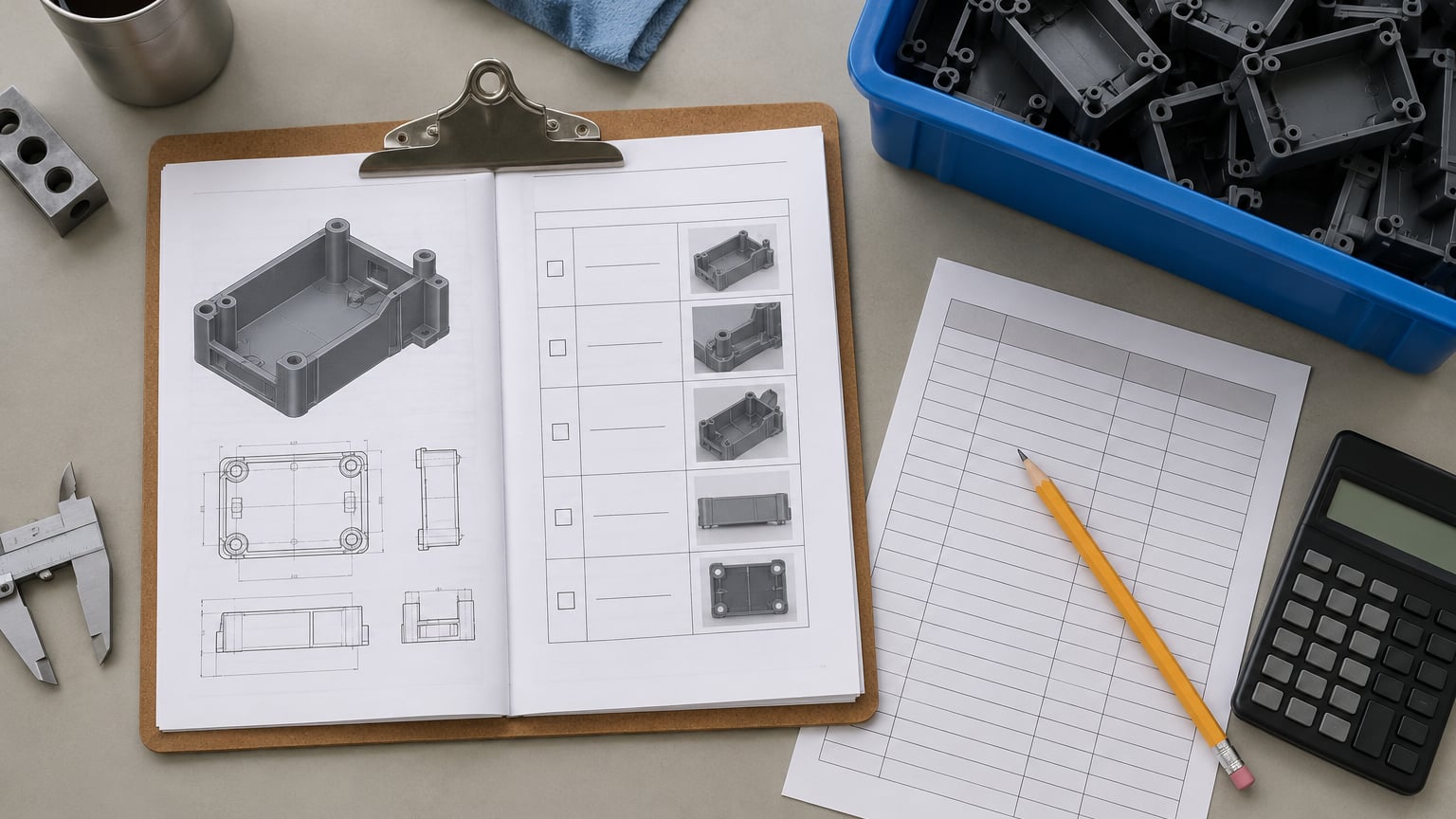
A plant runs 5,000 units of a molded enclosure per quarter, with 4,800 good units after a 4% reject rate.
- Standard material per unit: 0.665 resin + 0.620 inserts + 0.110 fasteners and labels + 0.050 process aids = 1.45
- Direct labor: 0.35 hours × 34.00 loaded = 11.90
- Machining overhead: budget 64,000 over 1,000 machine hours (0.20 per unit) = 64.00 per machine hour, so 12.80
- Assembly overhead: budget 21,600 over 750 labor hours (0.15 per unit) = 28.80 per labor hour, so 4.32
- Quality: 12,000 of inspection and gauges across 5,000 started = 2.40
Period manufacturing cost = 7,250 material + 59,500 labor + 64,000 machining overhead + 21,600 assembly overhead + 12,000 quality = 164,350. Divide by 4,800 good units and you get 34.24 per unit.
Add tooling amortized at 0.80 and packaging with outbound freight at 0.95, and the delivered cost lands at 35.99. At a 30% gross margin, the sell price needs to be about 51.41.
Now double the volume to 10,000 started and 9,600 good units. Variable costs hold steady per piece, while the flat overhead budgets spread across twice as many good units, so the cost per good unit drops to roughly 25.82. Same plant, same people, same resin — the entire difference is fixed cost spreading across more pieces.
Common Mistakes
- Dividing by units started. You absorb your scrap losses into every price. Divide by good units instead, and hold the loss where it belongs.
- Using base wages instead of loaded labor rates. Benefits and payroll taxes can add a quarter or more to the real cost of an hour. The error makes labor-intensive parts look cheaper than they are.
- Applying one allocation base everywhere. A labor-hour base on a machining department understates its burden and flatters high-volume parts. Set the base per department.
- Leaving tooling out of the unit cost. You end up treating an amortizable asset as a surprise expense. Put it in the model as a per-unit line from day one.
- Amortizing tooling over optimistic volume. If the tool only runs for two years, spreading it over a five-year forecast hides the real burden. Amortize over the volume you actually expect in the tool’s life.
- Ignoring rework. Rework consumes material and labor twice and usually never shows in the reject count. Track it as its own line.
- Confusing factory cost with delivered cost. Customers compare what arrives at their dock. Keep freight and packaging visible as a separate line rather than buried in overhead.
- Rebuilding the model every quote. Maintain one standard cost sheet and adjust the volume assumption. Recalculating from scratch invites copy-paste errors into customer quotes.
Shop-floor threads on r/manufacturing about burden rates come back to the same point: finance rolls standards annually, the plants drift apart over the year, and nobody reconciles until the annual review. Scheduling that reconciliation quarterly keeps the gap small.
Frequently Asked Questions
What is the formula for calculating the average manufacturing cost per unit?
Add direct materials, direct labor and manufacturing overhead for the period, then divide by the number of good units produced. The formula is: cost per unit = (direct materials + direct labor + manufacturing overhead) ÷ good units produced. Divide by good units rather than units started, so scrap is not silently buried in the price.
Is total manufacturing cost the same as COGS?
No. Total manufacturing cost is what it cost to produce during the period. Cost of goods manufactured is that figure adjusted for beginning and ending work in process, giving the cost of goods completed. Cost of goods sold is the completed goods that were actually sold. One is a production measure, the other is a matching rule for inventory.
How do you calculate a predetermined overhead rate?
Divide budgeted manufacturing overhead for a department by the budgeted allocation base for that department, such as machine hours or direct labor hours. Multiply the rate by the hours a unit consumed to get applied overhead. Set the rate at the start of the year, then compare applied versus actual overhead at year end to see how far the assumption drifted.
How much scrap and rework should I add to the unit cost?
Use your own history. Divide material issued by material contained in good units to get the scrap factor, then multiply standard material by one plus that factor. Track rework separately as added labor and material, because a reworked part consumed inputs twice and usually never appears in the reject count.
Should tooling, packaging and freight be in manufacturing cost per unit?
Tooling belongs in the model, amortized over the volume you expect the tool to run. Packaging and freight are often reported as a separate delivered-cost line, which is fine as long as it stays visible. Buyers compare what arrives at their dock, so keep the factory cost and the delivered cost as two distinct numbers.
How does volume change the cost per unit?
Variable costs such as material and direct labor stay roughly flat per unit. Fixed costs such as depreciation, rent and supervision spread across more units as volume rises, so the cost per unit falls. In the worked example, doubling volume took the delivered cost from about 35.99 to about 25.82 with no change to the plant.
Start With Your Own Production Data
Pull one closed period, list every input above, and build the standard cost sheet for a single part. Once that one number reconciles against actuals, extending the method to the rest of the catalog is mechanical.