
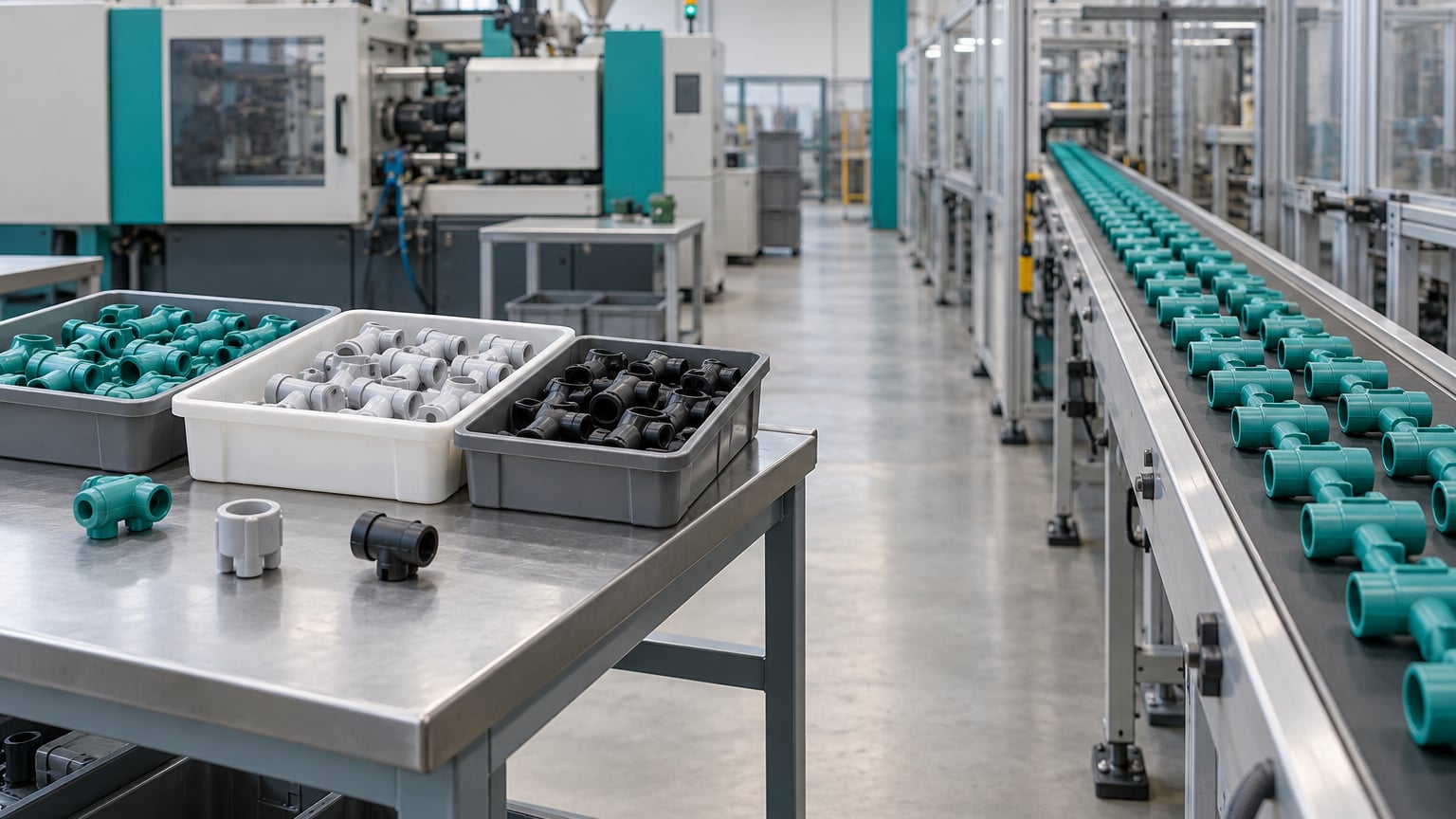
Batch production vs mass production is a choice about how much demand certainty you have. Batch production runs a defined quantity through the process, then stops and reconfigures. Mass production repeats one standardized route at high volume with no scheduled changeovers.
Batch wins when demand is variable, a part is customized, or you are still testing whether the product sells. Mass production wins when demand is predictable, the design is frozen, and you can spread tooling and setup cost across enough pieces to matter.
The honest answer is that most working factories run both. Core items go on the line. Variants, seasonal items, and anything the market keeps changing its mind about get batched.
Table of Contents
- Batch Production vs Mass Production at a Glance
- How the Two Production Models Work
- Batch Production: Process, Economics, and Best Uses
- Mass Production: Process, Economics, and Best Uses
- How Order Size Changes Unit Cost
- Tooling and Equipment Differences
- Lead Time, Scheduling, and Supply Chain Risk
- Quality Control and Production Consistency
- Which Should You Choose?
- Frequently Asked Questions
- Is batch production cheaper than mass production?
- What is the difference between batch production and continuous mass production?
- Is batch production considered mass production?
- How large must a production run be to justify mass production tooling?
- Can mass production be used for customized products?
- What is the best production method for a new plastic product?
- Conclusion: Start With Demand and Unit Economics
Batch Production vs Mass Production at a Glance
The table below is the short version. Read the row that matters most to your decision.
| Criterion | Batch production | Mass production |
|---|---|---|
| Production quantity | One defined run, then a reconfiguration | Continuous repeat output, often for months |
| Unit economics | Higher cost per piece, dominated by setup | Lower cost per piece, dominated by cycle time |
| Tooling | Low-volume tooling, or none at all | Hardened production tooling with scheduled maintenance |
| Lead time | Short runs, but a fresh setup every order | Long setup, then fast output from repeat runs |
| Flexibility | High. New colors, sizes, and variants are routine | Low. Every change means stopping the line |
| Quality control | Tight lot control, sampling across a small run | Process capability, automated inspection, traceability |
| Inventory risk | Low, you build to an order | High, you commit capital before demand proves out |
| Best for | Prototypes, custom work, seasonal goods, regulated lots | Stable consumer demand, high-volume standard goods |
| Wins when | The forecast is wrong or the market is still moving | The forecast holds and volume absorbs the tooling |
How the Two Production Models Work
Batch production schedules a fixed quantity and runs all of it through the same stages as a group. Nothing moves to the next operation until the run finishes at the current one. When the run ends, the equipment gets cleaned, retooled, and set up again.
Mass production removes the pause. Individual pieces flow continuously through dedicated stations, and the same part is made over and over with no changeover scheduled inside the production window. Setup work happens when the line is down, not between orders.
These two sit inside a larger set of production methods. Job production, batch production, mass production, and continuous production are the four most commonly named, running from one-off custom work up to uninterrupted flow processing.
Continuous production takes it further than mass production. It keeps material moving without a batch boundary at all, which is common in chemicals, refining, and some food lines. Mass production still has discrete units you can pick up and count, even when the line never stops for a changeover.
Batch Production: Process, Economics, and Best Uses
A batch operation starts with a defined run quantity. Materials are issued against one work order, the run completes every stage, and the lot gets recorded as a single traceable unit. Then the line reopens for whatever comes next.
That structure is genuinely useful. You can hold material in an unbatched state and pull it into a run only when you have a firm order. Changeover time is the number that decides whether batching is efficient or wasteful, and it is the metric most plants under-measure.
Fewer changeovers and faster changeovers both pay. If you can cut changeover from an hour to fifteen minutes, you recover hours of capacity a week without buying a single machine.
Why the cost per piece is higher
Setup gets spread over fewer pieces, so setup per piece stays high. Material buying happens in smaller lots, so purchasing power is weaker. Labor absorbs more non-value time, because operators are starting and stopping rather than repeating one motion smoothly.
Where batch production earns its keep
- Prototypes and market tests, where a design is still moving
- Custom or made-to-order products with a new spec on nearly every job
- Seasonal goods, where demand is real but arrives in a burst
- Regulated lots in food, beverage, and pharmaceuticals, where traceability is a legal requirement
- Low-volume plastic parts using bridge tooling while a hard tool is still being cut
- Repair and replacement parts for equipment no longer in production
In regulated industries, batching is not a cost decision at all. Lot identity and cleanup validation are built into the process, so the batch boundary is where the documentation lives.
Mass Production: Process, Economics, and Best Uses
Mass production commits equipment to one part for a long window. Once the line is proven, output is set by cycle time and equipment effectiveness, not by how many setups you can squeeze into a shift. Operators repeat a narrow task at a single station while material moves down the line.
The cost advantage comes from three places at once. Setup cost is amortized over a very large number of pieces. Material is bought in volume, which improves terms and reduces inbound frequency. And labor shifts from operating skill to supervision and exception handling.
Where the risk sits
The exposure is demand, not production. You have already paid for tooling, floor space, and a trained crew before the market has proven the demand. If the forecast is wrong, you do not have a production problem. You have an inventory problem that gets worse every week it sits.
Quality failures also move faster. A bad cycle that would be contained at one batch level can put hundreds of pieces through before anyone notices. That is why process capability and automated inspection are not optional extras in mass manufacturing.
Products that suit it
- Consumer goods with several years of steady sell-through
- Standardized automotive and appliance components
- Packaging items with a repeatable specification
- High-wear parts where material cost per piece dominates
- Any part with an approved design and no near-term revision
How Order Size Changes Unit Cost
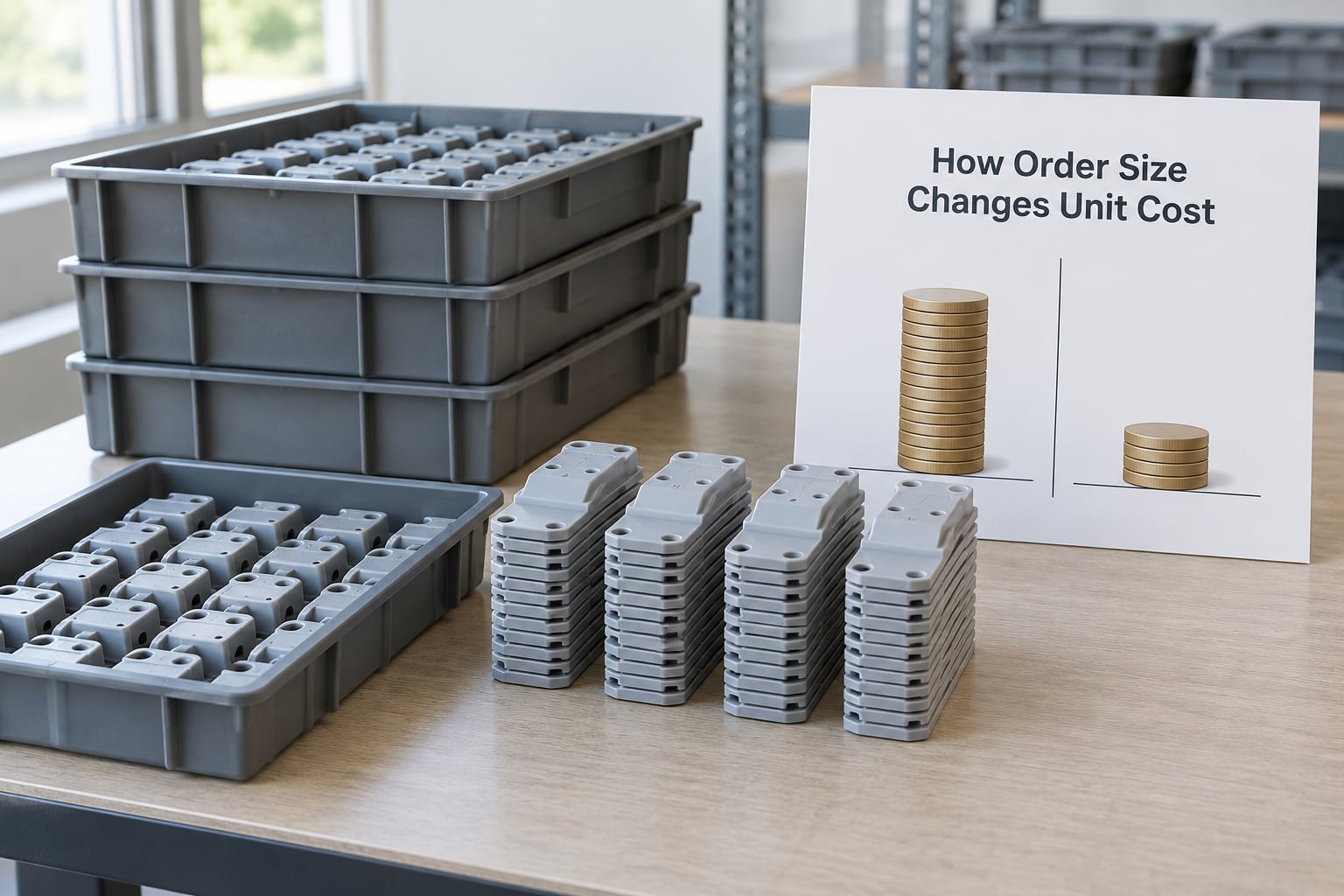
The real comparison is not price per run. It is price per piece after every fixed cost is spread out. Run the same part both ways and the gap almost always comes down to four buckets: setup, tooling, material purchasing, and inventory carrying.
| Cost bucket | Batch behavior | Mass behavior |
|---|---|---|
| Setup and changeover | Absorbed by one small run | Absorbed by tens of thousands of pieces |
| Tooling | Low-cost or shared, per-piece cost stays high | Hardened tool, cost per piece drops sharply |
| Material purchasing | Small lots, frequent inbound, less buying power | Large lots, fewer receipts, stronger terms |
| Labor | More start-stop and handling per piece | Repeat motion, supervision over more output |
| Inventory carrying | Build to order, minimal work-in-progress | Stock ahead of demand, capital tied up |
A simple break-even frame
Take a setup and tooling charge that lands once and then never repeats. Write that charge as a per-piece figure at two different run sizes and the answer appears on its own.
If a combined setup and tooling charge spreads across 2,000 pieces, each piece carries 0.50 on that line. Spread the identical charge across 20,000 pieces and each piece carries 0.05. The parts are identical. The arithmetic is what separates batch production from mass production economics.
Now ask the honest question: at what run size does the lower per-piece number outweigh the higher cost of capital and the risk of unsold inventory? That calculation depends on your contribution margin, your forecast error, and how quickly money moves. Nobody can hand you a universal quantity, because the number that makes sense for a high-margin short-life product makes no sense for a low-margin durable one.
A useful discipline is to run the comparison at three quantities: your pessimistic forecast, your base forecast, and your optimistic forecast. If mass production only wins at the optimistic number, you are gambling, not planning.
Tooling and Equipment Differences
Tooling is where the two models diverge most sharply. Batch work tolerates tools that are good for a few thousand pieces: cast aluminum, softer steel, lighter duty, and often shared across jobs. That is the bridge-tooling approach, and it exists to buy time while a production tool is being built. Our guide on bridge tooling explained for low volume production walks through when a cast aluminum tool is the right answer and when it is not.
Mass production needs hardened steel cavities, cooling that holds up at cycle rate, wear-resistant coatings where abrasive material flows through, and a maintenance schedule built around tool life rather than calendar time.
Equipment follows the same split. Batch cells stay flexible. A machine can run one cavity or four, switch inserts between orders, and handle a wide material range. High-volume lines trade that flexibility for repeatability: dedicated equipment, fixed automation, and guarding built around a part that will not change for years.
The practical implication is that flexibility is not free. Every degree of versatility built into a machine is a degree of compromise in speed, accuracy, or uptime. A batch cell that handles eight materials will never outrun a dedicated machine running one of them well.
Lead Time, Scheduling, and Supply Chain Risk
Lead time behaves differently in each model, and the trap is comparing the wrong numbers. Batch lead time looks short because a small run takes hours. But the customer-visible date depends on when the run starts, and the slot before it may already be booked.
Mass production has the opposite shape. Getting the first pieces out takes weeks or months because tooling, validation, and process qualification come first. After that, output rate is fast and predictable, and reorder lead time shrinks to days.
So the meaningful comparison is second-order lead time. For batch, it is a queue position plus a changeover. For mass, it is replenishment from finished inventory you already own.
Supply chain risk also sits in different places. Batch production keeps inventory light and pushes risk upstream onto suppliers who must deliver material on unpredictable dates. Mass production pushes risk downstream, into a warehouse holding finished goods against a forecast.
Forum discussions on r/manufacturing and r/LeanManufacturing return to this repeatedly. The recurring comment from operators is that changeover time is the make-or-break metric for batch efficiency, and that most plants have never measured it properly.
Seasonal demand swings favor batch. Steady demand favors mass. The same shop can run both, with the core range on the line and the seasonal range batched into a campaign before the season starts.
Quality Control and Production Consistency
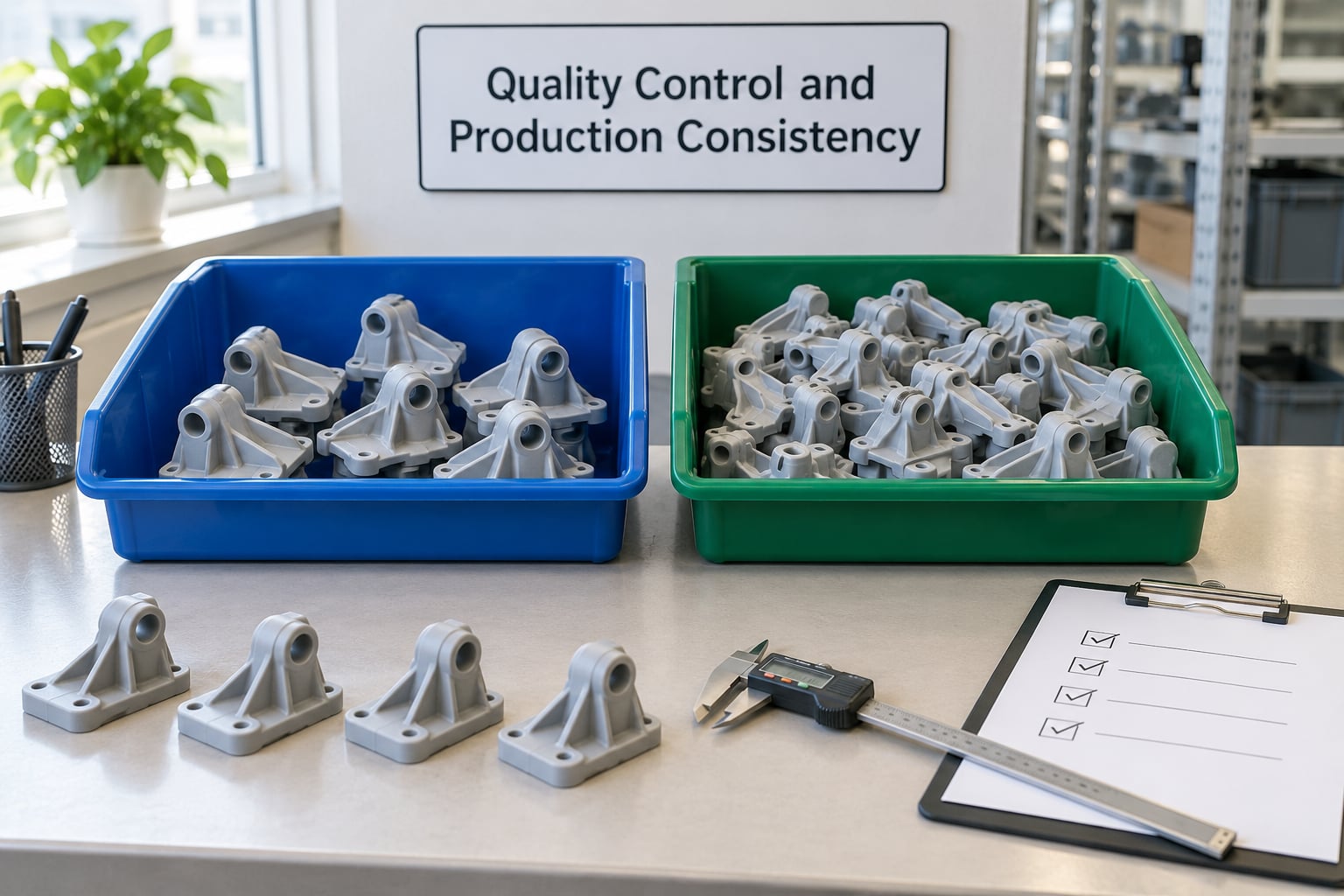
Batch production inspects lots. The entire run shares a set of conditions, so sampling across it tells you whether that lot is acceptable, and the whole lot is held or released together. When something goes wrong, the blast radius is bounded and traceability is clean.
Mass production inspects the process. Rather than testing every piece, you measure the variables that create defects and hold them inside a proven range. A temperature that drifts three degrees can be caught on a sensor before a single bad part leaves the station.
What makes consistency possible at volume
- Process capability studies that confirm the line can hold specification
- Automated vision and gauge inspection at defined stations
- Traceability records tied to equipment, material lot, and operator
- Preventive maintenance scheduled around cycle count rather than failure
- Equipment effectiveness monitored so degradation shows up as a trend
The advantage of batch control is speed of correction. The advantage of process control is that the correction happens automatically, thousands of times a day, without waiting for a sampling result.
Cost of quality is where the two differ most and where most comparisons go quiet. Scrap in a batch run is visible and recoverable. Scrap in mass production is a math problem measured in the defect rate multiplied by run length, which is why capability monitoring exists at all.
Color is the consistency problem that catches teams by surprise. A shade that matched on a bridge tool can drift once the production tool runs hotter cycles, so matching pigment and shrink rates across the two stages is its own discipline, covered in how to match plastic color across production runs.
Which Should You Choose?
Match the method to the certainty you have, not the volume you hope for.
Choose batch production when
- You are building prototypes or validating demand before committing tooling
- Every customer order needs a different specification
- Demand is seasonal or campaign-driven rather than continuous
- Regulation requires lot identity and documented cleanup between runs
- Your volume is too low to amortize a production tool
- You need short replacement runs for parts on aging equipment
Choose mass production when
- Demand has been stable across several cycles, not one good quarter
- The design is frozen and unlikely to change within a year
- The contribution margin can absorb a quality escape at volume
- Tooling cost per piece falls into your margin at your base forecast
- You can commit capital without betting on a single forecast
- Your process can be measured and controlled rather than inspected
A practical rule for moving from batch to mass
Move when repeat demand proves itself, not when it looks likely. Track the same part across consecutive runs, and look at how many consecutive batches cleared a threshold without a design change or a demand miss. Our prototyping to production transition checklist lays out the gates most plants skip before that decision.
When that pattern holds, the next step is bridge tooling rather than an instant jump to production tooling. It keeps the part in service, produces real volume, and hands you cycle time and wear data you need to size the final tool properly. Skipping that step is how plants end up with a tool cut against numbers that were never real.
When a hybrid floor makes more sense
Most established manufacturers run a mixed model. High-volume standard parts go to a dedicated line, variants and short runs go to flexible cells, and the same plant absorbs both scheduling demands. It costs more to organize, but it matches reality far better than forcing one method on every part.
Frequently Asked Questions
Is batch production cheaper than mass production?
Not per piece, and not for setup. Batch production costs less to start because tooling is cheaper and there is no capital commitment, but setup spreads across few pieces so the cost per piece stays high. Mass production pays more upfront and less per piece. Compare total landed cost at your realistic forecast, not at your best-case forecast.
What is the difference between batch production and continuous mass production?
Batch production runs a defined quantity, stops, and reconfigures before the next run, so it has a clear boundary and a traceable lot. Continuous mass production repeats one standardized route at volume without scheduled changeovers, and material keeps moving without a batch boundary. Mass production makes countable discrete pieces; continuous production often does not.
Is batch production considered mass production?
No. They are distinct production methods, though plenty of companies run both. Batch production produces a set quantity as a group before reconfiguration. Mass production repeats a standardized process continuously at high volume. If a plant batches small set quantities with a full changeover between them, it is batch manufacturing regardless of how many batches it runs in a year.
How large must a production run be to justify mass production tooling?
There is no universal number, because the answer depends on your margin and your forecast error. Divide the setup and tooling charge by the pieces in the run to get the per-piece cost, then test that figure against your pessimistic, base, and optimistic forecasts. If mass production only wins at the optimistic forecast, the investment is a gamble rather than a plan.
Can mass production be used for customized products?
Yes, with a structure that absorbs the variation. Mass production works for customized products when the customization sits at assembly or packaging and the molded or fabricated core stays identical, so the line keeps running while finished units differ. If customization reaches into the part geometry itself, you are running changeovers, and a flexible batch cell will usually serve you better.
What is the best production method for a new plastic product?
Start with batch, usually low-volume tooling or a bridge tool, and stay there until repeat demand shows up. Injection molding tooling is a large fixed commitment and gets more expensive every month it sits unused. Once the same part clears several consecutive runs without a design change, evaluate moving to production tooling against your base forecast.
Conclusion: Start With Demand and Unit Economics
Batch production serves variable demand, customization, prototypes, and regulated lots where the lot boundary carries documentation. Mass production serves stable, high-volume demand where tooling and setup amortize across enough pieces to matter.
Decide in this order. Validate the demand across more than one cycle. Compare full landed unit cost at your pessimistic and base forecasts, not your best case. Then assess tooling honestly, including who pays for it and how long it stays useful.
Then pilot before you scale. Bridge tooling gives you real cycle time and wear data at a fraction of the commitment, and it is the cheapest insurance in manufacturing.