

Takt time is the pace your line has to hit to satisfy customer demand, and you calculate it by dividing net available production time by customer demand for that same period. It is derived, not measured, so any factory, cell, molding operation or packaging line can run the same five steps in about fifteen minutes.
The word comes from the German Takt, the beat or pulse a conductor sets for an orchestra. Toyota adopted the idea in the 1950s as the rhythm that keeps just-in-time production from building more than the customer asked for.
If your line has ever missed its output target and nobody could say why, takt time is usually the missing number. Work through the steps below and you will end up with a seconds-per-unit target, a clear read on whether the current cycle time can meet it, and a defensible answer for how many operators the line needs.
Table of Contents
- What You Need
- Step-by-Step: How to Calculate Takt Time
- Common Takt Time Mistakes and How to Fix Them
- Frequently Asked Questions
- Is takt time the same as cycle time?
- Can takt time be measured with a stopwatch?
- What happens to takt time when available production time goes up?
- How do you calculate takt time across two shifts?
- When cycle time is slower than takt time, how many operators do you need?
- How do you calculate takt time when demand is uncertain?
- Conclusion
What You Need

You need four inputs, and two of them come from outside the plant.
- Customer demand in units for a defined period, taken from the order book, the shipping forecast or the customer’s own build schedule.
- Gross scheduled time: shifts per day, hours per shift, and days per week the cell is meant to run.
- Planned stops: breaks, lunch, shift-changeover, planned maintenance, set-up, changeover and any scheduled meetings or training.
- Measured cycle time for the station you plan to pace, plus the cycle times of every other station in the route.
Two habits make this much less painful later. Write the period on the top of the page before any other number, because every other number has to match it. And keep the assumptions next to the answer: whoever inherits this sheet in a year should be able to see what was subtracted and why.
If the operation involves set-up-heavy equipment, our guide to reducing changeover time on molding presses explains how set-up and changeover enter the calculation, which matters because those minutes come straight out of your available time.
Step-by-Step: How to Calculate Takt Time
Step 1: Define the Demand Period
Pick the period that matches how the line is actually scheduled, then keep demand and time in that same period. A single shift with a daily schedule is the easiest place to start; a five-day week works well for a cell that only runs Monday to Friday.
The trap is mixing periods, such as dividing weekly demand by a single shift’s available minutes. If demand is seasonal or a customer runs promotions, size the line to your peak sustained demand rather than the annual average, then accept that the line idles in the trough.
One more caution from people who size new lines: do not build the calculation from a single order or a single week. Practitioners on Lean and industrial engineering forums keep repeating that a launch ramp, a one-time catch-up order and a steady-state schedule are three different animals.
Step 2: Calculate Available Production Time
Available production time is scheduled time minus the stops you already know about. Call the result net available production time, and only subtract items your plant genuinely treats as planned downtime.
| Event | In or out of net available time |
|---|---|
| Breaks, lunch, shift change | Out |
| Set-up and changeover | Out |
| Planned or scheduled maintenance | Out |
| Tooling changes, quality gates, planned training | Out |
| Unplanned downtime, breakdowns, waiting on material | In, unless you deliberately build an allowance |
| Absenteeism above your normal allowance | In, unless you deliberately build an allowance |
A single shift of eight hours with an hour of breaks leaves 420 minutes of net available time. Two shifts of eight hours with the same 60 minutes of breaks per shift leave 840 minutes. A five-day week of two eight-hour shifts with 60 minutes of breaks per shift and 90 minutes of planned maintenance and changeover per day leaves 3,750 minutes for the week.
Notice that the deduction stays the same share of the schedule whether you run one shift or two: 480 gross minutes becomes 420 net, and 960 gross becomes 840 net. A second shift only buys real capacity if the breaks and changeover attached to it stay small.
Step 3: Divide Demand by Available Time
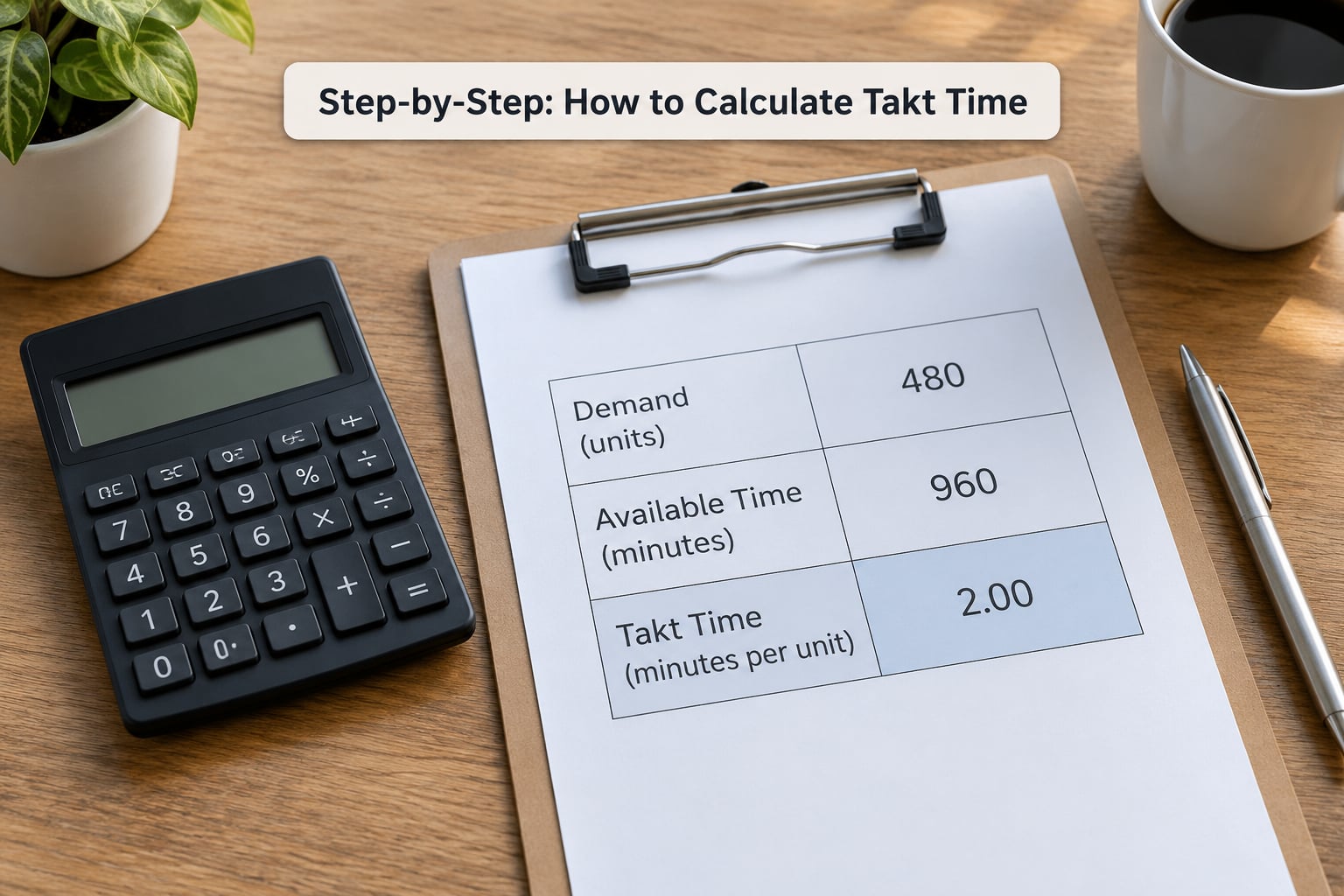
The takt time formula is net available production time divided by customer demand. Both inputs carry the same unit of time on top, and the answer comes out as time per unit, usually seconds or minutes.
Worked example: a cell runs one 480-minute shift, takes 60 minutes of breaks and lunch, and has to ship 210 units a day. Net available time is 480 minus 60, or 420 minutes. Dividing 420 minutes by 210 units gives a takt time of exactly 2 minutes per unit, or 120 seconds.
What happens to takt time when available time goes up? It goes up, in the same proportion. Hold demand at 210 units and lift net available minutes from 420 to 840, and the per-unit allowance doubles to 4 minutes. That is the direction to remember: available time sits on top of the division, so more time means a looser pace, while a demand spike tightens it.
How to calculate takt time for multiple products
When a line runs several SKUs, you cannot divide by total units and expect a usable number, because a bracket and a housing carry very different work content. The workable method is a weighted calculation: multiply each product’s demand by its cycle time, add the results, and compare that total against net available production time.
Say the cell must build 300 of product A with a 2-minute cycle time and 100 of product B with a 5-minute cycle time. Work content comes to 300 multiplied by 2, which is 600 minutes, plus 100 multiplied by 5, which is 500 minutes, for 1,100 minutes. Against 840 net available minutes, the cell is short by 260 minutes no matter how you arrange the mix. That deficit is the real message: mixed demand, not takt arithmetic, is the constraint.
Step 4: Compare Takt Time with Cycle Time
Takt time is what the customer allows. Cycle time is what the station actually takes. Comparing the two is the entire point of the exercise.
| Metric | Set by | Measured or calculated | Stopwatch? | Example |
|---|---|---|---|---|
| Takt time | Customer demand | Calculated | No | 2.0 min per unit |
| Cycle time | Work content and equipment | Measured | Yes | 1.6 min per unit |
| Lead time | Queue and flow between order and ship | Measured | Calendar | 6 days |
| Throughput time | Total time a unit spends in the process | Measured | Stopwatch or routing | 95 min per unit |
So is takt time equal to cycle time? Only in a perfectly balanced plant, which is rare. A cycle time of 1.6 minutes against a 2.0-minute takt means the station has 24 seconds of slack per unit and the line can absorb normal variation. Equal values mean no margin at all, so any hiccup shows up immediately as lost output. A cycle time of 2.4 minutes against a 2.0-minute takt means the station cannot meet demand, and the line produces 17 percent short every day.
When cycle time exceeds takt time, you have four options in order of cost: cut set-up and changeover so more of the shift is available, reduce work content at that station, add a parallel station or machine, or add operators to split the work. Start with set-up and changeover. Our piece on reducing injection molding cycle time covers the first three stations of a typical route in detail.
Target manpower follows from the same two numbers. Add up the total work content across all stations in minutes, divide it by the takt time, and the result is the number of stations or operators a paced line needs. Using the example above, 840 net available minutes with 1,680 minutes of total work content needs exactly 2.0 stations, so you round up to two operators.
Step 5: Validate the Result on the Line
A calculation that never touches the floor is a guess with a formula on it. Time several consecutive cycles on the station you intend to pace, record good parts only, and repeat during the slowest part of the shift.
Watch for two things while you count. First, defects: if the station makes one bad part in twenty, the effective cycle time is twenty percent longer than the raw number, and a takt target built on the raw number will be missed every cycle. Second, micro-stops: brief pauses to fetch material, clear a jam or consult a drawing usually average fifteen to forty seconds each, and a station that loses that time repeatedly will not hold a tight takt.
Track unplanned downtime separately from your planned downtime assumptions. Comparing planned time with actual output at the end of the shift tells you which of your exclusions were wrong, and that list is the input for next month’s calculation. When equipment reliability is part of the problem, MTBF and MTTR calculations give you the numbers to quantify it.
Common Takt Time Mistakes and How to Fix Them
- Using gross scheduled hours. Fix: subtract every planned stop before dividing. If your eight-hour shift really only delivers six and a half hours of running time, dividing by eight understates takt by nearly a fifth.
- Forgetting the shift changeover. Fix: add the clean-down, first-article checks and handover time your supervisors actually spend between shifts. On a two-shift schedule this is usually the single most overlooked deduction.
- Mixing units across periods. Fix: write the period next to every number. Weekly demand over a shift’s minutes produces a takt time that is five times too optimistic.
- Treating takt time as cycle time. Fix: label the two columns separately and never let one overwrite the other on the whiteboard. Takt is a demand-derived target, cycle time is a measurement of the station.
- Sizing the line from unrealistic demand. Fix: use the demand rate the process can sustain most of the year, not the best week you have ever had, and document the peak you designed for.
- Applying one takt time to products with different demand profiles. Fix: calculate each product family separately, then blend them with the weighted work content method in Step 3.
- Leaving variability out entirely. Fix: some plants hold a deliberate allowance by subtracting extra planned downtime; others subtract nothing and treat unplanned losses as a capacity gap. Whichever you pick, write it down, because the two methods produce very different staffing numbers.
Recalculate on a fixed rhythm rather than when something breaks. A weekly review of demand and a monthly recalculation of the full calculation is a common cadence, and any of these should trigger an immediate recalculation: a demand spike, new equipment, a new shift pattern, a new hire in a paced station, or a process change that alters work content.
Some limits are worth naming. Takt time assumes a repeatable, paced flow, so it fits badly in high-mix job shops where every order takes a different route. Pushing a takt time too tight leaves no room for operator fatigue, quality checks or breakdowns, and the line simply stops more often. And takt time tells you nothing about whether the route is achievable, only what it would take if it were.
Frequently Asked Questions
Is takt time the same as cycle time?
No. Takt time is calculated from customer demand and net available production time, so it is a target the customer sets. Cycle time is measured at a station with a stopwatch and reflects the work content and equipment there. They match only in a perfectly balanced line with no variation, which is why you should always record them in separate columns.
Can takt time be measured with a stopwatch?
No, it cannot. You measure cycle time with a stopwatch; takt time is always calculated by dividing net available production time by customer demand for the same period. If a number came from timing a run, it is cycle time or throughput time. Calling that figure takt time is the most common labelling error on shop floors.
What happens to takt time when available production time goes up?
It goes up, in direct proportion. Available time sits on top of the division, so hold demand at 210 units and lift net available minutes from 420 to 840, and the allowance per unit doubles from 2.0 to 4.0 minutes. More time means a looser pace; a demand spike is what tightens it.
How do you calculate takt time across two shifts?
Multiply the shift length by the number of shifts, then subtract planned stops per shift. Two eight-hour shifts give 960 gross minutes; at 60 minutes of breaks per shift, net available time is 840 minutes. Divide that by demand across both shifts. Forgetting to deduct the second shift’s breaks is the usual reason two-shift lines come out badly optimistic.
When cycle time is slower than takt time, how many operators do you need?
Add the work content of every station in the route in minutes, then divide that total by the takt time. The result is the number of stations a paced line needs, which equals the operators needed when each station has one operator. If the result is fractional, round up and check whether the line can be rebalanced so the extra operator is productive rather than waiting.
How do you calculate takt time when demand is uncertain?
Use a demand rate you can sustain most of the year rather than a peak or a single large order, and calculate separate takt times for product families with different demand profiles. In high-mix work, the weighted method is safer: multiply each product’s demand by its cycle time, add the totals, and compare against net available time to see what the mix actually costs you.
Conclusion
Start with the first action: list customer demand for one period, subtract every planned stop from scheduled time, divide the two, and write the result as seconds per unit. Then time a handful of real cycles at the station you intend to pace and set the two numbers side by side.
If the cycle time is longer than takt time, you have found your bottleneck. Take work content out of it, cut set-up and changeover, add a parallel station, or split the work across another operator. Recalculate when demand or the schedule changes, and keep the assumptions with the number so the next person does not have to guess.