
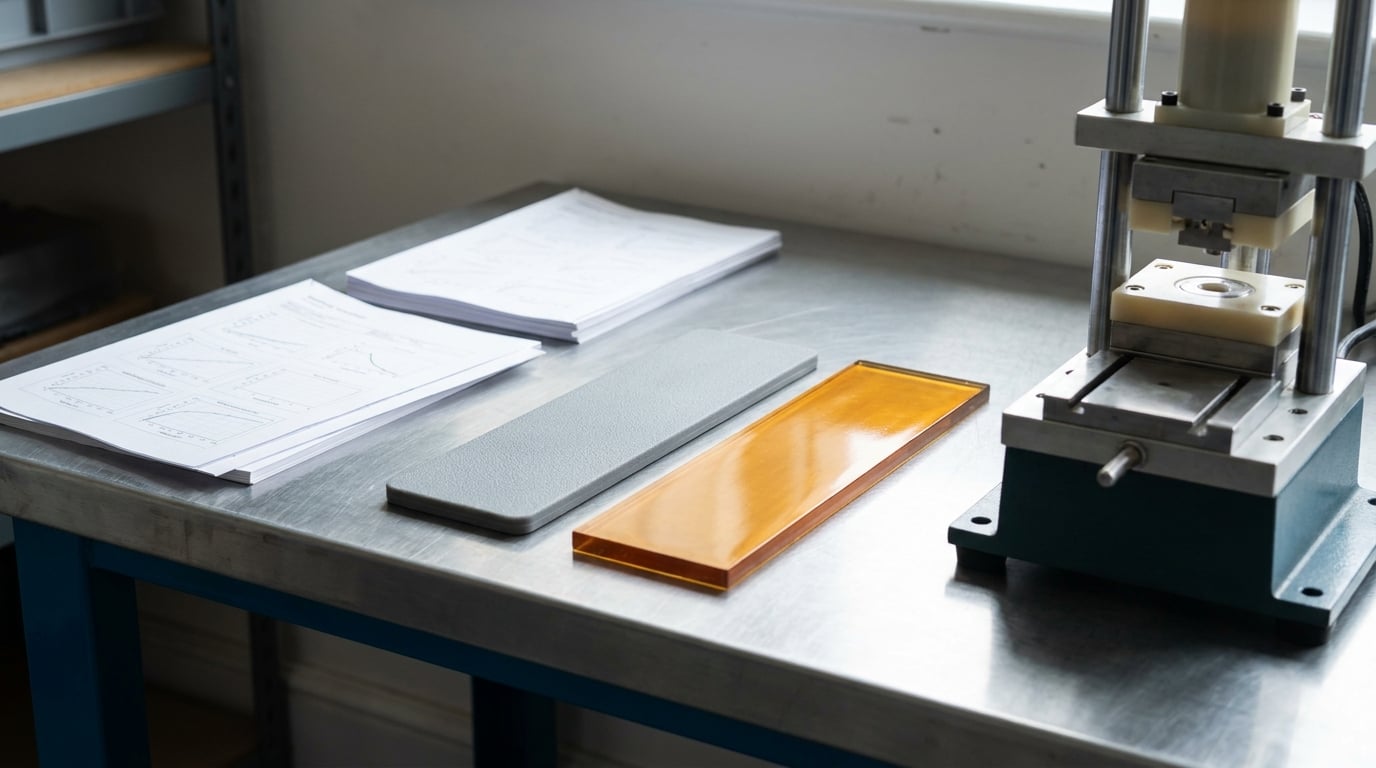
If you are weighing tpe vs tpu which elastomer to specify for a molded part, the short answer is this: specify TPU when abrasion, tear strength and consistency across suppliers matter, and specify a named TPE sub-class when you need softness, low cost, weatherability or a service temperature above what TPU tolerates. Neither material wins everywhere, and the single most common mistake in elastomer selection is treating TPE as one thing when it is a family.
That mistake is worth explaining, because it drives everything else. TPU is not an alternative to TPE. It is a member of it. A supplier who quotes you “TPE” can hand you a soft styrenic block copolymer or a cross-modified polyolefin that behaves completely differently, and you will only find out at the mould or on the test bench.
This guide breaks the two apart across the criteria that actually change a specification: hardness and elasticity, wear and chemical exposure, processing behaviour, and the total cost of the finished part. It is written for the engineer filling in a material line on a drawing, the buyer comparing quotes, and the print room choosing a flexible filament for prototypes.
Table of Contents
- TPE vs TPU: Which Elastomer to Specify at a Glance
- What Are TPE and TPU?
- TPE vs TPU: Flexibility and Elasticity
- TPE vs TPU: Abrasion, Wear, and Chemical Resistance
- TPE vs TPU: Processing and Manufacturing
- TPE vs TPU: Cost, Supply, and Sustainability
- TPE vs TPU: Which Is Better for Common Products?
- How to Choose Between TPE and TPU
- Which Should You Choose?
- Frequently Asked Questions
- Is TPE or TPU better for a product that must stretch and flex repeatedly?
- Which material is more abrasion-resistant, TPE or TPU?
- Can TPE and TPU both be used for overmolding?
- Are TPE and TPU suitable for outdoor products?
- How do I compare TPE and TPU suppliers for a manufacturing program?
- Which material is easier to recycle or reprocess?
- Conclusion
TPE vs TPU: Which Elastomer to Specify at a Glance
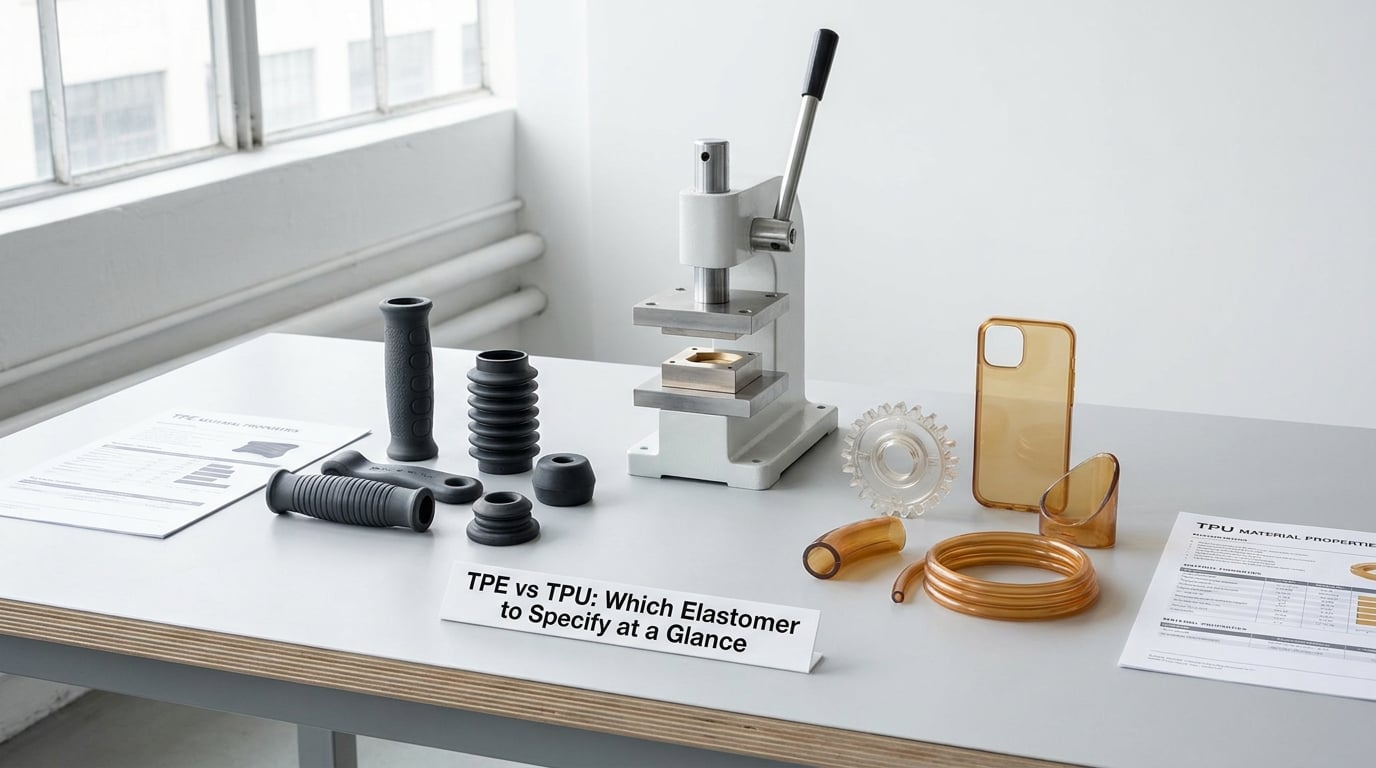
The single question that settles most selections is abrasion and tear. TPU normally wins that comparison by a wide margin, which is why it dominates protective cases, sport watch straps, caster wheels and wear strips. Where a soft, cheap, weatherable part is the goal, a styrenic or olefinic TPE usually wins on cost and feel.
| Criterion | TPE (family) | TPU (sub-class) |
|---|---|---|
| What it is | Broad family of rubber-like thermoplastics | Polyurethane sub-class with hard and soft segments |
| Typical Shore A range | 5A to 95A, some grades into Shore D | 70A to 98A, softest grades around 60A |
| Tensile strength | About 5 to 40 MPa depending on sub-class | About 20 to 60 MPa |
| Elongation at break | 200% to 800% | 200% to 600% |
| Abrasion and tear | Low to moderate, weak in styrenic grades | High, the deciding strength in most designs |
| Continuous service temperature | Wide range; some olefinic grades near 135 C | Usually up to about 90 C by grade |
| Oil and fuel resistance | Poor in SEBS, better in olefinic blends | Good with polyether grades, weaker with polyester |
| Moisture sensitivity | Low to moderate | Hygroscopic, needs drying before processing |
| Property consistency | Varies widely between sub-classes and suppliers | Tight and predictable within a named grade |
| Relative cost position | Generally the lower-cost option per part | Higher, usually justified by wear life |
Read the last row carefully. Cost per kilo tells you almost nothing. The cheaper resin that needs thicker walls, more material, tighter tolerance or a longer service life to do the same job is the more expensive part.
What Are TPE and TPU?
Yes, they are related, and no, they are not the same. All TPU is TPE, but not all TPE is TPU. TPE is the umbrella term for any polymer that behaves like rubber yet melts and flows like a plastic when heated, so it can be injection moulded, extruded or printed and then scrap can be remelted. TPU is one specific branch of that family, built from alternating hard diisocyanate segments joined to soft polyether or polyester segments. Because those segments are covalently bonded rather than physically blended, a TPU’s properties hold together more consistently than a blend’s, which is the practical reason a TPU part behaves the same way in year three as it did in week one.
The rest of the TPE family is where the confusion starts, because those grades can behave nothing like a TPU at all.
| TPE sub-class | Common chemistry | Hardness | Where it fits |
|---|---|---|---|
| TPE-S | SBS and SEBS styrenic block copolymers | Shore A 5 to 95 | Soft-touch grips, seals, consumer goods |
| TPE-O | Olefinic blends and dynamically vulcanised grades | Shore A 30 to 95 | Weatherable outdoor and automotive parts |
| TPE-V | Thermoplastic vulcanisate, EPDM or NR rubber crosslinked in a polyolefin | Shore A 40 to 95 | Seals, hoses, high-temperature under-hood use |
| TPC | Thermoplastic copolyester | Shore D 30 to 60 | Stiff, springy, high-rebound mechanical parts |
| TPAE and PEBA | Polyamide block copolymers | Shore D 15 to 55 | Sports footwear and very high rebound uses |
| TPU | Polyurethane block copolymer | Shore A 70 to 98 | Wear parts, cases, straps, medical tubing, cable |
One more definition trips people up. Shore A covers the soft range most people mean when they say rubber, and Shore D picks up the harder, semi-rigid grades. A 95A material is quite stiff, and a 20D material is in a completely different world, so mixing the scales on a drawing is a common and expensive error.
The sub-class table above is the reason a bare “TPE” on a drawing is close to useless. One olefinic TPE-V grade can hold continuous service near 135 C, while a soft SEBS grade can start softening around 60 C. Both answers are technically correct.
TPE vs TPU: Flexibility and Elasticity
TPU is the stiffer of the two families at equal hardness, and it recovers its shape faster. If a part has to stretch, release and return repeatedly, that faster shape recovery and higher tear strength usually matter more than a softer initial feel, which is why TPU shows up in stretch films, seals and wearables while softer TPEs dominate static bumpers and cushions.
Hardness is where most flexibility arguments are actually settled, and it is a harder choice to make than people expect because the same number means different things in each family.
| Shore A | What it feels like | What TPE is like at this grade | What TPU is like at this grade |
|---|---|---|---|
| 60A | Very soft, gummy | Typical for gel pads and soft seals | Available but uncommon and difficult to process |
| 70A to 80A | Soft, compliant | Comfortable grips, weather seals | Soft-touch skins, thin protective films |
| 85A to 90A | Firm but flexible | General purpose seals and bumpers | Wearable straps, phone case lips, cable |
| 95A to 98A | Stiff, near-rigid feel | Overmold grips needing stiffness | Cases, wheels, bushings, sports components |
Below about 70A, TPU becomes hard to feed and hard to weld, and most additive processes struggle. Below about 60A, both families turn gummy, stick to tooling and creep. If your design calls for a very soft part, a styrenic TPE is usually the practical answer even when a soft TPU grade exists on paper.
Two elastic properties catch engineers out. Compression set is how much a compressed seal fails to spring back, and TPU holds it better than most TPEs at the same hardness, which is why TPU dominates dynamic seals. Creep is a longer-term version of the same problem, and softened TPE grades that contain plasticiser will creep noticeably more, especially under sustained load and heat.
Temperature response differs too. TPU stiffens as it approaches its service ceiling and can feel brittle well before it fails, while olefinic TPE-V grades keep a usable grip further up the temperature scale. Below freezing, both families get harder, but the base polymer matters more than the family name, so check the low-temperature figure on the datasheet rather than assuming.
TPE vs TPU: Abrasion, Wear, and Chemical Resistance
TPU is the better choice for abrasion, cut and tear, and it is the clearest technical answer in this whole comparison. A TPU wear pad sliding against metal will typically outlast an SEBS or TPV pad in the same application by a wide margin, because the polyurethane hard segment resists cutting and the material does not gouge or roll under load. For wear strips, caster wheels, conveyor components, cable abrasion guards and any surface that rubs against a harder counterface, specify TPU unless cost is overriding the engineering.
Chemical exposure is where TPU loses ground, and the split inside TPU matters. Polyether-based TPU resists hydrolysis and handles moisture and long-term warm humid exposure well. Polyester-based TPU is tougher against oils, fuels, solvents and abrasion but hydrolyses: exposed to warm water or steam over months or years, it stiffens, cracks and loses most of its elongation. That is the classic field failure in ester TPU gaskets and bushings, and specifying a polyether grade is usually the fix.
TPE chemical performance is entirely a sub-class question. SEBS grades absorb oils and solvents badly, swell and stain over time, and lose their properties after sustained contact with petroleum products. Olefinic TPE-V grades, being cross-modified polyolefins, handle oils, fuels and weather far better, and are the standard answer for under-hood seals and outdoor gaskets. A datasheet comparison between “TPE” and “TPU” that ignores which TPE it means will mislead you on chemical resistance in both directions.
UV and weathering run in TPU’s favour. TPU holds its colour and mechanical properties outdoors better than styrenic TPE, which yellows and embrittles, and better than most polyolefin blends unless they are UV-stabilised or pigmented with carbon black. TPU is not immune. Uncoated ester grades chalking under long sun exposure is common, and a polyether grade with a light pigment is the safer outdoor choice.
These failure modes show up predictably, and each has a corrective action worth writing into the specification.
| Failure you see | Likely cause | What to change |
|---|---|---|
| Part stiffens and cracks after months outdoors | Polyester TPU hydrolysis | Move to a polyether TPU or a UV-stabilised TPE-V grade |
| Seal flattens and stays flat | High compression set, creep under sustained load | Increase hardness, or move to TPU for better compression set |
| Surface gouges under contact | Low abrasion resistance in the chosen grade | Specify TPU, or a reinforced TPU-V with filler |
| Colour drifts and material embrittles | Styrenic TPE UV degradation | Move to TPU or an olefinic TPE |
| Print stringing, bubbles, rough surface | Moisture in hygroscopic TPU | Dry resin properly and control humidity |
TPE vs TPU: Processing and Manufacturing
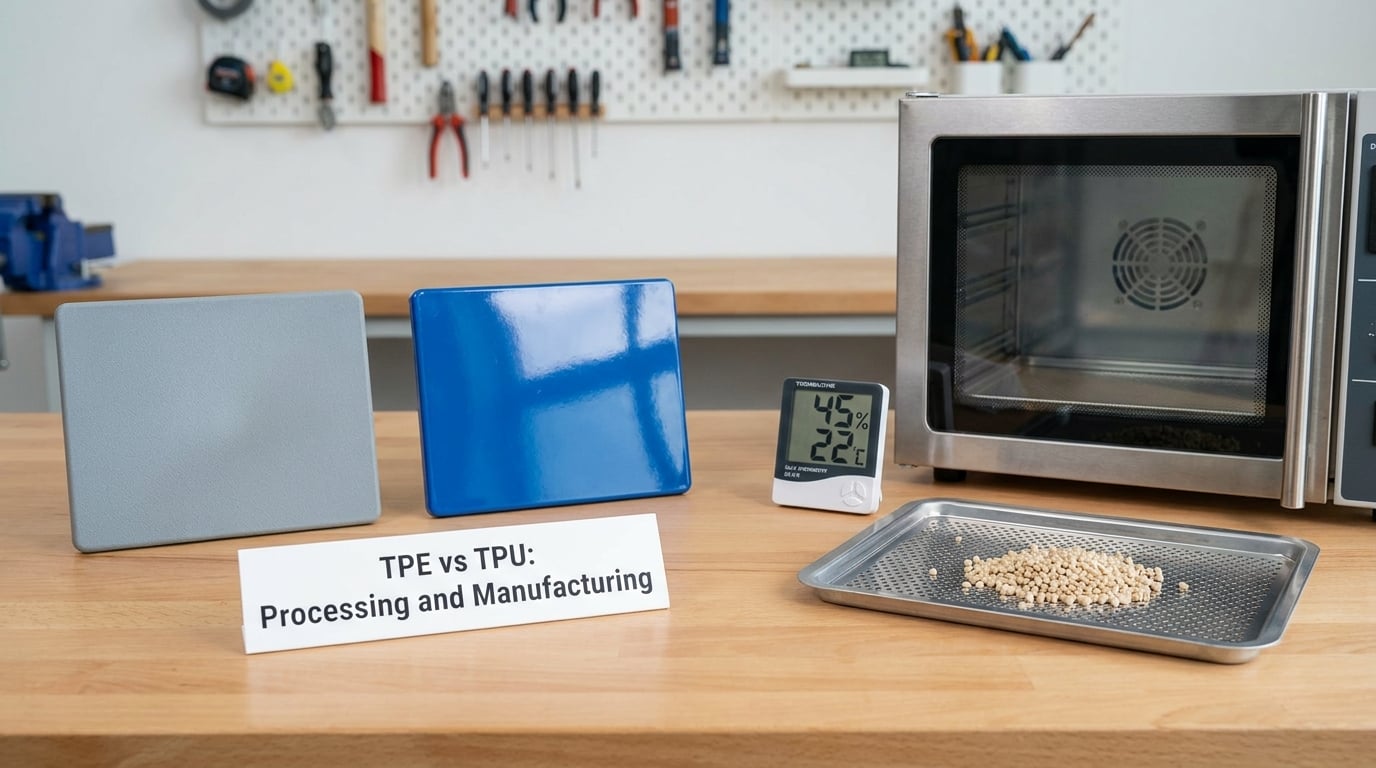
Both materials process on standard thermoplastic equipment, but they behave differently enough that the process route can decide the specification. TPU is hygroscopic and reacts to moisture with carbon dioxide gas, which shows up as splaying, bubbles and brittle weld lines. Drying is not optional for TPU. Most styrenic TPEs are far less moisture-sensitive, and olefinic grades are among the easiest elastomers to mould.
| Process | TPE behaviour | TPU behaviour |
|---|---|---|
| Injection moulding | Easy, forgiving, low injection pressure | Viable, needs drying and adequate shear at the gate |
| Overmolding | Good with olefinic grades, weak on some blends | Strong, wide bond window on rigid substrates |
| Extrusion | Simple, tolerant of long runs | Works, needs care with draw-down and cooling |
| FDM printing | Very soft grades buckle and feed poorly | 95A widely used, needs direct drive above soft grades |
| SLS or MJF | Limited grade availability | Well supported, good detail and repeatability |
| Recycled regrind | Often accepted in TPE, ratio controlled | Accepted, dry before reprocessing |
Overmolding is the area where TPU earns its keep in manufacturing. Because of the covalent hard segments and high surface energy, TPU bonds reliably to ABS, polycarbonate and many other engineering substrates across a wide mould-temperature window, where SEBS and other TPE blends need priming or plasma treatment. Independent testing by Incurelab found TPU produced higher and more consistent bond strength on ABS than SEBS, and that both TPU and common TPE sub-classes including SEBS, COPE and PEBA bond poorly to polyethylene without real surface preparation. If your part is a two-shot grip or a soft-touch skin on a plastic shell, that finding probably decides it for you.
For additive manufacturing, the split is mostly a hardness question. TPU at 95A is the workhorse flexible filament, holding shape well through feed and retraction. Below about 85A, both families need a direct-drive extruder, slower speeds and shorter retraction, and very soft TPE buckles inside the feeder. Bowden setups fight the softer grades. If the print is a functional prototype, many teams find it more useful to prototype in TPU and mould the final part in whichever elastomer the mechanical test selects.
Tooling and cycle time deserve a mention too. Softer TPEs need more draft and often need a release agent or a polished cavity, because a slightly sticky surface is a real defect on a consumer part. TPU at 95A and above moulds cleanly in a standard steel tool. Very soft grades also flash more readily, so gate and parting-line design get tighter than most newcomers expect.
TPE vs TPU: Cost, Supply, and Sustainability
Buyers almost always start with resin cost per kilo, and it is the wrong first number. TPU resin is generally more expensive than a commodity TPE, but the finished-part cost depends on part weight, cycle time, scrap rate, expected service life and warranty exposure. A bushing that runs twice as long at a higher material cost can still be the cheaper part over its life, and a thin-walled TPU design can beat a thick-walled TPE one on total cost despite the resin difference.
Beyond resin, the variables that actually move cost per part are these. Wall thickness, because stiffness scales with thickness far faster than material cost does. Cycle time, where a slow-cooling thick section can dominate. Scrap and rework, which hurt more on TPU because the bond and cosmetic bar is higher. Expected service life, which is where TPU’s wear advantage turns into real money. And secondary operations, since a part that needs a separate soft-touch coat or insert step can be redesigned as an overmolded single piece in either material.
Supply and sourcing work differently too. TPU is a mature global market with deep grade lists from multiple established suppliers, so qualification is straightforward and switching between sources is usually possible without redesign. A bare TPE specification, by contrast, can leave you dependent on one supplier’s formulation for a sub-class nobody else stocks. Naming TPU, or naming a precise sub-class plus Shore A hardness, is what makes the part reproducible across a multi-year program and across a second plant.
On sustainability, the honest position is that both are thermoplastics and both are mechanically recyclable in principle, and both are robust in a modern waste stream rather than biodegradable. Sorted TPU regrind is common in cable and footwear, and controlled regrind ratios are standard in moulding. Contamination is the real limit, and a TPE product containing carbon black or glass fibre rarely rejoins a clean stream. If your design has to be mono-material, that constraint often pushes you toward a single-polymer overmold or a snap-fit assembly instead of a soft skin on a rigid substrate.
Environmental claims deserve scepticism from both sides. Neither material meaningfully biodegrades in a landfill or an ocean, and any grade that carries an environmental claim should be asked for its test method and its certification rather than accepted on the label. For worn-out parts in service, abrasion loss is the question that matters, and that is another argument for TPU where wear is severe.
TPE vs TPU: Which Is Better for Common Products?
Consumer goods and soft-touch grips. A TPE usually wins here on cost and feel. Grip, handle, bumper and housing-lid parts are cosmetic, low-abrasion and price-sensitive, which is the exact profile of an SEBS or olefinic blend. Specify TPU only when the part is visibly scuffed in use or needs to survive a drop test without tearing.
Phone cases, wearables and straps. TPU wins and it is not close. This is pure abrasion and tear territory, and users routinely drop, pocket and scrub these parts. For a watch band, 85A to 95A TPU is the industry default because it holds a shape, resists sweat and skin oils, and does not creep on the wrist.
Automotive interiors and cabin trim. It depends on location. Soft-touch dashboards, armrests and console pads are usually TPV or olefinic TPE because they must survive sunlight and heat cycling without becoming sticky. Door and window seals, and anything exposed to weather and road oils, are more often TPE-V. TPU earns its place in cabin parts that take repeated flexing or that need bonded adhesion to a hard substrate.
Under-hood and drivetrain sealing. TPE-V is normally the right answer, not because TPU is weak but because the temperature ceiling is the binding constraint. Incurelab’s testing puts TPU at roughly 90 C continuous depending on grade, while TPE-V duct grades handle hot air and fumes up to about 135 C. Above that ceiling, TPU is simply out of the conversation.
Sports and outdoor equipment. Split by layer. Shoe midsoles and any part needing energy return want TPAE or PEBA, not either material here. TPU wins for grips, protective frames, cleats and anything scraping. A weatherable TPE wins for exposed outdoor trim where sun and rain do the damage.
Medical devices and wearables on skin. TPU, usually a medical or contact grade, because it carries well-established biocompatibility data, resists sweat and oils, and can be made transparent. TPE is acceptable for non-contact components, but for a skin-contact or fluid-contact path, buy the certified grade and ask for the documentation rather than assuming a generic elastomer is compliant.
Electronics and cable. TPU for abrasion and jacket protection, especially on charging leads and wearables where flex life is the whole job. TPE-V is common for heavier jacketing and grommets. The low-temperature flexibility of polyether TPU makes it a good pick for a cable that has to stay flexible in a cold vehicle.
Seals and gaskets. TPU, with a strong proviso. Polyether TPU is the right pick for dynamic seals in dry, moderate-temperature service, with good compression set and wear. Anything continuously immersed in hot water or steam should go to a hydrolysis-resistant grade or to TPE-V, because an ester-grade TPU will crack there.
Industrial rollers, wheels and wear strips. TPU, without much debate. Softer TPEs in these positions flatten, smear and shed material within months under continuous contact. If the wear is extreme enough to consider a reinforced TPU with added filler, that is a different material class again, so discuss it with the supplier at the design stage rather than after the first failure.
How to Choose Between TPE and TPU
Work through these questions in order, before opening a quote request, because the answers usually eliminate one material immediately.
- What is the worst exposure? Hot oil, hot water, steam, direct sun, solvent, abrasion against a hard surface, or nothing worse than a hand touching it. Name the single worst case and half the choice is made.
- What temperature does it see continuously, and what is the peak? Above roughly 90 C continuous, the TPE side of the family is the practical option.
- How hard does it need to be? Below 70A, both materials get difficult to process and TPU gets worse quickly. Above 95A you are into semi-rigid territory and TPC may be worth a look.
- Does it rub against something harder than itself? If yes, specify TPU unless cost is the overriding constraint.
- Will it be overmolded onto a rigid substrate? If yes, TPU gives you the better bond and a wider process window. If the substrate is polyethylene, surface treatment is needed either way.
- Does it contact skin, food, or body fluid? If yes, buy a certified grade with documentation, not a general-purpose elastomer.
- How many sources can supply it? If only one, the specification is too loose. Tighten the sub-class and hardness until at least two suppliers can quote it.
Turn those answers into a one-line rule using the table below. This is the format that works well on a purchase specification, because a supplier can answer each row without guessing.
| If your requirement is | Specify |
|---|---|
| Heavy abrasion, tear, or contact sliding on metal or hard plastic | TPU |
| Repeated flexing with shape recovery, a dynamic seal, a stretch film | TPU, usually polyether grade |
| Hard, thin-walled wear part or outboard wheel | TPU at 95A or above |
| Bonded overmold onto ABS or polycarbonate | TPU |
| Soft-touch cosmetic grip, bumper or handle | TPE, usually SEBS or olefinic |
| Continuous service above roughly 90 C | TPE-V or another olefinic TPE |
| Weathering, sunlight and ozone outdoors | UV-stabilised TPE-V, or TPU for wear combined with exposure |
| Very soft feel below 70A | TPE, since soft TPU is hard to process |
| Oil, fuel or hydrocarbon contact at moderate temperature | TPE-V, or polyester TPU with UV protection |
| Hot water or steam exposure over months | Polyether TPU, or TPE-V |
| Skin contact or a medical fluid path | Certified medical-grade TPU |
Then validate before you commit. No datasheet number substitutes for testing in your own service condition, and the tests worth running are cheap: a compression-set test at your working temperature for seals, an abrasion comparison against your real counterface, an immersion test in the actual fluid, and a UV exposure run for outdoor parts. Run those on a couple of shortlisted grades, because two nominal 95A materials from different suppliers can differ more than a 95A and a soft TPU do on paper.
Two more practical checks. Ask each supplier for the actual grade number and the full datasheet rather than a generic family brochure, and confirm the service temperature and chemical figures against your own conditions. If your team models these parts in FEA, be aware the two materials are simulated differently, with TPU usually treated as a hyperelastic material and TPE families more often as viscoelastic, and get your material card from the supplier rather than fitting numbers from a generic library.
Which Should You Choose?
Specify TPU when the part wears, stretches, bonds, or has to perform the same way in five years as it does this week. That covers abrasion and tear against a harder surface, dynamic seals, overmolding onto a rigid engineering substrate, cable and strap flex life, medical and skin-contact applications, and anything thin-walled that needs stiffness without brittleness. TPU is the more repeatable material, and repeatability is often the deciding factor on a long-running program.
Specify a named TPE sub-class when the part is soft, cosmetic, weatherable, hot, or price-driven. That covers soft-touch grips and bumpers, seals and gaskets in continuous service above roughly 90 C, outdoor and under-hood parts that see sun, oil and weather, very soft low-hardness parts, and high-volume consumer items where the cost of the resin is a real share of unit cost. Name the sub-class, never just TPE.
What justifies a specification switch is usually one of five findings. A wear failure that points at low abrasion resistance. A hydrolysis crack in a polyester TPU part sitting in warm water. A temperature ceiling that a TPU part cannot meet. A bond that delaminated on a substrate needing treatment. Or a supply problem where one grade could only be sourced from a single supplier. Each of those maps directly to a different fix, and each is easier to catch in testing than in a datasheet review.
Frequently Asked Questions
Is TPE or TPU better for a product that must stretch and flex repeatedly?
TPU is usually the better answer. It has higher tear strength and faster shape recovery than a soft TPE of the same hardness, so it survives repeated stretch cycles without nicking at the edges. A softer TPE feels stretchier at first but often takes a permanent set or tears sooner. If the part only needs to flex gently and never sees wear, a soft TPE is fine and cheaper.
Which material is more abrasion-resistant, TPE or TPU?
TPU, by a wide margin. Its hard segment resists cutting and gouging, so TPU wear strips, wheels and bushings normally outlast an SEBS or TPV part sliding on the same counterface. The exception is an olefinic TPE-V reinforced with filler, which can compete in heavy industrial wear. For general wear, abrasion and tear cases, TPU is the default.
Can TPE and TPU both be used for overmolding?
Yes, both work, but TPU gives a stronger bond across a wider process window on substrates like ABS and polycarbonate. Independent adhesion testing found TPU produced higher, more consistent bond strength on ABS than SEBS, and SEBS became competitive only when mould temperature was optimised. On polyethylene, both bond poorly without significant surface preparation, so plan for priming or plasma treatment.
Are TPE and TPU suitable for outdoor products?
Both can be, but they fail differently in sunlight. Styrenic TPE grades yellow and embrittle with UV exposure. TPU holds colour and properties much better, though uncoated polyester grades can still chalk over time. For continuously hot outdoor service, a UV-stabilised TPE-V grade often wins because it tolerates temperatures TPU cannot reach.
How do I compare TPE and TPU suppliers for a manufacturing program?
Ask each supplier for a specific grade number and full datasheet rather than a family brochure, then check the material against your own conditions: continuous service temperature, worst-case fluid exposure, compression set, and hardness tolerance. Confirm at least two suppliers can quote the same named grade, so a supply change does not force a redesign. Ask for certification documents for any skin or fluid contact part.
Which material is easier to recycle or reprocess?
Both are thermoplastics and both are mechanically recyclable rather than biodegradable. Sorted TPU regrind is common in cable and footwear, and TPE regrind is widely used with a controlled ratio. In practice TPU needs drying before reprocessing because it absorbs moisture, while olefinic TPEs are among the easiest elastomers to recycle. Contamination, not the polymer, is what usually limits reuse.
Conclusion
The decision rule is short: specify TPU when the part wears, bonds or flexes hard, and specify a named TPE sub-class when the part is soft, hot, weatherable or price-driven. TPU is the more consistent, higher-wear material; TPE-V is the one that survives temperatures TPU cannot; SEBS is the cheap, comfortable soft-touch option.
Start by writing down the worst exposure your part will meet and the temperature it must hold continuously, because those two answers usually eliminate half the field. Then request a specific grade number from at least two suppliers, and prototype a couple of shortlisted grades in your own service condition. Testing in the real fluid, against the real counterface, at the real temperature is the only step that reliably settles the argument, and it costs far less than a field failure.