

You choose a pallet pattern by working backwards from the load: measure the cartons, note their weight and compression strength, confirm how the pallet gets handled, then pick the pattern that carries that weight without crushing the bottom boxes or letting the load shift. Pick a pattern name first and the rest of the decision gets guesswork.
The pattern on the pallet and the stacking pattern on top of it are two different choices, and most shipping problems come from confusing them. The first is how the pallet itself is built — stringer, block, winged, double-face. The second is how you arrange cartons layer by layer — column, brick, pinwheel, split row. You settle the first against your equipment and route, the second against your product.
A wrong geometry cannot be rescued by packaging. Wrap and strapping contain a load; they do not create a stable one.
Table of Contents
- What You Need
- Step-by-Step: How to Choose a Pallet Pattern for Shipping
- Frequently Asked Questions
- What is the best pallet pattern for a general shipment?
- Should I choose a stringer, block, or column pallet?
- How do I know if my load is safe on a pallet?
- Can pallet patterns be changed without changing the products?
- Does pallet pattern affect shipping cost?
- What information does my carrier need about the pallet?
- Conclusion
What You Need
Gather this before you compare a single pattern. Without it, every option looks plausible.
- Carton dimensions and case weight per SKU — length, width, height, and gross weight for each product, not the average of your range.
- Pallet dimensions and deck height — a 48 x 40 inch North American pallet and a 1200 x 800 mm EUR pallet produce completely different layer counts.
- Box compression strength (BCT) — the load a single carton takes in a compression test. This is the number that decides whether a tall column stack is even possible.
- Total unit weight and intended stack height — both the palletized weight and the finished height, because trailer and container height limits bind before strength does.
- Handling equipment — hand pallet jack, powered pallet jack, forklift, or a robotic palletizing cell, plus whether the pallet needs two-way or four-way entry.
- Storage conditions — whether units are floor-stacked, block-stacked two or three high, or racked, and whether the building is dry or temperature-cycled.
- Route and carrier requirements — domestic LTL, FTL, or export, and the destination country’s rules on wood packaging.
- Packaging standards — ISPM-15 for wood leaving the country, and any customer or retailer spec you ship to.
If you can fill in the first three items accurately, you can already eliminate half the patterns.
Step-by-Step: How to Choose a Pallet Pattern for Shipping
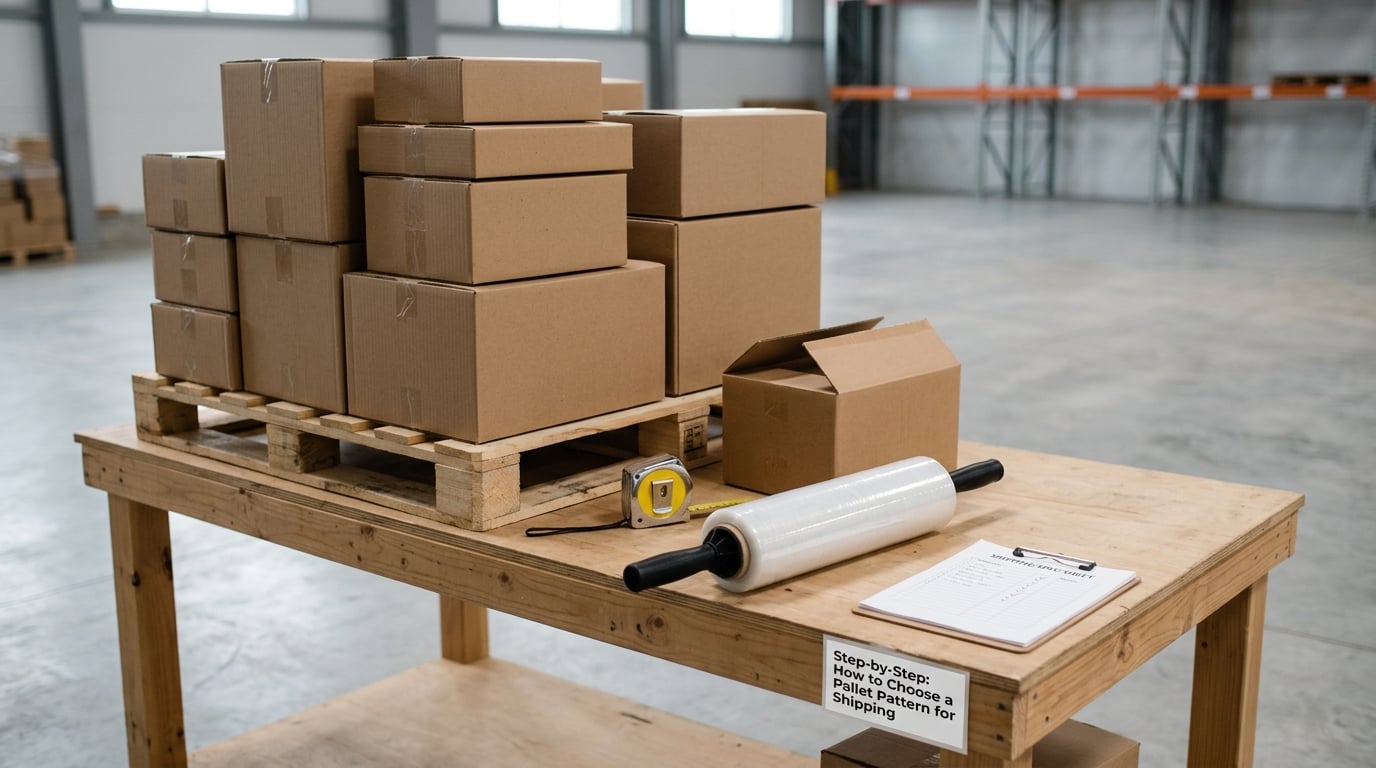
Measure and classify the load
Record three numbers per SKU: the carton footprint, the carton height, and the case weight. Then add the pallet’s own dimensions and deck height to get the finished unit’s height and footprint, and confirm the total weight including the pallet.
Classify the shipment on four axes before you look at patterns. Weight per layer, stacking demand (top-loaded by another pallet, or not), how uniform the cartons are, and what the load is vulnerable to — crushing, sliding, moisture, or vibration.
DHL’s guide on large shipments uses rough thresholds to separate these: shipments from about 50 kg, individual pieces above 30 kg, and palletised pieces around 1,000 kg. Useful as a sanity check, not a rule.
Uniform cartons plus known BCT is a solvable problem. Mixed cartons are a packing problem that the pattern can only stabilise, not solve.
Confirm the handling and storage conditions
Your pattern has to survive the equipment that touches it. A hand pallet jack entering from the side rules out a design with narrow openings; a forklift that approaches from any direction wants four-way entry; a robotic cell wants consistent, predictable case dimensions that the gripper can repeat on every cycle.
Then list the transfer points. Every time a unit is set down, picked up, or loaded, it is an opportunity for load shift, and each handling event argues for a more interlocked pattern than the last one. A unit that goes straight from your dock onto one trailer and is unloaded once is a low-handling load. A unit that sits in a cross-dock, goes to a 3PL, and gets re-palletized is not.
Storage matters as much as transport. A unit destined for two or three high block stacking in a warehouse has to carry more weight above it than a unit that ships immediately.
Match the pattern to the shipping method
Match the pallet’s construction pattern to your handling and route, and the carton stacking pattern to your product’s uniformity. Most warehouses settle the first once and vary the second by SKU.
Pallet construction patterns
- Stringer board — three boards running the length of the pallet, stringers between them, top and bottom decks. Two-way or four-way entry depending on the stringer position. The lightest and cheapest option, and the one most exposed to forklift damage on the stringers. Right for light to moderate loads, short routes, and hand or powered jack handling.
- Block — a solid block of nine blocks with the deck boards nailed across them. Stronger in bending and twisting than a stringer pallet, and the default choice for heavier loads and pallet racking. Needs decent forklift clearance under the deck.
- Winged — stringer pallets with a top deck overhang on the long sides to create a wider top surface. Useful where the product is a single wide item sitting on a narrower pallet, since the wings give it bearing support.
- Double-face — full top and bottom decks, loadable from either side. Standard for bagged, bottled, or palletised loose product where boxes or sacks need bearing across the whole footprint. Heavier and more expensive than single-face.
- Specialty patterns — half-pallets, display and pick pallets, heat-treated export pallets, plastic or composite pallets, and slip-sheet or sheet-fed systems for stretch wrapping. Choose these for a specific constraint: a narrow pick face, a hygiene requirement, a moisture problem, or a high-throughput automated line.
Carton stacking patterns
| Pattern | Best for | Lateral stability | Stacking speed | Main limitation |
|---|---|---|---|---|
| Column (block/row) | All cartons identical in size and weight | Low — vertical seams line up | Fastest | Each carton must carry full weight above it |
| Split row | Uniform cartons with a partial pattern variation | Medium | Fast | Needs consistent case counts per layer |
| Brick (interlock) | Two carton sizes, mixed loads | High — seams offset layer to layer | Moderate | Fewer cartons per pallet, more build time |
| Pinwheel | Long rectangular cartons, mixed heights | High | Slow | Wasteful space unless a central void is filled |
| Interlocking split row | Mixed sizes where a fast pattern is needed | High | Moderate | Requires a layer plan before you start |
| Pyramid | Nothing — avoid it | Poor | Moderate | Reduces load strength, not stackable |
Two numbers make the choice concrete. WebstaurantStore reports that column stacking improves box security and strength by 30 to 50 percent, and that overhang can cut box strength by 30 percent or more. That is the trade in one sentence: a column pattern gives you speed and compression strength, an interlocking pattern gives you lateral stability and a lower centre of gravity.
Column stacking is the default when every carton is the same size and the BCT is high enough for the stack height. Interlocking is the default when sizes vary, when the load gets handled more than once, or when anything in it is fragile. If the cartons are long and rectangular, pinwheel is usually the answer.
Check structural, dimensional and compliance requirements
Work through the checks in this order: pallet strength and grade, deck opening size, stringer or block placement, overhang, fasteners, labelling, documentation, and the applicable transport standard.
Overhang is the one to check first. A carton hanging over the pallet edge loses a large share of its compression strength, and that loss starts well before the carton is half off. Keep the load inside the footprint, and fill any pattern voids with dunnage, anti-slip sheets, or air bags rather than leaving them empty.
Fasteners matter more than people expect. Loose nails are the most common reason a pallet gets rejected, and cross-grade patterns need fasteners rated for the load, not the cheapest available.
For compliance, wood packaging leaving the country needs the ISPM-15 heat-treatment mark, and the carrier needs the unit’s weight, dimensions, and stack count. Castle Industrial points to EUMOS 40509 as the load-securing calculation method under the EU’s 2014/47/EU directive, which is the reference to check if you ship into Europe. Your own carrier’s rules come first, though — ask them for their current spec rather than working from memory of an old one.
Build a physical or digital load test
Build one fully packed unit with representative product before you commit the pattern to a whole production run. Build it the way your team will actually build it, on the same equipment, with the same wrap tension and the same number of people.
Then look for movement rather than for neatness. Rotate the unit on its base and watch whether the top layer slides or rocks. Push the upper section sideways and see if the layers separate. Withdraw one carton from the middle of a layer and see whether the ones above drop into the void.
For higher-risk loads, a digital load simulation gives you a repeatable answer faster than repeated physical testing, and it is the method Castle Industrial’s testing service is built around. If you run a robotic cell, a simulated cycle is also the only practical way to find out whether a mixed-size pattern cycles at all.
Write down what passed: pattern, layer diagram, case count per layer, wrap turns and tension, strap positions, and the carton BCT you assumed. That sheet is the spec, and it should be the same document the next shift reads.
Common Mistakes
Choosing on pallet cost first. A cheaper stringer pallet that damages the load costs more than the difference. Decide the pattern from the load, then buy the pallet that carries it.
Ignoring overhang. A load that looks efficient because it fits more cartons is often 30 percent weaker at the edges. Keep everything inside the deck footprint.
Assuming all pallets are interchangeable. Two-way and four-way entry pallets are not interchangeable for equipment, and a pattern built for one pallet size will not transfer to another. Record the pallet in the spec.
Not testing the fully packed unit. Testing an empty pallet or a partial stack tells you nothing. Load shift shows up under the weight and handling it will actually see.
Pyramid stacking. Tapering the load upward reduces strength, drops your cube utilisation, and makes the unit non-stackable. DHL is blunt about this one: it exists on show floors, not in transit.
Forgetting to secure the finished unit. A pattern sets the geometry; wrap, strapping, and corner boards do the containing. Keep no more than about 3 inches between the strap and the box beneath it, or the strap will not bite. Use corner boards or edge protectors wherever cartons take the load of the wrap pressing inward.
Ignoring the stacking height the destination allows. Two or three pallets is the practical maximum for block stacking in most warehouses, and trailer and container heights bind first. Confirm the limit before the pattern sets the height for you.
Frequently Asked Questions
What is the best pallet pattern for a general shipment?
For most mixed-product shipments, a brick or interlocking split-row pattern is the safest general choice. It offsets the vertical seams from layer to layer, so braking and cornering forces meet friction instead of a clean edge to slide against. If every carton is identical and its compression strength covers the planned stack height, column stacking is faster and equally safe. Check with your carrier or 3PL before assuming which one they prefer.
Should I choose a stringer, block, or column pallet?
Stringer, block, and column are not alternatives — they describe different things. Stringer and block describe how the pallet is built, and column describes how cartons sit on it. Choose a block pallet for heavier loads, racking, or repeated forklift handling. Choose stringer for lighter loads and cheaper handling. Then stack the cartons in a column or interlocking layout on whichever pallet fits your equipment.
How do I know if my load is safe on a pallet?
A load is safe when nothing moves when it should not. Rotate the unit on its base and watch for sliding, push the upper section sideways to see if layers separate, and pull a carton from the middle of a layer to check whether the stack drops into the void. Also check the finished height and weight against the carrier’s limits before you call it done.
Can pallet patterns be changed without changing the products?
Usually yes, as long as the cartons stay the same. Switching from column to an interlocking layout does not require different products, only different placement, and sometimes dunnage or anti-slip sheets to fill the voids an interlocking pattern creates. What does change is the carton count per pallet and the finished height, so re-check both and update the load sheet.
Does pallet pattern affect shipping cost?
Indirectly, yes. A tighter pattern fits more cartons into the same pallet footprint, which means fewer pallets and fewer freight units for the same product. A pattern that leaves a large void or needs pyramid-style tapering wastes cube, and cube you do not use is money you still pay to ship. Interlocking patterns usually carry fewer cartons per pallet, so the trade is stability against units per load.
What information does my carrier need about the pallet?
Most carriers want the unit’s dimensions including the pallet, its total weight, the number of stacked units, whether the wood carries the ISPM-15 mark for export, and how the load is secured. International shipments may also need a commercial invoice and the verified gross mass. Send all of it before pickup rather than at the dock, since a spec discovered late usually means a re-palletized load.
Conclusion
Choosing a pallet pattern for shipping comes down to three things in order: the load’s dimensions and compression strength, the handling it will actually see, and the shipping mode it goes out on. Measure those first, then pick column stacking for uniform strong cartons or an interlocking layout for mixed or multiply-handled freight.
Start by writing down the carton dimensions, case weights, and stack height for the shipment in front of you, then build one fully packed unit with the pattern you think wins. That single test usually settles it faster than another round of reading.