

To select a plastic for chemical resistance, you match the exact medium to the resin under the real service conditions. No polymer resists everything, so the decision comes down to four variables: the chemical and its concentration, the continuous service temperature, the exposure mode, and how long the part stays in contact. Start with those four, then screen candidate polymers against compatibility data and validate the winner before it goes into production.
That sounds obvious, but most failed plastic parts in chemical service were chosen on a single property. A resin was picked for strength, or because a supplier called it “chemical resistant” without stating a concentration or a temperature, and the part crazed, swelled or leaked a year later. The difference between those two outcomes is a repeatable screening method, which is what this guide sets out.
On a r/plastic thread, the recurring question was not which polymer is best but who could sanity-check the choice. You can do that screening yourself if you know what to write down first.
Table of Contents
- What You Need
- Step-by-Step
- Common Mistakes
- Frequently Asked Questions
- What plastic is best for chemical resistance?
- How do I choose a plastic for a chemical that is not listed?
- Does chemical resistance rating A mean the plastic will not be affected?
- What is the difference between chemical resistance and chemical compatibility?
- How does temperature affect plastic chemical resistance?
- Should chemical-resistant plastic be immersion tested before production?
- Start With the Medium, Not the Resin
What You Need
Before any resin is named, gather the inputs below. Most selection errors are really data-gathering errors, because someone decided with partial information and never revisited it.
- The full chemical identity. Not “acid” but “50 percent sulfuric acid.” A grade, a mixture, and a commercial blend all behave differently from the pure compound.
- Concentration and any contaminants. Water content, dissolved salts, chlorine traces, or a catalyst carry-over can change the answer more than the base chemical does.
- Continuous service temperature, plus the highest temperature during startup, cleaning or a fault condition, and how fast temperature changes arrive.
- Exposure mode and duration. Continuous immersion, splash, vapour or fuming contact, and static head pressure are different services. So are eight hours a day and eight hours a year.
- Mechanical requirements. The loads, stiffness, creep behaviour and impact the part has to carry while it is wetted.
- Compatibility data for the candidate grades, from the resin manufacturer rather than from a generic aggregator page.
- Regulatory and safety constraints. Food contact, pharmaceutical, potable water, cleanroom and outgassing requirements, plus any restriction your end market places on the chemistry.
Add your joining method to that list early. A part that performs well in sheet form can fail at the weld line, and that failure belongs to the fabrication process as much as to the resin.
Step-by-Step
How to Select a Plastic for Chemical Resistance
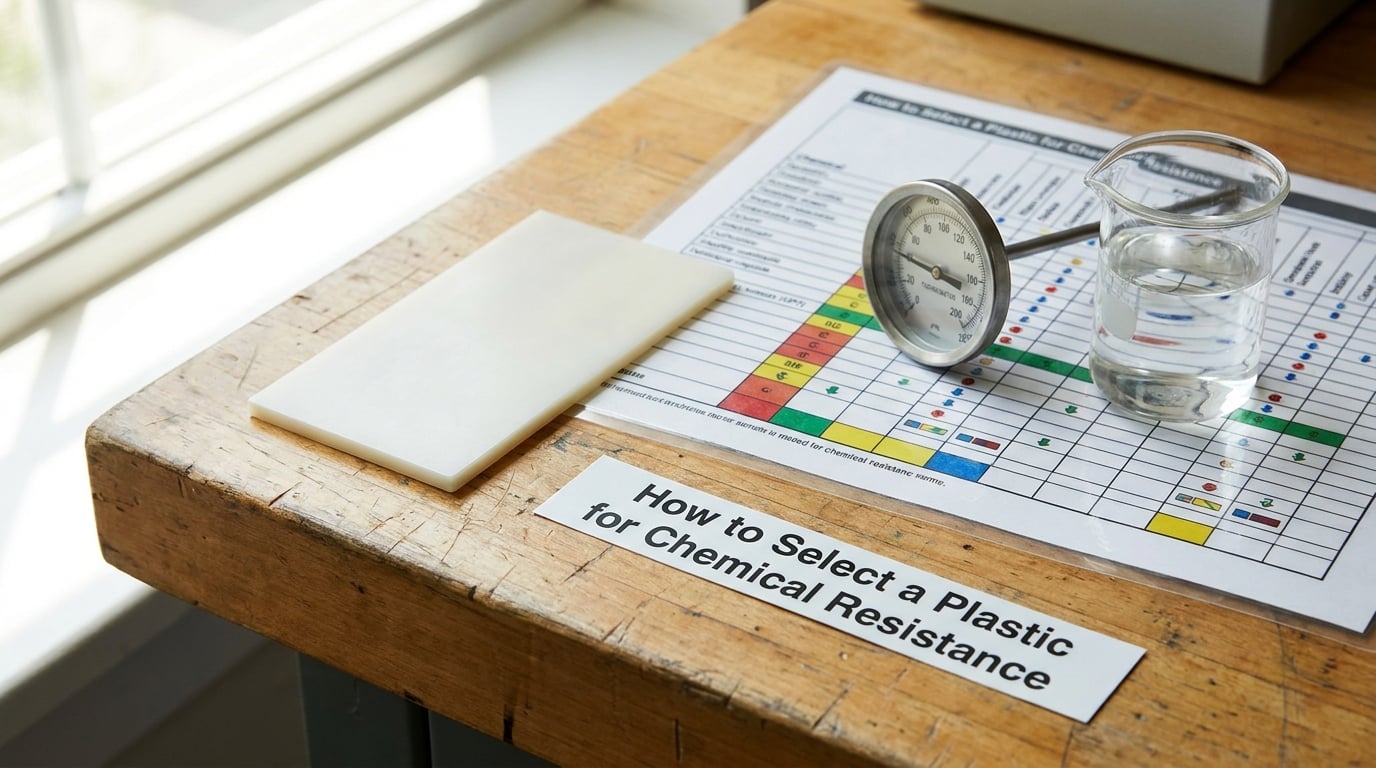
The workflow has six steps, and the order matters because each step narrows the field for the next one. Define the medium, set the temperature, decide the exposure mode, screen candidate polymers against compatibility data, apply the secondary constraints that chemistry alone will not settle, then validate with a test that represents real service.
Skipping ahead is expensive. Screening polymers first and discovering later that your operating temperature exceeds the resin continuous use limit means the compatibility work was wasted, because the part would have been rejected on temperature grounds regardless of how well it resisted the chemical.
Define the Chemical and Exposure Conditions
Write the service medium as a full specification, not a category name. “50 percent sulfuric acid at 80 C, continuous immersion, eight hours a day, with 20 minutes of agitation per batch” is a specification an engineer can screen. “Corrosive acid” is not.
Mixtures deserve their own treatment. A 50/50 blend of nitric and hydrochloric acid behaves nothing like either acid on its own, and many process streams pick up contaminants that are not on any purchasing record. If the composition is not fully known, say so in the selection record and treat that as the reason to test rather than the reason to relax.
Concentration and temperature move together. Dilute sulfuric acid at ambient temperature is a routine HDPE and PP duty. Concentrated sulfuric acid at elevated temperature is not, and the crossover is not always where a general reader expects it. Where you can, capture the range and check the resin at the worst corner, not the average one.
Then record the exposure mode. Continuous immersion puts the chemical against the whole outer surface under a sustained concentration gradient. Splash service only wets the part intermittently, which lets a weaker resin survive longer, though repeated wet-dry cycles are harder on the surface than steady immersion. Vapour or fuming contact is a different service again, because the concentration reaching the surface can be lower than the bulk liquid but the exposure is continuous. Static contact with no flow is gentler than a pumped line where the boundary layer is constantly stripped and replaced.
Finally, note the geometry question that charts rarely address: is contact one-sided or two-sided? A lined tank wall sees the medium from one face while the steel behind it sees it through the liner, which doubles the heat and mass transfer paths. Permeation through a wall becomes a containment question, not just a durability question.
Check Manufacturer Compatibility Data
Compatibility charts are a screening tool, not a specification. They compress an enormous amount of testing into a letter or a symbol, and the letter only means something once you know the conditions the publisher assumed when they assigned it.
Two rating scales are common in the industry. The A/B/C/D scale is common in North American supplier literature, and the ++/+/O/- scale appears in European chemical-handling tools. Both mean the same idea at the top and bottom of the range, but the middle tiers differ in wording, so read the legend rather than assuming.
| Rating | What it means | What it permits you to assume |
|---|---|---|
| A or ++ | Excellent or fully recommended | The resin is expected to withstand the medium at the stated temperature for continuous service. Attack, permeation and swelling are negligible over the rated life. |
| B or + | Good, or recommended with a reduction factor | Usable, but permeation, swelling or a modest reduction in service life can be expected. The part may need a thicker wall, and the rating is frequently tied to a lower maximum temperature. |
| C or O | Fair or conditional, restricted use | Requires individual assessment. Intermittent exposure, a lower temperature, a lower concentration, or a specific assessment for your part is expected before you commit. |
| D or – | Poor or not suitable | Chemical attack, rapid degradation, or a stress-cracking risk that is not controllable by design. Treat as a rejection rather than a caution. |
Three things to check every time you read a chart. First, whether the rating assumes continuous exposure at the listed temperature, because a rating derived from short immersion tests says little about a part that sits in service for a decade. Second, whether the chart states a concentration, since an unqualified “sulfuric acid” row usually means dilute. Third, what the publisher means by reduction factor, which is a multiplier on the maximum working temperature, not a strength reduction.
Also check the resin grade, not just the polymer family. Fillers, stabilisers, plasticisers and processing history all change behaviour. A glass-filled grade that is rated for a chemical may be fine chemically and unacceptable in another way, because glass fibre is attacked by some strong alkalis, and because the filler changes stress distribution in a stressed part.
Where two charts disagree, the manufacturer of the grade you intend to buy wins. Aggregator charts are useful for a first pass and a poor final authority, because they blend data from different sources, different concentrations and different test durations into one grid.
Compare Candidate Polymers Beyond Chemical Resistance
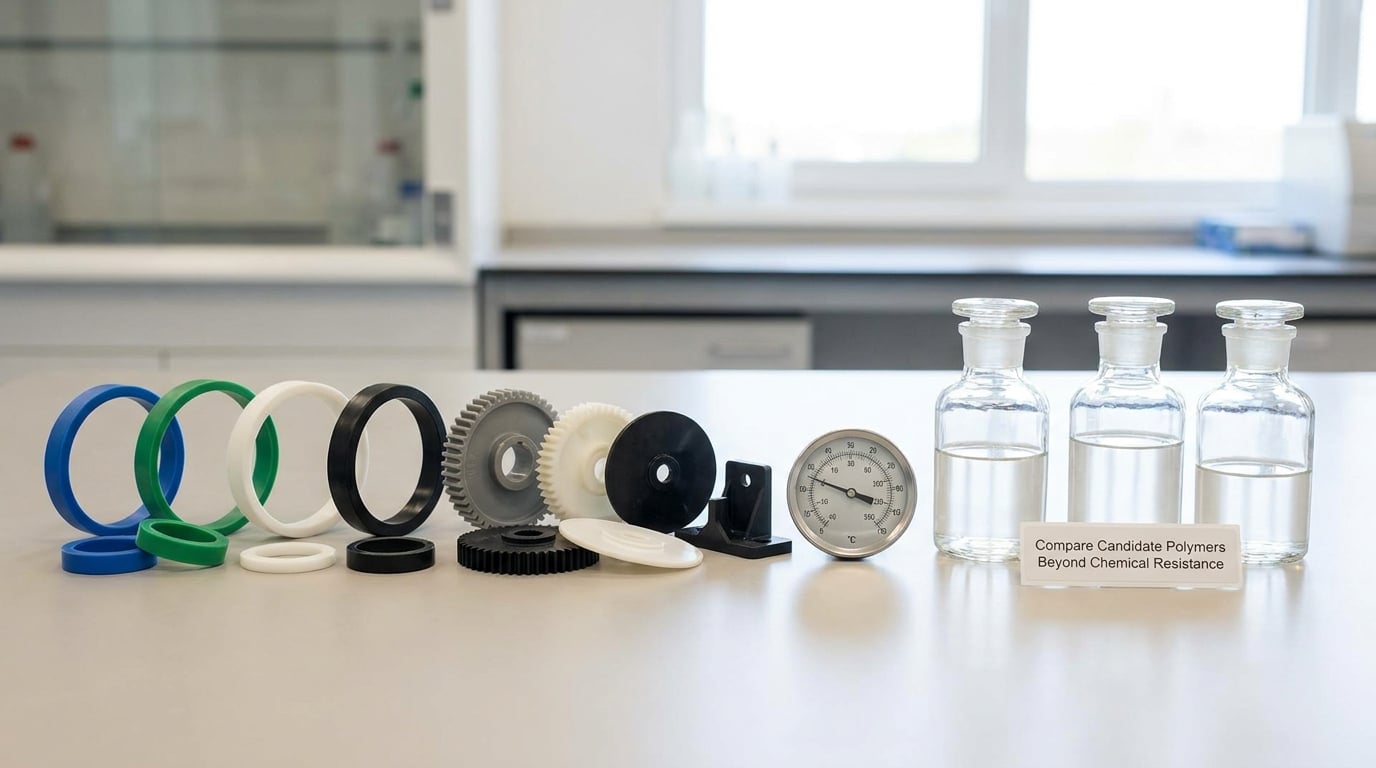
Once chemistry has produced a shortlist, the remaining decision is usually made on everything else. A resin that resists the medium perfectly but creeps under a static load, cannot be welded, or is unavailable in your part size is not a candidate.
| Chemical family | HDPE | PP | PVC | CPVC | PVDF | PTFE | FEP | PFA | PEEK | Acetal POM | Polycarbonate | Nylon PA66 |
|---|---|---|---|---|---|---|---|---|---|---|---|---|
| Dilute mineral acids | A | A | A | A | A | A | A | A | B | C | A | C |
| Concentrated mineral acids | C | C | C | B | A | A | A | A | B | D | D | D |
| Oxidising acids | D | D | D | D | B | A | A | A | C | D | D | D |
| Organic acids | A | A | A | B | A | A | A | A | A | D | C | D |
| Alkalis and caustics | A | A | B | A | C | A | A | A | A | B | C | C |
| Alcohols and glycols | B | B | C | C | B | A | A | A | A | A | C | B |
| Ketones and esters | C | C | D | D | B | A | A | A | B | D | D | C |
| Aromatics | C | C | D | D | B | A | A | A | B | D | D | D |
| Chlorinated solvents | C | C | D | D | A | A | A | A | B | C | D | C |
| Aliphatic solvents | C | C | D | D | B | A | A | A | B | D | D | C |
| Hydrocarbons, fuels and oils | B | C | D | D | A | A | A | A | A | C | C | D |
| Hydrogen peroxide and bleach | D | D | B | B | A | A | A | A | C | D | D | D |
| Chlorine wet or dry | C | D | B | B | B | A | B | A | D | D | D | D |
| Water, brine and seawater | A | A | A | A | A | A | A | A | A | A | A | A |
| Aggressive gases | C | D | C | C | B | A | B | A | C | D | D | D |
Read the matrix as a screen, not a decision. The fluoropolymers cluster together because they are chemically inert across nearly the whole grid, which is why they keep appearing as the safe answer to “what plastic is best for chemical resistance.” They pay for that breadth with softness, poor melt-processability, difficult joining, and in some fluoropolymers with regulatory attention around PFAS classifications, which can affect both specification and end-of-life handling.
At the other end, the polyolefins are the economical answer for dilute mineral acids, alkalis, salts and water at moderate temperature, and they are far easier to fabricate, weld and recycle. Accepting a C in one column buys a lot of processing simplicity. Just be honest about the columns marked D.
The secondary constraints are where most of the engineering work happens once the chemistry is settled.
| Polymer | Typical continuous use | Resistance breadth | Stiffness | Fabricability | Relative cost tier |
|---|---|---|---|---|---|
| HDPE and UHMW-PE | 60 to 80 C | Narrow, acids to alkalis and water | Low | Easy to weld and machine | Commodity |
| Polypropylene | 90 to 100 C | Narrow, better temperature margin than HDPE | Low | Easy to weld and machine | Commodity |
| PVC and CPVC | 60 C for PVC, up to 100 C for CPVC | Narrow, good on dilute acids and oxidisers for CPVC | Medium | Rigid, solvent-weldable | Commodity to mid |
| PVDF | About 150 C | Broad, strong on oxidisers and halogens | Medium | Good, weldable with care | Fluoropolymer |
| PTFE and FEP | 260 C for PTFE, about 200 C for FEP | Broadest, effectively inert across the matrix | Very low, cold flows under load | Limited melt processing, special joining | Fluoropolymer |
| PFA | About 260 C | Broad, fluoropolymer grade with better creep than PTFE | Low to medium | Melt processable, weldable | Fluoropolymer |
| PEEK | 250 C short term, lower continuous for many grades | Broad, including ketones and aromatics | High, fibre-reinforced grades higher | Excellent, machinable and injection mouldable | High performance |
| PPS and PPSU | 180 to 200 C | Broad, good on acids and solvents | High | Good, requires drying | Engineering |
| PSU and PES | 150 to 170 C | Broad, hydrolysis sensitive | High | Requires drying, machinable | Engineering |
| Acetal, polycarbonate, nylon, ABS | 60 to 115 C depending on grade | Narrow, stress cracking is the usual limit | Medium to high | Excellent, easy to machine and mould | Commodity to engineering |
Two traps sit in the table above. Acetal and polycarbonate are superb engineering materials that fail in chemical service through environmental stress cracking rather than dissolution, so a compatibility chart alone will not warn you about a heavily stressed bracket. And a filler changes the answer: carbon or glass reinforcement raises stiffness and heat resistance, but the binder chemistry and the fibre surface both participate in chemical attack, and a filled grade should be rated separately from the unfilled one.
Validate the Selection With Testing
Test when the chemical is not in the published data, when the service conditions are more severe than the test conditions behind the rating, when failure consequences are high, or simply when the part is expensive enough that a small test beats a large recall. People answering the “who can I ask” question on forums are usually in the second case without knowing it.
Coupon immersion testing is the workhorse. Cut representative coupons from the actual grade, in the actual fill and orientation, and record their mass and dimensions before exposure. ASTM D543 is the commonly referenced immersion practice for plastics in chemical environments, with ASTM D570 for water absorption, D638 for tensile properties and D790 for flexural properties as the mechanical baselines. Hold coupons in the actual medium at the actual temperature, and match the exposure to your duty cycle, which means a rotating or agitated bath if the real duty has agitation.
Set your pass criteria before you start, not after you see the numbers. Common ones: a mass change inside a limit you define, a dimensional change below your tolerance, a visual inspection for crazing, discoloration or surface attack, and tensile retention after exposure compared with the unexposed control. Record a worst-case corner too, since a coupon tested at average conditions tells you very little about the peak.
Short tests tell you about gross attack, not about a ten-year service life. A coupon that survives 30 days in the lab can still be swelling slowly enough to matter, so a long soak, an accelerated test at a higher temperature with an Arrhenius-based extrapolation, or a real component trial is worth doing when the duty is continuous and the consequence of failure is a leak or a shutdown.
Where you cannot replicate the medium safely at full scale, test the failure-critical part: a weld coupon, a fitting, a gasket edge, a liner panel with its actual fastener pattern. Failures concentrate at joints, not in the flat panel, so the flat panel is the least informative test you can run.
Document the Final Decision
The last step is the one teams skip, and it is the one that makes the selection survive contact with a procurement query, an audit, or the person who inherits the job.
Record the resin family, the specific grade, the supplier and the data sheet revision you relied on. Record the full medium specification with its assumed range, the temperature and duration you evaluated, the exposure mode, and every rating you accepted along with its source. Note the permeation and swelling expectations, the mechanical assumptions including any sustained load, and the fabrication and joining method including stress relief if it applies.
Then record what the evidence does not cover. An honest list of limitations is what lets someone else review the decision in three years instead of starting again, and it tells the quality team which properties need monitoring in service. Close with the approval status and who signed it, and attach the coupon results if you ran them.
On Quora and r/plastic, the pattern in these discussions is consistent: people want a second opinion because published charts are ambiguous. A written record with explicit assumptions is usually enough to get that review from a resin supplier’s technical team, and it is faster than an open forum thread.
Common Mistakes
Treating a generic chart as a specification. Aggregator charts blend data across concentrations, temperatures and exposure times. The fix: use the chart to shortlist, then confirm with the resin manufacturer’s data for the grade you will actually buy.
Ignoring temperature. A resin rated excellent at 25 C can be unsuitable at 90 C, and the continuous use limit is a separate number from the short-term limit. Rate the part at its hottest continuous condition, not at the average, and check the highest temperature reached during startup, cleaning and fault conditions.
Ignoring concentration. Many chart rows quietly assume dilution, and concentrated acids and caustics sit on the other side of the line from dilute ones for the same polymer. The fix: write the concentration into the specification and test the worst corner.
Confusing chemical resistance with containment. A resin that does not dissolve can still be permeated by the medium, and a lined wall with permeation carries the chemical into the structure behind it. The fix: check the permeation rate, not just the rating, and account for the media contacting both faces.
Selecting on strength alone. A stiff part in acetal or polycarbonate in an aggressive solvent can crack long before it yields. The fix: evaluate the part under sustained load in contact with the medium, and check the environmental stress cracking behaviour of the specific grade, including any weld lines or sharp corners.
Skipping validation for unfamiliar or changing service. Formulations change, catalyst carry-over changes, and a batch that was fine last year may not be fine now. The fix: keep the assumptions in the selection record and re-test when the service changes.
A couple of habits that help more than they sound: design out sharp corners and give the part generous stress relief radii, and keep weld lines and molded-in stresses away from the wetted surface where the geometry allows. Chemical failures start where the stress is, not where the chemistry is most aggressive.
Frequently Asked Questions
What plastic is best for chemical resistance?
The broadest-spectrum choices are PVDF, PTFE, FEP, PFA and PEEK, which tolerate the widest range of chemicals at elevated temperature. For dilute mineral acids, alkalis, salts and water at moderate temperature, HDPE and PP are the economical answer. There is no universally resistant plastic: every resin has a chemical that attacks it, so the correct choice depends on concentration, temperature and exposure mode as much as on the polymer name.
How do I choose a plastic for a chemical that is not listed?
Write the full service specification first: exact chemical, concentration, contaminants, continuous temperature, exposure mode and duration. Then identify the closest chemical family on a compatibility matrix and use it to shortlist two or three candidate resins. Confirm with the resin manufacturer for the specific grade, and run a coupon immersion test under conditions that match or exceed the real duty before you commit to production.
Does chemical resistance rating A mean the plastic will not be affected?
An A rating means no significant effect is expected within the stated conditions, not that nothing happens. Most charts assume continuous exposure at a listed temperature over a defined life, and a rating carries no information about conditions outside those limits. Permeation, swelling, or a small property change can still occur, and the rating is meaningless if your temperature, concentration or duty cycle differs from the one the publisher assumed.
What is the difference between chemical resistance and chemical compatibility?
Chemical resistance describes how much a material resists attack by a specific medium under specific conditions. Chemical compatibility is the broader judgment that a given plastic can be used with that medium in a given application. Compatibility is the practical conclusion, and it folds in more than chemistry: mechanical loading, temperature, permeation, joining method, regulatory requirements and the consequences of failure.
How does temperature affect plastic chemical resistance?
Higher temperature speeds every degradation mechanism at once: chemical attack, permeation, swelling and creep. A resin rated good at 25 C may drop to restricted or unsuitable at 90 C, and softening reduces stiffness while raising stress. Rate your part at its hottest continuous condition, and separately check short excursions such as cleaning cycles or startup, because those produce thermal stress that cold media can turn into cracking.
Should chemical-resistant plastic be immersion tested before production?
Yes, whenever the chemical is not in the published data, when your conditions are more severe than the test conditions behind the rating, or when failure would mean a leak, contamination or shutdown. Coupon immersion testing under ASTM D543, with mass change, dimensional change, visual inspection and tensile retention as pass criteria, is inexpensive compared with a part failure. Test the failure-critical geometry, such as welds and fittings, not just flat sheet.
Start With the Medium, Not the Resin
Do the first step today. Write down the exact chemical, its concentration range, the continuous temperature, the exposure mode and the duty cycle, and put that on one page. Everything after that is a shortlist, a rating check and a coupon test, all of which are straightforward once the inputs are written down. Picking the polymer first is the expensive way round, and it is the reason so many parts in chemical service end up replaced with a spreader that nobody documented.