
Last updated: October 2026
Short answer: pick EPS foam when the package ships once and needs to stay rigid and cheap. Pick EPP foam when the insert gets handled, dropped or returned many times. The two bead foams cost very different amounts per part, and they protect in very different ways.
That single rule covers most decisions. Everything else — density, geometry, drop height, humidity, tooling — decides the fine tuning around it.
Table of Contents
- EPS vs EPP foam for protective packaging at a glance
- What are EPS and EPP foam, and how are they made?
- How do EPS and EPP differ in protective performance?
- Which foam is better for impact, compression, and long-term storage?
- What are the environmental and end-of-life differences?
- How do cost, availability, and design requirements affect the choice?
- Which should you choose?
- Frequently Asked Questions
- Conclusion
EPS vs EPP foam for protective packaging at a glance
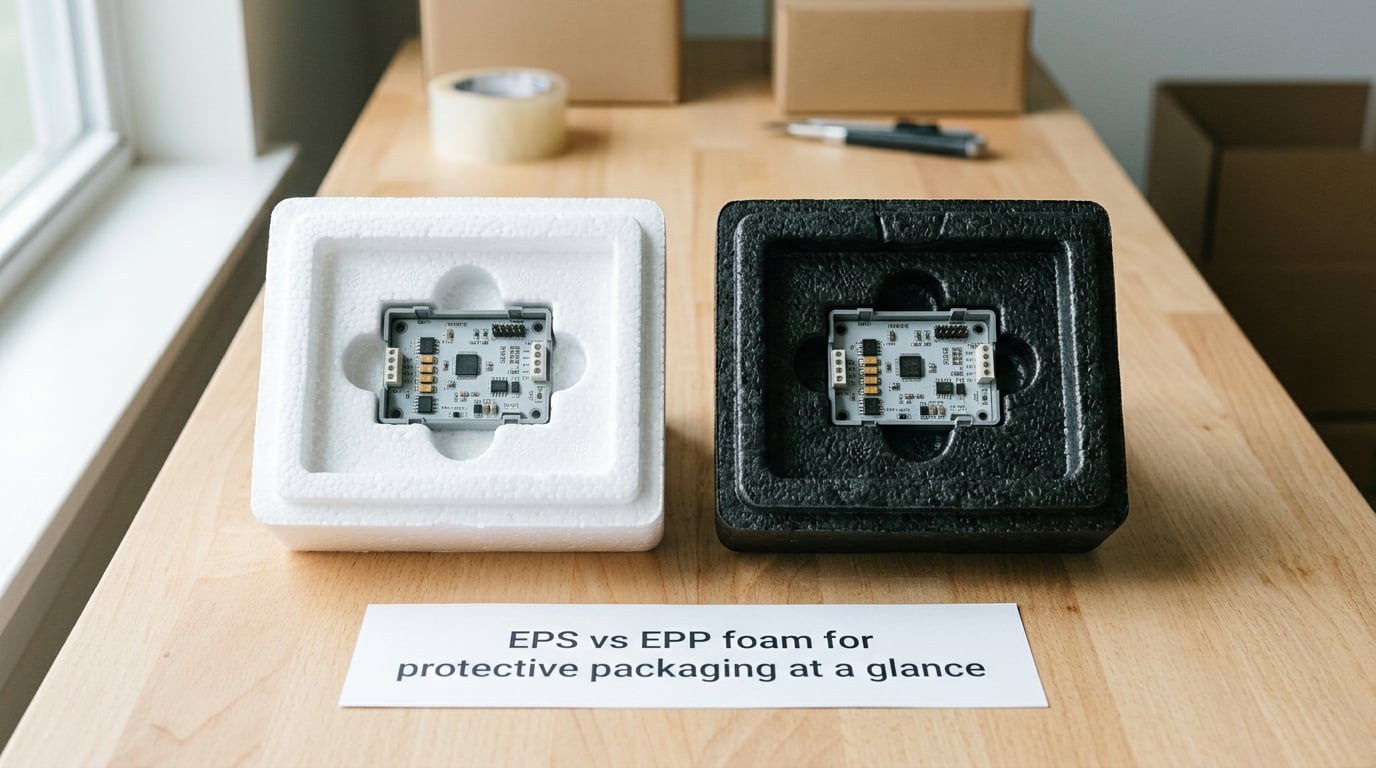
Both materials are closed-cell bead foams, both are molded into custom shapes, and both weigh almost nothing. The split comes down to how they respond to a hit. EPS absorbs energy by crushing and staying crushed, which is why it needs more material around the product and why it is cheaper per part. EPP absorbs energy by compressing and springing back, so it handles repeat hits without being replaced.
| Property | EPS (expanded polystyrene) | EPP (expanded polypropylene) |
|---|---|---|
| Polymer matrix | Amorphous polystyrene | Semi-crystalline polypropylene copolymer |
| Typical foam density | About 15 to 40 kg/m3 for packaging grades | About 20 to 60 kg/m3 for packaging grades |
| Air content by volume | Roughly 98% air | Roughly 90 to 95% air |
| Impact mode | Crushes to lock, permanent set after one hard hit | Compresses and rebounds, repeatable |
| Recovery after 50% compression | Minimal, the cell walls stay deformed | Better than 95% of original thickness |
| Behaviour at low density | Soft and friable, crushes early | Still firm and springy |
| Max service temperature | Around 80°C | Around 130°C |
| Water absorption | Very low, closed cell | Very low, closed cell |
| Chemical and solvent resistance | Weak against solvents and fuels | Good against oils, acids and cleaners |
| Behaviour under long load | Rigid and shape-retaining, good for stacking | Elastic, creeps under sustained heavy load |
| Resin code | #6 (PS) | #5 (PP) |
| Relative part cost | Lower, the default choice for single-use packs | Roughly 3 to 5 times the EPS part cost |
| Relative reusability | Single trip in most designs | Built for return loops and repeat handling |
Read that table as a starting point rather than a verdict. A well-designed EPS insert at the right density can protect a fragile instrument just as well as EPP, provided the package is not dropped twice.
What are EPS and EPP foam, and how are they made?
Expanded polystyrene is the familiar white bead foam from packing peanuts and protective blocks. Small beads of polystyrene already carry a pentane blowing agent inside. Steam heats them, the pentane expands, and the beads are fused together into a rigid, closed-cell structure that is almost entirely air.
Because polystyrene is amorphous, its cell walls are glassy and stiff. Under load they fracture rather than bend. That fracture is the mechanism: the part absorbs energy by taking a permanent set.
Expanded polypropylene starts from polypropylene copolymer beads that also carry a blowing agent. The beads are expanded in an autoclave at roughly 2.5 to 5.0 MPa, then steamed into a mold at higher temperature and pressure than EPS requires. A typical EPP line runs around 140 to 155°C with steam at about 0.3 to 0.5 MPa.
Polypropylene is semi-crystalline, so its cell walls bend and spring rather than shatter. That is why molded EPP inserts return to shape after being compressed, and why the material stays firm even at densities that leave EPS feeling soft and fragile.
The naming trips people up more than the physics does. EPE is expanded polyethylene, a softer and cheaper polyolefin frequently bundled in the same category by suppliers, sometimes even grouped informally as “EPO”. If a supplier will not confirm the resin code on the quote, the material is not specified.
How do EPS and EPP differ in protective performance?
The honest answer is that energy absorption depends on density and geometry at least as much as on the resin name. A light EPS part and a light EPP part of identical shape will behave quite differently, but so will a heavy EPS part compared with the light one.
Where EPS wins is stiffness at low weight. Because roughly 98% of the part is air, a rigid EPS shell holds a heavy, awkward component without much dead weight. It resists vibration settling and it stacks cleanly in a warehouse. Instruments, medical device cases, large appliances and automotive components shipped once all suit it well.
Where EPP wins is repeated loading. Recovering more than 95% of its thickness after being compressed in half means the same insert can absorb the second, fifth and twentieth impact. The crush-to-lock behaviour that protects an EPS part on the first drop is exactly the behaviour that ends its usefulness.
Creep is the other difference engineers notice. A sealed EPS insert under constant stack load keeps its dimensions over months in storage. An EPP insert under the same sustained load slowly compresses, which is fine in transit but matters if the part sits under weight in a trailer for weeks.
Thermal behaviour follows the polymer. EPP keeps working to roughly 130°C while EPS softens past about 80°C, so EPP is the practical choice for hot-fill, dishwasher-adjacent or steam-exposed applications. Both insulate well and both absorb almost no water, which is why both are used for cold chain.
Which foam is better for impact, compression, and long-term storage?
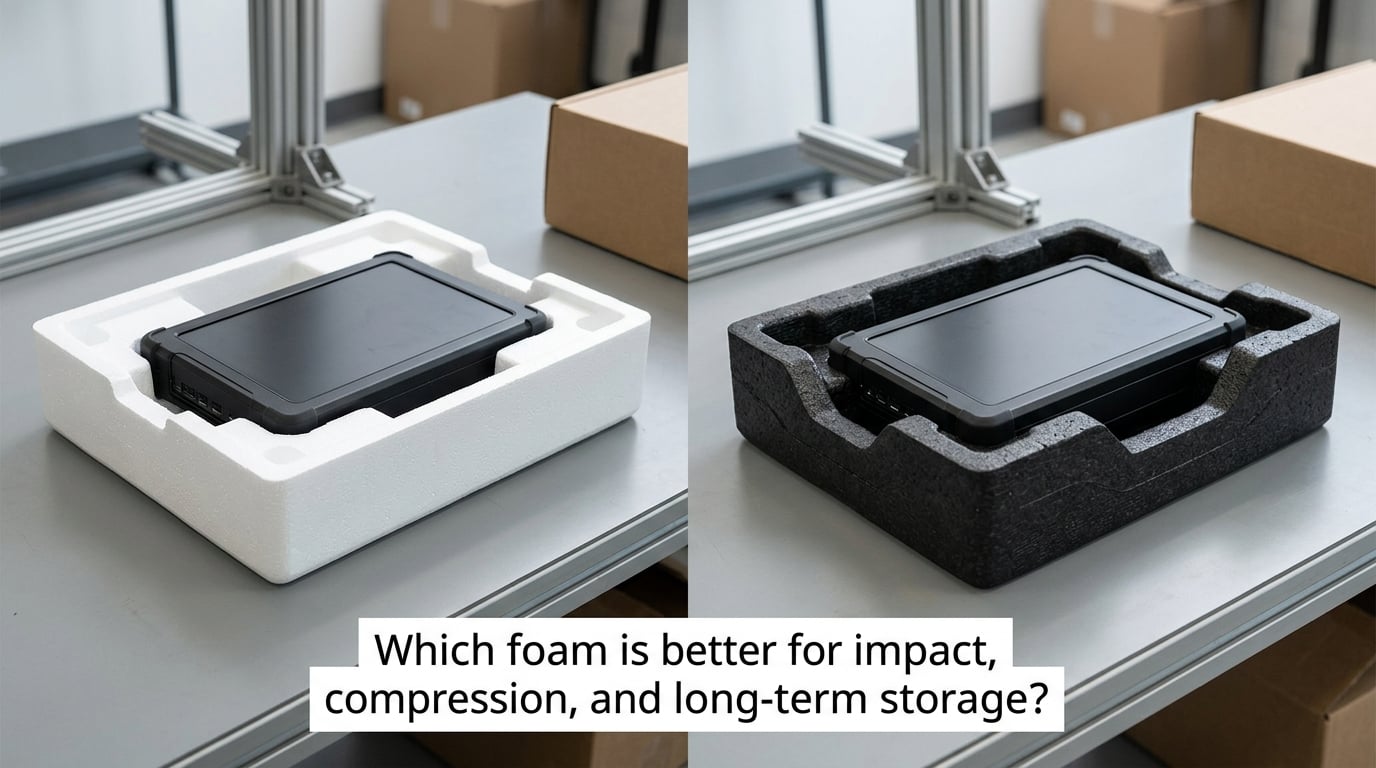
For single-drop protection with a heavy or rigid payload, EPS is usually the cleaner answer. The part stays dimensionally stable, it can be built into a thin rigid shell, and the part price leaves room for more foam where it matters.
For anything that returns to a dock, sits in a courier network, or gets handled by several people before it reaches the customer, EPP earns its extra cost. Returnable transit containers, reusable e-commerce packaging and automotive loops all sit in that category, and that is where the resin difference shows up as a durability difference.
Choose density by the failure mode, not by habit. Light densities suit void fill, cushioning and low-value items. Mid-range densities around 25 to 45 kg/m3 handle most molded insert work. Higher densities suit edge protection, tool cases and parts carrying static or heavy loads, and they add weight to every shipment.
Compression creep deserves its own test. Stack the packed units at the height they will actually see in a trailer or warehouse and leave them there. An insert that recovers when you test it in isolation can still be compressed flat after a month of real stacking.
Then run representative drop testing. ISTA procedures and ASTM D5276 give you a repeatable method, but the useful data comes from testing the finished package at the drop height your distribution network actually produces, on the faces and corners that land hardest.
What are the environmental and end-of-life differences?
Both materials carry a resin code that tells a sorter what it is holding: #6 for polystyrene, #5 for polypropylene. In practice, that is where the similarity ends.
Polypropylene, the #5 stream, is the easier one to recycle. Grocery and retail programs across North America and Europe collect #5 rigid plastics, and recycled EPP from automotive and consumer packaging already has an industrial market. Recycling rates reported for that stream sit comfortably above the figures commonly quoted for expanded polystyrene.
Expanded polystyrene collection is patchier. Where curbside programs accept bulky rigid plastics, clean EPS blocks are accepted, and dedicated drop-off sites exist in many metro areas. In regions without that infrastructure, the reported recovery rate for EPS can fall into the low teens as a share of what is put out, which means a used insert usually ends up in landfill or in an incinerator.
Two practical warnings. First, never let loose EPS beads into a recycling stream — they scatter, and municipal programs will not accept them. Second, be careful about contamination in either stream: a dirty or food-soiled insert is landfill regardless of resin code.
Reuse changes the equation more than any material swap. A package designed for 30 trips has an end-of-life footprint a fraction of thirty single-use packs, and a take-back or reverse-logistics program makes the recovery route predictable rather than hopeful. Local infrastructure, not the resin code, decides how well any of this works in practice.
How do cost, availability, and design requirements affect the choice?
EPP parts typically cost three to five times what the equivalent EPS part costs, mostly because the resin is dearer, expansion needs higher pressure equipment, and cycle times are longer. That gap only closes with reuse.
The simple way to think about it: an EPS insert at cost X used once costs X per shipment. An EPP insert at cost 4X used for 20 shipments costs 0.2X per shipment. Somewhere between 15 and 20 trips the two curves cross, and every trip past that point favours EPP. If your product ships once, the break-even point is never reached and EPS is the rational answer.
Total landed cost can shift the balance in either direction. EPP stays light because it delivers protection at lower density, but a thicker EPS wall to get the same performance can erase that saving once dimensional weight enters the freight calculation.
Design requirements add their own constraints. EPS is easier to trim, glue and machine, and it accepts fine detail. EPP needs more careful geometry to avoid voids, and bonding an EPP shell to an EPS or EPE core is common when you want a rigid exterior with a resilient interior. EPS tooling is cheap and widely available; EPP tooling and higher-pressure molding equipment are a real barrier at low volume.
Ask any converter the same set of questions before quoting: minimum order quantity, tooling cost and ownership, tooling life, first article lead time, production lead time, and whether they run EPS, EPP or both in house. Also ask whether the machine can run both materials, because assuming it can is how quotes go wrong.
Which should you choose?
| Use case | Recommended material | Typical density | Decisive property |
|---|---|---|---|
| Single-use shipping box for a fragile retail item | EPS | Low to mid | Low part cost, rigid fit |
| Instrument or medical device case | EPS core, optional EPP shell | Mid to high | Shape retention and stacking strength |
| Returnable transit container | EPP | Mid | Compression recovery over many trips |
| Reusable e-commerce packaging | EPP or EPP over EPE core | Mid | Multi-impact resilience |
| Automotive return container | EPP | Mid to high | Durability, temperature ceiling |
| Cold chain or seafood shipping box | Either, EPS for value, EPP for reuse | Mid | Insulation plus closed-cell moisture resistance |
| Edge protection and void fill | EPS | Low | Low cost per unit volume |
| Tooling, corner and bumper protection | EPP | High | Absorbs repeated handling |
Before you commit, run through this list:
- How many trips does this package make? One trip points to EPS.
- What is the drop hazard, and will the same package be dropped twice?
- How heavy and how fragile is the payload, and does it need to hold a shape?
- What is the temperature range, including any hot fill or wash-down step?
- How much stack height will the packed case sit under?
- What is your volume per year, and can that justify EPP tooling?
- What end-of-life route exists locally, and does your customer ask for one?
- How will you verify density and drop performance before approving a production run?
If two of those answers point in different directions, test both parts in the same package. Same geometry, same density, same drop height, different resin. That comparison settles arguments faster than any datasheet.
Frequently Asked Questions
Is EPP foam better than EPS for packaging?
No, not in general. EPP is better for packaging that is reused or handled repeatedly, because it compresses and springs back, surviving many impact cycles. EPS is better for single-use packaging, where it delivers comparable protection at a lower part cost and holds a rigid shape. The right choice depends on the number of trips, not on the material name.
Which is better for protecting electronics during shipping?
EPS wins for a single-trip consumer electronics shipment: it forms a tight rigid fit, adds little weight, and costs less. EPP wins when the same case is used again or when the electronics are shipped in a returnable loop. Avoid foam that contacts bare circuit boards directly; use a barrier film or liner so no bead or fragment touches the component.
Is EPS or EPP more recyclable?
EPP is more recyclable in practice. Polypropylene carries resin code #5, a stream accepted by most curbside programs in North America and Europe, and recycled EPP already has an industrial market. EPS carries resin code #6 and depends on local bulky-plastics collection, which is patchy, and reported recovery rates for expanded polystyrene can fall into the low teens. Clean, undamaged parts are the difference.
What density of EPS or EPP should I use for protective packaging?
Most molded packaging inserts work in the 25 to 45 kg/m3 range. Go lighter for void fill and low-value items, and denser for edge protection, tool cases and parts carrying heavy or static loads. EPP stays firm at low densities where EPS becomes soft and friable. Choose by the failure mode you need to control, then verify the delivered batch matches the specified density.
Can EPS and EPP inserts be reused?
EPP inserts are routinely reused, often for dozens of trips in returnable transport systems, because they recover their shape after compression. EPS inserts are designed for one trip: the part absorbs energy by taking a permanent set, so a crushed insert has no remaining capacity. A reused EPS insert may look intact but will absorb far less on the next drop.
How do I test EPS versus EPP before choosing a material?
Prototype both materials at the same density, in the same geometry, inside the same outer package. Run drop testing on the faces and corners that actually land hardest using an ISTA procedure or ASTM D5276, then stack the packed units at realistic trailer height to check compression creep. Add vibration exposure if the route includes rail or rough sea freight, and test to your real drop height.
Conclusion
Start with the failure risks, not the material list. Write down how the package gets dropped, how many trips it makes, what temperature it sees and how it leaves your building. Most single-trip shipments end up in EPS, and most return loops end up in EPP, for exactly the reasons above.
Then compare the two materials at equivalent density and identical package geometry, and run representative drop, compression and vibration tests on the finished pack. The data from those prototypes will tell you more than a general argument about which foam is “stronger”.