

Should cost modeling is the practice of building your own bottom-up estimate of what a part ought to cost to make, before you ever see a supplier’s number. You break the product into its cost drivers, price each one from an outside benchmark, add a sensible margin, and then compare the result with the quote you received.
In plastics that means doing the arithmetic on resin, cycle time, machine rate, labour, scrap, packaging and freight for an injection-molded component, blow-molded bottle or thermoformed tray. If the gap between your model and the quote is 30 percent, you now know which line items to ask about instead of guessing.
This guide is written for the person who has to build one, argue with a supplier about one, or decide whether the effort is worth it. Last updated October 2026.
Table of Contents
- What Is Should Cost Modeling?
- How Does Should Cost Modeling Work?
- What Costs Should You Include?
- How Do You Calculate a Product’s Should Cost?
- What Inputs Do You Need for an Accurate Model?
- Should Cost Model vs. Supplier Quote: What’s the Difference?
- How Do You Use Should Cost Modeling in Supplier Negotiations?
- How Accurate Should a Should Cost Estimate Be?
- What Are the Common Mistakes in Should Cost Modeling?
- Frequently Asked Questions
- Conclusion
What Is Should Cost Modeling?
Should cost modeling is the process of building an independent, evidence-based estimate of what a product or service ought to cost to produce, by breaking it into its underlying cost drivers — raw material, direct labor, manufacturing overhead, scrap and yield loss, packaging and logistics — and adding a reasonable supplier profit margin. The result is a benchmark you own, not a number a supplier handed you.
Three words get used interchangeably and shouldn’t. Should costing is the method, a way of thinking about cost drivers. A should cost model is the artifact: a spreadsheet or software model that holds your inputs, assumptions and calculations. The should cost itself is the number that falls out, per part or per order, including margin.
A third term shows up regularly and is worth separating out. Target costing starts from a market price and works backwards, asking what a product must cost to hit it and what has to change in the design. Should costing starts from the process and works forwards. Target cost is a market constraint; should cost is a cost estimate.
The origin matters if you deal with people who are skeptical. Should costing came out of the United States Department of Defense, which needed to judge whether defence suppliers were pricing fairly when the government was the buyer with no real alternative. That history is still faintly present in how buyers describe it, and it’s the reason a supplier may treat your spreadsheet as an accusation rather than a question.
How Does Should Cost Modeling Work?
The logic is simple. If you know what each part of the process should cost, you can look at a quoted price and see where it departs from the drivers. A quote is a single number with the reasoning removed. A should cost model is the same product broken into material, conversion, overhead, logistics and margin, each with a rate attached.
What you’re really hunting for is the cost driver: the input that actually moves the price. Cycle time on a slow machine matters more than most people think. Scrap rate at 8 percent versus 2 percent changes the resin line and the labor line at once. Packing format can quietly add more than the resin does on low-value parts.
Nobody claims the model is perfect. What it does is narrow the argument. Instead of “your price feels high,” you get “your 25-second cycle and my 19-second reference cycle account for most of the difference” — a statement the supplier can confirm, deny or explain with data.
The Should Cost Modeling Process Step by Step
Here’s the sequence I use. Seven steps, and the order matters because each one depends on the one before it.
- Define the part and the volume. Pin down the exact drawing revision, the annual and batch volume, and the market position you are pricing for. A should cost built for 500,000 parts a year is not the same model as one built for 5,000.
- Collect the inputs. Bill of material, resin grade, cycle time and changeover, machine and tool list, labor content, scrap and yield history, pack format, and the shipping terms you will actually pay.
- Price the material from a market benchmark. Use a published resin index or a recent comparable purchase, not the last price you happened to be billed.
- Convert time into loaded rates. Build a machine rate per hour that includes capital recovery, power, maintenance, consumables and labor, not just the electricity bill. Do the same for direct labor.
- Apply facility overhead. Add a burden rate that reflects the supplier’s actual plant economics — occupancy, quality, supervision, plant management, SG&A — rather than a generic percentage you found in a blog.
- Adjust for yield and downtime. Divide good output by the yield you can defend, so the 2 percent reject rate is already priced into the part.
- Add margin and validate. Apply a target margin that fits the category, then sanity-check the result against history before you put it in front of a supplier.
Steps three through six are the model. Step seven is where most of the value shows up, because that’s the only step that involves another person.
What Costs Should You Include?
For a molded plastics part, the cost stack has more layers than most first-time models capture. The three most common types of manufacturing cost — direct material, direct labor and manufacturing overhead — are the spine. Everything else modifies one of them or sits on top.
| Cost element | How you estimate it | Behaviour |
|---|---|---|
| Resin or polymer | Part weight plus runner and ringer, grossed up for yield, times a published index price per kg | Variable |
| Additives, masterbatch, color | Percentage of resin cost from the formulation | Variable |
| Direct labor | Standard minutes per piece times a fully loaded labor rate | Semi-variable |
| Machine time | Cycle plus changeover, times an hourly machine rate built from capital recovery, power, maintenance and tooling amortization | Semi-variable |
| Manufacturing overhead | Facility burden rate applied to conversion cost, covering occupancy, quality, supervision and utilities | Fixed, absorbed |
| Scrap and rework | Scrap percentage applied to material and conversion, or one minus yield on the grossed-up quantity | Variable |
| Tooling and amortization | Tool cost spread over the agreed program life, plus maintenance and repair of the tool | Fixed, customer-specific |
| Packaging | Cartons, bags, liners, labels, palletization | Variable |
| Freight, duty and insurance | Per kilogram or per pallet by mode, on the Incoterms you will actually use | Variable |
| Inspection and testing | Sample rate times inspection time; lab or certification costs where the spec requires them | Fixed or volume-based |
| Warranty and service | Expected failure rate times rework or replacement cost | Variable |
| Supplier profit margin | A percentage of total cost, or an added-on rate, depending on the category | Margin |
Two of those rows are where independent models most often go wrong. Tooling is treated as a one-time event when it is really a per-program charge with a maintenance tail, and inspection is treated as zero on a cosmetic part until a cosmetic defect comes back from the customer.
How Do You Calculate a Product’s Should Cost?
The formula underneath most models is straightforward. Cost per good piece equals gross material plus conversion plus overhead, all divided by yield. Add logistics and packaging, then apply margin.
Should cost per good part = (material + labor + machine + overhead) ÷ yield + packaging + freight, then × (1 + target margin)
Here is a worked example so the arithmetic is visible. Take an 18 gram polypropylene closure for a household product, running 25,000 pieces a year on a single-cavity tool. All figures are shown in CU, a single currency unit, so the ratios stay clean and the method is what transfers to your own numbers.
| Line item | Basis | CU per 1,000 good parts |
|---|---|---|
| Gross resin required | 18 kg at 85% yield, so 21.2 kg input | — |
| Resin cost | 21.2 kg at 1.40 CU/kg | 29.6 |
| Machine time | 25 s cycle + 3 s changeover = 7.8 machine hours × 65 CU/h machine rate | 505.6 |
| Direct labor | 0.9 hours × 42 CU/h fully loaded | 37.8 |
| Overhead burden | 25% of machine plus labor | 135.9 |
| Tooling amortization | Tool and maintenance spread over 3 years of production | included in machine rate |
| Packaging | 0.35 CU per piece for bags, labels and cartons | 350.0 |
| Freight and duty | Amortized per piece from a regional lane rate | 620.0 |
| Total should cost | Sum of the above | 1,679 |
| Target margin | 15% on cost | 252 |
| Should price | Cost plus margin | 1,931 |
The machine rate is the row worth explaining, because it is where a beginner model collapses. A 65 CU/h rate on that machine is built up as roughly 5.6 CU/h of capital recovery, about 22 CU/h of power, maintenance and consumables, and the balance covering operators and indirect attendance. Anyone who uses the machine’s electricity cost alone as the machine rate will understate a molding cost by an order of magnitude.
Now suppose the supplier quotes 2,610 CU per 1,000. The gap is 679 CU, or about 26 percent of their number. Divide that gap by the lines above and you can rank the likely causes: a 6 percent scrap rate instead of 2 percent explains most of the resin and labor difference, a slower machine rate explains the rest, and packaging may already be lower than your assumption. You have not proved anything yet, but you now know exactly which four questions to ask.
That is the real output. The number is a byproduct.
What Inputs Do You Need for an Accurate Model?
A should cost model is only as good as the assumptions logged inside it, so collect these before you start calculating rather than after the conversation gets difficult.
- Specification. Drawing revision, material grade, wall thickness, cosmetic specification, color standard and any regulatory requirement that adds inspection.
- Process route. Injection, blow, extrusion, thermoforming or assembly; number of cavities; cycle time; changeover time; expected scrap and rework rate.
- Volume profile. Annual demand, batch size and the realistic ramp. Volume drives amortization, setup frequency and machine choice more than any other input.
- Material prices. A current index or recent comparable transaction, with the date and source written into the model so it can be re-run later.
- Labor and machine rates. Regional wage data for direct labor, and a machine rate you have built from capital recovery, utilities and maintenance.
- Overhead basis. An allocation basis appropriate to a facility of the supplier’s size and utilization, not your own factory’s.
- Tooling terms. Tool cost, ownership, life, maintenance responsibility and any amortization period the supplier intends to use.
- Quality requirements. Inspection level, sampling frequency, documentation and certification.
- Commercial terms. Incoterms, payment terms, volume breaks, freight responsibility and who carries duty.
Keep an assumptions log. One tab, one line per input, with the value, the source and the date. When the model is challenged in six months — and it will be — that tab is the difference between a conversation and an argument.
Should Cost Model vs. Supplier Quote: What’s the Difference?
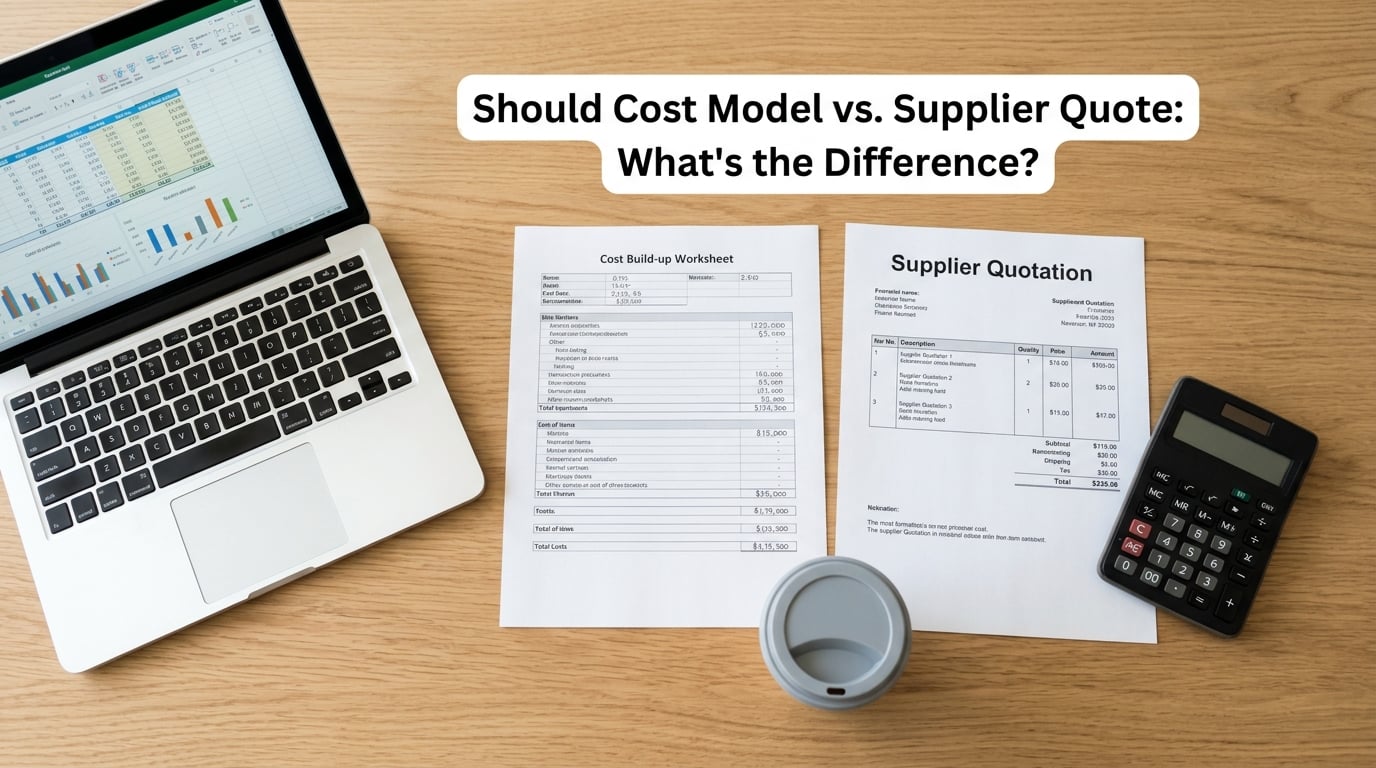
A should cost model and a supplier quote answer different questions. Your model answers “what should this cost to make, given a defined process and a fair margin.” The quote answers “what this supplier is willing to sell it for, under the terms we have offered.” One is an estimate built from benchmarks; the other is a commercial position from an interested party.
That difference shows up in timing, assumptions and transparency. Your model exists before the RFQ goes out, so you bring a position to the event rather than a reaction to the answers. The quote exists only after the supplier has modeled the same part, seen your volume, and judged your negotiating position.
| Aspect | Should cost model | Target cost | Supplier quote |
|---|---|---|---|
| Starting point | Process and cost drivers | Market or customer price | Supplier’s commercial judgment |
| Direction | Bottom-up, forwards | Backwards from price | Bottom-up, then negotiated |
| Who owns it | You | You, with design | The supplier |
| Timing | Before the RFQ | Before design freeze | After the request |
| Margin | Your assumption, stated | Whatever the price implies | Theirs, usually not itemized |
| Best use | Negotiation and challenge | Design decisions and make vs buy | Comparison and final offer |
Neither number is automatically right. A good model with a stale resin assumption can be wrong by more than a quote built on current data, and a supplier’s quote can be genuinely competitive while looking aggressive next to an optimistic model. Treat the gap as a prompt to investigate, not a verdict.
How Do You Use Should Cost Modeling in Supplier Negotiations?
The technique only works if you present it as a set of questions rather than an accusation. The standing complaint from practitioners is that a buyer who arrives with a should cost behaves as though they were responsible for making the part themselves, and the supplier hears that loud and clear.
- Show the drivers, not just the total. A single number invites a single objection. A breakdown gives the supplier somewhere to correct you, and correction is where you both learn.
- Ask for the underlying data. Cycle time, cavity count, scrap rate, machine list, labor content. Most suppliers will give these without giving their margin, and that is enough.
- Compare total landed cost. Your model rarely includes everything the quote does. Add freight, duty, packaging, inspection and payment terms to both sides before declaring a winner.
- Check the margin, do not fix it in advance. Category margin expectations vary widely. A commodity closure and a regulated medical component do not carry the same.
- Separate improvement from theft. Ask what you could do together — a longer run, a simpler pack, an earlier forecast — and reward the answer with volume rather than demanding a cut.
- Keep the relationship intact. If a supplier refuses cost detail, that is information about the relationship, not a licence to audit their accounts.
Scale is what makes the exercise worth doing. Illustrative case: a 1,000 kg batch of drug substance quoted at 2,600 per kg gets modeled internally at roughly 600, then negotiated down to 1,000 — a saving of about 1.6 million on a single order. The build-up took a couple of days. The arithmetic holds for plastics in exactly the same way whenever the modeled gap is double-digit, because the money sits in the same handful of lines.
How Accurate Should a Should Cost Estimate Be?
Precision and usefulness are not the same thing, which is where a lot of effort gets wasted. The five levels of cost estimation run from a rough order-of-magnitude screen to a fully cost-engineered production figure, and each is appropriate for a different decision.
- Order of magnitude. A single figure within a factor of three. Enough to say in or out.
- Analogy. Based on a similar part already made, adjusted for size, material and complexity. Useful for early screening.
- Parametric. Cost per unit of weight or cavity, times volume. Fast and decent for high-volume commodity parts.
- Bottoms-up analytical. Every cost driver estimated from benchmarks, as this guide describes. The working level for negotiation.
- Cost engineered. A bottom-up model calibrated against the supplier’s actual processes, data and quotes, with variance tracked over time. Only worth it on strategic parts and programs.
For a screening estimate, plus or 20 percent is honest. For a negotiation position, tighten to plus or 10 percent, and be transparent that it is an estimate. Above that, you need the supplier’s own data, and no amount of spreadsheet discipline substitutes for it.
The method weakens in a few specific places. On services and pure distribution, where the build-up is mostly labor judgment, a should cost is an opinion with a table around it. On very low volume, one-time tooling and setup can exceed the product cost and destroy the arithmetic. On sole-source items you have no bargaining room with, a model is useful internally for design decisions and nearly useless at the table. And where the product changes every quarter, a stale model is worse than no model.
Keep the error honest. Record the difference between your model and the eventual agreed price after every deal, and revisit the assumption that was wrong. A model that never gets calibrated is just a spreadsheet.
What Are the Common Mistakes in Should Cost Modeling?
Almost every bad should cost model I have reviewed fails in the same handful of ways.
Using market prices for inputs the supplier actually buys cheaper. Large resin buyers pay well below index. Anchoring to the index produces a model that overstates material cost and gives the supplier an easy credibility win, which undermines the lines you actually need to challenge.
Ignoring scrap and downtime. A model that prices perfect output is wrong by the reject rate, and reject rates on cosmetic or thin-wall parts are rarely small. Gross the material up for yield and add the downtime allowance separately.
Double-counting overhead. Applying a burden rate to a machine rate that already includes occupancy, power and supervision. Say clearly what each rate contains, and check that no cost appears twice.
Using generic labor rates. A national average wage ignores the regional market, shift patterns and the fact that a molding cell often runs with one operator attending two machines.
Treating tooling as a one-time expense. If the model is used to price the part, the tool has to be amortized over the agreed program life, along with maintenance and any repair history.
Guessing the margin. A margin assumption that comes from a decade-old article is an argument waiting to lose. Ask what the category supports and why.
Leaving out logistics and quality. On high-volume, low-value parts, packaging and freight can outweigh the resin. On regulated parts, inspection can outweigh the labor.
Never updating the model. A twelve-month-old model with a fixed resin price will be challenged immediately, and losing that argument costs you credibility on everything else in the file.
Frequently Asked Questions
What does should cost mean?
Should cost is an independent estimate of what a product or service ought to cost to produce, built from its cost drivers rather than from a supplier’s price. You take a bill of materials and process route, price each input from a market benchmark, convert labor and machine time into fully loaded rates, add overhead, adjust for scrap and yield, and finish with a reasonable supplier margin. The point is a benchmark you own.
What is a cost model in procurement?
A cost model in procurement is a structured calculation that estimates what a purchase should cost, based on the drivers behind that price. It can cover manufactured parts, logistics, packaging and services, and it usually exists to answer one of three questions: is this quote fair, where can we challenge it, or can we make or buy it ourselves. The model is only useful if its assumptions are written down and dated.
How do you create a cost analysis?
Create a cost analysis in seven steps: define the part and volume, collect the bill of material, process route and commercial terms, price the material from a published index, convert cycle and labor time into fully loaded machine and labor rates, apply a facility overhead burden, adjust for yield and scrap, then add a target margin. Finish by comparing the result to the quote line by line and logging every assumption with its source and date.
How accurate does a should cost model need to be?
Match the accuracy to the decision. A screening estimate within 20 percent is enough to rule an idea in or out. A negotiation position should be tighter than 10 percent and stated as an estimate rather than a fact. Above that, you need the supplier’s own process data, so a cost-engineered model calibrated against real quotes is the realistic ceiling without that access.
What is the difference between should cost and target cost?
Should cost is built forwards from the process: materials, labor, machine time, overhead, logistics and margin. Target cost is built backwards from a market price, asking what the product must cost to be profitable at that price and what in the design has to change. In practice, should cost tells you whether a price is fair, and target cost tells you what to redesign.
Is should cost modeling still relevant with collaborative suppliers?
It is relevant, but the framing has changed. Should costing began as a defense mechanism, developed by the United States Department of Defense to check whether suppliers were pricing fairly. With longer, more collaborative relationships, a model used as a weapon damages trust. Used as a shared working document, where the supplier corrects your assumptions and you both see the same drivers, it supports the kind of joint cost reduction that relationships are supposed to enable.
Conclusion
Start with the definition, not the spreadsheet. Fix the exact part, the annual volume, the process route and the margin you are prepared to defend, then build the cost stack from the resin up with every assumption written down and dated.
When the quote arrives, compare it line by line rather than as a single number. The first action this week is to pick one part you buy regularly, and build the seven-step model for it on a single sheet of paper.