

The tradeoff in dual sourcing vs single sourcing comes down to what you buy and what a stoppage costs you. Single sourcing is usually the right call for a custom, low-volume part where one supplier has already absorbed the engineering and tooling work. Dual sourcing earns its extra cost on components that stop a line, carry long lead times, or come from one region or one owner.
Most plants end up with both. You run single source on the molded housing that took 14 months to develop, dual source on the fasteners, and keep a qualified backup on the control board you cannot afford to wait for. The mistake is picking one strategy for the whole bill of materials.
This guide walks through the cost, resilience, and quality differences, then the criteria that decide it item by item.
Table of Contents
- Dual sourcing vs single sourcing tradeoffs at a glance
- What is the difference between dual sourcing and single sourcing?
- How do dual sourcing and single sourcing affect cost?
- Which sourcing approach improves supply chain resilience?
- How do quality and supplier performance compare?
- When does single sourcing make more sense?
- When does dual sourcing make more sense?
- What should manufacturers consider before qualifying a second supplier?
- Which should you choose?
- Frequently Asked Questions
- Is dual sourcing always more expensive than single sourcing?
- How much volume should a manufacturer give to a second supplier?
- What is the biggest risk of using two suppliers for molded plastic parts?
- How can a company qualify a backup supplier without disrupting production?
- Does dual sourcing eliminate supply chain risk?
- Can a manufacturer use dual sourcing for a custom or proprietary component?
- Conclusion
Dual sourcing vs single sourcing tradeoffs at a glance
| Criterion | Single sourcing | Dual sourcing |
|---|---|---|
| Unit cost | Lower. Full volume with one supplier, best learning curve, one invoice to manage | Higher per unit once volume, tooling and qualification are split across two plants |
| Supply continuity | Depends entirely on one supplier’s capacity and geography | Two failure domains, provided the second source is genuinely independent |
| Supplier bargaining power | Supplier holds most of it. You depend on them and they know it | Split. Both suppliers know you have an alternative |
| Quality consistency | One process, one set of capability studies, tight control of variation | Two processes to validate, plus interchangeability risk between them |
| Capacity and surge | Surge needs a negotiation, not a plan | Surge can be moved to the second source, if it has real headroom |
| Inventory | Simpler. One forecast, one set of minimum order quantities | More complex. Two forecasts and two sets of minimum order quantities, sometimes more total stock |
| Operational complexity | Low. One quality agreement, one development history | High. Two sets of drawings, inspections, audits, change notices and invoices |
| Fits best | Custom parts, proprietary processes, low volumes, tight co-development | Critical components, long lead times, standard items, high downtime cost |
| Main failure mode | No way out when that one supplier misses | A second source on paper that cannot actually run the part |
| It wins when | Qualification cost outweighs the risk you are removing | Cost of a single interruption exceeds the cost of running two |
What is the difference between dual sourcing and single sourcing?
Single sourcing means all demand for an item comes from one qualified supplier. Dual sourcing means two suppliers are qualified to the same specification and you allocate orders between them, usually with a primary and a secondary. Multi-sourcing is the same idea with three or more.
Sole sourcing is not the same as single sourcing
This is the distinction that trips people up. Single sourcing is a choice: you looked at alternatives and picked one. Sole sourcing is a situation: nobody else can make the part, because the process, the tooling, the license or the capacity sits with one company.
In regulated buying, “sole source” also describes a procurement award where no competition is permitted, often because switching requires revalidation. Same words, different situation, and treating them as the same is how a plant ends up with an unintended single point of failure.
What actually separates the two strategies
The difference is not the second supplier’s name on an approved list. It is whether a defined allocation rule exists and whether the second source has run production parts to a validated standard.
Divide purchases between two sources and both suppliers learn your volumes, tooling history and QA system. That is dual sourcing. Keep a second company warm with samples and an audit, but never let it run a production part, and you have a phone-book entry rather than a second source.
How dual sourcing works in practice
Three patterns cover most cases. In a primary and secondary model, the primary takes most of the demand and the secondary holds a small standing share or stays in contingency until a disruption triggers it. In a split model, volume is divided on a fixed ratio such as 60/40 or 50/50 so both plants stay current. In a contingency model, the second source is qualified and idle until needed.
Only the first two keep the backup real. A contingency source that has not run in a year usually needs requalification before it can help you.
How do dual sourcing and single sourcing affect cost?
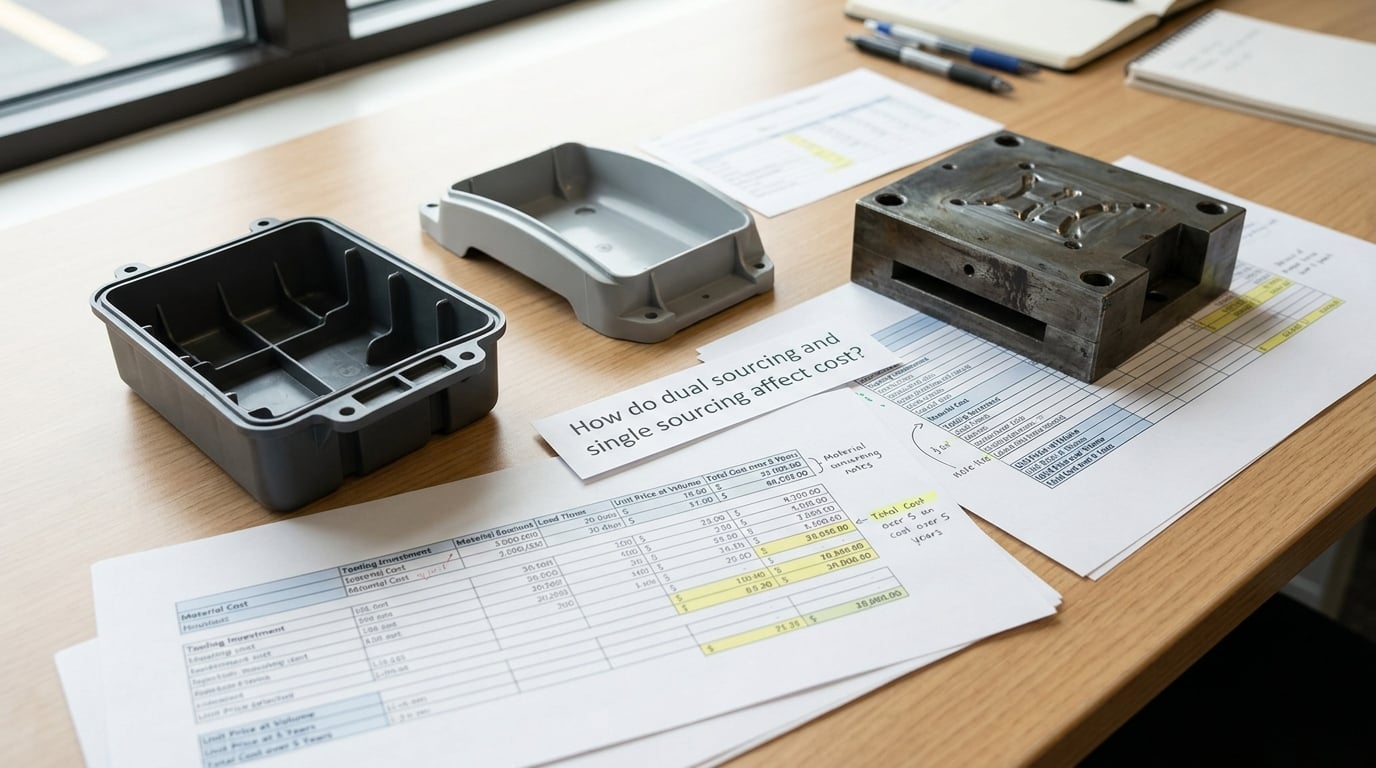
Dual sourcing costs more on paper and often costs less when you count the interruption you avoided. The line item that decides it is rarely the unit price.
Tooling and capital spread thinner
Plastic parts show this most clearly. A single molded housing carries one set of tooling amortized over the whole program. Run the same part at two molders and you own or finance two sets, each spread over half the volume. If the second tool also needs a different core layout, you have committed twice the capital to a decision that looks like a supply chain tactic.
Some companies avoid the second tool by producing identical parts from one tool and shipping to two assembly sites. That preserves resilience against assembly-site failure but leaves you exposed to the same molder, so it is not true dual sourcing for that part.
Volume commitments and learning curve
One supplier at full volume gets a learning curve on your part. A second supplier starts near the top of that curve and works back down, so the per-unit gap early on is larger than a quote suggests. Index-linked pricing and volume tiers help, but a 60/40 split can leave the secondary supplier priced out of its own tier at the volume you actually send.
Qualification expense
The second source has to be proven, not assumed. Budget for a process audit, sample tooling or a sample run, first article inspection, process capability studies, and the engineering hours to answer whatever the new plant asks about the drawing. For a machined part or an injection-molded tool, this is often the single largest dual sourcing cost, and it lands entirely in the year you start.
Inventory and management overhead
Two forecasts, two sets of minimum order quantities, two sets of certificates and two quality systems to track. Sometimes dual sourcing cuts finished goods inventory because you can drop a surge on the other source. More often it raises purchased inventory, because each supplier wants its own batch size.
The hidden cost of a single-source stoppage
Estimate downtime cost honestly: contribution margin per hour of good output, times planned volume, plus the expedite freight, the overtime and the scrap. A line that clears 400 units an hour at $30 of contribution loses $12,000 of margin for every hour it sits waiting for one part. If a single-source interruption has any realistic chance of costing you that, the premium on a second source is usually easy to defend.
Which sourcing approach improves supply chain resilience?
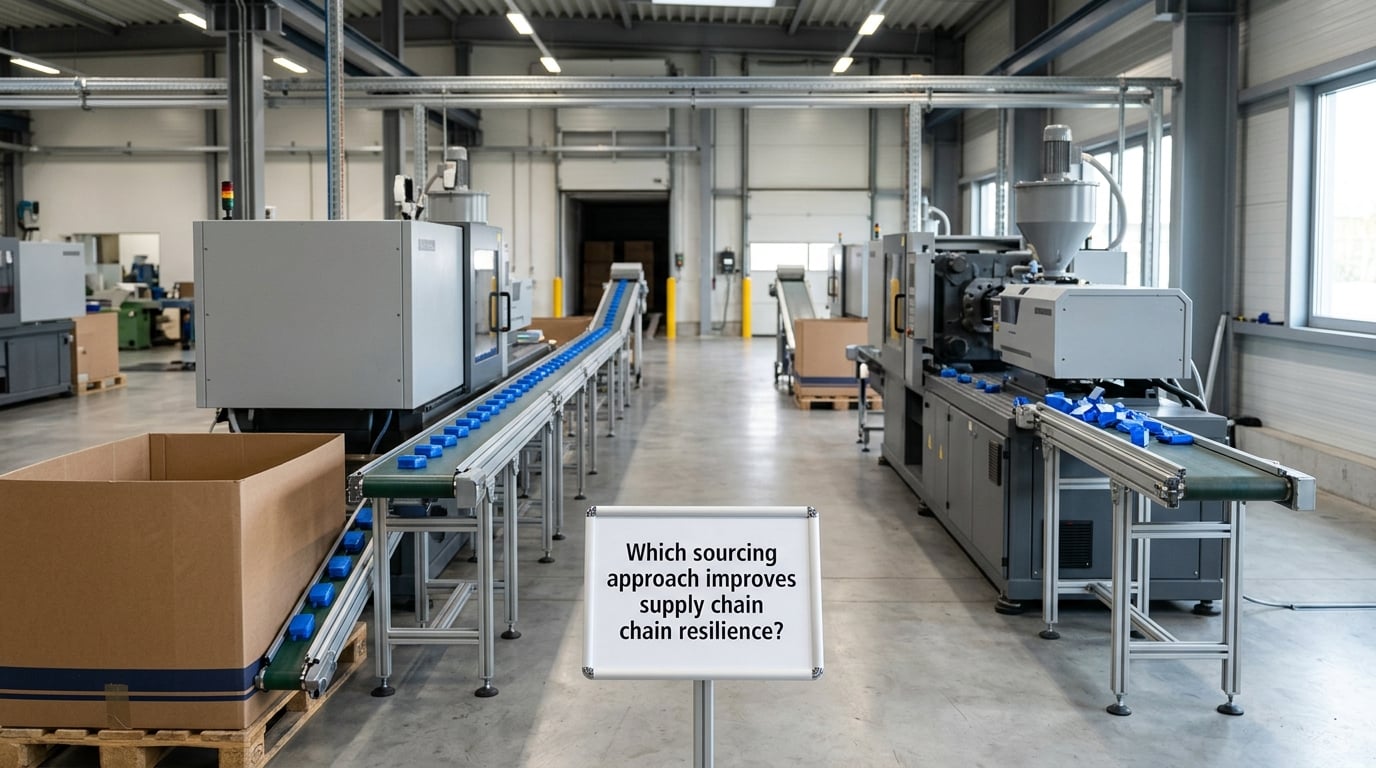
Dual sourcing improves resilience only when the second source fails differently from the first. Two plants running the same resin through the same port region is one supply chain with a duplicated address book.
Correlated risk is the trap
Ask where the two suppliers are actually dependent on the same thing: the same resin distributor, the same pigment or glass fiber supplier, the same port and rail corridor, the same sub-tier machine builder, the same tooling design owned by you and cut only by the primary.
If the answers line up, a disruption hits both. The second supplier is then a recovery option measured in months rather than weeks.
Recovery time is the number that matters
Resilience is not a checkbox, it is a duration. Ask how long from the moment you call to the moment good parts arrive: changeover time at the second plant, whether tooling is already on site and maintained, whether raw material is stocked, and how long their approval process takes for a resumed order. Write the answer into a business continuity commitment instead of trusting a slide.
Geographic spread that actually spreads
Moving a second source to a different country helps only if the inputs differ too. Nearshore or friend-shore options in Mexico, Central America and Southeast Asia shorten transit and cut some exposure, but resin and equipment still arrive through overlapping routes. Region plus resin plus sub-tier plus tooling ownership is the combination that buys you independence.
The useful question is no longer whether to diversify. It is which specific materials justify the cost, and how much of the volume each one needs. Buyers who treat dual sourcing as a company-wide policy end up qualifying a second source for items that never caused a problem, then letting it lapse at the first volume dip. Work the item list, not the policy.
How do quality and supplier performance compare?
One source gives you a single validated process, and that is a real quality advantage. Two sources give you two processes to prove, and the proof is where most spec drift shows up.
What single sourcing does for consistency
With one plant, you approve one mold, one process, one set of capability numbers and one incoming inspection routine. Corrections land once and stay. Your engineers also hold a single design history, which matters when the part changes three times a year.
Where a second source creates variation
Interchangeability is the test. A part from plant B has to fit the same assembly as a part from plant A, from the same revision of the drawing, with the same critical dimensions. Two different tools on the same nominal print will drift. Guard against it with a frozen specification, approved golden samples from each plant, defined critical-to-quality dimensions, and a change control process that reaches both suppliers at the same time.
Expect the secondary supplier to run a higher defect rate in its first several production runs. That is a learning curve, not a reason to disqualify them, but it should be planned for rather than discovered during an audit.
Performance monitoring you need for two suppliers
Track on-time in-full delivery, defect parts per million, cost of poor quality, and how fast each supplier closes a corrective action. With one supplier these are a scorecard. With two they are also a switching test: if the secondary cannot hit agreed delivery or quality numbers, you do not have a backup, you have a second vendor.
Give both suppliers the same scorecard and the same consequences. The moment a secondary source gets treated as a formality, it stops investing in your parts, and you have paid for nothing.
When does single sourcing make more sense?
Single sourcing wins when the qualification cost and the engineering coupling exceed the risk you are trying to remove.
- Highly customized parts. A part designed around one supplier’s process, with fixtures and gauges that only exist there, has a second source in name only.
- Proprietary processes. If the capability is patented, licensed or genuinely rare, a second qualified source may not exist.
- Low volume. Spreading a few hundred parts a year across two suppliers means neither gets enough volume to hold interest, and both quotes get worse.
- Tight technical integration. Parts designed jointly with a supplier, where the supplier’s engineers own part of the design, benefit from continuity rather than duplication.
- Regulated change control. In medical, pharma and aerospace, switching a material or process site can trigger revalidation, documentation and customer notification. Concentration is sometimes the compliant choice.
- No independent alternative. If both candidate plants buy the same resin from the same distributor and ship through the same corridor, dual sourcing doubles the paperwork and leaves the risk untouched.
Small buyers face this hard. A second supplier has little incentive to qualify and then go quiet, and the qualification spend has to come out of a budget that was built for one. For many companies under a few hundred million dollars in revenue, concentrating on fewer, deeper supplier relationships is the correct call for a large share of spend.
When does dual sourcing make more sense?
Dual sourcing wins when one missed delivery costs more than running two plants, and when a genuinely different source exists.
- Components that stop a line. Anything on the critical path where an hour of downtime has a calculable cost.
- Long lead times. Items at twelve weeks or more, where a recovery order has to be placed before the disruption is even visible.
- Custom parts with transferable tooling. If you own the tooling and the drawing is production-ready, a second molder can be qualified without redesigning anything.
- Standard and commodity items. Fasteners, packaging, common resins, hoses, castings. Many qualified suppliers already exist, and qualification is measured in days rather than months.
- Supplier-specific risk. Single ownership, a family business with no succession plan, a plant with one process, or a supplier in a region exposed to tariffs and trade measures.
- Customer requirements. Automotive and industrial customers frequently audit business continuity plans, and some will not accept an undocumented single source for a critical part.
Common allocation splits: keep the primary at 100% and hold a qualified backup for continuity, run 80/20 so the secondary stays current on tooling and process, 60/40 for parts where demand volatility is high, and 50/50 only where the item is genuinely standard or where a customer has demanded dual qualification.
Watch for the failure mode where the second supplier receives samples and an audit once, then no production volume for two years. It will be slower and more expensive to bring back than the plan assumed.
What should manufacturers consider before qualifying a second supplier?
Run through these ten checks before you send a purchase order. They are ordered by how often they are skipped.
- Frozen specification. Can plant B make the current revision as written, with no concessions? Freeze it, and freeze the revision that travels to both plants.
- Real capacity. Look at available machine hours and the plant’s other commitments, not the order book they would like to have. Ask what they would drop if you doubled the volume.
- Tooling terms. Who owns the tool, where it sits, who maintains it, and can it be moved to a third plant if the relationship ends. Get this in writing before the first shot.
- Certifications. Match the quality system the part needs, such as ISO 9001, IATF 16949, ISO 13485 or AS9100, and confirm the certificate covers the actual site.
- Process validation. First article inspection plus process capability studies on the dimensions that matter, not a sample that happens to fit.
- Honest lead time and minimum order quantity. Ask for the lead time at your real volume with their real material pipeline, including the first several runs.
- Geographic and sub-tier independence. Different region, different resin source, different logistics route, different sub-tier suppliers. Write down the answers.
- Financial and ownership stability. Ownership structure, years in business, capacity expansion plans, and how dependent they are on your volume.
- Total landed cost. Unit price plus freight, duty, packaging, inventory carrying, quality inspection and the management time to run a second source. Compare that to the full cost of a single-source interruption, not to the part price alone.
- Trial orders and a ramp plan. A paid trial run that moves through your real receiving and inspection process, with a scheduled increase once defect and delivery numbers hold.
Finish with governance. Someone has to own the allocation decision, the escalation path, and the annual review that decides whether the second source has earned real volume.
Which should you choose?
Choose per item, not per company. Segment the bill of materials, then apply a different strategy to each segment.
Take a mid-sized appliance manufacturer. Molded ABS enclosures with a tight tolerance and 14 months of tooling development stay single sourced with a plant that co-engineered them, because requalifying that tool elsewhere would cost more than the disruption risk. Injection-molded fasteners, bushings and cable ties move to dual sourcing, since several qualified suppliers exist and the qualification is measured in weeks. The main control board, at a 22-week lead time from a single owner-operated supplier in one region, goes to an 80/20 split with a second fabricator brought up in a second region. And stainless fasteners ordered by the carton move to 50/50 purely for bargaining position, because any distributor can supply them within a week.
The same logic shows up on a plant floor. Single sourcing tends to protect the availability factor in OEE by keeping changeovers and material planning simple, but a material shortage from one supplier turns into unplanned downtime that no amount of scheduling recovers. Dual sourcing is bought specifically to protect availability, at the cost of planning complexity. That is the trade, stated plainly.
A staged approach when you are not sure
Most teams get better results by starting small than by announcing a dual sourcing program across every category at once.
- Map your supplier dependencies and find the items with a single source and no internal alternative.
- Quantify the exposure: contribution margin per hour of lost output, times the realistic chance and length of an interruption.
- Verify that a genuinely independent second source is feasible before committing. If the resin, region and sub-tier all match, fix that problem first or accept the risk and buy inventory instead.
- Qualify the backup and put it on a small standing share, typically 10% to 20%, so tooling stays maintained and the process stays current.
- Review delivery, quality and total cost after two to four quarters, then move the split or stop pretending the second source is active.
Two suppliers you can actually switch between beat five suppliers listed in a brochure. Build the number you need and stop there.
Frequently Asked Questions
Is dual sourcing always more expensive than single sourcing?
No. Dual sourcing costs more per unit because volume, tooling and qualification are split, but it can cost less once you count the interruption it prevents. Compare the extra per-unit and qualification cost against contribution margin lost per hour of downtime, plus expedite freight and scrap. On low-value standard items, dual sourcing is often chosen for bargaining position alone.
How much volume should a manufacturer give to a second supplier?
For most critical components, 10% to 20% is enough to keep the second plant current on tooling, process and training without giving up volume leverage. Move toward 50/50 only for standard items or when a customer requires dual qualification. Whatever the split, set it as a written allocation rule so nobody has to negotiate during a disruption.
What is the biggest risk of using two suppliers for molded plastic parts?
Parts that are nominally identical but not interchangeable. Two tools built to the same print drift on critical dimensions, so a part from plant B will not fit an assembly containing a part from plant A. The fix is a frozen specification, approved golden samples from each plant, defined critical-to-quality dimensions, and change control that reaches both suppliers at once.
How can a company qualify a backup supplier without disrupting production?
Run the qualification in parallel with normal buying rather than as a project that pauses your primary supplier. Start with a process audit and a paid trial order that moves through your real receiving and inspection route, then add capability studies on the dimensions that matter. Give the backup a small standing share so tooling stays maintained and the process stays current.
Does dual sourcing eliminate supply chain risk?
It reduces concentration risk, but it does not remove it. If both suppliers buy the same resin from the same distributor, ship through the same port or region, and share sub-tier suppliers, one disruption hits both. The real question is whether the two suppliers fail independently. Test that by mapping resin, region, logistics route and tooling ownership before you commit.
Can a manufacturer use dual sourcing for a custom or proprietary component?
Sometimes. It works when you own the tooling, the drawing is production-ready, and the process is documented well enough for another plant to run. It rarely works when the process is patented, licensed, or embedded in a supplier’s fixtures and know-how. In those cases, deepen the relationship and buy inventory buffers instead of pretending a second source exists.
Conclusion
The decision rule is short: single source when qualification cost and engineering coupling exceed the risk you are removing, dual source when the cost of one interruption is higher than the cost of running two. The first step is to map which items have a single source and no internal alternative, then quantify what an hour of downtime costs you on each of those lines.
After that, check independence before you check price. If both candidate suppliers share resin, region, logistics route and tooling ownership, a second source buys paperwork rather than resilience, and extra inventory is the better spend. Where a real alternative exists, qualify it on a small standing share, hold it to the same scorecard as your primary, and let the delivery and quality numbers decide how much volume it earns.