

Tariffs affect plastic resin prices by adding a duty to the landed cost of imported resin, which pushes import parity — and therefore domestic resin pricing — upward. The effect is uneven: grades that depend on imported material rise most, while grades with plenty of domestic supply may barely move. The rules and rates behind all of this are still shifting, so treat any figure below as dated.
Here is the short version, in the order buyers actually run into it:
- The duty lands first. The US importer of record pays it at the border, on top of the resin’s production cost plus freight and insurance.
- Import parity moves. The landed price of imported resin becomes the ceiling that domestic sellers have to price against.
- Domestic benchmarks follow. US producers and distributors raise quotes toward that ceiling, which is why buyers who never import anything still see increases.
- Converter margins absorb what they can. Molders and fabricators either pass the increase to their own customers or eat it out of margin.
- The shelf price shows up later. The increase reaches molded parts, packaging, filament and finished goods after a lag set by contract terms and inventory turns.
Rates and trade programs change often. The rate context in this guide reflects reporting published in 2026 and earlier, and it is written as a framework rather than a live table. Check the current schedule of the Harmonized Tariff Schedule before you make a sourcing decision.
Table of Contents
- How Tariffs Affect Plastic Resin Prices at a Glance
- Why do tariffs change plastic resin prices?
- Which factors determine the size of the price increase?
- Do all plastic resins respond in the same way?
- Why can the impact appear before or after a tariff takes effect?
- How do tariffs affect domestic resin prices?
- What should US buyers do to limit tariff exposure?
- What questions should buyers ask resin suppliers?
- Frequently Asked Questions
- Do tariffs always raise the price of plastic resin?
- Are domestic plastic resin prices affected by tariffs?
- How long does it take for a tariff to reach molded plastic products?
- Can buyers avoid tariffs by changing resin suppliers?
- What is the difference between a tariff and a supplier surcharge?
- How should buyers prepare for future tariff changes?
How Tariffs Affect Plastic Resin Prices at a Glance
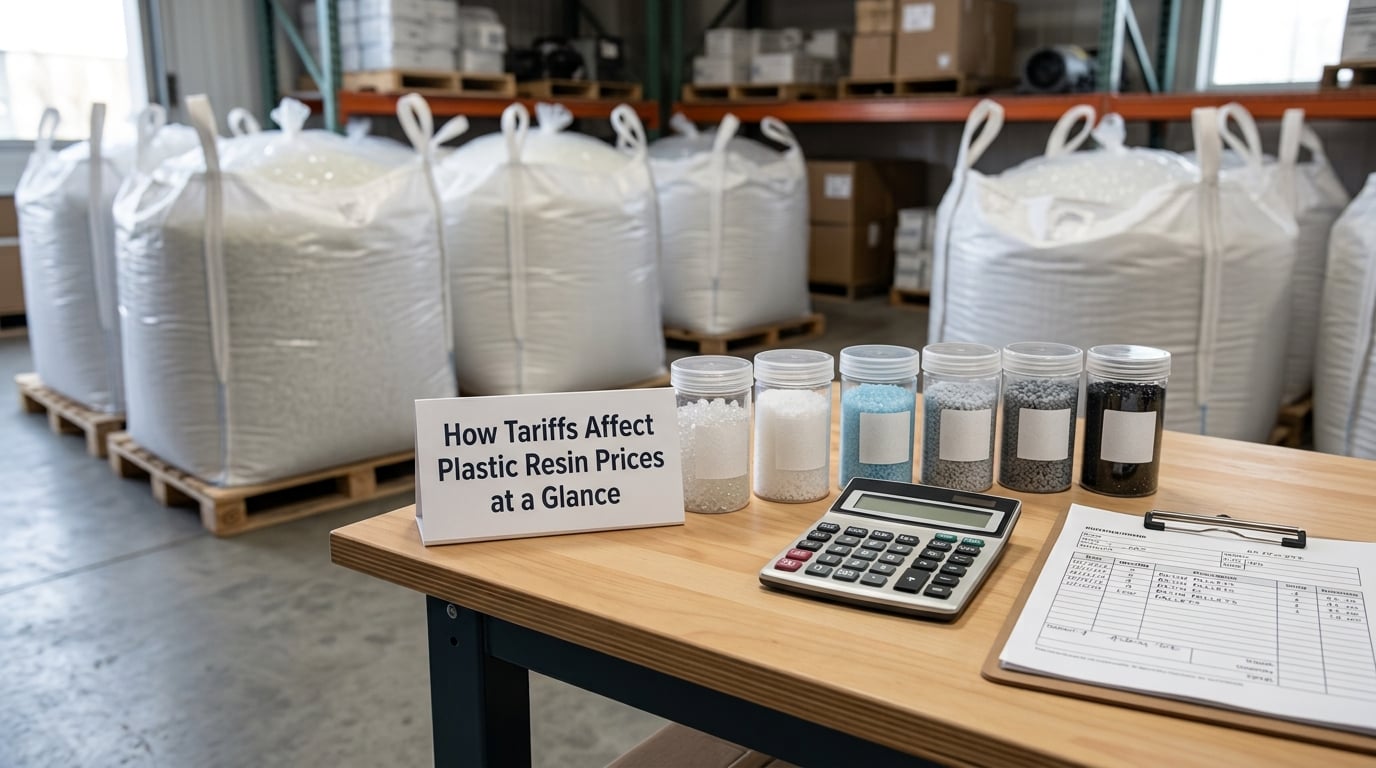
The table below answers the question directly. Tariffs raise resin prices for importers immediately and for everyone else through benchmark repricing, and the size of the move depends on origin, grade, and how much domestic supply exists to compete against the imported alternative.
| Factor | What changes | How fast buyers see it | Who absorbs it first |
|---|---|---|---|
| Direct duty on imported resin | Landed cost rises by the duty rate applied to the customs value | Immediately at the entry date | The importer of record |
| Import parity | The floor price for any resin entering the US rises with the duty | Same day as the entry | Importer, then the whole market |
| Domestic benchmark pricing | US resin quotes move up toward import parity | Days to a few weeks | Converters and distributors |
| Feedstock and energy costs | Tariffs on naphtha, ethylene, propylene or other inputs raise local production cost | One to two quarters | Resin producers |
| Capacity competition | Importers bid away domestic volume, tightening US supply | One to two quarters | Whoever is short of material |
| Supplier surcharge policy | Distributors add tariff recovery on top of the base price | Next quote or contract renewal | Converter margin |
| Substitution and requalification | Buyers shift grades or sources to avoid the duty | Weeks to months, depending on validation | Converter, in engineering time |
The important row is the third one. A duty is legally owed only by the importer, yet the price signal travels to the entire market because domestic producers set their prices with the import alternative in mind. That is the single fact most small buyers miss, and it is why a company that buys every pound domestically can still be quoted a higher number after a tariff announcement.
A second thing the table makes clear: the delay is not uniform. The duty itself is immediate, but everything downstream of it moves on its own clock, and that clock is what determines whether a price increase feels sudden or gradual.
Why do tariffs change plastic resin prices?
Because a tariff changes the arithmetic a buyer uses to decide what an imported pound is worth, and domestic sellers reprice to the new arithmetic. Nothing about the resin itself changes. The molecule that arrived at your dock is identical to the one that cleared last quarter; what changed is the invoice.
Plastics have been caught in trade measures for years. Section 301 duties on Chinese goods and the broader reciprocal tariff programs both reach polymer products, because plastic resin is classified under Harmonized Tariff Schedule codes and dutiable as an ordinary imported good. Trade press reporting from earlier this year described US PET duty levels reaching roughly 20–35% for several Asia-Pacific origins, around 15% for many others, and as high as 50% in specific cases. Read that as a snapshot of one moment in a moving schedule, not as a current rate card.
How tariffs affect plastic resin prices through the supply chain
The chain has five links, and each one can either pass the increase along or absorb it.
- Producer and country of origin. A cracker and polymer plant somewhere turns naphtha into pellets and sets an export price. The origin country attached to that shipment is what gets looked at later, under rules of origin rather than brand or intent.
- Importer of record. This is the party named on the customs entry. It owes the duty at clearance, and it may or may not be the company that ends up using the resin. In a distribution chain, an importer sells to a converter who may not realize any duty was ever involved.
- Distributor. Many buyers, especially smaller ones, never touch an importer directly. They see a distributor price, and the duty is already buried in it — sometimes itemised as a surcharge, often not.
- Converter. Injection molders, film extruders, pipe extruders and compounders take resin and add conversion cost: energy, labour, regrind, scrap rate, packaging. Resin is often the largest single line in that stack, which is why a small per-pound move shows up as a meaningful jump in unit cost.
- Finished goods. Only here does the tariff show up in something a consumer or a customer sees. By then the increase has been diluted, delayed, or absorbed into a margin decision made months earlier.
Two effects sit on top of this chain and are easy to miss. The first is temporary: an importer who bought heavily before a duty took effect keeps serving customers at the old price for as long as that inventory lasts, which can make early post-tariff months look quieter than the headline suggests. The second is structural: if the duty stays in place long enough, capacity that was serving exports gets redirected into the US market, domestic prices and import prices drift back together, and the gap that justified switching suppliers closes.
That second point explains something that otherwise looks contradictory. Tariffs are announced with a great deal of noise, yet spot resin prices have also been observed falling in periods of weak demand and cheaper feedstock. Both things can be true at once, because the tariff sets a ceiling while demand and input costs set the floor underneath it.
Which factors determine the size of the price increase?
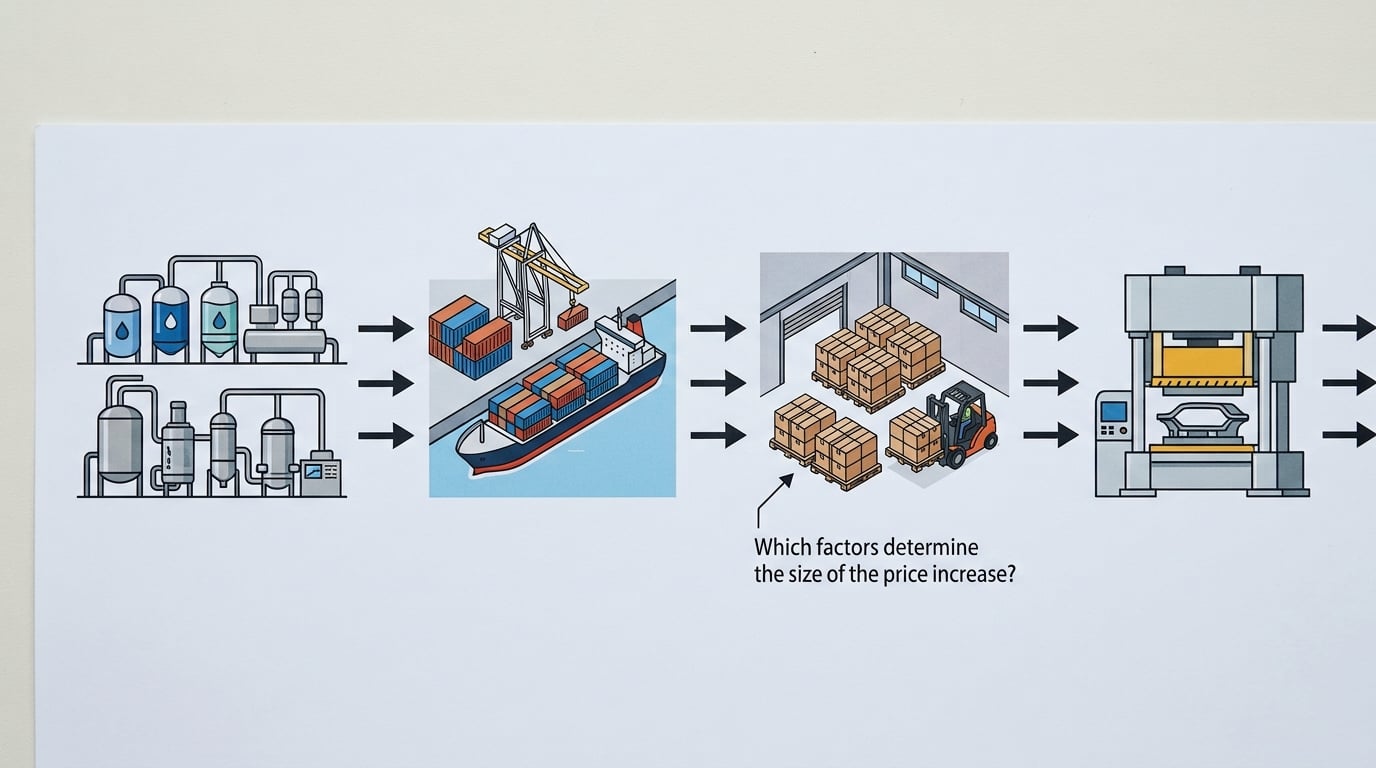
The size of the increase is set by the interaction of a dozen variables, and the duty rate is only the most visible one. The table below compares the drivers buyers actually track, with the direction each one typically pushes resin prices.
| Driver | Direction | Typical magnitude | How fast it moves prices |
|---|---|---|---|
| Tariff rate by country of origin | Up | Single to double digits as a percentage of customs value | Instant at the entry date |
| Polymer and grade | Either | Wide spread, from near zero to the full duty | Follows the duty schedule |
| Domestic availability of the same grade | Down if ample | Can absorb the entire increase | One to two quarters |
| Feedstock: naphtha, oil, ethylene, propylene | Either | Cents per pound for commodity grades | Monthly, with a lag |
| End-market demand | Down when weak | Enough to cancel out a duty entirely | Monthly |
| Freight and marine insurance | Either | Meaningful on long-haul Asia routes | Spot to monthly |
| Exchange rate | Either | Shifts import parity directly | Continuous |
| Buyer inventory position | Either | Determines whether you feel it this month or next quarter | Depends on your stock turns |
| Ability to substitute grade or source | Down | Reduces the realized increase | Weeks to months |
The row worth dwelling on is demand. A tariff creates a floor for imported material, but it does not create demand. If converters are running below capacity because their own customers cut orders, the duty gets absorbed into producer margins and buyers see much less than the headline rate suggests.
Substitution ability is the other big one. A converter running a standard injection molding grade on a well-known mould can often switch sources in weeks. A converter running a flame-retardant compound certified to a specific standard may be locked in for a year or more, and that converter pays the full increase.
Exchange rates deserve a mention because they work in the opposite direction from what people expect. When the dollar strengthens, imported resin becomes cheaper in dollar terms, which narrows the gap the tariff created. A weakening dollar does the reverse and can hand a buyer back some of what the duty took.
Do all plastic resins respond in the same way?
No, and the difference comes down to three things: how much of the supply is imported, how easily a buyer can substitute, and how long a qualification takes.
- Commodity polyolefins — polyethylene and polypropylene. These are the most liquid, most globally traded grades, and they see the largest immediate duty exposure because import volumes are high and grades are broadly interchangeable. They also respond fastest to weakness in demand, which is why they sometimes give back a tariff increase quickly. Within the family, film and injection grades behave differently from bottle and raffia grades.
- PET resin. Bottle-grade PET has been one of the most closely watched markets, with trade reporting this year framing it as under pressure from duties on top of other market forces. Semi-crystalline and amorphous grades do not price the same way, and a converter running a specialty copolyester is in a different market from one running standard bottle PET.
- PVC. Vinyl pricing has moved with oil derivatives as well as trade measures, and construction demand is a major swing factor. Pipe, siding and profile buyers sit in a market where feedstock and demand can easily outweigh the duty effect.
- Engineering polymers — ABS, polycarbonate, nylon, acetal. Smaller volumes, more import dependence in some grades, and long qualification cycles. These tend to see sticky, less reversible increases.
- Specialty compounds. Filled, flame-rated, medical or food-contact compounds are bought on specification. Tariff exposure is real but muted, because pricing power sits with the compound producer rather than with the importer.
- Recycled resin. Here tariffs cut the other way. Recycled material competes directly with cheaper virgin material, so a duty on virgin imports narrows the recycled-versus-virgin gap and can pull recycled pricing up with it.
- Bio-based plastics. A small and fast-growing segment with limited supply, so the duty effect is usually smaller than the supply effect.
Regional divergence shows up clearly here. Trade reporting has documented polyethylene prices rising in China following tariff announcements while staying flat in Europe, and Latin American markets moving on their own schedule entirely. A US buyer with a multi-region supply base is hedging across those different paths rather than facing one global price.
Why can the impact appear before or after a tariff takes effect?
Four separate clocks are running, and they rarely line up. Understanding which one you are waiting on is most of the work.
- Forward buying. Importers and distributors buy ahead of a known effective date. Prices in the market can rise before the duty legally applies, because the inventory was bought under old rules and is now quoted at new scarcity value.
- Customs clearance timing. Duty is assessed on entry, not on shipment. Material already afloat when a rule takes effect is treated differently from material not yet ordered, and the exact determination depends on the entry documentation and the rule’s effective date.
- Index-linked and formula contracts. Many industrial agreements reference a published resin index rather than a fixed number. Those reset on the index’s schedule, which can be monthly or quarterly, so a buyer on a formula contract can be weeks behind a spot buyer.
- Distributor buffers. Distributors hold working inventory bought earlier at a lower cost. How quickly they work through it depends entirely on how fast their own customers are buying.
- Your own production cycle. Even a settled resin price reaches your customer only when your parts run. Long lead-time programs and stocked parts can delay the visible effect for months.
This lag is why a buyer’s honest answer to “did the tariff hit my prices yet?” is often “not really, but it will.” Forum discussion in the 3D printing community mirrors the pattern at retail scale: a thread on r/BambuLab asked whether filament prices would rise as well, originally in speculative terms, and a poster on r/PrintedWarhammer later wrote that they had just ordered more resin because tariffs were starting to show up in the price. Both describe anticipation and inventory behaviour rather than an instant shock.
How do tariffs affect domestic resin prices?
No duty is charged on resin made in the US. The price effect on domestic material is entirely indirect, and it works through four channels.
- Benchmark repricing. Domestic producers watch import parity. When the duty lifts the import price, domestic quotes follow, because the alternative supply is now more expensive than what they can sell for.
- Input costs. If a duty reaches naphtha, monomers or other upstream inputs, US producers face a higher cost of their own. Tariffs on the whole chemical chain hit the feedstock side as well as the resin side.
- Tighter capacity. When importers buy less, some export volume should find its way into the US. In practice US capacity is often already committed, so demand from importers can tighten the market rather than add supply.
- Export pull. When US producers can sell more cheaply into an export market that has no duty on their product, they may prefer that outlet, tightening the domestic market further.
In practice, channels one and two do most of the work. The effect is strongest where domestic capacity is tight relative to demand and weakest where there is a large pool of idle capacity available at the margin. This is also why a buyer’s result can differ sharply from an industry-wide report on the same week.
What should US buyers do to limit tariff exposure?
These are the actions that show up in procurement practice, roughly in the order I would take them.
- Map your origin exposure by pound, not by invoice. Build a simple sheet showing which grades come from which origin countries, including indirect exposure where a distributor sourced them for you. Most buyers discover that a meaningful share of their resin is tariff-exposed through a supply chain they never mapped.
- Check the classification. Confirm the HTS codes being used on your entries. A wrong classification at the importer level becomes your cost. If something looks misclassified, there is a formal exclusion process, and it is worth knowing it exists even if you never need it.
- Separate tariff cost from surcharge cost. Ask your supplier to itemise. A supplier surcharge and a customs duty behave differently: one is negotiable and reversible, the other is not. A supplier that will not break the two apart is telling you something useful.
- Track the indices, not the headlines. Trade publications and index providers publish per-grade, per-region spot assessments. Watching a named index for your grade gives you a factual anchor that a news headline does not. Two well-known sources in this space are ICIS and The Plastics Exchange.
- Qualify a second source before you need one. Qualification is the long-lead item — trial batches, tooling or specification review, and in regulated applications a validation file. Doing it during a quiet quarter costs engineering hours; doing it during a spike costs both hours and money.
- Time purchases around the duty calendar, not around fear. If a rate change has a published effective date and you have storage and shelf life to spare, buying ahead of it is reasonable. If your material has a shelf life measured in months, pre-buying is a bet on both price and storage, and the second half of that bet often loses.
- Look at recycled grades as a partial offset. A duty on virgin imports narrows the virgin-versus-recycled gap. That is worth modelling for non-regulated applications, though food-contact and medical applications carry their own approval requirements.
- Reduce scrap and regrind loss. This is unglamorous and it is arithmetic: a two-point improvement in yield offsets a meaningful slice of a per-pound input increase without a single negotiation. A polymer converter noted in industry commentary that even a very small per-unit change in polymer cost materially affects conversion cost, inventory value and monthly profitability, which is why yield work counts.
For small buyers and hobbyists the calculus shifts. You have no index contract, no allocation leverage and no ability to qualify a new supplier in a quarter. A consumer publication reported this year that resin-printed 3D products had risen an average of 7.3% because of tariffs, which is the kind of figure worth knowing when you decide whether to pre-order. Your realistic levers are buying ahead within your storage limits, switching to a different supplier or channel, and shifting work between machines so the higher-cost material does less of the total job.
What questions should buyers ask resin suppliers?
Ten questions that separate a genuine tariff pass-through from ordinary repricing.
- What is the country of origin of the material in this shipment, and what documentation supports it?
- Which HTS code is being used at the customs entry, and who is the importer of record?
- Is the quoted price inclusive of duty, or is duty billed separately as a surcharge?
- If there is a surcharge, how is it calculated — by pound, by order value, or by index movement?
- Under what conditions does the surcharge come down?
- Is this quote index-linked or fixed, and if fixed, how long is it valid?
- How much material is already in the US, and what was its original entry date?
- What is your current lead time, and does it change when a duty takes effect?
- What alternative grades or sources can you offer, and what would qualification involve?
- Can you supply the entries, certificates and origin documentation our compliance team needs for review?
Question three is the one I would ask first. A supplier who itemises duty and base price separately is telling you where the money went, and that makes the rest of the conversation specific rather than atmospheric.
Frequently Asked Questions
Do tariffs always raise the price of plastic resin?
No. A duty sets a floor for imported material, but the price buyers actually pay also depends on feedstock costs, end-market demand, freight, exchange rates and how much domestic capacity is free. When demand is weak and input costs are falling, spot resin prices have been observed retreating even while duties were in force. Tariffs raise the ceiling; they do not guarantee a rise.
Are domestic plastic resin prices affected by tariffs?
Indirectly, and often meaningfully. No duty is charged on resin made in the US, but domestic producers price against the import alternative. When a duty lifts the landed cost of imported resin, US quotes follow it upward, and a buyer who never imports anything still gets quoted a higher number. Input costs, capacity tightness and export demand reinforce the effect.
How long does it take for a tariff to reach molded plastic products?
It depends on which clock you are watching. The duty is owed at the customs entry, so the import price moves immediately. Distributor inventory, monthly or quarterly index resets, contract terms and your own production lead times then stretch the timeline. Buyers on formula contracts typically see the change at the next index date, and molded or finished goods reach the end customer one production cycle after that.
Can buyers avoid tariffs by changing resin suppliers?
Sometimes, and it depends on whether the duty follows the material or the origin. A domestic supplier avoids the direct duty, but domestic prices rise to meet import parity, so the saving is often partial rather than the full rate. Changing origin country is a different and riskier move, because customs evaluates substantial transformation and rules of origin, and re-routing goods to capture a lower rate is treated as evasion.
What is the difference between a tariff and a supplier surcharge?
A tariff is a duty assessed by customs on the customs value of an imported good, set by trade law and payable by the importer of record. A surcharge is a commercial charge added by a supplier or distributor, negotiated in a contract and fully reversible by agreement. A duty usually appears on the entry paperwork; a surcharge may appear only on an invoice line, which is why itemisation matters.
How should buyers prepare for future tariff changes?
Map origin exposure by pound, keep at least one qualified alternative grade or source warm, confirm your HTS classifications, and track a published resin index for your specific grade so you have a factual anchor. Avoid pre-buying more material than your shelf life and storage can reasonably carry. Finally, read rate changes as dated information: schedules, exclusions and program names all change, and an old summary is worse than none.
If you take one thing from this: find out what share of your resin was imported, and from where. That single number tells you whether a tariff will show up as a rounding error in your cost sheet or as the biggest line item change of the year. Everything else — the indices to watch, the questions to ask, the timing of a pre-buy — follows from it.