
To calculate a machine hour rate, add up everything it costs you to own and run that machine over a year, then divide the total by the hours the machine can realistically produce in that year. The result is a cost per productive hour you can apply to every quote, work order and internal charge that touches the machine.
The first one takes an afternoon to build properly. After that it is a spreadsheet you refresh once a quarter, and it replaces the gut-feel number that most shops quote from.
Before the steps, the parts worth remembering:
- The rate is a cost figure. The price you quote is that cost plus markup or margin.
- Fixed costs (standing charges) stay the same whether the machine runs one hour or four thousand: depreciation, floor space, insurance, supervision.
- Variable costs (running charges) scale with use: electricity, coolant, consumables, perishable tooling, direct operator labour if you track it to the machine.
- Effective operating hours equal total available hours minus planned maintenance, changeovers, breaks and the idle time you honestly expect.
- That last deduction is where most published rates quietly go wrong, and it is the single biggest lever you control.
Table of Contents
- What You Need
- Step-by-Step
- 1. Define the Machine and Cost Center
- 2. Estimate Annual Productive Hours
- 3. Calculate Direct Machine Labour Cost
- 4. Add Equipment and Operating Costs
- 5. Allocate Manufacturing Overhead
- 6. Divide Total Cost by Productive Machine Hours to Set the Machine Hour Rate
- 7. Add Markup or Margin for Pricing
- 8. Review and Update the Rate
- Common Mistakes
- Frequently Asked Questions
- Conclusion
What You Need
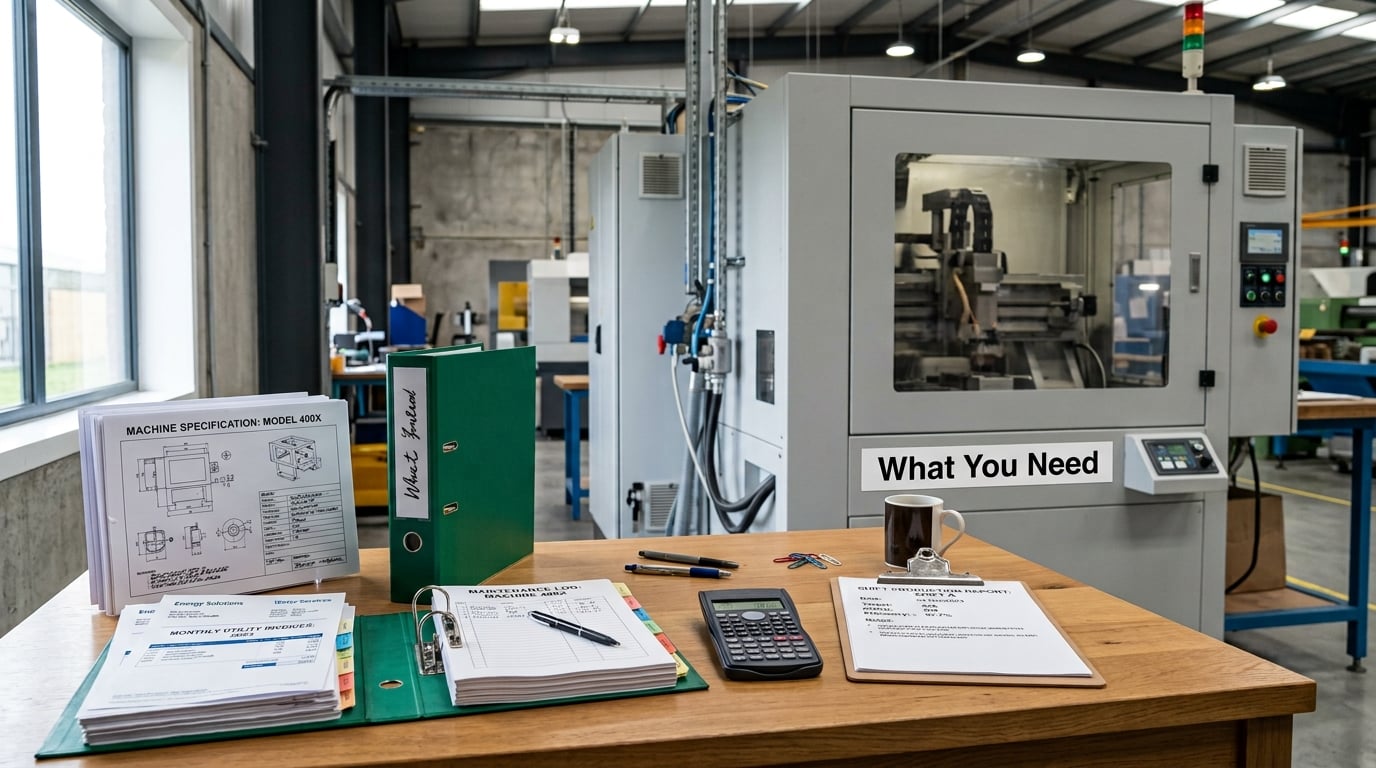
Everything you need already exists as paperwork in the shop. You are assembling it, not inventing it, which is what makes the finished rate defensible when a customer asks why your quote is higher than someone else’s.
- Machine cost and in-service date. Purchase invoice, capitalised cost from the fixed asset register, expected scrap or trade-in value, and the working life you assumed at purchase.
- Occupancy costs. Rent or property tax per square foot, your machine’s footprint, and its share of building heat, lighting, air conditioning and janitorial cost.
- Insurance and property tax on the asset from the annual schedule.
- Maintenance history. Preventive maintenance contract value, spare parts spend, and hours lost to breakdowns over the last twelve months.
- Energy data. Twelve months of electricity bills at best, machine submeter readings at better, machine nameplate kW at worst.
- Consumables and tooling spend. Coolant, lubricants, cutting inserts, perishable tooling, fixtures, gauges.
- Payroll data. Base wage for the operator who loads and runs the machine, plus a burden factor covering payroll taxes, benefits, workers’ compensation and insurance.
- Shared overhead to allocate. Plant supervision, quality systems, material handling, administration, and the facilities cost that no single machine causes but every machine pays for.
- Operating reality. Shifts worked, planned maintenance windows, average changeover time, and the product mix that fills the schedule.
Build these into a worksheet with one row per line item and four columns: the line item, whether it behaves as fixed or variable, the annual amount, and the source document it came from. That last column is what lets you re-run the rate in twenty minutes next quarter instead of an afternoon.
If you have no historical data at all, start with an industry benchmark for that machine class, state it openly as an assumption, and calibrate. Most shops can get to a real rate within two quarters of tracking actual electricity, actual maintenance spend and actual idle hours.
Step-by-Step
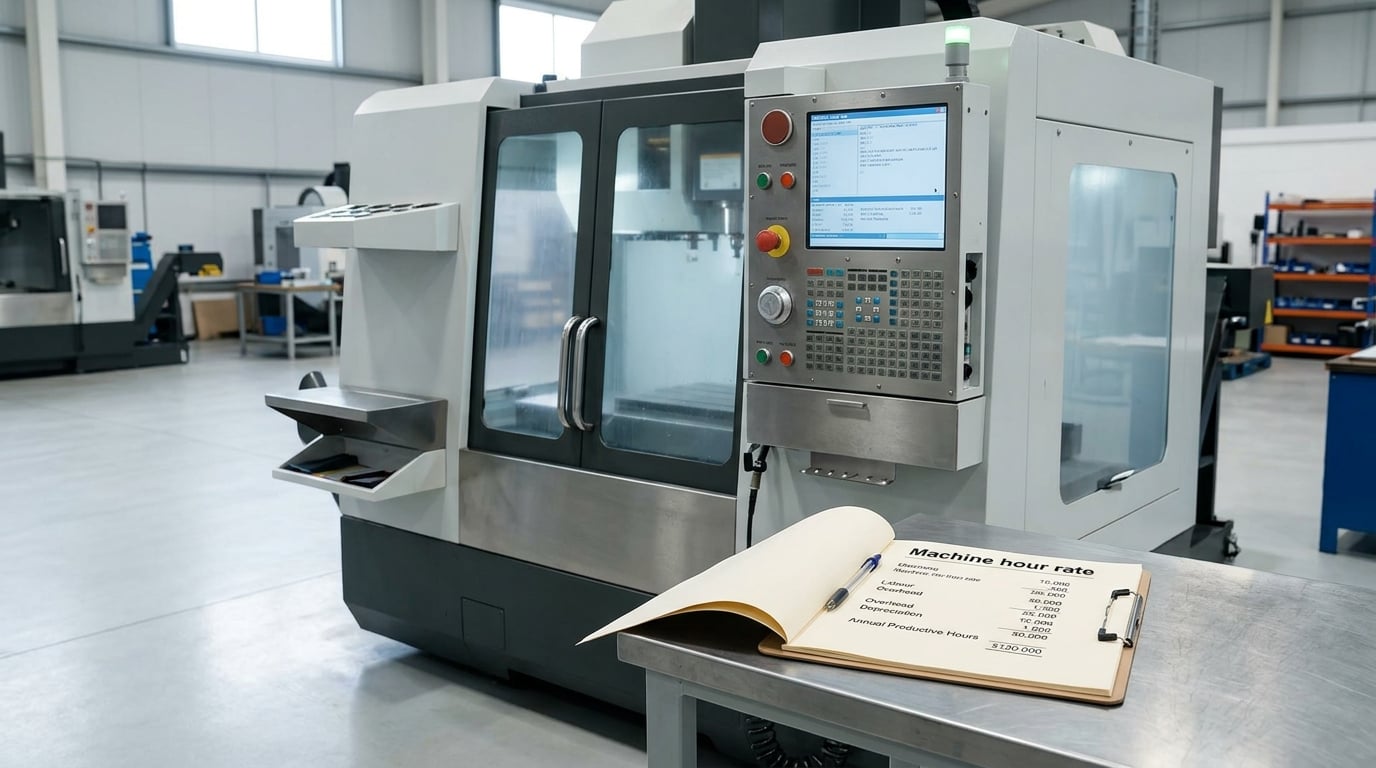
The whole method is one formula with two halves in the numerator and one number in the denominator:
Machine hour rate = (Annual fixed charges + Annual variable charges) ÷ Effective operating hours
Everything below just builds that formula carefully.
1. Define the Machine and Cost Center
Decide what the rate covers before you count a single cost. A single vertical machining centre with one dedicated operator gets one rate. A cell with two machines, a robot and a shared operator table gets one blended cell rate, and charging each machine separately would double-count the operator.
Then write down what the rate is meant to represent: which products and processes run on it, which shifts, and which cost drivers actually make the machine expensive. A laser and a vertical machining centre share the same formula and almost nothing else in the line items.
2. Estimate Annual Productive Hours
This is the denominator, and it is where most rates break. Work down from the hours the machine could physically run, then subtract everything that stops it producing.
- Available hours = working days × scheduled hours per day, after holidays and shutdown weeks.
- Less planned maintenance windows, usually budgeted as a day or two per month for a shop that has a PM contract.
- Less changeovers, setups, fixture and program waiting, run at changeovers per month × average setup minutes.
- Less breaks, training, operator meetings and shift handovers.
- Less the idle time you expect when no job is queued. This is the honest one, and most shops set it at zero.
Say the machine runs two shifts, five days, fifty weeks: 4,000 available hours. Subtract 250 hours of planned maintenance, 350 hours of changeovers, 150 hours of breaks and training, and 500 hours of expected idle, and you land on 2,750 effective operating hours. Those five hundred idle hours are not a failure, they are the schedule you actually run.
3. Calculate Direct Machine Labour Cost
Decide whether the operator sits inside the rate or gets billed separately, and be consistent. If the wage is in the rate, the quote covers the machine time only and must not add the operator hour again. If the wage is outside the rate, the rate covers running costs alone.
For shops that include it, annualise it: one operator at 28.50 an hour base, times a burden factor of 1.25 for payroll taxes, benefits and insurance, gives 35.63 an hour of loaded labour. Multiply by the paid hours for that operator across the year, plus any second operator for lights-out running, and you have the labour element. Add a share of direct supervision if nobody supervises full time.
4. Add Equipment and Operating Costs
Depreciation is the biggest fixed item on most machines and deserves its own arithmetic rather than a plug figure:
- Depreciable amount = purchase and installation cost minus expected scrap value.
- Annual depreciation = depreciable amount ÷ working life in years, straight line.
- Depreciation per machine hour = annual depreciation ÷ effective operating hours.
A machine bought and installed for 145,000 with an expected scrap of 15,000 over a ten year life depreciates at 13,000 a year, which at 2,750 effective hours is about 4.73 an hour. That number is a real, auditable expense even though nothing leaves the bank account, and it is what stops a machine you have owned for six years from quoting at almost nothing.
Then add the rest: electricity consumed at the machine, which you estimate from nameplate kW × load factor × hours or from submeter data; preventive and unplanned maintenance; coolant, lubricants and consumables; perishable tooling and inserts; and the occupancy line covering floor space, building utilities, insurance and property tax on the asset.
5. Allocate Manufacturing Overhead
Some costs belong to the plant rather than to your machine, but every job should carry a share. The standard method is a predetermined overhead rate: take estimated shared overhead for the year, choose an allocation base, and divide.
Machine hours are the right allocation base for a machine shop because they track the resource the jobs actually consume. Divide total shared overhead by total machine hours across all equipment to get the shop rate, then multiply by this machine’s effective hours. Be careful with a plant-wide rate applied to one specialised machine: a laser and a press do not consume supervision, floor space or quality time in anything like the same proportion, so one blended number quietly underprices the expensive machine and overprices the simple one.
Shared overhead worth allocating typically includes plant supervision, quality and inspection systems, material handling and warehouse, production scheduling, administration, and the facility costs that are not already in the occupancy line.
6. Divide Total Cost by Productive Machine Hours to Set the Machine Hour Rate
Add the annual charges and divide by effective hours. Here is the full vertical machining centre example with every line shown:
| Annual charge | Type | Amount |
|---|---|---|
| Depreciation (145,000 less 15,000 scrap over 10 years) | Fixed | 13,000 |
| Floor space, building utilities, occupancy | Fixed | 9,600 |
| Insurance and property tax on asset | Fixed | 1,450 |
| Preventive and unplanned maintenance | Mixed | 5,850 |
| Supervision, quality and indirect labour allocation | Fixed | 14,400 |
| Coolant, lubricants, consumables, perishable tooling | Variable | 5,800 |
| Electricity consumed at the machine | Variable | 4,900 |
| Total annual cost | 55,000 |
55,000 ÷ 2,750 effective operating hours = 20.00 per machine hour. At a 50,000 total annual cost and 2,000 operating hours the same arithmetic gives 25.00 per hour, which is where that familiar round figure usually comes from.
Check the sensitivity before you settle. Move expected idle hours from 500 to 300 and the rate rises to about 19.06. That single assumption is worth more than a day of arguing about energy prices.
7. Add Markup or Margin for Pricing
Recovery cost is not a price. Two conversions get you to the customer-facing figure, and mixing them up is the most expensive arithmetic error in the shop.
- Markup multiplies cost. A 35% markup on 20.00 gives 27.00 an hour. Markup is straightforward but it shrinks as a share of revenue as cost rises.
- Gross margin is a share of the selling price. A 45% margin means 20.00 ÷ 0.55 = 36.36 an hour, because the 20.00 is 55% of what the customer pays.
Use markup when you are quoting from a list and margin when you are setting a target return. Most shops end up doing a bit of both, then adjusting per job for setup intensity, material risk and lead time.
On a small aluminium bracket, 1.4 hours of machine time at 20.00 is 28.00. Add the deburr and inspection labour, inserts, outside anodising and material, then apply your margin to the total. Comparing that quote against a competitor’s tells you far more than comparing unit prices does, because now you can see whether the difference sits in machine hours, material or margin.
8. Review and Update the Rate
Refresh the rate at least annually and whenever one of these triggers fires: a new machine or disposal, a major process change on the machine, a move to a different shift pattern, a supplier price change on tooling or power, a change in the product mix, or a utilisation swing of more than ten points.
Keep it simple. Compare actual annual spend to the four assumptions you made, replace the estimates with real figures, and note what moved the rate. Shops that track downtime even loosely find the biggest gains here, because the denominator drifts before the costs do.
Common Mistakes
These are the errors that quietly make a rate wrong, in rough order of how much money they cost.
- Using calendar hours or all scheduled hours. A machine at 4,000 available hours but 2,750 productive hours costs about 45% more per hour than the same machine costed at 4,000. This is the single biggest distortion, and it flatters rates while quietly making quotes uncompetitive on paper and unprofitable in practice.
- Forgetting changeovers and idle time. Setup and queueing are not free capacity. Track changeovers per month for a quarter and multiply by average setup minutes; if the scheduler cannot produce the number, assume the worst and let the evidence correct you.
- Double-counting the operator wage. Including loaded labour in the rate and then billing the operator hour on the quote charges for the same 45 minutes twice. Pick one treatment, write it on the rate sheet, and never mix it across quotes.
- Mixing markup with margin. A 35% markup and a 35% margin are different numbers on the same rate. Quoting with the wrong one turns a healthy job into a thin one without anything visibly changing.
- Allocating every plant expense to one machine. Administrative cost that no single machine caused will still not go away if you remove it from the rate. Only allocate costs the machine could plausibly influence, and use machine hours as the base.
- Treating depreciation as a plug. A round number someone chose in year one becomes wrong forever. Calculate it from cost, scrap value and working life, then revisit the life assumption if the machine gets rebuilt or upgraded.
- Leaving tooling and consumables out. Inserts, coolant, gauges and perishable tooling belong somewhere in the rate or on the quote. If they are in neither, the job absorbs them and the margin quietly disappears.
- Applying one plant-wide rate to every machine. A 3-axis vertical machining centre, a CNC lathe, a laser cutter and a power press have different cost structures and different changeover behaviour. One blended rate makes the complex machine underpriced and the simple machine overpriced at the same time.
One honest note on scope. Owners on machining forums describe the final rate as partly a commercial decision constrained by cost reality, and that is fair. The calculation tells you the floor below which you lose money; the number you actually publish sits above it, based on what your market will bear and how badly you want the work.
Frequently Asked Questions
What is a machine hour rate?
A machine hour rate is the total cost of owning and operating a machine for a period, divided by the hours it is genuinely available to produce in that period. The numerator holds fixed costs such as depreciation, floor space, insurance and allocated overhead, plus variable costs like electricity, consumables and direct operator labour. The denominator is effective operating hours, not calendar hours. The result is a cost per productive hour used for quoting, job costing and internal charge-back.
How do you calculate the cost per machine hour?
Annualise every cost the machine carries for the year, separate fixed from variable, then divide the total by effective operating hours. Effective operating hours are available hours less planned maintenance, changeovers, breaks, training and the idle time you expect when no job is queued. For a machine costing 55,000 a year with 2,750 productive hours, the rate is 20.00 per hour. Run two sensitivity cases on the idle-hour assumption, since it moves the rate more than any cost line.
How do you calculate depreciation in a machine hour rate?
Take the installed cost of the machine minus its expected scrap value, divide by the working life in years using straight-line depreciation, then divide the annual figure by effective operating hours. A machine installed for 145,000 with 15,000 of expected scrap over ten years depreciates at 13,000 a year, or about 4.73 an hour at 2,750 productive hours. Depreciation is a fixed cost: it does not change when the machine runs more or fewer hours.
Is machine depreciation a fixed cost?
Yes. Standing charges like depreciation, rent and floor space occupancy, insurance and property tax stay the same whether the machine runs fifty hours or five thousand. Running charges such as electricity, coolant, consumables and perishable tooling scale with use. Keeping the two buckets separate matters because spreading a fixed cost across more hours lowers the rate, which is why a machine bought second-hand can quote below a new one even when variable costs are identical.
Should operator wages be included in the machine hour rate?
Both treatments are legitimate, but pick one and stay with it. If loaded wages sit inside the rate, the quote covers machine time only and must not bill the operator hour again, which is the most common double-count in job costing. If wages sit outside, the rate covers running costs alone and the quote adds the operator at a separate loaded rate. Document the choice on the rate sheet so estimators, schedulers and the customer-facing quote all follow the same rule.
How often should machine hour rates be recalculated?
At minimum once a year, and immediately after any of these: a machine purchase or disposal, a process change, a shift pattern change, a supplier price move on power or tooling, a shift in product mix, or a utilisation swing of more than ten points. In practice a quarterly review of actual spend against the four assumptions behind the rate keeps it honest. Comparing estimated to actual hours, maintenance and power usually shows where the estimate drifted.
Conclusion
Start with one machine you quote every week. Pull its twelve months of costs, calculate depreciation properly, work down from scheduled hours to realistic productive hours, divide, and write the assumption for idle time on the sheet where everyone can see it.
Then add your margin and test the resulting rate against a real quote you have already sent. If it does not match, the gap tells you which assumption is wrong. Repeat for the rest of the shop, and the machine hour rate stops being a guess and becomes the backbone of your job costing, your pricing and your capacity planning.