

To evaluate manufacturing quotes fairly, rewrite every quote onto the same basis: identical scope, identical volume, identical delivery point. You then compare landed cost per part, not the headline number, and score the suppliers against weights you wrote down before the quotes arrived. Anyone can do it. The work is in the standardization, not the math.
Most quote comparisons fail for a boring reason. The three suppliers were not pricing the same thing, and the buyer never found out. One quote carried a weld, inspection paperwork and freight inside the per-part price. The next listed all three as optional extras. The third quietly assumed a grade of resin the drawing did not specify.
Read the numbers carefully, and the comparison takes an afternoon. Skip the standardization, and you can spend months arguing with a supplier who was never actually low.
Table of Contents
- What You Need
- How to Evaluate Manufacturing Quotes Fairly, Step by Step
- 1. Define the scope and quote assumptions
- 2. Standardize every line item so you can compare manufacturing quotes apples to apples
- 3. Separate quoted price from total landed cost
- 4. Check technical compliance and exclusions
- 5. Compare supplier capability and risk
- 6. Normalize commercial terms
- 7. Calculate cost at realistic volumes
- 8. Score, clarify, and select the quote
- Common Mistakes
- Frequently Asked Questions
- Should I always choose the manufacturing quote with the lowest unit price?
- How should I compare quotes when suppliers quote different order quantities?
- Should tooling charges be included when comparing manufacturing quotes?
- How do Incoterms affect which manufacturing quote is cheapest?
- What should I do if a supplier will not clarify an assumption in its quote?
- Conclusion
What You Need
You cannot normalize scope after the quotes arrive if you never defined it. Gather these before the RFQ goes out, and send the same set to every supplier.
- Controlled drawing or model, with a revision number and a stated date. A quote against revision A is worthless if the shop builds revision C.
- Bill of materials listing resin or alloy grade, and any specification the supplier must buy to (a certification, a colour standard, a domestic-content requirement).
- Tolerances and datums, expressed on the drawing or in a written table. If you want a general tolerance and a general surface finish, say so in words, because each shop will interpret that differently.
- Volume schedule for the next two years, with the quantity you actually intend to release, the annual rate, and the peak you may have to hit in a good quarter.
- Quality deliverables: first article inspection, certificates of conformity, material traceability, or a full PPAP submission if the part is automotive or medical.
- Packaging: bag, tray, foam insert, label format, and how many parts per carton.
- Delivery point and Incoterm. If you do not name one, each supplier picks the term that flatters its own quote.
- A blank comparison worksheet, one row per cost line, one column per supplier, with a match column and a notes column. Build it before the quotes arrive, not after.
Drawings with unclear datums are the most common source of phantom price differences. Our guide to GD and T basics for plastic parts is worth a read before you send anything out.
How to Evaluate Manufacturing Quotes Fairly, Step by Step
The process runs in eight steps. Steps one and two decide whether a comparison is possible at all. Steps three and four turn a price into a real cost. Steps five to eight decide who gets the business and on what written terms.
1. Define the scope and quote assumptions
State material grade, part revision, tolerances, finish, quantity, packaging, delivery point, payment terms, and required documentation. Then state your assumptions explicitly, even where the drawing already says it, so a supplier who disagrees has something specific to correct.
Put the assumptions in the RFQ, not in a follow-up email. A supplier that quotes a different resin grade, a different cavity count or a lower tolerance without flagging it has told you something useful about how it will handle changes later.
Ask each bidder to return its own list of assumptions and exclusions as part of the quote. A supplier with nothing to declare is not being thorough. It usually means the estimator answered from memory.
2. Standardize every line item so you can compare manufacturing quotes apples to apples
Break each quote into the same rows for every supplier, then mark each row in scope, excluded, or different. A row that reads differently across suppliers is not a price difference yet; it is an unresolved scope difference, and it must be re-quoted before you compare anything.
| Cost line | Supplier A | Supplier B | Supplier C | Match? |
|---|---|---|---|---|
| Material, grade stated | in scope | in scope, different grade | in scope | No – re-quote B |
| Machine and cycle time | itemized | itemized | not itemized | Partial |
| Tooling, one-time | quoted, not amortized | quoted, not amortized | quoted, not amortized | Yes |
| Tooling amortization | not stated | per part at 25k | per part at 10k | No – model both at 25k |
| Setup and programming | one-time | one-time | per order | Check frequency |
| Secondary operations | excluded | in scope | excluded | No – add to A and C |
| Inspection and documents | FAI only | FAI plus CoC | excluded | No |
| Packaging | bulk cartons | trays and labels | bulk cartons | No – equalize |
| Freight, Incoterm | not stated | DDP | EXW | No – see landed cost |
| Duty, tariff, handling | excluded | included | excluded | No |
| Scrap allowance | not stated | stated | not stated | Ask each |
| Lead time to first article | stated | stated | stated | Yes |
If you want reference rates for the rows you cannot judge yourself, our scrap rate benchmarks for plastic manufacturing give you something defensible to ask about.
3. Separate quoted price from total landed cost
The quoted per-part price is the part on the supplier’s floor. Landed cost is everything it takes to get that part into your warehouse and keep it there. Build the same stack for every quote, using your own freight rates, your own duty and tariff position, and your own cost of capital.
| Cost element | What goes in it | Who usually absorbs it |
|---|---|---|
| Quoted per-part price | Production, material, cycle time, amortized setup | Supplier |
| One-time tooling | Mold, fixture, gauges, first article | Buyer, then amortized |
| Inbound freight | Air, ocean, road, drayage, insurance | Depends on Incoterm |
| Duty and tariff | HS classification rate, any exclusion you hold | Buyer under most terms |
| Port and brokerage | Handling, documentation, examination fees | Buyer |
| Inventory in transit | Value of parts plus freight while they sit | Buyer, always |
| Inspection and re-runs | Third-party inspection, sorting, rework of non-conforming lots | Buyer unless defect-related |
| Payment terms and FX | Cost of early payment, currency movement between quote and PO | Buyer |
Here is a worked illustration, in index points so the arithmetic stays clean. Three suppliers quote the same molded housing at an annual rate of 25,000 parts. Base per-part prices come back at 100, 103 and 106, a spread of 6 percent. Supplier A includes the secondary operation, the inspection report and delivered freight. Supplier B charges the secondary operation separately, quotes DDP pricing, and includes the certificates. Supplier C prices EXW with everything else excluded.
Add the excluded lines to each, add duty and in-transit inventory to all three, and divide by the same 25,000 parts. The totals land at 168, 141 and 133. The spread is now 26 percent, and the ordering has reversed. C is not the cheapest supplier, and A is not the expensive one; A is simply the only quote you can price without a phone call.
This is not a rare pattern. Star US Supply documented a version of it in October 2026: three quotes for 300 turned parts with welded tabs arrived within 8 percent of each other on base machining, and the gap widened to 32 percent once the welding was priced. The cheapest base price did not survive contact with the full scope.
Incoterms change who pays, so they change the arithmetic. Under EXW the buyer takes over at the supplier’s door and owns freight, duty and in-transit risk. Under FOB the seller covers export clearance and loading. Under DDP the seller nominally carries delivery, duty and risk, and you still need to read what was excluded inside the term.
4. Check technical compliance and exclusions
Read the exclusions list as carefully as the price. Anything a supplier has excluded is something you will pay for later, usually through a change order at a worse rate than the original quote.
Test each quote against the drawing yourself. Confirm the tolerance scheme, the surface finish, the material grade, the packaging, the documentation, and any validation or certification the part needs. Where a supplier has assumed a looser tolerance or a cheaper finish, write the difference into the worksheet and re-quote on the correct basis.
Suppliers who return a design-for-manufacture review alongside the quote have told you something. Sharp feedback on draft angles, wall thickness, gate position or part consolidation is evidence the estimator looked at the geometry, not just the material price. A quote with no engineering comment usually means a price from a pricing calculator. We covered the same thinking in root cause analysis methods for manufacturing defects from the quality side.
5. Compare supplier capability and risk
Cost is one input. A supplier that cannot hold a tolerance, cannot document material origin, or has answered nothing else in the RFQ is a different risk from a supplier with the same number and a full response.
Use the same evidence for everyone: capacity at your volume and at your peak, process fit for the actual part, quality history and certification scope, communication responsiveness, tooling control practices, and any performance history you hold from a first article or a pilot run.
Verify rather than assume. Ask for the certification directly instead of accepting a logo on a website. Ask where the material is sourced and whether the supplier buys resin or buys finished parts from someone else. For an offshore quote, ask for the machine count and the screw diameters, and be willing to visit or to have an independent auditor visit. A quote from a trading company with no plant of its own carries a different risk profile from the same number quoted by the manufacturer, and the two should never sit in the same column without a note.
6. Normalize commercial terms
Commercial terms decide how flexible the relationship is after the award. Compare them in writing, because these are the terms that get forgotten once the parts are flowing.
- Lead time for tooling, for first article, and for repeat production, stated separately.
- Price breaks by volume, and whether they are cumulative across the year or per order.
- Incoterm and named place, not just the term.
- Payment schedule, including any deposit for tooling and any milestone tied to first article.
- Quote validity in days, and what happens when it expires.
- Change-order pricing, including a written notice period before a price change takes effect.
- Warranty and defect allowance, and who pays for sorting and rework of a rejected lot.
- Tool ownership, maintenance and insert life, plus what happens to the tool if the relationship ends.
- Intellectual property: confidentiality, and whether your design can be used for other customers.
Resin and metal prices move, and a quote priced against last month’s resin is not a quote. Ask for the price basis and a dated validity window, and agree in advance what triggers a re-quote. Buyers on r/InjectionMolding raise this constantly in thread titles about tracking resin cost and about quotes going stale between issuance and award, and the same thread titles show real anxiety about contract terms when buying tooling from smaller shops. Treat quote validity and tool ownership as scored criteria, not as legal afterthoughts.
7. Calculate cost at realistic volumes
Most suppliers quote the quantity you asked for and price it accordingly. You need cost at the volume you will really buy, and the tooling spread over that volume.
Amortized tooling per part equals the one-time tooling cost divided by your planned volume. Add that to the quoted per-part price to get true per-part cost. Then test break-even: divide the tooling cost by the per-part saving against the alternative process or the commercial part, and the result is the volume at which the custom route pays for itself.
Do the same for setup and programming, which is often quoted per order rather than one-time. A supplier who charges setup on every release is effectively a higher-volume supplier, and your comparison has to reflect your release pattern. Ask for a blanket or framework price for committed annual volume, and check the scrap and yield assumption in writing; our scrap rate benchmarks cover what a defensible allowance looks like.
8. Score, clarify, and select the quote
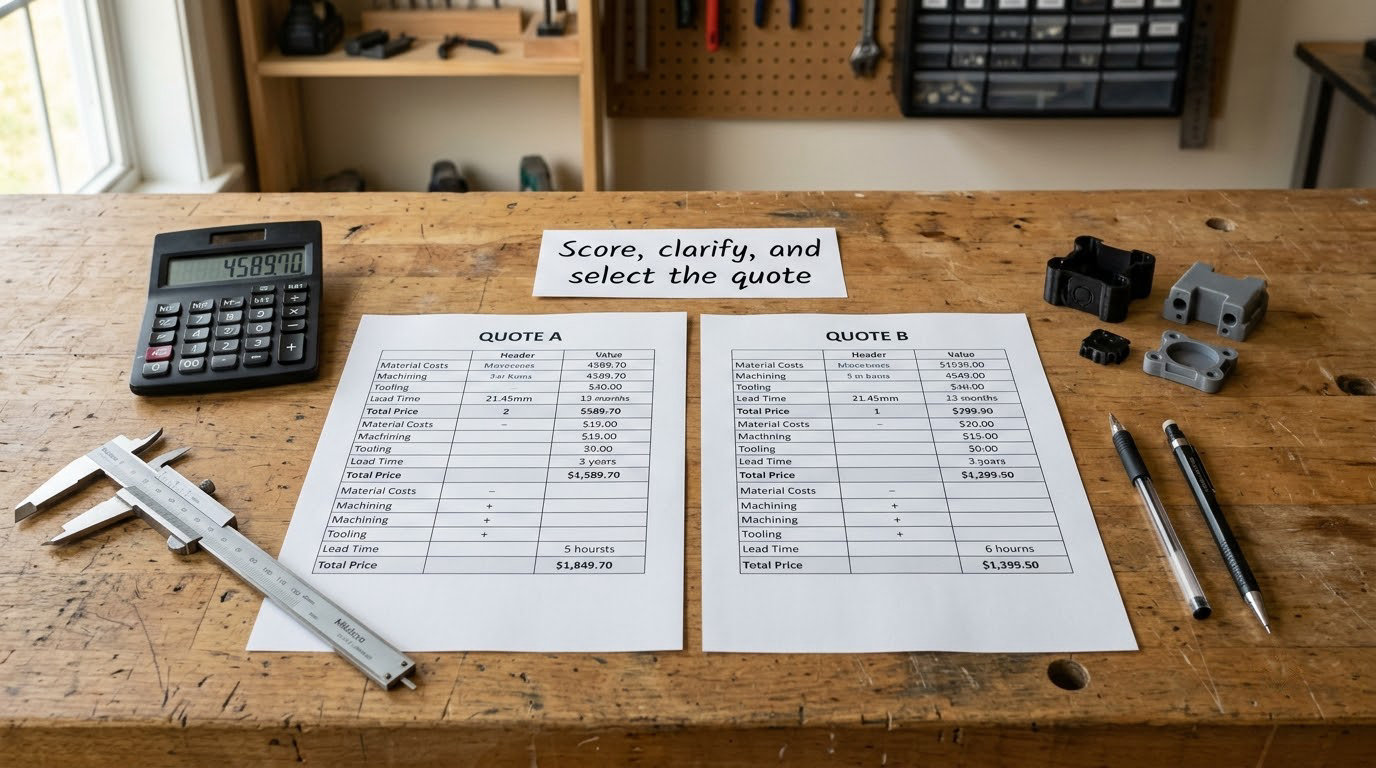
Set the weights before the quotes arrived, then score each supplier 1 to 5 against the same criteria. Record the reason for every score difference larger than one point.
| Criterion | Weight | Score 1-5 | Watch for |
|---|---|---|---|
| Technical response quality (DFM, real questions, assumptions declared) | 20% | Pricing-calculator quote with no engineering comment | |
| Total landed cost per part at your volume | 30% | Low headline price with large exclusions | |
| Quality system and documentation capability | 20% | Certification scope narrower than the part needs | |
| Capacity and lead-time reliability | 15% | No committed date for first article | |
| Commercial terms and contractual clarity | 10% | Short validity, open-ended change-order pricing | |
| Communication responsiveness and transparency | 5% | Slow answers to clarifying questions |
Where two suppliers land within about 5 percent on landed cost, the decision belongs to the scorecard, not to the spreadsheet. Buy from the supplier who answered your questions properly.
Then send clarifications on every ambiguous line, in writing, and ask for a revised quote that incorporates the answers. Finally, write the resolved scope into the purchase order: revision level, tolerances, material grade, packaging, documentation, quoted tolerances-of-tolerance, price basis, validity window, change-notice period, tool ownership, and the defect remedy. A quote that is not locked into the PO is a suggestion.
Common Mistakes
These are the errors that cost real money, in the order I see them most often.
- Awarding on the lowest per-part price. The fix: compare landed cost per part at your real volume, with every exclusion either priced in or removed from the award criteria.
- Comparing quotes for different scopes. A weld on one side and an option on the other is a 30 percent difference wearing a costume. The fix: mark every line in scope, excluded, or different, and re-quote anything that does not match.
- Ignoring tooling amortization. A big one-time charge spread over a small annual volume is a real per-part cost. The fix: divide tooling by planned volume and test the break-even against any alternative.
- Treating Incoterms as identical. EXW, FOB and DDP put freight, duty and risk in different hands, and the risk hand is the expensive one. The fix: convert every quote to the same delivery point and add the same logistics costs to all of them.
- Skipping supplier risk checks. The fix: verify plant and process ownership, certification scope, and material sourcing before you weigh the price.
- Fixing the weights after the quotes are open. That is not scoring, it is rationalizing. The fix: write the weights and the disqualification rules down, with the RFQ.
- Accepting a quote with no assumptions and no validity date. The fix: treat a missing validity window as a re-quote trigger and record the price basis in the PO.
A few practical habits help. Build a should-cost range from the drivers before you read a single number, so you know roughly what the part should cost. Ask every supplier the same clarifying questions in the same order, and answer those questions yourself before the RFQ goes out. Keep the worksheet as a live document rather than a one-off spreadsheet, because most change orders start as a line that somebody marked differently in a hurry.
Frequently Asked Questions
Should I always choose the manufacturing quote with the lowest unit price?
No. Compare landed cost per part at your real volume, with every exclusion priced in, before you look at the headline number. A low per-part price with large exclusions usually becomes a change order at a worse rate later. If two suppliers land within about 5 percent of each other on landed cost, decide with your scorecard rather than the price, and buy from the supplier who answered your questions properly.
How should I compare quotes when suppliers quote different order quantities?
Convert each quote to a common basis before comparing. Choose your planned annual volume, then ask every supplier to re-price at that quantity and, ideally, to quote volume breaks. Amortize one-time tooling and setup across your planned volume, and check whether setup is charged per order or once. If a supplier will not re-price, model their quote at your volume yourself and record the assumption.
Should tooling charges be included when comparing manufacturing quotes?
Include them, but amortized. Divide the one-time tooling cost by your planned volume to get a per-part figure, then add it to the quoted per-part price. Also test break-even by dividing tooling cost by the per-part saving versus a commercial part or an alternative process. Keep tool ownership, maintenance responsibility and insert life in the commercial terms, not just the cost.
How do Incoterms affect which manufacturing quote is cheapest?
They change who pays for freight, duty and in-transit risk, which changes the total. Under EXW you take over at the supplier door and own all three. Under FOB the seller covers export clearance and loading. Under DDP the seller nominally carries delivery and duty, but you should read what was excluded. Convert every quote to the same delivery point and add the same logistics costs before you rank them.
What should I do if a supplier will not clarify an assumption in its quote?
Ask in writing, name the specific line, and ask for a revised quote that reflects the answer. Then decide on the record. If a supplier cannot clarify a material assumption after a written request, that is a scored failure, and it belongs in the disqualification rules you set before the quotes arrived. Unstated assumptions become change orders once the parts are running.
Conclusion
Fair quote evaluation is a preparation problem wearing a spreadsheet costume. Freeze the scope, force line-item breakdowns, convert every quote to landed cost per part at a volume you actually intend to buy, and score the suppliers on weights you wrote down first.
Start with one action today: build a single standardized RFQ and a blank normalization worksheet, and complete the worksheet row by row before you open a single returned quote. Quotes you cannot put in the same columns are not competing, and you cannot fairly choose between them.