
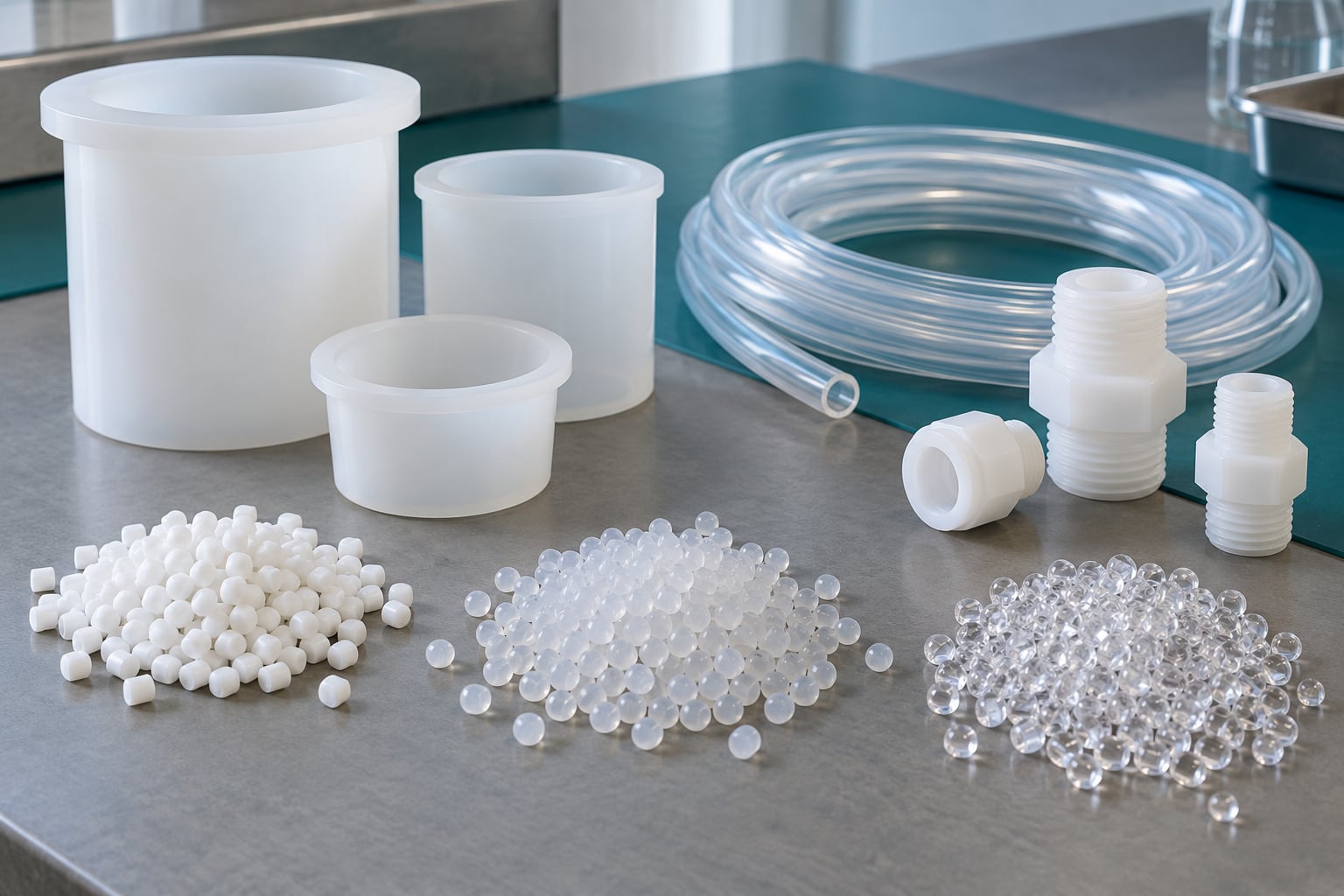
The one difference that decides most selections: PTFE is not melt-processable, while PFA and FEP flow when molten and can be injection moulded, extruded, thermoformed and welded. Temperature ceiling comes second. PTFE and PFA both rate around 260 C for continuous service, FEP stops near 200 C.
That combination explains almost every practical trade-off you will meet. PTFE gives up the cheapest, fastest production route in exchange for the lowest friction and the hardest-wearing surface of the three. FEP gives you a clear, weldable, extrudable polymer with a lower temperature rating. PFA costs more and buys you PTFE-level heat performance with conventional thermoplastic processing.
This guide is written for engineers, specifiers and technical buyers who have to sign off on a material, not browse. Everything below comes from published material data and standard supplier guidance, and the numbers are typical grade ranges rather than guarantees. Your specific part still has to be validated with the resin supplier’s own datasheet.
Table of Contents
- PTFE vs PFA vs FEP at a Glance
- What Are the Differences Between PTFE, PFA, and FEP?
- Temperature Resistance and Thermal Performance
- Strength, Creep, and Wear Resistance
- Chemical, Electrical, and Barrier Properties
- Processing, Forming, and Joining Methods
- PTFE vs PFA vs FEP Compared on Cost and Availability
- Which Should You Choose?
- Frequently Asked Questions
- Is PFA better than PTFE?
- Can FEP replace PTFE in high-temperature applications?
- Why is FEP transparent when PTFE and PFA are usually opaque?
- Which fluoropolymer has the highest continuous-use temperature?
- Can PTFE, PFA, and FEP be welded or joined together?
- When is a conventional engineering plastic better than all three?
- Conclusion
PTFE vs PFA vs FEP at a Glance
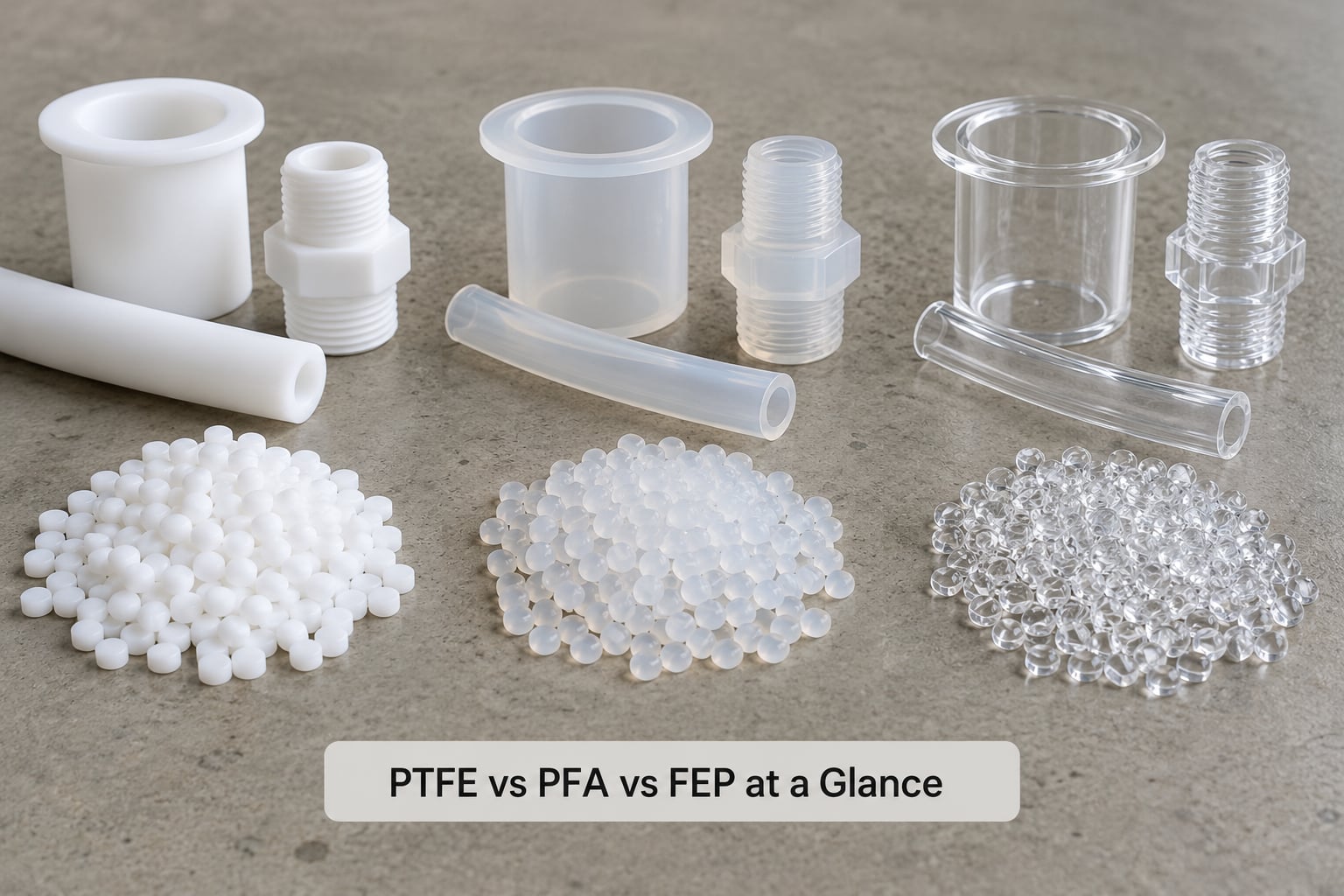
Here is the three-way comparison most engineers ask for. If a row does not matter to your service condition, ignore it and read on.
| Property or criterion | PTFE | PFA | FEP |
|---|---|---|---|
| Chemical family | Homopolymer, polytetrafluoroethylene | Perfluoroalkoxy copolymer | TFE and hexafluoropropylene copolymer |
| Continuous service temperature | -200 C to +260 C | Up to +260 C | -200 C to +200/205 C |
| Melting point (not a service rating) | About 327 C | About 305 C | About 260 C |
| Melt processable | No | Yes | Yes |
| Behaviour at -200 C | No embrittlement | No embrittlement | No embrittlement |
| Tensile strength | 25-35 MPa | 28-31 MPa | 20-30 MPa |
| Flexural modulus | About 495 MPa | About 690 MPa | About 600 MPa |
| Elongation at break | 350-400% | 260-300% | 250-350% |
| Flex life | Under about 50,000 cycles | Over 100,000 cycles | Between the two, grade dependent |
| Creep under sustained load | Highest, unfilled | Lowest of the three | Intermediate |
| Coefficient of friction | 0.03-0.05 | 0.05-0.08 | 0.05-0.08 |
| Dielectric strength | 50-100 kV/mm | About 55 kV/mm | About 55 kV/mm |
| Transparency | Translucent, milky | Opaque, translucency is grade dependent | Optically clear in thin sections |
| Chemical resistance | Broadest, fewest practical exceptions | Broad, with molten alkali metal exceptions | Broad, with high-temperature fluorine exceptions |
| Joining | Not weldable, bond by chemical etching | Weldable, bondable, thermoformable | Weldable, bondable, thermoformable, heat shrinkable |
| Relative cost | Lowest resin, highest conversion cost | Highest per part at low volume | Middle, cheapest to mould in volume |
| Best fit | Linings, seals, bushings, non-stick coatings | High-purity fluid systems, valves, semiconductor parts | Clear tubing, flexible wiring, liners, films |
Two rows in that table carry most of the weight. Processability decides what your part can look like and how long it takes to make it. The temperature row decides whether the part survives service at all.
What Are the Differences Between PTFE, PFA, and FEP?
All three are fluoropolymers, meaning their molecular chains are built largely from carbon-fluorine bonds. That bond is the strongest in ordinary organic chemistry, and it is why this family resists acids, solvents, heat and electricity at once.
PTFE, polytetrafluoroethylene, is the original. It arrived in the late 1930s and carries trade names like Teflon and Hostaflon. It is a straight homopolymer: every link in the chain is the same repeat unit, which gives it an extremely consistent, chemically tight structure.
FEP, fluorinated ethylene propylene, adds a second monomer, hexafluoropropylene, alongside tetrafluoroethylene. The side branch that comonomer introduces creates kinks in the chain. Those kinks lower the melting point into a range where the polymer can actually flow, which is the entire reason FEP exists as a separate grade family.
PFA, perfluoroalkoxy, solves the same problem by substituting bulky ether-containing side groups into the chain. Those groups make the melt workable and give PFA a higher continuous service temperature than FEP, closer to PTFE.
The letters are grade families rather than one fixed recipe. Within any of them you will find filled versions with glass fibre, carbon or ceramic, and different molecular weights that trade strength against melt flow. A filled PTFE and an unfilled PTFE behave very differently under load.
In practice the shared attributes are the same: chemical inertness, non-stick surface behaviour, low friction, high dielectric strength and UV resistance. What separates them is processability, temperature ceiling, mechanical durability and clarity.
Temperature Resistance and Thermal Performance
PTFE and PFA are rated for continuous service up to roughly 260 C, while FEP is rated to about 200-205 C and is generally ruled out above approximately 220 C. All three retain useful properties down to around -200 C without becoming brittle, which is why cryogenic service is viable in all of them.
The most common purchasing mistake is confusing melting point with continuous service temperature. PTFE melts near 327 C yet its continuous rating is about 260 C. FEP melts near 260 C yet only rates about 200 C. Continuous rating is the number that matters for a part sitting in a hot process line for years.
Why the melt point and the service rating are different numbers
A polymer softens progressively rather than collapsing at a single point. Long-term service ratings account for creep, dimensional drift and mechanical weakening that accumulate under steady heat and load. A fabricator quoting a higher number for a thin-walled part is usually working from a different test basis than a datasheet listing.
Thermal expansion is another differentiator. PTFE expands more than PFA across a temperature swing, and FEP sits between them. For a gasketed vessel or a long length of tubing, that difference shows up as a change in fit that your gasket design has to absorb.
Grade matters as much as polymer. Fillers change both the temperature behaviour and the mechanical numbers, and some filled grades carry lower continuous ratings than the pure polymer. Treat any single number as a starting point for supplier confirmation, not a spec.
Strength, Creep, and Wear Resistance
PFA is the strongest of the three under sustained mechanical load. Its flexural modulus is around 690 MPa against roughly 495 MPa for PTFE, and its flex life runs above 100,000 cycles compared to under 50,000 for PTFE, roughly a tenfold improvement that decides valve seat and bellows designs.
Unfilled PTFE stretches enormously before it breaks, with elongation at break around 350-400%. That sounds like toughness and is not the same thing. Under constant load it deforms steadily, and this cold flow or creep is the single biggest mechanical weakness of the material. A PTFE gasket under sustained bolt load will relax and lose its sealing force.
There are three standard answers to PTFE creep. Fill it with glass or ceramic, which reduces creep substantially at the cost of some chemical purity. Use it where the load is transient rather than constant. Or move to PFA, which creeps far less and holds dimensions over a long cycle.
FEP sits in between, with a flexural modulus near 600 MPa and elongation around 250-350%. Users of these films also report a practical stiffness difference: PFA reads as the softer of the two melt-processable grades, while FEP feels stiffer and drapes differently during forming.
For sliding and wear applications the ranking flips. PTFE’s coefficient of friction of 0.03-0.05 is the lowest here, and it has the longest established record as a bearing, slide and non-stick coating material. A PTFE moulded with a hard filler grades as a durable bearing material; PFA is generally chosen for dimensions and fatigue life instead.
Chemical, Electrical, and Barrier Properties
Chemical resistance barely separates these three. All of them are chemically inert to the great majority of acids, alkalis, solvents, fuels and aggressive process fluids at ordinary temperatures, and that breadth of resistance is the reason the whole family is specified for chemical handling.
The exceptions are what matter. Fluorine gas attacks fluoropolymers at elevated temperatures, which matters for fluorine service and for fluorination equipment. Molten alkali metals attack PFA in particular, and PFA is often excluded from those applications where PTFE would survive. PFA also permeates less than PTFE, which is why it dominates ultra-high-purity semiconductor fluid delivery.
On the electrical side, PTFE has the highest dielectric strength of the three at 50-100 kV/mm, against about 55 kV/mm for PFA and FEP. PTFE is specified for high-voltage insulation and wire and cable applications for exactly that margin.
Purity is the other axis. High-purity grades for semiconductor and pharmaceutical service are specified by ionic purity, extractables and low void content rather than by mechanical properties. Those grades are made in PFA and PTFE; FEP high-purity grades exist for tubing and film but dominate where optical clarity is the requirement.
Processing, Forming, and Joining Methods
This is where the materials diverge most sharply, and where processability earns its place as the decisive difference in PTFE vs PFA vs FEP compared discussions.
PTFE: pressed, sintered, then machined
PTFE will not hold a melt pool at working pressure because its melt viscosity is far too high to flow. Instead it is formed by compression moulding or ram extrusion into a blank, then sintered just below its melting point, then machined to final size. That sequence is why PTFE parts carry a machining allowance and why small PTFE parts are expensive relative to their resin cost.
PTFE cannot be welded and does not thermoform into shapes the way the melt-processable grades do. Adhesive bonding is done by treating the surface chemically, typically with a sodium naphthalene style etch, and then using a two-part epoxy.
PFA: conventional thermoplastic processing
PFA is injection moulded, extruded into tubing and rod, blown into bottles and vessels, film processed and thermoformed. Welded PFA systems are routine because the material fuses cleanly at its processing temperature. For a high-purity fluid path, a moulded PFA fitting with welded joints eliminates the machined PTFE step entirely.
FEP: extrusion and moulding with optical clarity
FEP extrudes into clear tubing and film, injection moulds into fittings and parts, and thermoforms into covers and liners. It is the workhorse for optical clarity because thin sections transmit light where PFA and PTFE do not. FEP also shrinks into place as a heat shrink tubing at around 110 C, where the equivalent PTFE process needs temperatures near 330 C.
The practical trap is assuming interchangeability. A design that works in FEP may fail in PTFE purely because the PTFE route forces machining, and a design that works in PFA may fail in FEP on temperature. The materials are similar in chemistry and different in manufacture.
PTFE vs PFA vs FEP Compared on Cost and Availability
Resin price alone misleads in all three directions. PTFE resin is the cheapest of the three, yet a machined PTFE part can cost more than a moulded PFA part at volume, because machining labour and material scrap are added after the resin is bought.
How Cost Differs in PTFE vs PFA vs FEP Compared
Compare on total part cost instead of resin cost. PFA carries the highest resin cost of the three but is the cheapest route for complex moulded geometries in production runs, since cycle time is short and there is no secondary machining operation. FEP sits between the two and is the most straightforward to convert into clear film and tube at volume.
Finishing cost swings the result. Welding, thermoforming and bonding are available in PFA and FEP and unavailable in PTFE. Installation cost follows the same line: clear FEP tubing is easy to inspect and install, while an opaque PTFE liner has to be trusted rather than checked.
Availability is a question of form. All three come as rods, sheets, tubes and pellets. FEP is the strongest in film and clear tubing. PFA is well served in high-purity tubing, moulded fittings and weldable systems. PTFE has the widest stock shapes, including filled grades, large sheets and thick blocks for machining. Lead time on a machined PTFE blank is usually longer than on an extrusion- or moulded part of the same size.
Regulatory cost belongs in this section too. All three are polymeric fluoropolymers and sit inside the broad PFAS definition that regulators are still working through, and the ongoing debate has made some buyers ask about food-contact and medical grades specifically. Rules differ by region and change over time, so check the current local position and ask your supplier for documentation rather than relying on a supplier blog. For general guidance on how factories document material choices and compliance, see our guide on shift scheduling models for factories compared, which covers the documentation habits that make compliance conversations easier.
Which Should You Choose?
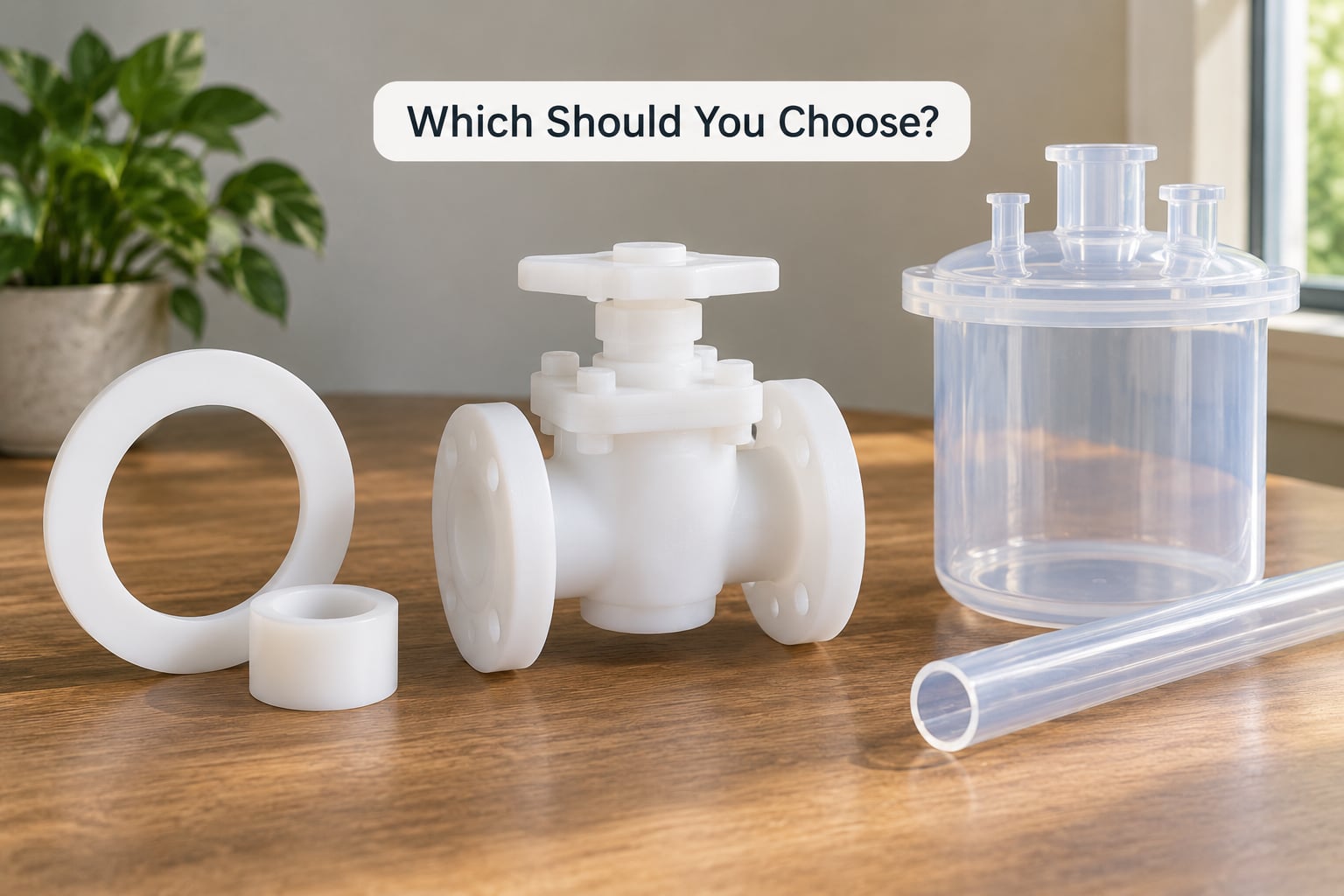
Choose PTFE for low-friction, chemically resistant, high-temperature components and machined parts. Choose PFA for demanding moulded parts, high-purity fluid systems, semiconductor environments and stronger joints. Choose FEP for clear tubing, flexible wiring, liners and films where optical visibility matters.
By application
- Semiconductor wet process: PFA tubing and fittings for high-purity delivery, where low ionic content and low permeation decide the grade. PTFE appears where temperature, not purity, drives the design.
- Oil and gas valve seats and seals: PFA or filled PTFE where sour gas and pressure cycling matter, since creep and flex life decide seat life.
- Aerospace wire and cable: PTFE for the highest dielectric strength and temperature ceiling, FEP for compact insulation and jacketing where weight and flexibility matter more.
- Hydrogen and renewable gas systems: PFA liners and bellows where permeation and flex fatigue are the limiting factors, PTFE where the operating temperature is higher than 200 C.
- Medical and laboratory tubing: FEP for clear fluid paths and heat shrink, PFA for autoclave-capable and higher-pressure assemblies.
- Non-stick coatings: PTFE, for the low surface energy and coefficient of friction no alternative in this family matches.
Decision checklist
- Temperature: Establish the continuous service temperature and the peak excursion separately. Above about 205 C, FEP is usually out.
- Load: Sustained compressive or bolt load points to PFA, or to a filled PTFE grade. Transient sliding load points to unfilled PTFE.
- Fabrication: Decide how the part will actually be made before choosing the resin. Complex moulded geometry is a PFA or FEP decision; machined PTFE is a different cost and lead time story.
- Regulatory and purity: Specify high-purity, food-contact or medical grades explicitly and get documentation.
- Lifecycle cost: Compare installed part cost, replacement frequency from creep or flex fatigue, and inspection time, not the resin price per kilogram.
Frequently Asked Questions
Is PFA better than PTFE?
Better depends on which property drives your design. PFA is stronger under sustained load, creeps far less, holds dimensions over long cycles and reaches a flex life above 100,000 cycles against under 50,000 for PTFE. PTFE wins on friction, sliding wear and resin cost, and it can be machined into shapes PFA will not mould. In PTFE vs PFA vs FEP compared terms, PFA suits valves, bellows and high-purity systems while PTFE suits bushings, linings and seals.
Can FEP replace PTFE in high-temperature applications?
Only below about 200 to 205 C. FEP is rated for continuous service to roughly 200-205 C and is generally ruled out above approximately 220 C, while PTFE and PFA both hold ratings near 260 C. A substitution also changes the joining method, since PTFE cannot be welded or thermoformed the way FEP can, and any chemical etch bonding step designed for PTFE has to be reworked.
Why is FEP transparent when PTFE and PFA are usually opaque?
Transparency is a matter of how much light scattering the polymer structure allows. FEP’s copolymer structure produces a more optically homogeneous material, so thin sections such as tubing and film transmit light clearly. PTFE is filled with the microscopic fraction of its own polymer that scatters light and reads as milky white, while PFA is typically opaque at normal wall thickness. Clarity is a viewing aid, not a purity guarantee.
Which fluoropolymer has the highest continuous-use temperature?
PTFE and PFA are effectively tied at roughly 260 C for continuous service. FEP is lower, at about 200 to 205 C. Melting points tell a different story: PTFE melts near 327 C, PFA near 305 C and FEP near 260 C. Continuous rating is the figure to design against, because it accounts for creep and dimensional drift that accumulate over years of service.
Can PTFE, PFA, and FEP be welded or joined together?
PFA and FEP can be welded to themselves with standard hot-gas or extrusion welding equipment, which is why they dominate moulded and welded high-purity fluid systems. PTFE cannot be welded at all; parts are bonded with epoxy after a chemical surface etch. Joining a PTFE component to a PFA or FEP one therefore requires the etched bonding route rather than a weld, and the difference in thermal expansion has to be allowed for.
When is a conventional engineering plastic better than all three?
When the service condition is mild. A standard engineering plastic such as polyamide or polycarbonate will usually be cheaper, stiffer and easier to mould than any of these three for a low-temperature, low-load, non-critical fluid or structural duty. Fluoropolymers earn their cost when you need chemical inertness, low friction, a temperature ceiling near 200 to 260 C or non-stick behaviour that commodity plastics simply cannot deliver.
Conclusion
Start the selection with four numbers: operating temperature, chemical exposure, mechanical load and fabrication method. Those decide the shortlist far more often than brand, colour or marketing adjectives do. PTFE earns its place with low friction and chemical inertness, PFA with strength and thermoplastic processing, FEP with clarity and manufacturability.
Then take the candidate grade to your supplier’s data sheet and validate it against representative testing on the real part, because fillers, wall thickness and design all shift the published figures. Before you order, write down the complete service environment: peak temperature and duration, the full fluid list including trace contaminants, sustained versus transient load, and the joining method you intend to use. Most field failures of these three materials trace back to one of those four being assumed rather than documented.