
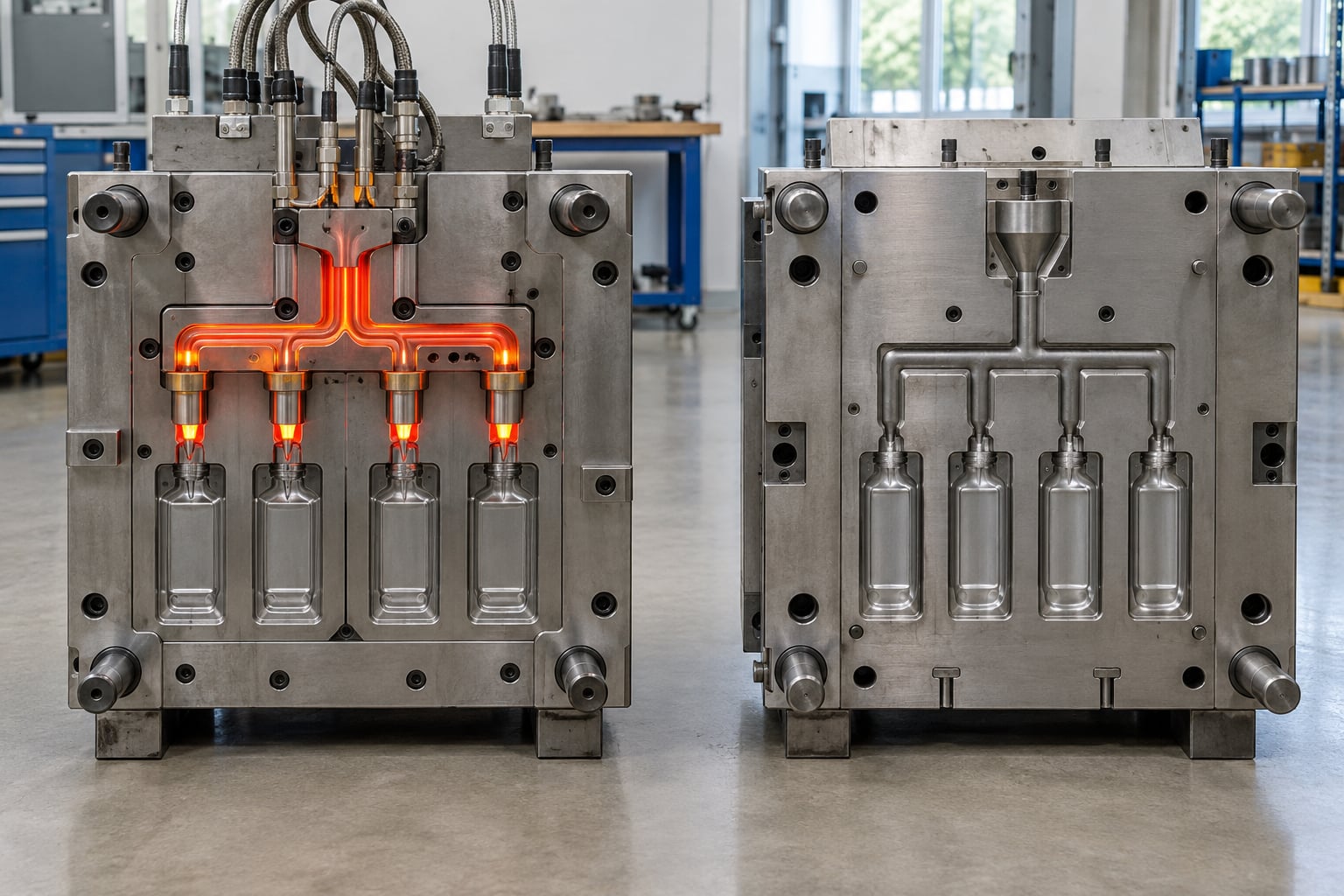
Hot runner vs cold runner molds are the two main feed systems used in plastic injection molding, and the choice is locked in when the tool is built. Pick a hot runner when you run high volumes, care about cosmetic surfaces and want every gram of resin to end up in the part; pick a cold runner for short runs, frequent color changes and the lowest possible tooling spend.
Neither system is the better one in the abstract. A cold runner that gets trimmed twice a shift can cost more over three years than a hot runner that paid for itself in its first year, and a hot runner on a 5,000-piece order is dead weight you will never recover.
The rest of this guide breaks down how each feed system works, what it does to your cycle time, scrap rate and maintenance load, and where the crossover sits in production volume. If you are new to runner systems, start with the terminology in the first section below — sprue, runner and gate are used constantly and people mix them up.
Table of Contents
- Hot Runner vs Cold Runner Molds at a Glance
- What Is a Hot Runner Mold?
- What Is a Cold Runner Mold?
- Cost and Tooling Investment
- Cycle Time, Scrap, and Material Efficiency
- Color Changes and Production Flexibility
- Maintenance, Reliability, and Process Control
- Materials, Applications, and Design Considerations
- Which Should You Choose?
- Frequently Asked Questions
- How much does a hot runner add to mold cost?
- At what part volume does a hot runner start paying for itself?
- How many seconds per cycle does a hot runner actually save?
- Are hot runner molds better than cold runner molds?
- Can you run color changes on a hot runner mold?
- Do hot runner molds need more maintenance than cold runner molds?
- The Short Version
Hot Runner vs Cold Runner Molds at a Glance
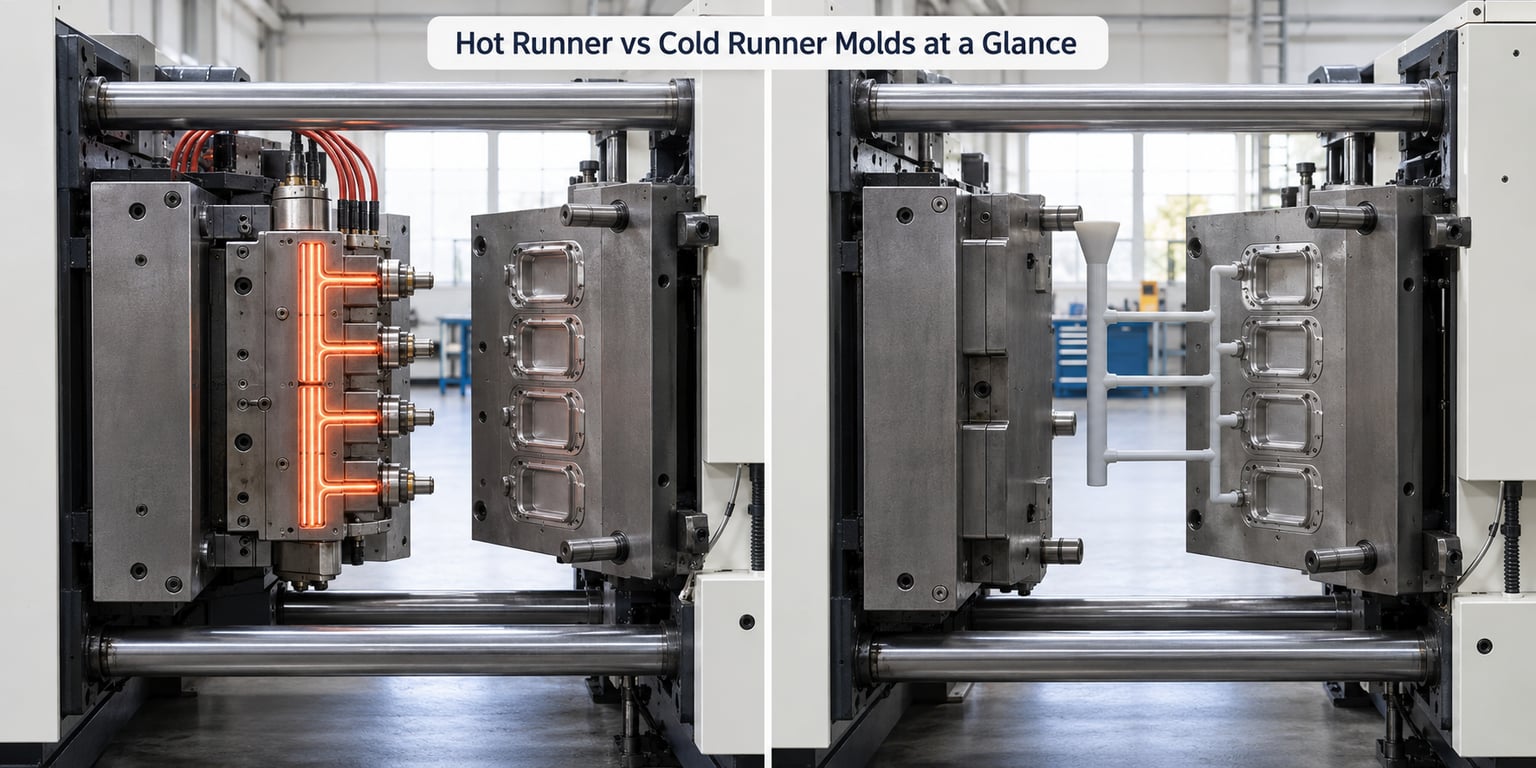
The table below is the shortest version of the answer. Every row is a real decision a mold buyer makes, and the right column depends on your part, your volume and your tolerance for maintenance.
| Criterion | Hot Runner Mold | Cold Runner Mold |
|---|---|---|
| Runner configuration | Heated manifold block with runner channels and nozzles mounted inside the tool | Machined sprue, runners and gates cut into two-plate or three-plate mold plates |
| Initial tooling cost | Higher: the manifold, hot half, heaters, thermocouples and wiring add a real premium | Lower: the extra cost is machined channels in the plates |
| Cycle time | Shorter, commonly 10 to 30 percent faster with faster gate freeze | Longer because the runner must cool solid enough to eject |
| Scrap | No runner scrap; melt stays in the manifold between shots | Sprue, runners and gate vestige come out with every shot |
| Color change | Slow: purge the manifold, line heater bands, re-establish temperature | Fast: dump the runner scrap, reload, restart |
| Maintenance | Heater bands, thermocouples, nozzle tips and valve pins all need service | Very little beyond mold preventive maintenance |
| Material flexibility | Wide, but residence time in a hot manifold limits heat-sensitive and long-residence resins | Nearly unlimited: every polymer that can be injection molded works cold |
| Best-fit volume | Generally above 50,000 parts per year | Generally under 10,000 parts per year |
| Typical applications | Cosmetic housings, medical parts, high-gloss panels, multi-cavity family tools | Prototypes, short-run programs, packaging, frequent color and material changes |
What Is a Hot Runner Mold?
A hot runner mold keeps the melt hot from the machine nozzle all the way to the cavity gate. An electrically heated manifold block sits on the top half of the tool, runner channels are machined inside it, and nozzle tips deliver melt straight into each cavity.
Because the melt never solidifies in the feed system, nothing has to be cut off after molding. Only the part comes out of the cavity.
How the hot half is built
The hot half is the collection of heated components that make this work:
- Manifold block — contains the runner channels and distributes melt to each drop.
- Heater bands and cartridge heaters — hold each zone at its own set point.
- Thermocouples — feed melt temperature back to the controller zone.
- Nozzles — the final tip that seats against the mold surface and gates melt into the cavity.
- Hot sprue — the heated, insulated feed from the machine nozzle into the manifold.
Insulation between the manifold and the mold plates matters as much as the heating does. Without it, the heat bleeds into the tool steel and you chase steady-state variation all day.
Open-gated and valve-gated nozzles
Open-gated nozzles are always open: cheap, simple and a good match for unfilled resins in clean, single-cavity work. Valve-gated nozzles use an actuating pin to open and close the gate on command, which stops drool between shots, gates every cavity at the same instant, and lets you sequence the fill.
Valve gates cost more in hardware and in control wiring, and they need maintenance attention. Engineers working with filled or pigmented resins, or with cosmetic surfaces where a vestige is unacceptable, usually want them anyway.
What Is a Cold Runner Mold?
A cold runner mold lets the melt cool in the feed system. Molten plastic travels from the machine nozzle into the sprue, along the runner network, through the gate and into the cavity, then solidifies along with the part.
The sprue, runners and gate vestige are ejected with the part and trimmed off, then ground and blended back as regrind. That single sentence explains nearly every difference between the two systems.
Most cold runner tools are built as two-plate or three-plate molds. The two-plate design keeps the feed channels in the same plates that form the part and the simplest configuration, while the three-plate layout moves the gate and runner onto a separate center plate so the cavity layout stays flexible.
Three-plate tools cost more to machine but let you place gates anywhere the layout allows. Two-plate tools are cheaper and faster to build, which is why they dominate prototyping and short-run work.
Cost and Tooling Investment
The cold runner is cheaper to buy and the hot runner is cheaper to run. Get quotes that break out the manifold, drop count and gating style as separate line items, because a quote that hides the hot runner premium inside one lump sum leaves you unable to compare feed systems at all.
For most single-drop tools the hot runner adds roughly 20 to 50 percent to the base mold price. Multi-drop manifolds, sequential gating and valve gates push that higher, and a quote for a hot sprue with a cold runner lands lower than a full conversion.
That upfront number is only part of it. A cold runner adds recurring cost that a hot runner largely removes: trimming stations and operators, regrind grinding, dust and noise in the molding area, QC on trimmed parts, and material bought twice because the first pass became scrap.
Tool steel choice interacts with the feed decision too, and the tradeoff is worth reading up on separately — see aluminum vs steel molds pros and cons for how that changes your tooling budget.
A worked breakeven example
Take a 6-cavity ABS automotive bezel running 250,000 parts a year. One field account of a tool converted from cold to valve-gated hot runner reported zero trimming, consistent fill and a cycle roughly six seconds faster than the cold runner test tool.
Six seconds on a long cycle is a large machine-hour win before you count the labor. Six extra operators snipping runners on a 100,000-piece medical part is the other side of the same ledger, and it is a mistake a tool quote will never warn you about.
Run the math in this order:
- Added tooling premium from the mold quote.
- Annual resin cost multiplied by the runner scrap percentage for the cold tool.
- Annual trimming labor, including fully loaded headcount and supervision.
- Machine-hour cost multiplied by the cycle-time saving, then by scheduled hours.
- Downtime risk on the hot tool, including the scrap dumped when a heater band or nozzle fails.
Compare the annual benefit in lines two through four against line one. On high-volume cosmetic work the crossover usually lands inside the first or second year; on a 5,000-piece order it never arrives.
Cycle Time, Scrap, and Material Efficiency
Cycle time is where a hot runner earns its keep fastest. Because melt arrives at the gate at full temperature and the runner never has to cool, the part freezes and ejects sooner. Field reports commonly land in the 10 to 30 percent range, with a handful of seconds off a long cycle being normal.
Scrap is the quieter win. A cold runner turns part plus sprue plus runners into scrap on every single shot. Industry analyses have put cold runner material waste at as much as roughly 18 percent of total part cost, which is why a glossy ABS panel that converted from cold to hot reported a scrap drop near 95 percent and lost a secondary finishing step entirely.
Material efficiency also feeds part weight. With a hot runner the cavity receives only the material the part needs, so wall thickness and overall part weight come down. On a resin-heavy program that shows up twice: less material bought and more parts per kilo.
The trade-off on precision runs the other way in one narrow case. A cold runner’s gate can be located and machined anywhere the tool design allows, and once the runner solidifies it holds its position. A hot manifold fixes the gate location permanently, so a bad early gate decision is expensive to undo. Mold flow analysis before the manifold is machined is not optional.
Color Changes and Production Flexibility
Cold runner tools change color in minutes. You pull the runner scrap, dump the hopper, load the new color and go back to production. That simplicity is the whole reason cold runners still run most short-run promotional and seasonal programs.
A hot runner has to be purged. Melt sitting in the manifold has to come out before the new color is clean, the heater bands and thermocouples have to be re-checked, and the line has to re-stabilize at temperature. Depending on drop count that is an hour or more per change, and the purged material is waste.
The other side of the same coin is short-run waste. A hot runner on a 500-piece order holds a full manifold of molten plastic and puts most of it straight into the purge bin, while the cold runner only ever holds the small amount in its channels. Short runs favor cold runners twice over.
Production flexibility also cuts both ways on part mix. Family tools and insert molding favor hot runners, because valve gating lets one tool fill different shapes in a controlled sequence. Frequent tool changes with completely different materials favor cold.
Maintenance, Reliability, and Process Control
A cold runner has almost nothing to fail. If a nozzle tip in a hot runner cracks or a heater band burns out, molten plastic escapes onto the tool and the run stops. That is the honest downside of hot runners: they generate scrap precisely when production is already going wrong.
The failure modes worth planning for:
- Heater band failure — a zone drifts or stops holding temperature entirely.
- Thermocouple drift — the reading no longer matches the melt, and control loops chase the wrong number.
- Drool and stringing — melt seeps past the nozzle tip when the tool is too hot or the tip is worn.
- Valve pin seating — a pin that does not fully close leaks, and a pin that sticks open never gates.
- Cross-drill misalignment and stack-up tolerance — small machining errors that let melt into the wrong channel as the tool heats up and expands.
- Hang-up or dead flow — resin degrading in a warm spot until it blocks a channel.
None of that is exotic. It is a maintenance program, spare parts on the shelf and a controller that somebody actually checks, and it belongs in the operating budget from day one rather than discovered at the first unplanned stop.
Process control runs in the opposite direction. A hot runner gives tighter melt temperature control by zone, which is why medical and cosmetic programs like it: fewer temperature-induced flow variations between cavity one and cavity eight. If your process struggles with venting or short shots, work through venting problems in injection molds before blaming the feed system.
Materials, Applications, and Design Considerations
Material compatibility is where a hot runner earns its reputation fastest. Because melt sits in the manifold between shots, residence time and melt temperature together determine how much thermal degradation the resin sees before it reaches the cavity.
High-temperature engineering polymers such as PEEK and PPS are the clearest case. They process at high melt temperatures and long cycle times, and a poorly tuned multi-zone manifold can degrade material sitting in a warm corner. Cold runners handle them well precisely because nothing dwells.
Heat-sensitive resins like PVC and some PC grades push the same limit from the other direction, where over-temperature manifold settings cause discoloration. Wide processing windows and short set-up times favor cold runners, while long residence time and long cycles favor hot runners as long as the zones are tuned properly.
Design for manufacturability matters more with a hot runner, not less. Runners are longer inside the manifold, so fill is harder to balance across eight drops than across eight cold channels with hand-tuned gates. Cavity layout, gate placement and volumetric shrinkage all have to be resolved on paper before any steel is cut.
Shot size capacity is a practical limit too. The manifold has to hold enough melt to feed every drop at once, and on small shots with many drops the remaining melt sits and waits. Regulated applications add one more rule: where medical or food contact limits regrind ratios, removing runner scrap entirely is not just a cost saving, it is the reason the tool can run clean resin only.
Which Should You Choose?
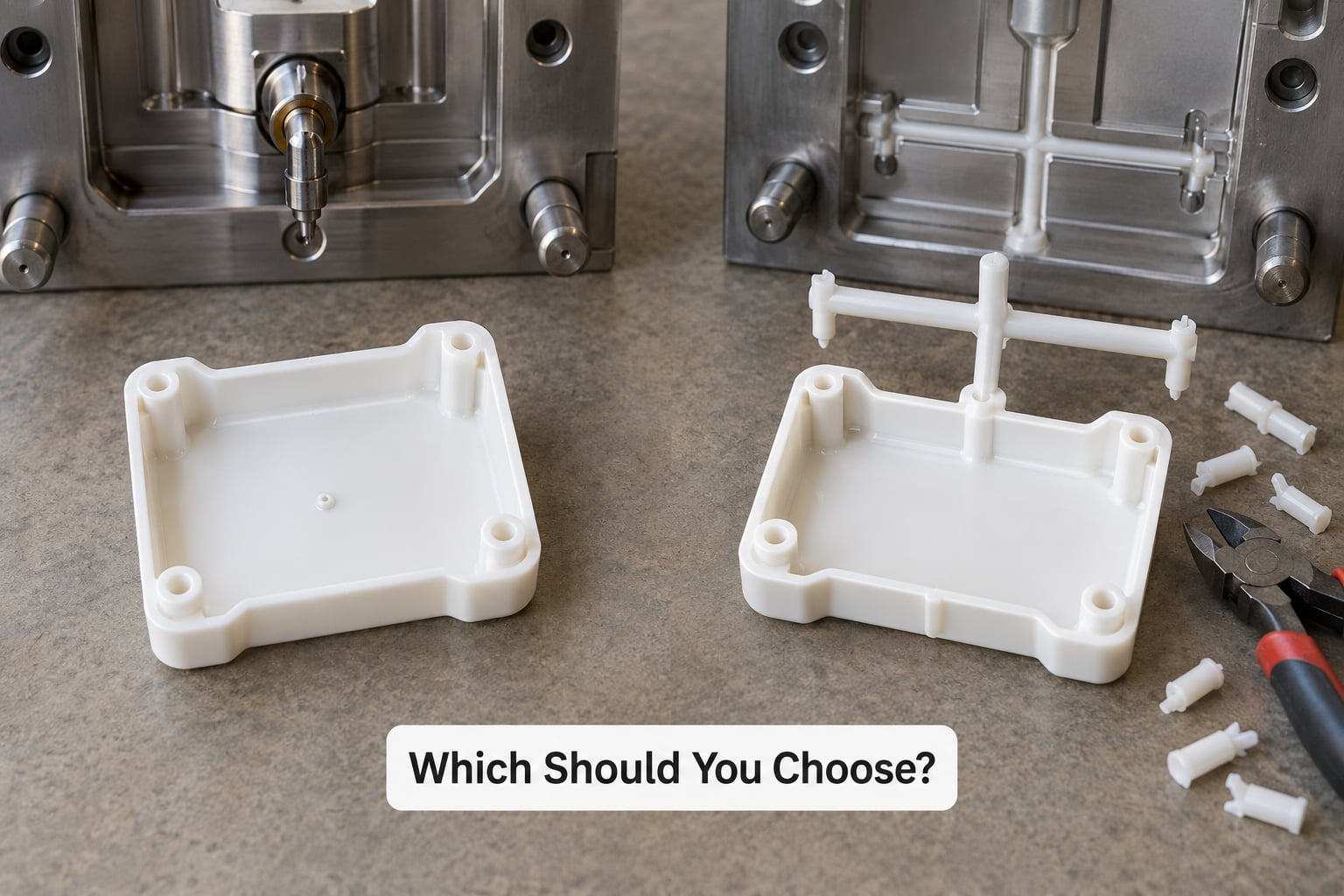
Hot runner vs cold runner molds: matching the system to your volume
Choose a hot runner when most of these are true:
- Annual volume is above roughly 50,000 parts, or a cosmetic surface has to look right without secondary finishing.
- Resin is expensive enough that runner scrap is a visible line in your cost sheet.
- Trimming labor or operators are constrained and you would rather not hire for them.
- Cycle time is the bottleneck and you cannot add another machine.
- Part geometry is stable, colors are few, and material changes are rare.
- Cycle consistency matters more than tool simplicity, such as on tight-tolerance medical parts.
Choose a cold runner when most of these are true:
- Volume sits below roughly 10,000 parts a year, or the program is prototype and pre-production work.
- Color or material changes are frequent, seasonal or promotional.
- Tooling budget is tight and you need the lowest purchase price you can get.
- The part is technical, high-temperature or hard to flow balance, so you want maximum flexibility to iterate on gates.
- Maintenance capability on hot runner hardware is limited at the plant.
Below 10,000 parts a year, lean cold. Above 50,000, run the hot runner numbers and see whether the payback lands inside your planning horizon. Between those two marks, part cost, cosmetic requirements and labor availability decide it.
There is a middle path worth quoting. A hot sprue feeding a cold runner eliminates the sprue string without committing to a full manifold, and a two-drop or four-drop manifold on a large tool captures most of the cycle-time and scrap benefit at a fraction of the conversion cost. Both are legitimate answers when the budget will not stretch to a full drop.
Frequently Asked Questions
How much does a hot runner add to mold cost?
On a typical single-drop tool, the hot runner manifold, hot half, heaters, thermocouples and wiring add roughly 20 to 50 percent to the base mold price. Multi-drop manifolds, sequential gating and valve gates push that higher, while a hot sprue with a cold runner sits at the low end. Ask for the manifold as a separate quote line so you can compare feed systems fairly.
At what part volume does a hot runner start paying for itself?
Most shop rules of thumb put the crossover between 50,000 and 100,000 parts a year. Below about 10,000 parts the tooling premium rarely recovers, because the scrap and labor savings are too small. Between those marks the answer depends on resin cost, cosmetic requirements and how expensive your trimming operation is.
How many seconds per cycle does a hot runner actually save?
Field reports commonly land between 10 and 30 percent off cycle time, and one account of a six-cavity ABS bezel converted to a valve-gated hot runner reported roughly six seconds saved per shot. The saving comes from faster gate freeze and no runner to cool. Short cycles gain less in absolute seconds than long ones.
Are hot runner molds better than cold runner molds?
For high-volume, cosmetic or resin-expensive parts, yes: no runner scrap, shorter cycles, no gate vestige and tighter repeatability. For short runs, frequent color changes or high-temperature polymers with long residence time, a cold runner is the safer and cheaper choice. The better system is the one that matches your volume and material.
Can you run color changes on a hot runner mold?
Yes, but it is slower and dirtier. You have to purge the melt sitting in the manifold, change the hopper, and verify every heater zone and thermocouple reads correctly before restarting. Depending on drop count that is an hour or more per change, and the purged material is waste. Cold runner tools change color in minutes.
Do hot runner molds need more maintenance than cold runner molds?
They do. Heater bands, thermocouples, nozzle tips and valve pins all need scheduled inspection, and a failure mid-run dumps molten plastic onto the tool. Cold runners need almost nothing beyond normal mold preventive maintenance. Budget spare parts and controller checks into the operating plan before the tool ships.
The Short Version
Start with your annual volume and your resin cost. If you are under 10,000 parts a year or change colors often, start the conversation with a cold runner quote. If you are above 50,000 parts, the surface has to look right without finishing, or trimming labor is your constraint, ask for a hot runner quote with the manifold broken out as its own line.
Either way, settle gate locations and flow balance on paper before the tool steel is ordered. That decision is expensive to reverse in either feed system.